CIENCE Pricing: What the Published Rate Card Covers
A setup fee, two recurring line items, an SDR rate card by level and region, and the commission formula. The published base is the small half of the cost.
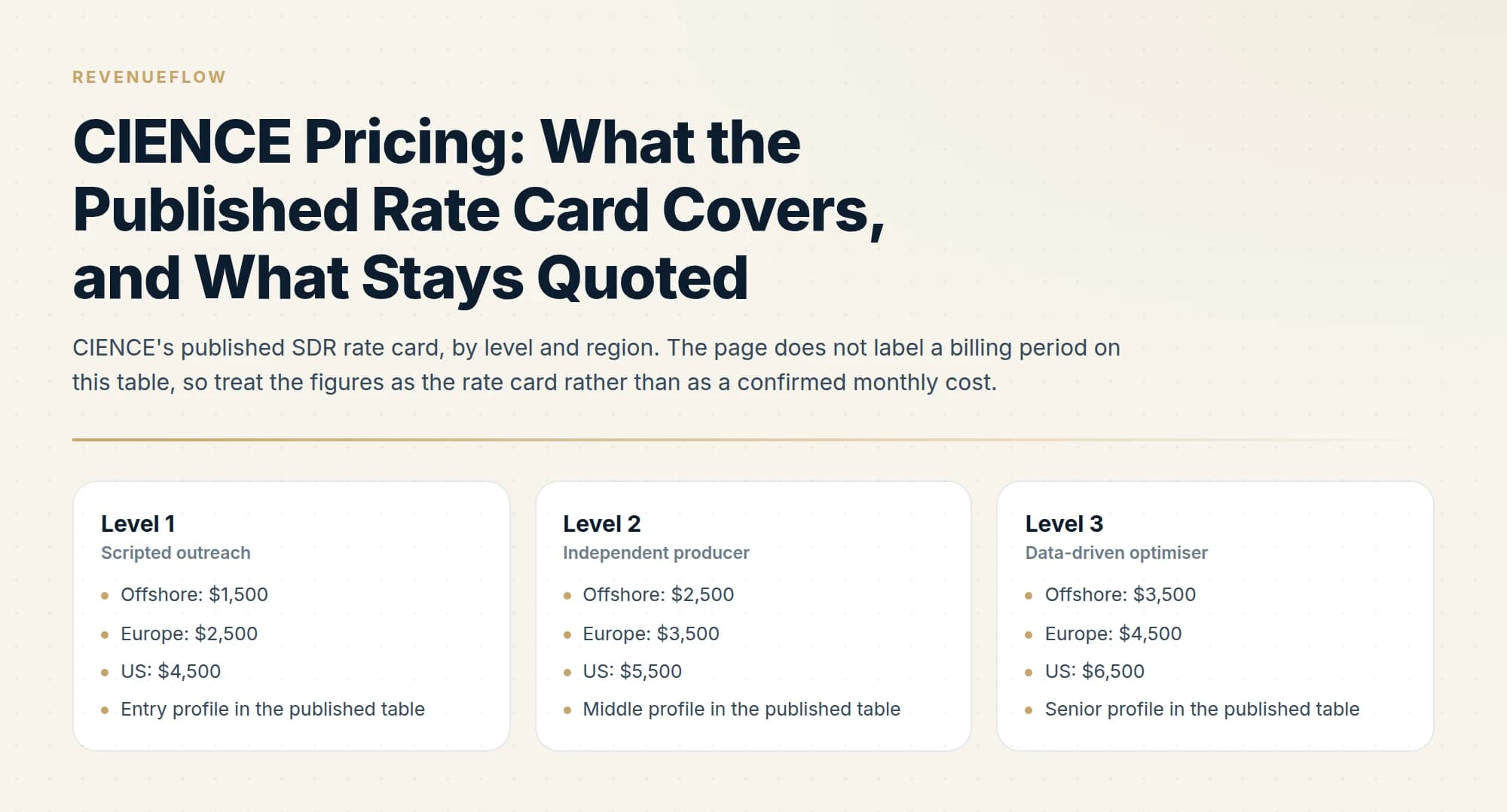
CIENCE pricing is published: a $5,000 one-time GTM setup, $2,000 a month for the strategic team and $499 a month for the graph8 platform, so the first month is $7,499 and later months $2,499 before SDRs. SDR capacity is quoted, with a rate card from $1,500 to $6,500 by level and region.
Key takeaways
- CIENCE's published base is a $5,000 one-time setup plus $2,000 a month for the strategic team and $499 a month for the graph8 platform, $7,499 in the first month.
- SDR capacity is quoted separately, with a published rate card from $1,500 offshore at level 1 to $6,500 US at level 3, and $1,000 one-time recruitment per SDR.
- The SDR commission formula pays nothing below 60% of target, base times percent of target times 0.35 up to 99%, and times 0.7 from 100%.
- The per-meeting fee is calculated from an agreed ROI goal, typically 4x, so the largest cost lines are the quoted ones rather than the published base.
Reviewed and updated September 21, 2026
Most outbound agencies answer the pricing question with a calendar link. CIENCE pricing is published as a rate card instead: a one-time setup fee, two recurring line items, an SDR price table broken out by seniority and region, and the commission formula its SDRs are paid on. Whatever you conclude about the model, the disclosure is unusual for the category and it makes the company straightforward to evaluate.
By contrast, some competitors publish no pricing at all, and SalesBread's guarantee-based pricing approach shows what buyers face when the offer rests on a lead definition instead of a rate card.
A disclosure of our own first, because it is the fair thing to lead with. RevenueFlow is an outbound agency too, so we compete with CIENCE for some of the same buyers. We are paid on attended qualified meetings rather than on a retainer, which is a different commercial shape and gives us a view. What follows is drawn from CIENCE's own pricing page rather than from roundups, and where the two models genuinely differ we have tried to name the trade-off in both directions.
One oddity about that page is worth stating before the numbers, because it affects how much weight to put on them. Its own body copy refers to itself in the third person as a rebuild of an earlier source page, which is design annotation left in production and means the page reads as a recent redesign that may still be settling. It is nonetheless CIENCE's canonical pricing URL, with a real title and no instruction to search engines to ignore it, so the figures are the company's own. We quote them as the page displays them, and anyone comparing quotes should re-read the page rather than treat these as fixed.
CIENCE pricing: what the page publishes
The core plan on its pricing page has three components and a stated first-month total.
| Component | Basis | Published price |
|---|---|---|
| GTM System Setup | One-time, 5-day sprint | $5,000 |
| Strategic Execution, dedicated GTM team | Recurring | $2,000 per month |
| graph8 platform licence | Recurring | $499 per month |
| SDR capacity | Optional | Quoted |
| First month, all in | Setup plus team plus platform | $7,499 |
The page describes the arrangement as month to month, with SDR capacity priced separately so teams can add coverage without a long-term contract.
The setup sprint is specified rather than vague: a complete GTM system and campaign setup, four campaigns described as intent-based, ICP-driven, visitor targeting and competitor targeting, target data configuration, outbound and inbound digital infrastructure, and AI sales development setup. The recurring platform licence includes 75,000 monthly credits and covers AI-driven outreach, visitor deanonymisation and data enrichment.
The SDR rate card
This is the part almost nobody publishes. CIENCE lists SDR pricing across three levels and three regions.
| SDR level | Offshore | Europe | US |
|---|---|---|---|
| Level 1, scripted outreach | $1,500 | $2,500 | $4,500 |
| Level 2, independent producer | $2,500 | $3,500 | $5,500 |
| Level 3, data-driven optimiser | $3,500 | $4,500 | $6,500 |
A level 3 offshore SDR is priced below a level 1 US SDR. Onboarding and recruitment: $1,000 one-time per SDR.
One honest caveat on that table: the page presents it as a rate card by level and region without stating the billing period alongside it, so confirm whether those are monthly figures before you build a budget on them. Separately, CIENCE lists SDR onboarding and recruitment at $1,000 one-time per SDR.
The regional spread is the interesting part. A level-three offshore SDR is priced below a level-one US SDR, which tells you the model treats geography as a bigger cost lever than seniority. That is a real choice with real consequences either way, and it is visible in the pricing rather than buried in a proposal.
The commission mechanics

CIENCE also publishes how its SDRs are compensated, which is rarer still and worth reading if you care about what the person contacting your market is optimising for.
No commission is paid below 60% of target. Between 60% and 99% of target a reduced rate applies, calculated as base salary multiplied by percent of target hit multiplied by 0.35. At or above 100% the full rate applies, at base salary multiplied by percent of target hit multiplied by 0.7. Each SDR is measured against their own target, and where several are assigned to one account, one of them hitting target does not trigger bonuses for the others.
There is also a per-meeting fee, which the page says is calculated from the agreed ROI goal, typically a 4x ROI, using a campaign calculator.
What the commission formula tells a buyer
It is worth sitting with those numbers for a moment, because compensation design is one of the few reliable predictors of how a programme will behave in month three.
The cliff at 60% is the sharpest feature. An SDR at 59% of target earns no commission at all, and one at 60% earns base multiplied by 0.6 multiplied by 0.35, which is 21 percent of base salary. That is a strong incentive to reach the threshold and a much weaker one to move from 80% to 90%, since the reduced multiplier applies across the whole band. Crossing 100% doubles the multiplier from 0.35 to 0.7, so as illustrative arithmetic an SDR at 99% earns about 35 percent of base and one at 100% earns 70 percent, and at 120% the figure is 84 percent. That concentrates effort at the two edges.
The clause about multiple SDRs on one account matters more than it looks. Because each is measured against their own target and one hitting quota does not trigger bonuses for the others, a large account staffed with several reps has no shared incentive. Everyone is running their own race inside your programme.
None of this is unusual for the industry and none of it is hidden, which is the point. Most agencies will not tell you how the person contacting your market is paid, so you cannot reason about it at all. Here you can, and the reasoning is worth doing before you agree targets, because the targets are what the compensation is measured against.
Reading the model
What this shape does well is let you start without committing to headcount. A team can buy the system and the strategic layer for a published monthly figure, see whether the motion works, and add SDRs afterward. Month to month with no long-term contract on the capacity is a genuine commercial concession in a category where twelve-month minimums are common.
Data subscriptions underneath a programme like that carry their own catch, since a first year rate that lapses at renewal is shown to new visitors as the annual price.
What it asks of you in exchange is that the largest and least predictable component, SDR capacity plus the per-meeting fee, is the part not published as a fixed number. The published base is the small half of a real programme's cost. That is not a criticism so much as the thing to model before signing: after the first month the published base is $2,499 a month, $2,000 for the team and $499 for the platform, so build the budget from the quoted SDR figures and the ROI-derived meeting fee on top of that, not from the $7,499.
Vendors withhold different halves of the same answer, and a published contract term with no published rate inverts which part a buyer can check before signing.
Where our model differs, in both directions
We are paid on attended qualified meetings against criteria agreed in writing before launch, so a month with no meetings is a month with no invoice. That suits a buyer who wants outcome risk carried by the agency and dislikes paying for activity.
It suits others less well. A retainer-plus-capacity model like CIENCE's buys you a system you keep, a platform licence and a named team, and it does not require anyone to agree a meeting definition up front. Teams who want an outbound function built inside their own operation, rather than meetings delivered into it, are usually better served by that shape than by ours.
The other real difference is channel philosophy. We run one message per campaign and do not send follow-up sequences or thread bumps, on the view that a second message to someone who ignored the first mostly adds volume rather than relevance. Most of the category, CIENCE included, runs multi-touch programmes across calls, email and LinkedIn. Both positions are defensible; they optimise for different things, and a buyer should pick the one matching how they want their market approached.
Questions worth asking

Do not assume $7,499 approximates a running monthly cost.
The question about what happens to the GTM system on exit deserves particular attention, because you have paid a one-time fee for something described as a system rather than a service. Whether the campaigns, the data configuration and the infrastructure remain usable once the subscription stops is a materially different proposition from renting them, and the pricing page does not settle it either way.
The meeting-definition question applies to every agency in this category including us, and it is the one buyers most often skip. Budget, timing and decision authority should never be billing conditions, and the criteria should be written down before launch rather than argued about after the first invoice.
The short version
CIENCE publishes more of its commercial model than almost anyone in outbound: $5,000 setup, $2,000 a month for the strategic team, $499 a month for the platform, a $7,499 first month, an SDR rate card running from $1,500 to $6,500 by level and region, $1,000 per SDR recruitment, and the commission formula underneath it. The published base is not the whole cost, because SDR capacity and the per-meeting fee are quoted, so model those before you commit. If you want a system and a team inside your operation, the shape fits. If you want meetings delivered with the outcome risk carried elsewhere, a per-meeting model fits better.
For the wider category, the five delivery models and what each costs sets the shapes side by side, what a lead generation agency actually costs covers the ranges, and how to compare providers on pricing and risk covers diligence. If you are weighing an agency against hiring, outsourced SDR versus in-house does that arithmetic.
You can also see what a campaign would look like for your market before committing to anyone.
All CIENCE figures are from CIENCE's own pricing page at https://www.cience.com/pricing/. Pricing and features are taken from the vendors' own pages. Verify current terms with the vendor before relying on them.
Frequently asked questions.
Frequently asked questions- How much does CIENCE cost?
- CIENCE's pricing page lists a $5,000 one-time GTM system setup, $2,000 a month for the strategic team and $499 a month for the graph8 platform, a first month of $7,499 and $2,499 a month after. SDR capacity and a per-meeting fee set from an agreed ROI goal are quoted on top, so the published base is the smaller part.
- What does CIENCE charge for SDRs?
- CIENCE publishes an SDR rate card by level and region: level 1 from $1,500 offshore to $4,500 in the US, level 2 from $2,500 to $5,500, level 3 from $3,500 to $6,500. The page does not label a billing period on that table, so confirm it is monthly, and it adds $1,000 one-time per SDR for onboarding and recruitment.
- How are CIENCE SDRs paid commission?
- The pricing page states that no commission is paid below 60% of target, that between 60% and 99% the rate is base salary times percent of target times 0.35, and that at 100% and above it is base times percent of target times 0.7. Each SDR is measured against their own target, so reps on one account do not share bonuses.
- Is CIENCE month to month?
- The page describes strategic execution and the platform as month to month, with SDR capacity priced separately so coverage can be added without a long-term contract. The $5,000 setup is a one-time fee for a five-day sprint that builds the GTM system and four campaigns before sending starts.
About the author.

Ben Carden is CRO at RevenueFlow, which builds and operates outbound revenue engines for B2B companies. Previously at Gartner Enterprise. Studied at London School of Economics.
Ben Carden · CRO
Connect on LinkedIn →Explore more.
Ready to scale your outreach?
We build GTM engines that book real meetings. See the receipts.
Related articles.
Belkins Pricing: What the Service Page Publishes
Belkins publishes a starter price and four figures on its service page, and no price at all on its pricing page. Which page a number came from decides what it means.
Blue Zebra Appointment Setting: The Vendor's Pages Are Gone
Search results still describe a B2B appointment setting firm at this address. The pages themselves return 404 and the domain now serves something else entirely.
What Is Callbox? The Campaign Pod Model
Callbox sells outbound in units it calls Campaign Pods, and it is one of the few agencies in the category that puts a monthly price band on its own pricing page.
Lead Generation as a Service: What the Service Part Changes
Most vendors selling lead generation as a service have productised the scope and kept the price bespoke. What that trade buys you, and how to tell which half is fixed.
How Much Do Lead Generation Companies Charge: The Structure
A rate is one payment. The structure decides how many there are, when the first lands, what you owe if you leave early, and what you have to re-buy afterwards.
Unbounce Alternatives: Two Boundaries, Four Meters
Teams leave Unbounce at two published boundaries: the 500 visitor entry ceiling and testing starting on the third tier. Each alternative moves one, both or neither.