White Label Marketing Agency Pricing: The Margin Stack
You are buying cost of goods, so the headline spread between wholesale and retail overstates what you keep once account management hours and rework land.
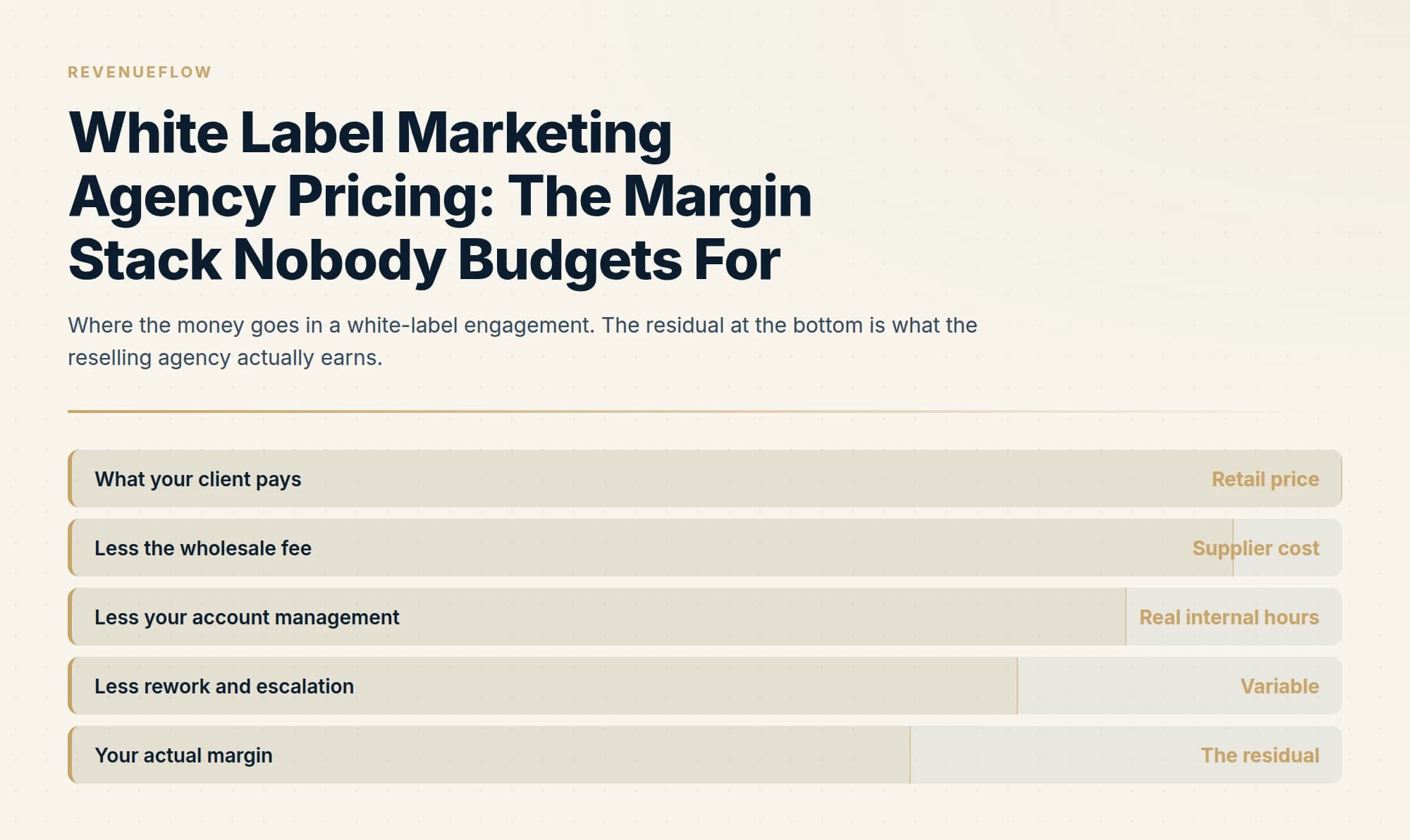
White label pricing is a cost-of-goods decision. Your margin is the retail price less the wholesale fee, less your own account management hours, less the rework your client rejects and you absorb. That residual is frequently half of what the headline spread between wholesale and retail suggests, which is why thin reselling margins fail.
Key takeaways
- Account management on resold work is real labour nobody invoices separately, so price your internal hours even though they never appear on a client bill.
- Fixed wholesale per client punishes vague scoping, since expanding client expectations erode your margin while the supplier fee stays flat.
- Your retail price should follow the value of the outcome to your client, because anchoring on a multiple of the wholesale fee caps the business for no reason.
- You own the client outcome while the supplier owns only the work, so their exposure is capped at their fee while yours is the whole relationship.
Reviewed and updated September 1, 2026
White-label pricing has one feature that makes it unlike every other agency purchase: the number you pay is not the number your client sees, and your entire business model lives in the gap between them. You are not buying a service, you are buying cost of goods sold. That changes which questions matter, and almost every published guide on the topic answers the wrong ones.
The buyer here is an agency reselling someone else's delivery under its own brand. The economics, the risks and the failure modes are different enough from ordinary agency procurement that the two decisions should not share a framework.
The margin stack is the whole business
Start with the arithmetic, because it constrains everything downstream.
Set by your positioning and your market, not by your supplier
The white-label provider's price to you, usually the only number discussed
Briefing, reviewing, reporting and client comms, which the supplier does not do
The cost of anything the client rejects, absorbed by you rather than the supplier
Frequently half of what the headline spread suggests
Most agencies price white-label work by applying a multiple to the wholesale fee, commonly somewhere between two and three times, and stop there. The two middle rows are what makes that estimate optimistic. Account management on resold work is real labour that nobody bills separately, and rework lands on you because your client's dissatisfaction is your problem contractually, not your supplier's.
Direct mail agency cost breakdown breaks down how postage costs and agency markups stack in a single channel, illustrating the same margin logic explored above.
A useful discipline is to price the internal hours explicitly, even though you never invoice them. If a resold engagement consumes six hours a month of your own team's time, that time has a cost, and comparing suppliers on wholesale fee alone will lead you to the cheapest one rather than the one that consumes the least of your attention.
The two structures, and what each does to you
White-label arrangements broadly come in two shapes, and they behave differently under stress.
Fixed wholesale per client. You pay a set fee per client per month and charge whatever you like above it. Predictable, easy to model, and it rewards you for selling at a higher price point. The risk sits with you: a client who demands more than the standard scope erodes your margin while the supplier's fee stays flat.
Cost-plus or pass-through with a management fee. Your supplier's cost is visible and you add a defined percentage. Lower risk, lower ceiling, and it tends to cap what you can earn from an efficient supplier. It also makes your margin legible to any client who thinks to ask, which is uncomfortable in a model built on not disclosing the supplier.
The first structure is more common and it is the one that punishes bad scoping. If you sell white-label delivery on a vague scope and your client's expectations expand, you absorb the difference in both directions: more supplier fees if you buy extra, or more of your own hours if you do not.
What actually determines whether this works

- Yes: Turnaround times are contractual, not aspirational, and you have seen them missed and handled
- Yes: You know exactly what happens when your client rejects the work
- Yes: Communication rules are explicit about whether the supplier ever contacts your client
- Yes: The supplier will not take your client directly, in writing
- Yes: You have run one pilot client before signing a volume commitment
- No: Choosing purely on the lowest wholesale fee
- Depends: Whether the supplier's quality is consistent across their whole team, not just their pitch team
The rework question is the one that separates a workable supplier from an expensive one. If revisions are unlimited within a defined scope, your margin is predictable. If revisions are billable, then every fussy client becomes a loss-maker and you have no way to know which clients those are until you have signed them.
The direct-contact rule matters more than agencies expect. Even well-intentioned suppliers create awkwardness when their staff appear on a call, in a shared document's revision history, or in an email header. Ask specifically how they prevent that, because the answer tells you whether they have done this at scale before.
Setting your retail price without anchoring on the wholesale one
The most common pricing mistake in reselling is letting the supplier's fee set your retail number. It is a natural instinct and it caps your business at whatever multiple feels defensible.
Your retail price should be set by the value of the outcome to your client and by what your market pays for that outcome, which has nothing to do with what your supplier charges. If a service is worth $4,000 a month to your client and your supplier charges $800, your price is $4,000 and your margin is excellent. If you price at $2,400 because 3x felt like the right multiple, you have handed your client $1,600 a month for no reason and made your own business harder to run.
The counterweight is that a large gap creates fragility. A client who discovers a wholesale rate substantially below what they pay tends to react badly, even though the same gap exists invisibly in every agency that employs junior staff. Two things reduce that risk. Sell the outcome and the accountability rather than the labour, so the comparison to a raw supplier rate is not apples to apples. And genuinely add something: strategy, integration with the rest of their marketing, or the fact that one throat gets choked when it goes wrong.
If the only thing you add is a purchase order, the margin is hard to defend and probably temporary.
The risk nobody prices: you own the outcome, they own the work
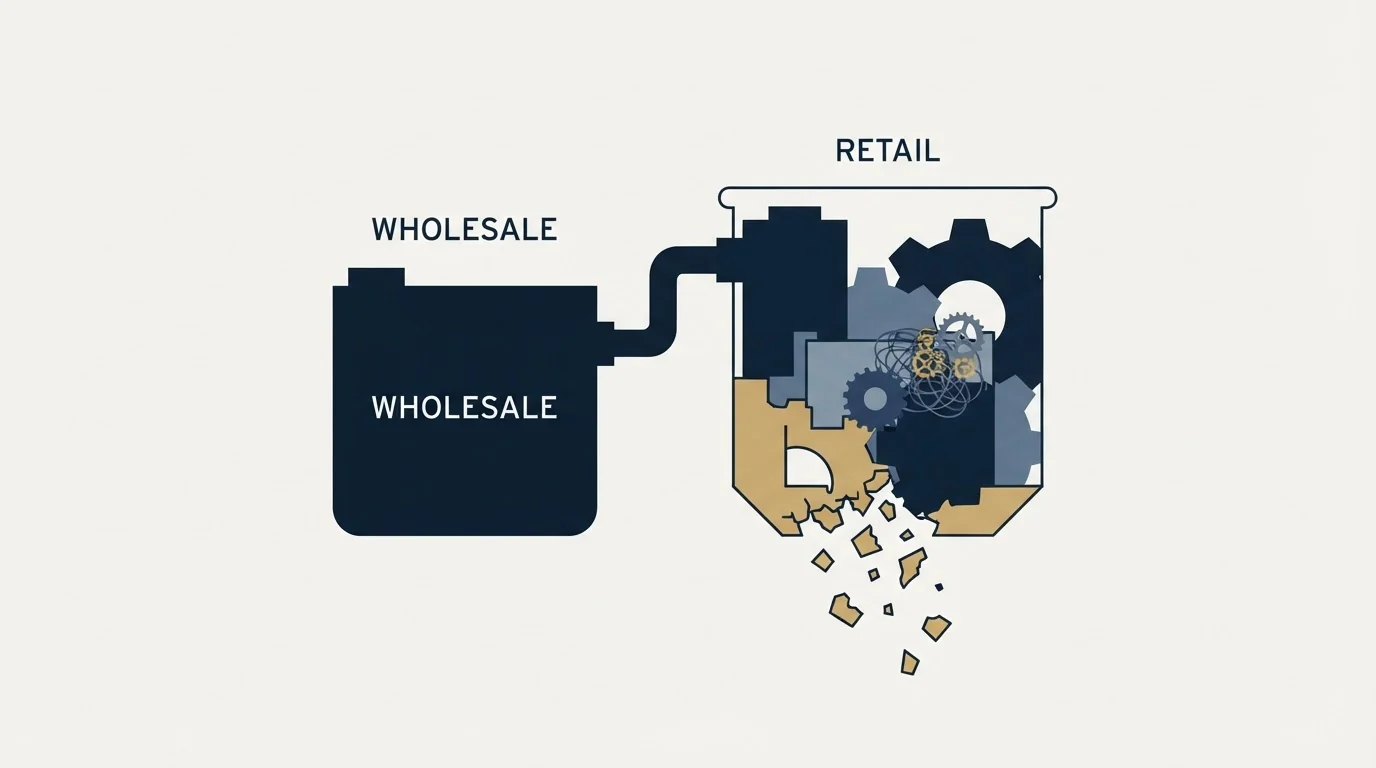
This is the structural asymmetry of the model and it deserves to be stated plainly.
Your client contracted with you. When delivery is late, wrong or thin, your client escalates to you, and your relationship absorbs the damage. Your supplier's exposure is capped at their fee, and their worst case is losing one reselling partner while yours is losing a client you spent months acquiring.
- Late, wrong or thin delivery escalates to you
- Your relationship absorbs the damage
- Rework lands on you, because your client's dissatisfaction is your contractual problem
- Worst case is losing a client you spent months acquiring
- Capped at their fee
- No contractual relationship with your client
- Worst case is losing one reselling partner
- Which is why thin margin on resold delivery is downside carried without being paid for it
That asymmetry is not a reason to avoid white-label work. It is a reason to pick suppliers on reliability rather than price, and to keep a disproportionate share of margin as compensation for carrying a risk you cannot fully control. An agency running white-label delivery at thin margin has taken on the downside without being paid for it.
Contractually, the practical protection is a service credit that flows through to you when the supplier misses a committed turnaround, so at least part of the remedy you owe your client is funded by the party that caused it.
It is also the argument for keeping at least one capability genuinely in house. An agency that resells everything has no ability to absorb a supplier failure, and no independent view of whether the work it is reselling is any good.
Where email and outbound are a special case
Most white-label services are reputationally self-contained: a badly written blog post is embarrassing and recoverable. Email is not, because sending carries a durable asset that can be damaged on your behalf.
If a supplier sends outbound email for your client, ask which domains it sends from. Outbound belongs on domains separate from the client's primary company domain, so a reputation problem in the prospecting programme cannot reach the address their invoices come from. A supplier that sends from the client's main domain is putting an asset at risk that neither you nor they own, and the consequences outlast the engagement.
The same applies to your own domain if the supplier sends on your agency's behalf. Email marketing white label covers the specifics of that arrangement, and our cold email deliverability guide covers the infrastructure discipline underneath it.
Where we sit
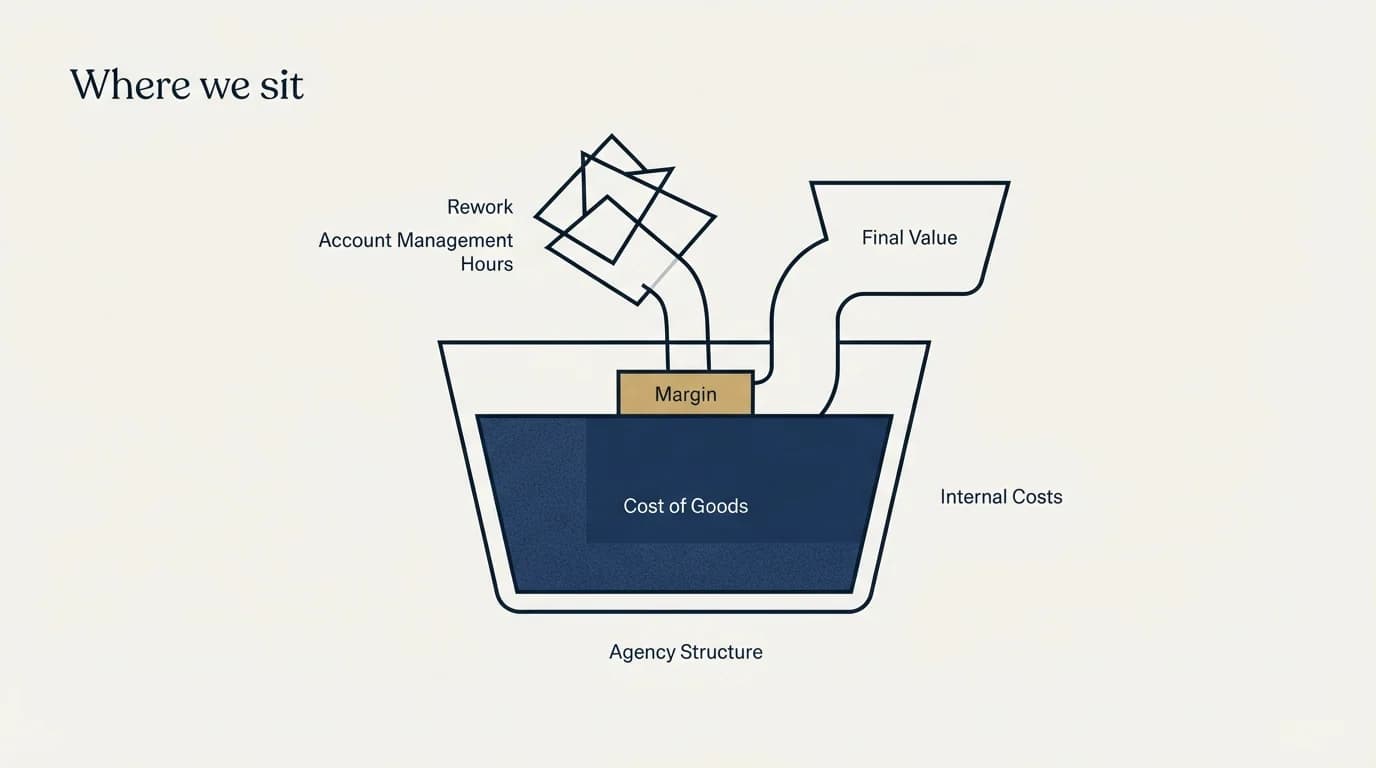
We deliver outbound for clients directly and are paid on attended qualified meetings against criteria agreed in writing before launch. We are not a general white-label marketing supplier, and this piece is written from the perspective of understanding the model rather than selling into it.
Worth saying because it is relevant to the margin discussion above: an outcome-priced supplier changes the arithmetic of white-label reselling, since your cost of goods moves with delivery rather than sitting fixed. That makes margin harder to forecast and easier to defend, which suits some reselling models and not others.
For the broader procurement question, in-house versus agency marketing covers what to own and what to rent, and social media marketing agency pricing covers a category where white-label delivery is especially common. Agencies buying for their own pipeline should see lead generation for marketing agencies.
You can also see what a campaign would look like for your market.
The short version
White-label pricing is a cost-of-goods decision, not a service purchase. The headline spread between wholesale and retail overstates your margin, because account management hours and rework land on you and not on your supplier. Price your internal time even though you never invoice it, choose suppliers on reliability rather than the lowest fee, get the rework and direct-contact rules in writing, and pilot one client before committing to volume. Above all, remember that you own the client outcome while your supplier owns only the work, and keep enough margin to be paid for carrying that gap.
Frequently asked questions.
Frequently asked questions- How should an agency price white label services?
- Set the retail price from the value of the outcome to your client and what your market pays for it, then check the margin holds after your own costs. Applying a two to three times multiple to the wholesale fee is the common approach, and it caps your business at whatever multiple feels defensible, regardless of what the work is worth.
- What are the two white label contract structures?
- Fixed wholesale per client, where you pay a set fee per client per month and charge whatever you like above it, is predictable and puts scope risk on you. Cost-plus or pass-through with a management fee keeps the supplier cost visible and adds a defined percentage, which lowers risk, caps the ceiling and makes your margin legible to a curious client.
- What should you ask a white label supplier?
- Whether turnaround times are contractual, and how a miss has been handled before. Exactly what happens when your client rejects the work, and whether revisions are billable. Whether their staff ever contact your client, and how they prevent it. A written undertaking that they will not take your client directly. And run one pilot client before any volume commitment.
- Why is reselling email a special case?
- Because sending builds durable reputation on domains somebody owns, and a revision request cannot undo it. Ask which domains a supplier sends from. Outbound belongs on domains separate from the client's primary company domain, so a reputation problem in the prospecting programme cannot reach the address their invoices come from. The consequences outlast the engagement.
About the author.

B2B cold email experts helping companies generate qualified leads through done-for-you outreach campaigns.
RevenueFlow Team
Explore more.
Ready to scale your outreach?
We build GTM engines that book real meetings. See the receipts.
Related articles.
B2B Lead Lists for Aviation Companies: Build or Buy
Aviation is one of the few industries whose accounts are published by its regulator, which changes what is worth buying and what is worth downloading yourself.
Cold Calling for Food and Beverage Companies: Three Doors
Cold calling for a food or beverage company: who picks up at a chain, a distributor and an independent grocer, where each publishes its door, and when the phone is wrong.
Win Rate Benchmarks: Which Figures State a Population
A catalogue of the published average sales win rates, sorted by whether the page names the population behind its own number. Most do not.
LinkedIn Outreach for Banks: A Regulated Message
How a bank's relationship managers use LinkedIn to reach business owners: what the FFIEC guidance, FINRA's notices and LinkedIn's own rules require, and where to stop.
Cold Calling for PPC Agencies: What You Can See First
A paid media prospect is partly readable before the call and has already been told by the platform what to do when a stranger rings about its ads.
Cold Calling for Consulting Firms: The Partner's Hour
Cold calling for a consulting firm: who it dials and who picks up, why partner-led economics argue against the phone, the client's fiscal year, and when to skip it.