In-House Versus Agency Marketing: What to Own, What to Rent
Cost is the least interesting part of the decision. In-house buys depth and context, an agency buys breadth and elasticity, and the diagnosis decides which.
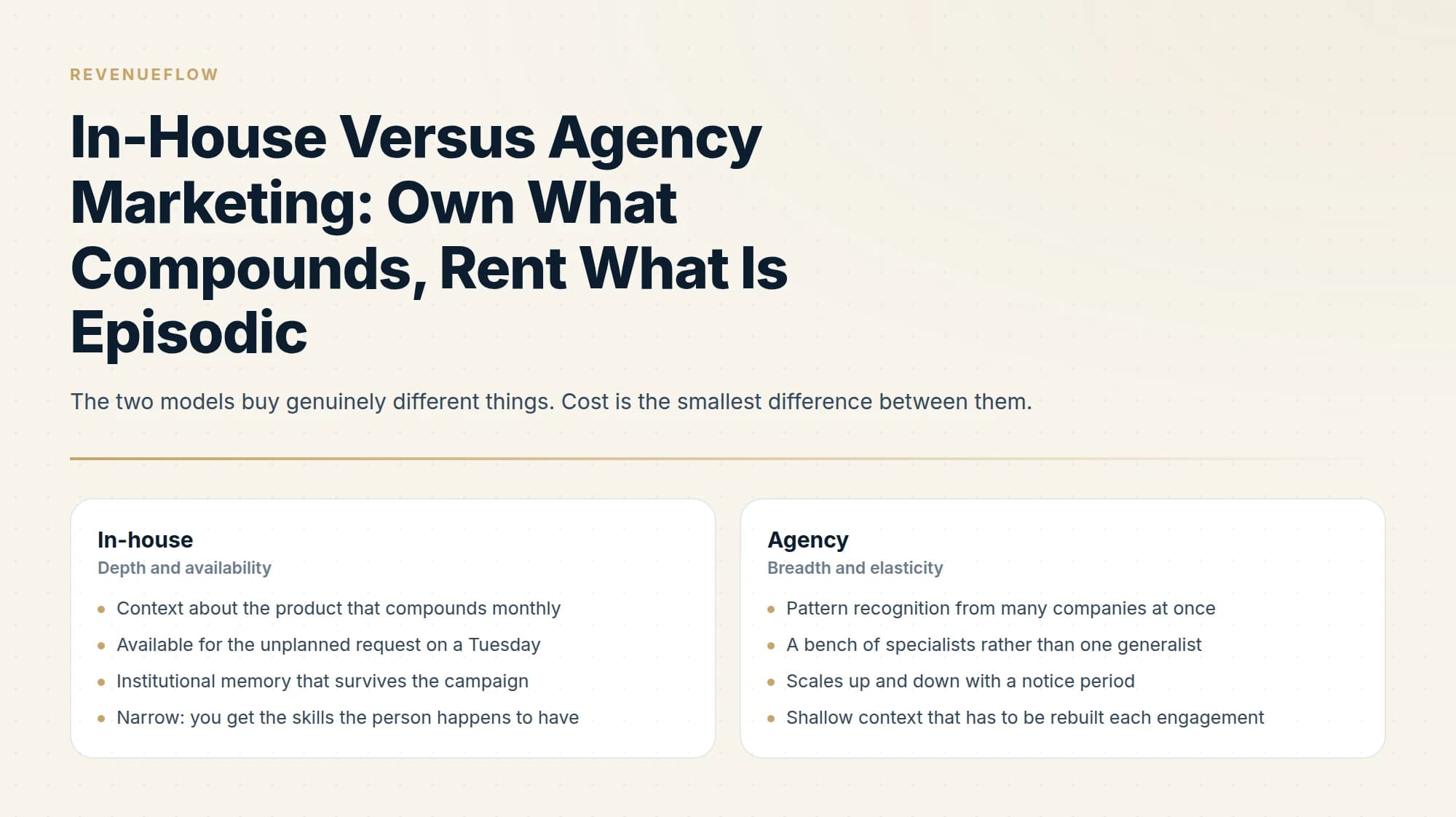
In-house buys depth, product context and availability, and costs you breadth and flexibility. An agency buys breadth, specialist craft and elasticity, and costs you context. Own positioning, messaging and customer research because they compound with tenure. Rent episodic and specialist work, because hiring for it means paying full time for part-time need.
Key takeaways
- A functioning marketing programme needs nine or ten distinct skills, and almost nobody is genuinely good at more than three of them.
- Whichever third of the surface your first marketing hire covers well determines what your marketing becomes for the next two years.
- Both estimates understate by a similar margin, since salary omits burden and ramp while a retainer omits briefing, review and rebuilding context.
- A company short of direction should not be buying channel execution, and a company short of hands should not be buying another strategist.
Reviewed and updated September 1, 2026
The in-house versus agency decision is usually presented as a cost comparison, and cost is the least interesting part of it. Two marketing functions with identical budgets can produce wildly different results depending on which one has context about the product and which one has seen the same problem at thirty other companies. The real question is which of those two things your situation is short of.
Most companies answer it by accident. They hire when they have budget for a head, and they retain an agency when they do not, and the structure that results is a consequence of hiring timing rather than a decision about capability.
If you are reading this as one of the agency owners it is written for, the persona-specific version of this playbook lives in our guide to outbound for agency owners.
What each option actually buys
- Context about the product that compounds monthly
- Available for the unplanned request on a Tuesday
- Institutional memory that survives the campaign
- Narrow: you get the skills the person happens to have
- Fixed cost that does not flex with the pipeline
- Pattern recognition from many companies at once
- A bench of specialists rather than one generalist
- Scales up and down with a notice period
- Shallow context that has to be rebuilt each engagement
- Variable cost, and you are never the only client
The most common mistake is buying breadth when the problem needed depth. A company whose positioning is unclear does not have an execution problem, and hiring an agency to run channels against unclear positioning produces well-executed campaigns that do not work. Conversely, a company with sharp positioning and no hands is not short of thinking, and hiring a strategist to solve an execution gap produces documents.
The capability spread nobody budgets for
Marketing is not one job. A functioning programme needs positioning and messaging, content production, demand generation, lifecycle and email, paid media, web and conversion work, design, analytics and marketing operations. That is nine or ten distinct skills, and almost nobody is genuinely good at more than three.
That arithmetic is what actually drives the decision, and it is why the first in-house hire is so consequential. A single marketer covers perhaps a third of the surface competently, does another third adequately, and leaves the rest undone or outsourced anyway. Whichever third they are good at determines what your marketing becomes for the next two years, regardless of what the strategy deck says.
- Depends: Your positioning is unclear and nobody internally can articulate the wedge
- Yes: You need several specialist skills at part-time intensity
- Yes: Demand is seasonal or lumpy and a fixed head would idle
- Yes: You are testing a channel you may abandon in two quarters
- No: The work requires deep product knowledge that takes months to acquire
- No: The output is continuous and predictable rather than project-shaped
- No: You need someone in the room for unplanned decisions
Read the "no" answers as arguments for hiring. Deep product context, continuous predictable work and presence in the room are the three things an agency structurally cannot provide at the same quality as an employee, and no amount of account management closes that gap.
The costs that do not appear in either comparison
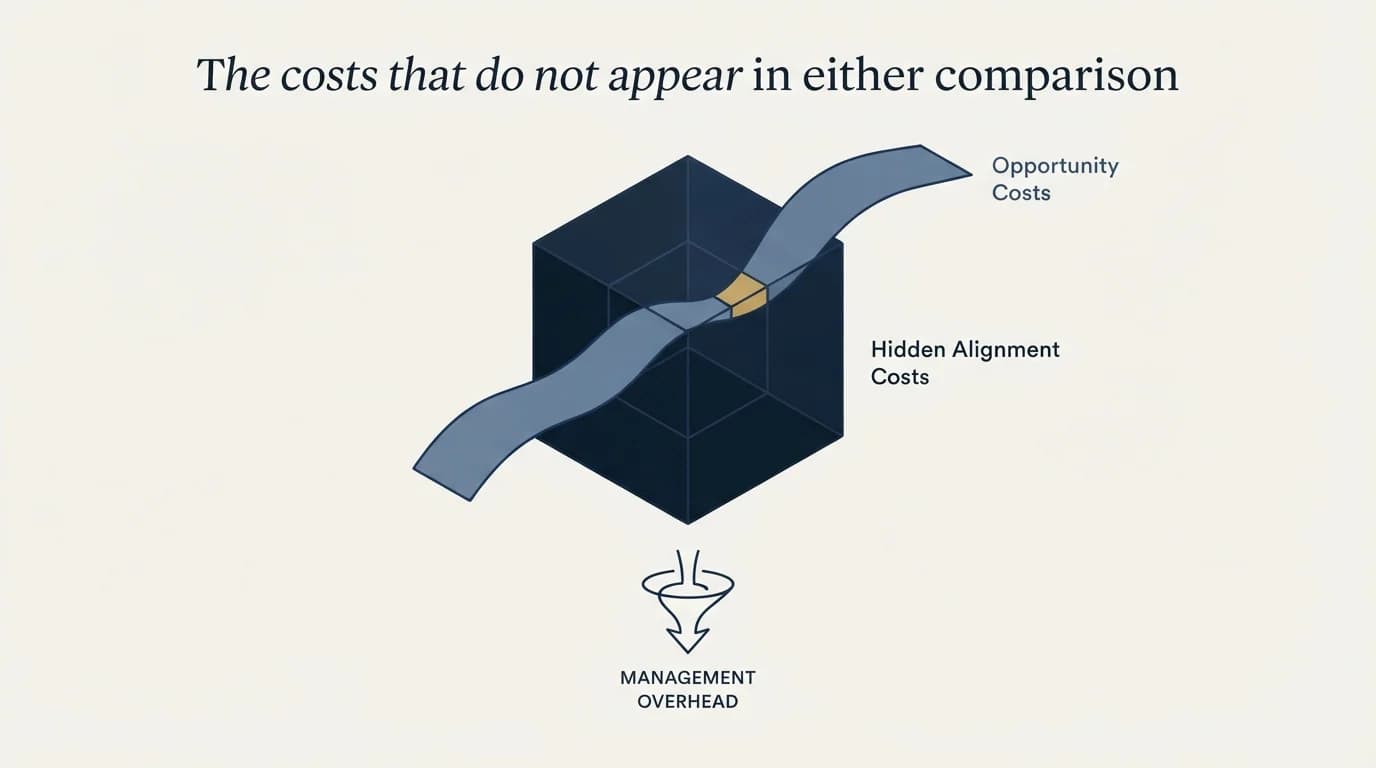
Both sides of this decision hide costs, and they hide different ones.
The in-house estimate that gets presented is usually salary. The real figure adds employment taxes, benefits, equipment, software seats the person needs, recruitment cost, and the management time of whoever they report to. It also has to account for the ramp, because a marketing hire is rarely productive in month one, and for the risk that the hire is wrong, which on a first marketing hire is not a small probability.
The agency estimate that gets presented is the retainer. The real figure adds the internal time to brief, review and approve, which is substantial and always underestimated, plus media spend where relevant, plus tooling that sits in your name rather than theirs, plus the cost of rebuilding context when the account team changes.
That last one deserves emphasis. Agency staff turnover transfers your context loss onto you at no charge to them, and it happens more often than the pitch implies. Ask who specifically will do the work, and what happens if that person leaves.
The hybrid that usually works
This split also decides what an in-house team can realistically pick up from an outside one. In-house SDRs learn from an agency in the compounding column, where the positioning and the message live, and much less in the episodic column, where the value is infrastructure and craft that the agency maintains precisely because you would not staff it full time.
In practice the durable answer is rarely one or the other, and the split that works is consistent enough to state as a default.
Own the things that compound. Positioning, messaging, the customer research behind both, and the relationships with your own customers. These get better with tenure and they are the assets that outlive any campaign. They belong to an employee.
Rent the things that are episodic or specialist. A website rebuild, a paid media programme in an unfamiliar channel, design capacity for a launch, technical SEO, outbound infrastructure. These need depth of craft at intervals rather than continuously, and hiring for them means paying full-time for part-time work.
Be honest about which category outbound falls into. It is specialist and it is continuous, which is why it sits awkwardly in this framework and why so many companies get it wrong in both directions. The infrastructure side genuinely is specialist: sending domains separate from your primary company domain, authentication, list quality, and pacing are a discipline rather than a task. The judgment side, who to contact and what to say, depends on product context an outsider takes months to build.
Before choosing a sending platform for that infrastructure, check whether it permits purchased or scraped lists, since Brevo's anti-spam rules for cold outreach explain why such lists trigger suspension.
- Step 1Fix positioning first, internally
If nobody can state the wedge in a sentence, no amount of execution capacity helps. This is not outsourceable.
- Step 2Name the channels you actually believe in
Two done properly beats six done thinly, and the list determines which specialists you need.
- Step 3Hire for the continuous work
The skills you need every week belong in house, even if that means one generalist to start.
- Step 4Retain for the episodic and specialist
Bring in depth for launches, unfamiliar channels and infrastructure, with a defined scope and an exit.
The sequencing question most companies get backwards

There is an order to this that matters more than the model choice, and getting it wrong is expensive in a way that is hard to see at the time.
The common sequence is to hire a senior marketing leader first, on the reasoning that strategy should precede execution. It sounds right and it frequently fails, because a senior hire with no hands underneath them spends the first two quarters producing plans that nobody has capacity to run. The company pays a senior salary for documents and concludes that marketing does not work.
The inverse failure is just as common. A company hires a junior executor because it is cheaper, gives them no direction, and gets activity with no thesis behind it. Posts go out, the newsletter ships, and none of it connects to a pipeline number.
What tends to work is deciding which of the two gaps you genuinely have. If there is a clear thesis and nobody to run it, hire hands and keep the thinking where it already lives, usually with a founder. If there is capacity but no direction, buy senior thinking in a bounded form, as a fractional engagement or a defined strategy project, rather than as a permanent hire whose main output is going to be judgment you only need periodically.
The reason this matters for the agency question is that it changes what you should be shopping for. A company short of direction should not be buying channel execution, and a company short of hands should not be buying another strategist. Both mistakes look like the model failed when what failed was the diagnosis.
Where each one quietly fails
An in-house team fails by becoming comfortable. Without external pressure, a small marketing function drifts toward the work it enjoys, stops testing things that might not work, and slowly optimises for internal approval rather than pipeline. The tell is a team that is busy and a pipeline that is flat.
An agency fails by never learning enough about the product to say anything a competitor could not say. The tell is copy that reads well and describes any company in the category. That failure is usually shared: agencies produce generic work most often when the client has not made anyone available to teach them the specifics.
The other agency failure is scope drift in reverse, where the retainer stays flat while the work quietly narrows. Review what you actually received against what you are paying for every quarter, because nobody else will raise it.
Where we sit, and where we do not

We run outbound for clients, paid on attended qualified meetings against criteria agreed in writing before launch. That is deliberately the episodic-and-specialist category from the framework above: infrastructure, list building, copy and sending, with the outcome risk on our side.
We are not a substitute for a marketing function and we would say so before taking the engagement. Outbound into unclear positioning underperforms in a very specific way, producing replies that argue with the premise rather than the offer, and no amount of sending volume fixes it. If the positioning question is open, that gets solved internally first.
For the narrower comparison of an outsourced SDR against an in-house one, outsourced SDR versus in-house has the cost arithmetic in detail. If you are evaluating providers, how to compare B2B lead generation companies covers diligence and the five delivery models covers commercial shapes. Agencies buying for their own pipeline should read lead generation for marketing agencies.
You can also see what a campaign would look like for your market.
The short version
Cost is the wrong first question. In-house buys depth, context and availability, and costs you breadth and flexibility. An agency buys breadth, specialist craft and elasticity, and costs you context. Own positioning, messaging and customer research because they compound. Rent episodic and specialist work because hiring for it means paying full-time for part-time need. Be suspicious of any comparison that shows only salary on one side and only the retainer on the other, because both understate by a similar margin and in opposite directions.
Frequently asked questions.
Frequently asked questions- Should we hire a marketing team or use an agency?
- Decide from the gap rather than the budget. Deep product context, continuous predictable work and presence in the room for unplanned decisions are the three things an agency structurally cannot match. Several specialist skills at part-time intensity, lumpy demand and a channel you may abandon in two quarters all point to an agency. Most companies need both.
- What costs get left out of the comparison?
- On the in-house side, employment taxes, benefits, equipment, software seats, recruitment cost, the manager's time, the ramp before the hire is productive, and the real probability that a first marketing hire is wrong. On the agency side, internal briefing and review time, media spend, tooling in your name, and rebuilding context whenever the account team changes.
- Should the first marketing hire be senior or junior?
- Answer the question of which gap you actually have. A senior leader with no hands underneath them spends two quarters producing plans nobody can run. A junior executor with no direction produces activity with no thesis. If the thesis is clear and nobody can run it, hire hands. If capacity exists and direction does not, buy senior thinking in a bounded form.
- Where does outbound sit in the own-versus-rent split?
- Awkwardly, because it is both specialist and continuous. The infrastructure side is genuinely specialist: sending domains separate from the primary company domain, authentication, list quality and pacing are a discipline rather than a task. The judgment side, who to contact and what to say, depends on product context an outsider takes months to build.
About the author.

Ben Carden is CRO at RevenueFlow, which builds and operates outbound revenue engines for B2B companies. Previously at Gartner Enterprise. Studied at London School of Economics.
Ben Carden · CRO
Connect on LinkedIn →Explore more.
Ready to scale your outreach?
We build GTM engines that book real meetings. See the receipts.
Related articles.
Time Decay Attribution: Setting the Half-Life
Time decay weights recent touches more heavily, and the half-life that controls how fast credit fades decides more than the choice of model does.
Position-Based Attribution: The U, the W and the Timestamp
U-shaped and W-shaped attribution are one model with a switch, and the switch is whether your CRM can be trusted to stamp lead creation.
Last-Touch Attribution: What It Credits, and What It Deletes
Last-touch gives every point of credit to the final interaction, which in outbound is the email that got the reply rather than the work that earned it.
Xactly Competitors: Nobody Publishes a Price
Five sales compensation platforms, none publishing a rate. What their own pages say about the unit each bills on, the setup fee, and what sits outside the subscription.
Monthly Sales Meeting Agenda: What the Month Decides
The weekly meeting triages deals in flight. The monthly one closes a period and changes the list. Six blocks, ninety minutes, one output each.
PartnerStack Alternatives, Priced Five Ways
Every page ranking for a PartnerStack alternative sells one. These five are grouped by how they charge, with each rate read off the vendor's own page.