Social Media Agency Pricing: One Verified Rate Card
The circulating ranges trace back to other blog posts. One agency's published card, read at source, exposes the structure any quote is really built from.
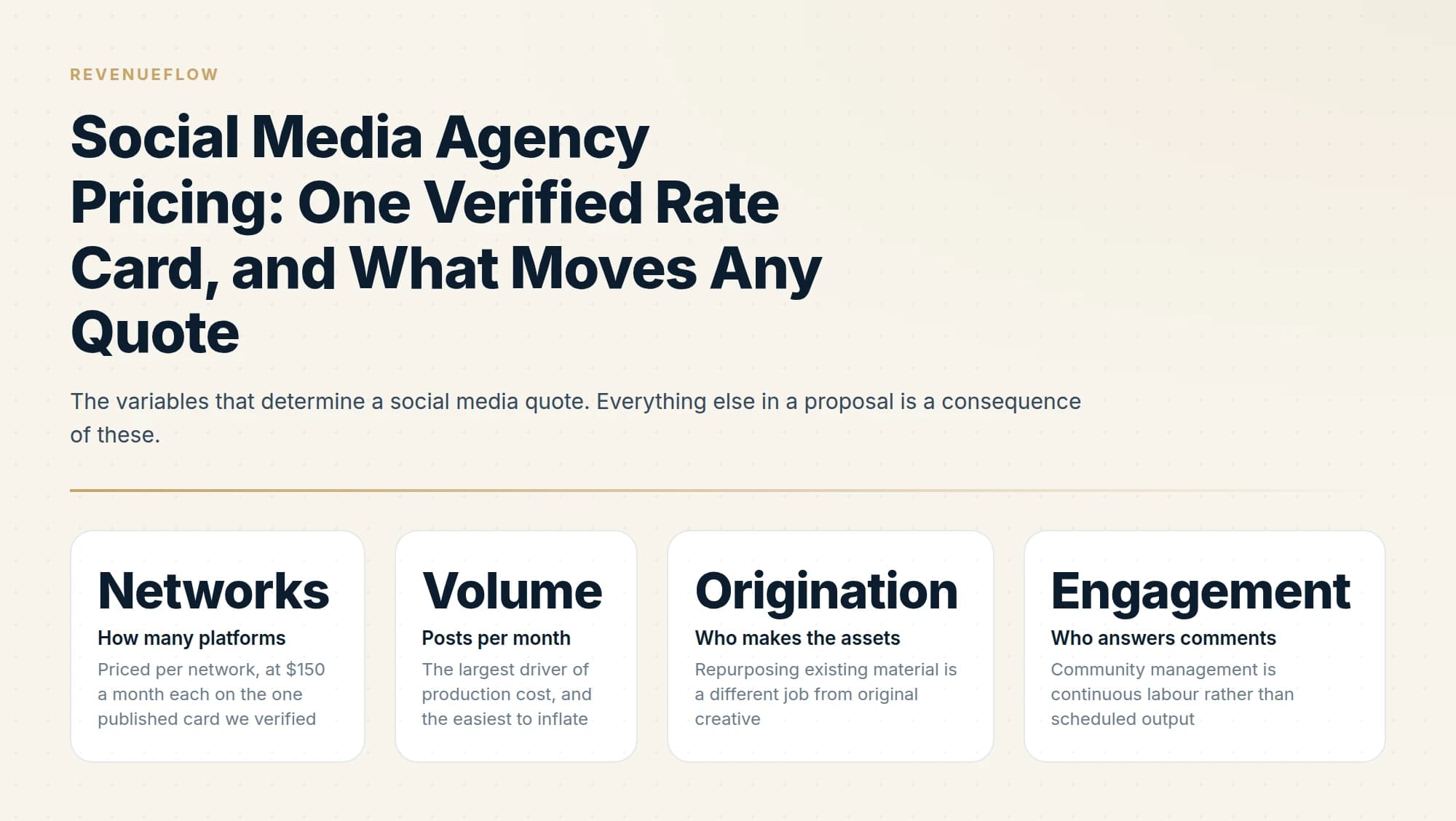
Social media agency pricing follows four models: a monthly retainer, a per-channel charge for each added network, a project or setup fee, and performance pricing tied to results. One rate card verified at source, LYFE Marketing's, publishes packages at $750, $1,350 and $1,550 a month, $150 per added network, and a stated range of $750 to $7,000.
Key takeaways
- Four pricing models cover almost every social media agency quote: retainer, per-channel, project or setup fee, and performance, and most quotes combine the first two.
- LYFE Marketing's own page publishes three packages at $750, $1,350 and $1,550 a month, additional networks at $150 each, and an overall range of $750 to $7,000 a month.
- On that card the step from image posts to vertical video costs $600 a month at the same 12 posts, while eight more posts cost $200, so format moves the price more than volume.
- Most ranges circulating for this category cannot be traced to an agency's own page, so normalise competing proposals to cost per original asset and ask for three months of recent work.
Reviewed and updated September 18, 2026
Search for social media agency pricing and you will find a dozen articles quoting confident ranges: $500 to $2,500 a month, or $2,000 to $5,000, or $10,000 and up for enterprise. Almost none of those numbers come from an agency. They come from other blog posts, which took them from earlier blog posts, and the ranges have been circulating long enough to feel corroborated by repetition alone.
Here is a more useful approach. One agency's published rate card, read at source, plus the structure that determines what any quote will say, so you can construct the comparison yourself rather than trusting a range nobody can attribute.
Social media agency pricing: the four models behind any quote
Social media agency pricing comes in four models: a monthly retainer for a fixed package, a per-channel charge for each added network, a project or setup fee for one-off work, and performance pricing tied to results. Most quotes combine the first two. The one rate card verified here, LYFE Marketing's, shows three of the four: packages from $750 a month, $150 per added network and a $300 setup fee.
Retainer
A fixed package, billed monthly
On the card Three named packages at $750, $1,350 and $1,550 a month, plus a custom tier.
Per channel
A charge for each added network
On the card $150 a month per network beyond the packaged set.
Project or setup
A one-off fee for one-off work
On the card A $300 account setup fee on PPC management, and none on the social packages.
Performance
Price tied to a counted result
Not on the card Nothing on that page ties a fee to an outcome.
The retainer is the default because the work is continuous. Posts go out every week and comments arrive every day, so agencies sell a month of capacity and define it by what gets produced. On LYFE's page the retainer also carries a term: clients sign an initial three month contract, which then moves to month to month.
Per-channel pricing sits on top of a retainer and rarely replaces it. The packaged set on that card is Facebook and Instagram, and each additional network is a separate monthly line. A quote that lists networks individually is showing you this model, and a quote that does not is hiding the same cost inside the package.
Project and setup fees cover work that happens once: account builds, audits, a launch campaign, a brand photo shoot. The same agency uses both approaches on one page. Its social packages state no setup fee or initial campaign investment, while its PPC management lists a $300 account setup fee that may be waived. A setup fee is worth questioning only when the quote cannot say what one-off work it pays for.
Performance pricing is the model buyers ask about and rarely get. It needs a result both sides can count and agree on before launch, and a social retainer's natural outputs are posts and responses, which are activity. That is why no fee on that page is tied to an outcome. Where an agency does offer it for social, the definition of the counted result is the whole negotiation.
One published rate card, verified at source
LYFE Marketing publishes pricing on its own site, which makes it citable in a way that roundup figures are not.
On its social media marketing packages page, the company states that social media marketing costs between $750 and $7,000 a month or more, depending on needs, goals and budget, and repeats the same range in its own FAQ. One published package example shows an estimated monthly cost of $550. Additional social networks beyond the packaged set are listed at $150 a month per network. On the paid side, the same site lists PPC management at $300 to $3,000 a month with a $300 account setup fee that may be waived, and Bing network management at $150 a month.
Below that range the page sets out three named packages. The page lists GOOD at $750 a month for image posts on Facebook and Instagram at 12 posts a month. It lists BETTER, marked most popular, at $1,350 for vertical video, adding TikTok and Instagram Reels, at the same 12 posts. The page lists BEST at $1,550 for vertical video at 20 posts a month, and a custom tier is priced on request. Every package lists community management at 10 responses per day, a single account manager and no setup fee.
That single rate card is more informative than every range-quoting article combined, because it exposes the structure. Look at what varies: the number of networks, the number of posts, and whether paid management is included. Those three inputs are what any agency is actually pricing, whatever headline number they lead with.
The four things that move any quote
The per-network structure is the one buyers most often miss. Adding LinkedIn and TikTok to a package scoped for Facebook and Instagram is not a rounding adjustment; it is closer to a proportional increase, because each network needs different asset dimensions, a different posting rhythm and a different tone. An agency that adds networks for free is either repurposing one asset across all of them, which shows, or absorbing a cost it will recover elsewhere.
The card bears that out in dollars. Moving from GOOD to BETTER costs $600 a month and changes the format while the post count stays at 12, and moving from BETTER to BEST adds eight posts for $200. On that page the change of format costs three times what the extra volume does.
Volume is the variable most likely to be gamed in a proposal. Thirty posts a month sounds like more value than twelve, and it usually means the same amount of thinking spread thinner. Ask how many original assets are produced, not how many slots are filled.
The question that actually decides value

Community management is continuous, and production is episodic. Most proposals bundle them and price them as one thing, which hides the more important question of who is answering your customers.
A brand posting three times a week with nobody watching replies is running a broadcast channel with a comment section attached. If prospects and customers ask questions there, response time is the part of the service that affects revenue, and it is the part least visible in a package comparison. LYFE's card is unusually specific here, listing community management at 10 responses per day on every package, which is a cap you can plan around. Ask what the response-time commitment is and who covers weekends, because "community management" in a proposal can mean anything from a daily sweep to a genuine service level.
Comparing quotes without a benchmark
You do not need a market range to compare two proposals. You need to normalise them.
| Package | Month | Posts | Per post |
|---|---|---|---|
| GOOD image | $750 | 12 | $62.50 |
| BETTER video | $1,350 | 12 | $112.50 |
| BEST video | $1,550 | 20 | $77.50 |
Run on the one published card, that normalisation is illustrative arithmetic and it is ours: $62.50 a post on GOOD, $112.50 on BETTER and $77.50 on BEST. The headline prices rank the packages one way and the unit prices rank them another, which is exactly what the exercise is for. It also ignores the community management and reporting bundled into each, so use a per-post figure only to compare two proposals on the same footing.
That last step matters because the two needs are genuinely different purchases. A company that wants a consistent content presence is buying production, and cost per original asset compares proposals fairly. A company whose customers live in the comments is buying responsiveness, and asset counts are close to irrelevant.
Why the published ranges are so wide, and why that is honest
A span of $750 to $7,000 on a single agency's own page looks evasive until you consider what sits at each end, and then it starts to look like the only defensible way to publish.
At the bottom is a small business on two networks wanting a dozen posts a month, mostly repurposed, with light monitoring. At the top is a multi-location brand on five networks with original photography, video editing, paid amplification and same-day response commitments. Those are not the same service with a different volume dial. They need different people, and the senior end needs people whose time cannot be bought at the junior rate.
This is why agencies that publish a single headline price tend to be selling a narrow, standardised product, and why the ones selling range are usually selling custom scope. Neither is better. A standardised package is easier to compare and easier to outgrow; a custom scope fits better and makes you do the comparison work yourself.
A similar published-rate-card pattern turns up in RevOps agency pricing, where capacity-based tiers price hours rather than outcomes.
What the width does mean is that a quote near either end tells you something. A number at the bottom of the market almost certainly implies templated output and offshore production, which can be entirely appropriate for a business that needs presence rather than distinction. A number at the top should come with named senior people and original production, and if it does not, the price is buying overhead rather than capability.
What social media pricing will not tell you
The uncomfortable part of this category is that price correlates weakly with outcome, more weakly than in most marketing services.
Social performance is dominated by whether the content is good and whether the audience is there, and neither is a function of the retainer. A $7,000 engagement producing competent, forgettable content will lose to a $1,500 engagement producing three genuinely useful posts a month. Nothing in a pricing comparison surfaces that difference, which is why the work sample matters more than the rate card.
Ask to see the last three months of work the specific team did for a client in a comparable category, not the agency's portfolio highlights. Portfolio pages show the best work an agency has ever produced. The recent-work question shows what a normal month looks like, which is what you are buying.
The question about who specifically does the work is worth pressing on. Social media is one of the more heavily delegated services in marketing, and the person in the pitch is frequently not the person writing your posts. Some of it is resold outright, which is a legitimate model with its own economics covered in white label marketing agency pricing. None of that is automatically a problem, provided you know it going in and have seen the actual author's work.
Account and asset ownership is worth checking before signing rather than at the exit. Agencies that set up ad accounts under their own business manager, or hold creative files, create a switching cost that has nothing to do with performance.
Where this sits next to outbound
Social media and outbound get compared as though they compete for the same budget, and they answer different questions. Social builds familiarity with an audience that already knows you exist or can find you. Outbound reaches people who do not know you and were not looking.
Both are legitimate and the sequencing depends on your sales cycle. Where they interact usefully is credibility: a prospect who receives a cold message often checks the company before replying, and a dormant profile is a reason not to answer. That is a genuine argument for a modest social presence alongside outbound, and a poor argument for a large one.
We run outbound rather than social, paid on attended qualified meetings, so treat that framing as coming from someone with a position. If you are weighing where a marketing budget should sit more broadly, in-house versus agency marketing covers the structural decision, and lead generation for digital agencies covers the agency-buying-for-itself case.
You can also see what a campaign would look like for your market.
The short version
The ranges circulating for social media agency pricing are mostly unattributable, so treat them as noise. One verified published card, LYFE Marketing's, puts the span at $750 to $7,000 a month with additional networks at $150 each, which usefully exposes the real structure: networks, volume, origination and engagement are what any agency is pricing. Normalise competing proposals to cost per original asset or cost per response commitment, insist on three months of recent real work rather than a portfolio, and check that you own the accounts and assets. Price tells you very little here, and the work sample tells you almost everything.
LYFE Marketing figures are from its own packages page at https://www.lyfemarketing.com/social-media-marketing-packages/, verified as of mid-2026. No other pricing figures are stated in this article, because the widely circulated ranges for this category could not be traced to an agency's own published page. Verify current terms with any vendor before relying on them.
Frequently asked questions.
Frequently asked questions- How much does a social media agency cost per month?
- The one agency rate card verified at source for this article, LYFE Marketing's, states that social media marketing costs between $750 and $7,000 a month or more, and lists three packages at $750, $1,350 and $1,550 a month. Most other ranges in circulation trace back to blog posts, so use them cautiously.
- What pricing models do social media agencies use?
- Four. A monthly retainer buys a fixed package of posts and community management. A per-channel charge adds each extra network, listed at $150 a month on LYFE Marketing's page. A project or setup fee covers one-off work such as an account build. Performance pricing ties the fee to a counted result, and it is rare for social work.
- Why do social media agency prices vary so much?
- Because the scope does. The bottom of a published range is a small business on two networks with a dozen mostly repurposed posts. The top is a multi-location brand on five networks with original video, paid amplification and same-day responses. Those need different people, so a wide range on one agency's page is usually honest.
- How do I compare two social media agency quotes?
- Normalise them. Count original assets produced each month, ask what adding or removing one network changes, and get production priced separately from community management. Then divide by the outcome you need: cost per original asset for a content need, or cost per response commitment if your customers live in the comments.
About the author.

Tim Carden is CMO / CTO at RevenueFlow, which builds and operates outbound revenue engines for B2B companies. Studied at McGill University.
Tim Carden · CMO / CTO
Connect on LinkedIn →Explore more.
Ready to scale your outreach?
We build GTM engines that book real meetings. See the receipts.
Related articles.
Account-Based Content Marketing: Reaching the Buying Group
Account-based content usually fails at distribution rather than at writing. Count buying-group coverage instead of reads, and assign a route to every named person.
B2B Marketing Conversion Rates: Who Published What
Every published B2B conversion benchmark, by channel and by stage, with the publisher, the population, the method and the date beside each figure.
Email Subject Line Capitalization: What the Guides Say
What the style authorities actually rule on subject line case, what the published tests measured, and the default for a one to one sales email.
Best Time to Cold Call: What the Studies Counted
The best time to cold call figures traced to their originals: one inbound study from six companies, three vendor call datasets, and what survives the read.
Best Time to Send a Sales Email: What Was Measured
The send time studies behind the midweek morning answer, what each one actually counted, and why a broadcast finding does not transfer to a sales email.
Sales Enablement Statistics, Traced to Their Sources
The sales enablement figures in circulation, followed to their publishers: which state a population, which are gated, and which are quietly seven years old.