SerpApi Pricing: The Per Thousand Rate and the Throughput
SerpApi publishes five plans by monthly search allowance. What each works out to per thousand, why throughput caps spend rate, and what the legal shield is.
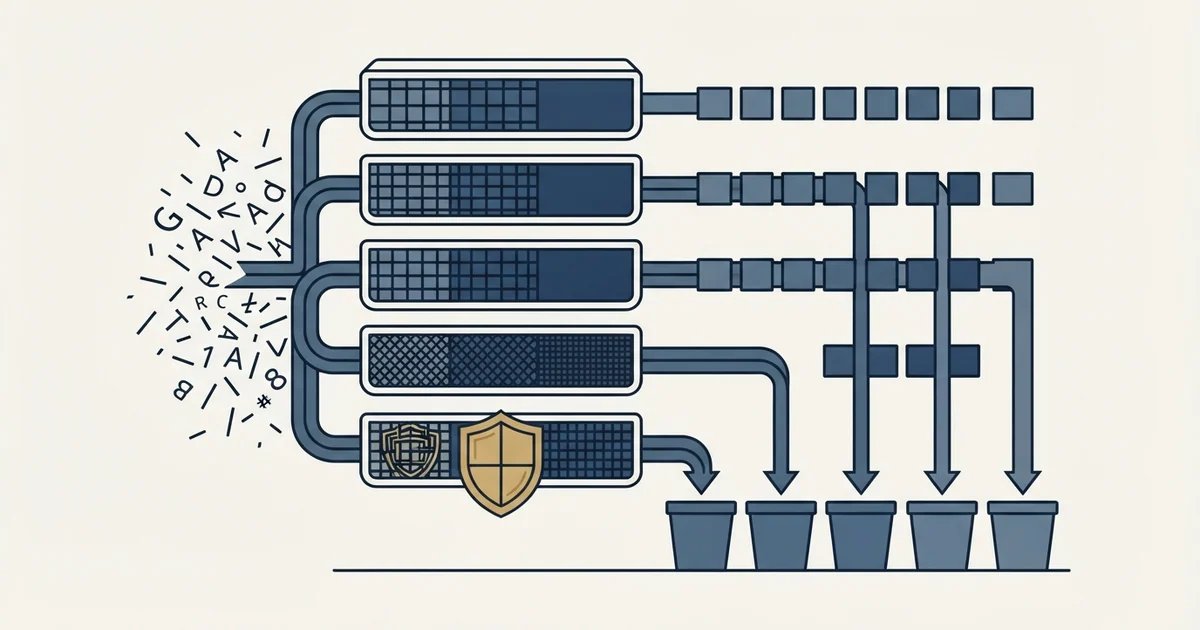
SerpApi publishes a free tier at 250 searches a month and four paid tiers: Starter $25 for 1,000, Developer $75 for 5,000, Production $150 for 15,000 and Big Data $275 for 30,000, with Enterprise quoted. Effective rates run from $25.00 per thousand down to about $9.17, and hourly throughput is one fifth of each plan's monthly allowance.
Key takeaways
- Effective cost falls from $25.00 per thousand searches on Starter to roughly $9.17 on Big Data, so under-buying and topping up repeatedly costs materially more per search.
- Guaranteed hourly throughput is exactly one fifth of the monthly allowance on every tier including the free one, so the plan caps how fast searches can be spent as well as how many.
- Only successful searches count against the allowance, and a response with a hundred results costs the same one search as an empty one.
- Every plan card carries a U.S. Legal Shield described as up to $2 million of coverage for scraping and parsing search engine data, conditional on the use being lawful.
Reviewed and updated September 2, 2026
SerpApi's cheapest paid plan costs $25 a month and buys 1,000 searches. That works out at $25 per thousand, which is the single most useful number on the page and the one the page does not print: under the heading "Choose the plan that suits you best." every tier carries a monthly price and a monthly search allowance, and the division is left to the reader.
Doing that division across the ladder is where the pricing decision actually lives, and it produces a second observation the page also leaves implicit: the throughput limit on every plan, including the free one, is exactly one fifth of that plan's monthly allowance per hour.
All figures below were read from serpapi.com/pricing on 30 August 2026.
What SerpApi is, in one paragraph
SerpApi is a paid API that runs a search query on a search engine and returns the results page as structured JSON. Instead of fetching a search results page and parsing HTML that changes without notice, a caller sends a query and gets back named fields: organic results with positions, local map packs, knowledge panels, job listings, shopping results, and so on. The vendor operates the fetching and the parsing, and sells the output by the search.
The breadth is unusual and it is the thing being paid for. The pricing page's own API list runs past a hundred named endpoints, covering Google Search, Google Maps, Google Local, Google Jobs, Google News, Google Images, Google Flights, Google Hotels and Google Patents, and then repeating much of that surface for Amazon, Apple App Store, Bing, Baidu and others. A lead-generation workflow typically touches one or two of those.
For a go-to-market team the use is narrow and specific: turning a search query into a list. "Every dental practice in a metro", "every company hiring for a named role", "every business of a type in a set of postcodes" are search queries before they are lead lists, and a SERP API is what makes them programmatic. That is the job the infinite lead glitch walks through end to end, and the reason the tooling shows up in a GTM engineer's stack at all.
The ladder, and the per-thousand rate underneath it

| Plan | Monthly price | Searches per month | Throughput per hour |
|---|---|---|---|
| Free | $0 | 250 | 50 |
| Starter | $25 | 1,000 | 200 |
| Developer | $75 | 5,000 | 1,000 |
| Production | $150 | 15,000 | 3,000 |
| Big Data | $275 | 30,000 | 6,000 |
| Enterprise | Contact SerpApi sales for pricing | Custom | Custom |
The paid tiers sit under one line on the SerpApi page: "Month-to-month. Cancel anytime. Starter" opens the ladder.
Dividing each SerpApi price by its allowance gives the effective rate: $25.00 per thousand on Starter, $15.00 on Developer, $10.00 on Production and roughly $9.17 on Big Data. Those four divisions are ours, taken over the figures in the table above; nothing else in this article is calculated. The spread matters because it is wide. Committing to thirty times the volume, for eleven times the spend, cuts the unit rate by nearly two thirds, so a team that under-buys and tops up repeatedly pays a materially worse rate than one that sizes the plan honestly at the start.
- USD 25 a month for 1,000 searches
- 200 searches an hour guaranteed
- USD 75 a month for 5,000 searches
- 1,000 searches an hour guaranteed
- USD 275 a month for 30,000 searches
- 6,000 searches an hour guaranteed
Throughput is the second axis, and it is a fixed ratio
Every plan pairs a guaranteed throughput figure in successful searches per hour with the same advice: "To improve performance, distribute your searches evenly throughout the hour and across multiple hours."
Run the ratio and the design becomes visible. Fifty per hour against 250 a month, 200 against 1,000, 1,000 against 5,000, 3,000 against 15,000, 6,000 against 30,000. Every one is exactly one fifth, on every tier including the free one.
The practical consequence is that the plan does not only cap how much you can buy, it caps how fast you can spend it. A team that wants 15,000 searches finished inside one working day cannot buy that on Production, because 3,000 an hour over eight hours is 24,000 and the monthly allowance is gone in five. Burst capacity and monthly volume are the same purchase here, which is a different shape from a prepaid credit model where the two are separate.
Caps of that kind hide elsewhere too, and the fair-usage policy on CallHippo's cheapest plan forbids exactly the bulk calling an outbound team would buy it for.
That is the thing to size against. A recurring weekly list build with a predictable shape fits the ladder well. An occasional very large one-off does not, and the honest answer for that job is a plan a tier or two above what the monthly total suggests.
What counts as a search, and what does not
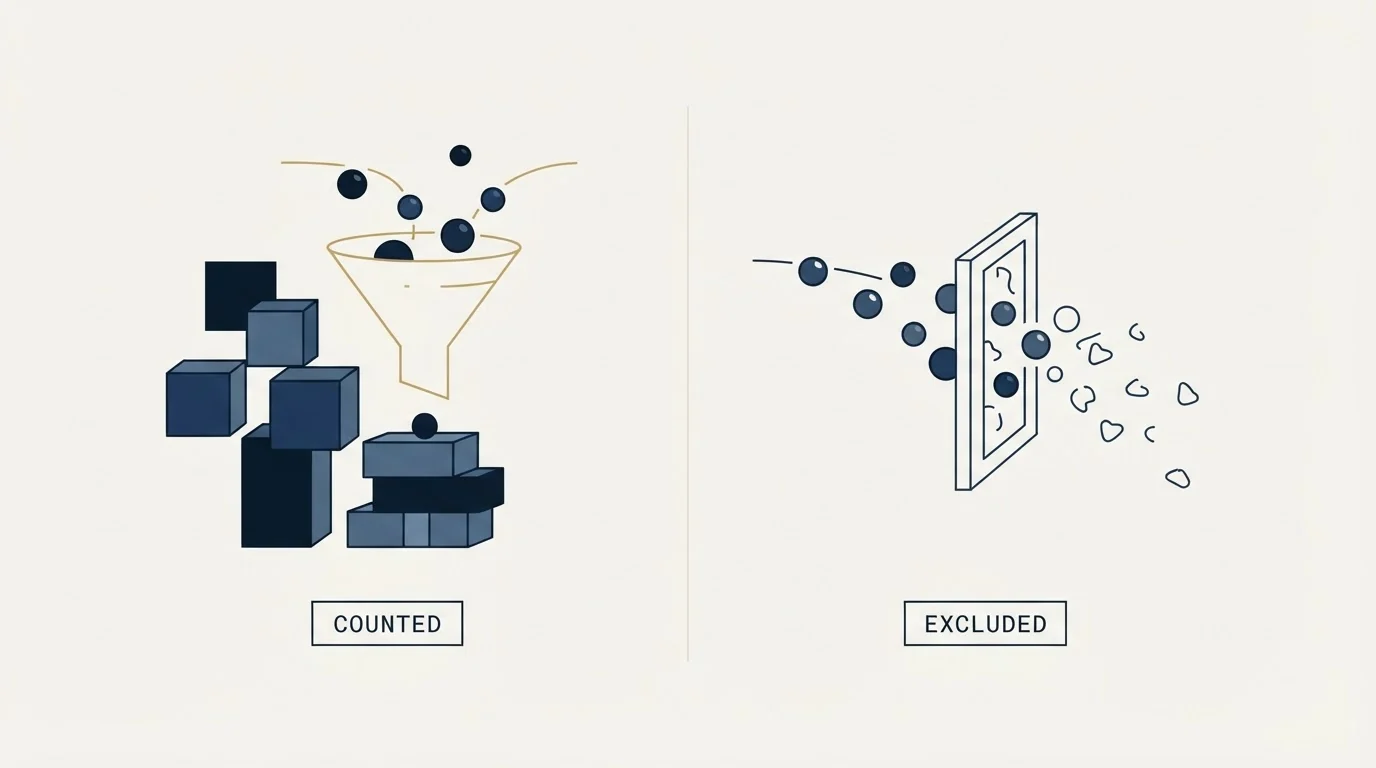
The billing rules are published and unusually clear, which is worth saying because they are frequently the source of surprise invoices elsewhere.
Only successful searches count: "Only successful searches are counted toward your monthly searches. Cached, errored, and failed searches are not." The same FAQ adds that the number of results returned does not change the cost, so a response with a hundred results and one with an empty result set each count as a single search.
Three further mechanics sit in the FAQ. Upgrading mid-cycle charges only the difference between plans and keeps the renewal date. Downgrading keeps the renewal date and moves any remaining searches into an extra credits balance rather than voiding them. And an automatic early renewal setting exists, which resets the allowance the moment it is exhausted rather than waiting for the billing date, which is convenient and is also the setting that turns a runaway job into a larger bill than expected.
Refunds are time and usage bound: the page offers a full refund within seven days of subscribing, provided no more than twenty percent of the plan's searches have been used.
- Yes: Only successful searches count; cached, errored and failed ones do not
- Yes: Result count does not change the price: a hundred results and zero results both cost one search
- Depends: Hourly throughput is one fifth of the monthly allowance on every tier
- Yes: Unused searches survive a downgrade as an extra credits balance
- Depends: Automatic early renewal refills the allowance the moment it runs out
- Depends: Refund window is seven days and closes once twenty percent of searches are used
The legal line item nobody else prices
Every plan card, including the free one, has an entry called U.S. Legal Shield, whose own line reads that "U.S. Legal Shield provides up to $2 million in coverage for the scraping and parsing of search engine data", with SerpApi conditioning it on the use of the data or service not being illegal.
That is an unusual thing to find on a pricing page, and it is a direct acknowledgement of what a buyer is really purchasing. Fetching and parsing search results at volume is a contested activity, and the exposure a team takes on by doing it in house does not appear on any invoice until it does. A vendor that puts an indemnity figure on the card is pricing that exposure explicitly rather than leaving it with the customer.
It is not a blank cheque and the page does not present it as one. The condition is stated in the same sentence, and no coverage attaches to a use that is itself illegal. Reading the actual terms before relying on the number is the obvious next step, and the number's presence is the reason to go and read them.
Two adjacent commitments sit beside it. ZeroTrace Mode, listed on the free and enterprise tiers, prevents search data from being stored on SerpApi's systems: "When enabled, we do not retain search parameters, queries, or results", and each request is discarded once it completes. And the security block states SOC 2 Type II, SOC 3 and ISO 27001 certification with uptime service level agreements of up to 99.97 percent. For a team whose search queries encode their target list, the retention question is a real one rather than a compliance formality, because the queries are the strategy.
The general treatment of legality this corpus applies to scraping tools has not changed: scraping ZoomInfo and LinkedIn web scraping both set out what the terms actually say rather than repeating a vendor's safety framing, and search results are a different surface with different rules again.
Whether this is the right price for the job
The honest question is not whether SerpApi's $25 per thousand is expensive in the abstract. It is whether the breadth being paid for is breadth you use.
A team pulling Google results into a lead pipeline touches one endpoint. It is paying for coverage of a hundred, plus an indemnity, plus certifications, plus a throughput guarantee. Those are real things and some buyers need all of them. A weekend list build for a single campaign needs none of them, and the market has cheaper answers for exactly that case, priced per thousand rather than per plan. What the SERP API market charges sets those side by side, each from its own vendor's pricing page.
Where the ladder is genuinely strong is the mid-tier steady state. Production at $150 for 15,000 searches a month, at a $10 per thousand effective rate with 3,000 an hour of guaranteed throughput and a published indemnity, is a defensible line item for a team running list builds continuously rather than occasionally. Below that, the free tier's 250 searches a month is enough to prove a pipeline works before anything is bought, which is the right way to start, and the same approach applies whether the orchestration is a script or a no-code extraction chain.
None of this fixes a list that converts badly. A search API makes building the wrong list faster. Get a free campaign plan if the constraint is what happens after the list exists.
Pricing and features verified as of August 2026. Verify current terms with the vendor before relying on them.
Frequently asked questions.
Frequently asked questions- How much does SerpApi cost per search?
- Dividing each published plan price by its published allowance gives $25.00 per thousand on Starter, $15.00 on Developer, $10.00 on Production and about $9.17 on Big Data. The pricing page publishes the monthly price and the monthly search count for each tier and leaves that division to the reader, which is why the effective rate is easy to miss.
- What is SerpApi used for?
- It runs a search query on a search engine and returns the results page as structured JSON, so a caller gets named fields rather than HTML to parse. Its pricing page lists more than a hundred endpoints across Google Search, Maps, Local, Jobs, News, Flights and Hotels, plus Amazon, Apple App Store, Bing and Baidu. Lead workflows usually touch one or two.
- What is SerpApi's throughput limit?
- Each plan publishes a guaranteed rate in successful searches per hour: 50 on Free, 200 on Starter, 1,000 on Developer, 3,000 on Production and 6,000 on Big Data. Every one is one fifth of that plan's monthly allowance. The page advises spreading searches evenly through the hour and across hours to improve performance.
- Does SerpApi charge for failed searches?
- No. The pricing page states that only successful searches count toward the monthly allowance, and that cached, errored and failed searches do not. It also states that the number of results returned does not change the cost, so a response with a hundred results and one with an empty result set each count as a single search.
About the author.

B2B cold email experts helping companies generate qualified leads through done-for-you outreach campaigns.
RevenueFlow Team
Explore more.
Ready to scale your outreach?
We build GTM engines that book real meetings. See the receipts.
Related articles.
The Real Cost per 1,000 Emails, Verifications and Data Credits in 2026
Unit prices computed from verified vendor plans: $1.00 per 1,000 emails sent, $2.00 per 1,000 verifications and $19.60 per 1,000 enrichment credits.
Free Tiers and Trials in Sales Tools: What $0 Gets You Across 386 Vendors
37.0% of 386 verified sales tools have a permanent free plan. The median free data tier gives 50 credits and the median free sending plan 2,500 emails a month.
Lavender Pricing: Two Products, No Pricing Page
Lavender has no pricing page. The Email Coach ladder per seat at both billing states, the free routes, and the separate per-agent price for Ora.
Airscale Pricing: Three Plans, One Credit, Four Rates
Airscale prints a different credit cost on every plan, and its advertised per-email price belongs to the custom one. The dated ladder and the rollover rules.
What Cold Email and Sales Tools Actually Cost in 2026: Pricing Data From 386 Vendors
RevenueFlow's verified dataset of 386 sales tools puts the median starting price at $39.98 a month. Here is the spread by category, tier and billing model.
Snitcher Pricing: The $49 Table Is the Annual Rate
Snitcher's visible price table is the annual-billing ladder. The ten bands at both billing states, the unique-company meter, and the rules on a help page.