SerpApi Alternatives Priced per Thousand Google Searches
Every SERP API comparison online was written by a SERP API vendor, and none converts the units. What four alternatives cost per thousand Google searches.
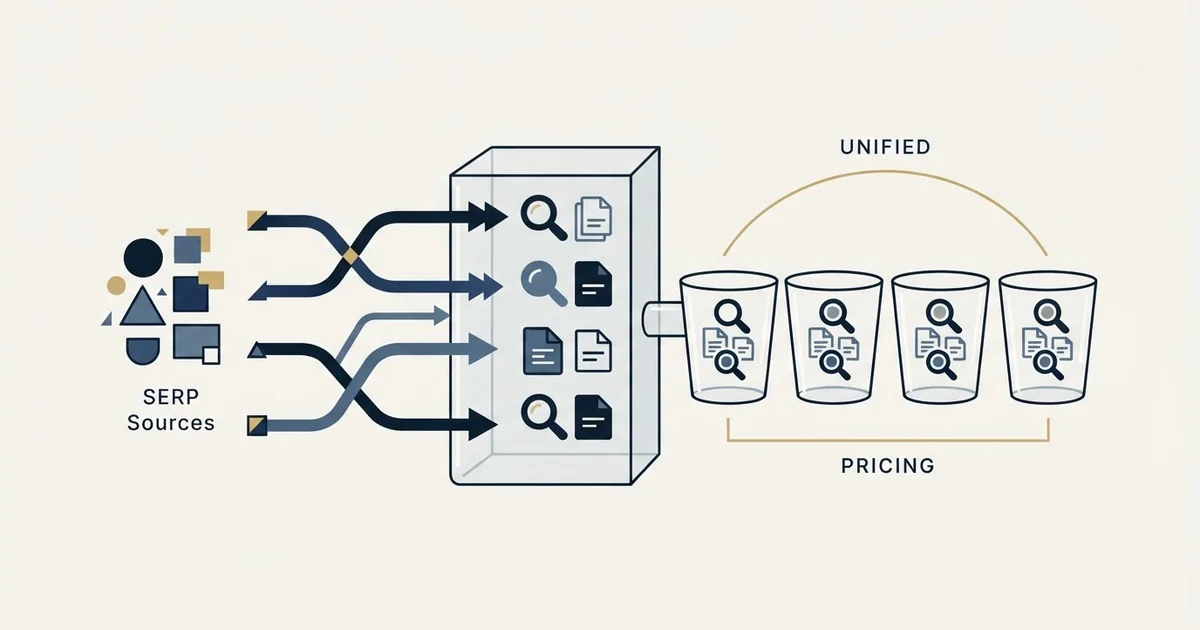
Converted to a common unit of one thousand Google search requests, SerpApi Starter is $25.00, ScraperAPI Hobby is $12.25 once its 25 credits per Google request are applied, and Serper Starter is $1.00 falling to $0.30 at its top bundle. DataForSEO prices pay as you go from a $50 minimum payment.
Key takeaways
- One Google request costs 25 ScraperAPI credits by its own published schedule, so a $49 plan of 100,000 credits buys 4,000 Google searches rather than 100,000.
- Serper sells prepaid credits at one credit per query, publishing $1.00 per thousand at entry and $0.30 at its largest bundle, with credits valid for six months rather than resetting monthly.
- Oxylabs publishes two different starting prices for the same products on the same pricing page, so the applicable rate is a question for the vendor rather than a reading.
- The expensive option is buying different things: more than a hundred endpoints, a published legal indemnity and named security certifications rather than a lower rate.
Reviewed and updated September 2, 2026
Every comparison of SERP APIs currently ranking for this query was written by a SERP API vendor. Vendors in this market publish their own, and a vendor's comparison page concludes that the reader should buy from the vendor. That is not dishonest, and it does mean nobody neutral has priced the field.
The harder problem sits underneath the bias. These vendors do not sell the same unit, so the per-thousand figures they quote at each other are not comparable, and the conversion that makes them comparable is published by each vendor in a different place.
What follows prices four alternatives to SerpApi in one unit: a thousand Google search requests. Every figure comes from the named vendor's own pricing page, read on 30 August 2026, and every conversion between a vendor's unit and a Google search is stated so it can be checked.
That method transfers to any vendor-written category, and nine interactive demo vendors priced the same way each carry a recorded billing state because most publish two ladders in one document.
The unit problem, in one example
ScraperAPI's cheapest plan is $49 a month for 100,000 API credits. Read as searches, that is 49 cents per thousand, which would make it fifty times cheaper than SerpApi's Starter tier.
It is not, and ScraperAPI's own FAQ says so: "A standard page costs 1 credit. Amazon costs 5, Google and Bing (including their subdomains) cost 25, and LinkedIn costs 30." Sites behind bot protection add 10 credits per request when bypassed.
One Google search on ScraperAPI therefore costs 25 credits. The $49 ScraperAPI plan buys 4,000 Google searches, not 100,000, which puts it at $12.25 per thousand. That single division changes the ranking of the whole field, and it is the kind of thing a vendor-authored comparison has no incentive to perform on itself.
The same discipline applies in both directions. Serper prices in credits where one credit is one query, so its own per-thousand figures need no conversion. Oxylabs prices its Web Scraper API per thousand results rather than per request, which is a third unit again.
The field, converted
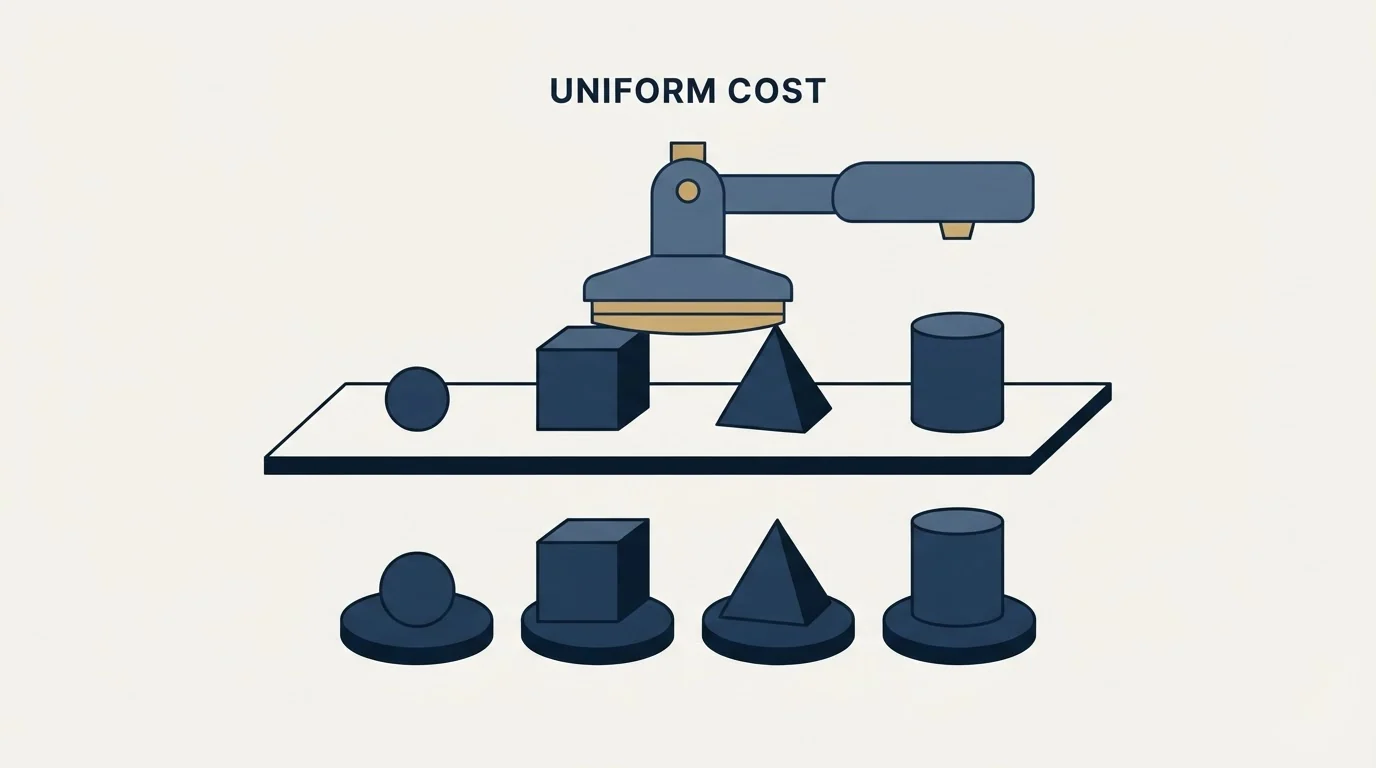
| Provider | Entry plan | What it buys | Per 1,000 Google searches |
|---|---|---|---|
| SerpApi Starter | $25 a month | 1,000 searches | $25.00 |
| SerpApi Big Data | $275 a month | 30,000 searches | $9.17 |
| Serper Starter | $50 prepaid | 50,000 credits, 1 per query | $1.00 |
| Serper Ultimate | $3,750 prepaid | 12,500,000 credits | $0.30 |
| ScraperAPI Hobby | $49 a month | 100,000 credits, 25 per Google request | $12.25 |
| ScraperAPI Advanced | $1,975 a month | 21,500,000 credits | $2.30 |
The SerpApi and ScraperAPI rows are divisions performed here over each vendor's own price, allowance and credit schedule. The two Serper rows appear on Serper's page in that form already, under the banner "The World's Fastest & Cheapest Google Search API", so they are copied rather than calculated. The SerpApi and ScraperAPI figures throughout are divisions performed here over each vendor's own price, allowance and credit schedule, and each is shown with its inputs. The two Serper rows appear on Serper's page in that form already, so they are copied rather than calculated.
- USD 25 a month for 1,000 searches
- One search costs one search
- USD 49 a month for 100,000 credits
- A Google request costs 25 credits, so 4,000 searches
- USD 50 prepaid for 50,000 credits
- One credit is one query, and the rate is on Serper's own card
Serper, and the shape of a prepaid model
Serper publishes four prepaid credit bundles, under a line that reads "No monthly subscriptions; simply pay for the credits you need." Serper Starter is $50 for 50,000 credits at $1.00 per thousand. Serper Standard is $375 for 500,000 credits at $0.75 per thousand. Serper Scale is $1,250 for 2.5 million credits at $0.50 per thousand. Serper Ultimate is $3,750 for 12.5 million credits at $0.30 per thousand. Each tier has a rate limit, 50 queries per second on Starter rising through 100 and 200 to 300 on Ultimate, and each is marked "Credits valid for 6 months" with prices excluding sales tax, VAT and GST.
Two structural differences from a subscription matter more than the headline rate.
Credits do not reset monthly, they expire at six months. A team with lumpy demand can buy once and draw down across two quarters, which suits an occasional large list build far better than a monthly allowance that vanishes unused.
And the rate limit is decoupled from the balance. Serper's Starter tier allows 50 queries per second, which is 180,000 an hour, against a 50,000-credit bundle. That inverts the constraint found on subscription ladders where hourly throughput is pinned to a fraction of the monthly allowance, and it means a Serper bundle can be spent as fast as the caller can issue requests.
The trade is coverage. Serper's own banner calls it "The World's Fastest & Cheapest Google Search API", and its endpoints are Google surfaces: search, images, news, maps, places, videos, shopping, scholar, patents and autocomplete. A workflow that needs Amazon, an app store or Bing is not served by it, and that is precisely the breadth SerpApi's much higher rate is buying.
Serper also makes two claims worth separating from its prices: "In general, all queries are returned in 1 to 2 seconds." and that its prices are up to ten times cheaper than competitors including SerpApi and Bright Data. The first is a performance claim with no method attached. The second is a comparison the seller performs on itself, and the conversion table above suggests the multiple is larger than ten at the entry tier and depends entirely on which tiers are set against each other. A free allowance of 2,500 queries with no card required is the cheap way to test both claims rather than to accept them.
ScraperAPI, once the credits are converted
ScraperAPI's ladder runs Hobby at $49 a month for 100,000 credits with 20 concurrent threads, Startup at $149 for 1 million and 50 threads, Business at $299 for 3 million and 100 threads, Scaling at $475 for 5 million and 200 threads, Professional at $975 for 10.5 million and 300 threads, and Advanced at $1,975 for 21.5 million. Annual ScraperAPI billing takes ten percent off. A seven-day ScraperAPI trial with 5,000 credits requires no card.
At 25 credits per Google request the effective ScraperAPI rate for Google runs from $12.25 per thousand at the bottom to $2.30 at the top. That is genuinely cheaper than SerpApi at every comparable point, and it is a long way from the impression the credit headline creates.
Two things the credit model gives that a per-search plan does not. Geotargeting is a tier feature here rather than a parameter, restricted to the US and EU on the two cheapest plans and global from Business upward, which is a real constraint for anyone building lists outside those regions. And because a standard page costs one credit, the same balance covers ordinary web scraping alongside search, so a workflow that reads a search result and then fetches the pages behind it runs on one meter instead of two. That is the pattern in the infinite lead glitch, where a search API produces the URLs and a scraper reads the pages.
DataForSEO and Oxylabs, and what could not be read
DataForSEO prices pay as you go: "With DataForSEO you pay only for the individual services you consume." and, on the same page, "Note that the minimum payment amount is $50." There is no subscription and no plan ladder beside those two lines. Its per-endpoint prices live on separate pages that did not render figures to either a plain fetch or a headless browser render, so no DataForSEO per-search rate is quoted here. An unreadable page is a fact about the fetch rather than about the vendor, and the honest position is that the model is published and the numbers were not obtained.
Oxylabs presents a different problem, and it is on the vendor's own page rather than in the fetching. One Oxylabs pricing page gives the Web Scraper API as "Starts from $0.25 /1K results" in one section and "Starts from $49/mo" in another, and residential proxies at $2.5 per gigabyte in the first and $6 per gigabyte in the second. Both figures for each product are on the same document. Where a vendor's own page carries two numbers, the disagreement is the finding rather than something to resolve by picking the friendlier one, and a buyer should get the applicable rate in writing. Note also that a price per thousand results is not a price per thousand searches, since one search returns many results.
- Yes: Establish what one unit is: a search, a query, a credit, or a result
- Yes: Find the credit schedule, because a Google request can cost many credits
- Yes: Check whether unused volume expires monthly or carries for months
- Yes: Check whether throughput is pinned to the plan size or sold separately
- Depends: Check whether geotargeting is a parameter or a paid tier
- Depends: Check which engines beyond Google are actually covered
Choosing, without pretending there is one answer

Three shapes cover most go-to-market use, and they point at different providers.
Google only, at volume, on an occasional schedule. The prepaid model wins here on both rate and expiry, and Serper's own $1.00 per thousand at entry is the lowest committed entry rate in this set.
Search plus the pages behind it. A single credit balance that covers both is worth more than a marginally lower search rate, which favours a general scraping API over a pure SERP one.
Durability belongs in that choice too, since an API ended by a LinkedIn settlement makes a replacement's relationship to that data the variable worth checking first.
Breadth, indemnity and certifications. SerpApi's own pricing is the expensive option in this set and it is buying things the others do not put on a card: coverage of more than a hundred endpoints across several engines, a legal indemnity on every plan card, and named security certifications. A team whose procurement asks who owns the risk is paying for a different product, not the same one at a worse rate.
What none of them changes is the quality of the list that comes out. A cheaper search API builds a badly targeted list faster and for less, which is the failure mode the GTM tools market map keeps circling: the tooling layer got cheap and the targeting did not get better on its own. The same caution applies to whatever orchestrates the calls, whether that is a script or a no-code extraction chain.
If the constraint is what happens after the list exists, get a free campaign plan rather than a cheaper API.
Pricing and features verified as of August 2026. Verify current terms with the vendor before relying on them.
Frequently asked questions.
Frequently asked questions- What is the cheapest SerpApi alternative?
- On published entry rates converted to Google search requests, Serper is the cheapest in this set at $1.00 per thousand, falling to $0.30 per thousand on its largest prepaid bundle. The trade is coverage: Serper publishes Google surfaces only, so a workflow needing Amazon, an app store or Bing is not served by it at any price.
- How much does Serper cost?
- Serper publishes four prepaid credit bundles with no monthly subscription: $50 for 50,000 credits at $1.00 per thousand, $375 for 500,000 at $0.75, $1,250 for 2.5 million at $0.50 and $3,750 for 12.5 million at $0.30. One credit is one query, credits are valid six months, and rate limits run from 50 to 300 queries per second.
- Is ScraperAPI cheaper than SerpApi for search?
- Yes, but by far less than its credit headline implies. ScraperAPI charges 25 credits for a Google or Bing request against 1 credit for a standard page, so its $49 plan of 100,000 credits buys 4,000 Google searches at $12.25 per thousand. That is cheaper than SerpApi Starter at $25.00 per thousand and nowhere near 49 cents.
- Why do SERP API price comparisons disagree so much?
- Because the vendors do not sell the same unit and most comparisons are written by one of them. A search, a query, a credit and a result are four different things, and credit schedules can charge many credits for one search. Converting everything to one unit changes the ranking, and the conversion factors are published in different places on each site.
About the author.

B2B cold email experts helping companies generate qualified leads through done-for-you outreach campaigns.
RevenueFlow Team
Explore more.
Ready to scale your outreach?
We build GTM engines that book real meetings. See the receipts.
Related articles.
The Real Cost per 1,000 Emails, Verifications and Data Credits in 2026
Unit prices computed from verified vendor plans: $1.00 per 1,000 emails sent, $2.00 per 1,000 verifications and $19.60 per 1,000 enrichment credits.
Free Tiers and Trials in Sales Tools: What $0 Gets You Across 386 Vendors
37.0% of 386 verified sales tools have a permanent free plan. The median free data tier gives 50 credits and the median free sending plan 2,500 emails a month.
Snitcher Pricing: The $49 Table Is the Annual Rate
Snitcher's visible price table is the annual-billing ladder. The ten bands at both billing states, the unique-company meter, and the rules on a help page.
TexAu Pricing: Four Tiers, Billed Only on a Match
TexAu charges credits only when a lookup succeeds. The four tiers at both billing states, the rollover cap, and three places the page disagrees with itself.
Airscale Pricing: Three Plans, One Credit, Four Rates
Airscale prints a different credit cost on every plan, and its advertised per-email price belongs to the custom one. The dated ladder and the rollover rules.
Autobound Pricing: One-Time Credit Packs, Not Seats
Autobound's pricing page sells one-time credit packs for a signal data API, not seats. The six packs, the per-endpoint meter, and what a company costs.