Proxycurl Alternatives: What Actually Replaces It
Proxycurl shut down in July 2025 under a LinkedIn settlement. The replacement options, what each publishes, and the risk that moved rather than vanished.
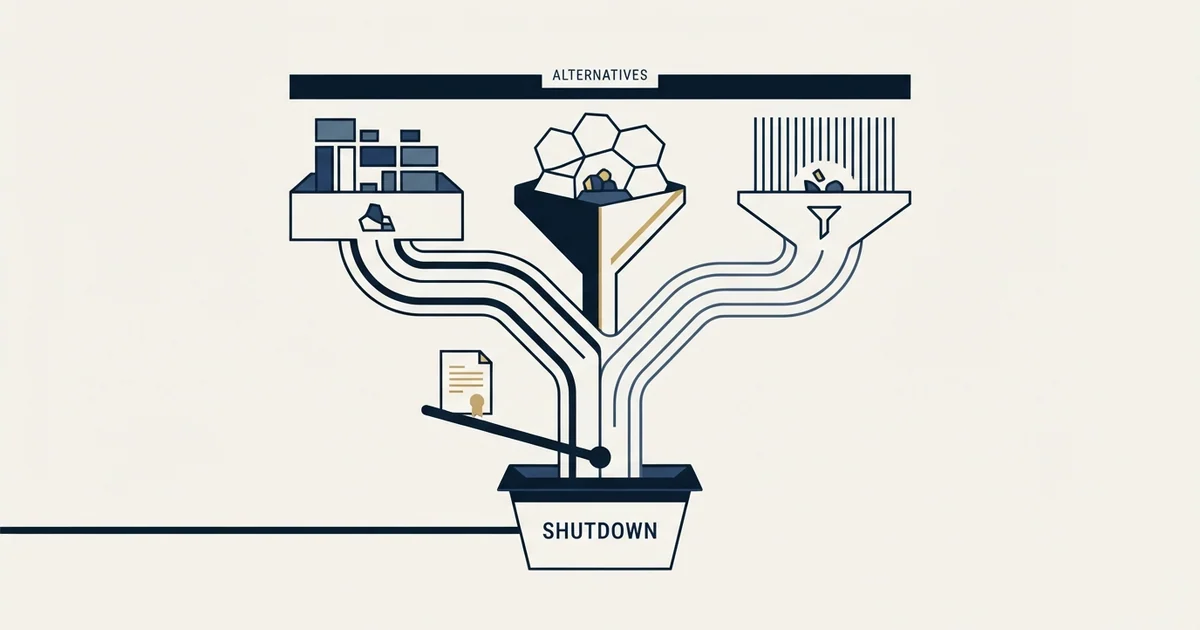
Proxycurl shut down on 4 July 2025 to comply with a legal settlement with LinkedIn, per its own closing post. Replacements fall into three shapes: licensed datasets such as Coresignal and Bright Data, the same team's successor NinjaPear, and account-based APIs such as Unipile, which carry different provenance risk.
Key takeaways
- Proxycurl's own closing post attributes the shutdown to a legal settlement with LinkedIn rather than to a commercial failure, and puts the business at roughly $10M revenue when it closed.
- Replacements divide into licensed datasets, live third-party fetch and account-based access, and only the middle shape is what Proxycurl actually sold.
- NinjaPear, built by the same team, publishes a four-tier credit ladder from $49 to $1,899 a month and states that failed requests are never charged.
- Coresignal publishes a full monthly ladder from $49 to $5,000, while comparison pages for this query are commonly published by vendors selling their own replacement.
Reviewed and updated September 2, 2026
The Proxycurl API is gone. On 4 July 2025 the company published a post titled "Proxycurl Shuts Down. Thank you." on its own blog, and the page is still there, still serving, still the clearest account of what happened to a LinkedIn data API that thousands of outbound and recruiting stacks were built on.
That single fact reshapes the question. Most articles ranking for Proxycurl alternatives are written by companies selling a replacement, and every one of them is answering which vendor you should buy, when the more useful question is what killed the last one and whether the thing you are about to buy has the same problem.
What the shutdown post actually says
The account below is the company's own, taken from the post at nubela.co as served on 30 August 2026. It is worth quoting closely because a founder writing about his own shutdown is a better source than a competitor's summary of it.
The post states that "In January earlier this year (2025), LinkedIn filed a lawsuit against Proxycurl", and that "Today, we are shutting Proxycurl down." It gives two reasons for not fighting: "The American Rule, which means that even if we were to win the lawsuit, we would not be able to claim legal fees", and that "LinkedIn, owned by Microsoft, has more or less an unlimited war chest."
Two further details from the same page matter to anyone still running an integration. The closure was staged rather than abrupt: "This is not a sudden closure. Over the past few weeks/months, I have been assisting our existing customers with deboarding Proxycurl as best as I can." And the shutdown is described as a settlement obligation rather than a business decision, with the founder writing that the company grew "to a ~$10M revenue business before we had to shut it down to comply with the legal settlement with LinkedIn."
A profitable business at roughly ten million in revenue did not close because the product stopped working or the customers left. It closed because of where the data came from.
The risk did not disappear, it moved
Here is the part the vendor comparison pages skip. If a settlement with LinkedIn is what ended Proxycurl, then the relevant question about any replacement is what its relationship to LinkedIn's data actually is, because that is the variable that decided the last one.
Replacements sort into three genuinely different shapes on exactly that axis, and the shapes matter more than the feature grids.
- The provider assembles records and sells access to the assembled set
- Freshness depends on the provider's own refresh cycle
- Coverage is whatever the provider already holds
- Your exposure is contractual, through the provider's terms
- A request is made on your behalf at the moment you ask
- This is the shape Proxycurl sold
- Freshness is as good as it gets
- The provider carries the collection question, and so did Proxycurl
- The API acts through a real account you have connected
- Scope is limited to what that account can already see
- Rate limits are the account's limits, not an API plan's
- The exposure attaches to the account, which is yours
None of those three is a recommendation. They are different trades, and a team that has just lost a live integration should pick the trade deliberately rather than picking whichever vendor ranked first for the alternatives query.
The same team's successor

The most direct continuity is NinjaPear, which the shutdown post names as where the team went: "The team is now focused on NinjaPear, a Competitive Intelligence Data company." Its pricing page as served on 2 September 2026 answers the provenance question directly, stating that it does not scrape LinkedIn or any professional social media platform, which is a deliberate repositioning by people who have just been through the alternative.
The commercial model is credit-metered per endpoint rather than per seat. As served on 2 September 2026 the page says "Every endpoint has a published credit cost" without printing the per-endpoint numbers on the pricing page itself. What it prints is a four-tier subscription ladder, Starter at $49 a month for 2,500 credits, Growth at $299 for 25,000, Pro at $899 for 89,900 and Ultra at $1,899 for 211,000, with Enterprise on request, and a throughput table beneath it that translates credits into monthly volumes per endpoint.
Credit meters make cross-vendor comparison harder than it looks, and search APIs converted to one common unit shows how far a headline rate can drift from the real cost.
One line on that page settles a cost most enrichment vendors bury: it states that "Failed requests are never charged". That is worth confirming per endpoint before migrating, because paying for a miss is normal in this category, and a lookup volume that is mostly misses prices very differently from one that mostly hits.
Two expiry terms on the same page deserve attention before anyone migrates a production integration onto it. Pay-as-you-go packs carry a 90-day validity that extends with further purchases, and subscription credits expire at the end of each billing period, so an unused allowance is gone rather than banked. The page as read on 2 September 2026 states "no monthly minimums" and carries no twelve-month commitment or cancellation-fee language, which is still worth confirming in the order form rather than the marketing page.
That is a twelve-month obligation wearing a monthly price tag, and it is exactly the kind of term that matters more than usual when you are replacing a vendor that disappeared.
Licensed datasets, priced by credit
Coresignal sells the assembled-dataset shape, and its pricing page as served on 30 August 2026 publishes a full ladder rather than a contact-sales form. The published tiers run "Mini $49/month", "Starter $199/month", "Pro $499/month", "Growth $1,000/month", "Premium $1,500/month", "Scale $3,000/month" and "Elite $5,000/month" above a free tier, against published monthly credit allowances running from 2,000 on the free tier to 10,000,000 on Elite. The same page offers a "7 day free trial" and a yearly toggle advertising 10% off.
The credit costs are published beside the ladder, and they are what make the ladder legible. That page prices an "Employee record 10-20 credits", a "Company record 10-20 credits", a "Job posting 1 credit" and a "Contact enrichment 20 credits". A range rather than a fixed cost per record is worth noticing: budgeting at the bottom of a 10 to 20 credit band and landing at the top of it doubles the bill, so the arithmetic to run before committing is your own expected mix at the pessimistic end of each range.
Bright Data occupies the same shape at a different scale. Its LinkedIn datasets page, served on 2 September 2026, headlines "LinkedIn Datasets - 907M+ Records Available", a live counter that moves, and the same navigation describes pre-collected data from more than 600 domains alongside scraper APIs covering more than 800 websites. That is an infrastructure company that sells professional data as one line among many, which cuts both ways: the scale is real, and the LinkedIn dataset is not the thing the company is organised around.
Account-based access, a different trade entirely

Unipile sells the third shape, and it is the one least like Proxycurl. Its pricing page, as served on 30 August 2026, prices by linked identity rather than by record: "49€ / $55 minimum per month, up to 10 linked accounts", then 5.00€ per linked account per month, "going down to 3.00€ per account at the highest tier". The same page defines the unit plainly, stating that one account equals one linked identity and that one LinkedIn profile linked counts as one. It advertises a 7-day free trial with no credit card required, and states that every tier includes unlimited API calls and unlimited requests.
Unlimited calls against a per-identity fee is a genuinely different cost curve from per-record credits. It gets cheaper the more you read and more expensive the more identities you connect, which is the inverse of every credit-metered option above. For a team enriching a large list from a small number of seats it is the cheapest shape on this page; for a team that needs breadth across many accounts it is the most expensive.
The structural point matters more than the price. An account-based API acts through an identity you connected, so the scope of what it can retrieve is the scope that identity already has, and the rate limits are that account's limits. Whether that suits you is a question about your own risk posture and your own account, and it is not a question a pricing page can answer.
What to check before you migrate
Losing a vendor to a legal settlement is a specific kind of failure, and it suggests a specific kind of diligence that a feature comparison does not cover.
- Yes: Ask the provider, in writing, where the professional profile data comes from
- Yes: Read the commitment term rather than the monthly label, because a monthly price can carry an annual obligation
- Yes: Price your own expected mix at the pessimistic end of any per-record credit range
- Yes: Confirm what a failed lookup costs, because a miss is rarely free
- Yes: Check whether the shape is dataset, live fetch, or account-based, and decide which trade you want
- Yes: Keep the integration behind an internal interface so the next swap is a config change
- Depends: Assume a comparison page written by a vendor is a sales asset and verify its claims on the named vendor's own site
The last one is not cynicism. Comparison pages for this query are commonly published by companies selling a replacement, including several of the vendors named above. Their factual claims about themselves are usually accurate and their claims about each other are selected. The technique that costs least is to take the shortlist from wherever you like and then verify every number on the vendor's own pricing page, which is what every figure in this article is.
That pattern is not unique to this category, and alternatives to a response management platform return a first page written mostly by companies that would like to be the alternative.
The wider lesson for a data stack

The teams that had the easiest time with this shutdown were the ones whose enrichment sat behind their own interface, because swapping the provider underneath was a configuration change rather than a rewrite. The teams that had the hardest time had called the vendor's client directly from a dozen places.
That is not a Proxycurl-specific lesson. It applies to every enrichment dependency, and the same discipline that governs LinkedIn web scraping and the terms questions covered in scraping ZoomInfo applies here: the provider is a swappable component, and the parts of your stack that assume otherwise are the parts that hurt when a provider disappears.
It is also worth separating the enrichment question from the outreach question. A replacement data provider fills the same slot Proxycurl filled, and it does not change how the resulting list should be worked. If the enrichment was feeding a prospecting motion, the sourcing choices in B2B prospecting and the provider-testing method in Findymail are the pieces that decide whether better data produces better meetings, and the honest answer is that a data swap on its own rarely does.
For teams weighing whether to keep rebuilding this layer at all, the comparison worth running is against having the whole motion operated for you. That is what a free campaign is for.
Pricing and features verified as of August 2026 and re-read on 2 September 2026. Verify current terms with the vendor before relying on them.
Sources: Proxycurl closing post, NinjaPear pricing, Coresignal pricing, Bright Data LinkedIn datasets, Unipile pricing
Frequently asked questions.
Frequently asked questions- Why did Proxycurl shut down?
- Its own closing post, published 4 July 2025, states that LinkedIn filed a lawsuit in January 2025 and that the company shut down to comply with the resulting legal settlement. The founder cites the American Rule on legal fees and LinkedIn's resources as the reasons for settling rather than fighting, and describes the closure as staged, with existing customers helped to deboard.
- Is there a direct drop-in replacement for the Proxycurl API?
- No single vendor replicates it exactly. NinjaPear comes from the same team and prices a four-tier credit ladder with a published cost per endpoint, but it is positioned as a competitive-intelligence platform rather than a like-for-like profile API. Licensed dataset vendors and account-based APIs solve the same underlying problem with different freshness characteristics and a different provenance question attached.
- What should I check before signing with a replacement?
- Ask where the professional profile data comes from, since that is what ended the previous vendor. Then read the expiry and commitment terms rather than the monthly label: NinjaPear's pricing page as read on 2 September 2026 states no monthly minimums, with subscription credits expiring each billing period and pay-as-you-go packs valid for 90 days. Price your own volume mix at the pessimistic end of any credit range.
- Why do the comparison pages disagree with each other?
- Comparison pages for this query are commonly published by companies selling a replacement, including several of the vendors they compare against. Their claims about themselves are usually accurate and their claims about competitors are selected. Take the shortlist from wherever you like, then verify every figure on the named vendor's own pricing page before budgeting anything.
About the author.

B2B cold email experts helping companies generate qualified leads through done-for-you outreach campaigns.
RevenueFlow Team
Explore more.
Ready to scale your outreach?
We build GTM engines that book real meetings. See the receipts.
Related articles.
Firmographic Data Providers: What Six of Them Publish
Six firmographic data providers read from their own pages: the fields each sells, the coverage each states, how the data is delivered, and who prints a price.
Bookyourdata Pricing: 25 Packs, Priced Per Contact
Bookyourdata sells credits in twenty-five packs with no subscription. The dated ladder, the per-contact rates rendered in the browser, the guarantee rule and BeSpoke.
Seamless.AI Email Finder: How It Works, What a Credit Buys
How Seamless.AI's email finder resolves a contact in real time, what one Universal Credit buys, the Total AI score on every address, and what the Chrome extension reads.
Is Clay Free? The Free Plan, the Trial and Where Each Stops
Clay's free plan, its 14-day trial and the no-charge-on-a-miss rule are three different things. What each holds and where it stops, from clay.com on 19 September 2026.
Snitcher Pricing: The $49 Table Is the Annual Rate
Snitcher's visible price table is the annual-billing ladder. The ten bands at both billing states, the unique-company meter, and the rules on a help page.
Apollo Integrations: What Connects, and on Which Plan
Apollo's integrations marketplace sorted by job: what its own pages say each CRM sync moves, which plan ticks which integration, and what a sync costs.