Lead Magnets: What You Are Buying With That Email Address
A lead magnet trades something useful for something you want to know, and the email address is the least valuable half. How to sort them by signal strength.
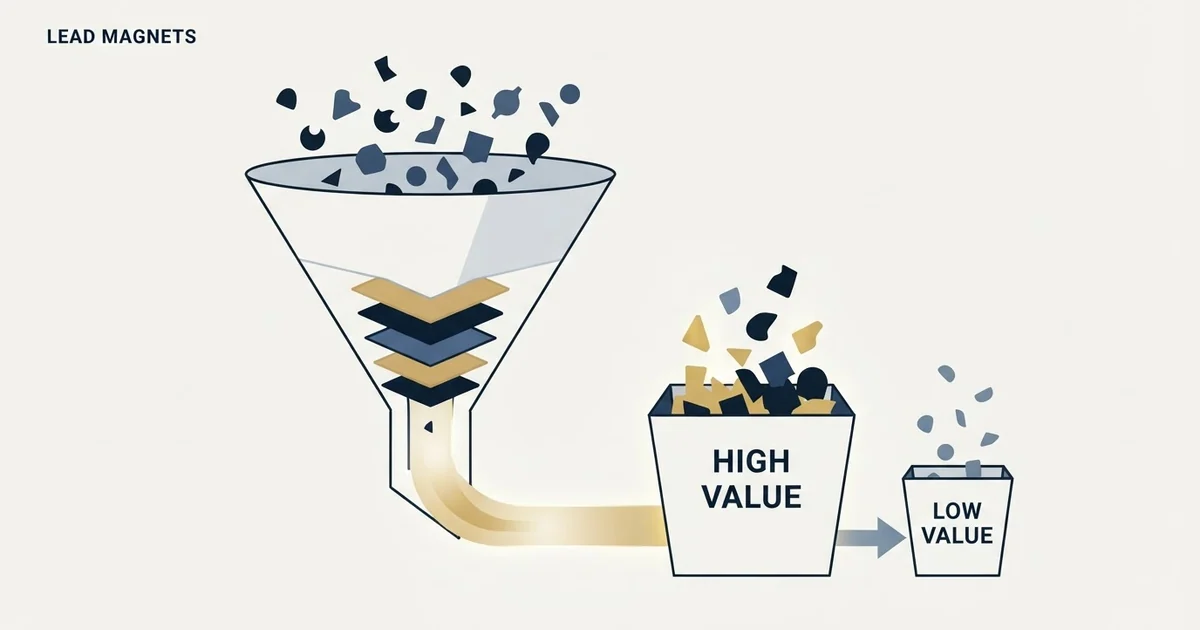
A lead magnet buys two things: contact details and the context of what that person wanted that day. The context is worth more and decays faster. Magnets that make the reader describe their own situation, such as calculators and audits, convert fewer people and produce far better conversations than downloadable reports do.
Key takeaways
- Sort lead magnets by the strength of the signal they produce, not by whether they are an ebook, a checklist or a webinar.
- A magnet that requires the reader to describe their own situation generates fewer downloads and more real conversations.
- Rank behaviour by what it cost the prospect to produce; an email address costs almost nothing and predicts almost nothing.
- In the UK the ICO's soft opt-in does not cover prospective customers, so a download alone is not consent to market.
Reviewed and updated September 2, 2026
Lead Magnets: What You Are Actually Buying With That Email Address
A team ships a 30-page industry report behind a form. Four hundred people download it in six weeks, which everybody agrees is a good number. The list goes to sales. Sales works it for a month and reports back that the leads are unusable, and the marketing team quietly concludes that lead magnets do not work in their market.
The report worked exactly as designed. The design was the problem. Four hundred people told you they were interested in a topic, and a topic interest is one of the weakest pieces of information a person can give you. The magnet collected an email address and threw away the chance to learn anything that would have made the address worth having.
That is the whole subject in one paragraph. A lead magnet is a trade: something useful for something you want to know. Most of them are built as though the email address is the thing you want to know, and the email address is the least valuable half of the trade.
What the trade actually gets you
Two things come back through a form. The contact details, and the fact that this specific person wanted this specific thing on this specific day.
The second one decays fast and is worth far more while it lasts. An address is permanent and inert. The context is temporary and actionable: it tells you what problem they were working on, how they framed it, and roughly how far along they were. A magnet that produces a strong context signal makes the following conversation easy. A magnet that produces only an address makes it a cold conversation with a warm-sounding name attached, which is the situation the team above found themselves in.
So the useful way to sort lead magnets is not by format. Every guide sorts them by format, which is why every guide produces the same list of ebooks, checklists, webinars and templates and never explains why some of them work. Sort them by the strength of the signal they generate.
Webinars sit on every one of those format lists, and Goldcast sells the recording rather than the event, which changes what the format is worth after the live hour.
Sorting lead generation offers by signal strength rather than by file type is what separates the ones that start a conversation from the ones that only collect an address.
- Tells you: a subject interested them
- Cheapest to make, easiest to ignore
- Downloader may be a student or a competitor
- Works as reach, weak as qualification
- Tells you: their numbers and their setup
- They describe their own problem to you
- Much smaller volume, far better context
- The next message writes itself
- Tells you: they tried to do the job
- Closest to the product, hardest to build
- Volume is low, intent is unmistakable
- Doubles as product evaluation
An access magnet, meaning a community, a newsletter or a course, sits outside those three. It buys ongoing permission to be read rather than a moment of intent, and it should be measured on retention rather than on conversion. Judging a newsletter by how many meetings it booked this month is the same error as judging a report by how many people opened it.
Worked examples, and what each one is for
A pricing calculator for a category with confusing pricing. The person enters their headcount, their volume, their current spend. You now know their size and their spend band before anyone speaks. This is a situation signal and it is the highest-leverage magnet most B2B companies could build and have not.
A benchmark comparison where the reader submits their own number. They tell you their conversion rate, you show them the distribution. They learn something genuinely useful and you learn whether they are above or below the line, which is exactly the thing that determines whether they need you.
A teardown or audit of the reader's own asset. Their website, their pricing page, their listing, their setup. Expensive to deliver and impossible to fake interest in. This is the strongest form of the trade and the one that most resembles the product.
A template or framework that only makes sense once you have the specifics. A blank strategy template is a topic signal. The same template with three fields the reader must fill in before it renders is a situation signal, and the change costs almost nothing.
A report of original data nobody else has. This is the honest use of a topic-signal magnet. It will not qualify anyone, and it is not supposed to. It is reach, and it earns its keep by being cited.
The pattern across all five: the more the reader has to tell you about themselves to get value, the better the resulting conversation. Volume falls, which reads as failure on a dashboard counting downloads, and it is the opposite of failure.
The arithmetic, done honestly

Take a page getting 2,000 visits a month. Suppose an ebook converts 4 percent of them, so 80 downloads. Suppose 1 in 20 of those turns into a real conversation, so 4. Now suppose a calculator converts 1.5 percent, so 30 downloads, but 1 in 5 becomes a conversation, so 6.
Half the volume and half again, and more conversations. Those numbers are illustrative and yours will differ, which is exactly the point: the download count and the conversation count move independently, and only one of them is a business outcome. Run the calculation with your own two rates before you decide which magnet was better, and be suspicious of any comparison that stops at the first number.
The general form of that trap, and how to price a lead so the number means something, is in cost per lead B2B.
The three ways they fail
Gating something already free. If a competent search finds the same information in four minutes without a form, the form is a toll booth on a public road. The reader who fills it in anyway is disproportionately likely to be the reader who fills in every form, which is a population you do not want.
Solving a problem adjacent to the one you sell. A payroll company publishing a hiring-manager interview guide will attract hiring managers, who are not the payroll buyer. The magnet performs beautifully and generates nothing, and the diagnosis takes a year because the download numbers look fine.
Treating the download as an intention to buy. It is an intention to read. A person who downloads a report on warehouse automation has told you they are interested in warehouse automation, which is a long way from being in the market for yours. The stage vocabulary for that gap, and why the handoff argument between sales and marketing is really an argument about evidence, is in MQL vs SQL. The criteria that make the difference visible are in qualified lead marketing.
- Yes: The reader has to tell you something about their situation to get value
- Yes: The problem it solves is the problem your product solves
- Yes: It would still be worth making if it generated no addresses at all
- No: A capable searcher could find the same thing free in five minutes
- No: Its main success metric is the download count
- Depends: You know what the first human message after the download will say
The consent question, which most advice gets wrong
There is a widely repeated assumption that a download creates permission to market to that person. In the UK and under the same family of rules across Europe, that assumption is wrong in a specific and checkable way.
The ICO's guidance on electronic mail marketing states that you "must not send marketing emails or texts to individuals without specific consent", with a limited exception for previous customers known as the soft opt-in. The guidance is explicit about the limit of that exception: the soft opt-in "does not apply to prospective customers or new contacts (eg from bought-in lists)". A person who downloaded your report is a prospective customer, so the exception does not reach them. The same page notes that the rules for individuals differ from the rules for contacting companies, which is where a lot of the confusion starts.
The practical consequence is small and worth getting right: ask for consent at the point of download, in plain words, separately from the download itself, and record it. A tick box costs nothing. Discovering two years later that a 40,000-person list has no lawful basis costs a great deal. (ICO guidance on electronic mail marketing, verified mid-2026.)
Where we differ from standard practice
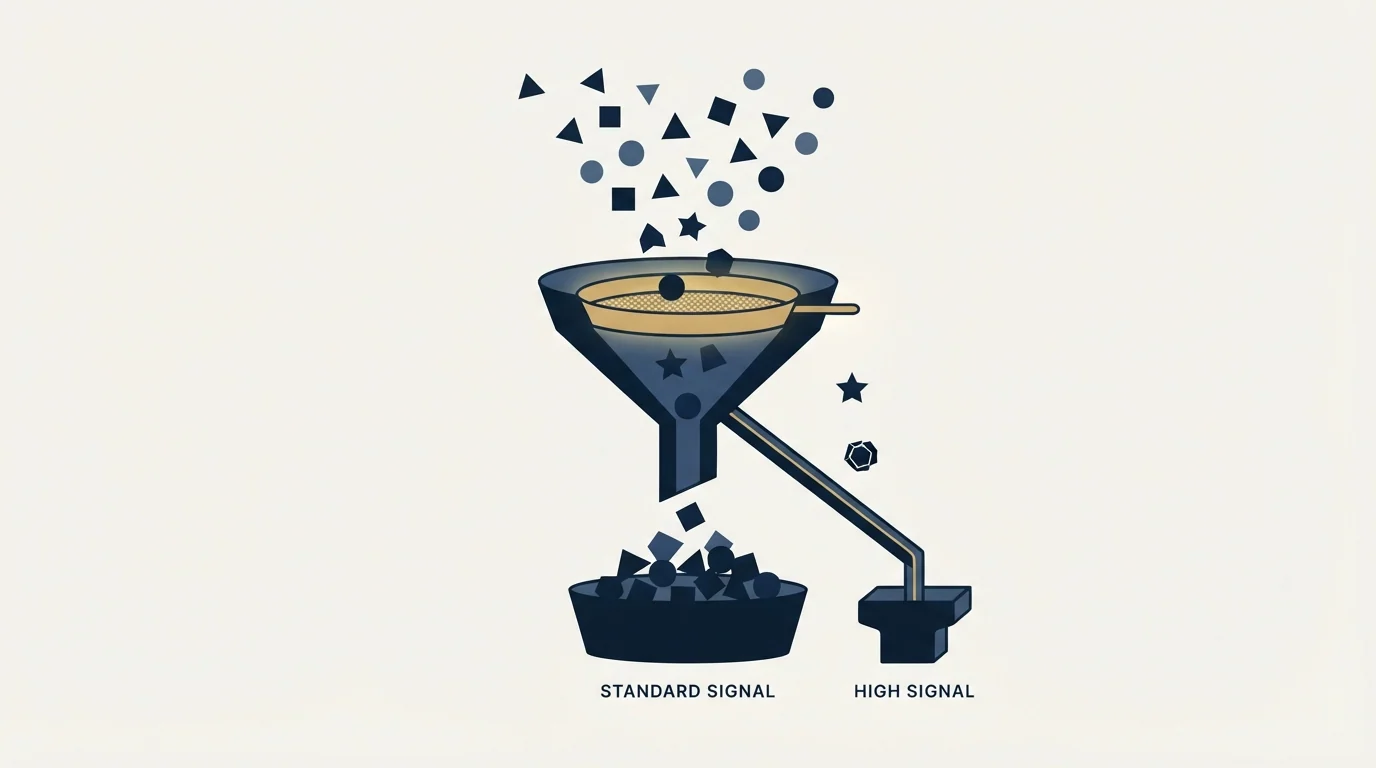
Standard practice after a download is a scheduled run of educational emails arriving over the following weeks until the person books something or stops opening. We never run those, on our own outbound or on our clients'. One message per campaign, built on one premise, sent once.
If the download tells us something specific, the next contact is a single message about that specific thing, from a person, and it says why we are writing. If it tells us nothing specific, that is information too, and the honest answer is to leave them alone until they do something that gives us a reason.
The argument is that scheduled repetition substitutes for having something to say. When you have a real reason to write you do not need a timer, and when you do not have one, the timer is just the sound of a company talking to itself. What happened to our meeting rate when we stopped is in we stopped using follow-up emails.
A later approach to the same person is a new campaign with a new premise rather than the next item on a schedule.
Two practical questions, answered briefly
Do you need lead magnet software? Mostly no. The category exists to turn documents into designed PDFs and host them behind a form, and if you already have a site and a form you have the mechanism. Spend the budget on the thing being offered. A situation-signal magnet needs a form that branches and a result that renders, which is a small build rather than a purchase.
What should the page around it do? One offer, one field if you can stand it, and a specific description of what the reader gets. Every additional field costs completions, and the fields worth keeping are the ones that generate the situation signal rather than the ones that fill in your CRM. If you cannot say in one sentence what the reader will know after reading it that they do not know now, the page is not the problem.
Lead magnets in outbound, which is a different job
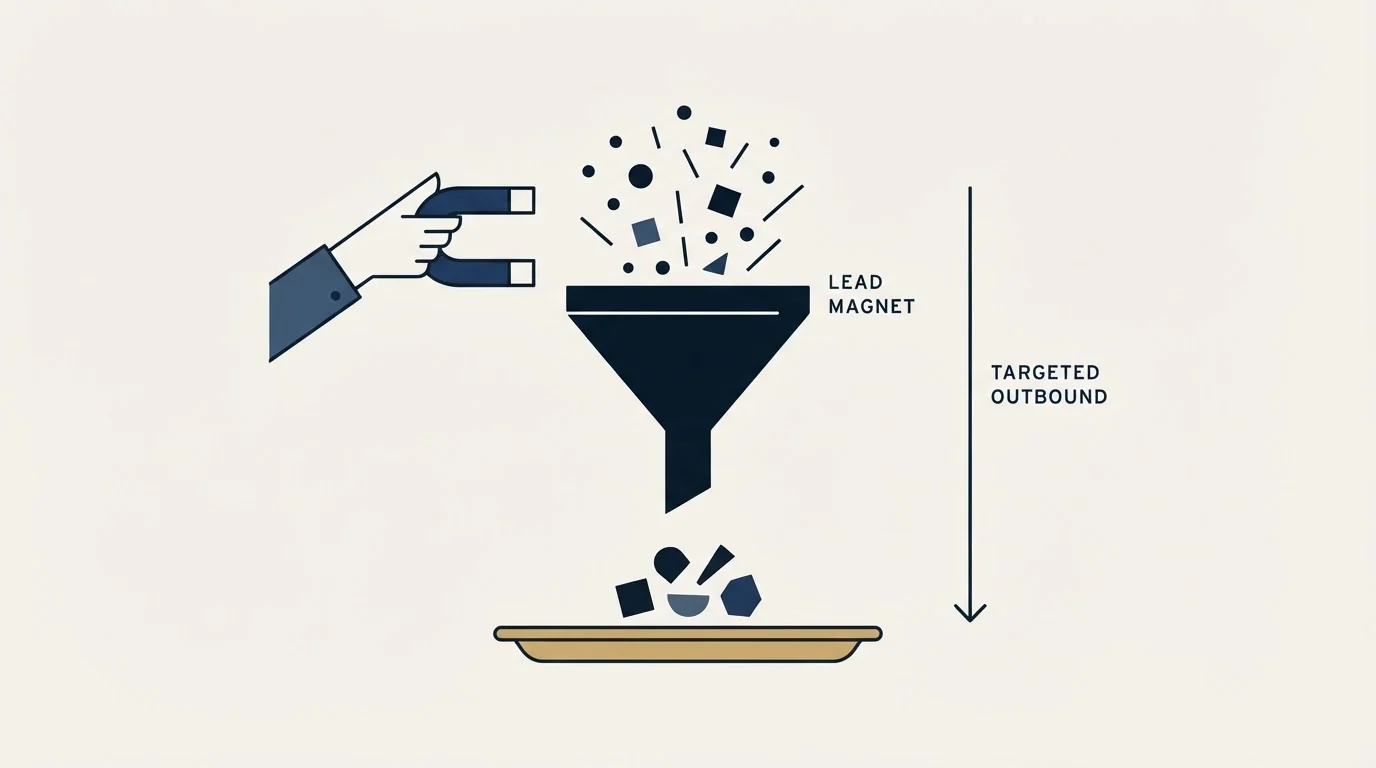
Everything above is inbound: the magnet sits on a page and waits. The same asset used as the offer inside a cold message behaves differently, because the recipient did not go looking for it. There the strongest version is a sample of the work itself rather than information about it, which removes the need for the reader to believe anything you claim. That case is made in try before you buy lead magnets, and the broader pattern of leading with content in outbound is in content-led outbound.
The short version
You are buying context, and the address is the receipt. Build the magnet that makes the reader describe their own situation, accept the smaller number, and measure conversations rather than downloads. Ask for consent properly at the form. Then write one real message to the people whose answers gave you something to write about, and leave the rest alone until they give you a reason.
If you would rather see what a researched single message to twenty named accounts looks like before building anything, we will put one together: free campaign.
Frequently asked questions.
Frequently asked questions- What actually counts as a good lead magnet?
- One that solves the same problem your product solves and requires the reader to tell you something about their situation to get value. A pricing calculator, a benchmark that takes their number, or an audit of their own asset all qualify. A general industry report does not, because it tells you only that a topic interested somebody.
- Why did our ebook generate leads that sales could not use?
- Because a topic interest is one of the weakest signals a person can give you. Four hundred downloads means four hundred people found a subject worth an email address. It says nothing about their company, their role, their timing or whether they have the problem you solve. Change what you ask for, not who you send it to.
- Does someone downloading a lead magnet consent to marketing emails?
- Not automatically. The ICO's guidance says you must not send marketing emails to individuals without specific consent, and the soft opt-in exception for existing customers explicitly does not apply to prospective customers or new contacts. Ask for consent at the form, separately and in plain words, and record it.
- Why don't you use a nurture track after a download?
- Because a schedule substitutes for having something to say, and silence after a download is information rather than an obstacle. We send one message when the download tells us something specific enough to write about, and nothing at all when it does not. If a genuine new reason appears later, that is a new campaign with a new premise.
About the author.

Ben Carden is CRO at RevenueFlow, which builds and operates outbound revenue engines for B2B companies. Previously at Gartner Enterprise. Studied at London School of Economics.
Ben Carden · CRO
Connect on LinkedIn →Explore more.
Ready to scale your outreach?
We build GTM engines that book real meetings. See the receipts.
Related articles.
eWebinar Pricing: Two Meters and a Level That Moves
eWebinar does not ask you to pick a plan. Published webinars set the level and registrants set the overage, and the two directions do not move on the same schedule.
BrightTALK Pricing: What the Vendor Does Not Publish
Six BrightTALK surfaces carry no price at all. The $500 figure filling that gap is a 2022 scrape on a listing the vendor says it does not manage.
Goldcast Belongs to Cvent Now: The Buying Question
Cvent announced its Goldcast acquisition in December 2025 and completed its ON24 acquisition in April 2026. Two shortlist names, one owner, one live contract question.
On-Demand Webinars: What Changes When You Take the Date Away
A live webinar earns most of its value from the date. Removing it keeps the topic signal and the address, and loses the deadline, the burst and the room.
Define Content Syndication: Two Purchases Behind One Word
One budget line, two different purchases. Republication buys reach; lead syndication buys contact records produced by a download. The deliverable tells you which.
Lead Generation Statistics: The Denominator Nobody States
One roundup lists the same budget statistic twice in different words, and three list one finding under three different attributions. The genre explains itself.