Qualified Lead Marketing: What One Score Destroys
Fit and behaviour are two kinds of evidence, and summing them into one score makes opposite situations indistinguishable. Build the grid instead of the number.
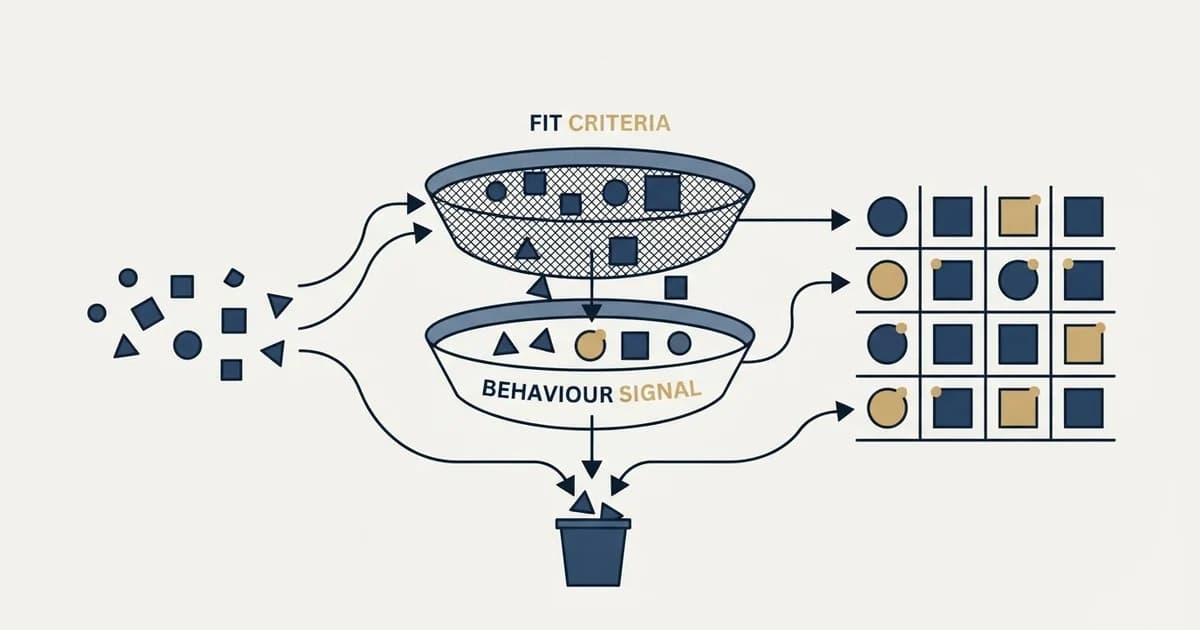
A qualification model is built from fit, meaning who they are, and behaviour, meaning what they did. Summing them into one score makes two opposite situations look identical, which is why reps stop using it. Keep the two numbers separate, rank behaviour by what it cost the prospect to produce, and leave budget, timing and authority out entirely.
Key takeaways
- Report fit and behaviour as two numbers, because a single score cannot distinguish a perfect-fit quiet account from an unsellable enthusiastic one.
- Rank behaviour signals by what they cost the prospect: inviting a colleague into a trial outranks any download.
- Check that each fit attribute is populated on most records and verifiable externally, or the model is running on blanks nobody has noticed.
- Budget, timing and decision authority are unknowable from outside and unstable inside, so they belong nowhere in a qualification model.
Reviewed and updated September 2, 2026
Qualified Lead Marketing: Why One Score Destroys the Information You Need
A marketing team builds a scoring model. Job title is worth 20 points, company size 15, an ebook download 5, a pricing page visit 20, a webinar attendance 10. Anything over 70 goes to sales as qualified. The model is thoughtful, the weights were argued over, and within two months sales has stopped looking at the number.
The usual diagnosis is that the weights were wrong. They were not. The problem is upstream of any weighting: two entirely different situations produce a score of 75, and the model gives sales no way to tell them apart.
The two ingredients, and why they must stay separate
An agency delivering unqualified low quality leads is the visible end of this failure, and the diagnosis is almost always that fit and behaviour were added together before anybody looked at them separately.
Every qualification model is built from two kinds of evidence.
A lead in marketing is any person or company the model is scoring: a record whose fit or behaviour suggests a sales conversation might be worth having, before qualification decides whether it is.
Fit is who they are. Industry, size, the technology they run, whether they have the role that owns this problem. Fit is stable, verifiable from outside, and it does not change because somebody clicked something.
Behaviour is what they did. Pages viewed, assets downloaded, events attended, product tried. Behaviour is volatile, easy to measure, and it is the half most scoring models over-weight, because it is the half that generates events.
Add them into one number and you have created a score where 75 might mean a perfect-fit company whose junior analyst read one page, or a company you cannot sell to whose whole team has read everything you have ever published. Those two require opposite actions. One is worth a researched approach to a different person at the same company. The other is worth nothing and will consume a rep's week.
The fix is not better weights. It is two numbers, and a grid.
- Exactly the company you sell to
- One person read one page
- Right target, wrong person or wrong moment
- Action: research the account, approach the actual owner
- Most valuable quadrant, routinely scored as lukewarm
- A company you cannot serve well
- Consumed everything you publish
- Often a competitor, a student, or a consultant
- Action: leave alone, and stop counting them
- Most flattering quadrant, and worth nothing
Behaviour signals are not equal, and cost is the ranking
The useful way to rank a behaviour signal is by what it cost the person to produce. Effort is a proxy for intent that is hard to fake and does not need a model to interpret.
Reading a blog post costs nothing and can happen by accident. Downloading a gated asset costs an email address, which is real but small, and is routinely paid by people with no purchase intent whatsoever. Visiting a pricing page costs nothing in effort and a great deal in signal, because almost nobody visits a pricing page idly. Starting a trial costs setup time. Inviting a colleague into that trial costs social capital, which is the most expensive thing on this list and the strongest signal on it.
Rank your own signals that way and most scoring models rearrange themselves immediately. The download that carries five points and the pricing visit that carries twenty are usually the wrong way round in the other direction, and the colleague invitation is usually not tracked at all.
Incorporating engagement signals into a scoring model therefore means ranking them by what they cost the person to produce and keeping them in their own column, rather than folding them into a total where a cheap signal and an expensive one weigh the same.
The one warning: a strong behaviour signal from a poor-fit account is still worth nothing. Behaviour ranks within a fit band. It does not rescue one.
That same split decides what a rejection means later, since a fit failure and a readiness failure call for opposite handling once the record is filed.
Fit criteria that survive contact with the data

The failure mode here is quiet. A model uses six fit attributes, four of which are blank for most records, so in practice it runs on two and nobody notices because it still produces numbers.
Before a fit attribute goes into a model, check what percentage of your actual records have it populated. An attribute present on three records in ten works as a coin flip with extra steps rather than as a criterion. Either fix the source, buy the data, or drop the attribute and say so.
Teams that consider buying that missing data will find the hidden costs of purchased contacts worth weighing before the fit attribute goes anywhere near a model.
Second check: can you verify it from outside, without the prospect telling you? Self-reported fields on a form are aspirational at best. Company size entered by a person choosing from a dropdown while trying to reach a PDF is not a fact about the company.
- Yes: Fit and behaviour are reported as two numbers, never summed into one
- Yes: Every fit attribute is populated on most records and verifiable externally
- Yes: Behaviour signals are ranked by what they cost the prospect to produce
- Yes: Scores decay, so a burst of activity in March does not still read as hot in July
- No: Budget, timing or authority appear anywhere in the model
- Depends: Sales can name, without looking it up, what makes a lead qualified
Nothing ever subtracts
Look at almost any scoring model and you will find that every rule adds points. There are no negative terms. A model that can only go up will, given enough time and a large enough database, eventually declare most of your list qualified.
Negative signals are cheap to add and they clean up the top of the list faster than any positive rule:
Competitor domains. A competitor's marketing team reads everything you publish, attends your webinars and downloads your comparison pages. They will out-engage your real buyers and sit at the top of any behaviour-weighted list.
Job-seeker and student patterns. Traffic on careers pages, personal email domains on a product sold to enterprises, university addresses. Genuine readers, entirely unqualifiable.
Support-shaped behaviour from existing customers. Somebody reading your documentation because something is broken is not a purchase signal, and in a lot of setups their activity flows into the same score.
Roles that are adjacent but never buy. Analysts, journalists, consultants comparing tools for a client. Valuable to your reputation, worth zero to a rep's week.
None of these should be filtered out of your database, because several of them matter for other reasons. They should simply be prevented from reaching a sales queue, and a model with no negative terms has no mechanism for that.
The decay nobody builds
Almost every model accumulates and almost none of them forget. A prospect who read six pages during a project in March still carries those points in July, long after the project was shelved and the budget moved.
Teams that let stale scores inflate their qualified list should note how contact syncing quietly triggers billing upgrades in Zoho Campaigns, another case of an automated number changing outcomes unnoticed.
Intent is a statement about now. Give behaviour points a half-life, so a score answers the question a rep is actually asking, which is whether this person is engaged this month. Fit points should not decay, because the company has not changed. That asymmetry is another reason the two numbers cannot live in one field.
What must never be in the model
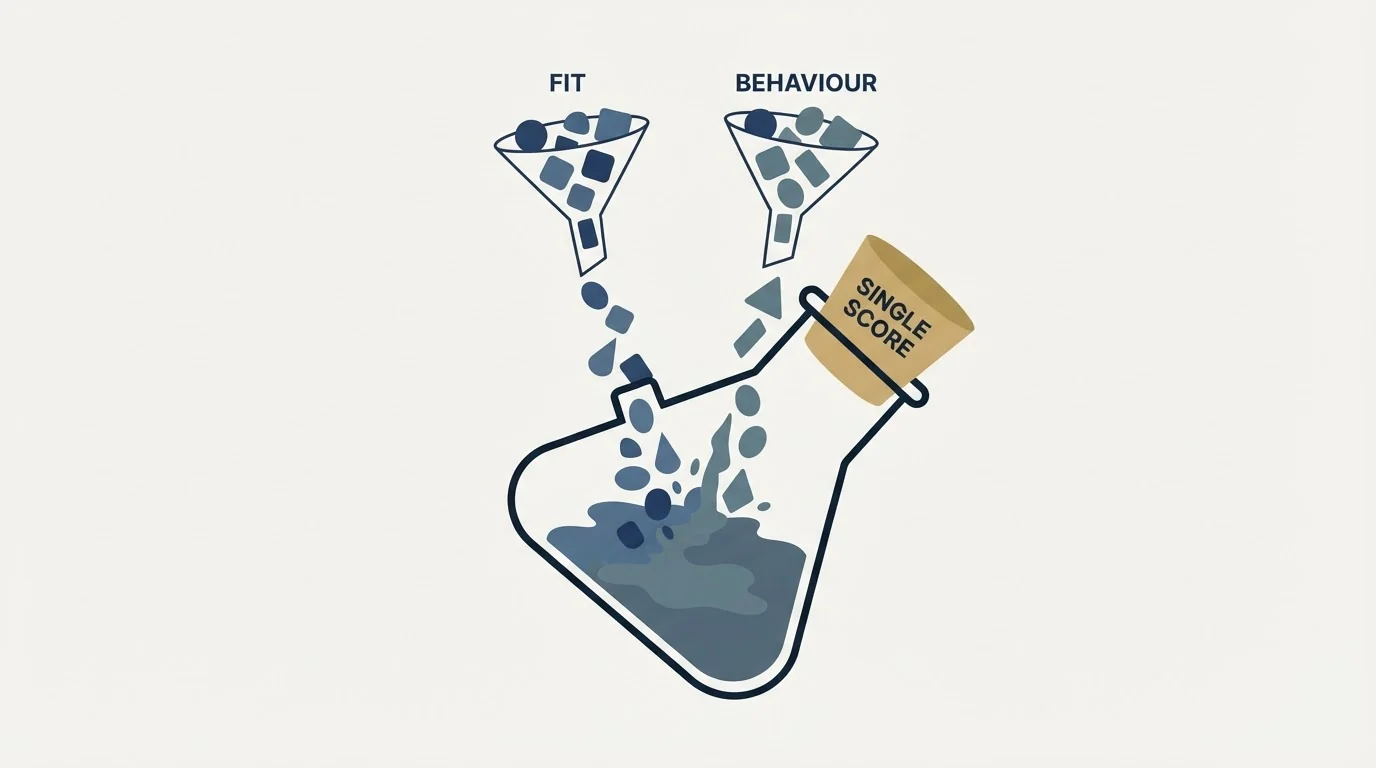
Budget, timing, and decision authority. These get added because they feel like the serious criteria, and they are the three that make a qualification standard unusable.
All three are unknowable from outside and unstable from inside. Budget appears when a problem becomes urgent rather than the other way round. Timing changes when a competitor has an outage. Authority in a B2B purchase is distributed across people who will never all appear in your CRM. A model that requires them will reject the accounts most worth talking to, because a company that has already budgeted for the problem has usually already chosen a vendor.
This matters most where a qualification standard carries commercial weight. When meetings are the billable unit, we hold to criteria agreed in writing before anything sends, and budget, timing and authority are never among them. A meeting counts when the company fits the agreed profile, the person has real responsibility for the area, they agreed to a relevant conversation, and they turned up. Whether they were ready to buy is a sales outcome rather than a qualification test.
The commercial version of that argument, including the four different things vendors mean when they use the word, is in qualified lead generation services.
Where the label gets applied, and by whom
A qualification model is a prediction. It becomes useful only when somebody on the other side accepts or rejects the prediction and that decision is recorded.
The missing piece in most setups is the acceptance step. Marketing marks a lead qualified, it moves, and no one records whether sales agreed. Without that record there is no feedback, so the model cannot improve and the monthly argument has no evidence on either side. Add one field for accepted or rejected and one for the reason, review the rejections monthly, and the model starts correcting itself. The stage vocabulary that makes this handoff legible is in MQL vs SQL.
Note that outbound does not fit this model at all, and should not be forced into it. A person contacted cold has generated no behaviour, so their behaviour score is zero by construction. Scoring them on the same scale as inbound leads means they will always look unqualified. Outbound qualification is a targeting decision made before the message goes out, and it is measured differently.
What the number is for

The point of qualification is to decide where finite attention goes, and to make that decision reviewable afterwards. A model that produces a defensible ranking of who to work today has done its job even if half the individual scores are debatable.
It does not tell you what a lead is worth. That is a separate calculation, and doing it properly is the difference between a marketing team that can defend its budget and one that reports volume. The method is in cost per lead B2B, and the third-party signals worth folding in, along with what they genuinely predict, are in B2B intent data.
The short version
Keep fit and behaviour as two numbers, because summing them destroys the only distinction a rep needs. Rank behaviour by what it cost the prospect to produce. Use fit attributes that are actually populated and externally verifiable. Give behaviour a half-life. Keep budget, timing and authority out of it entirely, and write down what qualified means before anyone is measured against it.
If you would rather see qualification applied at the targeting stage, against twenty named accounts you would want, we will build the list and the message: free campaign.
Frequently asked questions.
Frequently asked questions- Why do sales teams ignore our lead scores?
- Usually because the score sums fit and behaviour into one number, so two opposite situations produce the same value. A rep who cannot tell whether 75 means a perfect-fit company with one page view or a poor-fit company that read everything has no basis for acting on it, and will fall back on their own judgement.
- What is the difference between fit and behaviour scoring?
- Fit describes who the company and person are: industry, size, role, technology. It is stable and verifiable from outside. Behaviour describes what they did: pages, downloads, trials. It is volatile and easy to over-weight because it generates events. Behaviour ranks accounts within a fit band and never rescues a poor one.
- Should budget and timing be part of lead qualification?
- No. Both are unknowable from outside and unstable from inside, and a model requiring them rejects the accounts most worth talking to, because a company that has already budgeted has usually already chosen a vendor. Where meetings are billable we agree criteria in writing beforehand and never include budget, timing or authority.
- How should outbound leads be scored?
- They should not be run through the same model. A person contacted cold has generated no behaviour, so their behaviour score is zero by construction and they will always read as unqualified. Outbound qualification is a targeting decision made before anything is sent, and it is measured on the reply and the meeting instead.
About the author.

Ben Carden is CRO at RevenueFlow, which builds and operates outbound revenue engines for B2B companies. Previously at Gartner Enterprise. Studied at London School of Economics.
Ben Carden · CRO
Connect on LinkedIn →Explore more.
Ready to scale your outreach?
We build GTM engines that book real meetings. See the receipts.
Related articles.
eWebinar Pricing: Two Meters and a Level That Moves
eWebinar does not ask you to pick a plan. Published webinars set the level and registrants set the overage, and the two directions do not move on the same schedule.
BrightTALK Pricing: What the Vendor Does Not Publish
Six BrightTALK surfaces carry no price at all. The $500 figure filling that gap is a 2022 scrape on a listing the vendor says it does not manage.
Unqualified Lead: Which Test It Actually Failed
One flag covers two opposite verdicts. A fit failure is stable and belongs in an exclusion; a readiness failure expires and belongs on a watch list with its trigger.
Warm Lead: What Made It Warm, and When It Expires
Warmth is a property of evidence rather than of a person. Store the action and its date, because a temperature column cannot be turned back into the event behind it.
On-Demand Webinars: What Changes When You Take the Date Away
A live webinar earns most of its value from the date. Removing it keeps the topic signal and the address, and loses the deadline, the burst and the room.
Define Content Syndication: Two Purchases Behind One Word
One budget line, two different purchases. Republication buys reach; lead syndication buys contact records produced by a download. The deliverable tells you which.