Product Market Fit vs Go-to-Market: Telling Them Apart
Both problems produce the same flat quarter and cost different years to fix. Four tests that separate them, and the third state that sits between the two.

Product market fit asks whether a group has a problem urgent enough to change what they do and whether your product solves it well enough that they stay. Go-to-market asks whether you can reach that group repeatably and convert at a rate that pays. The symptoms overlap; retention separates them.
Key takeaways
- The symptoms are identical from the front. Separate the two by what happens after a sale rather than before it: retention, expansion, and whether the customers who stayed share an attribute.
- Go-to-market fit is a distinct third state. A product people keep, sold only through a founder network, looks like success until someone measures how much revenue arrived by a repeatable route.
- The fixes are not comparable. A distribution fix is a quarter with a readable result; a fit fix is a roadmap decision measured in quarters and cannot be accelerated by adding volume.
- Scaling distribution over an unresolved fit question destroys the evidence. The list gets spent, the message gets judged, and the segment gets written off, none of which was the real variable.
Reviewed and updated September 2, 2026
A quarter ends with eleven meetings booked, four of them held, and nothing that reached a second conversation. The board asks what happened. Half the room says the message needs work and the channel needs more volume. The other half says nobody actually wants the product yet. Both explanations fit every fact available, and the two fixes cost different amounts and take different quarters to run.
Product market fit and go-to-market are separate problems that produce almost identical symptoms, which is why teams argue about them instead of diagnosing them. The distinction is worth getting right because scaling distribution on top of a product problem is the most expensive mistake in the sequence: it consumes the budget, exhausts the list, and produces a result that still cannot be interpreted.
The two questions, stated so they can be told apart
Product market fit asks whether a group of people has a problem urgent enough that they will change what they do to solve it, and whether your thing solves it well enough that they keep using it. It is a question about the product and the market together, and neither half answers it alone.
Go-to-market asks whether you can reach that group repeatably, say something they recognise, and convert the conversation at a rate that pays. It is a question about distribution, message and economics.
Where the signal comes out of the product instead of a list, the product-led sales motion sets a usage threshold that decides which accounts earn a seller.
The sequencing matters because the second question cannot be answered while the first is open. A distribution experiment run against a market that does not have the problem returns a low number, and the low number is uninterpretable: it is consistent with a bad message, a bad list, a bad channel, and with the market being wrong. Every one of those has a different remedy.
- People who see the message respond, but you cannot find enough of them
- The ones who buy renew and expand
- Referrals happen without being asked for
- Wins cluster in one segment you did not deliberately target
- The pitch changes very little between calls
- Plenty of first meetings, almost no second ones
- Customers go quiet after onboarding
- Every deal needs a bespoke promise to close
- Wins have nothing in common with each other
- The pitch is different on every call because nothing sticks
The tests that separate them

Four tests are available before you spend a quarter finding out the expensive way. None requires a research project.
Look at what happens after the sale, not before it. Retention and expansion are the only signals that speak to fit rather than to persuasion. A team with strong first-meeting rates and weak retention has a fit problem being masked by good selling. A team with weak top-of-funnel and strong retention has the opposite, and the opposite is much better news.
Look at whether wins have anything in common. Where the customers who stay share an observable attribute, fit exists inside that attribute and the work is to find more of them, which is a distribution problem. Where the customers who stay share nothing, there is no segment yet to build a list against, and building one is premature. The method for testing which attributes actually predict a good customer is in the ideal customer profile guide.
Look at what closing a deal required. Deals that close on the standard promise indicate fit. Deals that each required a different bespoke commitment indicate that the product is being sold as a services engagement, and the pattern is invisible in a pipeline report because both show as closed won.
Look at whether the buyer was already spending on the problem. A buyer already paying a contractor, a temp, or a competitor has told you the problem is real and funded. A buyer who was not spending anything has told you nothing yet. That distinction sets both the plausible conversion rate and the honest read window, and it is the same distinction that separates the three plays in demand creation versus capture versus conversion.
Go-to-market fit, the state between the two
The operators who write about this most usefully name a third state that sits between the two, and it explains why the diagnosis so often comes out ambiguous. Predictable Revenue's Go To Market Fit vs. Product Market Fit and Stage 2 Capital's page on go-to-market fit both treat it as its own milestone. The Stage 2 Capital page draws the line directly: product market fit ensures you have a product customers want and keep using, while go-to-market fit is about finding efficient and sustainable ways to reach and serve those customers.
A company can have product market fit and no go-to-market fit for years. The product retains, the customers are happy, and every new customer arrives through a founder's network, which does not scale and cannot be handed to anyone. The failure mode is subtle because nothing looks broken. The number that exposes it is the proportion of new revenue that arrived through a repeatable route as against a personal one.
The reverse also happens and is more dangerous: a channel that produces meetings cheaply into a market that does not retain. That combination funds itself for two or three quarters and then stops, and the stop is usually attributed to the channel. It is attributed to the channel because the channel is the thing that changed most recently, and because the retention curve that explains it sits in a different report, owned by a different team, read on a different cadence. Naming go-to-market fit as its own milestone is mostly a way of forcing those two numbers onto the same page early enough to act on.
- Step 1Does the problem exist and does the product solve it
Read retention, expansion, and whether the buyer was already spending on the problem. Answered from existing customers, not from a new campaign.
- Step 2Is there a segment the wins have in common
Find the observable attribute shared by the customers who stayed. Without one, there is no list to build and no message to write.
- Step 3Can one channel reach that segment repeatably
One segment, one message, one channel, run at a volume that produces a readable result inside a quarter.
- Step 4Does the arithmetic pay at that volume
Cost per meeting held against contract value. Only meaningful once the three questions above have answers.
What each fix actually costs
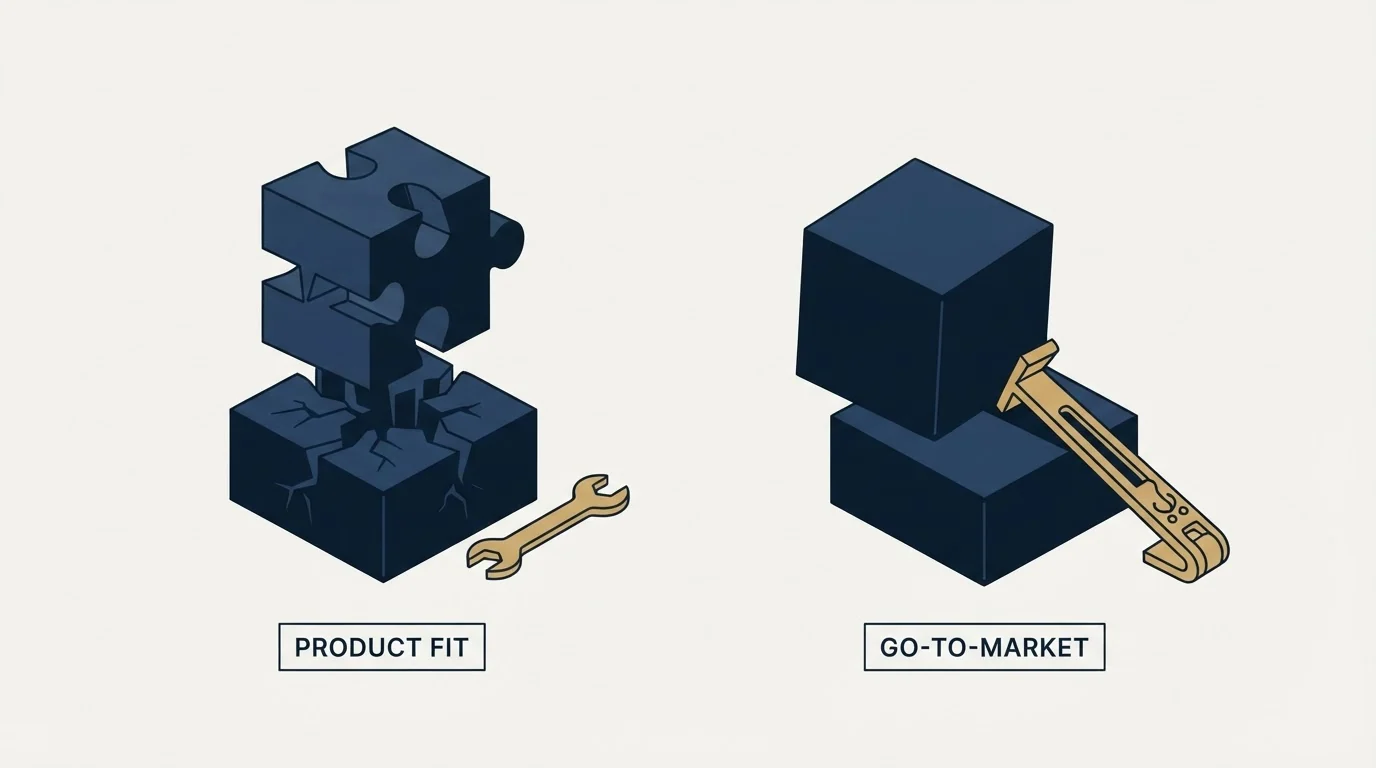
The reason the diagnosis is worth making carefully is that the two remedies are not comparable in price or in duration.
A go-to-market fix is a quarter of work with a readable result: change the segment, change the first sentence, change the channel, run enough volume to read it. The infrastructure is the same in each case, the learning compounds, and a wrong turn costs weeks. The layer of decisions this involves, from list building through to reply handling, is walked through in the outbound sales playbook.
Deciding how to sequence that quarter of work once fit is confirmed comes down to ordering the stages correctly, which the go-to-market roadmap covers by setting exit conditions instead of dates.
A product market fit fix is a roadmap decision, and it is measured in quarters. It may mean serving a narrower group properly instead of a wider group approximately, changing what the product does, or changing who it is sold to entirely. It cannot be accelerated by adding distribution, and adding distribution while it is unresolved destroys the evidence: the list gets contacted, the message gets judged, and the segment gets written off, none of which was the actual variable.
There is a third case worth naming because it is common and gets misfiled as one of the other two. Sometimes the constraint is neither the product nor the channel: it is that the market does not yet know it has the problem, so the demand does not exist to be captured at any volume. That is a content and timing problem with its own economics, and diagnosing it before funding a plan is the whole subject of the demand gen strategy guide.
Answering it without waiting a quarter
The cheapest diagnostic available is a single narrow test, run properly, on the segment where the existing wins cluster.
One segment, defined tightly enough that a stranger could build the list. A single message, naming the situation those customers had been in before they bought. One channel, at a volume that produces a readable number inside six weeks. Criteria for what counts as a real meeting, written down before anything sends, so the result cannot be relitigated afterwards.
If that test produces meetings that reach second conversations, the fit question is settled for that segment and the remaining work is distribution. If it produces meetings that go nowhere, the message and the market are both still candidates, and the next move is more conversations with the customers who did stay rather than more volume.
The five decisions that this test forces you to write down, and the test that finishes each one, are set out in the go-to-market strategy guide. The decisions are the same whether the answer turns out to be product or distribution, which is the practical argument for writing them before the argument starts.
The short version
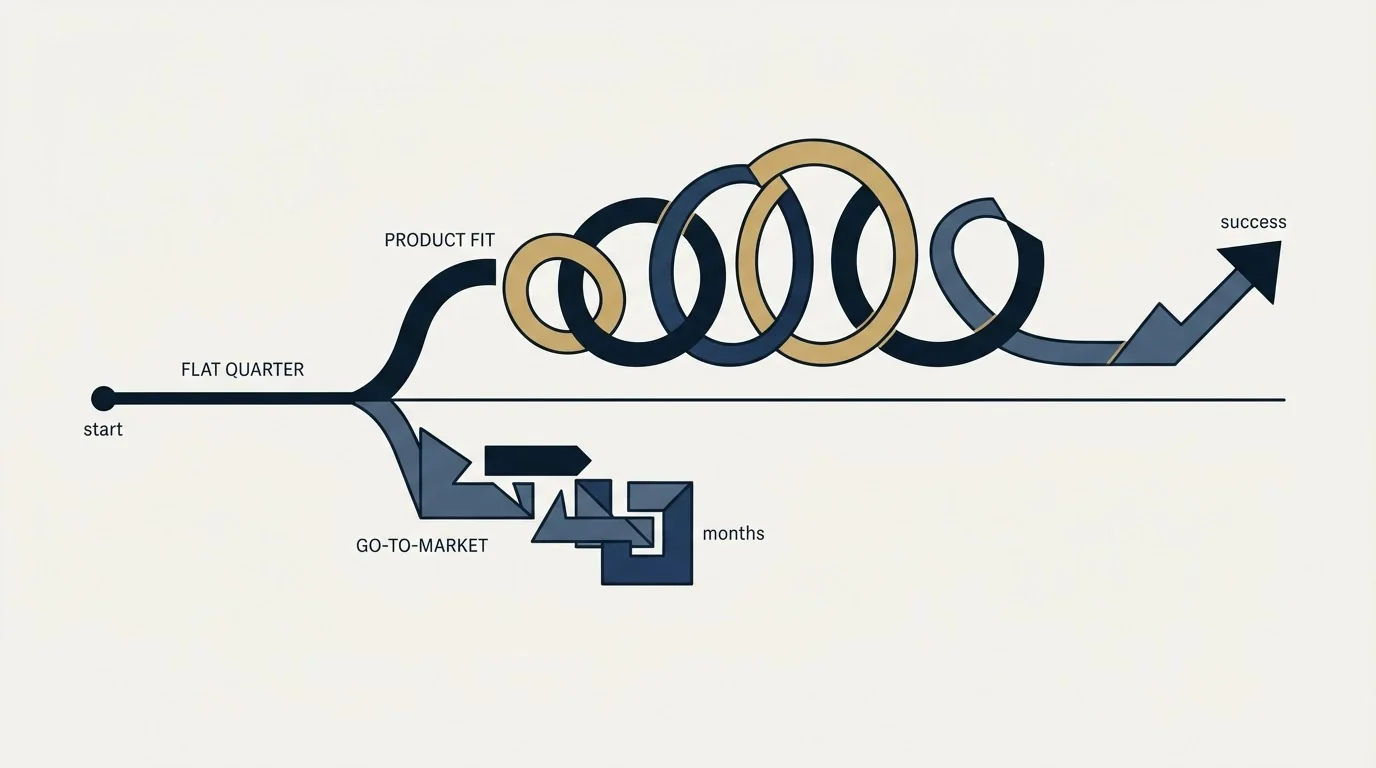
Product market fit asks whether a group has a problem urgent enough to change what they do, and whether your product solves it well enough that they stay. Go-to-market asks whether you can reach that group repeatably and convert them at a rate that pays.
They produce the same visible symptom, so separate them with what happens after the sale rather than before it: retention, expansion, whether wins share an observable attribute, whether each deal needed a bespoke promise, and whether the buyer was already spending on the problem.
A third state sits between them. Go-to-market fit is a distinct milestone, and a company can have a product people keep and no repeatable route to more of them, which looks like success until someone measures how much new revenue came through a personal network.
The fixes cost different amounts. Distribution is a quarter; fit is a roadmap. Running the distribution experiment first, on an unresolved fit question, spends the list and returns a number nobody can interpret.
Where the wins do cluster and the question is genuinely distribution, one narrow test answers it faster than another planning cycle. We are paid on attended meetings that meet criteria agreed in writing before launch, so the segment and the meeting definition get settled before anything sends. You can see what that test would look like for your segment.
Frequently asked questions.
Frequently asked questions- Can you have product market fit and still fail at go-to-market?
- Yes, and it is common enough to have its own name. Customers retain and expand while every new one arrives through a founder introduction, which cannot be handed to anyone or forecast. Nothing looks broken, so the problem usually surfaces only when growth is compared against the proportion of revenue from repeatable routes.
- Which should you fix first?
- Fit, because the distribution experiment cannot be interpreted while fit is open. A low reply rate against a market that does not have the problem is consistent with a bad list, a bad message, a bad channel and a wrong market, and those four have different remedies with very different costs.
- What is the cheapest test that separates them?
- Look at the customers who stayed. Where they share an observable attribute, fit exists inside it and the remaining work is finding more of them. Where they share nothing, there is no segment to build a list against yet, and more conversations with those customers will teach you more than more volume will.
- Does a high meeting rate prove product market fit?
- No. First meetings measure whether the message earned attention, which good selling can produce in a market that will not retain. That combination funds itself for two or three quarters and then stops, and the stop is usually blamed on the channel rather than on the fit question nobody answered.
About the author.

B2B cold email experts helping companies generate qualified leads through done-for-you outreach campaigns.
RevenueFlow Team
Explore more.
Ready to scale your outreach?
We build GTM engines that book real meetings. See the receipts.
Related articles.
Appointment Setting for Business Brokers: The Seller Meeting
What a bought meeting with a business owner has to be for a brokerage: the three-part qualification, the confidentiality rules, the licence line and the owner's reasons.
SDR Outsourcing for Logistics Companies: The Brokerage Line
What an outside sales development team may do in a freight company's name, the calling and email rules it inherits, and which arrangement survives a bid-shaped market.
SDR Outsourcing for Business Brokers: The Fee Timing
Whether a success-fee brokerage should rent sales development at all: the fee timing, the texts that limit what an outside person may say about value, and who signs.
Cold Calling for PPC Agencies: What You Can See First
A paid media prospect is partly readable before the call and has already been told by the platform what to do when a stranger rings about its ads.
LinkedIn Lead Generation for Financial Services Firms
A LinkedIn message from a regulated firm is a communication the rulebook already defines, and the definition turns on how many people receive it within thirty days.
SDR Outsourcing for Financial Services: The Third Party
What a bank, broker-dealer, adviser or agency's regulators say about an outside team that speaks for it, the licensed line, and which arrangement survives due diligence.