Cold Calling as a Lead Source: the Arithmetic
Whether calling can produce ten meetings a month is arithmetic, not opinion. Four numbers decide it, and working backwards is the version that stops bad hires.

Cold calling as a lead source is four multiplications: reachable contacts, connect rate, conversation to meeting, and show rate. Multiply them for meetings held per unit of dialing, then divide fully loaded cost to get a cost per meeting. Work it backwards from your target to check the market can supply the dials.
Key takeaways
- Count reachable contacts rather than database records, because a populated phone field is not a number that reaches the person.
- Working the arithmetic backwards from a meeting target exposes markets too small to supply the dials required.
- Belkins' appointment-setting page pairs 1,500 leads a month with 100 guaranteed appointments a year, one of the few published capacity figures in this market.
- Fully loaded cost includes data, tooling and management listening time, not just salary, and leaving those out changes the decision.
Reviewed and updated September 21, 2026
A founder asks whether calling can produce ten meetings a month. The answer is arithmetic, it takes about fifteen minutes, and doing it first changes the hiring decision that usually gets made on instinct.
Cold calling as a lead source is a chain of four multiplications. Every claim anyone makes about the channel, in either direction, is a claim about one of the four numbers. Getting them onto paper in your own market is more useful than any script, because the chain tells you whether the channel can physically produce the number you need before you spend a salary finding out.
The four numbers
Reachable contacts. Not accounts, not records, and not contacts with a phone field populated. The count of people you can actually get on a phone: a direct line or a mobile that reaches the named human. This number is always smaller than the database says, usually by a lot, and it is the only one of the four you can measure before spending anything.
LinkedIn sharpens who you are calling before you dial, though it seldom hands over a working phone number, a limitation covered in what LinkedIn changes before a call.
Connect rate. The share of dials where a human answers. It varies by seniority, industry, time of day and the age of the data, and it is the number vendors quote most confidently and know least about for your market.
Conversation to meeting. Of the people who answer and stay on the line, the share who agree to a diary slot. This is the number a script, an opening and a caller's skill actually move.
Show rate. The share of booked meetings that happen. Ignoring this is how programmes report success for a quarter before anyone notices the calendar is full of ghosts.
Multiply the four and you have meetings held per unit of dialing. Divide the fully loaded cost of the calling by that number and you have a cost per meeting you can compare against every other channel.
Fully loaded is doing real work in that sentence. The cost of a calling programme is salary plus employment costs plus the data plus the tooling plus the management time spent listening to calls, and the last two are the ones that get left out. A calculation built on base salary alone will understate the true cost by a margin large enough to change the decision, which is convenient for whoever proposed the programme and unhelpful to everyone else.
the input you control
connect rate applies here
survived the opening
where the script matters
the only number worth reporting
Work it forwards and backwards

Forwards tells you what a caller can produce. Backwards tells you whether the market is big enough to support the target, and backwards is the version that stops bad decisions.
Take the ten meetings a month. Work back through the show rate to get booked meetings, back through the conversation rate to get conversations, back through the connect rate to get dials, and then compare the dial count against the reachable contacts you counted at the start. If the arithmetic says you need more dials per month than you have reachable people, calling cannot hit the target at any level of skill, and the honest options are to widen the market, change the channel, or lower the target.
This is where most calling plans quietly fail. The plan is built forwards from an activity target, the activity target is met, and nobody checked that the market contained enough phone numbers to sustain it. A caller who runs out of list starts dialing the same accounts more often, and repeat dialing into a small market has a ceiling that arrives fast.
The market-size question cuts the other way too. Below a few thousand qualifying accounts, calling stops competing with written outbound and starts beating it, because a small market rewards effort per account rather than volume. That case is argued in full in our piece on why calling suits a small addressable market.
What a caller's week actually contains
The arithmetic assumes a caller spends their time calling, and no caller does. Planning against the raw hours is how a forecast ends up double what the team can deliver.
A full-time caller's week absorbs list preparation, research on the accounts worth researching, logging outcomes, internal meetings, handing over booked meetings to whoever runs them, and the recovery time that follows a run of rejections. What is left is the dialing window, and it is usually a fraction of the working day rather than most of it.
Two consequences follow. Build the forecast on dialing hours rather than on employed hours, and count them honestly by asking the caller to log a normal week before you set a target. And when volume needs to rise, look at the non-dialing half first. Removing an hour of manual list preparation buys more dials than any amount of pressure on the person doing it, and it does not cost anyone their morale.
That is also the answer to why a calling programme is hard to scale. Every other channel scales by adding capacity to a system, and calling scales by adding people, because the constraint is dialing hours and a person supplies a fixed number of them. Doubling the output means roughly doubling the headcount, carrying the recruitment, ramp and management that come with it, and the reachable-contacts ceiling above still applies to the larger team. The two levers that do not require another hire are removing non-dialing work from the week and improving the list so that fewer dials are wasted, and both of them run out well before a growth target does.
This is also the strongest argument for the tooling around a calling programme. The dialer buys back the gaps between calls, the data layer buys back the research hour, and the logging integration buys back the admin at the end of the day. None of them improves a conversation, and all three change the number of conversations that fit in a week.
The published capacity anchors

One vendor publishes numbers that help calibrate the arithmetic, and they are worth knowing because so little else in this market is public.
Belkins' appointment-setting page publishes 100 guaranteed appointments a year alongside an average starter price from $5,000, with 1,500 leads a month and 3 outreach channels on the same stat row. The arithmetic that turns those into a cost per guaranteed appointment, and the way per-seat, per-meeting and per-qualified-meeting models differ underneath, is worked through in our breakdown of outsourced SDR pricing.
Use them as sanity checks rather than as forecasts. A vendor's published capacity describes their process on their lists, and the only figures that predict your programme are the ones measured on your market.
What breaks the chain
Three things break it, and they break it in a fixed order of severity.
Bad numbers break it completely. A wrong mobile is not a low-converting dial, it is a dial that could never have worked, and no amount of coaching recovers it. Measure this first: pull two hundred records, dial them by hand, and record the share that reached the intended person. That single measurement is worth more than any benchmark you could find.
Wrong seniority breaks it silently. Calls connect, conversations happen, the caller reports a good day, and none of the people they spoke to can convene a decision. This shows up as a healthy conversation rate and a dying pipeline, which is the hardest failure to diagnose from a dashboard.
No specific reason to call breaks the opening. The recipient's first question is why you are phoning them today, and a generic answer ends the call. That specificity is a property of the research behind the list rather than of the script, and it is the argument set out in our piece on the first ten seconds and the list behind them.
What counts as a specific reason differs by industry, and cold calling for chemical companies names the three published trends that give a materials seller one.
- Yes: You have counted reachable contacts, not database records
- Yes: Phone-number accuracy measured by hand on a sample of your own list
- Yes: The backwards arithmetic shows the market can supply the dials the target needs
- Yes: Meetings held, not meetings booked, is the reported number
- Yes: A named person owns the definition of a qualifying meeting
- Yes: Cost per meeting is compared against the same figure for your other channels
- Depends: You know what happens to an account after a caller has spoken to it and failed
Comparing it honestly against the written channels
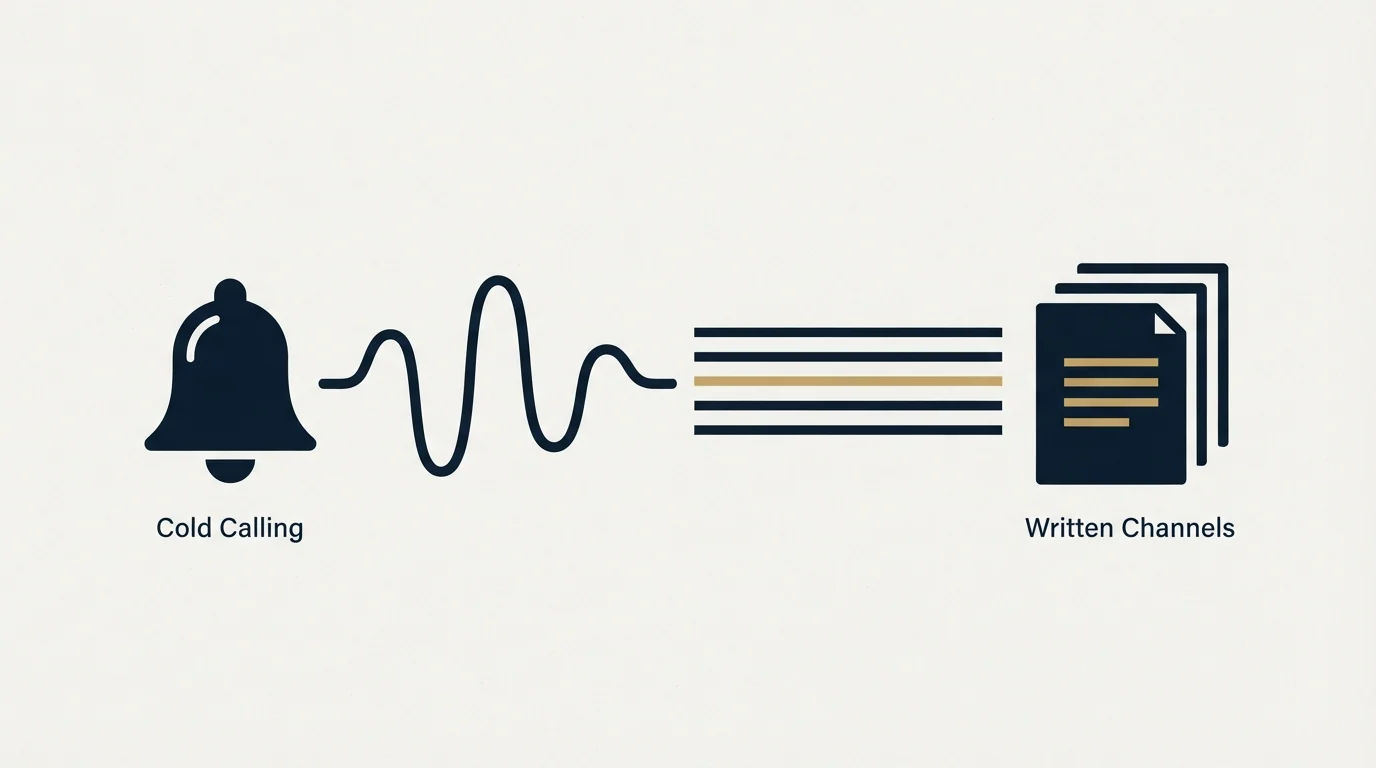
Cost per lead is the metric most teams reach for here, and it is the one most likely to mislead, because a lead from a phone conversation and a lead from a form fill are different objects wearing the same label. Our piece on why cost per lead misleads in B2B sets out what to compare instead, and the short version is that meetings held is the earliest honest common denominator.
The other honest comparison is speed. Channels differ enormously in how fast they answer, and calling answers fastest: you know within a week whether the market responds, where written outbound takes longer to produce a readable signal. That difference is worth real money when you are deciding what to test first, and we have sorted the options that way in our overview of lead generation channels by how fast they answer.
RevenueFlow runs cold email and LinkedIn outbound rather than calling. The comparison we would actually make, having built both sides of it for clients, is that calling buys speed and depth in a small market while written outbound buys reach in a large one, and the arithmetic above is what tells you which situation you are in. If the written half is the part you want built and measured, we will build the first campaign and run it through our outbound programmes on one message per prospect with nothing scheduled behind it.
Vendor capacity figures are taken from Belkins' own page, with dated snapshots retained. The funnel proportions in this article are illustrative and are not benchmarks. Measure your own.
Frequently asked questions.
Frequently asked questions- How many cold calls does it take to book a meeting?
- No published benchmark predicts your market, because the answer is the product of your connect rate and your conversation-to-meeting rate, both of which move with seniority, industry and data age. Measure them on two hundred dials of your own list. That measurement is worth more than any figure you could find online.
- Is cold calling better than cold email for lead generation?
- They win in different situations. Calling suits a small addressable market, buys speed of signal, and gives an answer within a week. Written outbound reaches markets no calling team could physically cover, and costs infrastructure rather than salary. Market size and how fast you need to learn usually decide it.
- What breaks a cold calling programme most often?
- Bad numbers break it completely, since a wrong mobile is a dial that could never have worked. Wrong seniority breaks it silently, producing healthy conversation rates and no pipeline. A generic reason for the call breaks the opening. The first two are list problems, which is why the list outranks the script.
- How much of a caller's week is spent calling?
- Less than most forecasts assume. List preparation, research, logging, internal meetings, handing over booked meetings and recovery time all consume the day, so the dialing window is a fraction of employed hours. Build the forecast on logged dialing hours, and buy back the non-dialing half before pressuring the person.
About the author.

Ben Carden is CRO at RevenueFlow, which builds and operates outbound revenue engines for B2B companies. Previously at Gartner Enterprise. Studied at London School of Economics.
Ben Carden · CRO
Connect on LinkedIn →Explore more.
Ready to scale your outreach?
We build GTM engines that book real meetings. See the receipts.
Related articles.
Two Agencies, One Target List: Who Owns Which Accounts
Two outbound suppliers on one market will contact the same companies unless the buyer splits it first. How to cut the list, run the exclusion feed and check the overlap.
HR Lead Generation: The Renewal Clock and Who Signs
An HR buyer who agrees with every word still cannot act outside their own renewal window. Which triggers are observable, and who signs.
IT Lead Generation: The Buyer Runs Your Playbook
Technology buyers evaluate outbound for a living, and their purchases carry a security review nobody in your meeting owns. Which triggers are real.
5 ABM Campaign Examples and How Each One Is Built
Five worked account-based campaign examples, each built on the same five fields: account set, tier, plays in order, owner and handoff, and the exit condition.
Last Outbound Agency Did Not Deliver: Locating the Failure
The leads were bad names a symptom and no stage. Four places an outbound engagement fails, the counts that separate them, and what to change in the next purchase.
When Outbound Stops Scaling: What Breaks First
Doubling the budget rarely doubles the meetings. The five constraints that bind in order, the signature each one leaves in the numbers, and what actually buys more.