Open Rate: What the Pixel Counts, and What It Stopped Proving
Open rate is unique opens divided by messages delivered, measured by embedding a remote tracking pixel and logging requests for it. It records an image fetch rather than a person reading, and mail clients that pre-load remote content on the recipient's behalf now fetch a share of those images automatically.
Key takeaways
- An open is an inference from an image request, so a message read with images disabled records nothing and a message nobody read can record an open.
- Apple states that Mail Privacy Protection prevents senders from seeing whether a message was opened, which changes the measurement rather than the behaviour.
- Figures either side of that change are not comparable, so a baseline taken before it is measuring a different thing.
- The metric is defensible as a placement early warning against your own recent campaigns, and indefensible as a way to choose copy.
Open rate is the share of the messages you sent that were recorded as opened, normally counted as unique opens divided by messages delivered. It is measured by embedding a small remote image in the message and treating a request for that image as evidence that a person looked at it.
That measurement method is the whole of the definition and also the whole of the problem. An open is not an event a mail client reports; it is an inference drawn from an image request, and a great deal now requests images without anybody reading anything.
How the number is produced
A tracking pixel is a transparent image, usually one pixel square, hosted on a domain the sender controls and referenced in the message body. When a mail client renders the message it fetches that image, the sender's server logs the request, and the message is marked open. Most platforms report both a raw count, which rises every time the image is fetched again, and a unique count, which counts one open per recipient.
Three consequences follow directly from that mechanism, and they are worth stating before any number is quoted.
A message read with images disabled records no open at all, however carefully it was read. A message never opened by a human records an open whenever anything else fetches the image. And the denominator is a choice: dividing by delivered and dividing by sent produce different figures on the same campaign, and platforms differ on which they use.
- Step 1A pixel is embedded
A small remote image is referenced in the message, hosted on a domain the sender controls.
- Step 2Something fetches it
A mail client rendering the message, a preview pane, a security scanner, or a privacy proxy pre-loading on the recipient's behalf.
- Step 3The request is logged
The sender's server records a hit and attributes it to that recipient.
- Step 4It is reported as an open
Nothing in the request distinguishes a person reading from a machine fetching.
Why it matters: the metric moved without the behaviour changing
The reason to treat open rate carefully is not that it is imprecise. It is that its precision changed sharply at a moment nobody controlled, so figures either side of that change are not comparable.
Mail clients began pre-loading remote content on the recipient's behalf as a privacy measure, which fetches the pixel whether or not the message is ever read. Apple's own documentation is explicit about the intent: Mail Privacy Protection "prevents senders from seeing if you've opened the email message they sent you." Corporate security systems do something similar for a different reason, scanning links and content in a message before it reaches the mailbox, which produces the same log entry.
So the population of recorded opens now contains a share that never corresponded to a person, and the size of that share depends on which mail clients your audience uses. Two campaigns to different audiences can report very different open rates while producing identical human attention.
- Relative comparison between your own campaigns, sent the same way in the same period
- A sharp fall from your own baseline, which is a genuine signal worth investigating
- A directional read on subject lines, treated as weak evidence rather than as a verdict
- A crude early warning that placement has changed
- Comparison against another company's figure, or a published benchmark
- Comparison against your own figures from before the tracking change
- Any claim about how many people read the message
- Optimising copy or offers on open rate as the outcome
The sharpest of those is the first in the right-hand column. Benchmarks are quoted constantly, and an open rate carries no stated denominator, no stated audience composition and no stated tracking method, which makes a comparison against somebody else's number almost meaningless. Our own cold email open rate benchmarks publish ranges with their limitations stated for exactly this reason: the bands are directional, and the useful comparison is against your own history rather than against a table.
The second matters more than it looks. A team that adopted a baseline before the pre-loading change and never re-anchored is comparing two different measurements and reading the difference as performance.
Where the textbook definition misleads
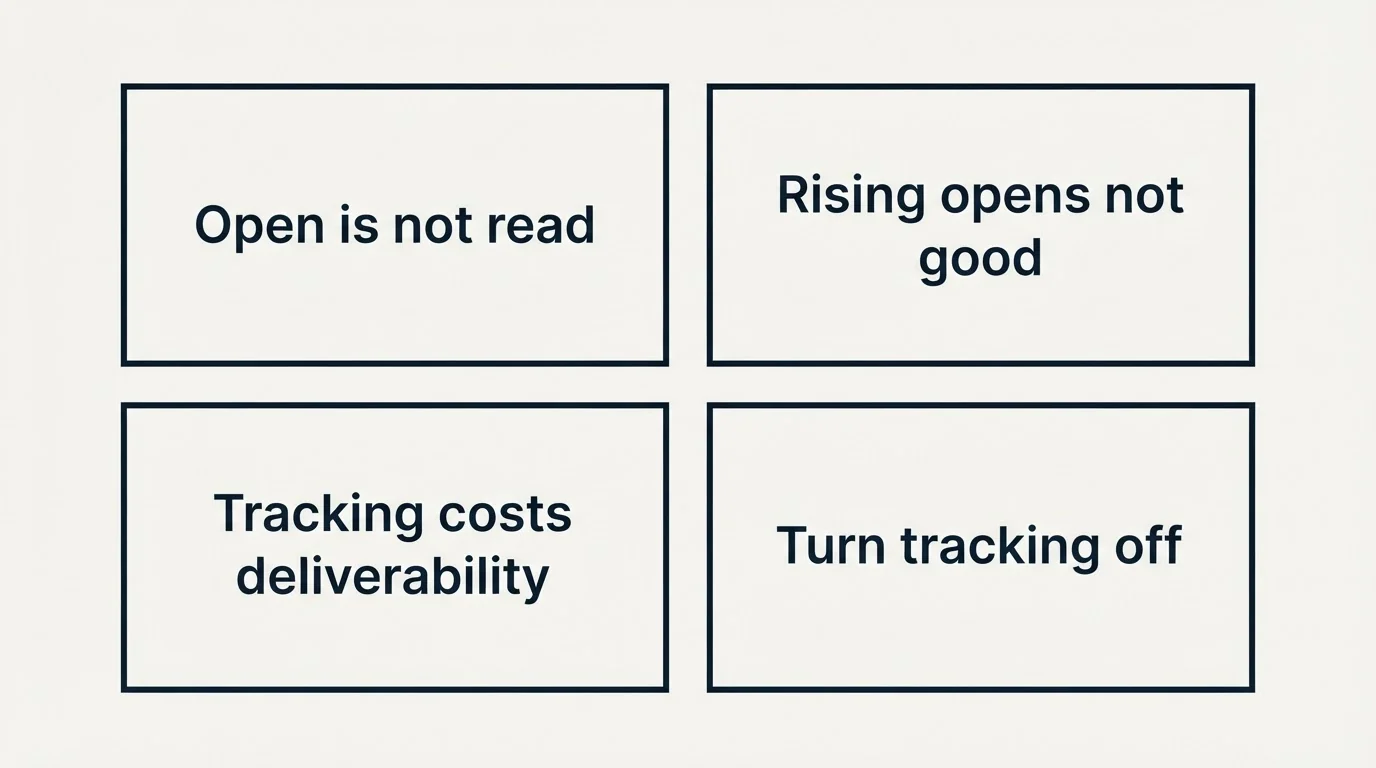
An open is not a read. It is an image request. The most common misuse of the metric is treating it as attention, then building a follow-up decision on it.
A rising open rate is not automatically good news. Because the inflating factor is client-side, a shift in audience composition toward a privacy-preserving client raises the number with no change in behaviour at all. The interpretation people reach for is that the subject lines improved.
Tracking costs something on the deliverability side. Every open pixel is a remote image reference and a link to a tracking domain, and a badly configured or shared tracking domain is a reputation liability of its own. That is why the tracking domain gets its own treatment as a custom tracking domain, and why a plain text email carrying no pixel is a legitimate choice rather than a lost measurement.
Turning tracking off is a real option. A cold programme measured on replies and meetings loses very little by not tracking opens, and gains a message with no remote image in it. The metric worth protecting is the one attached to money.
How it is used in outbound
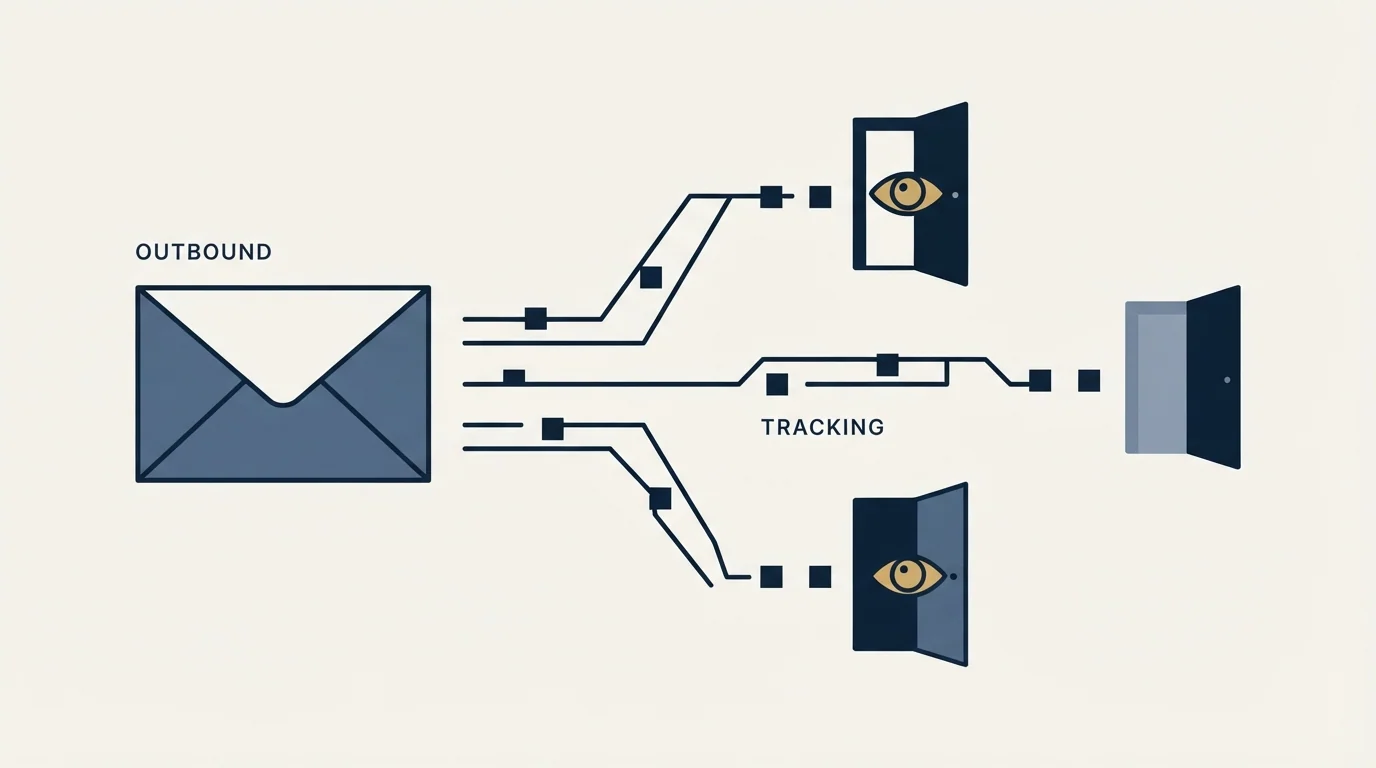
In an outbound programme the open rate has one job it does well and several it does badly.
The job it does well is early warning on the infrastructure. A sudden fall against your own recent baseline, concentrated at one receiving provider, is a placement signal worth acting on before replies have had time to move, and it is cheaper to notice than a seed test. That is a diagnostic use, and it holds because it is a comparison against yourself rather than against anybody else.
The jobs it does badly are all downstream decisions. Choosing a subject line on open rate optimises for the thing least connected to a booked meeting, and a subject line that lifts opens while depressing replies is a common and entirely unremarkable result. Judging a segment on opens confuses which mail clients that segment uses with whether those people wanted the message.
Our own position removes the most damaging use of it outright. We send one message per campaign, so there is no cadence to trigger from an open and no bump to send to somebody who opened without replying. A later approach is a separate campaign with its own premise, decided on something that actually changed rather than on an image request. That constraint is easier to hold when the reporting is not offering an opened-but-did-not-reply segment as an invitation.
- Yes: The denominator is stated, and it is the same one in both figures being compared
- Yes: Unique opens rather than raw opens, so one recipient counts once
- Yes: Compared against your own recent campaigns rather than a published benchmark
- Yes: Split by receiving provider, since the inflation varies by mail client
- Yes: Read as a placement signal rather than as attention
- No: Used to choose the subject line that gets shipped
- No: Compared against a baseline taken before the tracking behaviour changed
The metric that survives all of this is the one further down. Replies and meetings are counted from events a person performed deliberately, they carry no inference, and they are the numbers a campaign is actually accountable for. The click-through rate sits in between, more reliable than an open and still inflated by security scanners that follow links, which is why click-to-open rate inherits every problem the open has.
What to measure instead, and what open rate still catches
Replacing the metric is easier than repairing it, because everything downstream of an open is measured on something a person did on purpose.
A reply is unambiguous. A booked meeting is unambiguous. A bounce is a server statement. Those three carry no inference at all, and a programme reported on them loses nothing except the comfort of a large number near the top of a dashboard. The awkward part of the swap is that reply counts are small, so a weekly reading of them is noisy in a way an open rate never looks, and the honest response is a longer window rather than a return to the softer metric.
There is one thing open rate still catches earlier than anything else, and it is worth keeping the tracking on for as long as that use is the reason. Placement problems show up in opens before they show up in replies, because a message filed into spam is neither read nor answered, and the read count is larger so it moves first. A fall of a third against your own two-week baseline, concentrated at one receiving provider, is a prompt to run a placement test rather than to rewrite anything, and the diagnostic order from there is in the cold email deliverability guide. Held to that use, the metric is a smoke alarm. Asked to grade copy, it is a coin toss with a percentage sign.
Related terms
Click-through rate is the next metric down the chain and is measured on a deliberate action rather than an inference. Inbox placement is what a falling open rate is usually pointing at. Custom tracking domain is the surface the pixel and the links resolve through, and plain text email is the shape that carries neither. Sender reputation is what the placement signal is ultimately about.
The short version
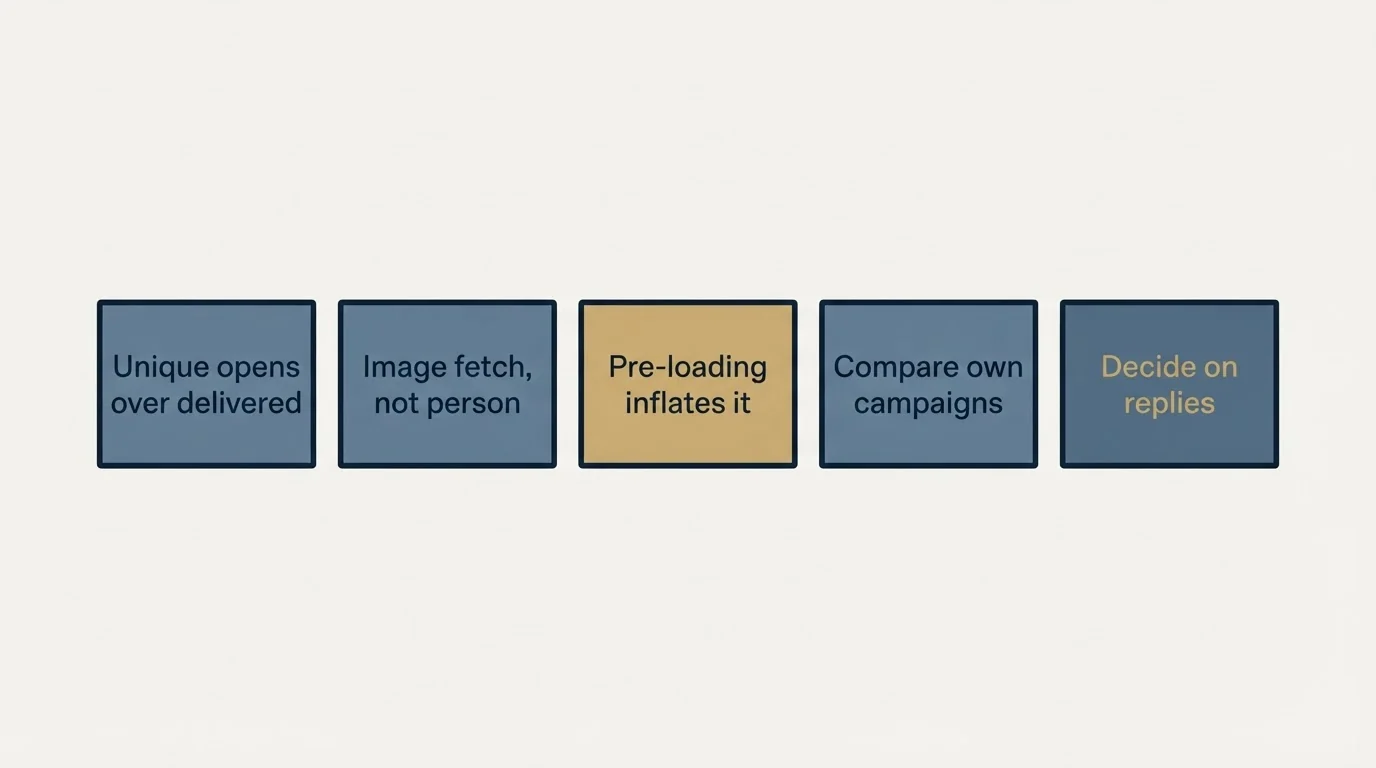
Open rate is unique opens over messages delivered, produced by logging requests for a tracking pixel. It measures an image fetch rather than a person, and mail clients that pre-load content on the recipient's behalf now fetch a share of those images with nobody reading anything. Use it as a comparison against your own recent campaigns, split by receiving provider, as an early signal that placement has moved. Do not use it to pick copy, do not compare it against a benchmark or against your own pre-change history, and keep the decisions on replies and meetings.
RevenueFlow runs cold email and LinkedIn outreach for B2B teams and is paid on attended qualified meetings, which is the metric this one is a poor substitute for. See how the campaigns work.
Verified as of mid-2026 against Apple's iPhone User Guide. Mail client behaviour changes; verify current handling with the source before relying on it.
Frequently asked questions.
Frequently asked questions- How is email open rate calculated?
- Normally unique opens divided by messages delivered, expressed as a percentage. Unique counts one open per recipient, while a raw count rises each time the tracking image is fetched again. The denominator is a choice: some platforms divide by messages sent instead, which produces a different figure on the same campaign, so the basis has to be stated before any comparison.
- Why are open rates unreliable now?
- Because the measurement depends on something fetching a remote image, and mail clients began pre-loading remote content on the recipient's behalf as a privacy measure. Corporate security systems scanning messages before delivery produce the same log entry. Both record an open with nobody reading anything, and the size of that share depends on which clients your audience uses.
- Is a high open rate good?
- Not on its own, because the inflating factor is client-side rather than behavioural. An audience that shifts toward a privacy-preserving mail client produces a higher open rate with no change in attention at all. A fall against your own recent baseline is the more informative direction, and it usually points at inbox placement rather than at the subject line.
- Should I turn off open tracking?
- It is a reasonable choice for a programme measured on replies and meetings, which lose nothing by it. Removing the pixel also removes a remote image reference and a tracking domain lookup from every message. Keep tracking on only while you are actively using the number as a placement early warning, and read it against your own history rather than against a benchmark.