SDR Outsourcing for Public Sector Vendors: When It Fits
How a public sector vendor decides whether to outsource sales development: the rules a third party inherits, what a setter must know, which model fits an RFP cycle.
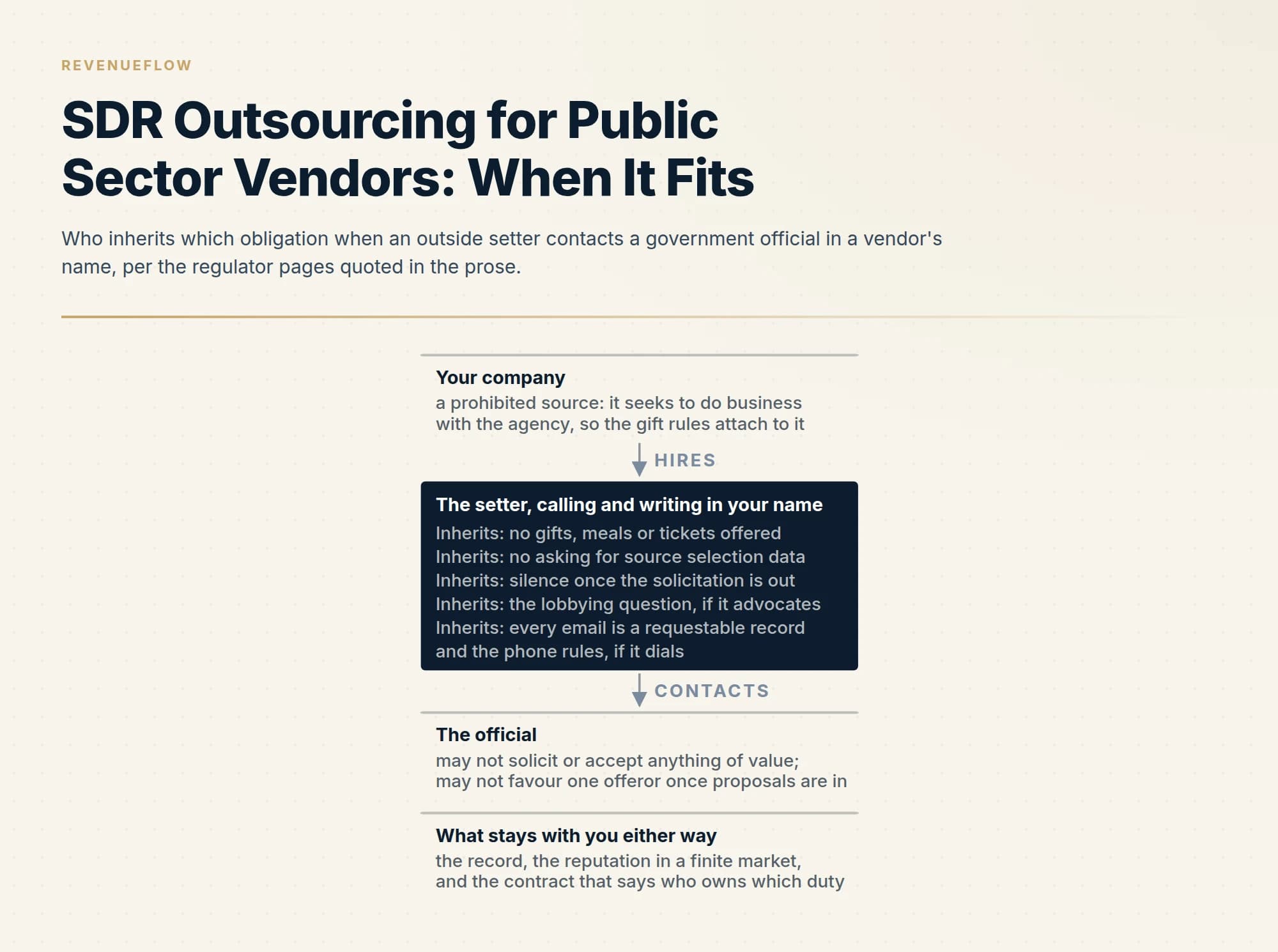
A public-sector vendor outsources sales development successfully when the setter inherits the rules and knows it: no gifts to officials, nothing asked about source selection, silence after a solicitation, the lobbying line respected, every email a record. Outcome-based meeting buying fits a wide, vehicle-led market; a dedicated team fits a wide, solicitation-led one; a finite market is founder work.
Key takeaways
- A setter acting for a vendor carries the vendor's status as a prohibited source under 5 CFR 2635, so FAR 3.101-2's bar on officials accepting anything of value, FAR 3.104-4's bar on disclosing source selection information and FAR 15.306's limits after proposals are received all bound what it may do in your name.
- The House Clerk's lobbying disclosure page sets quarterly registration thresholds, and FOIA.gov says generally any person can request agency records, so a provider must be asked whether its people are registered lobbyists and told that every email it sends to a federal address is requestable.
- A public-sector setter has to say which fiscal quarter a federal office is in, per USAspending's glossary, which SAM.gov registration and cooperative contracts the vendor holds, and which segment's signatory it is booking, since TAM to Target notes K-12 purchasing authority often sits at the district level.
- Deltek describes the sale as a process that ends in an RFP or a contract vehicle; outcome-based meeting buying fits a wide, vehicle-led market, a dedicated team fits a wide, solicitation-led one, and a finite market is a founder-led motion where TAM to Target warns there is no next territory.
Reviewed and updated September 18, 2026
TAM to Target, an agency selling this service, opens its guide to public-sector SDR teams with a warning rather than a pitch: "one aggressive cold call can close doors across an entire state", because "Budget cycles are fixed by law. Procurement often requires formal RFP responses." (tamtotarget.com, published 23 February 2026, read 18 September 2026). That is the frame for this decision. Hiring an outside team to open government conversations means letting someone else carry your name into a market where the buyer is bound by ethics rules, the record is public, and the people talk to each other.
This page is for a public-sector vendor, a govtech company, a services firm or a contractor selling to federal, state, local or education buyers, deciding whether to outsource sales development. The four staffing shapes behind the phrase, a dedicated agency team, a fractional SDR, offshore staffing and outcome-based meeting buying, are in SDR outsourcing; the billing units are in outsourced SDR pricing; the build-or-buy arithmetic is in outsourced SDR versus in-house. This page adds the public-sector layer: the rules a third party inherits when it calls or writes in your name, what a setter has to be able to say, which shape fits an RFP-shaped cycle, and the questions that separate a provider who knows this market from one who says it does. Every fact comes from a page fetched on 18 September 2026 and is cited where it appears.
The rules a third party inherits
Every conduct rule here is written for the official, and a setter who does not know them puts your buyer at risk. FAR 3.101-2 states that "As a rule, no Government employee may solicit or accept, directly or indirectly" a gratuity, gift, favour, entertainment, loan or anything of monetary value from anyone seeking business with the agency (FAC 2026-01, effective 13 March 2026, acquisition.gov, read 18 September 2026). The executive-branch ethics rule defines a prohibited source as anyone who "Is seeking official action by the employee's agency" or does business or seeks to do business with it (ecfr.gov, read 18 September 2026). A setter acting for you carries that status into every call: the lunch invitation a commercial setter uses as a soft ask is a gift question here.
The second rule is about information. FAR 3.104-4 states that "no person or other entity may disclose contractor bid or proposal information or source selection information to any person other than a person authorized" to receive it (acquisition.gov, read 18 September 2026), and FAR 15.306 limits what government personnel may exchange with offerors once proposals are in (acquisition.gov). A setter who chases an official for feedback after a solicitation closes is asking that person to break a rule; a provider that has worked this market stops contacting an account at that point, and one that has not calls it persistence.
The third is the line between selling and lobbying. The House Clerk's lobbying disclosure page states that an organisation employing in-house lobbyists "whose total expenses in connection with lobbying activities do not exceed and are not expected to exceed $16,000 in the quarterly period during which the registration would be made is not required to be registered", with a lower threshold for firms paid by clients (lobbyingdisclosure.house.gov, read 18 September 2026). Selling a product is not lobbying, but a setter whose script argues for an appropriation is doing something else; ask a provider whether any of its people are registered lobbyists and what its scripts ask officials to do. The fourth is the record. FOIA.gov's own answer to who may request agency records is "Generally any person - United States citizen or not - can make a FOIA request." (foia.gov, read 18 September 2026). Every email a setter sends to a federal address in your name can be requested.
If the provider dials, the phone rules attach. The FTC's Telemarketing Sales Rule guide says "Most phone calls between a telemarketer and a business are exempt from the TSR" (ftc.gov, read 18 September 2026), a statement about federal coverage and not a licence, and the FCC's page states that "AI-generated voice calls are illegal unless the consumer has agreed to receive them or the caller is exempt" (fcc.gov, read 18 September 2026), so a provider proposing an AI voice agent to warm a list of agencies is proposing what the regulator names. By email, the FTC's CAN-SPAM guide "makes no exception for business-to-business email" (ftc.gov, read 18 September 2026). None of this is legal advice; the contract with a provider should say who owns each duty.
What a setter has to be able to say
A public-sector setter has to answer four questions on a first call unprompted. The first is the calendar. USAspending's glossary states that the federal fiscal year "runs from October 1 to September 30" and divides it into quarters (usaspending.gov, read 18 September 2026); NASBO's Budget Processes in the States, 2021 edition, reports that "At least 31 states also reported submitting agency requests to the legislature directly, usually at the same time they are submitted to the governor" (nasbo.org, read 18 September 2026; page 12 of the report). A setter who cannot say which quarter a federal office is in is writing into a closed window.
The second is the door. SAM.gov states that "Registration is for organizations that want to directly bid on government contracts and apply for federal assistance" (sam.gov, read 18 September 2026), and Sourcewell, a cooperative used by state and local buyers, describes itself as "a local unit of government under Minnesota state statute" that "competitively solicits and awards contracts" (sourcewell-mn.gov, read 18 September 2026). The setter must know which registrations and cooperative contracts you hold; how to buy is the question that matters. The third is the segment: TAM to Target separates K-12, higher education, state and local, and federal buyers, noting for K-12 that "purchasing authority often sits at the district level"; a setter who books the champion without the signatory has booked half a meeting. The fourth is the person's role, the subject of how to cold email procurement managers.
Which shape fits an RFP-shaped cycle
Deltek's public-sector sales article, published 11 March 2024, describes the shape of the sale: "The public sector sales process begins when a government seeks goods and services through a specific process that ultimately produces a request for proposal or RFP or is bundled into a larger contract vehicle" (deltek.com, read 18 September 2026). That decides which staffing shape can work. Where the sale is solicitation-led, the setter's job ends months before the award; where it runs through a vehicle the buyer already uses, a meeting can become an order inside the quarter.
The other axis is how finite the market is. TAM to Target puts it plainly: "When your entire TAM fits in a spreadsheet, you can't afford to burn through prospects with irrelevant outreach and move to the next territory. There is no next territory." It says outsourcing "often makes sense" for companies entering the public sector, and warns that "Public sector SDR programs typically take longer to ramp than commercial B2B" and that a vendor should "Avoid providers who promise specific numbers without understanding your situation". Read that as a provider describing its offer. Four cases fall out. A finite market with a vehicle in place is a founder-led, named-account motion where an outside team is a layer between you and people you will meet at every conference. A wide market with a vehicle in place is where outcome-based meeting buying fits, if the written definition names the segment, the role and the door. A wide, solicitation-led market fits a dedicated team that carries the long pre-solicitation conversation to your capture people. A finite, solicitation-led market is the wrong place for a setter at all.
What the market's providers sell
Two providers own the promise and both describe a phone-led model. TAM to Target's later guide, published 27 July 2026, reaches buyers "primarily on the phones, all connected to your CRM", and calls public-sector markets "small, tight-knit communities where people talk, and one clumsy outreach message can hurt your reputation with buyers you have not even met yet" (tamtotarget.com, read 18 September 2026). memoryBlue's public-sector page says the firm "officially launched the memoryBlue Public Sector practice in 2020", that its campaigns "typically run out of our HQ office, which operates right in the heart of the greater Washington, DC area", and its B2G page counts 55 dedicated B2G SDRs (memoryblue.com, memoryblue.com, read 18 September 2026). Those are vendors describing what they sell.
We run email and LinkedIn, on Email Bison and in-house tooling for email and HeyReach for LinkedIn, one message per buyer per campaign, billed on a held meeting against a definition agreed in writing before launch; where a vendor's reality is the phone, that is a model a provider runs, not ours. The reputational point is shared: in a finite market a second message under an ignored first one is a bump the whole state sees.
The due diligence a provider should survive
The questions below come from the rules and the providers' pages. TAM to Target's advice on data ownership holds whoever you hire: "You own all contacts, playbooks, and sequences. If the engagement ends, that institutional knowledge stays with you. Confirm this in writing before signing any agreement." Vendor Registry's page for vendors adds the buyer's view of the process, "Get registered, get noticed and get in the know." (vendorregistry.com, read 18 September 2026): ask a provider whether it has ever sat in a pre-bid meeting.
Confirm in writing before signing
- You own every contact, playbook and sequence when the engagement ends
- Which registrations and cooperative contracts the setter will name, and who checks them
- No gift, meal or ticket is ever offered to an official
- Contact with an account stops when a solicitation is released
- Whether any of the provider's people are registered lobbyists, and what the scripts ask for
- The written definition of a qualified meeting: segment, role, door, attended
Walk away when the provider
- Promises a specific number of meetings before understanding your situation
- Proposes an AI voice agent to warm a list of districts or agencies
- Runs sequences that put a second message under an ignored first one
- Cannot say which fiscal quarter a federal office is in
- Treats a district champion as the buyer when authority sits at the district office
Three openers a setter could send, with the source beside each
Each opener is grounded in one page fetched on 18 September 2026, names no real recipient, carries no contact details and claims nothing about results; brackets hold the vendor's facts.
To a state human resources director. NASBO's spring survey says fourteen states reported eliminating vacant positions in governors' proposed budgets for fiscal 2027. If your agency is one of them and the work those positions did has to be carried by fewer people, [product] does [what it does]; we can send the one-page summary your budget office would need to see. Source: NASBO's Spring 2026 Fiscal Survey, which states "14 states reported eliminating vacant positions" (nasbo.org). Legitimate because the fact is public, dated and the recipient's own.
To a county fleet director. Sourcewell's guide list for public purchasers includes transitioning a public fleet to electric vehicles. If that is on your capital plan, [product] is on [cooperative contract], which means no local solicitation; we can send the contract number and what the guide leaves out. Source: Sourcewell's home page, which lists a guide on "Transitioning your public fleet to electric vehicles" (sourcewell-mn.gov). Legitimate because the guide is the cooperative's own.
To a federal programme office, in the first quarter. The new fiscal year opened on 1 October and the plan is funded. If [scope] is in this year's plan, we hold [registration and vehicle] and can be on a call before the second quarter; if it is not, we would rather know now than in September. Source: USAspending's glossary, which states the year "runs from October 1 to September 30". Legitimate because the calendar is the government's own.
The first quarter of an engagement
The order matters because the ramp is long: a provider that sends in week one, before the doors are mapped and the rules are in writing, spends your reputation.
When outsourcing is the wrong play for a public-sector vendor
It is the wrong play for a finite, solicitation-led market, because the work there is capture, teaming and proposal writing, and a meeting booked a month before the solicitation drops is one the rules will end. It is the wrong play below the purchase-card line: the FAR sets the micro-purchase threshold at 15,000 dollars (acquisition.gov, read 18 September 2026), and a product priced there is bought from a catalogue. It is the wrong play when the founders already know every buyer who could act this year, and if no one on your side can write the definition of a qualified meeting before the first send.
The short version
A public-sector vendor outsources sales development successfully when the setter inherits the rules and knows it: no gifts, nothing asked about source selection, silence after a solicitation, the lobbying line respected, every email a record; and when it can say which fiscal quarter the buyer is in, which registration and cooperative contract you hold, and which segment's signatory it is booking. Outcome-based meeting buying fits a wide, vehicle-led market; a dedicated team fits a wide, solicitation-led one; a finite market is founder work. If your list of agencies is wider than your founders can reach and you can write the definition first, RevenueFlow books qualified meetings on a pay-per-meeting basis.
Regulatory facts are taken from the regulator's own page, read on 18 September 2026; state ethics and lobbying rules vary and are not characterised. This is not legal advice.
Sources (regulators and associations; vendor pages are linked where quoted): FAR 3.101-2, FAR 3.104-4, FAR 15.306, FAR 2.101, 5 CFR 2635 subpart B, Lobbying Disclosure, House Clerk, FOIA.gov FAQ, USAspending glossary, NASBO Budget Processes in the States, NASBO Fiscal Survey of States, SAM.gov entity registration, Sourcewell, FTC Telemarketing Sales Rule guide, FCC telemarketing and robocalls, FTC CAN-SPAM guide
Frequently asked questions.
Frequently asked questions- What rules does an outsourced SDR inherit when calling government buyers?
- The vendor is a prohibited source under 5 CFR 2635 the moment it seeks an agency's business, and a setter acting for it carries that status: FAR 3.101-2 bars officials from soliciting or accepting anything of monetary value, FAR 3.104-4 bars disclosing source selection information, FAR 15.306 limits exchanges once proposals are in, the Lobbying Disclosure Act sets registration thresholds, and FOIA makes federal emails requestable. That is what the regulators publish, not legal advice.
- Which SDR outsourcing model fits public sector sales?
- It depends on how finite the buyer set is and whether the sale runs through a vehicle or a solicitation. A wide market with a cooperative or schedule contract in place suits outcome-based meeting buying against a written definition naming segment, role and door. A wide, solicitation-led market suits a dedicated team that carries the long pre-solicitation conversation to capture staff. A finite market is founder-led work, and a finite, solicitation-led market is the wrong place for a setter.
- What should a public sector vendor confirm before signing with an SDR provider?
- In writing: that the vendor owns every contact, playbook and sequence when the engagement ends, as TAM to Target advises; which registrations and cooperative contracts the setter will name; that no gift, meal or ticket is ever offered to an official; that contact with an account stops when a solicitation is released; whether any of the provider's people are registered lobbyists; and the definition of a qualified meeting by segment, role, door and attendance.
- How long does an outsourced public sector SDR programme take to ramp?
- Longer than commercial B2B, by the providers' own account: TAM to Target says public sector SDR programmes typically take longer to ramp and warns vendors to avoid providers who promise specific numbers without understanding their situation. The first quarter should map the whole market and its doors, put the conduct rules into the contract, and write into a fiscal window before any meeting is counted.
About the author.

B2B cold email experts helping companies generate qualified leads through done-for-you outreach campaigns.
RevenueFlow Team
Explore more.
Ready to scale your outreach?
We build GTM engines that book real meetings. See the receipts.
Related articles.
Outbound Sales for Public Sector Vendors: The Two Clocks
How a vendor builds outbound into government buyers: federal against SLED, the two fiscal calendars, SAM.gov and cooperative vehicles, and the conduct rules.
SDR Outsourcing for Fintech Companies: Assessability Test
For the fintech weighing an outside setter: the three assessability sentences, the promotion rules that bind every message, the sponsor test and which model fits.
SDR Outsourcing for Food and Beverage Companies: Food Layer
For the food or beverage brand weighing an outside setter: the buyer by channel, the broker and distributor map, the review calendar and the traceability rule's dates.
SDR Outsourcing for Solar Companies: The Commercial Layer
For the solar company weighing an outside setter: which segment a setter fits, the four sentences it must be able to say, and the consumer rules it inherits.
SDR Outsourcing for Biotech Companies: When It Fits
SDR outsourcing for life science sellers: which parts of the job can go outside, what FDA research use only guidance means for the brief, and when it is the wrong play.
SDR Outsourcing for Insurtech Companies
What an outsourced SDR team must be able to say for an insurtech: the buyer function, the enrollment and trade-press calendar, the licence question, the security review.