Outbound Sales for Public Sector Vendors: The Two Clocks
How a vendor builds outbound into government buyers: federal against SLED, the two fiscal calendars, SAM.gov and cooperative vehicles, and the conduct rules.
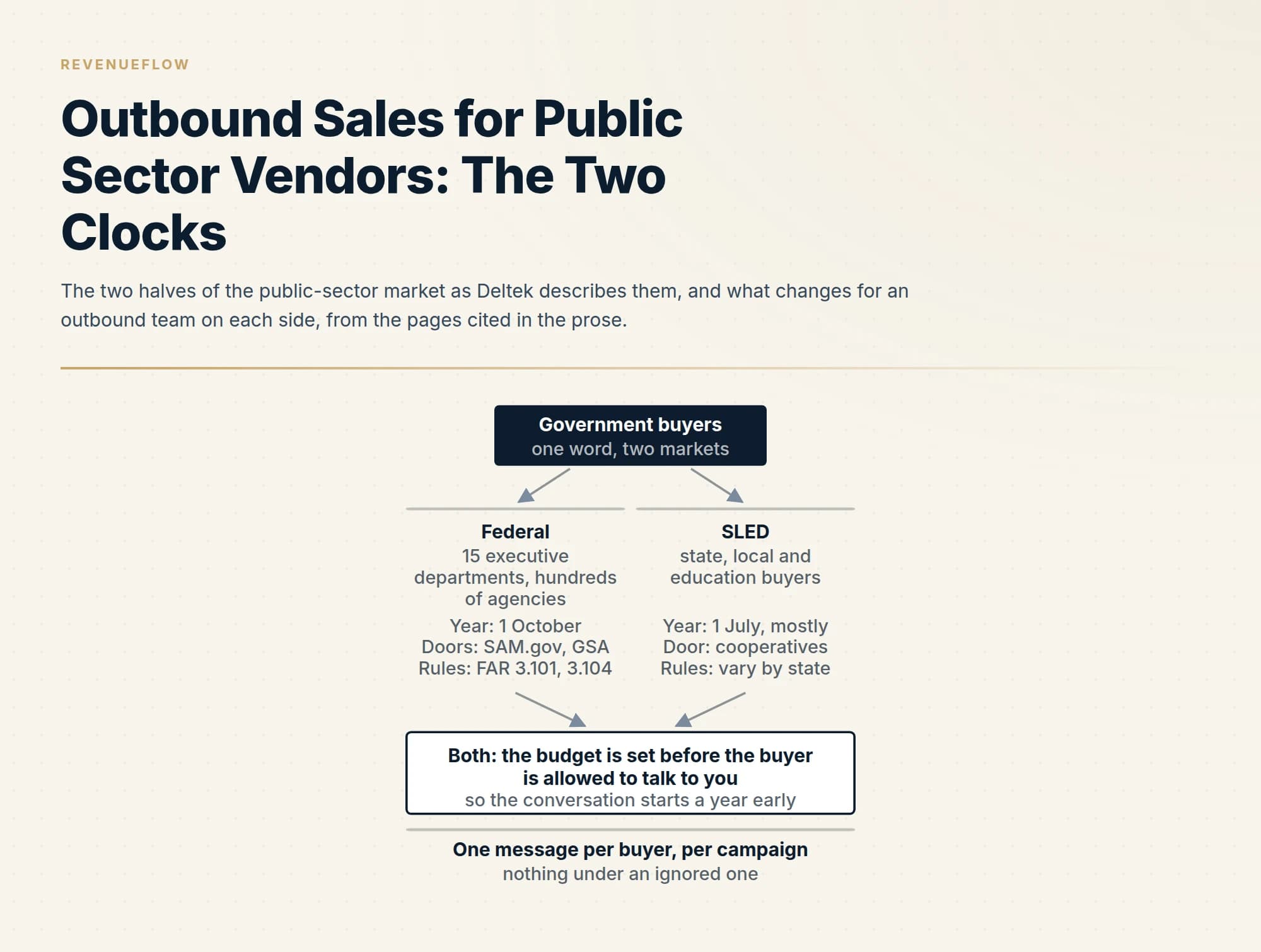
A public-sector vendor builds outbound around two fiscal calendars, the federal year from 1 October and the state year from 1 July in all but four states, and around the doors a buyer can use: SAM.gov registration, a GSA schedule, NASPO ValuePoint or Sourcewell. The FAR gift, source-selection and post-solicitation rules leave one window: before the solicitation, about the plan.
Key takeaways
- USAspending's glossary puts the federal fiscal year at 1 October to 30 September, and a 2018 Senate committee letter records that agencies historically increase spending in the fourth quarter, so a July message asks an office to spend money it has and a November message asks it to plan.
- NASBO's Budget Processes in the States reports that fiscal years for all but four states begin on 1 July, with requests written in the autumn, governors proposing in winter and legislatures adopting in spring; its Spring 2026 survey names 22 states with targeted cuts in proposed fiscal 2027 budgets.
- A buyer can only act through a door: SAM.gov registration to bid federally, GSA's Multiple Award Schedule, and cooperatives such as NASPO ValuePoint and Sourcewell for state and local buyers, so the list is filtered by which doors the vendor already holds.
- FAR 3.101-2 and 5 CFR 2635 bar gifts to officials, FAR 3.104-3 bars obtaining source selection information, FAR 15.306 limits exchanges once proposals are in, and FOIA makes every federal email requestable, which puts the outbound window before the solicitation.
Reviewed and updated September 18, 2026
The National Association of State Budget Officers' Spring 2026 Fiscal Survey, read on 18 September 2026, reports that "22 states reported targeted spending cuts" in governors' proposed budgets for fiscal 2027, while "29 states reported fiscal 2026 revenues were exceeding original forecasts at the time of data collection" (nasbo.org). A public sector vendor reading that page knows something about every state it sells to this autumn: the cuts are named, and the agency director who wants a new system has to fit it into a document that already exists. The budget is decided long before the buyer is allowed to talk to you.
This page is for a vendor, a govtech company, a services firm or a contractor, building outbound into government buyers with its own team. The message craft for the purchasing function is in how to cold email procurement managers, and the head for the motion itself is the outbound sales playbook, with the definition in outbound sales; none of that is repeated here. This page adds the public-sector layer: federal against SLED, the two fiscal calendars, the vehicles that decide whether a buyer can act, and the conduct rules that bound a vendor's own people. Every fact comes from a page fetched on 18 September 2026 and is cited where it appears.
Federal and SLED are two markets, and the titles differ
Deltek's public-sector sales article, published 11 March 2024, sets out the split: "The U.S. federal government is divided into 15 different executive departments, along with hundreds of federal agencies and commissions", while "State, local, and education governments (sometimes referred to as SLED in government contracting)" include municipalities, K-12 agencies and special districts (deltek.com, read 18 September 2026).
The titles change with the layer. TAM to Target, a vendor, maps them: for K-12, "Superintendents, CIOs/CTOs, Curriculum Directors, and Procurement Officers", noting that "purchasing authority often sits at the district level"; for state and local government, "Agency Directors, IT Managers, Procurement Officers, and Program Managers"; for federal, "Contracting Officers, Program Managers, and CIOs" (tamtotarget.com, published 23 February 2026, read 18 September 2026). Read that as a vendor's framing; for a list it means the buyer at a district is two people, the site champion and the district signatory.
The two fiscal calendars
USAspending's glossary, the Treasury's own reference, states that for the federal government the fiscal year "runs from October 1 to September 30", with the fourth quarter running from July to September (usaspending.gov, read 18 September 2026). When the Senate Homeland Security and Governmental Affairs Committee wrote to thirteen agency chief financial officers on 29 August 2018, its letter stated the pattern as a matter of record, "Historically, federal agencies increase spending during the fourth quarter of the fiscal year", citing a report that agencies had spent 11.1 billion dollars "in the final week of the fiscal year" (hsgac.senate.gov, read 18 September 2026). A July message asks an agency to spend money it has; a November message asks it to plan money it does not yet have.
The states run on another clock. NASBO's Budget Processes in the States, 2021 edition, states that "Fiscal years for all but four states begin on July 1", with New York on 1 April, Texas on 1 September, Alabama and Michigan on 1 October; guidelines are "generally distributed to agencies in the summer months", agencies submit requests to the governor in the autumn, and "Adoption of the budget typically occurs in the spring before the beginning of the state fiscal year" (nasbo.org, read 18 September 2026; pages 12 and 13 of the report). The spring survey quoted above is where the governors' proposals become public, and its "22 states reported targeted spending cuts" line is why an October message to an agency in one of those states should be about consolidation, not a new line item.
Registration and vehicles: whether the buyer can act
A buyer who wants what you sell still needs a lawful way to buy it. Federally, the first fact is registration; SAM.gov states "If you want to apply for federal awards as a prime awardee, you need a registration", and "A registration allows you to bid on government contracts and apply for federal assistance" (sam.gov, read 18 September 2026). The second is the vehicle. GSA describes its Multiple Award Schedule as the programme "where federal, state, local, tribal governments, and other eligible buyers get commercial products, services, and other solutions at good prices", and lists which item numbers are "eligible for cooperative purchasing" (gsa.gov, read 18 September 2026).
On the SLED side the cooperatives are the door. NASPO ValuePoint's home page states "$21B+ Annual Spend Managed", "450+ Suppliers", "62 ValuePoint Portfolios" and "30 States Serving in the Lead State Model" (naspovaluepoint.org, read 18 September 2026). Sourcewell describes itself as "a local unit of government under Minnesota state statute" that "competitively solicits and awards contracts" (sourcewell-mn.gov, read 18 September 2026). For a list this is a filter: an account whose cooperative contract you hold gets a different first line from one where you hold none.
| Door | What its own page says | What the first line can say |
|---|---|---|
| SAM.gov registration | Needed to bid on government contracts and apply for federal awards as a prime awardee | That you are registered, before any federal office is written to |
| GSA Multiple Award Schedule | Federal, state, local, tribal and other eligible buyers buy commercial products and services; some item numbers are open to cooperative purchasing | Your schedule contract and whether the buyer's state can order through it |
| NASPO ValuePoint | Portfolios led by one state and usable by the others, from fleet to information technology | The portfolio and its lead state, so the buyer knows the bid is already done |
| Sourcewell | A Minnesota unit of government that solicits and awards contracts for public buyers | The contract number, and that no local solicitation is needed |
| A direct solicitation | The RFP path the cooperatives exist to shorten | Nothing that favours you once the solicitation is out; see the rules below |
The conduct rules that bound a vendor's outreach
The rules are written for the official, which is why a vendor must know them. The Federal Acquisition Regulation requires that government business be conducted "with complete impartiality and with preferential treatment for none" (FAR 3.101-1, FAC 2026-01, effective 13 March 2026, acquisition.gov, read 18 September 2026), and 3.101-2 states that as a rule no government employee may solicit or accept "any gratuity, gift, favor, entertainment, loan, or anything of monetary value" from anyone seeking business with the agency (acquisition.gov). The ethics rule behind it, 5 CFR 2635, defines a prohibited source to include anyone who "Does business or seeks to do business with the employee's agency", with one small exception: "An employee may accept unsolicited gifts having an aggregate market value of $20 or less per source per occasion", capped at 50 dollars a year from one source (ecfr.gov, read 18 September 2026). A coffee invitation in a first message is a gift question for the reader.
Two rules decide what may be asked, and when. FAR 3.104-3 states that "A person must not, other than as provided by law, knowingly obtain contractor bid or proposal information or source selection information before the award of a Federal agency procurement contract to which the information relates" (acquisition.gov). Once proposals are in, FAR 15.306 says government personnel involved in the acquisition "shall not engage in conduct that" favours "one offeror over another" (acquisition.gov). That is why an official who talked in March goes silent in June; The Point Company writes that "Procurement rules limit how vendors can interact with buyers once a formal solicitation is released" (thepointco.com, published 8 May 2026, read 18 September 2026): the outbound window is before the solicitation, never during it.
Two more sit beside the FAR. The House Clerk's lobbying disclosure page sets the registration thresholds at 3,500 dollars of quarterly lobbying income per client for a firm and 16,000 dollars of quarterly expense for in-house lobbyists, and states that "The next adjustment will be made on January 1, 2029" (lobbyingdisclosure.house.gov, read 18 September 2026). Selling a product is not lobbying, but a vendor whose outreach becomes advocacy for a budget line should read that page and its state equivalents. And FOIA makes the exchange a record: "Federal agencies are required to disclose any information requested under the FOIA unless it falls under one of nine exemptions" (foia.gov, read 18 September 2026), and generally any person can ask. Write every federal email as if a competitor will read it.
The email rule is the ordinary one: the FTC's CAN-SPAM guide "makes no exception for business-to-business email" (ftc.gov, read 18 September 2026). We run email and LinkedIn, one message per campaign, on Email Bison and in-house tooling for email and HeyReach for LinkedIn; much of this market still opens by phone, and a vendor whose team calls is describing its own practice, not ours. None of this is legal advice.
What the market's own voices say
TAM to Target puts the reputational one bluntly: "one aggressive cold call can close doors across an entire state", because "Superintendents talk to each other" (tamtotarget.com, 23 February 2026). Vendor Registry, whose platform agencies use to manage vendors, concludes that "Because of their painful buying experience, buyers look for longer-term partners" (vendorregistry.com, read 18 September 2026). The Point Company's timing objection is the sharpest: "the delays that kill most government deals are almost never caused by the procurement process itself", they are caused by vendors who "show up too late, engage the wrong people". Deltek's 17th annual Clarity study, based on "proprietary survey data from 917 contractors", sits behind a download and none of its numbers are repeated here (deltek.com, read 18 September 2026).
Channel reality, and three openers with the source beside them
Federal programme staff have published .gov addresses; state and local directors are on LinkedIn and answer a desk phone; superintendents sit behind district offices. What reply rates look like on email into agencies is in government cold email benchmarks. GovSpend, a data vendor, sells the public signals: "With open bids and public meeting transcripts, you can find agencies looking or planning to purchase the goods and services you sell" (govspend.com, page dated 24 November 2025, read 18 September 2026). Read that as what it sells. Each opener below is grounded in one page fetched on 18 September 2026, names no real recipient, carries no contact details and claims nothing about results; brackets hold the vendor's facts.
To a state agency director, in October. NASBO's spring survey says twenty-two states, yours among them, proposed targeted cuts for fiscal 2027. If the [function] request you are writing this autumn has to show a consolidation rather than a new line, [product] replaces [what it replaces] on a cooperative contract your state can already order from; we can send the two-page comparison your budget office will ask for. Source: NASBO's Spring 2026 Fiscal Survey. Legitimate because the cuts are public, dated and the recipient's own.
To a federal programme manager, in July. The fiscal year closes on 30 September. If a [scope] task order on our GSA schedule would use funds your office would otherwise return, the vehicle is in place and we can quote inside the week; if not, we would rather talk in November about next year's plan. Source: USAspending's glossary and the Senate committee letter. Legitimate because the calendar is the government's own.
To a county fleet manager, after a cooperative award. NASPO ValuePoint announced supplier awards for its Automotive Parts portfolio on 19 August. If your county buys parts through your state's participating addendum, the bid is already done; we are [on / not on] that portfolio, and either way we can send what the award changes for a fleet your size. Source: NASPO ValuePoint's home page. Legitimate because the award is public and dated.
To: an agency director in a state that proposed targeted cuts; Subject: the consolidation your fiscal 2027 request needs
NASBO's spring survey says twenty-two states, yours among them, proposed targeted cuts for fiscal 2027. 1
If the request you are writing this autumn has to show a consolidation rather than a new line, [product] replaces [what it replaces] on a cooperative contract your state can already order from. 2
We can send the two-page comparison your budget office will ask for. 3
- 1Opens on a public, dated fact about the recipient's own state, from the budget officers' association, not on the vendor.
- 2Names the calendar (the autumn request) and the door (a cooperative contract), so the buyer knows the conversation can become an order.
- 3The ask is a document the buyer needs anyway, not a demo; nothing of value changes hands, so no gift question arises.
When outbound is the wrong play for a public-sector vendor
It is the wrong play below the thresholds: the FAR sets the micro-purchase threshold at 15,000 dollars and the simplified acquisition threshold at 350,000 dollars, with exceptions (acquisition.gov, read 18 September 2026), and FAR 13.201 makes "The Governmentwide commercial purchase card" the preferred way to pay for micro-purchases (acquisition.gov), so a product that sells for card money is bought from a catalogue, not a conversation. It is the wrong play once a solicitation is out, for a federal pursuit that is really capture work of teaming and proposals, and for a vendor with no registration and no vehicle, whose good meeting has nowhere to go.
Whatever is sent, the definition of a qualified conversation is agreed in writing first: an agency in the vendor's registered scope, a person who owns the programme or the purchase, an agreed conversation about a named need, attended, not already a customer or an open bid. Budget, timing and authority stay out of it; here the budget is a document that will not exist for a year.
The short version
A vendor building outbound into government sells into two markets on two clocks, the federal year from 1 October and the state year from 1 July in all but four states, each written a year ahead. The buyer can only act through a door, SAM.gov and a GSA schedule federally, NASPO ValuePoint or Sourcewell in the states, so the list is filtered by which doors the vendor holds. The rules are the official's, and they leave one window: before the solicitation, about the plan. If the list of agencies with a public reason to talk is longer than your team can write to, RevenueFlow books qualified meetings on a pay-per-meeting basis, against a definition agreed in writing first.
Regulatory and calendar facts are taken from the regulator's or association's own page, read on 18 September 2026; state lobbying and gift rules vary and are not characterised. This is not legal advice.
Sources (regulators and associations; vendor pages are linked where quoted): NASBO Fiscal Survey of States, NASBO Budget Processes in the States, USAspending glossary, Senate HSGAC on fourth-quarter spending, SAM.gov entity registration, GSA Multiple Award Schedule, NASPO ValuePoint, Sourcewell, FAR 3.101-1, FAR 3.101-2, FAR 3.104-3, FAR 15.306, FAR 2.101, FAR 13.201, 5 CFR 2635 subpart B, Lobbying Disclosure, House Clerk, FOIA.gov, FTC CAN-SPAM guide
Frequently asked questions.
Frequently asked questions- When should a vendor write to a government buyer?
- Before the solicitation, about the plan. Federally, the fiscal year runs from 1 October to 30 September and agencies historically spend heavily in the fourth quarter, so a July message can use funds an office would otherwise return while an autumn message shapes next year's plan. In most states the year begins on 1 July and agencies write their requests the previous autumn, when a message about consolidation can still land in the request.
- What is the difference between federal and SLED sales for outbound?
- Deltek describes the federal market as 15 executive departments plus hundreds of agencies and commissions, and SLED as state, local and education governments, from counties and cities to K-12 districts and special districts. The calendars differ, the doors differ, SAM.gov and GSA schedules federally against cooperative contracts in the states, and the titles differ, with a district champion and a district-office signatory being two separate people on a list.
- What rules limit how a vendor may contact a government official?
- The Federal Acquisition Regulation requires impartial conduct and bars officials from soliciting or accepting gratuities or anything of value from anyone seeking agency business; 5 CFR 2635 defines that person as a prohibited source with a small unsolicited-gift exception. FAR 3.104-3 bars knowingly obtaining source selection information before award, FAR 15.306 limits exchanges once proposals are in, and the Lobbying Disclosure Act sets registration thresholds. That is what the regulators publish, not legal advice.
- When is outbound the wrong play for a public sector vendor?
- Below the purchase-card line, because the FAR sets a micro-purchase threshold and makes the government purchase card the preferred way to pay for those purchases, so catalogue products are not bought through conversations. Once a solicitation is out, when officials may not favour one offeror. For a federal pursuit that is really capture work of teaming and proposals. And for a vendor holding no registration and no vehicle, whose good meeting has nowhere to go.
About the author.

B2B cold email experts helping companies generate qualified leads through done-for-you outreach campaigns.
RevenueFlow Team
Explore more.
Ready to scale your outreach?
We build GTM engines that book real meetings. See the receipts.
Related articles.
SDR Outsourcing for Public Sector Vendors: When It Fits
How a public sector vendor decides whether to outsource sales development: the rules a third party inherits, what a setter must know, which model fits an RFP cycle.
SDR Outsourcing for Fintech Companies: Assessability Test
For the fintech weighing an outside setter: the three assessability sentences, the promotion rules that bind every message, the sponsor test and which model fits.
Appointment Setting for Manufacturers: Who a Setter May Call
For the manufacturer hiring a setter: the ranked titles to hand over, the rep and distributor map that decides which accounts may be called, and the meeting types.
Outbound Sales for Architecture Firms: The Two Roads
For the firm winning its own work: who commissions buildings, the private road and the public qualifications road, the six FAR criteria, and the wrong-play cases.
Outbound Sales for Web Development Companies: A Guide
Outbound for a web shop starts from the prospect's own public site: what it runs on, how it performs and whether a dated accessibility duty applies.
LinkedIn Outreach for Ecommerce Companies: Who Is Reachable
LinkedIn outreach to ecommerce brands: why the storefront address reaches support, what Shopify's partner agreement says about contacting merchants, and who is reachable.