SDR Scripts: One Worked Set for Call, Email and LinkedIn
One worked set of SDR scripts for a single invented prospect: an email, a LinkedIn note, a call opener, a voicemail and the one follow-up call that is allowed.
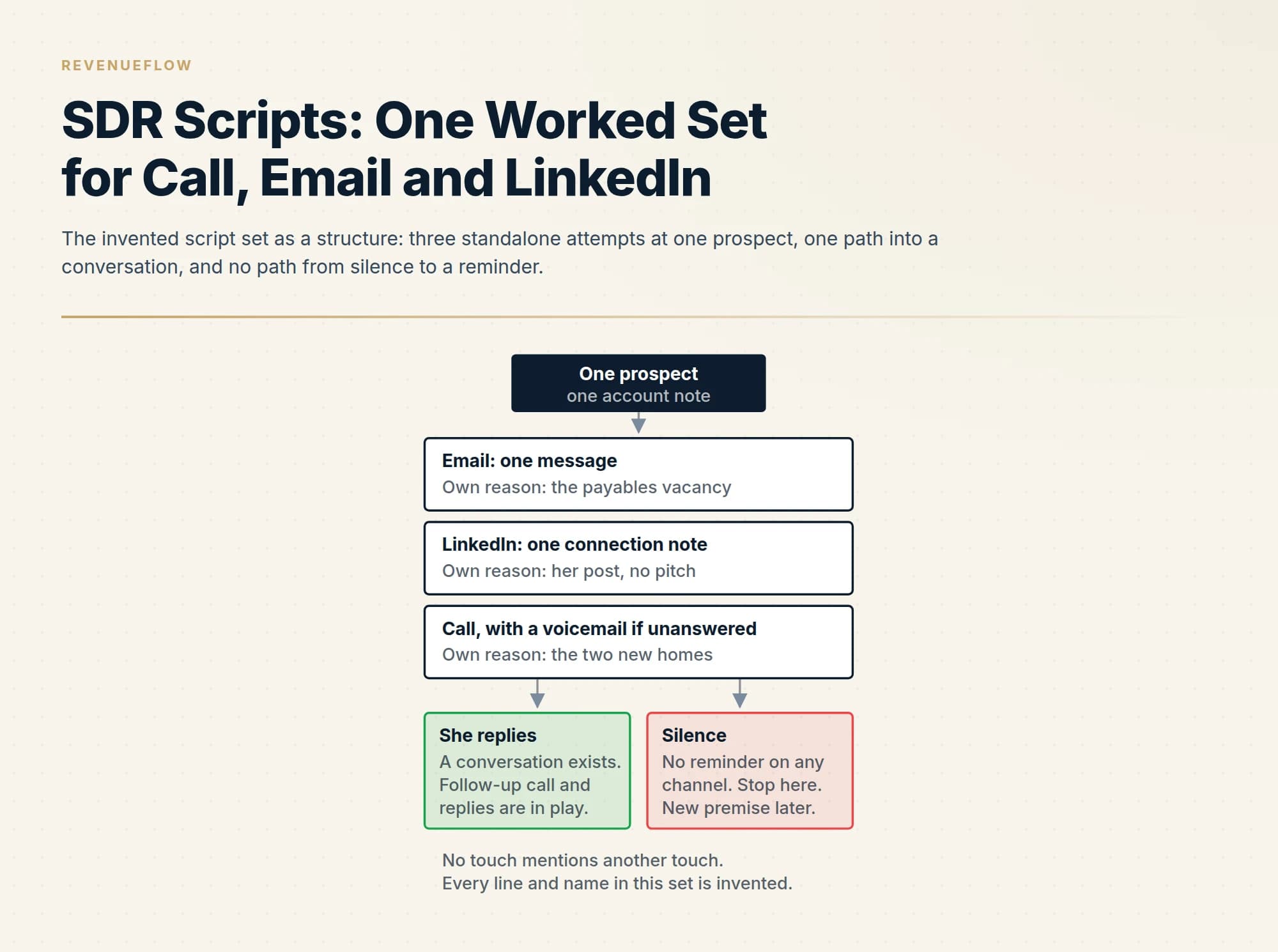
A strong set of SDR scripts is written from one account note, with each channel using a different true fact: one email, one LinkedIn connection note with no pitch, and one call with a voicemail behind it. No touch mentions another, a follow-up call happens only after a reply, and silence goes to a later campaign with a new premise.
Key takeaways
- Write every script for an account from one short note of true facts, and give each channel a different fact, so that any touch could arrive first, arrive alone and still make sense.
- Give each channel one attempt: one email, one LinkedIn connection note with no pitch, and one call with one voicemail, and ban the reminder line on all of them.
- The only follow-up call in the set comes after the prospect has replied, because following up inside a conversation is ordinary correspondence and ringing about an unanswered email is a bump.
- When nothing comes back the campaign ends; the contact goes into a later campaign built on a premise that did not exist when the first one ran.
Reviewed and updated September 18, 2026
A new SDR is usually handed three documents on the first day: a call script, an email sequence and a list of LinkedIn messages. Each was written by a different person in a different quarter, and the prospect on the receiving end hears from three strangers who happen to share a logo. The email says one thing, the voicemail asks whether the email arrived, and the LinkedIn note refers to both.
This page takes the opposite approach to SDR scripts. It is one worked script set for one invented prospect, across a call, a voicemail, an email and a LinkedIn connection note, where every touch stands on its own reason and none of them is a reminder of another. The company, the people, the events and every line below are invented for illustration. The method is ours, the written half is how we run outbound for clients, and RevenueFlow does not sell calling, so the call scripts are offered as craft with no results claim.
The rule the whole set follows
Each channel gets one attempt, each attempt carries its own reason to exist, and no attempt mentions another. That rule comes from how we run written outbound: one message per campaign, no bumps and no thread replies, for the reasons and with the campaign numbers set out in why we stopped using follow-ups. On LinkedIn the rule is stricter, because a second message lands directly under the one the person already declined to answer, so we do not send one.
The consequence for script writing is simple to state and awkward to practise. A line asking whether they saw the email is off the table, because it is a reminder. So is a LinkedIn note that says "I also emailed you". Every touch has to be able to arrive first, arrive alone, and still make sense. Our older multi-channel templates page shows the conventional sequence, in which each touch points back at the last; this page is the other design.
The account note comes first
All four scripts are written from one short note, because the research is done once at the account level. Here is the invented note.
The seller is Tarnbrook, a made-up firm that audits supplier invoices for care providers. The SDR is Ravi. The prospect is Freya Lockwood, finance director at Marlow Care Group, an invented operator of fourteen care homes. Three things are true about the account in this example: the group opened two homes this year, it is advertising for an accounts payable clerk, and Freya wrote a LinkedIn post last week about the cost of agency staff.
Three facts, three channels. Each script below uses one of them, which is what lets every touch stand alone. If an account yields only one usable fact, it gets one touch on one channel, and the set shrinks to fit.
Script 1: the email
One message, short enough to read on a phone, with an ask that can be answered in a line. Invented example:
Subject: Agency invoices at Marlow
Freya, agency staffing invoices are the ones we see go wrong most often in care groups, usually on shift rates billed above the contracted rate. With fourteen homes and an accounts payable vacancy, that checking is probably landing on whoever has a spare hour.
We audit those invoices against the contracts and send back only the lines that disagree. Would a one-page example of that report be useful?
Ravi, Tarnbrook
Subject: Agency invoices at Marlow
Agency staffing invoices are the ones we see go wrong most often in care groups, usually on shift rates billed above the contracted rate. 1
With fourteen homes and an accounts payable vacancy, that checking is probably landing on whoever has a spare hour. 2
Would a one-page example of that report be useful? 3
- 1The premise: one specific problem, stated as something the seller sees, with no statistic attached.
- 2The fact from the account note that makes it about this reader: the vacancy is public and checkable.
- 3An interest ask, answerable in one line. It offers a document and does not ask for a meeting.
The subject line is written last and says what the message is about. There is no second email in this campaign. What a subject line can honestly do when it has to carry the whole campaign is covered in sales email subject lines.
Script 2: the LinkedIn connection note
LinkedIn is its own campaign with its own reason, which here is the post Freya wrote. It is not a warm-up for the call, and our piece on what LinkedIn adds to a cold call explains why an invitation sent as call preparation costs more than it looks. Invented example:
Freya, your post on agency staff costs is the clearest account going of why the rate card and the invoice drift apart. We work on the invoice side of that problem for care groups at Tarnbrook. Connecting to follow what you write.
One sentence about her post, one about the sender, no pitch and no ask beyond the connection. If she accepts and says nothing, that is the end of the LinkedIn campaign. If she accepts and writes back, a conversation has started and ordinary correspondence applies.
Script 3: the call opener
The call uses the third fact, the two new homes, and opens as a cold call because it is one. Invented example:
"Freya, it's Ravi Menon at Tarnbrook. We have not spoken before. I rang because Marlow opened two homes this year, and new homes usually mean new agency contracts on new rate cards, which is where billing drifts. Is supplier invoice checking something that sits with you?"
It does not say "I sent you an email". The reason for the call is a fact about her company, and the ask is a routing question she can answer in a word. More openers for other situations are in cold call openers by situation, and if the call is answered by a front desk, the route through is in how to get past the gatekeeper.
Script 4: the voicemail
If the call goes to voicemail, the message carries the same reason and asks for nothing. Invented example:
"Freya, it's Ravi Menon at Tarnbrook. I rang because Marlow opened two homes this year and we audit agency invoices against rate cards for care groups. No need to call back."
One attempt means one voicemail. The message deliberately does not promise another call, because in this design there may not be one.
| Touch | Its own reason | Never says |
|---|---|---|
| 1. Email | The accounts payable vacancy | Anything about a call or LinkedIn |
| 2. LinkedIn note | Her post on agency staff costs | A pitch, or that an email was sent |
| 3. Call opener | The two homes opened this year | Any mention of the email |
| 4. Voicemail | The same reason as the call | A callback request or a promise to retry |
| 5. Call after a reply | Her reply, quoted back | Anything she did not say |
Script 5: the only follow-up call in the set
Suppose Freya answers the email with one line: "Yes, send the example." A conversation now exists, and that changes what is allowed. Following up inside a conversation is ordinary correspondence, and it is the single exception the follow-ups article makes. Invented example:
"Freya, it's Ravi at Tarnbrook. You replied this morning and asked for the example report, which is in your inbox now. I thought two minutes on the phone would save you reading it cold. Have you got the rate cards for the two new homes to hand, or is that a job for the new clerk?"
This is the only follow-up call in the set, and it follows a reply. There is no script here for ringing someone because they did not answer, because that call is a bump delivered by phone. The full set of calls into an existing conversation, from after a demo to ahead of a renewal, is in follow up call scripts.
Why not the conventional sequence
The usual SDR sequence works differently, and it is fair to describe it before disagreeing with it. A sequence chains touches so that each one refers to the last: the second email replies to the first, the call mentions the emails, the final message asks whether to stop. Its logic is that busy people miss things, and its cost is that every later touch goes only to people who saw an earlier one and chose not to answer.
- Second email sits in the first one's thread
- Call opens by asking about the email
- LinkedIn note mentions the email
- Final message asks whether to stop
- The reader is told, several times, that they did not answer
- One email, about the payables vacancy
- One LinkedIn note, about her post
- One call and voicemail, about the new homes
- Silence ends the campaign on that channel
- A later campaign needs a new premise
We chose the second design for the written channels and we state its cost plainly: each contact is reached less often. A team that runs the phone is entitled to decide differently about the phone, since a call is a two-way conversation in a way a broadcast is not. The scripts above still work in that case. What stops working is the reminder line, on any channel, because it spends the prospect's attention on the fact that they ignored you.
If nothing comes back
Then nothing further happens in this campaign. Freya goes into a later campaign, weeks on, built on a premise that did not exist when the first one ran. Invented example of what that might be: the group's annual accounts are filed and show agency costs as a separate line. That is a new fact and it earns a new email, written as if it were the first.
Before building any of this at volume, settle who the set is for. The scripts depend on three true facts per account, and that is a targeting job done before any writing. An account with no true fact to write from should not be in the campaign, however good the script.
The short version
A set of SDR scripts is strongest when it is written from one account note and every touch uses a different fact from it. Give each channel one attempt with its own reason: one email, one LinkedIn connection note with no pitch, one call with a voicemail behind it. Ban the reminder line everywhere. Follow up by phone only inside a conversation the prospect has started, and send silence to a later campaign with a new premise.
If the written half is the part you would like run for you, that is what we do: see what a first campaign would look like.
Every company, person, event and line in this script set is invented for illustration. The method describes how RevenueFlow runs written outbound; the call scripts are craft and carry no measured result.
Frequently asked questions.
Frequently asked questions- What scripts does an SDR need?
- A short account note and four scripts written from it: one email with an ask that can be answered in a line, one LinkedIn connection note with no pitch, one call opener that states its own reason, and one voicemail that asks for nothing. Add a fifth for the call you make after a prospect replies. Each script uses a different fact about the account.
- Should an SDR mention the email on a cold call?
- Not in this design. Opening a call by asking whether the person saw your email turns the call into a reminder and tells the prospect they ignored you. The call should carry its own reason, a fact about their company that explains why you rang today, so that it works whether or not the email was ever opened.
- How many times should an SDR follow up with a prospect?
- Our practice in written outbound is one message per campaign, with no bumps and no thread replies, and on LinkedIn no second message under one that went unanswered. Once a prospect replies, a conversation exists and following up is ordinary correspondence. A contact who stays silent goes into a later campaign with a new premise. The cost we accept is reaching each contact less often.
- What should an SDR say in a LinkedIn connection request?
- Two sentences about something the person wrote or did, one sentence on who you are, and no pitch or meeting request. Treat LinkedIn as its own campaign with its own reason, and do not describe it as a warm-up for a call or mention an email you sent. If the person accepts and says nothing, that campaign is finished.
About the author.

B2B cold email experts helping companies generate qualified leads through done-for-you outreach campaigns.
RevenueFlow Team
Explore more.
Ready to scale your outreach?
We build GTM engines that book real meetings. See the receipts.
Related articles.
LinkedIn Outreach for Machine Shops
How a job shop or CNC machine shop uses LinkedIn to win OEM work: the four buyer titles, the RFQ gate, the ISO, AS9100 and ITAR facts, and LinkedIn's own rules.
Sales Outsourcing for SaaS Companies: What to Hand Over
For SaaS companies weighing an outside sales team: what the industry's own survey found, what a third party cannot hold in a software sale, and what can go out.
Cold Call Openers: Eleven Lines by Situation, and the Data
Eleven cold call openers sorted by what is true about the call, the four beats every opener has, and what Gong's 2018 opener study actually counted.
LinkedIn Outreach for Software Development Companies
LinkedIn outreach for development firms: buyers are saturated with capacity pitches, LinkedIn prohibits the usual playbook, and public signals earn a reading.
LinkedIn Outreach for Logistics Companies: Finding Shippers
LinkedIn outreach for brokers, forwarders and 3PLs: why the industry filter returns competitors, how to find shippers by function, and what goes in one checkable message.
SDR Outsourcing for Biotech Companies: When It Fits
SDR outsourcing for life science sellers: which parts of the job can go outside, what FDA research use only guidance means for the brief, and when it is the wrong play.