Cold Email Sender Name: Whose Name Goes On It
The from field is read before the subject line and is the only part of a cold email a recipient can independently verify. What has to agree, and what breaks it.

Use a real person with a first name and a surname, findable, whose public employer matches the signature. Route replies to that same person. Keep the sending domain from contradicting the other signals. Where a supplier sends on your behalf, the name should belong to whoever the reply actually reaches, because that is the version that stays true afterwards.
Key takeaways
- The from name is read before the subject line and is the only element of a cold email the recipient can verify independently, which is why it fails after the message is read rather than before.
- Four things have to agree: the from name, the signature, the sending domain and a public profile. A reader checking one of them will encounter the others.
- A reply-to routed to an unrelated identity surfaces in the recipient's own draft, which makes it one of the few technical details a non-technical reader notices.
- An invented sender fails the search test by construction, and it fails it exactly when the recipient was interested enough to look the person up.
Reviewed and updated September 1, 2026
A campaign is ready to send and the last unanswered question is the smallest one on the page: whose name does it come from. Somebody suggests the founder, somebody suggests the account manager who will actually run the replies, somebody suggests a team alias, and the decision gets made in about forty seconds by whoever is holding the mouse.
That field is the first thing the recipient reads, before the subject line and long before the first sentence. It is also the field most likely to be checked against reality by a mildly interested stranger, which makes it the only part of a cold email whose credibility can be independently verified by the person receiving it.
What the recipient is actually deciding
Two judgements happen in the inbox list view, both in under a second, and both before the message is open.
The first is whether this is a person or a system. A human first name and surname reads as correspondence. A department, a product name or a generic alias reads as a broadcast, and a broadcast from a company the recipient has never bought from is the shape of an advertisement rather than a message.
The second is whether the sender is plausibly connected to whatever the subject line refers to. A name attached to a company the recipient recognises resolves differently from a name attached to nothing. Neither of these judgements is about deliverability. They are about whether the message earns the two seconds needed to read the opening line, and the anatomy of that whole sequence sits in cold email format.
- Reads as correspondence rather than broadcast
- Can be checked, and frequently is
- Carries an implied person to reply to
- Fails badly when the person cannot be found
- Adds context when the brand is recognised
- Adds nothing when it is not
- Useful where the company is the reason for the message
- Can read as a marketing identity in some clients
- Reads as a system and is treated as one
- No individual accountability implied
- Sometimes correct for a genuine shared function
- Wrong for a first unsolicited message
The search test, and why it is the part senders skip
A recipient who is mildly interested and mildly suspicious will look the sender up. That check is cheap, it takes a few seconds, and it is the single most common way a cold email is disqualified after being read rather than before.
The test has one condition: the name in the from field has to resolve to a findable human who plausibly works where the signature says they work. What breaks it is not usually deception. It is ordinary operational drift. A campaign sent under the name of somebody who left. A first name with no surname anywhere in the message. A signature naming a company whose website lists a different team. A profile that exists but shows an unrelated employer.
Four things need to agree with each other, and a recipient checking any one of them will encounter the others: the from name, the signature, the domain the message arrived from, and a public profile somewhere. Where all four agree, the check resolves in the sender's favour and usually ends there. Where one of them does not, the check produces a specific kind of doubt that no amount of good copy recovers, because the reader has stopped evaluating the offer and started evaluating the sender.
- Yes: The from name is a real person with a first name and a surname
- Yes: That person is findable, and the employer shown matches the signature
- Yes: The signature names a company, a role and a way to reach a human
- Yes: The reply-to address routes to the person whose name is on the message
- Depends: The sending domain is explicable if the recipient looks at it
- Depends: The person named still works there on the day the campaign sends
The reply-to mismatch, and why it reads as automation
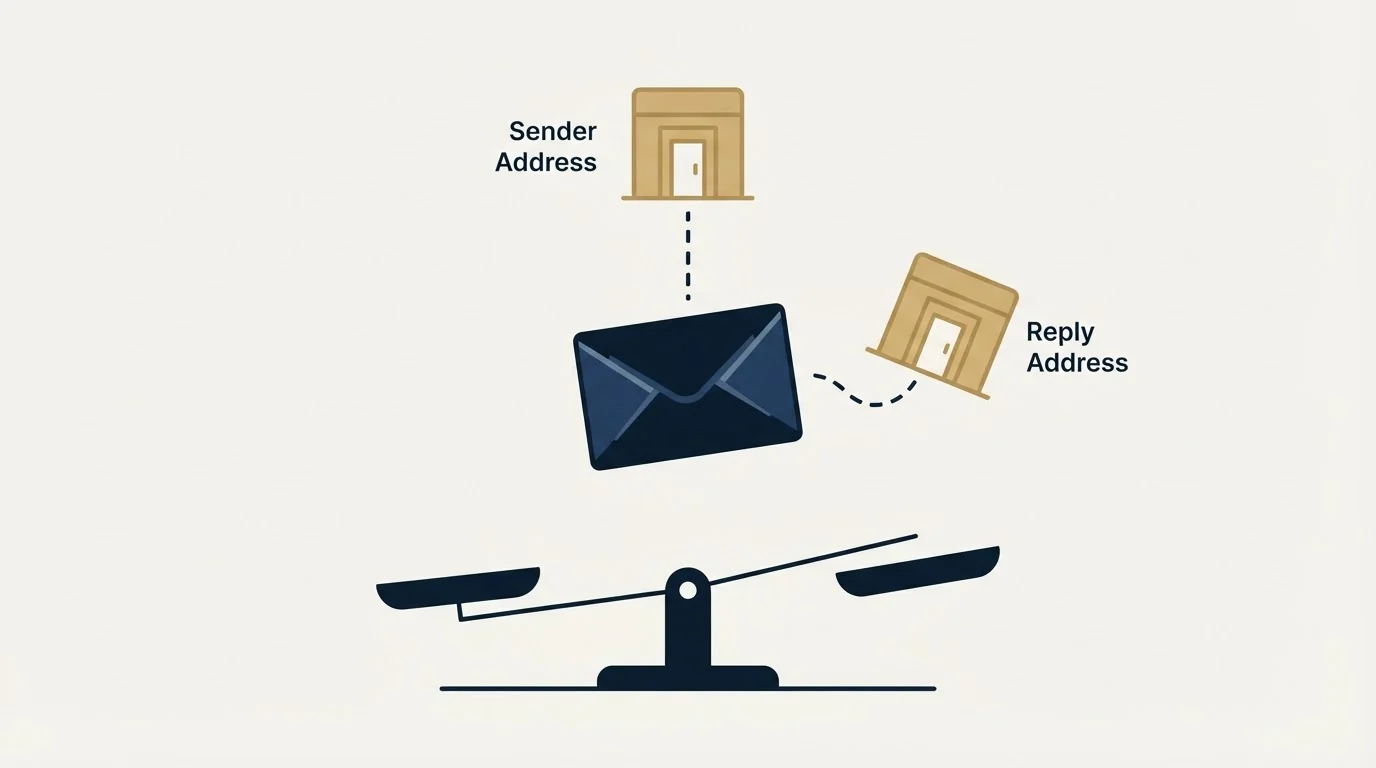
The reply-to header is set separately from the from address, and a message sent as one identity with replies routed to an unrelated one is visible in most mail clients the moment somebody hits reply. It is one of very few technical details that a non-technical reader notices, because it surfaces as the wrong name appearing in the recipient's own draft.
There are legitimate reasons to route replies elsewhere: a shared inbox where several people triage, a handover to whoever is available. None of them require the routing to be invisible or contradictory. Where replies go to a shared function, say so in the signature, so that the recipient discovers it from you rather than from their mail client.
The sending domain, and the mismatch objection
Outbound belongs on domains separate from a company's primary domain, so that a reputation problem in one cannot reach the other. That separation is standard practice and it creates an obvious tension with everything above: the recipient sees an address that is not quite the company's main address.
The tension resolves once you notice which of the four signals the recipient actually checks. The domain is the weakest of them and the one a non-technical reader is least likely to inspect. The from name, the signature and the findable profile are the strong ones. What matters is that the domain does not contradict the others: a sending domain that is recognisably related to the company reads as ordinary infrastructure, while one that has nothing to do with anything named in the message is the version that costs credibility.
This is also where our own position is a documented practice rather than an opinion. Sending domains come from generic pre-warmed inventory and we do not register client-branded or lookalike domains for a campaign. The client's identity lives in the sender display name and in the signature, which are the fields the recipient reads and checks, rather than in a domain string bought to imitate one. The mechanics of that layer, including why a separate domain is not optional, are in sending domain and the cold email deliverability guide.
- Step 1Pick the human
Somebody real, findable, still employed, and willing to answer replies
- Step 2Check they survive a search
Employer on their public profile matches the signature in the message
- Step 3Set reply-to honestly
Route where replies are genuinely handled, and say so if it is shared
- Step 4Align the signature
Name, role, company and a working way to reach a person
- Step 5Write in that person's voice
A message signed by a named individual and written as a broadcast contradicts itself
Whose name, when somebody sends on your behalf
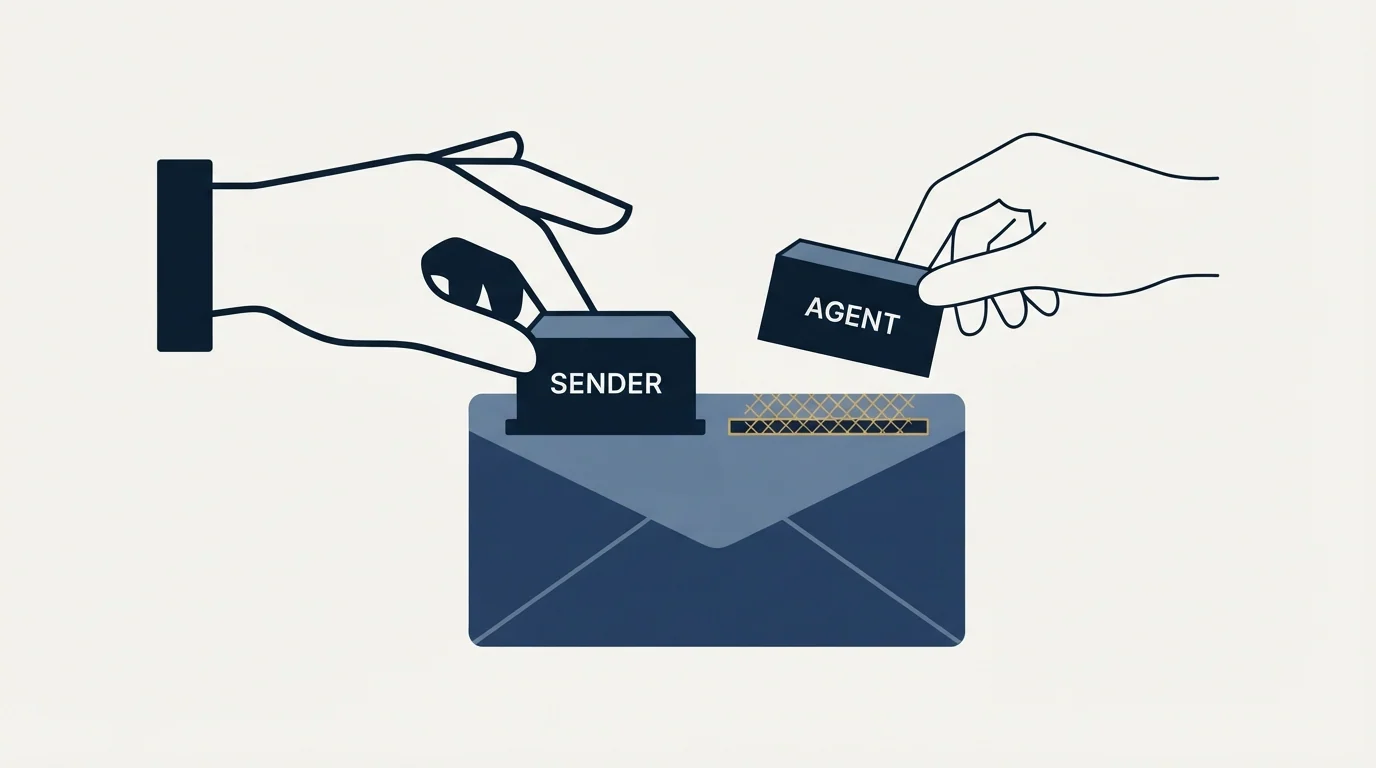
A supplier running outbound for a company has three options and only one of them is comfortable in every case.
Sending under a named person at the client is the strongest for credibility, because everything a recipient checks belongs to the company they are actually being asked to meet. It requires a real person who agrees to it, whose profile supports it, and who is available when replies arrive, since a reply landing with somebody who did not know the campaign existed undoes the credibility the name bought.
Sending under a named person at the supplier is honest and weaker, because the recipient now has to understand a relationship before they can evaluate the offer. It works where the supplier is itself recognised, and it makes the first sentence do extra work.
Sending under an invented person is the option to refuse. It fails the search test by construction, and it fails it exactly when the recipient was interested enough to look.
The general rule is that the name should belong to whoever the reply is genuinely going to, because that is the only version that stays true after somebody responds.
Where the shared inbox is genuinely the right answer
Everything above argues against role accounts for a first unsolicited message, and there is one case where the argument inverts.
When the message is a reply into an existing thread, or when the recipient has already been told that a named function handles a particular kind of request, an alias stops reading as a broadcast and starts reading as a routing address. The recipient is no longer deciding whether to trust a stranger, they are deciding where to send an answer, and a shared address is the more useful destination.
The distinction is whether the recipient already has a reason to expect the message. A first cold email has to establish that somebody chose to write to them specifically, and no alias can carry that claim. Once the relationship exists, the same alias carries something the individual name cannot, which is that the answer will be seen even if one person is away.
The practical version for a small team is to send from named individuals and to publish the shared address in the signature as the alternative, so both properties are available and the recipient chooses.
Small decisions that matter more than they look
First name only. Reads as informal rather than suspicious in isolation, and it removes the searchability that everything above depends on. Use both.
Nicknames. A message from a name that does not match any public record of the person creates a small unnecessary gap. Where somebody genuinely goes by a shortened name, having it appear on their public profile closes it.
Titles in the from field. Rarely helps. The subject line and the opening sentence carry the reason for the message better than a job title compressed into an identity field.
Consistency across a campaign. Changing the sending identity partway through a campaign, or across mailboxes inside one, splits whatever recognition the campaign builds and makes replies harder to route. Pick the identity before the send rather than during it.
One message, one identity. Because we run a single message per campaign and never send a follow-up under a different name, the identity question is settled once per campaign rather than drifting across a sequence. A later approach is a separate campaign, with its own premise and its own sender decision.
The short version
The sender name is read before the subject line and is the only part of a cold email a recipient can independently verify. Use a real person with a first name and a surname, make sure they are findable and that their public employer matches the signature, route replies to the person whose name is on the message, and keep the domain from contradicting the other three signals. Where somebody sends on your behalf, the name should belong to whoever the reply actually reaches. Getting this right does not make a weak message work, and getting it wrong disqualifies a strong one after it has already been read. The wider definition of what separates this from bulk mail is in what a cold email is.
If you would rather see the whole identity, infrastructure and message decision made once and made properly, get a free campaign plan.
Frequently asked questions.
Frequently asked questions- Should a cold email come from a person or from a company address?
- From a named person, with a first name and a surname, for a first unsolicited message. A role address reads as a broadcast and is treated as one. The exception is a reply into an existing thread, or a function the recipient has already been told handles that request, where a shared address is the more useful destination rather than a weaker identity.
- Does the sender name affect deliverability or just credibility?
- The judgements described here are credibility ones, made by a human in the inbox list view. The technical layer that decides whether the message arrives at all is separate and sits with authentication, domain separation and sending volume. Both matter, and confusing them leads teams to rewrite identity fields when the actual problem is infrastructure.
- Whose name should be used when an agency sends on your behalf?
- Whoever the reply is genuinely going to. A named person at the client is strongest, because everything a recipient checks belongs to the company they are being asked to meet, but it needs that person to be available when replies arrive. A named person at the supplier is honest and weaker. An invented person is the option to refuse.
- Does a separate sending domain hurt credibility?
- Less than most senders expect, because the domain is the weakest of the four signals a recipient checks and the one they are least likely to inspect. What matters is that it does not contradict the others. A domain recognisably related to the company reads as ordinary infrastructure; one unconnected to anything named in the message is the version that costs something.
About the author.

Ben Carden is CRO at RevenueFlow, which builds and operates outbound revenue engines for B2B companies. Previously at Gartner Enterprise. Studied at London School of Economics.
Ben Carden · CRO
Connect on LinkedIn →Explore more.
Ready to scale your outreach?
We build GTM engines that book real meetings. See the receipts.
Related articles.
What a Cold Email Is, and What Separates It From Spam
A cold email is a first business email to somebody with no prior relationship with you. What that one condition rules in, rules out, and demands technically.
The Cold Email Signature Is an Identity Claim
A recipient who is mildly interested and mildly suspicious checks that you exist before replying. The signature is where that check either resolves or does not.
GMass Mail Merge: Sending Inside Gmail, and What It Costs
GMass runs the merge inside Gmail, which removes every setup step and hands your sending ceiling and your reputation to Google in the same move.
The GMass Extension: What Sending From Your Mailbox Trades
GMass puts the sending layer inside Gmail, which removes the setup and concentrates the risk on your primary domain. When that trade is right, and when it is not.
Disposable Email: The Data-Quality Class Hiding Inside a Privacy Tool
A disposable email address is a throwaway inbox created to receive one message. In a B2B list it is a row that will accept mail and never be read again.
How to Write a Third Follow Up Email, Line by Line
A third follow up email belongs only in a thread where the person replied or agreed to something. When to send one, and how to write it line by line.