Disposable Email: The Data-Quality Class Hiding Inside a Privacy Tool
A disposable email address is created for short-term throwaway use, typically to receive one message and then be abandoned, so the person's real address is never given out. For a sender it is a data-quality class: a row that accepts mail, cannot reply, and quietly sits in the denominator of every rate you calculate.
Key takeaways
- The same address means opposite things at each end: a privacy tool to the person who created it, a defect in an otherwise accurate record to the sender holding it later.
- They enter B2B datasets through gated content, trials, webinars and any form that trades an email address for something the visitor wants immediately.
- They rarely bounce and never reply, so they show up as delivered and silently distort reply, positive-reply and meeting rates.
- Detection matches against a list of known throwaway domains, so a clean verdict describes the checker's list rather than your data.
Disposable Email: The Data-Quality Class Hiding Inside a Privacy Tool
A disposable email address is an address created for short-term, throwaway use, typically to receive one message and then be abandoned, so the person's real address is never given out. From the sending side it is a data-quality class: a row in your list that will accept mail and that nobody will ever return to read.
That second sentence is the whole reason this entry exists. Almost everything written about disposable addresses is written for the person creating one. This is written for the person who has several thousand of them sitting in a prospect list without knowing it.
What the services actually do
The mechanics are simple, and knowing them is what makes the addresses recognisable.
A disposable address service hands a visitor a working inbox with no signup. Some publish a fixed pool of public addresses that anyone can read, which is why they were originally called throwaway or trash mail. Most now generate a unique address on demand at one of the domains the service controls, show the visitor a live inbox page for it, and expire that inbox after a set period. A few forward to a real address for a limited window, then stop.
Three properties follow, and all three matter to a sender.
They are almost always receive-only. The service exists to catch a confirmation link, so there is usually no way to reply from the address at all. A prospect who wanted to answer you could not.
They expire. The inbox is gone within hours or days, and mail arriving afterwards either bounces or vanishes into a mailbox nobody has ever opened. Neither outcome produces a signal you can read as disinterest.
They run on domains the service owns, and a service can own hundreds. Adding a new one costs the operator almost nothing, which is the fact that determines everything in the detection section below.
How they end up in a B2B dataset
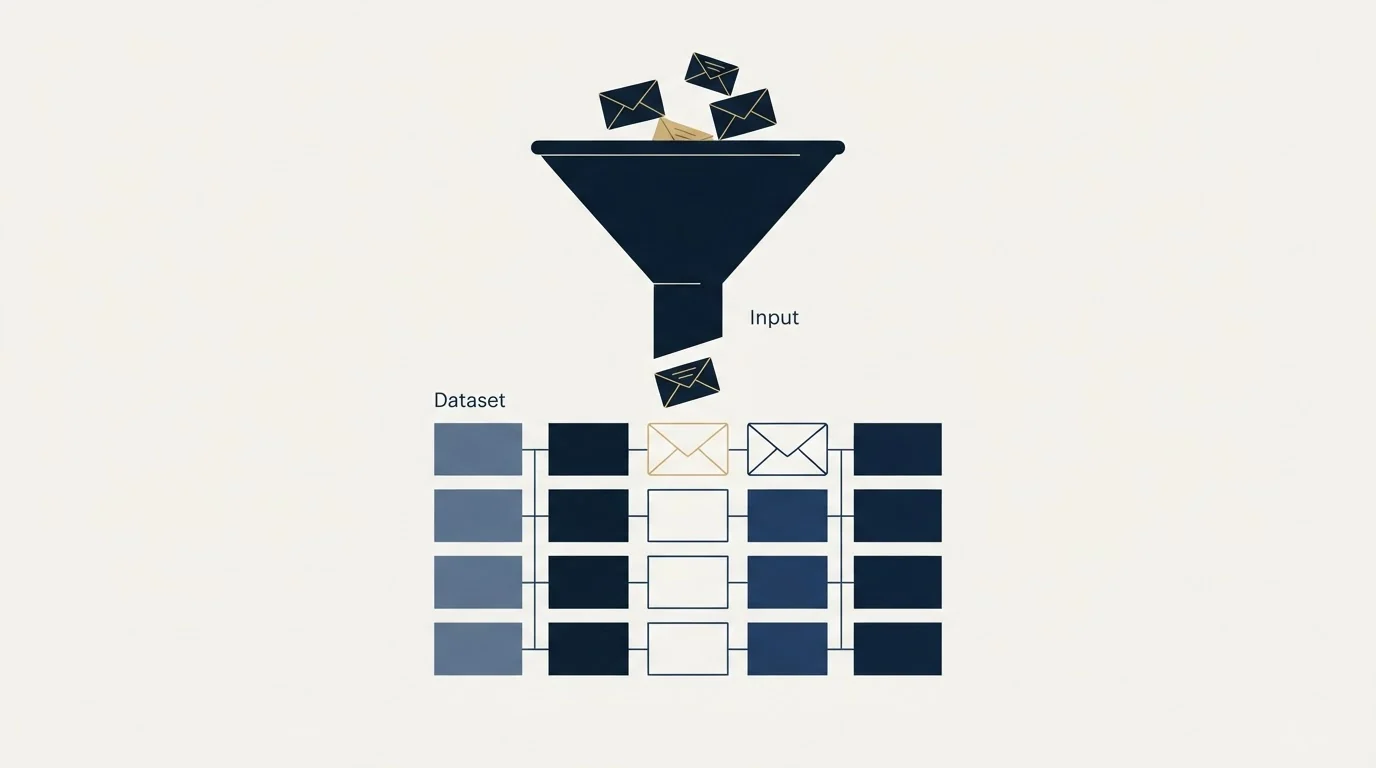
Nobody deliberately buys disposable addresses. They arrive as a side effect of any exchange that trades an email address for something the visitor wants immediately.
- Step 1Something is gated
A report, a template pack, a pricing page, a trial. The visitor wants the thing and does not want the mail that comes with it.
- Step 2The visitor supplies a throwaway address
A working inbox at a domain the service controls, created in seconds, expected to survive one confirmation link.
- Step 3The address is stored as a lead
It enters the marketing database with the visitor's real name, real company and real job title attached.
- Step 4It is enriched, exported or sold
Providers and lists absorb the row. By this point the address looks exactly like every other business contact in the file.
- Step 5You send to it
The message is delivered to an inbox that expired months ago, and the row counts as a contacted prospect.
The step that produces the damage is the third one. The rest of the record is genuine, so nothing about the row looks suspect. A real person at a real company gave a real name and a real title, and lied about exactly one field. Every downstream system treats the row as high quality because five of its six fields are accurate.
Gated content is the largest single source, and the trade behind it is worth understanding on its own terms: what a form is really asking a visitor to pay is set out in lead magnets, and the field-by-field cost of asking is in landing page lead generation. Free trials, webinar registrations and anything with a download button behind an email field all contribute the same way.
Why they are worthless as outbound targets
A disposable address fails every purpose an outbound list has, and it fails them quietly.
It cannot generate a reply, because the inbox has expired and frequently could not send in the first place. It does not generate a clean permanent failure either, at least not reliably, because some services keep accepting mail at their domains indefinitely and simply discard it. So the address does not show up as a bad address in your bounce reporting, and it does not show up as a disinterested prospect in your reply reporting. It shows up as delivered, and delivered is the metric most programmes treat as the floor of success.
The result is a slow, invisible dilution. Every disposable address in a campaign is a send that had no chance of an outcome, sitting in the denominator of every rate you calculate. Reply rate, positive-reply rate and meeting rate are all computed against a population that includes contacts who were never reachable. The number you are optimising against is quietly wrong, and it is wrong in the direction that makes your copy look worse than it is.
The dilution compounds when the same population is used to make decisions. A campaign judged weak on a rate computed over unreachable rows gets rewritten, and the rewrite is judged against the same contaminated denominator, so the comparison between the versions is no more reliable than the original reading was. Any test run on that list inherits the same defect, and the contamination is rarely spread evenly, since the rows came from particular acquisition channels rather than at random. One segment can carry most of it while another carries none, which turns a data problem into a false conclusion about which segment responds.
There is a smaller second cost. Some throwaway domains are watched by receiving providers precisely because legitimate senders should not be mailing them in volume, so a stream containing a visible share of them is one more input into how your sending is judged. The reputational cost is modest next to the measurement cost, and both are avoidable with the same pass.
Where the definition breaks

Two things go wrong here, and the first is a matter of perspective rather than data.
The same object means opposite things at each end
To the person creating one, a disposable address is a privacy tool and a perfectly reasonable one. They are protecting a real inbox from a mailing programme they never asked to join, and the address does its job the moment the download arrives.
To the sender holding that address six months later, the same object is a defect. It is the one field in an otherwise excellent record that guarantees the record cannot be used. Nothing about it has changed; only the end you are standing at has changed.
The inversion matters practically, because it explains why the search results for this term are almost entirely useless to a sender. The literature is consumer literature. It compares services, ranks them on how long the inbox lives and how few adverts it shows, and never mentions that the addresses it is helping people create are the thing corrupting somebody's dataset. If you arrived looking for a temporary inbox, this entry is not that, and the right answer is any of the services the rest of the internet reviews.
Detection is a list, and a list is never complete
The second break is the one that costs money, because most people assume detection is solved.
Identification works by matching an address's domain against a list of known throwaway domains. That is the entire mechanism in every verification product, every open-source library and every home-grown regex anybody has ever written. It is a lookup. It is fast, cheap and correct about everything it contains.
The problem is what it does not contain. New throwaway domains appear constantly, because registering one costs an operator almost nothing and rotating them is the obvious defence against exactly this kind of blocking. Some services deliberately run on ordinary-looking custom domains chosen so that no list carries them. Others let users bring their own domain, which means the address is functionally disposable and looks completely unremarkable.
- Yes: None of your addresses sit on a domain the checker's list knows about
- Yes: The obvious, long-running throwaway services are excluded
- No: Your list carries no addresses from services registered since the checker last updated
- No: Your list carries no addresses at custom domains the service runs deliberately to stay off lists
- No: Every remaining address belongs to a person who reads it
There is a structural reason the lag never closes. The list maintainer has to observe a domain being used as a throwaway service before it can be added, and the operator only has to register a fresh one. The cost of evasion is a domain registration; the cost of detection is discovery, verification and distribution to every product consuming the list. Those two costs are not close, so the gap is permanent rather than a temporary state of tooling. Any checker will be strongest against the services that have existed longest and weakest against whatever appeared last month, which is also the pool most likely to be feeding a list assembled recently.
That is the same shape as a blocklist reading, and the same discipline applies: an absence of matches is a statement about the list the checker holds, never a guarantee about your data. The parallel is exact, and the blacklist check and recovery case has the same structure, where a clean lookup across the lists a tool happens to query says nothing about the ones it does not. Treat a disposable-address verdict as a floor on the problem rather than a measurement of it.
The practical consequence is that detection should not be your only defence. The behavioural signals are more durable than the domain list: an address that has never produced an open, a click or a reply across any campaign, on a record whose other fields look excellent, is a plausible throwaway regardless of what its domain looks like. Comparing that against what normal cold traffic actually returns is easier with bounce rate benchmarks in hand, since an address class that neither bounces nor replies distorts both sides of the picture.
Three classes that get flattened into one
Disposable addresses are usually filed alongside two other things under a single heading called bad data, and the three want genuinely different treatment.
- Created to receive one message and be abandoned
- Frequently cannot reply at all
- No amount of copy quality recovers it
- Detection is a domain list and the list is always behind
- Remove it
- info@, sales@, support@, admin@
- Read by several people or by nobody, depending entirely on company size
- Genuinely reachable in small businesses
- Detection is reliable, since the local part is the signal
- Handling depends on the audience
- The domain accepts mail for every local part
- Verification cannot confirm the mailbox exists
- Often a large, well-run organisation
- Detection is reliable at the domain level
- Treat as unknown, not as invalid
The detail of the other two belongs elsewhere. Role-based addresses have their own entry in this glossary, and the short version is that the blanket rule against them is wrong at the small end of the market, where a generic inbox is frequently read by the owner. Catch-all domains have their own entry too, and the short version there is that an unresolved address is not a bad address. Filing all three under one heading produces one blunt policy, and the blunt policy either keeps addresses that cannot work or discards addresses that would have.
In a live programme

The handling is short. Run a verification pass that includes a disposable-domain check, because it is cheap and it removes the obvious tier; the products that do it are compared in email verification tools. Then treat the result as incomplete, and let engagement history carry the rest of the load over time.
Where the class is worth real attention is at the point of ingestion rather than the point of sending. A list assembled largely from gated downloads, trial signups and webinar registrations carries a materially higher share of throwaway addresses than one built from published company data, because the first kind of list is made of exactly the moments that produce them. Knowing which of those two a dataset came from tells you more about how much of it is real than any check you can run afterwards.
Keeping these classes apart is list work that never quite finishes. Our pay-per-qualified-meeting outbound absorbs it, so what reaches you is the meetings.
Frequently asked questions.
Frequently asked questions- What is a disposable email address?
- An address created for short-term throwaway use, usually to catch one confirmation message and then be abandoned. The service hands out a working inbox at a domain it controls, shows it in a browser, and expires it after a set period. Most are receive-only, so the person behind one cannot reply even if they wanted to.
- How do disposable addresses get into a B2B prospect list?
- Through anything that trades an email address for immediate access: gated reports, template packs, free trials, webinar registrations. The visitor gives a genuine name, company and title alongside a throwaway address. The record then looks high quality in every field but one, and enrichment and list resale carry it onward.
- Can email verification detect every disposable address?
- No. Detection works by matching the domain against a list of known throwaway services, and new domains appear faster than lists absorb them. Some services deliberately run on ordinary-looking custom domains that no list carries. A clean result is a floor on the problem rather than a measurement of it.
- Are disposable, role-based and catch-all addresses the same problem?
- No, and treating them as one bucket of bad data produces a blunt policy. A disposable address is unreachable and should go. A role-based address is genuinely reachable in a small business and a black hole in a large one. A catch-all address is unresolved rather than invalid, so it should be treated as unknown.