Cold Email Length Benchmarks: 2026 Performance Data
Industry data shows cold emails between 50-125 words achieve the highest response rates. Discover the optimal length benchmarks for different situations and audiences.
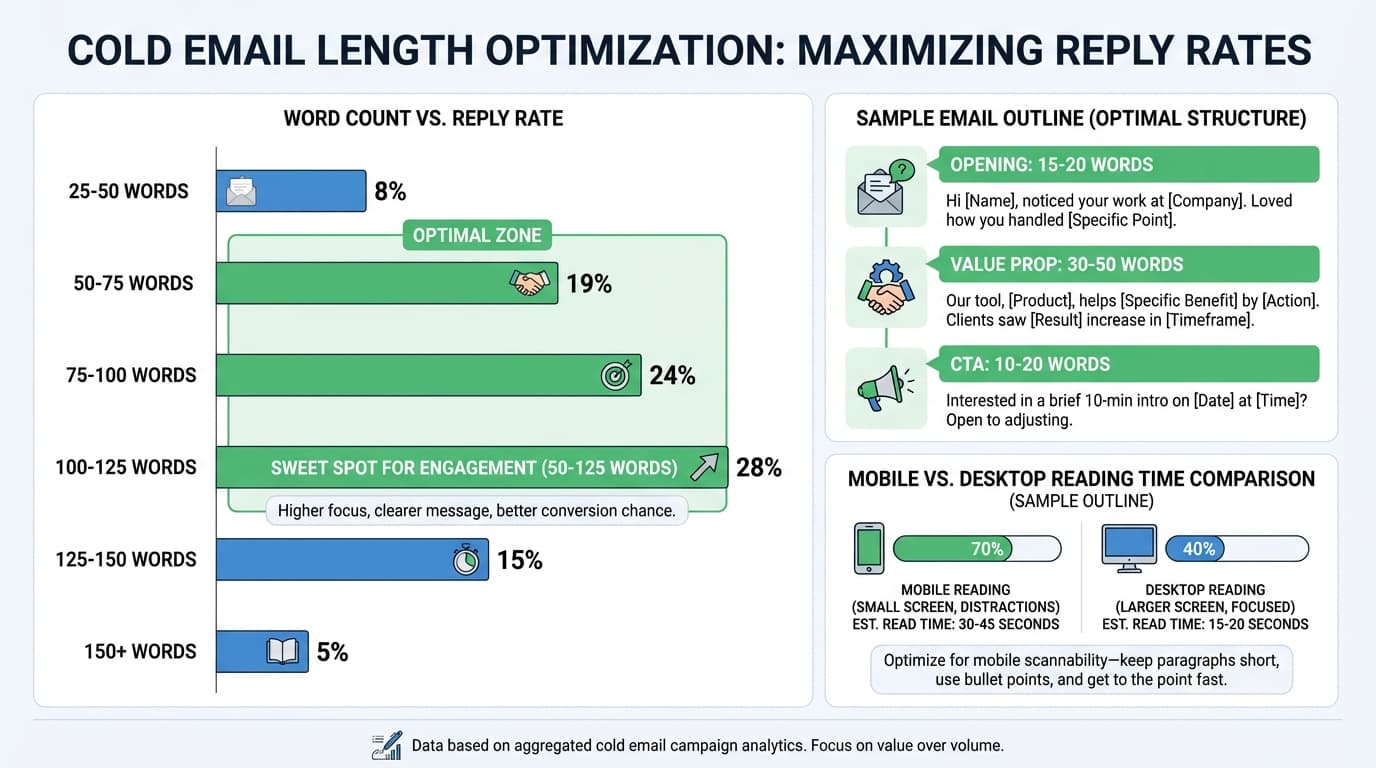
Cold emails between 50-125 words achieve the highest response rates in B2B outreach, typically generating 4-9% reply rates. The optimal length is 50-75 words for initial emails, with performance declining significantly beyond 150 words. Executive audiences require shorter emails (40-75 words) while individual contributors tolerate up to 125 words when content is directly relevant.
Key takeaways
- Emails in the 50-75 word range achieve the highest reply rates at 5-9%, while emails over 200 words drop to 1-3% response rates.
- Follow-up emails should progressively decrease in length, with the first follow-up at 40-70 words and breakup emails at just 20-40 words.
- C-suite executives require the shortest emails at 40-75 words maximum, while managers and individual contributors engage with emails up to 125 words.
- Technology and SaaS buyers prefer shorter 50-90 word emails due to high inbox volume, while professional services audiences tolerate 75-125 words.
- The average reader spends only 8-12 seconds on cold emails, making the first 3-4 sentences critical for engagement.
Reviewed and updated August 28, 2026
Cold Email Length Benchmarks: 2026 Performance Data
The objection is often phrased as cold email taking too long, which runs two complaints together: the length of the message, answered by the bands here, and the time before results appear, which is a property of the sales cycle rather than of the copy.
Email length is one of the most debated topics in cold outreach. Industry data provides clear guidance: shorter emails generally outperform longer ones, with the sweet spot falling between 50-125 words for most B2B cold email campaigns. However, optimal length varies by situation, audience, and email position in a sequence.
This benchmark report covers the performance data for different email lengths, providing specific guidance on when shorter or longer formats work best.
About This Data
The benchmarks presented in this report are compiled from publicly available industry research, aggregated data from sales engagement platforms, and typical ranges observed across B2B cold email campaigns. These figures represent industry estimates and general ranges rather than definitive standards. Your actual results will vary based on your specific industry, target audience, and message quality.
We recommend using these benchmarks as directional guidance while testing length variations for your specific audience.
Email Length Performance Overview
The question is usually asked as how many words a cold email should be, and the ranges below are the answer, read against the audience and the email type rather than as a single target.
Asked instead as how long should a cold email be, the answer is the same set of ranges, judged against the audience and the email type rather than against a single target number.
Here are the general benchmarks for cold email performance by word count:
| Word Count | Typical Reply Rate | Best Use Case |
|---|---|---|
| Under 25 words | 3% - 5% | Simple follow-ups only |
| 25-50 words | 4% - 7% | Follow-ups, short asks |
| 50-75 words | 5% - 9% | Effective initial emails |
| 75-100 words | 5% - 8% | Good balance |
| 100-125 words | 4% - 7% | Complex value propositions |
| 125-150 words | 3% - 6% | When detail is necessary |
| 150-200 words | 2% - 5% | Only when required |
| 200+ words | 1% - 3% | Generally too long |
The optimal range is 50-125 words. This provides enough space to establish relevance, convey value, and include a clear CTA without overwhelming the reader.
Length Performance by Email Type
Different email types have different optimal lengths.
Initial Cold Outreach
| Length | Performance | Recommendation |
|---|---|---|
| Very short (under 50 words) | Medium | May lack context |
| Short (50-75 words) | Highest | Ideal for most situations |
| Medium (75-125 words) | High | Good with strong personalization |
| Long (125+ words) | Lower | Only for complex offerings |
First emails should be concise enough to respect the reader's time while providing enough context to establish relevance.
Follow-Up Emails
| Email Position | Optimal Length | Notes |
|---|---|---|
| Follow-up 1 | 40-70 words | Shorter than initial |
| Follow-up 2 | 30-60 words | Brief, new angle |
| Follow-up 3 | 50-80 words | Can add value |
| Follow-up 4+ | 25-50 words | Very brief |
| Breakup email | 20-40 words | Minimal, direct |
Follow-up emails should progressively decrease in length, acknowledging that you have already made your main case.
Value-Add Emails
| Content Type | Optimal Length | Approach |
|---|---|---|
| Resource share | 50-80 words | Brief intro + link |
| Case study | 60-100 words | Summary + offer to share more |
| Insight/news reference | 50-90 words | Quick context + relevance |
| Event invitation | 40-70 words | Key details only |
Length by Audience Seniority
Different seniority levels have different attention spans and expectations.
C-Suite Targeting
| Metric | Benchmark |
|---|---|
| Optimal length | 40-75 words |
| Maximum recommended | 100 words |
| Key requirement | Immediate relevance |
Executives have the least time and highest inbox competition. Every word must earn its place.
VP/Director Targeting
| Metric | Benchmark |
|---|---|
| Optimal length | 60-100 words |
| Maximum recommended | 125 words |
| Key requirement | Clear value proposition |
Mid-level leaders have more time than executives but still prefer efficient communication.
Manager/IC Targeting
| Metric | Benchmark |
|---|---|
| Optimal length | 75-125 words |
| Maximum recommended | 150 words |
| Key requirement | Practical relevance |
Individual contributors may engage with slightly longer emails if the content is directly relevant to their work.
Length by Industry
Different industries show varying tolerance for email length.
Technology and SaaS
| Metric | Benchmark |
|---|---|
| Optimal length | 50-90 words |
| Typical tolerance | Lower |
| Key factor | Get to the point quickly |
Tech buyers receive heavy email volume and expect efficient communication.
Professional Services
| Metric | Benchmark |
|---|---|
| Optimal length | 75-125 words |
| Typical tolerance | Medium-High |
| Key factor | Relationship context matters |
Professional services buyers accept slightly longer emails that establish relationship potential.
Healthcare
| Metric | Benchmark |
|---|---|
| Optimal length | 75-125 words |
| Typical tolerance | Medium |
| Key factor | Compliance and evidence context |
Healthcare buyers may need more context around compliance and evidence, justifying moderate length.
Financial Services
| Metric | Benchmark |
|---|---|
| Optimal length | 60-100 words |
| Typical tolerance | Medium |
| Key factor | Trust and credibility signals |
Financial services buyers prefer efficient emails but value trust-building context.
Reading Time Benchmarks
Understanding reading patterns helps optimize length.
Average Reading Metrics
| Metric | Average | Optimal Target |
|---|---|---|
| Time spent on cold emails | 8-12 seconds | Design for 10 seconds |
| Reading speed | 200-250 words/minute | 50-100 words in window |
| Attention drop-off | After 3-4 sentences | Front-load value |
| Mobile reading | 35% shorter attention | Write for mobile |
Reading Behavior by Device
| Device | Attention Span | Optimal Length |
|---|---|---|
| Desktop | 12-15 seconds | 75-125 words |
| Tablet | 10-12 seconds | 60-100 words |
| Mobile | 8-10 seconds | 50-80 words |
With over 60% of emails first opened on mobile, optimizing for shorter attention spans is critical.
Structure and Length Interaction
How you structure your email affects how length impacts performance.
Optimal Structure by Length
| Length | Recommended Structure |
|---|---|
| Very short (under 50) | 1 sentence context + 1 sentence ask |
| Short (50-75) | 2-3 sentences total |
| Medium (75-100) | 3-4 sentences with clear breaks |
| Longer (100-125) | 4-5 sentences, possible bullets |
| Long (125+) | Must use formatting for scannability |
Paragraph Length Best Practices
| Paragraph | Max Lines | Purpose |
|---|---|---|
| Opening | 1-2 lines | Hook/relevance |
| Body | 2-3 lines | Value proposition |
| CTA | 1-2 lines | Clear ask |
Short paragraphs (2-3 lines max) improve readability regardless of total length.
Sentence Length Impact
| Avg Sentence Length | Readability | Performance |
|---|---|---|
| Under 15 words | Excellent | Highest |
| 15-20 words | Good | High |
| 20-25 words | Acceptable | Medium |
| Over 25 words | Poor | Lower |
Short sentences improve comprehension and make emails feel shorter even at the same word count.
When Longer Emails Work
While shorter generally performs better, some situations warrant longer emails.
Justified Longer Emails
| Situation | Why Length Helps |
|---|---|
| Complex technical offering | Needs explanation |
| High-value, infrequent opportunity | Worth the investment |
| Strong personalization | Research deserves space |
| Multiple stakeholder concerns | Address varied interests |
| Referral introductions | Context from referrer |
When to Go Long
| Factor | Go Longer If... |
|---|---|
| Personalization depth | You have specific, relevant insights |
| Offer complexity | Value requires explanation |
| Trust requirement | Extra context builds credibility |
| Referral context | Connection story adds value |
Even when going longer, staying under 150 words is almost always advisable.
Length Optimization Techniques
Cutting Without Losing Value
| Technique | Example |
|---|---|
| Remove filler phrases | "I wanted to reach out" becomes "Reaching out" |
| Eliminate redundancy | "Various different options" becomes "options" |
| Use active voice | "Meetings can be scheduled by you" becomes "Schedule a meeting" |
| Cut preambles | Remove "I hope this finds you well" |
| Tighten language | "In order to" becomes "to" |
Common Length Traps
| Trap | Problem | Solution |
|---|---|---|
| Long company intro | Self-focused | One line max |
| Feature lists | Overwhelming | Focus on one benefit |
| Multiple CTAs | Confusing | One clear ask |
| Excessive qualifications | Weakens message | Be direct |
| Repeated points | Wastes space | Make point once |
Length A/B Testing Results
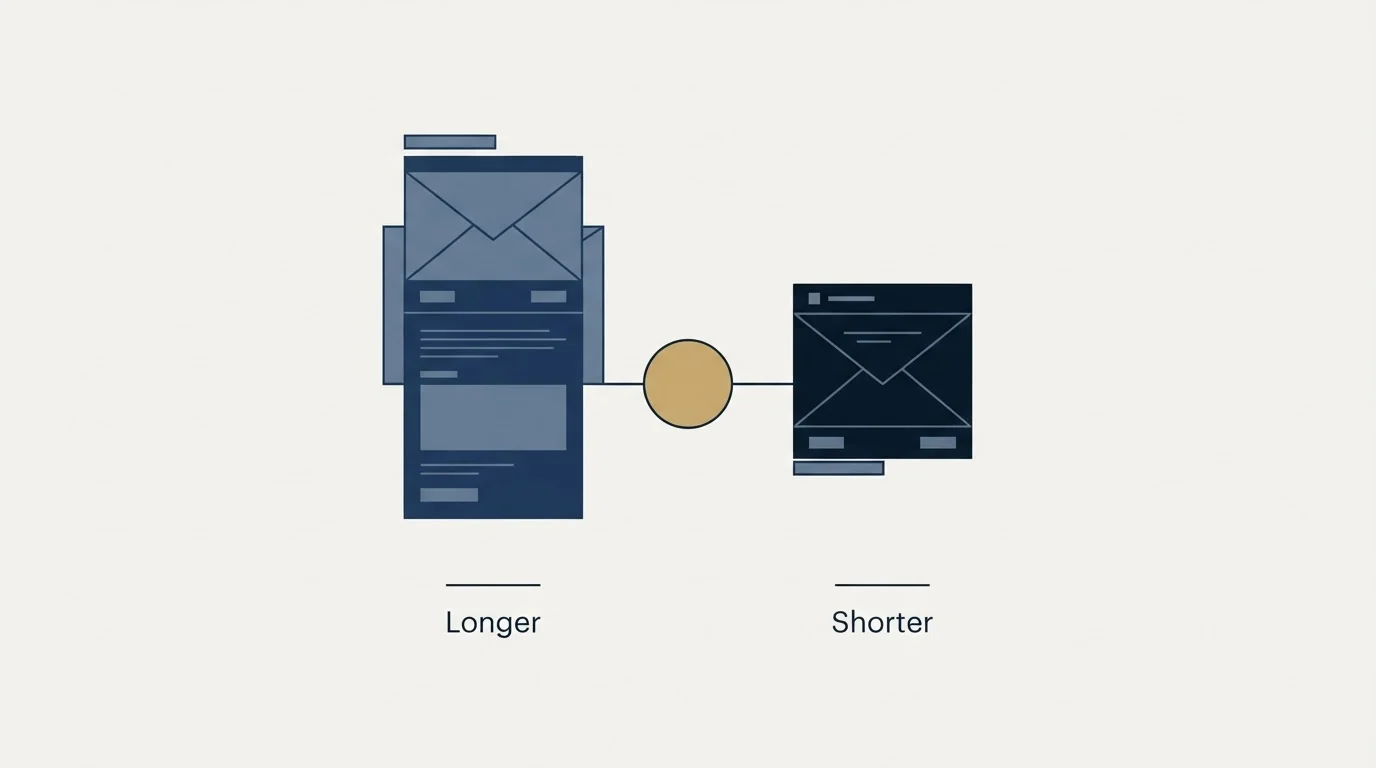
Testing consistently shows shorter emails winning.
Typical Test Outcomes
| Test | Winner | Margin |
|---|---|---|
| 50 words vs. 100 words | Shorter | +15-25% |
| 75 words vs. 150 words | Shorter | +20-35% |
| 100 words vs. 200 words | Shorter | +30-50% |
Testing Recommendations
| Test Approach | Implementation |
|---|---|
| Start with extremes | 50 vs. 150 words |
| Refine the winner | 50 vs. 75 words |
| Test by segment | Different audiences may vary |
| Consider quality | Reply quality, not just volume |
Length Standards by Email Component
Subject Line Length
| Length | Open Rate | Recommendation |
|---|---|---|
| 1-4 words | 45% - 55% | Good for simple messages |
| 4-7 words | 50% - 60% | Optimal |
| 8-10 words | 40% - 50% | Getting long |
| 10+ words | 30% - 42% | Too long |
Body Copy Breakdown
| Component | Max Words | Purpose |
|---|---|---|
| Opening line | 15-20 | Hook attention |
| Value proposition | 30-50 | Core message |
| Social proof (if included) | 15-25 | Build credibility |
| CTA | 10-20 | Clear ask |
P.S. Line (If Used)
| Length | Effectiveness |
|---|---|
| 10-20 words | High readership |
| 20-30 words | Still effective |
| 30+ words | Diminishing returns |
P.S. lines get high readership but should be brief and add value.
Measuring Length Impact
Key Metrics to Track
| Metric | How Length Affects It |
|---|---|
| Open rate | Indirect (preview text) |
| Reply rate | Direct correlation |
| Read time | Direct correlation |
| Meeting conversion | Quality indicator |
Performance Tracking
Track performance by word count ranges:
- Under 50 words
- 50-75 words
- 75-100 words
- 100-125 words
- 125+ words
Compare reply rates, positive reply rates, and meeting conversions across groups.
Length Guidelines Summary
Quick Reference by Situation
| Situation | Target Words |
|---|---|
| Initial cold email | 50-75 |
| Follow-up email | 30-60 |
| Executive targeting | 40-75 |
| Complex offering | 100-125 max |
| Breakup email | 20-40 |
| Resource share | 50-80 |
The 100-Word Test
A simple rule of thumb: if you cannot make your point compellingly in 100 words, either your message lacks focus or your value proposition needs refinement.
Setting Length Standards
Based on industry benchmarks, here are recommended length standards:
| Element | Standard |
|---|---|
| Initial email | 50-100 words |
| Follow-up emails | 30-75 words |
| Maximum length | 125 words (rare exceptions) |
| Sentence length | Under 20 words average |
| Paragraph length | 2-3 lines maximum |
Optimizing Your Email Length
Email length is an easy variable to optimize with clear performance implications. The benchmarks consistently show that shorter, more focused emails outperform longer alternatives. Respect your recipient's time, and they are more likely to give you theirs.
If you want to optimize your email length or need help crafting concise, high-converting cold emails, our team specializes in building effective outreach programs for B2B companies.
Get a free campaign audit and see how your current email structure compares to top performers. We will identify specific opportunities to tighten your messaging for better response rates.
Related Reading
Frequently asked questions.
Frequently asked questions- What is the ideal length for a cold email?
- The optimal cold email length is 50-125 words, with 50-75 words performing best for most initial outreach. This range achieves reply rates of 5-9%, balancing enough context to establish relevance without overwhelming the reader. Emails shorter than 50 words may lack necessary context, while those exceeding 150 words see response rates drop to 2-5% or lower.
- Should cold emails to executives be shorter than emails to managers?
- Yes, executives require significantly shorter emails. C-suite targets respond best to 40-75 word emails with a 100-word maximum, while managers and individual contributors engage with 75-125 word emails. Executives face higher inbox competition and have less time, making every word critical. VP and director-level contacts fall in between at 60-100 words optimal length.
- How long should follow-up emails be compared to the first email?
- Follow-up emails should be progressively shorter than your initial outreach. The first follow-up should be 40-70 words, the second 30-60 words, and subsequent follow-ups 25-50 words. Breakup emails work best at just 20-40 words. This decreasing length acknowledges you've already made your main case and respects the recipient's decision-making process.
- Does industry affect the optimal cold email length?
- Yes, different industries show varying tolerance for email length. Technology and SaaS buyers prefer shorter 50-90 word emails due to high email volume. Professional services and healthcare audiences accept 75-125 words when establishing relationship context or addressing compliance needs. Financial services contacts prefer efficient 60-100 word emails that still include trust-building elements.
About the author.

Hosun Chung is COO at RevenueFlow, which builds and operates outbound revenue engines for B2B companies. Previously at Gleacher Shacklock LLP. Studied at London School of Economics.
Hosun Chung · COO
Connect on LinkedIn →Explore more.
Ready to scale your outreach?
We build GTM engines that book real meetings. See the receipts.
Related articles.
Cold Email Spam Rate Benchmarks: 2026 Performance Data
Industry standards require keeping spam complaint rates below 0.1% to maintain sender reputation. Learn the benchmarks and strategies to protect your cold email deliverability.
Cold Email Follow-Up Benchmarks: 2026 Performance Data
The follow-up benchmarks kept intact and read against their own definitions, plus why RevenueFlow sends one message per campaign instead.
Cold Email Bounce Rate Benchmarks: 2026 Performance Data
A 3.04% platform bounce rate held 1.27% true hard bounces, 2.38% with blocks included, and 12.6% delay notices. What low bounce email data is made of.
Cold Email Subject Line Benchmarks: 2026 Performance Data
Industry data reveals that subject lines determine 35-50% of open rate variation. Discover the benchmarks for length, personalization, and format that drive the highest engagement.
Cold Email Personalization Benchmarks: 2026 Performance Data
LeadMagic, Cognism, Explorium and others sell funding and competitor signals. What published data ties to higher reply rates, and how to turn a signal into a line.
Cold Email Sequence Benchmarks: 2026 Performance Data
Every industry sequence figure, kept intact and read honestly: the opening message produces 30-40% of replies, and here is what the rest of them cost.