Social Media Lead Generation: Two Motions, One Number
Social lead generation is an audience that compounds and outreach that costs the same every month. Counted as one number, neither can be managed.
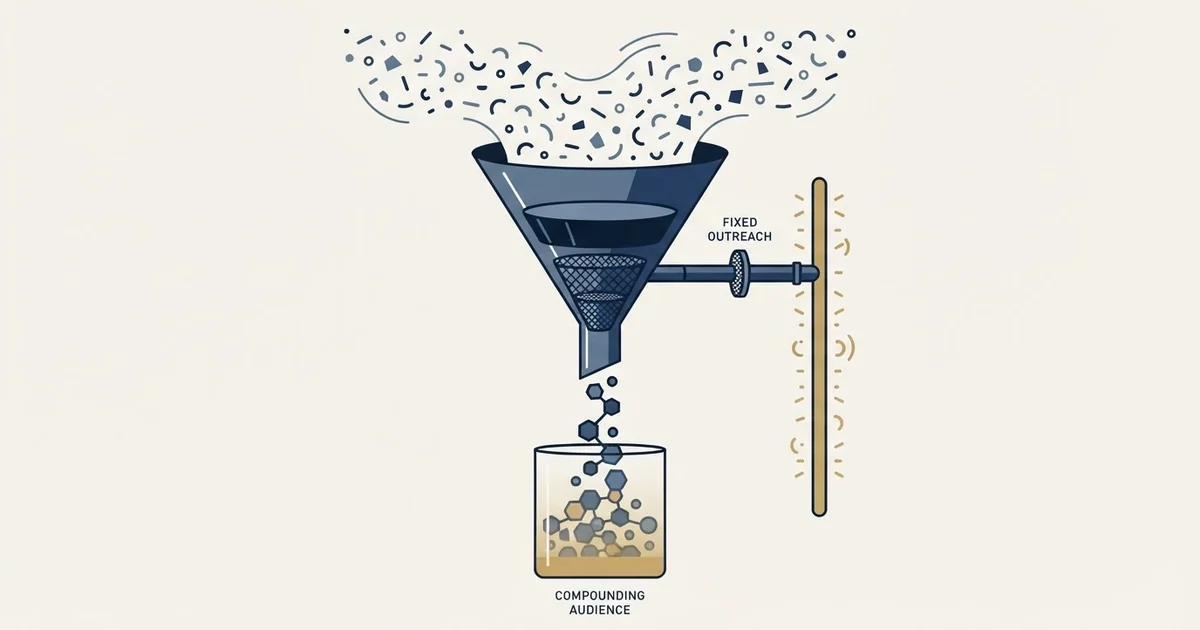
Social media lead generation is two separate motions sharing a platform. The audience motion publishes and waits, taking quarters and getting cheaper as it compounds. The outreach motion sends direct messages, works in days, and costs the same every month. Counting them as one number makes both unmanageable.
Key takeaways
- The audience motion compounds and the outreach motion does not, so a single combined lead count causes the compounding half to be judged early and cut.
- Social outreach is capped by platform limits rather than by budget, which makes it a precision channel for a chosen list and never a volume channel.
- Analytics systematically under-credit the audience motion, because a reader who follows for months usually arrives through a search for your company name.
- The audience motion needs a real expert inside the company willing to publish for years, and it cannot be outsourced into existence.
Reviewed and updated September 1, 2026
Social Media Lead Generation: Two Motions Counted as One Number
A marketing lead reports that social generated forty-one leads last quarter. The sales lead pulls the list and finds that nine came from a founder's posts, which took a year of consistent publishing to make possible, and thirty-two came from direct messages a contractor sent to a purchased list. Both arrived through the same platform and both were logged the same way, so both are in the forty-one.
Nothing about that number is usable. It mixes an asset that compounds and gets cheaper with an activity that costs the same every month, and any decision made from it will be wrong for at least one of the two.
Social media lead generation is really two motions that happen to share a login. Keeping them apart is most of what makes the channel manageable.
B2B social selling is the label usually put on both of them at once, which is the reason programmes sold under it are so hard to judge.
Most guides package this as a social media sales funnel, with awareness at the top and a booked call at the bottom. The shape is not wrong so much as it is one funnel drawn over two motions that fill it at completely different rates, which is why a single conversion figure across both tells you nothing about either.
Twitter, now X, is the platform where the audience motion and the outreach motion diverge most sharply, and the outreach half has no equivalent of a connection request to gate it.
The two motions, and why they behave nothing alike
- Publishing, commenting, being visible
- Latency measured in quarters
- Cost per lead falls as the audience grows
- Volume is uncontrollable and uncapped
- Fails by inconsistency and by being boring
- Produces warm, self-selected inbound
- Connection requests and direct messages
- Latency measured in days
- Cost per lead is roughly flat forever
- Volume is hard-capped by platform limits
- Fails by account restriction and bad targeting
- Produces cold conversations you chose
The cost curves are the important row. The audience motion is an investment whose return arrives late and then keeps arriving; the outreach motion is a purchase you make again every month. Treating them as one channel means the compounding one is judged early, when it looks worst, and the flat one is expected to improve with time, which it does not.
They also fail in unrelated ways. An audience programme fails quietly by stopping. An outreach programme fails loudly by getting an account restricted, and that failure takes a real person's professional profile with it.
Where the buyers actually are, per platform
Worth being blunt, because platform choice in B2B is less contested than the volume of content about it suggests.
LinkedIn carries both motions and is where nearly all B2B intent sits. It is also the platform with the most consequential rules, since the outreach motion runs on a personal account that a person needs for their career.
X works for the audience motion in some categories, mostly developer tools, and barely functions for outreach. Direct messages from strangers are close to invisible.
YouTube is an audience motion with an unusually long latency and an unusually durable asset. A video that answers a specific buying question keeps producing conversations for years, which no other social surface does as reliably.
Reddit and niche communities work when a real practitioner participates and fail immediately when marketing arrives. The mechanism is not really social publishing, it is being a known participant, and it cannot be delegated to someone who is not one.
Instagram and TikTok carry very little B2B buying intent for most categories. There are exceptions, generally where the buyer is an owner-operator rather than a functional manager.
Paid social is a separate discipline from everything above and we do not practise it, so treat any advice here about organic reach as not applying to it.
The audience motion, briefly

There is a good first-hand account of what this takes on the site already, and it is more useful than a summary would be: fifteen lessons from growing an audience while revenue grew alongside it.
The two points worth repeating in a channel context. It is a multi-year commitment and the first two quarters look like failure by any measure you would apply to a fast channel, which is the latency and control problem in its purest form. And it does not fix a bad offer; it makes more people aware of whatever the offer already is.
The outreach motion, and the constraint most guides skip
The direct-message motion is the one that gets sold as a service, and the honest framing starts with the platform's own rules rather than with tactics. LinkedIn's help centre states that it does not permit third-party software, including crawlers, bots and browser extensions, that scrape, modify the appearance of, or "automate activity on LinkedIn's website", and that members using such tools "risk having their accounts restricted or shut down". Source: LinkedIn Help, Prohibited software and extensions.
Outreach sold as a done-for-you service still depends on client-owned inputs, a division of labor explored in the inputs that cannot be outsourced.
What is being wagered there is somebody's professional identity rather than a marketing budget, which is a different category of exposure entirely, and the what is safe to outsource piece works through where that risk actually lands when a vendor runs the programme on your team's accounts.
The mechanics of the routes available to reach a stranger, and what each costs, are covered in LinkedIn prospecting.
The constraint specific to this article is that the outreach motion is hard-capped. Platform limits on invitations and messages set a ceiling on attempts per account per week, and that ceiling does not move with budget. So social outreach is a channel whose volume is bounded by headcount rather than by spend, which is unusual and which decides where it fits: it is a precision channel for a list you have chosen carefully, and it cannot be scaled into a volume channel.
There is one thing we refuse here, and it is worth stating plainly because it is standard practice elsewhere. We never write to someone on LinkedIn again on the grounds that they stayed silent the first time. Anything new lands directly underneath what they already saw, in a thread they read and chose to leave, so whatever the campaign structure says, it arrives as a nudge. Email behaves differently, because a fresh message is genuinely a fresh arrival, while a LinkedIn thread is one continuous surface that never resets.
The practical effect is that the opening has to be worth answering on its own merits, which is a healthy constraint on a channel where the temptation to substitute persistence for relevance is unusually strong. It also changes how a list is built. When you get one attempt per person, the cost of a loose list is immediate and visible rather than absorbed by volume, so targeting stops being a quality preference and becomes the thing that decides whether the programme works at all. Teams that adopt this constraint tend to cut their list size and raise their acceptance rate in the same month, because the two were always connected.
Measuring it without fooling yourself

The attribution problem here is worse than in any other channel, and it is structural rather than a tooling gap.
Somebody reads six posts over four months, forms a view, and then searches your company name and arrives through Google. Every analytics system on the market records that as organic search. The audience motion produced the demand and the search box got the credit, which means social is systematically under-credited in exactly the categories where it is working.
- Yes: The two motions are counted separately, always
- Yes: A self-reported how did you hear about us field exists on the form
- Yes: The audience motion is reviewed quarterly, never monthly
- Yes: The outreach motion tracks account health alongside reply rate
- Depends: Follower count is treated as a proxy, not as a result
- No: Last-click attribution is used to decide the audience motion's budget
The self-reported field is a blunt instrument and it is still the best available signal for the audience motion, because it is the only one that captures the reader's own account of what moved them. Its answers are messy and directionally honest, which beats a precise number that is measuring the wrong thing.
For the outreach motion, track account health as a first-class metric next to reply rate. A programme with a rising reply rate and a rising restriction risk is not improving, and reply rate alone will not show that.
What a sensible position looks like
For most B2B companies: run the outreach motion as a precision channel against a list you chose deliberately, sized to what the platform allows rather than to what you wish it allowed. Run the audience motion if a real person inside the company will publish consistently for more than a year, and do not start it if that person does not exist, because it cannot be outsourced into existence.
Once outreach gets outsourced entirely, it helps to understand what a productised lead generation subscription actually includes before signing a renewing contract.
That last point is where most social programmes actually die, and it is a staffing question dressed up as a strategy question. The audience motion requires someone with genuine domain expertise to put their own name and opinions on the internet every week for years. Ghostwriting can help an expert publish more; it cannot manufacture the expertise, and readers detect the difference faster than most marketing teams expect. So the honest first question is not which platform, it is whether that person exists in your company and wants to do it. If the answer is no, the audience motion is not available to you this year regardless of budget, and the sensible move is to put everything into the outreach half and revisit when it changes.
Count the two separately, judge them on different calendars, and accept that the compounding one will be under-credited by your analytics for as long as it is working.
The short version

Social lead generation is two motions with opposite economics sharing a platform: an audience that compounds slowly and outreach that costs the same every month. Counted as one number, neither can be managed. LinkedIn carries most B2B intent and most of the account risk; the outreach motion is capped by platform limits rather than by budget, so it is a precision channel and not a volume one. Count the motions separately, review them on different calendars, and expect attribution to under-credit the audience half.
If the precision half is what you want running against a list you have chosen, we can build and send the first campaign.
Platform policies verified as of mid-2026. Verify current terms with the platform before relying on them.
Frequently asked questions.
Frequently asked questions- Which social platform is best for B2B lead generation?
- LinkedIn carries nearly all B2B buying intent and supports both motions, which is why it also carries the most account risk. X works for the audience motion in some categories, mainly developer tools. YouTube is a slow but unusually durable audience asset. Instagram and TikTok carry little B2B intent outside owner-operator markets.
- How should we measure social media lead generation?
- Count the two motions separately and review them on different calendars, quarterly for the audience half and monthly for outreach. Add a self-reported how-did-you-hear field, because it is the only signal that captures the audience motion honestly. For outreach, track account health next to reply rate, since a rising reply rate can accompany rising restriction risk.
- Is LinkedIn automation safe to use?
- LinkedIn's own help documentation prohibits third-party tools that automate activity on the site and says members using them risk having accounts restricted. The risk being taken is somebody's professional profile rather than a marketing budget, which is a different category of exposure and worth understanding before a vendor runs the programme on your team's accounts.
- Should we message people again if they ignore the first LinkedIn message?
- No. Anything new lands directly under what they already saw in a thread they chose to leave, so it arrives as a nudge whatever the campaign structure says. Email behaves differently because a fresh message is genuinely a fresh arrival. The practical effect is that the opening has to earn a reply on its own, which raises the bar on targeting.
About the author.

Ben Carden is CRO at RevenueFlow, which builds and operates outbound revenue engines for B2B companies. Previously at Gartner Enterprise. Studied at London School of Economics.
Ben Carden · CRO
Connect on LinkedIn →Explore more.
Ready to scale your outreach?
We build GTM engines that book real meetings. See the receipts.
Related articles.
Lead Verification: What Each Check Actually Proves
Lead verification covers two different jobs. One asks whether a mailbox will accept mail, the other asks whether the person behind the row is real and lawful to contact.
5 ABM Campaign Examples and How Each One Is Built
Five worked account-based campaign examples, each built on the same five fields: account set, tier, plays in order, owner and handoff, and the exit condition.
On-Demand Webinars: What Changes When You Take the Date Away
A live webinar earns most of its value from the date. Removing it keeps the topic signal and the address, and loses the deadline, the burst and the room.
Two Agencies, One Target List: Who Owns Which Accounts
Two outbound suppliers on one market will contact the same companies unless the buyer splits it first. How to cut the list, run the exclusion feed and check the overlap.
Define Content Syndication: Two Purchases Behind One Word
One budget line, two different purchases. Republication buys reach; lead syndication buys contact records produced by a download. The deliverable tells you which.
Last Outbound Agency Did Not Deliver: Locating the Failure
The leads were bad names a symptom and no stage. Four places an outbound engagement fails, the counts that separate them, and what to change in the next purchase.