Pipeline Lead Generation: Counting at the Top or Acceptance
Leads are counted on arrival by the team that caused them. Pipeline is counted on acceptance by the team that closes it. What the gap between them means.
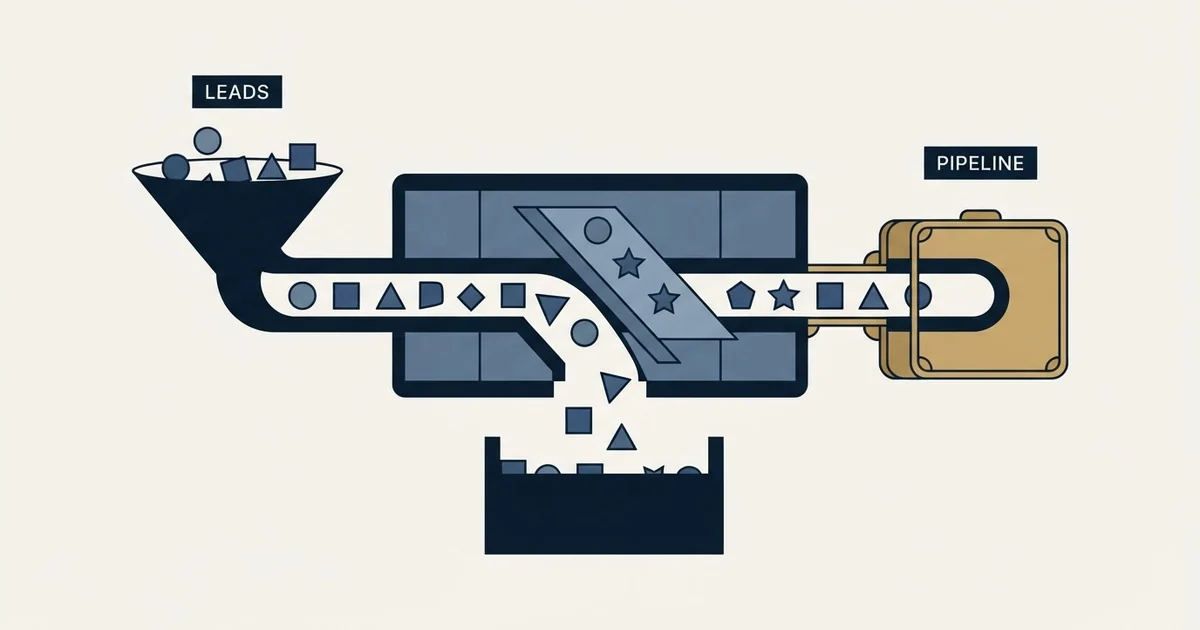
Lead generation counts contacts on arrival; pipeline generation counts opportunities a seller has accepted. The gap between the two numbers is not a quality verdict until acceptance criteria are written down, rejection reasons are recorded, and both counts are taken over the same cohort of contacts rather than the same calendar month.
Key takeaways
- A lead is counted on arrival by the team that caused it; pipeline is counted on acceptance by the team that has to close it.
- A wide gap is not evidence of poor lead quality until you have ruled out a moved definition, a routing delay, and mismatched cohorts.
- Recording a rejection reason from a short fixed list converts an unresolvable quality argument into a distribution you can act on.
- Outbound settles the fit half of qualification before sending, but the timing half stays unknown, which is why its acceptance rate differs from inbound's for structural reasons.
Reviewed and updated September 2, 2026
Marketing reports 340 leads for the quarter. Sales reports 11 opportunities. Both figures here are invented to show the shape of the problem rather than drawn from any programme. Both are internally correct, both teams can show their work, and the meeting that follows is not really about lead quality. It is about which of those two numbers the programme was bought on, and nobody wrote that down at the start.
Pipeline lead generation is the phrase people reach for when they have noticed the gap. It is worth separating into its two halves, because they are counted at different moments by different people, and almost every argument about outbound performance is an argument about which moment counts.
The two counts, and where each one is taken
Asked as how to increase sales pipeline, the question has two answers depending on which count is short, and the two need opposite work: more names entering at the top, or a higher share of them surviving to acceptance.
A lead is counted at the top, on arrival. Someone filled a form, replied to an email, accepted a connection request, or downloaded something. The count is taken by the team that caused the arrival, and it can be taken with certainty the same day.
Pipeline is counted at acceptance. A seller has looked at the opportunity, agreed it is real, and put it in the forecast. The count is taken by the team that has to close it, and it can only be taken after a conversation.
The denominator marketing and outbound both start from
Counted here, this is the lead number
The first count that needs the buyer to show up
Counted here, this is the pipeline number
The two numbers describe the same programme and they are not versions of each other. The lead count answers whether the message reached anyone. The pipeline count answers whether the people it reached were the right ones, and whether a seller agreed. A programme can be excellent at the first and poor at the second, and the reverse happens too, more often than people expect.
Why the gap is not automatically a quality problem
Not enough qualified leads at the top is therefore two different diagnoses wearing one sentence, and which one it is depends on whether the count is short at entry or short at acceptance.
Asking for more qualified pipeline from outbound is asking about the second count rather than the first, and the two respond to different work: more sending raises the top count, and only the acceptance standard and the targeting behind it move the one that gets reported to a board.
A third lever sits upstream of both counts, since growing the pool outbound later harvests is different work from capturing interest that already exists.
The reflex reading of a wide gap is that the leads were bad. Sometimes they were. But three other causes produce exactly the same shape, and they are worth eliminating before anyone reworks the targeting.
The first is a definition that moved. If sales tightened what it accepts, the pipeline number falls while nothing about the leads changed. This is invisible unless the acceptance criteria are written down somewhere with a date on them.
The second is a routing delay. A reply that sits unactioned for four days converts far worse than the same reply actioned in an hour, and the lead count does not record the difference. The live piece on inbound lead generation makes the same point about the response job being the one nobody owns, and it applies identically to outbound replies.
Measuring that delay properly means splitting it, since the clock from arrival to first contact attempt contains a processing leg and a response leg that behave differently.
The third is that the two counts are taken over different populations. Leads are counted in the month they arrive. Pipeline is counted in the month it is accepted, which for anything with a real sales cycle is often the following month. Comparing this month's leads to this month's pipeline compares two different cohorts and produces a ratio that means nothing.
What pipeline generation requires that lead generation does not

The practical difference is that pipeline generation has a second gate in it, and the gate is staffed by someone with different incentives.
Lead generation can be run end to end by one function. Pipeline generation cannot, because the acceptance decision belongs to the team being measured on close rate, and that team is right to be conservative. This is the structural fact underneath most of the friction, and no amount of shared dashboards removes it.
Teams weighing whether outbound deserves its own function should consider choosing a go-to-market motion, which explains why adding one is an organisational commitment with its own cost structure.
- Owned by one function end to end
- Countable the same day
- Rewarded for volume
- Fails visibly when nothing arrives
- Says nothing about who arrived
- Requires agreement from a second team
- Countable only after a conversation
- Rewarded for what a seller will forecast
- Fails quietly, as a widening gap
- Says nothing about whether it will close
The consequence for anyone buying an outbound programme is that the two are priced differently and should be contracted differently. A per-lead arrangement puts all the risk on the buyer, because the supplier controls the number it is paid on. A pipeline-based arrangement moves the risk but introduces a dependency the supplier does not control, which is the buyer's own acceptance behaviour. The honest version sits between the two: agree the acceptance criteria in writing before anything sends, then count against them. That is our documented practice and the reason for it is exactly this gap.
Instrumenting the handoff so the gap is readable
Four things make the difference between a readable gap and a monthly argument.
- Yes: Written acceptance criteria, dated, agreed by both teams before launch
- Yes: A rejection reason on every lead sales declines, from a short fixed list
- Yes: Cohort dating, so leads are compared to the pipeline they produced rather than to the pipeline accepted alongside them
- Yes: Time from reply to first seller action, recorded
- No: A single scoring number blending fit and behaviour
- No: A quality debate held without either team's criteria written down
The rejection reasons are the item that pays for itself fastest. A list of five reasons, applied consistently, turns an unresolvable quality argument into a distribution: wrong company size, no budget cycle, already a customer, wrong role, no real problem. Each of those points at a different fix, and three of the five are targeting problems that get solved upstream in a week. Without the list, every rejected lead is evidence for whichever argument the reader already held.
The stage definitions matter for the same reason, and sales pipeline stages covers the test that makes them work: an exit criterion someone other than the deal owner could check. Acceptance is just the first of those criteria, and it is the one that decides whether the pipeline number exists at all. The formal name for the object created at that moment is a sales qualified opportunity, and the reason it has its own term is that two teams have to agree on it.
One further note on the cohort point, because it is the item most often skipped and the one that silently invalidates the rest. Cohort dating means tagging each accepted opportunity with the month its originating contact was created, not the month it was accepted. Without it, a programme that improved three months ago looks flat, because this month's pipeline is being divided by this month's leads while it was actually produced by the leads from two months back. Teams have concluded a working programme was failing on exactly this arithmetic, and the fix is a field rather than a strategy.
Running that arithmetic forwards instead, from a segment size through the four outbound ratios to a meetings number the market can actually supply, is covered in what makes a pipeline predictable.
Where outbound sits in this

Outbound has an advantage here that inbound does not, and a disadvantage that gets less attention.
The advantage is that the population is chosen. An outbound programme decides which companies it contacts, so the fit half of qualification can be settled before a single message goes out. If the list is built against the written acceptance criteria, wrong company size and wrong role stop appearing in the rejection distribution entirely, and what remains is timing, which nobody can control.
The disadvantage is that the timing half is genuinely unknown at send time. An inbound lead has already told you something happened. An outbound contact has told you nothing, which is why response rates are what they are and why the acceptance rate on outbound replies runs differently from the acceptance rate on inbound forms. Comparing the two conversion rates without saying which is which produces a number that flatters inbound every time, for reasons that have nothing to do with either programme.
This is also where the vocabulary in MQL vs SQL stops fitting cleanly. That model assumes a lead arrives, gets scored, and is promoted. Outbound skips the arrival, so the marketing-qualified stage has no content, and teams that force outbound into the same funnel end up with a stage every deal passes through instantly and nobody reads.
There is a reporting consequence too. Because outbound and inbound acceptance rates differ for structural reasons rather than quality reasons, a single blended acceptance rate across both is a number with no owner and no interpretation. Splitting it is a one-time reporting change and it removes a recurring argument, because each half then moves for reasons somebody can name.
What the pipeline number still cannot tell you
Pipeline is a better measure of an acquisition programme than lead count. It is not a good measure of revenue, and the substitution is common enough to be worth naming.
Accepted pipeline tells you a seller believed a deal was real on the day they accepted it. It does not tell you the deal will close, and the further from close the acceptance sits, the less it predicts. A programme judged purely on pipeline created can be gamed by accepting generously, and the tell is a pipeline number that grows while closed revenue does not move. The pairing that catches it is pipeline created against win rate on that cohort, held together rather than read separately.
The honest position is that neither number is the answer on its own. Lead count tells you the message works. Pipeline tells you the targeting works. Only closed revenue on the same cohort tells you the programme works, and that answer arrives one full sales cycle after the decision you wanted it to inform.
Deciding when a pipeline number can actually be trusted is itself a sequencing question, and structuring a go-to-market roadmap explains how to set exit conditions instead of dates so the result stays readable.
If you want the outbound half of this built against criteria agreed in advance rather than argued about afterwards, that is what a test campaign is for.
The short version

Lead generation is counted on arrival by the team that caused it. Pipeline generation is counted on acceptance by the team that has to close it. The gap between them is not evidence of anything until acceptance criteria are written down, rejection reasons are recorded, and the two counts are taken over the same cohort. Once those three exist, the gap becomes a distribution you can act on, and most of what it contains turns out to be fixable upstream.
Frequently asked questions.
Frequently asked questions- What is the difference between lead generation and pipeline generation?
- Lead generation is counted at the top, when someone replies or fills a form, by the team that caused the arrival. Pipeline generation is counted at acceptance, when a seller agrees the opportunity is real and forecastable. The first can be counted the same day. The second requires a conversation and the agreement of a second team with different incentives.
- Why do marketing and sales report completely different numbers?
- Usually because both are correct and neither says which count they used. Marketing reports arrivals, sales reports accepted opportunities, and the two are taken at different moments over different populations. The argument resolves once acceptance criteria are written down with a date, and once leads are compared to the pipeline they produced rather than to whatever was accepted the same month.
- Should we pay an outbound supplier per lead or per opportunity?
- Per lead puts the risk on the buyer, because the supplier controls the number it is paid on. Per opportunity moves the risk but adds a dependency the supplier cannot control, which is your own acceptance behaviour. The workable middle is agreeing acceptance criteria in writing before anything sends, then counting against them, which is what we do.
- How do we tell whether the leads are bad or the follow-up is slow?
- Record the time between a reply arriving and the first human action on it, and record a rejection reason on every lead sales declines. If rejections cluster on fit reasons like company size or role, it is a targeting problem solved upstream. If response times run into days, the leads were never given a fair test and the quality question cannot be answered yet.
About the author.

B2B cold email experts helping companies generate qualified leads through done-for-you outreach campaigns.
RevenueFlow Team
Explore more.
Ready to scale your outreach?
We build GTM engines that book real meetings. See the receipts.
Related articles.
Win Rate Benchmarks: Which Figures State a Population
A catalogue of the published average sales win rates, sorted by whether the page names the population behind its own number. Most do not.
Sales Kickoff Agendas: Five Published, Session by Session
Five publishers print a sales kickoff agenda. They agree on four blocks and disagree on session length, rehearsal and where the agenda comes from.
SDR Outsourcing for Logistics Companies: The Brokerage Line
What an outside sales development team may do in a freight company's name, the calling and email rules it inherits, and which arrangement survives a bid-shaped market.
SDR Outsourcing for Business Brokers: The Fee Timing
Whether a success-fee brokerage should rent sales development at all: the fee timing, the texts that limit what an outside person may say about value, and who signs.
Sales Cycle Length Benchmarks: What Each Figure Counts
The published B2B sales cycle benchmarks, sorted by what each page says it counted. The same number means two different things in two of them.
Sales Enablement Charters: What the Published Ones Ask For
Six publishers set out what a sales enablement charter should contain. Five describe a document nobody can check, and one writes a definition with inspection in it.