Clay vs Apollo vs ZoomInfo: They Are Not the Same Thing
Three tools that get shopped for as one category and are not one category. What Clay, Apollo and ZoomInfo are each actually for, and how to choose between them.
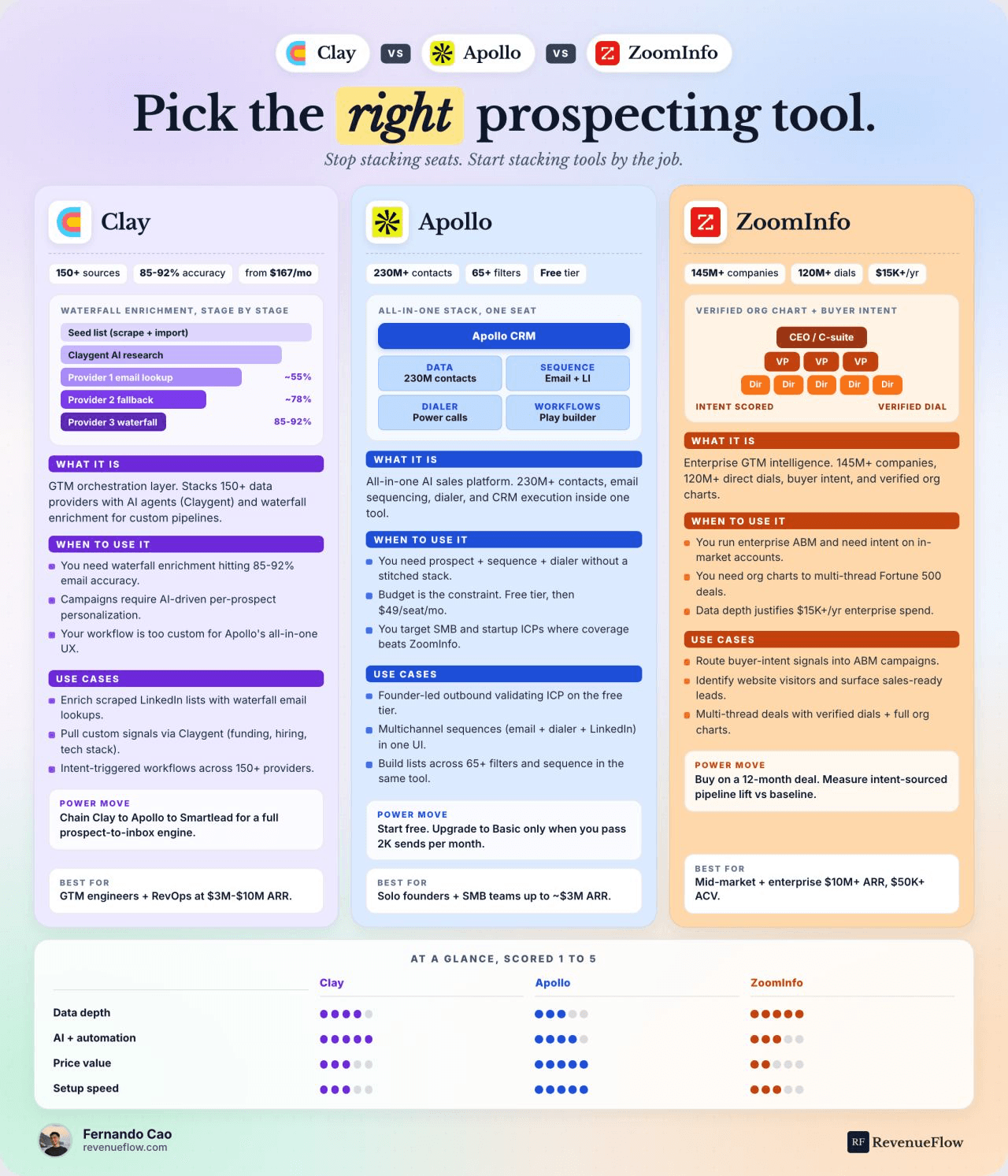
Clay vs ZoomInfo is a choice between an orchestration layer and an enterprise database. Clay holds no database, runs other providers in a waterfall and publishes prices from $185 a month. ZoomInfo is bought for depth per account and its pricing page returned HTTP 403 here. Apollo is the third option: a database with sequencing from $49 a seat.
Key takeaways
- Clay is an orchestration layer with no database of its own, priced from $185 a month or $167 on annual billing, with unlimited seats on every plan.
- ZoomInfo's pricing page answered HTTP 403 to a plain request and blocked a headless browser, so no ZoomInfo price or database figure is stated on this page.
- Apollo's pricing page lists Basic at $49 per seat per month billed annually with 30,000 credits a year, which is 30,000 emails or 3,750 phone numbers at 8 credits each.
- A coverage test on 200 real target accounts during each vendor's trial tells you more than any feature comparison, especially for European or small-business lists.
Reviewed and updated September 18, 2026
Clay vs ZoomInfo is the question underneath most of these three-way shortlists. One is an orchestration layer that holds no database, the other is an enterprise database sold by quote, and Apollo gets added as the third option because its entry price is published and low. These three tools get compared constantly, usually by somebody trying to pick one. That framing is the problem. They occupy the same budget line and they do not solve the same problem, so a shortlist containing all three is usually a sign that the requirement has not been written down yet.
Clay vs ZoomInfo: Which One Do You Need?
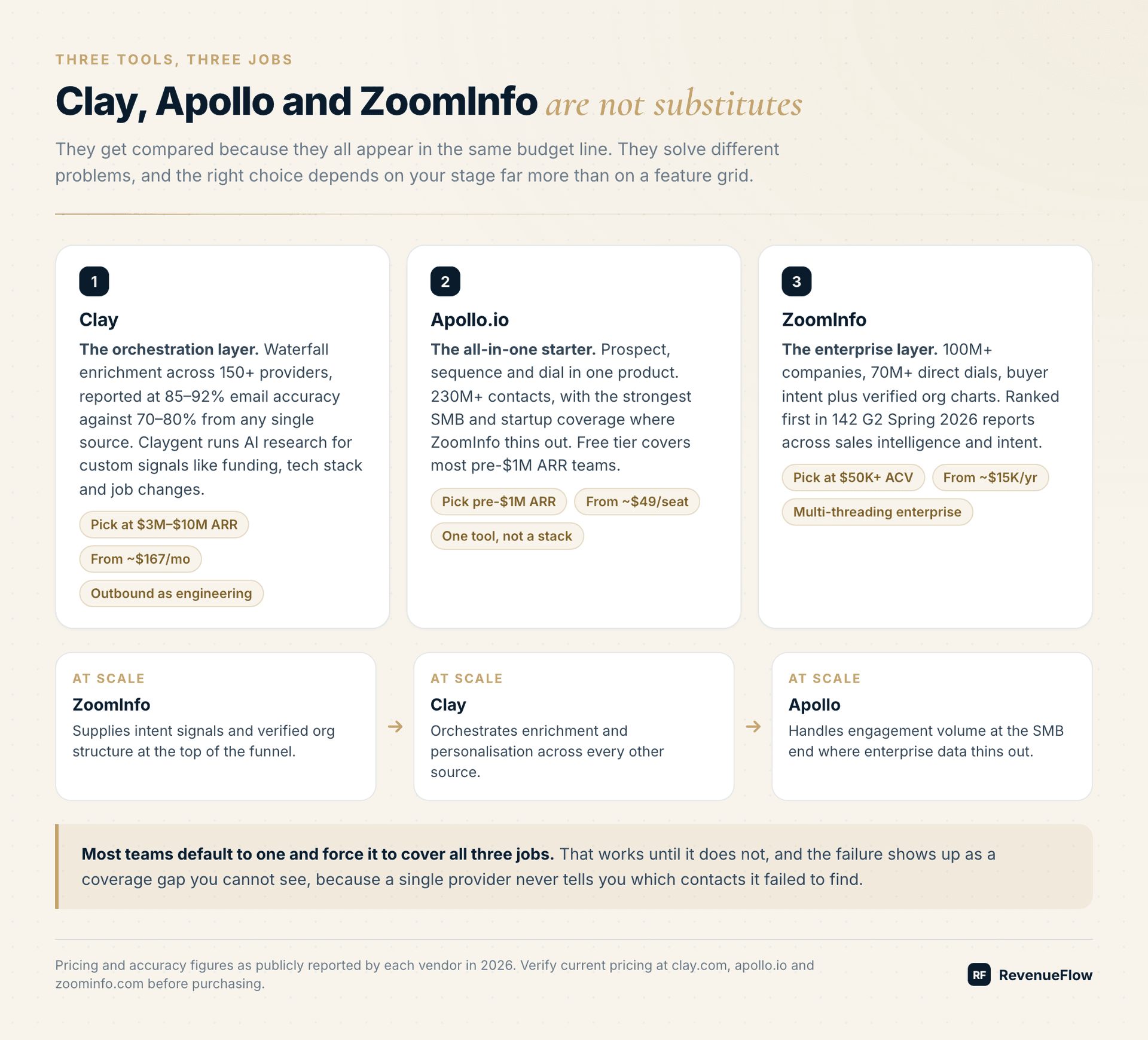
Clay and ZoomInfo do different jobs, so choosing between them is choosing a job. Clay is an orchestration layer: it holds no database, runs other providers in a waterfall and publishes its prices, from $185 a month. ZoomInfo is an enterprise database bought for depth per account, and its pricing page returned HTTP 403 for this comparison. Pick by whether you need a source or something that coordinates sources.
Read the other way round, ZoomInfo vs Clay is a question about order. A team with high contract values and nobody to build usually buys the database first, because org-chart depth is usable on day one. A team with a builder and patchy coverage buys Clay first and decides later which databases to put underneath it.
Clay: read from its pricing page
- Free plan with 500 actions and 100 data credits a month
- Launch from $185 a month, or $167 on annual billing
- Growth from $495 a month, or $446 on annual billing
- Unlimited seats on every plan
- Enrichment from 150+ providers
ZoomInfo: nothing readable
- Pricing page answered HTTP 403 to a plain request
- A headless browser was blocked as well
- No ZoomInfo price, database size or accuracy figure appears on this page
What Each One Actually Is
All three get shopped for as a lead generation database, and that single label is what makes the comparison confusing. Only two of them are databases at all, and the third is buying the same records from somewhere else on your behalf.
Clay is an orchestration layer. Its own pricing page describes running multiple data providers in a waterfall and enriching the result with Claygent, its AI research agent. It holds no database of its own.
Apollo.io is an all-in-one prospecting platform: a contact database with sequencing and a dialer attached. Its homepage reads 240M+ contacts and 30M+ companies.
ZoomInfo is the enterprise data platform of the three, bought for depth per account rather than for breadth across accounts.
A Note On The Evidence Behind This Page
Two of these vendors published figures this comparison could verify today and one did not.
Clay's and Apollo's pricing pages were both readable, and the numbers below were grepped out of
dated snapshots of those pages. ZoomInfo's pricing page answered HTTP 403 to a plain request
and to a headless browser alike, so no ZoomInfo price, database size or accuracy figure appears
anywhere on this page. Our own pricing dataset carries ZoomInfo figures stamped
lastVerified: '2026-01-09', which is old enough that republishing them here would be asserting
something nobody has checked this year.
That absence is a limit on this page rather than a claim about ZoomInfo. A page that will not load is not evidence that a figure is wrong.
Clay: The Orchestration Layer
Clay's job is to coordinate other data sources rather than to be one. Its plan-comparison table describes enriching from 150+ providers and its data-marketplace copy describes buying from 200+, so the page carries two different counts and this article quotes both rather than picking the flattering one.
The argument for an orchestration layer is that no individual database has complete coverage, and the gaps are not random. They concentrate in smaller companies, non-US geographies, and people who changed roles recently, which is frequently where the best-fit accounts live. Querying several providers in sequence until one returns a verified result closes gaps that any single provider would simply report as unavailable.
Pick Clay when outbound has become an engineering function rather than a headcount function, and there is somebody who will build in it. Launch is published from $185 a month, or $167 on annual billing, and the page shows how the annual number is assembled: $54 a month of actions plus $113 a month of data credits, on two ladders that expand independently. The page starts Growth at $495 a month, or $446 on annual billing, and the free plan carries 500 actions and 100 data credits a month with unlimited seats.
The honest downside. Clay has a real learning curve and it bills on usage, which means costs are variable and occasionally surprising. It also assumes somebody willing to build. A team without that person will pay for a powerful tool and use a fraction of it, and the usage-based invoice still arrives.
Apollo.io: The All-In-One Starter
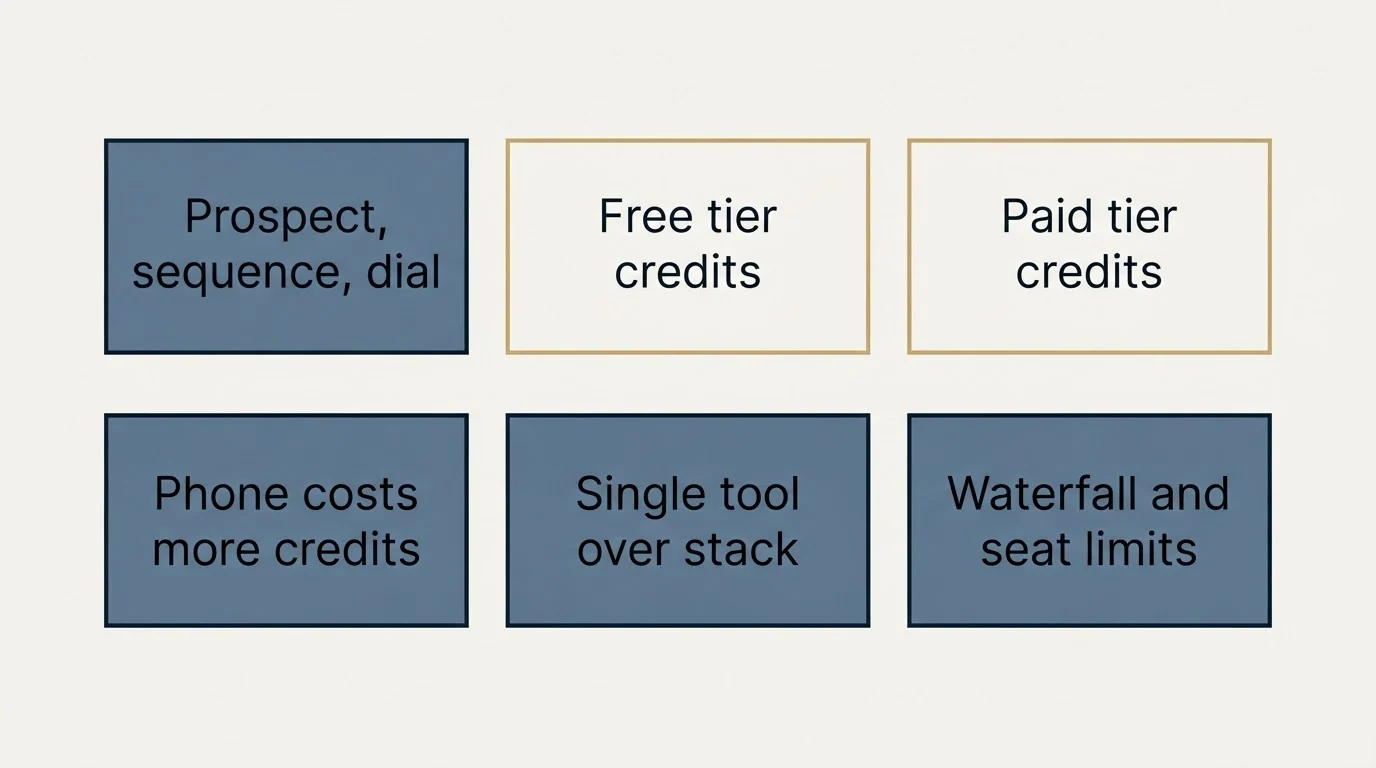
Prospect, sequence and dial in one product. The free tier grants 900 credits per seat per year, which covers most teams below any real sending volume, and Basic at $49 per seat per month billed annually grants 30,000 credits per seat per year upfront.
Apollo's credit table is the part worth reading before comparing it to anything: an email costs 1 credit and a phone number costs 8. That ratio is what converts a credit grant into a list size, and it is the number comparisons of Apollo tend to leave out.
Basic's 30,000 credits a year is therefore 30,000 emails or 3,750 phone numbers, and most real lists are a mix of the two.
Pick Apollo when you need one tool rather than a stack, and when the team will genuinely work inside it.
The honest downside. The moment you need waterfall enrichment across several providers, the limits appear, and Apollo is a strong starting point that becomes a constraint later. Everything is priced per seat, so a team that wants one sourcer supplying five people pays for five. The page also carries a note, beside its add-ons, that pricing is introductory and may change.
Apollo.io's comparison against Freshsales explains why engagement platforms and CRMs solve separate problems rather than competing for the same budget.
Teams evaluating lighter enrichment options can see how smaller data enrichment providers compare on database size and social integration.
ZoomInfo: The Enterprise Layer
ZoomInfo is bought for depth on a small number of accounts rather than for breadth across many. The org-chart data is the underrated part: a team selling six-figure deals is multi-threading into five people at an account, and knowing the reporting structure is worth more than another thousand email addresses.
Pick ZoomInfo when average contract value is high enough that depth per account beats coverage across accounts, and when a long annual commitment is acceptable.
The honest downside. Price is a genuine barrier, contracts are typically annual with limited flexibility, and no figure for any of that is published on a page this comparison could read. A buyer has to get the number from a salesperson, which is itself part of the trade.
The Stack That Wins At Scale
ZoomInfo for depth and org structure. Clay for enrichment and orchestration. Apollo for engagement volume at the smaller end.
Most teams default to one tool and force it to cover all three jobs. That works until it does not, and the failure is invisible: a single provider never reports which contacts it failed to find. A smaller list comes back and the team assumes that is the market.
Choosing which tool owns which stage matters outside data providers too, and multi-channel orchestration versus cold email execution draws a comparable line between coordination and campaign execution.
How To Actually Choose
Skip the feature comparison and answer three questions.
What is the average contract value? At the low end, Apollo's coverage and price are hard to beat. At the high end, ZoomInfo's depth per account justifies itself. In between is where Clay usually wins.
Is there somebody to build? Clay's value is proportional to the willingness to build workflows in it. No builder, no value, and the bill arrives regardless.
Where does the market live? For a European or small-business ICP, test coverage before signing anything. The gaps between these providers in that segment are larger than any marketing page will say.
Run a coverage test on 200 real target accounts before committing to an annual contract. Every vendor will allow it. The result is more informative than every comparison article, including this one.
Then price the winner against a year of the volume you actually ran during the test, rather than the volume in the demo.
Where These Sit In A Cold Outbound Stack
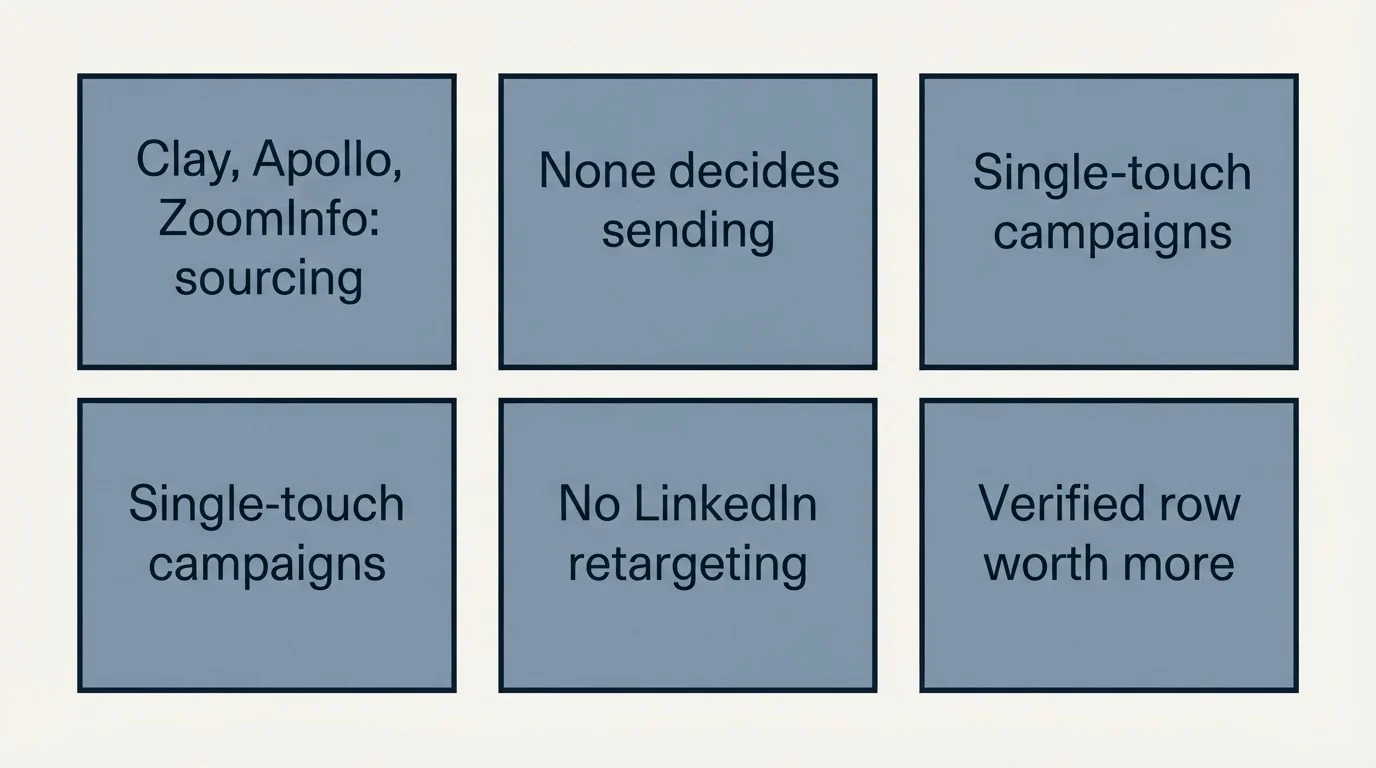
All three sit in the sourcing slot. None of them decides what gets sent, and that boundary is worth keeping firm.
House practice puts one message in a campaign and sends no bumps and no thread replies, so a prospect who does not answer is retargeted through a fresh single-message campaign rather than a follow-up under the original. No LinkedIn no-reply retarget is sent at all, because a second LinkedIn message lands directly under the one they ignored, so it reads as a bump whatever the campaign structure says.
That single-touch rule raises the value of the sourcing layer considerably. There is no second message to recover from a wrong address, so a row that has been through a waterfall and a verification step is worth more than two rows that have not. It is the strongest practical argument for orchestration over any single database.
Whether a resulting meeting counts is agreed in writing before launch, against criteria that never include budget, timing or authority.
Side By Side
| Clay | Apollo.io | ZoomInfo | |
|---|---|---|---|
| Primary job | Orchestration and enrichment | All-in-one prospecting | Enterprise depth per account |
| Entry paid rung | $185/month, or $167 billed annually | $49/seat/month billed annually | Not published on a readable page |
| What it charges for | Actions and data credits, on two ladders | Seats, with a credit grant each | Quoted per team |
| Data model | Waterfalls other providers | Own database, 240M+ contacts | Own database |
| Free tier | Yes, 100 data credits a month | Yes, 900 credits per seat per year | Not verified here |
| Main limitation | Learning curve, usage-based billing | Limits appear as you scale | Price, annual contracts, no published rate |
Frequently Asked Questions
Can I just use one of these?
At early stage, yes, and Apollo is usually the right single choice. The problem appears at scale, because a single provider never reports which contacts it failed to find. A smaller list comes back and the team assumes that is the market.
Since Apollo often anchors an early stack, teams weighing engagement platforms against enrichment tools can see how Apollo stacks up against LeadIQ on outreach versus sourcing.
Is Clay a replacement for Apollo or ZoomInfo?
No, it is a layer above them. Clay orchestrates other data sources rather than being one, and plenty of teams run Clay with Apollo underneath it as one of the providers in the waterfall.
Why is waterfall enrichment more accurate than a single database?
Because coverage gaps are not random. They cluster around smaller companies, non-US geographies and people who changed roles recently. Checking sources in sequence until one returns a verified result closes gaps that any individual provider would report as unavailable.
How should I actually test these?
Take 200 real target accounts and run them through each vendor during a trial. Compare match rate, accuracy on records you can verify yourself, and coverage in your specific geography and company-size band. That single test outperforms any feature comparison.
Related Reading
- Clay vs ZoomInfo: Data Enrichment Tool Comparison
- ZoomInfo vs Clay: Enterprise Data Platform vs Data Orchestration Tool
- Clay vs RocketReach: Data Enrichment Tool Comparison
If you would rather have this run for you, RevenueFlow books qualified meetings on a pay-per-meeting basis and publishes client results.
Pricing and features are taken from the vendors' own pages. Verify current terms with the vendor before relying on them.
Frequently asked questions.
Frequently asked questions- Clay vs ZoomInfo: which should I choose?
- Choose by the job. Clay is an orchestration layer that holds no database and runs other providers in a waterfall, so it suits a team with somebody willing to build. ZoomInfo is an enterprise database bought for depth per account and org charts. Clay publishes prices from $185 a month, and ZoomInfo's pricing page would not load for this comparison.
- Is Clay a replacement for ZoomInfo or Apollo?
- No. Clay sits a layer above them. It coordinates other data sources and enriches the result with its Claygent research agent, and plenty of teams run Clay with a database underneath it as one of the providers in the waterfall. Replacing a database with Clay only works if another provider supplies the records.
- How much does Clay cost compared with Apollo?
- Clay's pricing page starts Launch at $185 a month, or $167 on annual billing, with unlimited seats, and meters actions and data credits. Apollo's pricing page lists Basic at $49 per seat per month billed annually with 30,000 credits per seat a year. Clay's bill follows pipeline length and Apollo's follows headcount, so team size decides which is cheaper.
- Why is there no ZoomInfo price on this page?
- Because the page could not be read. ZoomInfo's pricing page returned HTTP 403 to a plain request and blocked a headless browser as well, so no price, database size or accuracy figure is repeated here. That is a limit on this comparison. It says nothing about ZoomInfo's actual figures, which a buyer has to get from a salesperson.
About the author.

Fernando Cao is CEO at RevenueFlow, which builds and operates outbound revenue engines for B2B companies. Previously at Accenture Strategy. Studied at University of Bath.
Fernando Cao · CEO
Connect on LinkedIn →Explore more.
Ready to scale your outreach?
We build GTM engines that book real meetings. See the receipts.
Related articles.
PromptLoop vs ZoomInfo: Web Research Against a Database
PromptLoop builds a dataset from the live web in credits it publishes; ZoomInfo sells access to a maintained database by quote. Both pages read 18 September 2026.
Cognism vs Upcell: A Data Provider Against a Data Layer
Cognism sells compliance-first contact data by quote and credit; Upcell sells a layer that runs your providers, Cognism included, through one record. Read 18 Sep 2026.
Chili Piper vs LeanData: Form-First Against CRM-First
Chili Piper publishes a seat floor and bundles scheduling and chat; LeanData prices by Salesforce object and sells scheduling separately. Both read 18 September 2026.
Metadata vs 6sense: Paid Media Execution vs Intent
Metadata runs paid B2B campaigns through seven AI agents; 6sense ranks accounts on intent and sells contact data by credit. Neither publishes a rate. Read 18 Sep 2026.
Zoom Revenue Accelerator vs Gong: An Add-On vs a Platform
Zoom's support centre documents Revenue Accelerator as a licence on a Zoom account in two classes; Gong sells a platform per user plus a platform fee. Neither has a rate.
Mailshake vs Pipedrive: A Sender and a CRM, Side by Side
Mailshake sells per-user sending with a two-way Pipedrive sync from its middle tier; Pipedrive is a per-seat CRM with sequences from Growth. Both read 18 September 2026.