Cold Email for Automotive: OEMs, Dealers and Suppliers
The automotive industry has complex supply chains and specific procurement requirements. Here's how to approach cold email outreach to dealers, OEMs, and suppliers.
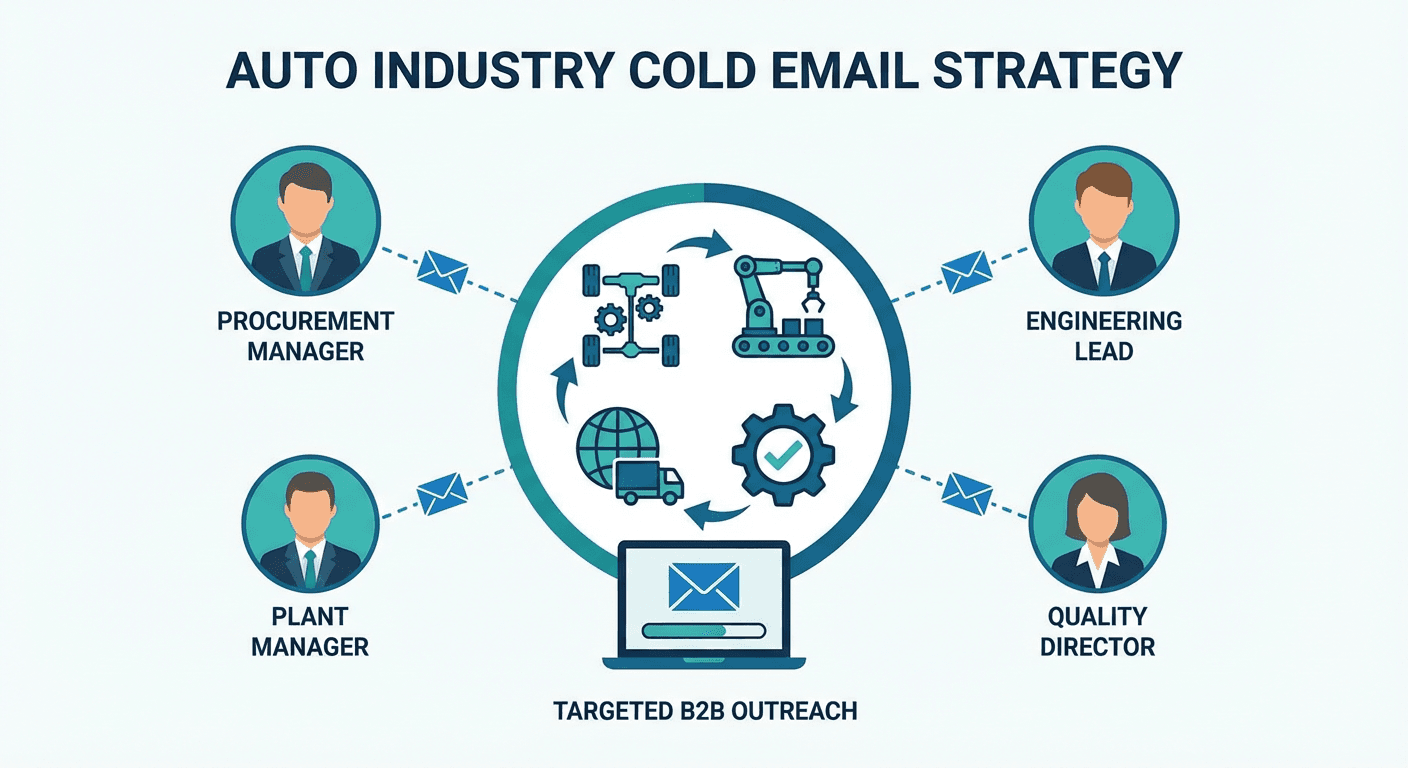
Cold email outreach to automotive OEMs, Tier 1 suppliers, and dealers requires segment-specific targeting. OEMs have 2-5 year decision cycles and demand IATF 16949 certification. Tier 1 suppliers prioritize cost reduction and quality improvement. Dealerships make faster decisions through dealer principals and fixed operations directors. Multi-threading across purchasing, engineering, and program managers increases success rates. Automotive-specific messaging must address quality certifications, long development cycles, and established supplier relationships.
Key takeaways
- OEM decision cycles span 2-5 years for new programs, so outreach is about being known when a program opens rather than converting quickly.
- Tier 1 suppliers are more accessible than OEMs and actively seek innovations to maintain competitive position while managing cost-down pressure.
- IATF 16949 certification is a common prerequisite for OEM supplier qualification, representing a significant barrier to entry.
- Multi-threading across purchasing managers, program managers, engineering directors, and quality managers increases response rates in automotive organizations.
- Dealerships offer shorter decision cycles and more accessibility through dealer principals, fixed operations directors, and department managers.
Reviewed and updated September 1, 2026
Cold Email for Automotive: Reaching OEMs, Dealers, and Tier 1 Suppliers
The automotive industry represents one of the most complex B2B environments for cold email outreach. With multi-tier supply chains, strict quality requirements, long development cycles, and entrenched supplier relationships, reaching decision makers at OEMs, dealerships, and Tier 1 suppliers requires a specialized approach. Generic outreach gets filtered immediately.
Automotive professionals operate under intense pressure. OEM program managers juggle dozens of suppliers while meeting aggressive launch timelines. Dealer principals balance inventory, financing, and service operations. Tier 1 supplier executives navigate razor-thin margins while maintaining quality standards that can make or break their business with a single defect.
This guide covers the specific strategies, targeting approaches, and messaging frameworks that make cold email effective in the automotive sector.
Understanding the Automotive Industry Structure
Success with automotive outreach requires understanding how the industry is organized and how purchasing decisions flow through different segments.
Original Equipment Manufacturers (OEMs)
OEMs are the vehicle manufacturers themselves: Ford, General Motors, Toyota, Honda, BMW, and others. They sit at the top of the supply chain and make decisions that cascade down through thousands of suppliers.
Reaching OEMs through cold email is challenging but possible. Key characteristics:
- Extremely long decision cycles (2-5 years for new programs)
- Multiple approval layers for new suppliers
- Stringent qualification requirements (IATF 16949 certification often required)
- Strong preference for established supplier relationships
- Global sourcing with regional variations
OEM outreach works best when you have existing automotive credentials, can reference other OEM relationships, or offer solutions for specific programs or initiatives rather than general capabilities.
Tier 1 Suppliers
Tier 1 suppliers sell directly to OEMs. Companies like Bosch, Magna, Denso, Continental, and ZF represent the largest, but thousands of smaller Tier 1 suppliers exist. They manufacture major components and systems: powertrains, electronics, interiors, chassis systems, and more.
Tier 1 suppliers are often more accessible than OEMs:
- Still have significant purchasing authority
- Face continuous cost-down pressure from OEMs
- Actively seeking innovations to maintain competitive position
- More responsive to cold outreach than OEMs
- Regional operations may have more autonomy
Your outreach to Tier 1 suppliers should emphasize cost reduction, quality improvement, or technology that helps them win and retain OEM business.
Tier 2 and Tier 3 Suppliers
These companies supply components to Tier 1 suppliers. They are smaller, more numerous, and often more accessible. Tier 2 and Tier 3 suppliers include:
- Raw material suppliers
- Component manufacturers
- Tooling and equipment providers
- Specialty process companies
Outreach to lower-tier suppliers can be highly effective because:
- Shorter decision cycles
- Fewer approval layers
- More responsive to new suppliers
- Actively seeking competitive advantages
Automotive Dealerships
Dealerships represent an entirely different segment within automotive. They purchase from OEMs and sell to consumers, but they also buy services, software, equipment, and supplies from numerous B2B vendors.
Dealer decision making involves:
- Dealer principal or general manager for major purchases
- Fixed operations director for service and parts
- Sales managers for showroom and sales tools
- F&I managers for finance and insurance products
- Marketing managers for advertising and lead generation
Dealerships often make faster decisions than manufacturing companies and are generally more accessible through cold outreach.
Aftermarket Companies
The automotive aftermarket includes parts retailers, service chains, collision repair networks, and performance product companies. This segment is large, fragmented, and often overlooked by B2B marketers.
Aftermarket characteristics:
- More entrepreneurial decision making
- Shorter sales cycles
- Price sensitivity but also quality awareness
- Regional variations in preferences and needs
Key Decision Makers by Segment
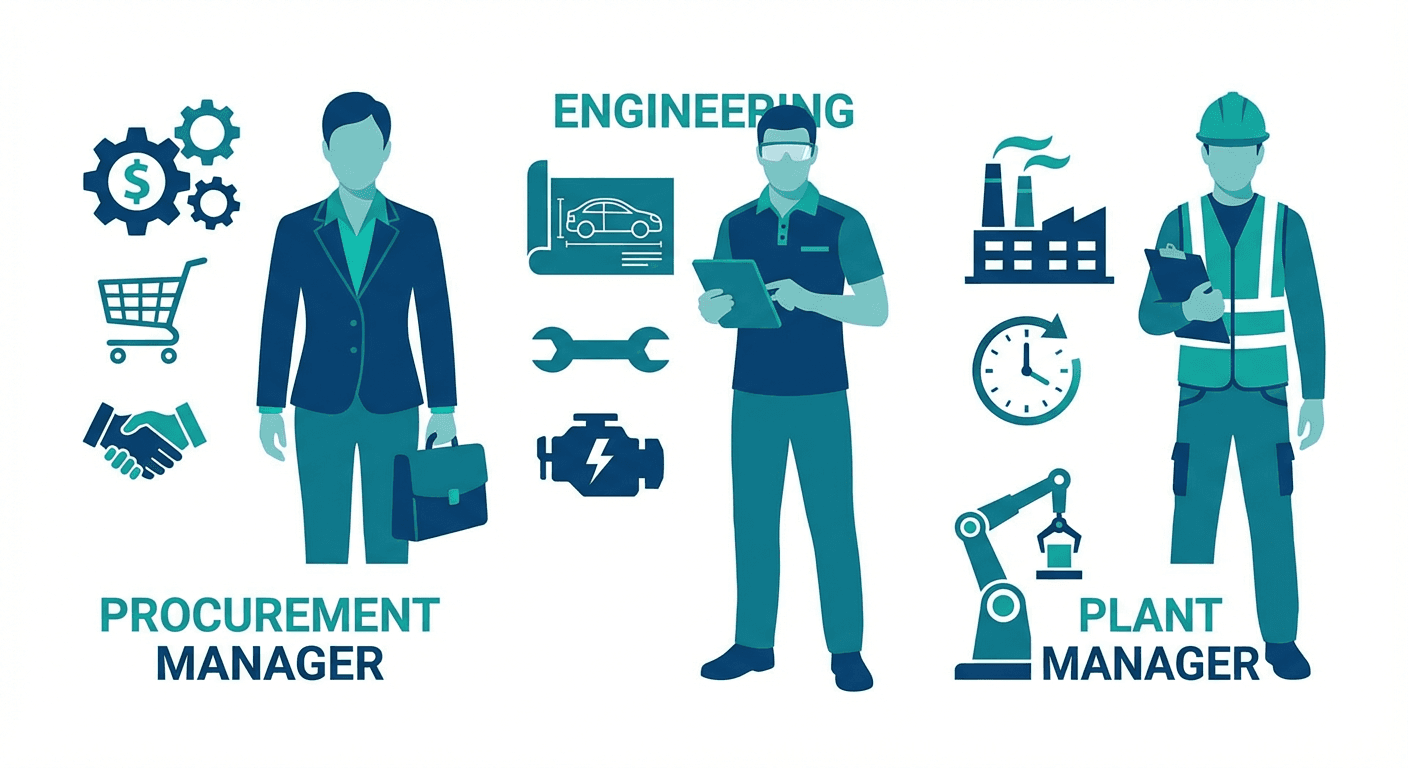
Different automotive segments have different stakeholder structures. Understanding who makes decisions and what they prioritize improves targeting and messaging.
OEM Decision Makers
Purchasing/Procurement Managers
- Control supplier selection and pricing negotiations
- Focus on cost, quality, delivery, and supplier financial stability
- Require detailed documentation and compliance certifications
- Build long-term relationships with preferred suppliers
Program Managers
- Oversee specific vehicle programs from development to production
- Focus on timing, budget, and program success
- Need suppliers who can meet aggressive timelines
- Influential in supplier selection for their programs
Engineering Directors
- Evaluate technical capabilities and innovation
- Concerned with performance, reliability, and integration
- Drive specifications that influence supplier selection
- Receptive to new technologies that solve engineering challenges
Quality Managers
- Gate new suppliers through qualification processes
- Focus on defect rates, process capability, and continuous improvement
- Require evidence of quality systems and track record
- Can veto suppliers who fail quality assessments
Tier 1 Supplier Decision Makers
VP of Operations
- Owns manufacturing efficiency and cost performance
- Focus on productivity, capacity utilization, and operational excellence
- Receptive to solutions that improve margins
- Influential in capital equipment and process decisions
Director of Purchasing
- Manages supplier base and procurement costs
- Under continuous cost-down pressure from OEMs
- Seeks suppliers who can contribute to annual savings targets
- Values reliability and partnership over lowest price
Engineering Manager
- Drives product development and process improvement
- Focused on meeting OEM requirements and timelines
- Receptive to technology that improves product performance
- Influential in specifying components and materials
Plant Manager
- Responsible for facility performance
- Focused on throughput, quality, and labor efficiency
- Makes decisions on equipment, services, and supplies
- Accessible through plant-level outreach
Dealership Decision Makers
Dealer Principal/Owner
- Ultimate authority on major decisions
- Focused on overall profitability and business growth
- Often involved in vendor selection for significant purchases
- May be hands-on or delegate to managers depending on dealership size
General Manager
- Day-to-day operational authority
- Balances all departments and functions
- Often the key decision maker for operational purchases
- Reports to dealer principal on major initiatives
Fixed Operations Director
- Oversees service, parts, and collision departments
- Controls significant purchasing for service operations
- Focused on customer retention and service profitability
- Key contact for service-related products and services
Controller/CFO
- Financial oversight and analysis
- Evaluates ROI and payment terms
- Approves major expenditures
- Important stakeholder for software and financial products
Crafting Automotive-Specific Messages
Automotive professionals receive countless sales pitches. Standing out requires messages that demonstrate industry knowledge and speak to specific priorities.
For OEM Outreach
OEM outreach must overcome significant barriers. Your messaging should address their core concerns directly.
Lead with credentials: OEMs only work with qualified suppliers. Reference relevant certifications (IATF 16949, ISO 14001), existing OEM relationships, and track record in automotive.
Focus on specific programs or initiatives: Generic capability pitches get ignored. Reference specific vehicle programs, announced initiatives (electrification, autonomous driving, sustainability), or known challenges.
Emphasize risk reduction: OEMs are risk-averse. Position your solution as reducing risk: quality risk, supply risk, cost risk, or timeline risk.
Quantify value: Provide specific data on cost savings, quality improvements, or efficiency gains from comparable automotive applications.
For Tier 1 Supplier Outreach
Tier 1 suppliers face pressure from multiple directions. Your messaging should address their squeeze between OEM demands and operational constraints.
Address cost-down pressure: Tier 1 suppliers face continuous demands for annual cost reductions. Solutions that contribute to savings get attention.
Reference OEM requirements: Position your offering as helping them meet specific OEM requirements or win new business.
Highlight operational benefits: Improvements in efficiency, quality, or delivery performance directly affect Tier 1 competitiveness.
Demonstrate understanding of their products: Research their specific products and applications. Generic manufacturing messaging misses the mark.
For Dealership Outreach
Dealerships are more accessible but still require relevant messaging.
Focus on profitability: Dealers measure everything by its impact on gross profit. Connect your solution to specific profit drivers.
Reference manufacturer programs: Many dealer purchases align with OEM programs, incentives, or requirements. Reference relevant manufacturer initiatives.
Understand the department: Service, sales, and F&I have different priorities. Tailor messaging to the specific department and decision maker.
Acknowledge competitive pressures: Dealers compete for customers, inventory, and talent. Position your solution in the context of competitive advantage.
Example Cold Emails for Automotive
Example 1: Software Solution to OEM Program Manager
Subject: Reducing validation time for [Vehicle Program]
Hi [First Name],
I saw the announcement about [Vehicle Program]'s accelerated timeline. Compressed development schedules often create bottlenecks in validation and testing, especially when integrating new suppliers and components.
We help OEM program teams reduce validation cycle time by 30-40% through automated test data management. Our platform is currently used by [X] OEM programs and integrates with common automotive test systems.
Would a brief conversation be useful to explore whether our approach could help [Vehicle Program] meet its timeline? I can share specific examples from similar programs.
Best, [Your name]
Example 2: Manufacturing Equipment to Tier 1 VP Operations
Subject: Addressing labor efficiency at [Company]
Hi [First Name],
Tier 1 suppliers producing [product type] often struggle with labor-intensive assembly operations. Rising wages and workforce availability challenges make automation increasingly attractive, but traditional solutions require significant capital and floor space.
Our collaborative automation systems are designed specifically for automotive component assembly. They install in existing production cells with minimal disruption and typically deliver 18-24 month payback through labor efficiency gains.
Would it be valuable to see how [similar Tier 1] reduced assembly labor costs by 28% on their [similar product] line? I can share the case study or arrange a brief call to discuss applicability to your operations.
Best, [Your name]
Example 3: Service to Tier 1 Purchasing Director
Subject: Contributing to your annual cost-down targets
Hi [First Name],
Purchasing teams at Tier 1 suppliers face relentless pressure to deliver 3-5% annual cost reductions while maintaining quality and supply security. Many of the obvious savings have already been captured, making each year more challenging.
We specialize in [service category] for automotive suppliers and have helped companies like [similar company] identify $2-3M in annual savings through [specific approach]. Our work is typically structured with payment tied to realized savings.
Would a 15-minute call be useful to explore whether similar opportunities exist in your operations? I can provide an initial assessment based on publicly available information about your supply chain.
Best, [Your name]
Example 4: Software to Dealership Fixed Operations Director
Subject: Service department profitability at [Dealership]
Hi [First Name],
Fixed operations directors at [Brand] dealerships often find that service department profitability plateaus despite consistent car counts. The gap typically comes from technician efficiency, parts markup capture, or service advisor performance.
Our service department analytics platform helps [Brand] dealers identify specific profit leaks and track improvement over time. Dealers using our system average $180K in additional annual gross profit through better visibility into daily operations.
Would it be helpful to see a demo using data from a comparable [Brand] store? I can show you exactly where the opportunities typically hide.
Best, [Your name]
Example 5: Equipment to Dealer Principal
Subject: Reducing reconditioning costs at [Dealership Group]
Hi [First Name],
For dealer groups handling [X+] used vehicles monthly, reconditioning costs represent one of the largest controllable expenses. Most groups spend $800-1,200 per vehicle on recon, but top performers achieve $600-800 through process optimization and in-house capabilities.
We provide reconditioning equipment and workflow systems specifically designed for dealer groups. Our customers typically reduce per-vehicle recon costs by 25-35% while improving turn times.
Would a conversation about your current reconditioning operation be valuable? I can share benchmark data from groups of similar size and volume.
Best, [Your name]
Addressing Automotive-Specific Challenges
Quality Requirements and Certifications
The automotive industry has some of the most demanding quality requirements in manufacturing. IATF 16949 (the automotive-specific quality management standard) is often required for OEM and Tier 1 suppliers.
When your prospects ask about quality:
- Reference relevant certifications you hold
- Provide PPAP (Production Part Approval Process) documentation if applicable
- Share quality metrics from existing automotive customers
- Describe your quality management systems and continuous improvement processes
If you lack automotive certifications but serve the industry indirectly:
- Acknowledge the certification requirements honestly
- Focus on applications where certifications are not required
- Reference quality track record in other demanding industries
- Offer to work toward certification if the opportunity justifies it
Long Development Cycles
Automotive product development cycles span 3-5 years. Decisions made early in development lock in suppliers and technologies for the entire program life.
Implications for cold outreach:
- Timing matters enormously. Reaching prospects during active sourcing windows is ideal.
- Monitor program announcements, RFQ releases, and development timelines
- Position solutions for future programs when current decisions are already made
- Build relationships before active sourcing begins
Follow-up strategies:
- Maintain long-term nurture sequences (quarterly or semi-annual touches)
- Track trigger events: new program announcements, supplier issues, executive changes
- Provide value through industry insights and benchmark data
- Request inclusion in future RFQ processes
Established Supplier Relationships
Automotive companies prefer to work with known suppliers. Relationships often span decades and include significant joint investment in tooling, processes, and engineering.
Breaking into established accounts:
- Target specific gaps or pain points with current suppliers
- Offer complementary products or services that do not displace incumbents
- Look for new programs where supplier decisions are not yet locked
- Reference relationships with their peers or competitors
- Start small to prove capabilities before expanding
Positioning against incumbents:
- Avoid direct criticism of existing suppliers
- Focus on specific capabilities or value they cannot match
- Offer performance guarantees to reduce switching risk
- Propose pilot programs or parallel sourcing to prove your value
Cost Pressure and Negotiation Culture
The automotive industry is notorious for aggressive cost negotiations. Annual price-down expectations of 3-5% are standard. Purchasing professionals are skilled negotiators who expect pushback.
Preparing for automotive negotiations:
- Build your value proposition on total cost, not just purchase price
- Quantify quality costs, productivity gains, and efficiency improvements
- Prepare detailed ROI analyses and payback calculations
- Expect multi-round negotiations and plan your concession strategy
Communicating value in cold outreach:
- Lead with cost savings or productivity improvements
- Provide specific data from comparable applications
- Reference your approach to continuous improvement
- Position yourself as a partner in meeting their cost targets
Building Multi-Threaded Relationships
Given the complexity of automotive purchasing decisions, reaching multiple stakeholders at target accounts improves your success rate significantly.
OEM Multi-Threading
For OEM opportunities, consider reaching:
- Purchasing Manager - Commercial relationship owner
- Program Manager - Vehicle program authority
- Engineering Contact - Technical evaluation owner
- Quality Engineer - Qualification gatekeeper
- Supplier Development - New supplier onboarding
Coordinate your outreach so each stakeholder receives relevant messaging. Reference conversations with their colleagues when appropriate.
Tier 1 Supplier Multi-Threading
For Tier 1 suppliers, typical stakeholder maps include:
- VP or Director of Purchasing - Commercial authority
- Plant Manager - Operational implementation
- Engineering Manager - Technical specification
- Quality Manager - Qualification approval
- Finance/Controller - Capital approval
Dealer Multi-Threading
For significant dealer opportunities:
- Dealer Principal - Ultimate authority
- General Manager - Day-to-day decisions
- Department Head - Specific functional authority
- Controller - Financial analysis and approval
Where we differ from standard practice
Much of the advice on this page reflects how outbound is commonly run. We run it differently, and since this page sits on our site it is worth saying where the difference is and what it costs us.
- A sequence of messages to each prospect over several weeks
- Later messages often land in the same email thread
- Every contact is reached more than once, so a distracted reader gets another chance
- The later messages go only to people who did not answer the first
- Reputation cost accrues on the sending domain across everything else it sends
- One message, then that campaign is finished for that contact
- No thread replies and no bumps
- A non-responding audience becomes a new campaign with a genuinely different premise, not a reminder
- More of the work moves into targeting and into the one message
- We reach each contact less often, and that is the cost we accept
The reasoning is mechanical rather than moral. A follow-up arrives underneath a message the recipient has already seen and chosen not to answer, so it is delivered to the population most likely to mark it as spam, and the reputation cost of that lands on the sending domain across every campaign running on it. We set that cost against the replies a sequence recovers and decided the trade was not worth it. The full argument, with the numbers from our own campaigns, is in why we stopped using follow-ups.
Follow-Up Strategies for Automotive
Automotive sales cycles require persistent, value-adding follow-up over extended periods.
Short-Term Follow-Up (1-4 weeks)
Standard follow-up sequence:
- Day 3-4: Brief follow-up referencing original message
- Day 7-10: Offer specific resource (case study, white paper, benchmark data)
- Day 14-17: Try different angle or value proposition
- Day 21-28: Final attempt or request for redirect
Adjust timing based on response patterns and segment. Dealers may warrant more frequent follow-up. OEMs may require longer intervals.
Long-Term Nurture (Months to Years)
For opportunities not ready now:
- Monthly or quarterly value-adding touches
- Share relevant industry news or analysis
- Provide benchmark data or research findings
- Invite to webinars, trade show meetings, or facility tours
- Reference trigger events (program announcements, competitor news)
Track timing of budget cycles, program phases, and sourcing windows to time outreach appropriately.
Trade Show Integration
Automotive trade shows (NAIAS, SEMA, Automechanika, PRI) remain important. Coordinate cold email with show schedules:
- Pre-show outreach to schedule meetings
- Reference show presence in your messaging
- Post-show follow-up within 48 hours
- Use show content as follow-up material
Measuring Automotive Outreach Performance
Track metrics appropriate for automotive's longer cycles and lower response rates.
Email Metrics
- Open rates: 30-45% is reasonable for well-targeted automotive lists
- Reply rates: 3-8% for cold outreach to automotive executives
- Meeting rates: Track conversion from positive replies to scheduled calls
Pipeline Metrics
- Opportunities created: Number entering pipeline from outreach
- Opportunity value: Average deal size from outreach-generated opportunities
- Cycle length: Time from first contact to close (expect longer than other industries)
- Win rate: Close rate for outreach-generated opportunities
Segment Analysis
Compare performance across:
- OEMs vs. Tier 1 vs. Tier 2 vs. Dealers
- Different job titles and functions
- Various company sizes
- Geographic regions
Use this analysis to focus resources on highest-performing segments.
Common Mistakes in Automotive Outreach
Ignoring Certification Requirements
Reaching OEMs or Tier 1 suppliers without relevant automotive certifications often wastes effort. Research requirements before targeting.
Generic Manufacturing Messaging
Automotive has specific terminology, processes, and standards. Generic manufacturing language signals you do not understand the industry.
Underestimating Cycle Length
Expecting quick wins in automotive leads to premature abandonment. Plan for long-term relationship building.
Focusing Only on Purchasing
Purchasing controls vendor relationships, but engineering, quality, and operations influence decisions. Multi-thread your outreach.
Missing the Sourcing Window
Automotive decisions are often locked years in advance. Timing outreach to active sourcing windows dramatically improves results.
Neglecting the Aftermarket
The automotive aftermarket is large, fragmented, and often more accessible than OEM supply chains. Consider aftermarket opportunities.
Final Thoughts
Cold email success in automotive requires industry-specific knowledge, patience, and sustained effort. The industry rewards suppliers who understand its unique dynamics and demonstrate commitment to automotive relationships.
Start with realistic expectations about timeline and conversion rates. Build credibility through references, certifications, and demonstrated expertise. Target specific programs, initiatives, or pain points rather than generic capabilities.
The automotive industry values long-term partnerships. Companies that invest in relationship building, even when immediate opportunities are not available, position themselves for success when sourcing windows open.
Focus your initial outreach on segments where you have the strongest credentials and value proposition. Expand to more challenging targets (large OEMs, established Tier 1 accounts) as you build automotive references and experience.
Related Reading
- Cold Email for Retail: The Complete Guide to B2B Outreach
- Cold Email for SaaS Companies: The Complete Guide to B2B Outreach
If you would rather have this run for you, RevenueFlow books qualified meetings on a pay-per-meeting basis and publishes client results.
The strategies in this guide apply broadly across automotive segments, but specific approaches should be tailored to your product category, target customer segment, and existing automotive credentials.
Frequently asked questions.
Frequently asked questions- How long does it take to close a deal with an automotive OEM?
- OEM decision cycles typically range from 2 to 5 years for new programs. This extended timeline includes supplier qualification, multiple approval layers, stringent quality assessments, and alignment with vehicle development schedules. Success depends on timing outreach to program windows rather than expecting quick conversions. Tier 1 suppliers generally have shorter cycles, while dealerships can make decisions in weeks to months.
- What certifications do I need to sell to automotive OEMs?
- IATF 16949 certification is often required for new suppliers to OEMs. This automotive quality management standard represents a significant barrier to entry. OEMs also demand detailed documentation, compliance certifications, and evidence of quality systems. Having existing automotive credentials or OEM relationships substantially improves cold email success rates when approaching new automotive accounts.
- Should I target OEMs or Tier 1 suppliers first with cold email?
- Tier 1 suppliers are generally more accessible and responsive to cold outreach than OEMs. They maintain significant purchasing authority, face continuous cost pressure, and actively seek competitive advantages. Tier 1 suppliers offer shorter decision cycles and fewer approval layers. Target OEMs when you already have automotive credentials, can reference other OEM relationships, or offer solutions for specific programs rather than general capabilities.
- Who are the key decision makers at automotive dealerships?
- Dealership decision makers include the dealer principal or general manager for major purchases, fixed operations director for service and parts, sales managers for showroom tools, F&I managers for finance products, and marketing managers for advertising. Dealerships generally make faster decisions than manufacturing companies and are more accessible through cold outreach, with shorter sales cycles than OEMs or Tier 1 suppliers.
- Why is multi-threading important in automotive cold email outreach?
- Automotive organizations have multiple stakeholders involved in purchasing decisions: purchasing managers control supplier selection, program managers oversee vehicle programs, engineering directors evaluate technical capabilities, and quality managers gate new suppliers through qualification. Multi-threading across these personas increases response rates and prevents deals from stalling when a single contact becomes unresponsive or lacks authority for your specific solution.
About the author.

Fernando Cao is CEO at RevenueFlow, which builds and operates outbound revenue engines for B2B companies. Previously at Accenture Strategy. Studied at University of Bath.
Fernando Cao · CEO
Connect on LinkedIn →Explore more.
Ready to scale your outreach?
We build GTM engines that book real meetings. See the receipts.
Related articles.
Cold Email for Telecom: Reaching Carriers and MSPs
Telecom companies face rapid technology changes and competitive pressures. Here's how to approach cold email outreach to carriers, MSPs, and UCaaS providers.
Cold Email for Architecture Firms: 2026 Strategy Guide
Architecture firms buy on project phases rather than fiscal quarters. How to build a list, time the spec window, and write cold emails principals answer.
Cold Email for Trucking and Fleet Companies: 2026 Guide
How to reach carriers, fleet operators, and safety buyers with cold email: FMCSA-driven list building, trigger timing, four templates, and compliance.
Cold Email for Cannabis Companies: 2026 Strategy Guide
The April 2026 rescheduling order split cannabis buyers into two tax realities. Here is how to segment, list-build, and write cold email for each.
Cold Email for Private Equity Firms: 2026 Strategy Guide
How to run cold email into private equity: mapping fund-level and portfolio-level buyers, list sources, four templates, and PE-specific deliverability rules.
Cold Email for Wealth Management Firms: 2026 Strategy Guide
RIAs are 16,500+ mostly small firms with public Form ADV data, small buying committees, and a compliance gate. How to run cold email into wealth management.