Cold Email for Aviation: The Complete Guide
A comprehensive guide to cold email outreach for the aviation industry, covering airlines, MRO providers, airports, and aviation suppliers with strategies for reaching airline executives, procurement teams, and aviation decision-makers.
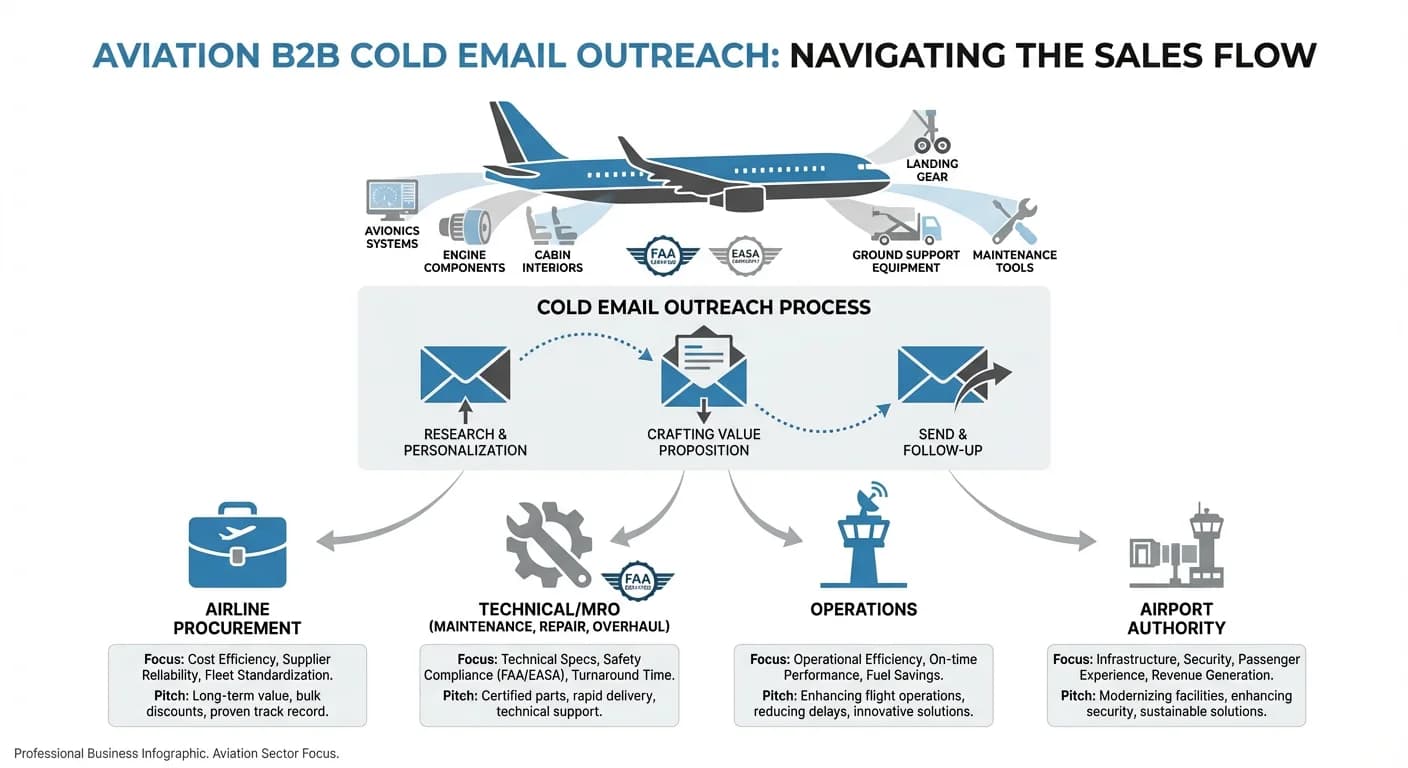
Cold email works effectively in aviation because decision-makers are identifiable through industry directories and conferences, operational pressures create continuous needs for cost reduction and efficiency improvements, and technical complexity requires specialized vendors across hundreds of product categories. Key buyer personas include airline procurement executives who manage billions in spending, technical leaders who evaluate certifications and OEM approvals, operations executives focused on reliability metrics, and airport authority decision-makers overseeing terminal operations and passenger experience.
Key takeaways
- Aviation decision-makers are accessible through published leadership structures, industry directories, conference attendance lists, and professional networks.
- Airlines operate on thin margins with constant pressure to reduce costs and improve on-time performance, driving continuous evaluation of new suppliers.
- Airline procurement teams manage billions of dollars in annual spending across categories including aircraft parts, fuel, ground services, IT systems, and catering.
- Technical and engineering leaders require vendors with FAA/EASA certifications, OEM approvals, and demonstrated experience with specific aircraft types.
- Aviation purchasing involves extended qualification cycles with formal RFP processes for significant purchases and approved vendor lists for established categories.
Reviewed and updated September 15, 2026
Cold Email for Aviation: The Complete Guide
The aviation industry connects the world through a complex ecosystem of airlines, airports, maintenance providers, manufacturers, and specialized service companies. With global air passenger traffic expected to continue growing and airlines investing billions in fleet renewal and operational improvements, opportunities abound for companies that can effectively reach aviation decision-makers.
Cold email has proven to be a valuable business development channel in aviation. While the industry maintains strong relationship networks cultivated through years of operation, the constant pressure to reduce costs, improve efficiency, and enhance passenger experience creates openings for new vendors with compelling value propositions.
This guide provides a comprehensive framework for implementing cold email campaigns that generate qualified opportunities within the aviation industry.
Why Cold Email Works for Aviation
Aviation's industry structure and operational dynamics create favorable conditions for well-executed cold email outreach.
Decision-makers are identifiable. Airlines, airports, and MRO providers are established organizations with published leadership structures. Industry directories, conference attendance lists, and professional networks provide access to decision-maker contact information.
Operational pressures create ongoing needs. Airlines operate on thin margins and face constant pressure to reduce costs, improve on-time performance, and enhance customer experience. These pressures drive continuous evaluation of new solutions and service providers.
Industry consolidation opens opportunities. Airline mergers and MRO industry consolidation have disrupted long-standing vendor relationships. Procurement teams increasingly conduct formal supplier evaluations that welcome new entrants.
Technical complexity requires specialized vendors. Aviation's technical requirements create demand for specialized suppliers across numerous categories: parts, ground support equipment, IT systems, training, catering, and hundreds of other product and service areas.
Conference networking has limitations. While events like MRO Americas, IATA conferences, and regional aviation gatherings remain important, they occur infrequently and involve substantial investment. Cold email extends relationship building beyond these periodic opportunities.
Understanding Aviation Industry Buyers
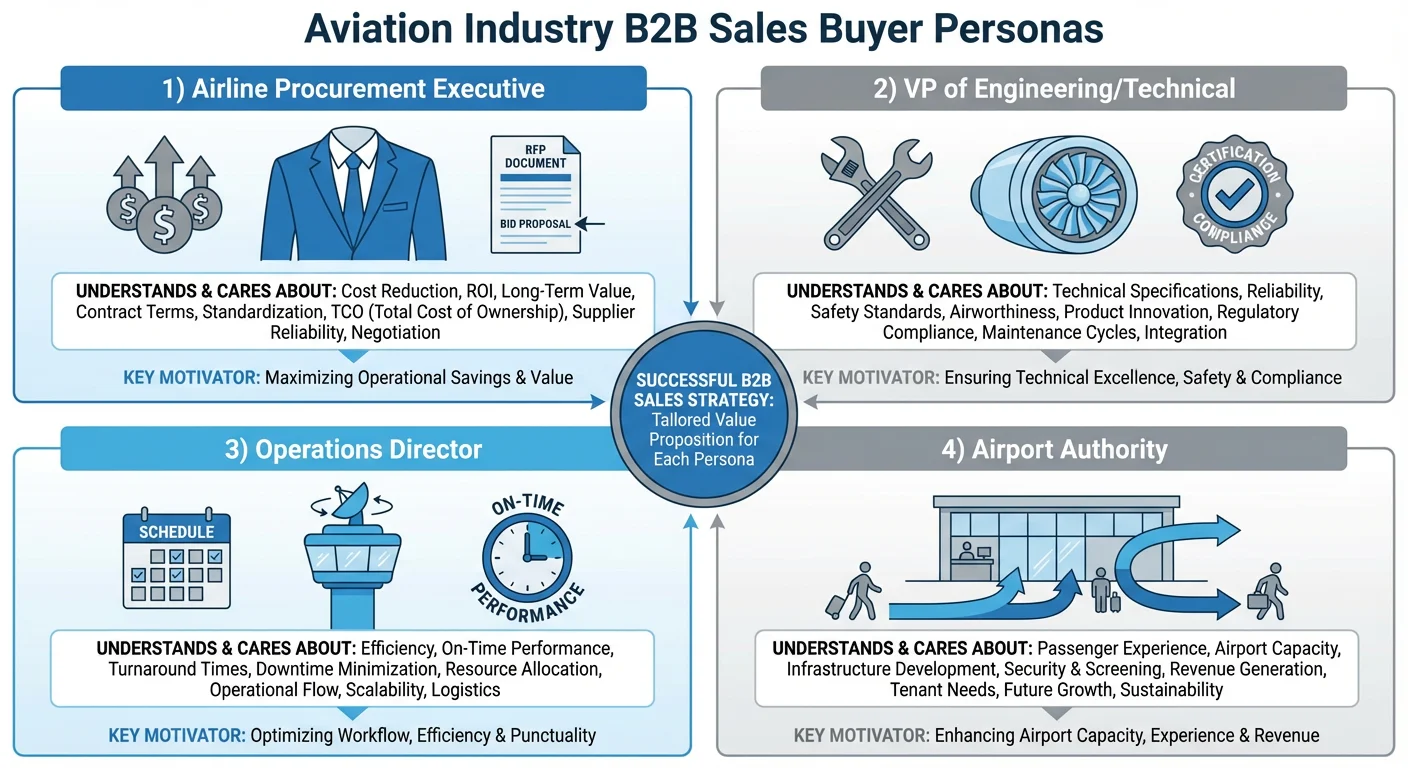
Effective cold email requires understanding the distinct roles, priorities, and decision-making patterns of aviation industry buyers.
Airline Procurement Executives
Airline procurement teams manage billions of dollars in annual spending across aircraft parts, fuel, ground services, IT systems, catering, and countless other categories. They balance cost optimization with operational reliability requirements.
What they value: Competitive pricing, supply chain reliability, quality certifications, favorable payment terms, and simplified vendor management.
Communication preferences: Procurement executives respond to emails that address specific category needs and demonstrate understanding of airline procurement processes.
Decision-making patterns: Procurement teams run formal RFP processes for significant purchases while maintaining authority over approved vendor lists and smaller purchases within established categories.
Technical and Engineering Leaders
VP of Engineering, VP of Maintenance, and technical director roles oversee aircraft maintenance, engineering standards, and technical operations. They evaluate vendors based on technical capability, certification status, and track record with similar aircraft types.
What they value: OEM approvals, FAA/EASA certifications, technical specifications, repair capabilities, and demonstrated experience with relevant aircraft types and systems.
Communication preferences: Technical leaders appreciate substantive communications that demonstrate genuine aviation expertise. They respond to emails that address specific aircraft types, components, or maintenance challenges.
Decision-making patterns: Technical leaders have significant authority over MRO vendor selection and parts sourcing decisions. Major capital purchases typically require coordination with finance and executive leadership.
Operations and Customer Experience Executives
Chief Operating Officers, VP of Operations, and customer experience leaders focus on operational efficiency, on-time performance, and passenger satisfaction. They evaluate services that improve operational metrics or customer experience scores.
What they value: Operational reliability, passenger satisfaction improvement, turn time efficiency, and measurable performance impact.
Communication preferences: Operations leaders appreciate communications that connect offerings to operational outcomes and customer experience metrics.
Decision-making patterns: Operations executives drive decisions affecting schedule reliability, ground operations, and passenger-facing services.
Airport Authority Decision-Makers
Airport directors, operations managers, and commercial directors oversee terminal operations, aeronautical services, and non-aeronautical revenue generation. They evaluate vendors that improve airport operations, passenger experience, or revenue performance.
What they value: Operational efficiency, passenger throughput improvement, safety compliance, revenue enhancement, and terminal aesthetics.
Communication preferences: Airport executives respond to communications that acknowledge the unique challenges of airport operations and demonstrate relevant experience.
Decision-making patterns: Airport authorities typically use formal procurement processes for significant contracts, with decisions involving multiple stakeholders (operations, finance, legal, board approval for major initiatives).
Aviation Industry Challenges in Cold Email Outreach
Cold email in aviation faces unique obstacles that require thoughtful strategies.
Challenge 1: Regulatory and Certification Requirements
Aviation vendors must meet extensive regulatory requirements, including FAA/EASA certifications, OEM approvals, and airline-specific qualification processes. These requirements create barriers to entry that extend procurement cycles.
Strategic response: Lead with certification status and regulatory compliance in cold email communications. Highlight relevant FAA/EASA approvals, OEM authorizations, and experience with similar airline qualification processes.
Practical application: Include certification numbers and approval status in email content and signature blocks. Reference specific aircraft types, engine models, or systems for which you hold approvals.
Challenge 2: Safety-Critical Decision Making
Aviation purchases often affect aircraft safety, making buyers extremely cautious about new vendors. The consequences of supplier failure can include safety incidents, operational disruptions, and regulatory action.
Strategic response: Acknowledge safety criticality in your communications. Emphasize quality systems, track record, and references from similar aviation customers.
Practical application: Reference AS9100/AS9110/AS9120 certifications, safety records, and established relationships with recognized aviation organizations. Avoid aggressive sales tactics that feel inconsistent with safety-focused culture.
Challenge 3: Extended Qualification and Procurement Cycles
New aviation vendor qualification can require 6-24 months depending on the product category and customer requirements. Formal RFP processes add additional timeline considerations.
Strategic response: Design cold email campaigns for relationship building and qualification initiation rather than immediate sales. Position outreach as the beginning of a long-term engagement process.
Practical application: Plan 18-24 month engagement sequences. Focus initial outreach on earning qualification opportunities and demonstrating capabilities rather than immediate purchase commitments.
Challenge 4: Incumbent Vendor Advantages
Airlines and MROs often maintain long-standing relationships with established vendors. Switching costs (qualification, training, inventory) create significant barriers for new suppliers.
Strategic response: Position as a complement or alternative source rather than complete replacement for incumbents. Emphasize specific capabilities or value propositions that differentiate from existing suppliers.
Practical application: Focus on specific gaps (geographic coverage, component capabilities, capacity constraints) that existing suppliers may not adequately address. Emphasize dual-sourcing benefits for supply chain resilience.
Challenge 5: Market Cyclicality and Financial Pressures
Airline profitability fluctuates dramatically with fuel prices, economic conditions, and global events. Financial pressures can freeze procurement activity while strong periods accelerate fleet investment.
Strategic response: Monitor airline financial performance and adjust outreach timing and messaging accordingly. During downturns, emphasize cost reduction. During growth periods, emphasize capacity and service expansion.
Practical application: Track airline earnings reports and fleet announcements. Adjust messaging to reflect current financial conditions and strategic priorities.
Cold Email Best Practices for Aviation
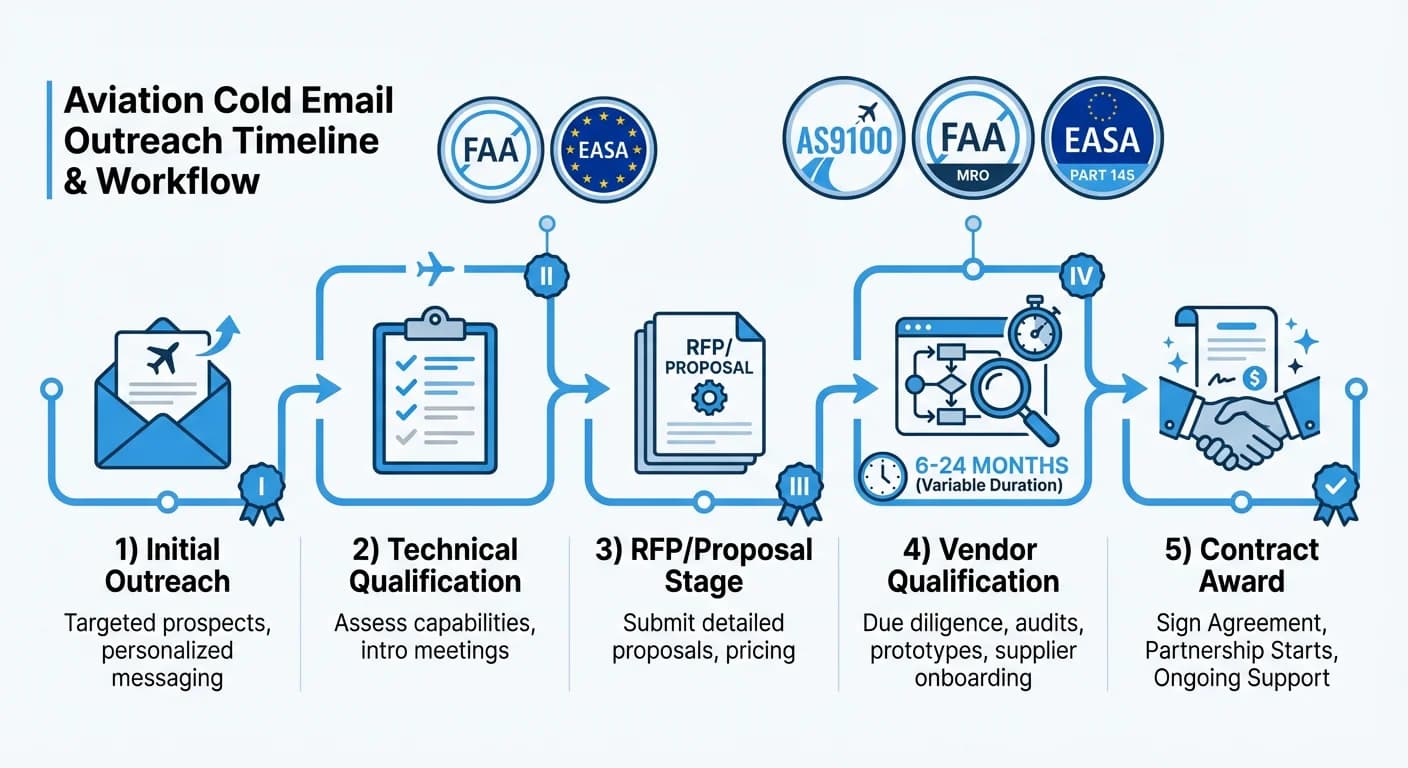
Effective aviation industry cold emails combine sector knowledge with proven outreach principles.
Subject Lines That Get Opened
Aviation professionals receive numerous emails daily. Subject lines must immediately establish aviation relevance and specific value.
Effective approaches:
- Reference specific aircraft types: "737 MAX component availability for return to service"
- Mention operational benefits: "Reducing ground time at hub operations"
- Highlight certification status: "FAA-approved PMA alternatives for CFM56 components"
- Connect to industry trends: "Sustainable aviation fuel supply for 2027 requirements"
Approaches to avoid:
- Generic capability claims: "Best-in-class aviation solutions"
- Urgency tactics: "Limited time pricing on aircraft parts"
- Vague propositions: "Partnership opportunity in aviation"
- Questions that feel manipulative: "Are you overpaying for MRO services?"
Email Copy Structure
Aviation cold emails should establish technical credibility, communicate specific value, and provide clear engagement paths.
Opening statement: Reference a specific aircraft type, operational challenge, or industry development that establishes relevance to the recipient.
Credibility establishment: Within the first few sentences, establish why your company deserves attention. Include specific FAA/EASA approvals, OEM authorizations, or reference airlines.
Value proposition: Clearly state what you offer and why it matters to aviation operations. Focus on outcomes (cost reduction, availability improvement, compliance assurance) rather than feature lists.
Call to action: Request a specific, appropriate next step. For aviation, this often means a technical discussion, capability review, or qualification opportunity.
Signature: Include relevant certifications (AS9100, FAA/EASA approvals), OEM authorizations, and industry association memberships in your signature block.
Timing Considerations
Aviation cold email timing should align with industry cycles and operational realities.
Optimal timing:
- Following airline earnings announcements that indicate financial health
- During budget planning cycles (typically Q3-Q4)
- Before heavy maintenance seasons
- After new aircraft delivery announcements
- When regulatory changes create new requirements
Timing to avoid:
- During operational crises or safety incidents
- Immediately following significant financial losses
- During known blackout periods around active RFPs
Sample Cold Emails for Aviation
The following examples demonstrate effective cold email approaches for different aviation industry scenarios.
Example 1: Parts Supplier to Airline Procurement
Subject: FAA-PMA alternatives for [aircraft type] rotable components
Body:
Managing rotable inventory costs while maintaining dispatch reliability remains a constant challenge for airline procurement teams. FAA-approved PMA components offer cost savings potential without compromising airworthiness.
[Your Company] manufactures FAA-PMA replacement parts for [aircraft type] interior and cabin components. Our parts are approved under PMA number [XXX] and currently installed on aircraft operated by [number] airlines worldwide.
Typical savings range from 30-50% compared to OEM pricing, with equivalent or superior warranty coverage.
Would a brief call make sense to discuss which components might benefit [Airline]'s [aircraft type] fleet?
Best regards, [Name] [Title] [Company] FAA PMA Holder | AS9100D Certified
Example 2: MRO Provider to VP of Technical Operations
Subject: [Engine type] heavy maintenance capacity for Q3 2027
Body:
Engine shop visit planning requires balancing maintenance timing with slot availability, and capacity constraints at established providers can complicate scheduling.
[Your Company] operates [engine type] overhaul facilities with current capacity available for Q3 and Q4 2027 shop visits. We hold FAA/EASA Part 145 approval and maintain OEM authorization for [engine type] heavy maintenance.
Our average turnaround time of [X] days and first-time pass rate exceeding [X]% help minimize aircraft downtime.
Would you be interested in discussing how we might support [Airline]'s engine maintenance requirements?
Best regards, [Name] [Title] [Company] FAA Part 145 | EASA Part 145 | [OEM] Authorized
Example 3: Technology Provider to Airport Operations Director
Subject: Reducing passenger processing time at security checkpoints
Body:
Checkpoint throughput directly impacts passenger experience scores and connection reliability, yet many airports struggle to balance security requirements with processing efficiency.
[Your Company] provides automated screening technology deployed at [number] airports worldwide. Our systems typically increase checkpoint throughput by 25-35% while maintaining full TSA compliance.
Recent installations at [similar airport type] have demonstrated measurable improvements in passenger satisfaction scores and reduced peak-hour queuing.
Would a demonstration of our technology's applicability to [Airport] operations be valuable?
Best regards, [Name] [Title] [Company] TSA Qualified | [Relevant Certifications]
Example 4: Training Provider to VP of Flight Operations
Subject: [Aircraft type] type rating capacity for 2027 fleet growth
Body:
Fleet expansion requires pilot training capacity that aligns with delivery schedules. Training provider capacity constraints can create bottlenecks that delay aircraft deployment.
[Your Company] operates [aircraft type] full-flight simulators at [number] training centers worldwide. We currently have type rating capacity available for 2027 that could support [Airline]'s reported fleet expansion plans.
Our instructors include former [aircraft type] line captains from major carriers, and our completion rates exceed [X]%.
Would a conversation about your 2027 training requirements be helpful?
Best regards, [Name] [Title] [Company] FAA Part 142 | EASA ATO Approved
Building Your Aviation Cold Email Program
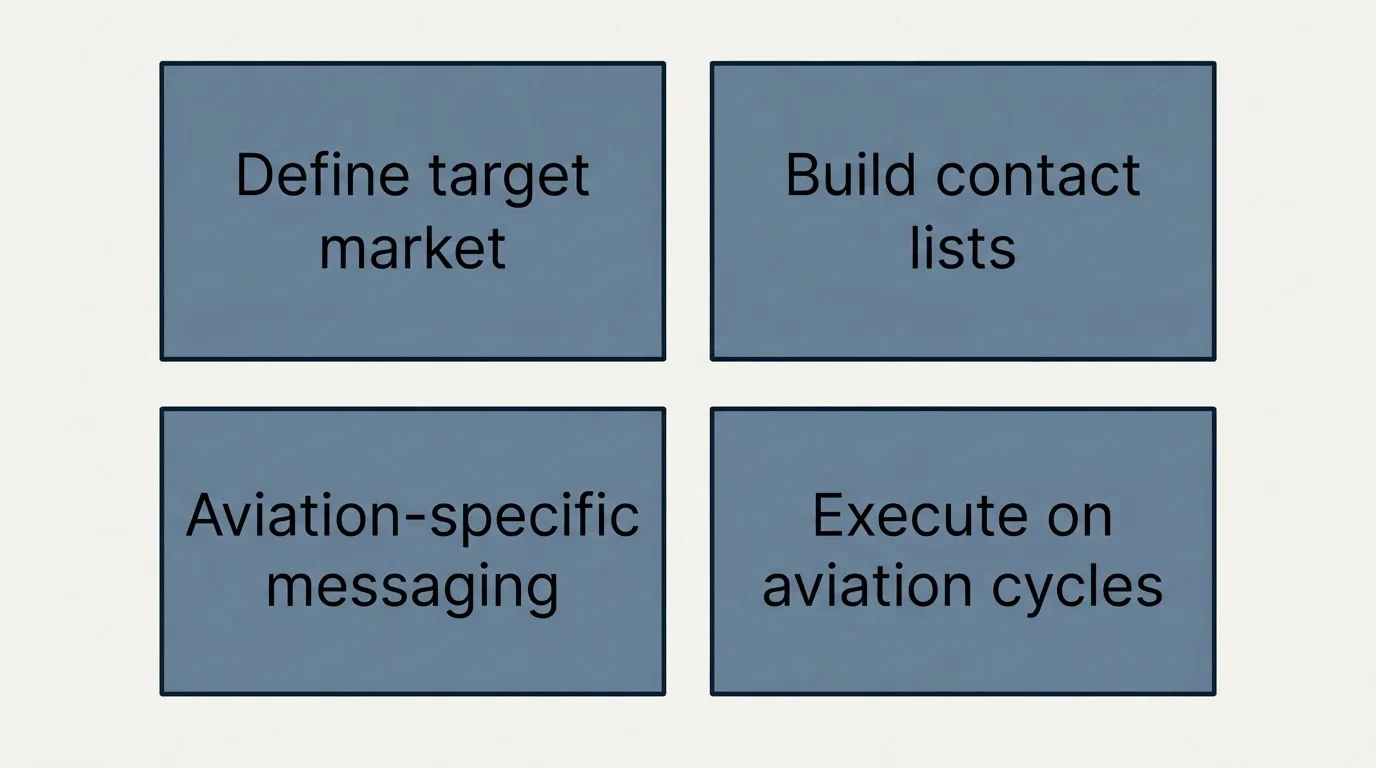
Implementing an effective aviation cold email program requires systematic approach to targeting, messaging, and execution.
- Step 1Define Your Target Market
Clearly identify which aviation segments represent your best opportunities based on customer type, aircraft fleet, geographic presence, and operational characteristics.
- Step 2Build Targeted Contact Lists
Aviation industry contacts can be identified through multiple sources, including company websites, LinkedIn, aviation directories, and industry events.
- Step 3Develop Aviation-Specific Messaging
Create email sequences that demonstrate genuine understanding of aviation operations and offer specific value to recipients.
- Step 4Execute with Aviation Cycles in Mind
Time campaign execution to align with industry and company-specific cycles.
Step 1: Define Your Target Market
Clearly identify which aviation segments represent your best opportunities based on customer type, aircraft fleet, geographic presence, and operational characteristics.
Segmentation considerations:
- Customer type (airline, MRO, airport, OEM, lessor)
- Fleet composition and aircraft types
- Geographic headquarters and operational regions
- Airline business model (full-service, low-cost, cargo)
- Current fleet investment and growth plans
- Financial health and investment capacity
Step 2: Build Targeted Contact Lists
Aviation industry contacts can be identified through multiple sources, including company websites, LinkedIn, aviation directories, and industry events.
High-value contact sources:
- Aviation Week Intelligence Network and similar databases
- Airline and airport organizational announcements
- Industry association directories (IATA, ACI, ARSA, etc.)
- Conference speaker and attendee lists
- Trade publication editorial contacts
Verification requirements:
- Confirm current employment and role
- Validate email addresses before sending
- Verify relevance to your offering and aircraft types
Step 3: Develop Aviation-Specific Messaging
Create email sequences that demonstrate genuine understanding of aviation operations and offer specific value to recipients.
Message development guidelines:
- Reference specific aircraft types, engine models, or operational challenges
- Include certification status and approval numbers
- Quantify performance claims with supportable data
- Acknowledge safety and regulatory priorities
Step 4: Execute with Aviation Cycles in Mind
Time campaign execution to align with industry and company-specific cycles.
Execution considerations:
- Monitor airline financial performance and fleet announcements
- Track industry capacity utilization and MRO demand
- Align with maintenance planning and budget cycles
- Coordinate with industry event schedules
Aviation Cold Email Checklist
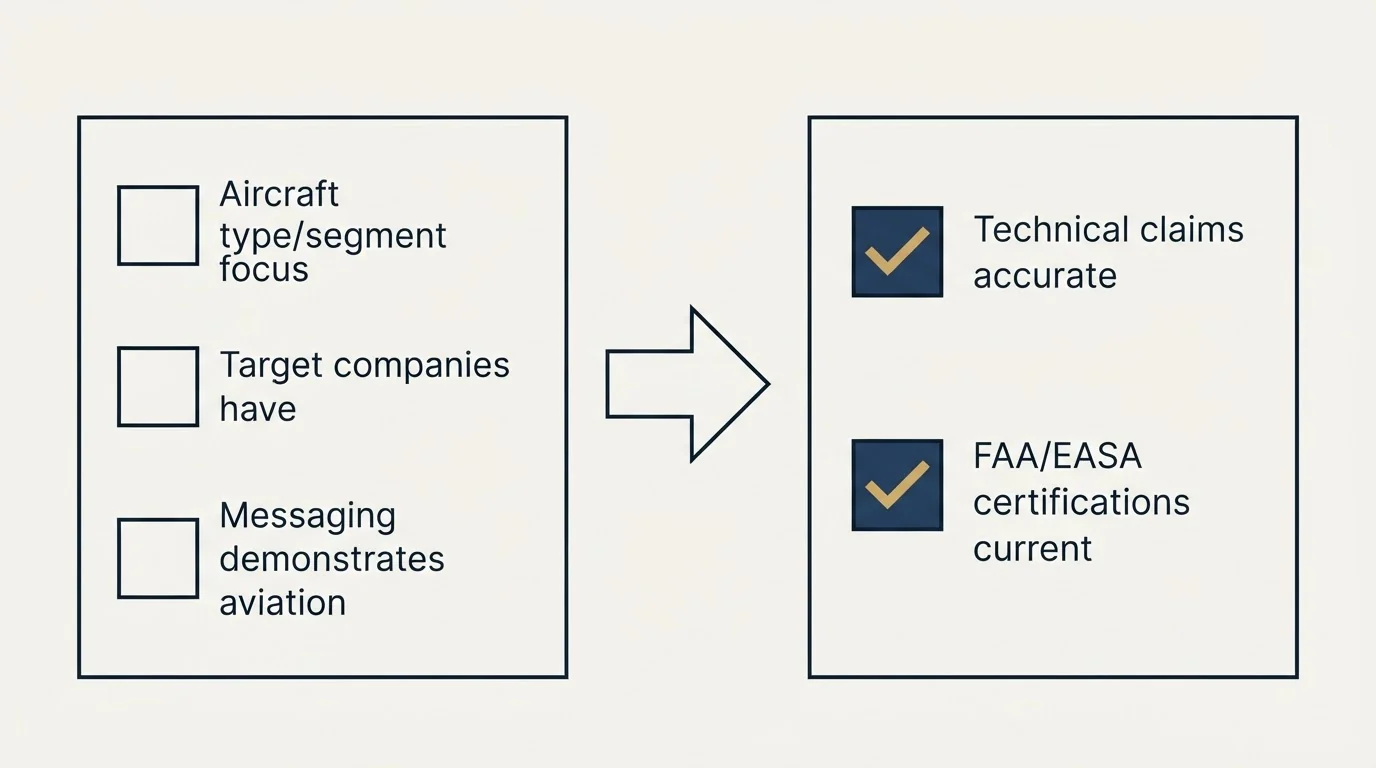
Before launching aviation industry cold email campaigns, verify the following:
Industry alignment:
- Aircraft type/segment focus appropriate for offering
- Target companies have relevant fleet composition
- Messaging demonstrates aviation expertise
- Technical claims accurate and supportable
Certification and compliance:
- FAA/EASA certifications current and highlighted
- OEM approvals noted where relevant
- AS9100 or equivalent quality certification held
- Reference customers appropriate to mention
Targeting accuracy:
- Decision-maker titles confirmed
- Company fit verified
- Email addresses validated
- Geographic targeting appropriate
Message quality:
- Subject line specific to aviation challenges
- Opening establishes aircraft type or operational relevance
- Value proposition quantified where possible
- Call to action appropriate for aviation buying cycles
- Safety and compliance awareness demonstrated
Technical setup:
- Email authentication configured
- Reply handling process established
- Follow-up sequences prepared
- CRM tracking functional
Getting Started with Aviation Cold Email
The aviation industry offers significant opportunities for suppliers and service providers who understand its unique requirements. Cold email provides direct access to aviation decision-makers who may be difficult to reach through industry events alone.
Success requires technical credibility demonstrated through certifications and references, patience to navigate extended qualification processes, and flexibility to adapt messaging to industry cyclical conditions.
RevenueFlow specializes in cold email campaigns for aviation industry suppliers and service providers. Our team understands the certification requirements, procurement processes, and relationship-building timelines that drive success in aviation business development.
Get your free cold email campaign and start reaching aviation industry decision-makers →
Related Reading
Frequently asked questions.
Frequently asked questions- Why does cold email work for reaching aviation industry decision-makers?
- Cold email works in aviation because decision-makers are identifiable through industry directories and professional networks, operational pressures create ongoing needs for efficiency improvements, and technical complexity requires specialized vendors. Airlines face constant pressure to reduce costs and improve performance, which drives continuous supplier evaluation. Additionally, airline mergers and MRO consolidation have disrupted traditional vendor relationships, opening opportunities for new entrants through formal procurement processes.
- Who are the key decision-makers for aviation cold email campaigns?
- Key aviation decision-makers include airline procurement executives who manage billions in spending, technical and engineering leaders (VP of Engineering, VP of Maintenance) who evaluate certifications and aircraft-specific capabilities, operations and customer experience executives focused on reliability and passenger satisfaction, and airport authority decision-makers overseeing terminal operations and revenue generation. Each persona has distinct priorities, with procurement focused on cost and reliability, technical leaders on certifications and specifications, and operations on performance metrics.
- What challenges make aviation cold email outreach difficult?
- Aviation cold email faces five primary challenges: regulatory and certification requirements that create high barriers to entry, safety-critical decision-making that demands extensive vetting, extended qualification and procurement cycles that lengthen sales timelines, incumbent vendor advantages built through years of relationship networks, and market cyclicality with financial pressures that affect purchasing authority. These factors require specialized messaging that demonstrates aviation expertise, relevant certifications, and understanding of operational priorities specific to airlines, MRO providers, or airports.
- What do airline procurement executives value when evaluating vendors?
- Airline procurement executives prioritize competitive pricing, supply chain reliability, quality certifications, favorable payment terms, and simplified vendor management. They manage billions in annual spending across categories like aircraft parts, fuel, ground services, IT systems, and catering. Procurement teams run formal RFP processes for significant purchases while maintaining authority over approved vendor lists and smaller purchases within established categories, making them responsive to emails addressing specific category needs with demonstrated understanding of airline procurement processes.
About the author.

Fernando Cao is CEO at RevenueFlow, which builds and operates outbound revenue engines for B2B companies. Previously at Accenture Strategy. Studied at University of Bath.
Fernando Cao · CEO
Connect on LinkedIn →Explore more.
Ready to scale your outreach?
We build GTM engines that book real meetings. See the receipts.
Related articles.
Cold Email for Maintenance Services: The Complete Guide
A comprehensive guide to cold email outreach for commercial maintenance companies, covering how to reach facility managers, property managers, and operations directors with messaging that wins preventive maintenance and repair contracts.
Cold Email for Staffing Agencies: The Complete Guide
A comprehensive guide to cold email outreach for staffing and temp agencies, covering how to reach HR directors, hiring managers, and operations leaders with messaging that wins temporary staffing, contract placement, and direct hire business.
Cold Email for Telecom: Reaching Carriers and MSPs
Telecom companies face rapid technology changes and competitive pressures. Here's how to approach cold email outreach to carriers, MSPs, and UCaaS providers.
Cold Email for Electronics Companies: The Complete Guide
A comprehensive guide to cold email outreach for electronics manufacturers, component suppliers, and EMS providers, covering buyer personas, OEM relationships, contract manufacturing, and proven strategies for reaching engineers, procurement managers, and supply chain leaders.
Cold Email for Security Services: The Complete Guide
A comprehensive guide to cold email outreach for security service providers, covering how to reach facility managers, corporate security directors, and property managers with messaging that builds trust and wins contracts.
Cold Email for Cloud Services: The Complete Guide
Learn how to effectively reach decision-makers at cloud service providers and enterprises adopting cloud infrastructure. This guide covers targeting strategies, technical credibility, and email templates for the cloud services industry.