Cold Email for Beauty: The Complete Guide
A comprehensive guide to cold email outreach for the beauty and cosmetics industry, covering brands, retailers, salons, and spas with strategies for reaching beauty buyers, brand managers, and spa directors.
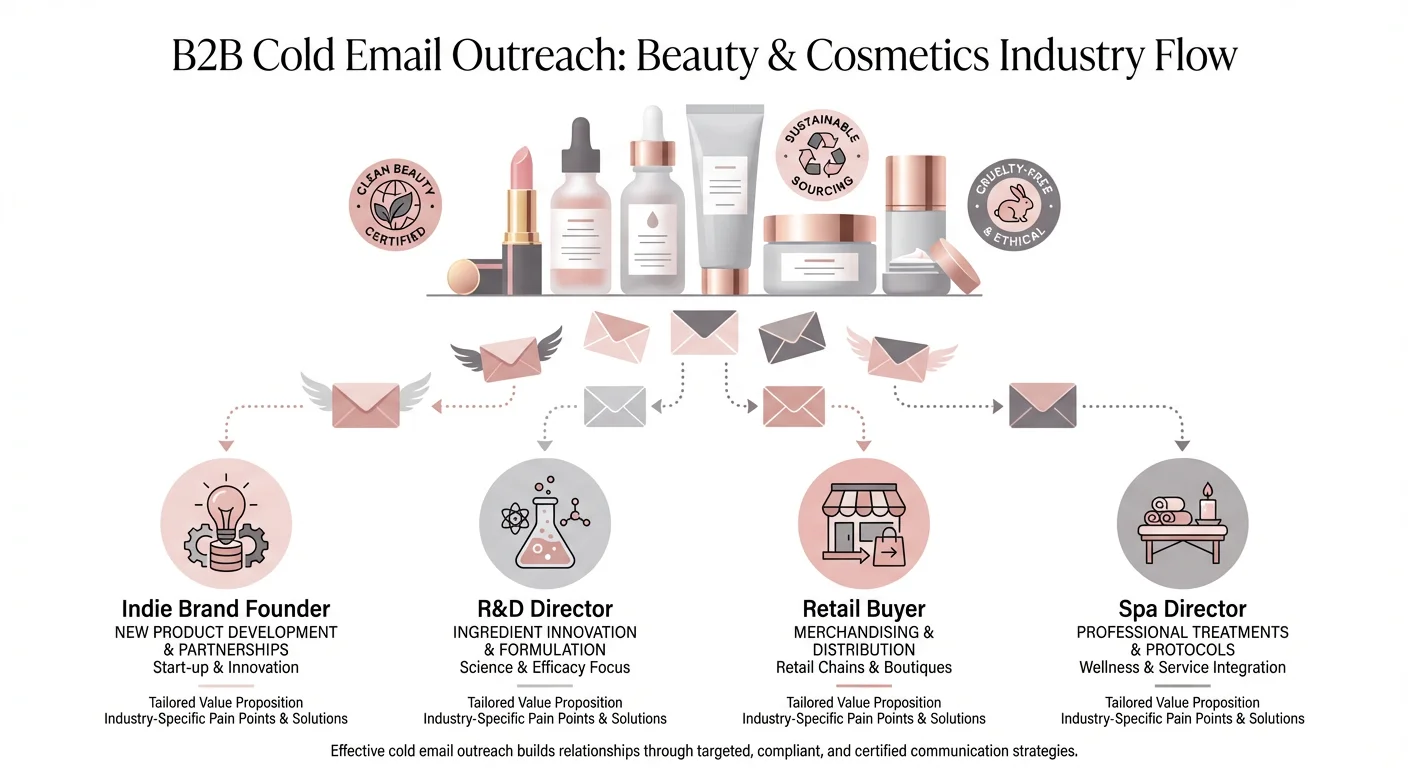
Cold email works effectively in the beauty industry because brands continuously seek ingredient, packaging, and formulation innovations to differentiate products. Decision-makers like brand managers, R&D directors, and spa owners maintain identifiable professional profiles, while the growth of indie brands has created new opportunities for suppliers seeking vendor relationships. Cold email extends relationship building beyond infrequent trade shows, providing direct access to buyers who actively evaluate new solutions for competitive advantage.
Key takeaways
- The beauty industry has distinct buyer personas including indie brand founders who make purchasing decisions personally, R&D leaders who evaluate based on technical specifications and safety data, retail buyers who focus on brand positioning and margin structure, and spa directors who balance product efficacy with brand prestige.
- Independent beauty brand founders value flexibility on minimum order quantities, regulatory support, and vendors willing to grow with emerging brands, often making decisions quickly despite budget constraints.
- R&D professionals at established brands respond to substantive technical content showing cosmetic science expertise, requiring safety documentation and regulatory compliance with FDA and EU regulations.
- Retail buyers at specialty stores and department store chains make assortment decisions within their categories based on brand story, consumer demand evidence, and marketing support.
- The proliferation of independent beauty brands has expanded opportunities for ingredient suppliers, contract manufacturers, and packaging providers as these emerging brands have limited supplier networks and welcome new vendor relationships.
Reviewed and updated September 15, 2026
Cold Email for Beauty: The Complete Guide
The beauty and cosmetics industry represents a global market generating hundreds of billions in annual revenue, encompassing prestige brands, mass market products, professional salon lines, and emerging indie labels. This dynamic ecosystem creates extensive B2B relationships where ingredient suppliers, packaging companies, retailers, distributors, and service providers compete for attention from beauty industry decision-makers.
Cold email has become an essential business development tool for companies serving the beauty industry. Whether you supply ingredients, packaging, technology, retail distribution, or professional services, proactive outreach to beauty buyers and brand decision-makers accelerates market access in ways that trade shows and industry networking alone cannot achieve.
This guide provides a comprehensive framework for implementing cold email campaigns that generate qualified opportunities within the beauty and cosmetics industry.
Why Cold Email Works for Beauty
The beauty industry's characteristics create favorable conditions for well-executed cold email outreach.
Innovation drives competitive advantage. Beauty brands continuously seek new ingredients, formulations, and packaging innovations that enable product differentiation. Cold email introduces innovation to brand decision-makers who actively evaluate new solutions.
Decision-makers are identifiable. Brand managers, category buyers, salon owners, and spa directors maintain professional profiles accessible through industry directories, trade show attendee lists, and professional networks.
The indie brand explosion creates opportunity. The proliferation of independent beauty brands has expanded the market for ingredient suppliers, contract manufacturers, and packaging providers. These emerging brands often have limited supplier networks and welcome new vendor relationships.
Retail channel evolution opens new paths. Changes in beauty retail (specialty retail growth, e-commerce expansion, subscription models) have created new buyers and purchasing processes that may be more accessible to cold outreach.
Trade show limitations persist. While events like Cosmoprof, MakeUp in Paris, and ISSE remain important, they occur infrequently and involve substantial investment. Cold email extends relationship building beyond these periodic gatherings.
Understanding Beauty Industry Buyers
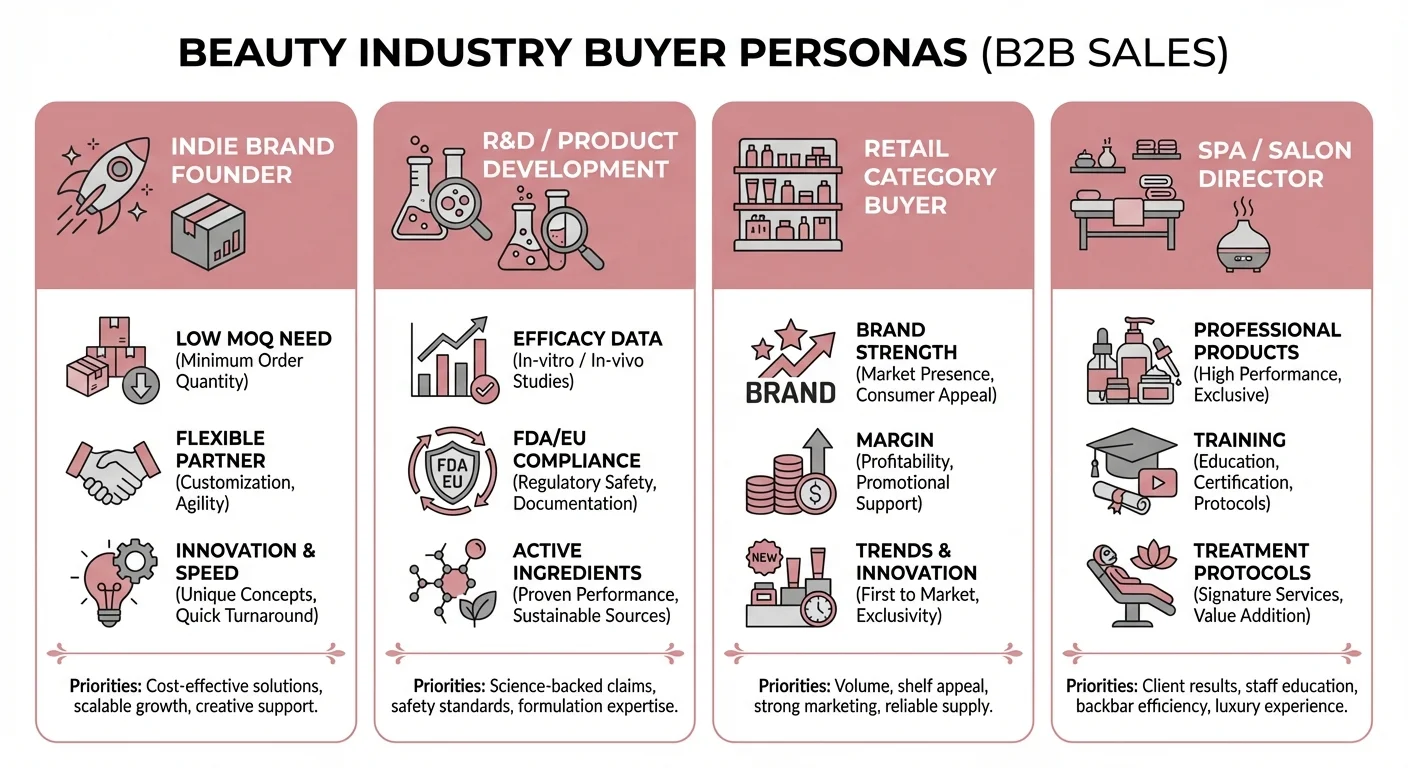
Effective cold email requires understanding the distinct roles, priorities, and decision-making patterns of beauty industry buyers.
Brand Founders and Indie Brand Leaders
Independent brand founders make purchasing decisions personally and often seek vendor partners who understand emerging brand challenges. They balance quality aspirations with startup budget realities.
What they value: Flexibility on minimum order quantities, quality guidance, regulatory support, and vendors willing to grow with emerging brands.
Communication preferences: Indie founders appreciate communications that acknowledge the challenges of building a beauty brand and demonstrate genuine interest in partnership.
Decision-making patterns: Founders make decisions personally and often quickly. Budget constraints may require creative solutions or phased engagements.
Product Development and R&D Leaders
Product development professionals at established brands drive new product creation and product improvement initiatives. They evaluate ingredients, formulations, and packaging based on performance, safety, and brand positioning.
What they value: Technical specifications, efficacy data, safety documentation, regulatory compliance (FDA, EU regulations), trend alignment, and application support.
Communication preferences: R&D professionals appreciate substantive technical content and specific performance data. They respond to emails that demonstrate genuine cosmetic science expertise.
Decision-making patterns: Product development influences supplier selection through specification development while working with procurement on commercial terms and sourcing decisions.
Retail Buyers and Category Managers
Retail buyers at specialty beauty retailers, department stores, and mass market chains make decisions about which brands and products to carry. They evaluate opportunities based on brand strength, consumer demand, margin, and category strategy.
What they value: Brand story, consumer demand evidence, margin structure, marketing support, and supply chain reliability.
Communication preferences: Retail buyers appreciate concise communications that quickly establish brand positioning and consumer appeal.
Decision-making patterns: Buyers have authority over assortment decisions within their categories. Major brand additions may involve merchandising leadership and formal vendor review processes.
Spa Directors and Salon Owners
Spa directors and salon owners select professional products for use in services and retail. They balance product performance with brand positioning, training requirements, and margin considerations.
What they value: Product efficacy, brand prestige alignment, training and education support, and profit margin potential on retail sales.
Communication preferences: Spa and salon decision-makers appreciate communications that acknowledge the intersection of technical performance and client experience.
Decision-making patterns: Owners and directors make decisions about product lines, often with input from lead estheticians or stylists. Professional brand switches involve training and inventory considerations.
Beauty Industry Challenges in Cold Email Outreach
Cold email for the beauty industry faces unique obstacles that require thoughtful strategies.
Challenge 1: Brand and Positioning Sensitivities
Beauty brands are highly conscious of brand image and positioning. Vendors must demonstrate alignment with brand aesthetics and values to earn consideration.
Strategic response: Research brand positioning before outreach and tailor messaging to demonstrate alignment. Acknowledge brand values and aesthetic sensibilities in communications.
Practical application: Reference the brand's positioning and explain how your offering supports their brand values. For sustainable brands, emphasize sustainable credentials. For prestige brands, emphasize quality and exclusivity.
Challenge 2: Regulatory Complexity
Cosmetics and personal care products face regulatory requirements that vary by market (FDA in the US, EU Cosmetics Regulation, etc.). Buyers need confidence that suppliers understand and comply with relevant regulations.
Strategic response: Lead with regulatory knowledge and compliance credentials in cold email communications. Demonstrate understanding of market-specific requirements.
Practical application: Reference specific regulatory frameworks relevant to the recipient's market. Include compliance documentation availability and testing capabilities in your capabilities summary.
Challenge 3: Trend Sensitivity and Speed to Market
Beauty industry success depends on responding quickly to trends. Brands need suppliers who can support rapid product development and launch timelines.
Strategic response: Emphasize speed, flexibility, and trend awareness in messaging. Demonstrate understanding of current beauty trends and ability to support rapid development.
Practical application: Reference current trends relevant to your offering. Highlight turnaround times, minimum order flexibility, and ability to support quick-turn projects.
Challenge 4: Established Supplier Relationships
Beauty brands often maintain long-standing relationships with ingredient suppliers, manufacturers, and packaging providers. These relationships represent significant switching barriers.
Strategic response: Position as a complement or alternative for specific needs rather than complete replacement. Emphasize unique capabilities or innovations that existing suppliers may not offer.
Practical application: Focus on specific capabilities (novel ingredients, specialized packaging formats, emerging market expertise) that create openings alongside established suppliers.
Challenge 5: Quality and Consistency Requirements
Beauty products must meet exacting quality standards for safety, stability, and sensory experience. Buyers need confidence in supplier quality systems.
Strategic response: Demonstrate quality credentials through certifications, testing capabilities, and track record. Address quality concerns proactively in communications.
Practical application: Include relevant certifications (ISO, GMP), testing capabilities, and quality systems in your communications. Reference experience with similar quality-sensitive applications.
Cold Email Best Practices for Beauty
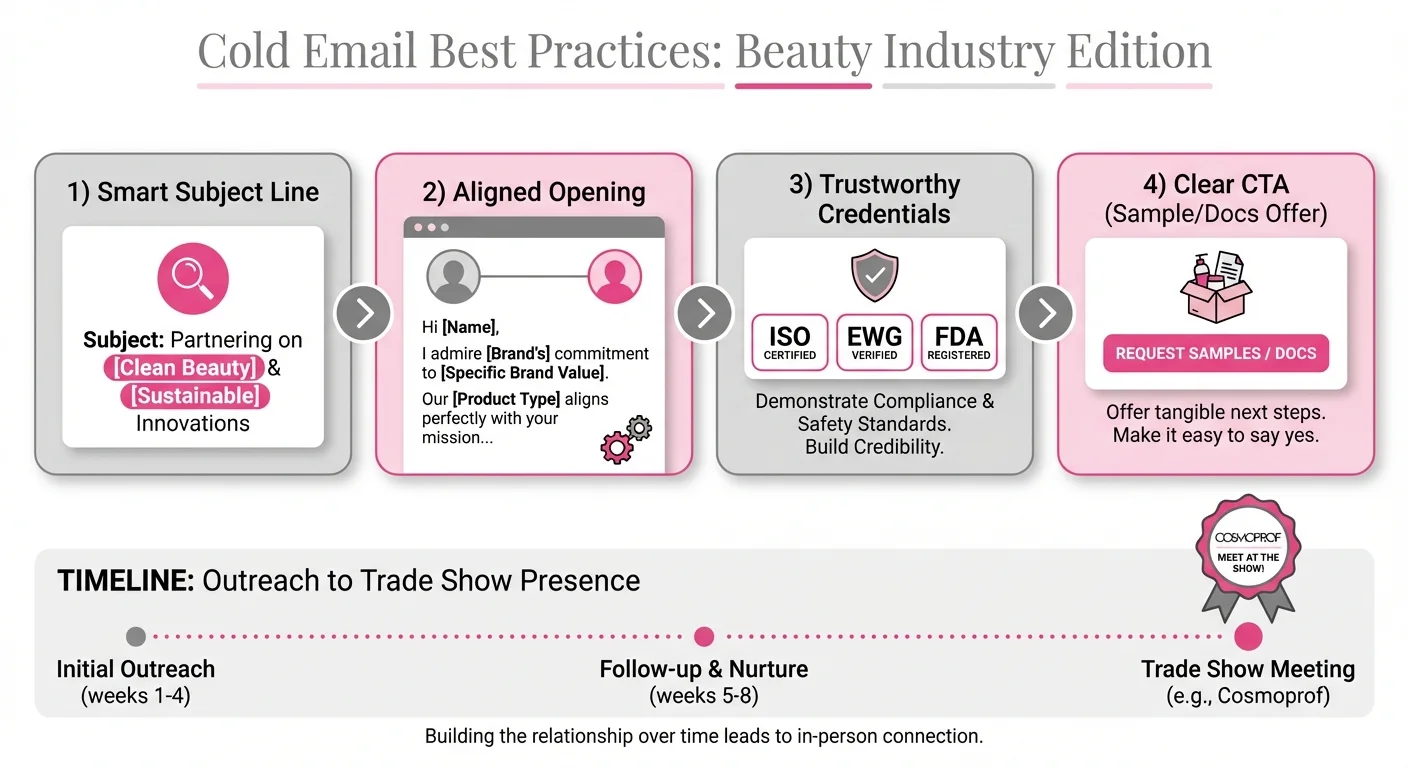
Effective beauty industry cold emails combine sector knowledge with proven outreach principles.
Subject Lines That Get Opened
Beauty industry professionals receive numerous vendor emails. Subject lines must immediately establish relevance and appeal.
Effective approaches:
- Reference specific product categories: "Clean beauty preservative systems for skincare formulations"
- Mention trend alignment: "Sustainable packaging solutions for refillable cosmetics"
- Highlight innovation: "Biotechnology-derived active ingredients for anti-aging claims"
- Connect to business needs: "Contract manufacturing for indie beauty brand launches"
Approaches to avoid:
- Generic capability claims: "Leading beauty industry supplier"
- Overly promotional language: "Amazing new beauty ingredients"
- Vague value propositions: "Partnership opportunity in cosmetics"
- Questions that feel manipulative: "Looking for better ingredients?"
Email Copy Structure
Beauty industry cold emails should establish credibility, communicate specific value, and provide clear engagement paths.
Opening statement: Reference a specific product category, trend, or brand positioning element that establishes relevance to the recipient.
Credibility establishment: Within the first few sentences, establish why your company deserves attention. Include relevant experience, certifications, and brand references where appropriate.
Value proposition: Clearly state what you offer and why it matters to the recipient's brand or business. Focus on outcomes (differentiation, speed to market, cost efficiency) rather than generic descriptions.
Call to action: Request a specific, appropriate next step. For beauty, this might be samples, technical documentation, or a discovery conversation.
Signature: Include relevant certifications, brand references, and credentials in your signature block.
Timing Considerations
Beauty industry cold email timing should align with product development cycles and industry patterns.
Optimal timing:
- Q1-Q2 for holiday product development (9-12 month lead times)
- Before major trade shows (Cosmoprof, ISSE, MakeUp in)
- When trend reports indicate relevant category growth
- Following brand announcements indicating new product initiatives
- During formula review and supplier evaluation cycles
Timing to avoid:
- During trade show weeks (attention elsewhere)
- Immediately before major product launches (focus on execution)
- During peak production periods for seasonal businesses
Sample Cold Emails for Beauty
The following examples demonstrate effective cold email approaches for different beauty industry scenarios.
Example 1: Ingredient Supplier to Brand R&D Director
Subject: Biotechnology-derived retinoid alternative for clean beauty formulations
Body:
Many R&D leaders I work with in clean beauty face the challenge of delivering anti-aging efficacy while maintaining clean and natural positioning. Traditional retinoids present formulation and claim challenges that conflict with clean beauty standards.
[Your Company] produces a biotechnology-derived retinoid alternative that delivers clinically demonstrated anti-aging benefits with a clean ingredient profile. Our active has completed safety testing and efficacy studies showing [specific results] in wrinkle reduction and skin texture improvement.
We supply similar ingredients to [brand categories] and can provide technical documentation, samples, and formulation guidance.
Would samples and efficacy data be helpful for your product development work?
Best regards, [Name] [Title] [Company] ISO 22716 | EWG Verified Supplier
Example 2: Contract Manufacturer to Indie Brand Founder
Subject: Small-batch skincare manufacturing for emerging brands
Body:
Launching a skincare brand requires manufacturing partners who understand emerging brand economics while delivering the quality that builds brand reputation.
[Your Company] specializes in contract manufacturing for independent skincare brands. We offer minimum order quantities starting at [amount], FDA-registered facilities, and end-to-end support from formulation refinement through production and fulfillment.
Current brand partners include [brand types], and we have capacity to support new brands with launch timelines as short as [timeframe].
Would a conversation about your manufacturing needs and launch timeline be helpful?
Best regards, [Name] [Title] [Company] FDA Registered | ISO 22716 | Leaping Bunny Certified
Example 3: Packaging Supplier to Brand Packaging Director
Subject: Sustainable packaging for prestige skincare repositioning
Body:
Prestige skincare brands increasingly seek packaging that communicates sustainability commitment while maintaining the premium aesthetics their positioning requires. Standard sustainable options often compromise on quality perception.
[Your Company] manufactures sustainable packaging components that combine recycled and renewable materials with prestige-quality finishes. Our solutions include [specific components] that have been adopted by [brand categories].
We can provide samples, sustainability documentation, and design consultation to explore how our capabilities might support your packaging evolution.
Would samples and a capabilities overview be valuable?
Best regards, [Name] [Title] [Company] FSC Certified | PCR Capability
Example 4: Professional Brand to Spa Director
Subject: Results-driven facial protocols for [Spa Name]
Body:
Spas seeking to differentiate through visible results need professional product partners whose formulations deliver measurable outcomes that build client loyalty and drive rebooking.
[Your Company] provides professional skincare protocols designed for spa environments. Our formulations feature [key differentiators], and our facial protocols are designed to deliver visible results that clients notice immediately.
We provide comprehensive training, marketing support, and retail programs that help spa partners build product revenue alongside service revenue.
Would a product demonstration and training overview be valuable for [Spa Name]?
Best regards, [Name] [Title] [Company] [Relevant Certifications]
Building Your Beauty Cold Email Program
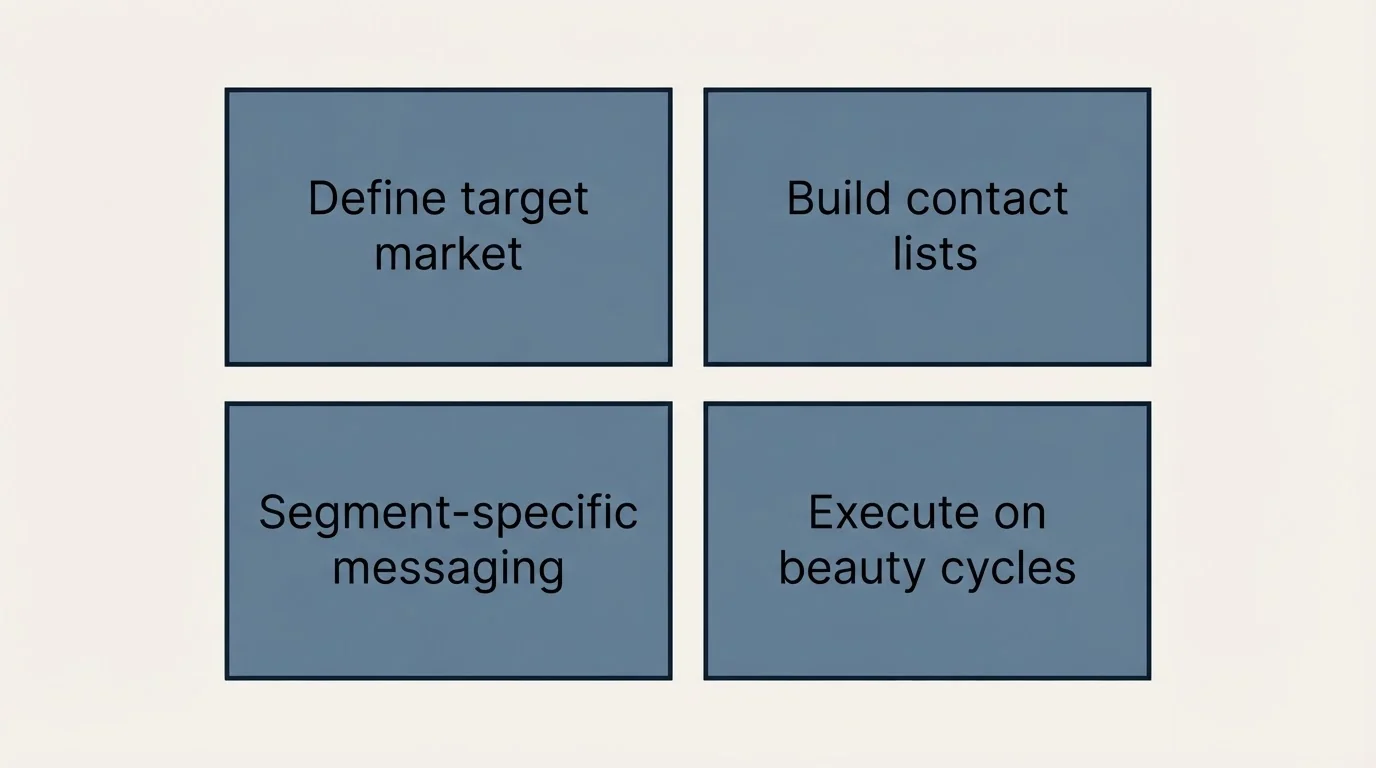
Implementing an effective beauty industry cold email program requires systematic approach to targeting, messaging, and execution.
- Step 1Define Your Target Market
Clearly identify which beauty segments represent your best opportunities based on offering fit, price positioning, and service capability.
- Step 2Build Targeted Contact Lists
Beauty industry contacts can be identified through multiple sources, including company websites, LinkedIn, trade show exhibitor lists, and industry databases.
- Step 3Develop Segment-Specific Messaging
Create email sequences that demonstrate genuine understanding of specific beauty segments and their priorities.
- Step 4Execute with Beauty Cycles in Mind
Time campaign execution to align with beauty industry development cycles and seasonal patterns.
Step 1: Define Your Target Market
Clearly identify which beauty segments represent your best opportunities based on offering fit, price positioning, and service capability.
Segmentation considerations:
- Product category (skincare, color cosmetics, haircare, fragrance)
- Brand positioning (prestige, masstige, mass market, indie)
- Channel (retail, professional, direct-to-consumer)
- Market geography and regulatory requirements
- Brand size and purchasing capacity
- Sustainability and values alignment
Step 2: Build Targeted Contact Lists
Beauty industry contacts can be identified through multiple sources, including company websites, LinkedIn, trade show exhibitor lists, and industry databases.
High-value contact sources:
- Trade show exhibitor and attendee lists (Cosmoprof, ISSE, MakeUp in)
- Industry association directories
- LinkedIn professional searches
- Beauty industry databases and directories
- New brand launch announcements
- Industry publication editorial contacts
Verification requirements:
- Confirm current employment and role
- Validate email addresses before sending
- Verify relevance to your offering and positioning
Step 3: Develop Segment-Specific Messaging
Create email sequences that demonstrate genuine understanding of specific beauty segments and their priorities.
Message development guidelines:
- Reference specific product categories and applications
- Include relevant certifications and compliance credentials
- Connect offerings to current trends and market dynamics
- Offer samples or documentation as engagement mechanisms
Step 4: Execute with Beauty Cycles in Mind
Time campaign execution to align with beauty industry development cycles and seasonal patterns.
Execution considerations:
- Account for long product development lead times
- Monitor trend reports and category growth indicators
- Align with trade show calendars
- Track brand announcements and funding news
Beauty Industry Cold Email Checklist

Before launching beauty industry cold email campaigns, verify the following:
Industry alignment:
- Product category focus appropriate
- Brand positioning alignment verified
- Regulatory compliance documented
- Quality certifications current
Targeting accuracy:
- Decision-maker roles confirmed
- Brand type and size appropriate
- Email addresses validated
- Channel alignment verified
Message quality:
- Subject line specific to beauty category
- Opening establishes positioning relevance
- Credentials appropriately featured
- Call to action includes samples or documentation offer
- Professional tone appropriate to beauty industry
Technical setup:
- Email authentication configured
- Reply handling process established
- Sample fulfillment process ready
- CRM tracking functional
Getting Started with Beauty Cold Email
The beauty and cosmetics industry offers significant opportunities for suppliers and service providers who understand its dynamics and can reach decision-makers effectively. Cold email provides direct access to brand founders, product developers, and buyers who may not discover your capabilities through trade shows alone.
Success requires understanding of beauty industry positioning sensitivities, regulatory knowledge appropriate to your market, and relationship building that respects the creative and brand-focused nature of beauty decision-making.
RevenueFlow specializes in cold email campaigns for beauty industry companies. Our team understands the brand dynamics, regulatory requirements, and relationship-building approaches that drive success in beauty industry business development.
Get your free cold email campaign and start reaching beauty industry decision-makers →
Related Reading
Frequently asked questions.
Frequently asked questions- Why does cold email work well for beauty industry outreach?
- Cold email works well because beauty brands continuously seek new ingredients, formulations, and packaging innovations for product differentiation. Decision-makers are identifiable through industry directories and professional networks. The indie brand explosion has created opportunities for suppliers, as emerging brands have limited supplier networks and welcome new relationships. Cold email also extends relationship building beyond infrequent trade shows like Cosmoprof and MakeUp in Paris.
- Who are the main decision-makers in beauty industry purchasing?
- The main decision-makers include indie brand founders who make purchasing decisions personally, product development and R&D leaders who evaluate ingredients and formulations, retail buyers and category managers who decide which brands to carry in stores, and spa directors and salon owners who select professional products for services and retail. Each role has distinct priorities, from technical specifications to brand positioning and margin considerations.
- What do beauty industry R&D professionals look for in cold emails?
- R&D professionals value substantive technical content and specific performance data that demonstrates genuine cosmetic science expertise. They require technical specifications, efficacy data, safety documentation, and regulatory compliance information for FDA and EU regulations. They appreciate emails showing trend alignment and offering application support, as they influence supplier selection through specification development while working with procurement on commercial terms.
- How do indie beauty brand founders make purchasing decisions?
- Indie brand founders make purchasing decisions personally and often quickly, balancing quality aspirations with startup budget realities. They value flexibility on minimum order quantities, quality guidance, regulatory support, and vendors willing to grow alongside emerging brands. Budget constraints may require creative solutions or phased engagements, and they appreciate communications acknowledging the challenges of building a beauty brand.
About the author.

Fernando Cao is CEO at RevenueFlow, which builds and operates outbound revenue engines for B2B companies. Previously at Accenture Strategy. Studied at University of Bath.
Fernando Cao · CEO
Connect on LinkedIn →Explore more.
Ready to scale your outreach?
We build GTM engines that book real meetings. See the receipts.
Related articles.
Cold Email for Maintenance Services: The Complete Guide
A comprehensive guide to cold email outreach for commercial maintenance companies, covering how to reach facility managers, property managers, and operations directors with messaging that wins preventive maintenance and repair contracts.
Cold Email for Staffing Agencies: The Complete Guide
A comprehensive guide to cold email outreach for staffing and temp agencies, covering how to reach HR directors, hiring managers, and operations leaders with messaging that wins temporary staffing, contract placement, and direct hire business.
Cold Email for Telecom: Reaching Carriers and MSPs
Telecom companies face rapid technology changes and competitive pressures. Here's how to approach cold email outreach to carriers, MSPs, and UCaaS providers.
Cold Email for Electronics Companies: The Complete Guide
A comprehensive guide to cold email outreach for electronics manufacturers, component suppliers, and EMS providers, covering buyer personas, OEM relationships, contract manufacturing, and proven strategies for reaching engineers, procurement managers, and supply chain leaders.
Cold Email for Security Services: The Complete Guide
A comprehensive guide to cold email outreach for security service providers, covering how to reach facility managers, corporate security directors, and property managers with messaging that builds trust and wins contracts.
Cold Email for Cloud Services: The Complete Guide
Learn how to effectively reach decision-makers at cloud service providers and enterprises adopting cloud infrastructure. This guide covers targeting strategies, technical credibility, and email templates for the cloud services industry.