Cold Email for Blockchain: The Complete Guide
Master cold email outreach for the blockchain and Web3 industry. Learn how to reach decision-makers at crypto exchanges, DeFi protocols, NFT platforms, and enterprise blockchain companies.
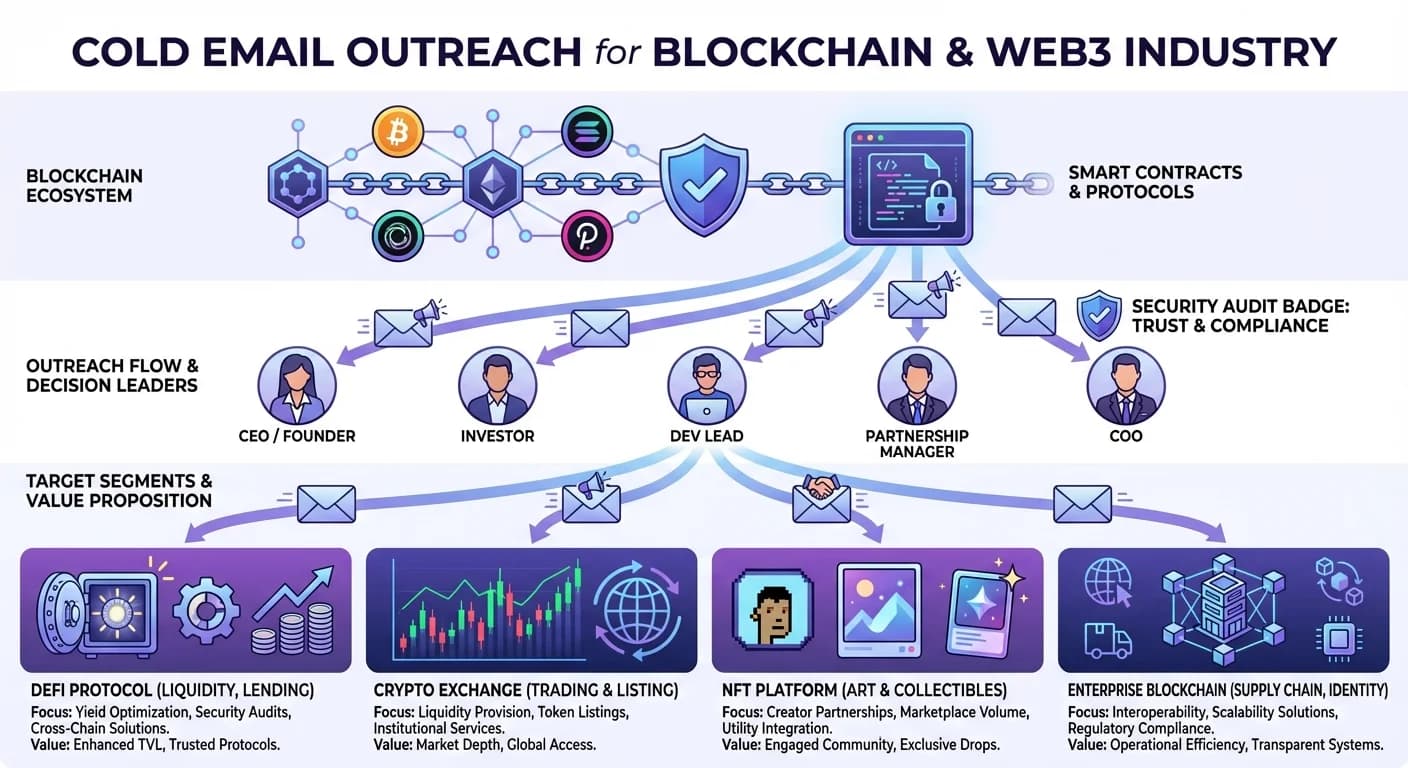
Cold email for blockchain requires segment-specific targeting across DeFi protocols, cryptocurrency exchanges, NFT platforms, and enterprise blockchain, each with distinct priorities. Success depends on using accurate technical terminology, referencing specific security vulnerabilities or compliance requirements, and timing outreach to protocol launches, security incidents, or regulatory announcements. Key decision-makers include CTOs focused on protocol architecture, Security Leads prioritizing smart contract vulnerabilities, and Compliance Officers managing regulatory requirements.
Key takeaways
- The blockchain market divides into distinct segments including protocol developers, DeFi protocols, cryptocurrency exchanges, NFT platforms, enterprise blockchain, and service providers, each with different buying behaviors and priorities.
- Security vulnerabilities in DeFi protocols can result in significant financial losses, making security auditing and smart contract security the top priority for these organizations.
- Key decision-makers in blockchain purchasing include CTOs focused on protocol architecture and scalability, Security Leads concerned with smart contract vulnerabilities, and Compliance Officers managing regulatory requirements.
- Timing outreach to protocol launches, security incidents, regulatory announcements, and market cycles significantly impacts cold email effectiveness in the blockchain industry.
- Building credibility requires using accurate blockchain terminology, referencing specific security vulnerabilities, and demonstrating knowledge of protocol-specific requirements rather than generic blockchain messaging.
Reviewed and updated September 17, 2025
Cold Email for Blockchain: The Complete Guide
The blockchain industry has evolved from experimental cryptocurrency projects into a mature ecosystem spanning decentralized finance, enterprise solutions, digital assets, and Web3 applications. Organizations worldwide are building blockchain infrastructure, deploying smart contracts, and integrating distributed ledger technology into their operations.
This growth creates opportunities for vendors serving the blockchain ecosystem. Whether you offer security auditing, development tools, compliance solutions, or consulting expertise, cold email can help you reach decision-makers who are actively building their blockchain capabilities.
However, the blockchain market presents unique challenges. The industry moves rapidly, with new protocols, regulations, and use cases emerging constantly. Buyers range from deeply technical protocol developers to business executives evaluating enterprise blockchain applications. Navigating this diverse landscape requires targeted strategies.
This guide covers everything you need to know about cold emailing blockchain companies effectively.
Understanding the Blockchain Market
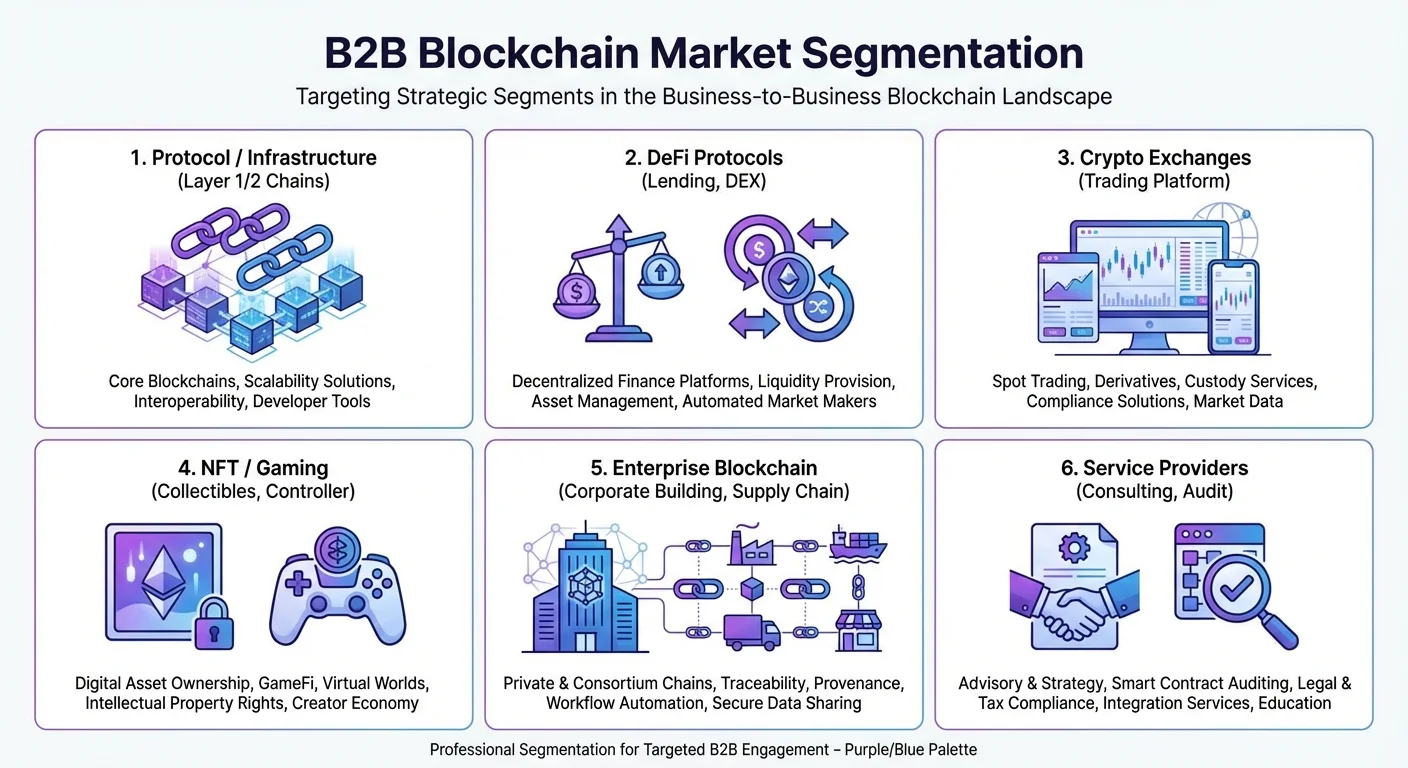
The blockchain industry encompasses distinct segments with different needs and buying behaviors.
Protocol and Infrastructure Developers
Protocol developers build the foundational blockchain networks and infrastructure. They include Layer 1 blockchains, Layer 2 scaling solutions, and cross-chain bridges.
These organizations prioritize security, performance, and developer adoption. They evaluate vendors based on technical depth, security expertise, and ecosystem reputation.
Decentralized Finance (DeFi) Protocols
DeFi protocols build financial applications on blockchain networks. They include lending platforms, decentralized exchanges, yield aggregators, and stablecoin issuers.
DeFi teams focus on smart contract security, liquidity management, and user growth. Security vulnerabilities can result in significant financial losses, making security a top priority.
Cryptocurrency Exchanges and Custodians
Exchanges and custodians provide the infrastructure for trading and storing digital assets. They range from centralized exchanges to decentralized platforms and institutional custody providers.
These organizations prioritize security, compliance, and operational reliability. Regulatory requirements increasingly shape their purchasing decisions.
NFT and Gaming Platforms
NFT marketplaces and blockchain gaming companies build consumer-facing applications. They include NFT exchanges, play-to-earn games, and metaverse platforms.
These teams focus on user experience, creator relationships, and platform growth. Technical infrastructure must support high transaction volumes and media-rich content.
Enterprise Blockchain
Large enterprises implement blockchain for supply chain transparency, digital identity, trade finance, and other applications. They seek proven solutions that integrate with existing systems.
Enterprise buyers have longer purchasing cycles and require compliance, security, and integration capabilities.
Blockchain Service Providers
Service providers offer development, auditing, compliance, and consulting services to blockchain organizations. They combine technical expertise with industry knowledge.
Service providers focus on reputation, delivery quality, and client relationships. Referrals and industry visibility drive much of their business.
Key Decision Makers in Blockchain
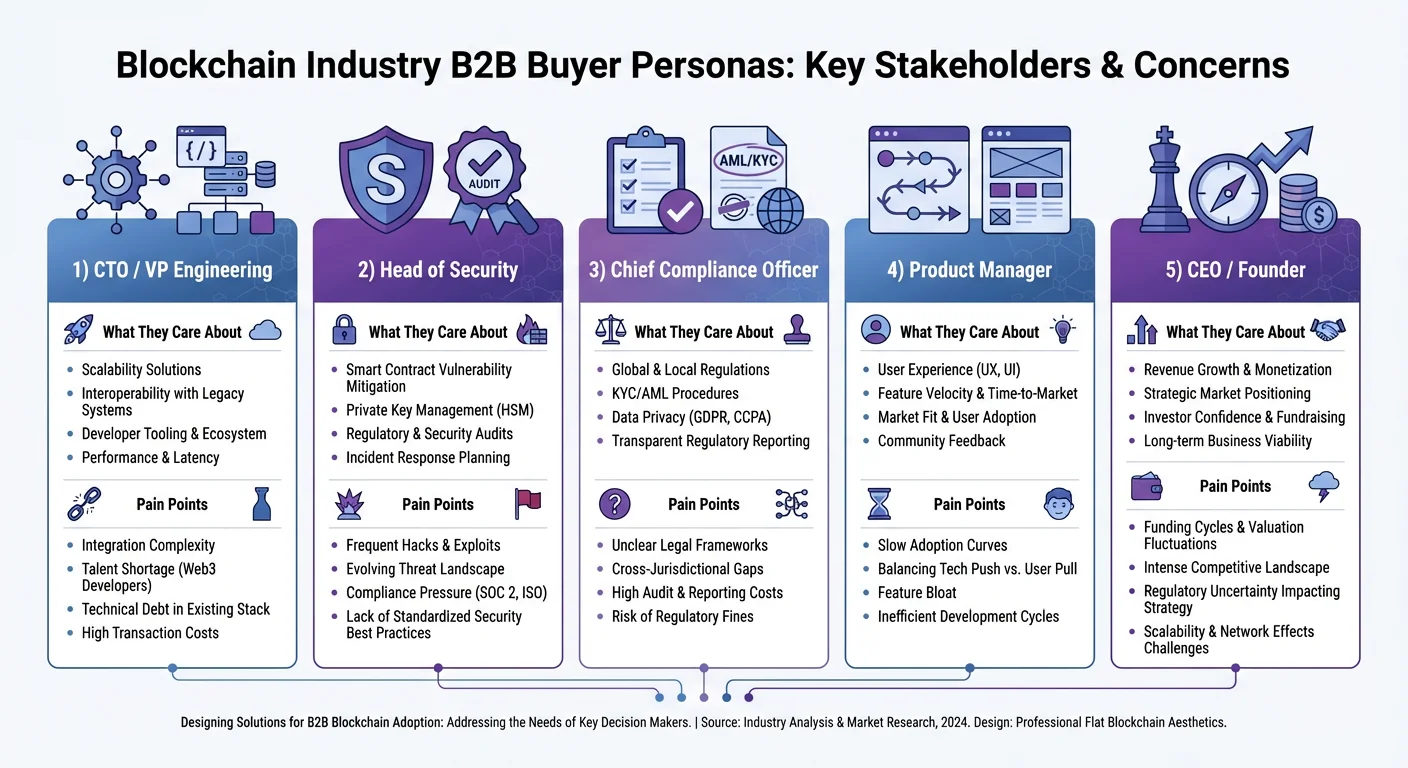
Blockchain purchasing decisions involve multiple stakeholders with different priorities.
CTO or VP of Engineering
What they care about: Protocol architecture, system security, development velocity, technical scalability, and team capabilities.
Pain points: Security vulnerabilities, scaling challenges, developer productivity, technical debt, and talent acquisition.
Trigger events: Security incidents, protocol upgrades, scaling requirements, and technology strategy reviews.
Email angle: Focus on technical capabilities and engineering efficiency. Emphasize security and scalability benefits.
Head of Security or Security Lead
What they care about: Smart contract security, infrastructure protection, threat detection, and incident response.
Pain points: Security vulnerabilities, audit coverage, monitoring gaps, and evolving attack vectors.
Trigger events: Security incidents (theirs or industry-wide), protocol launches, and audit cycles.
Email angle: Lead with security expertise and track record. Address specific vulnerability types and protection capabilities.
Chief Compliance Officer or Head of Compliance
What they care about: Regulatory requirements, AML/KYC compliance, licensing, and risk management.
Pain points: Regulatory uncertainty, compliance complexity, investigation requests, and cross-jurisdictional requirements.
Trigger events: Regulatory announcements, enforcement actions, and new market expansions.
Email angle: Focus on compliance capabilities and regulatory expertise. Reference relevant jurisdictions and requirements.
Product Manager or Head of Product
What they care about: Product roadmap, user experience, feature delivery, and competitive positioning.
Pain points: Development timelines, technical constraints, user adoption, and market timing.
Trigger events: Product launches, competitive announcements, and roadmap planning cycles.
Email angle: Position around product capabilities and time-to-market improvements. Show how your solution enables new features.
CEO or Founder
What they care about: Company strategy, fundraising, partnerships, market positioning, and team building.
Pain points: Market volatility, regulatory risk, competition, and operational challenges.
Trigger events: Fundraising rounds, strategic initiatives, and major company announcements.
Email angle: Focus on strategic value and business outcomes. Connect technical capabilities to business objectives.
Smart Contract Developer
What they care about: Development tools, testing frameworks, security best practices, and code quality.
Pain points: Testing complexity, security uncertainty, deployment friction, and debugging difficulty.
Trigger events: New projects, audit preparation, and tool evaluations.
Email angle: Lead with developer experience and technical capabilities. Offer resources like documentation and trial access.
Technical Considerations in Blockchain
Blockchain buyers are highly technical. Your outreach must demonstrate genuine understanding of blockchain technology and challenges.
Smart Contract Development
Smart contract security and development practices are central to blockchain applications.
Solidity and Vyper: Ethereum-compatible smart contract languages with distinct characteristics.
Testing frameworks: Foundry, Hardhat, and other tools for contract testing and development.
Security patterns: Reentrancy guards, access control, upgradability patterns, and other security considerations.
Gas optimization: Techniques for reducing transaction costs in smart contracts.
Reference relevant development practices when reaching out to development teams.
Protocol and Network Concepts
Understanding blockchain protocols helps you position your solution appropriately.
Consensus mechanisms: Proof of Work, Proof of Stake, and other consensus approaches.
Layer 1 and Layer 2: Base layer blockchains versus scaling solutions built on top.
Cross-chain bridges: Infrastructure connecting different blockchain networks.
MEV (Maximal Extractable Value): Transaction ordering opportunities that affect protocol economics.
Use terminology accurately when reaching out to protocol teams.
Security Considerations
Blockchain security has unique characteristics that distinguish it from traditional software security.
Smart contract audits: Code review and formal verification for contract security.
Economic attacks: Exploits targeting protocol economics rather than code vulnerabilities.
Oracle manipulation: Attacks targeting external data sources used by smart contracts.
Bridge vulnerabilities: Security challenges specific to cross-chain infrastructure.
Security expertise is highly valued in blockchain and demonstrating understanding builds credibility.
Compliance and Regulatory
Regulatory requirements increasingly shape blockchain purchasing decisions.
AML/KYC: Anti-money laundering and know-your-customer requirements for financial applications.
Securities regulations: Rules governing token offerings and digital asset classification.
Licensing: Jurisdictional requirements for operating blockchain businesses.
Travel rule: Information sharing requirements for cryptocurrency transactions.
Understanding regulatory context helps you position compliance-related solutions.
Industry Segments in Blockchain
Different blockchain segments have different priorities and use cases. Tailoring your messaging improves response rates.
DeFi Protocols
Applications include lending and borrowing, decentralized exchanges, derivatives, and yield optimization.
Key concerns center on smart contract security, economic design, and liquidity management.
Messaging angle:
"DeFi protocols face unique security challenges including economic attacks and oracle manipulation. Our audit approach specifically addresses [specific DeFi vulnerability type] that traditional audits often miss."
Centralized Exchanges
Applications include spot trading, derivatives, and fiat on-ramps.
Key concerns include regulatory compliance, security, and operational reliability.
Messaging angle:
"Exchanges operating in [specific jurisdiction] need [specific compliance capability] to meet regulatory requirements. We help platforms achieve compliance while maintaining operational efficiency."
NFT and Digital Collectibles
Applications include marketplaces, creator tools, and royalty management.
Key concerns center on creator experience, transaction costs, and platform scalability.
Messaging angle:
"NFT platforms scaling transaction volume need [specific capability] to maintain user experience. Our solution helps marketplaces achieve [specific outcome] while managing infrastructure costs."
Enterprise Blockchain
Applications include supply chain tracking, trade finance, and digital identity.
Key concerns include integration with existing systems, privacy requirements, and governance.
Messaging angle:
"Enterprise teams implementing blockchain for [specific use case] need [specific capability] to integrate with existing systems. We help organizations achieve [specific outcome] while meeting enterprise requirements."
Blockchain Gaming
Applications include play-to-earn games, in-game assets, and virtual worlds.
Key concerns center on user experience, transaction scalability, and economic design.
Messaging angle:
"Blockchain gaming platforms handling [specific volume] transactions need [specific capability] to maintain smooth gameplay. We help gaming teams achieve [specific outcome] without sacrificing user experience."
Cryptocurrency Custody
Applications include institutional custody, wallet infrastructure, and key management.
Key concerns include security, insurance requirements, and operational procedures.
Messaging angle:
"Custody providers serving institutional clients need [specific capability] to meet insurance and compliance requirements. We help custodians demonstrate [specific security standard]."
Building Credibility in Blockchain Outreach
Blockchain professionals are skeptical of vendors unfamiliar with the industry. Building credibility requires demonstrating genuine blockchain understanding.
Use Accurate Terminology
Blockchain has specific terminology. Using terms correctly signals expertise.
Correct usage examples:
- "Smart contract" rather than "blockchain program"
- "Gas fees" rather than "transaction costs" (for Ethereum)
- "TVL" (Total Value Locked) for DeFi metrics
- "On-chain" and "off-chain" for data location
- Specific protocol names (Ethereum, Solana, Polygon) rather than generic "blockchain"
Incorrect terminology immediately signals unfamiliarity with the industry.
Reference Specific Security Vulnerabilities
Blockchain security professionals track specific vulnerability types. Referencing relevant categories demonstrates expertise.
Examples:
- Reentrancy attacks
- Flash loan exploits
- Oracle manipulation
- Access control vulnerabilities
- Front-running and MEV-related issues
Including specific vulnerability references signals genuine security understanding.
Acknowledge Industry Dynamics
The blockchain industry moves rapidly with significant volatility. Acknowledging these dynamics builds credibility.
Example:
"Market conditions affect protocol priorities. We help teams maintain security standards during both growth periods and consolidation phases."
This demonstrates understanding of the industry beyond purely technical concerns.
Reference Audit Track Record
For security-related services, audit track record matters significantly. Mention relevant experience.
Example:
"Our team has audited [X] smart contracts securing [dollar amount] in TVL, including protocols in DeFi, NFT, and cross-chain infrastructure."
Timing Your Outreach
Several factors affect timing in the blockchain industry.
Market Cycles
Blockchain activity correlates with market conditions. Bull markets bring increased development, hiring, and spending. Bear markets create focus on security, cost efficiency, and sustainable operations.
Adjust your messaging based on market conditions. Security and efficiency resonate during downturns. Growth and scaling resonate during expansions.
Protocol Launch Timing
Protocol launches and major upgrades create natural outreach opportunities. Teams preparing for launches need audits, infrastructure, and operational support.
Monitor protocol announcements and roadmaps to identify timely outreach opportunities.
Regulatory Announcements
Regulatory developments create urgency for compliance-related solutions. Major regulatory announcements affect purchasing priorities across the industry.
Time compliance-focused outreach around relevant regulatory developments.
Security Incidents
Industry-wide security incidents increase security awareness and spending. While respecting the seriousness of incidents, relevant security outreach can be timely.
Appropriate timing:
"Recent industry security events highlight the importance of [specific security practice]. We help protocols address [specific vulnerability type] before deployment."
Conference and Event Timing
Major blockchain events create natural conversation opportunities.
Relevant events:
- ETHDenver (February)
- Consensus (June)
- DevConnect and ETHGlobal events
- Protocol-specific conferences
Reaching out before or after events with relevant context improves engagement.
Email Templates for Blockchain
Here are templates adapted for different blockchain scenarios.
Template 1: Security Audit Outreach
Subject: Smart contract security at [Protocol]
Body:
[First Name],
Quick question: does [Protocol] have audit coverage for [specific contract type or feature]?
We specialize in [specific audit focus, e.g., DeFi protocols, cross-chain bridges, NFT contracts]. Our team has audited [X] contracts securing [dollar amount] in TVL.
Recent audits have identified [specific vulnerability type] that standard audits often miss.
Happy to share our methodology and sample reports before any call.
[Your name]
Template 2: Compliance Outreach
Subject: [Jurisdiction] compliance for [Company]
Body:
[First Name],
Noticed [Company] is [expanding to new market / launching new product / handling specific asset types].
Organizations operating in [jurisdiction] need [specific compliance capability]. Regulatory requirements in this area have [specific recent development].
We help crypto businesses meet these requirements while maintaining operational efficiency. Currently supporting [X] organizations with [relevant compliance area].
Worth a brief conversation about your compliance roadmap?
[Your name]
Template 3: Developer Tools Outreach
Subject: Smart contract development at [Company]
Body:
[First Name],
Development teams building on [specific chain/protocol] typically struggle with [specific development challenge, e.g., testing complex contract interactions, gas optimization, deployment automation].
We help teams [specific capability]. Currently used by developers at [notable reference projects].
Documentation and free tier available for immediate evaluation.
Worth exploring if this applies to your development workflow?
[Your name]
Template 4: Infrastructure Outreach
Subject: [Specific infrastructure need] at [Company]
Body:
[First Name],
Protocols scaling to [specific metric, e.g., X transactions, Y users] need reliable [specific infrastructure, e.g., RPC nodes, indexing, monitoring].
We provide [specific capability] optimized for [relevant chain/protocol].
Currently supporting [X] protocols including [notable references if available].
Is infrastructure scaling a priority as [Company] grows?
[Your name]
Template 5: Enterprise Blockchain Outreach
Subject: Blockchain for [specific use case] at [Company]
Body:
[First Name],
Enterprise teams implementing blockchain for [specific use case, e.g., supply chain, trade finance] typically face challenges with [specific challenge, e.g., integration, privacy, governance].
We help organizations address this with [specific capability]. Currently deployed at [X] enterprises in [relevant industry].
Would it be useful to share how similar organizations have approached this?
[Your name]
Common Mistakes to Avoid
Mistake 1: Generic "Blockchain" Messaging
The blockchain industry encompasses vastly different technologies and applications. Generic messaging fails to resonate.
Weak:
"Our solution helps blockchain companies."
Strong:
"Our audit approach specifically addresses reentrancy and flash loan attack vectors in Solidity-based DeFi protocols."
Specificity about protocols, technologies, and use cases demonstrates expertise.
Mistake 2: Ignoring Market Conditions
Blockchain markets are cyclical. Messaging appropriate for bull markets falls flat during downturns.
Adjust your messaging to acknowledge current market conditions and align with current priorities.
Mistake 3: Overstating Security Claims
Blockchain security is serious business. Overstating security capabilities damages credibility and can create liability.
Weak:
"Our audits guarantee your contracts are secure."
Strong:
"Our audit process includes manual review, automated analysis, and economic modeling. We provide detailed findings with severity ratings and remediation guidance."
Be precise about what your solution does and does not guarantee.
Mistake 4: Neglecting Protocol Specificity
Different blockchains have different characteristics. Generic messaging that ignores protocol specifics fails.
Reference specific chains, languages, and ecosystems relevant to your target accounts.
Mistake 5: Ignoring Regulatory Context
Regulatory requirements increasingly shape blockchain purchasing decisions. Ignoring compliance considerations limits your relevance.
Address regulatory context when reaching out to exchanges, financial protocols, and enterprise deployments.
Mistake 6: Treating All Blockchain as Crypto
Enterprise blockchain applications differ significantly from cryptocurrency and DeFi. Using cryptocurrency terminology with enterprise buyers creates misalignment.
Tailor your messaging to the specific blockchain context of your target accounts.
Building a Blockchain Cold Email Program
List Building
Quality targeting matters in the specialized blockchain market.
Focus on:
- Organizations with visible blockchain activity (protocol development, fundraising, launches)
- Decision-makers at appropriate levels for your solution
- Accounts with observable growth signals or challenges
- Companies in target segments (DeFi, enterprise, gaming, etc.)
Segmentation Approaches
Effective segmentation improves response rates.
By segment:
- Protocol and infrastructure
- DeFi
- Exchanges and custody
- NFT and gaming
- Enterprise blockchain
By chain ecosystem:
- Ethereum and EVM-compatible chains
- Solana
- Other Layer 1s
- Layer 2 scaling solutions
By stage:
- Pre-launch projects
- Early production
- Scaled protocols
By need:
- Security
- Compliance
- Development tooling
- Infrastructure
Where we differ from standard practice
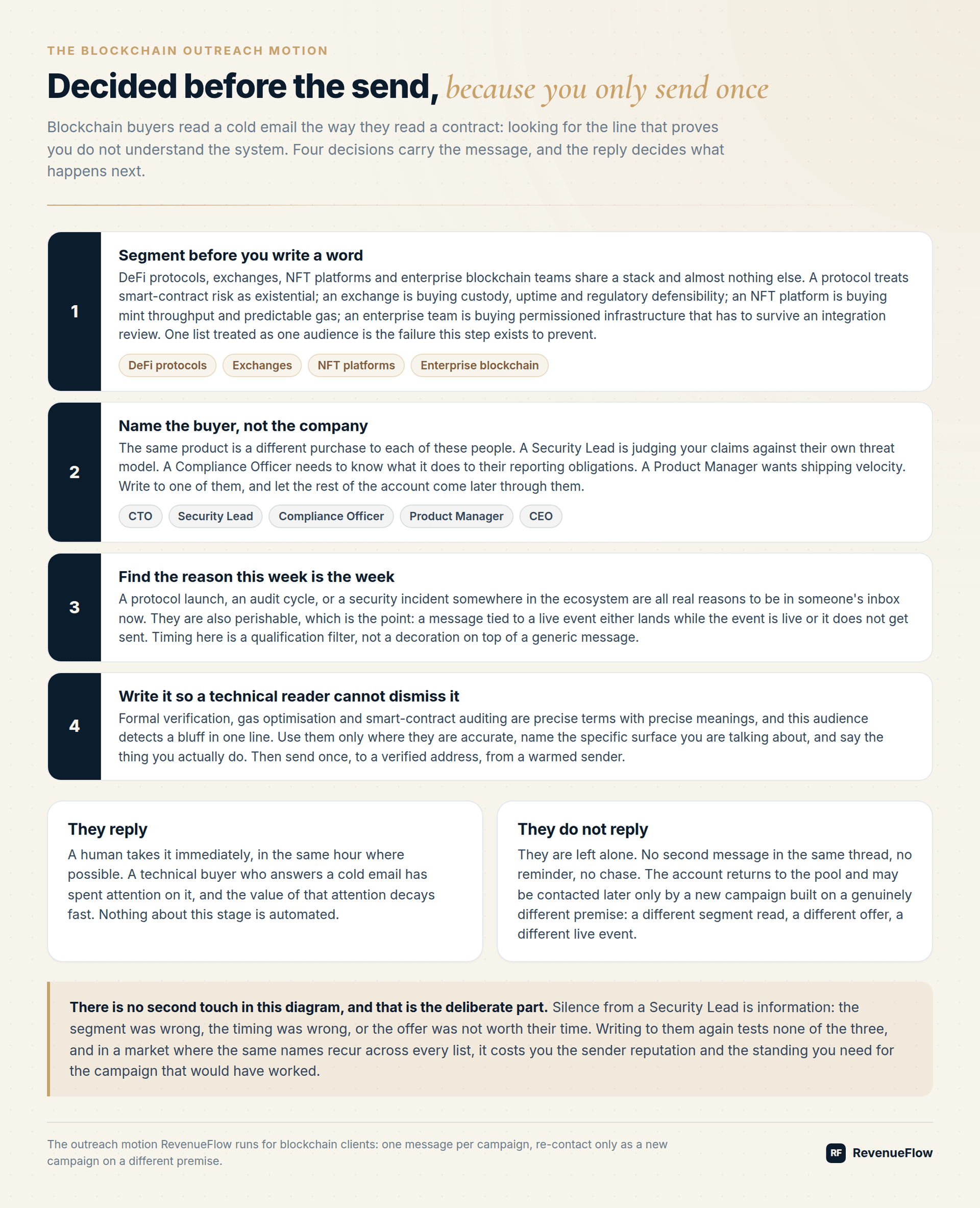
Much of the advice on this page reflects how outbound is commonly run. We run it differently, and since this page sits on our site it is worth saying where the difference is and what it costs us.
- A sequence of messages to each prospect over several weeks
- Later messages often land in the same email thread
- Every contact is reached more than once, so a distracted reader gets another chance
- The later messages go only to people who did not answer the first
- Reputation cost accrues on the sending domain across everything else it sends
- One message, then that campaign is finished for that contact
- No thread replies and no bumps
- A non-responding audience becomes a new campaign with a genuinely different premise, not a reminder
- More of the work moves into targeting and into the one message
- We reach each contact less often, and that is the cost we accept
The reasoning is mechanical rather than moral. A follow-up arrives underneath a message the recipient has already seen and chosen not to answer, so it is delivered to the population most likely to mark it as spam, and the reputation cost of that lands on the sending domain across every campaign running on it. We set that cost against the replies a sequence recovers and decided the trade was not worth it. The full argument, with the numbers from our own campaigns, is in why we stopped using follow-ups.
Follow-Up Strategy
Blockchain professionals are busy with fast-moving projects. Most programmes plan four to six touches spaced five to seven business days apart. We send one message per campaign and put that effort into targeting and into the first message instead.
Where that effort goes:
- Share relevant security research or industry analysis
- Reference recent developments in their ecosystem
- Provide useful information about their specific challenges
- Keep the message concise and focused
When a non-responding list is worth another approach, it becomes a new campaign with its own premise rather than a second message under the first.
Measurement and Optimization
Track metrics to improve your program over time.
Key metrics:
- Open rates by segment and ecosystem
- Reply rates by protocol type and organization stage
- Meeting conversion rates
- Pipeline progression from cold outreach
- Deal size and close rates by source
Use data to refine targeting, messaging, and timing continuously.
Building Long-Term Relationships in Blockchain
The blockchain industry values reputation and community involvement.
Contribute Security Research
Publishing vulnerability research, security best practices, or technical analysis builds credibility. Share findings that help the ecosystem improve security.
Participate in Bug Bounties
Active participation in bug bounty programs demonstrates security expertise and community contribution.
Engage in Community Forums
Blockchain communities are active on Discord, forums, and social media. Participating thoughtfully builds visibility and credibility.
Support Open Source
Many blockchain tools and protocols are open source. Contributing to relevant projects builds reputation.
Present at Conferences
Speaking at blockchain events builds visibility and credibility. Share technical knowledge that helps the community.
Summary
Cold emailing the blockchain industry requires genuine understanding of blockchain technology, ecosystems, and current market conditions.
Success depends on:
- Understanding the market including DeFi, exchanges, NFT platforms, and enterprise blockchain
- Targeting the right decision-makers with role-appropriate messaging
- Demonstrating technical credibility through accurate terminology and relevant expertise
- Tailoring to industry segments with use-case-specific messaging
- Timing outreach around market cycles, launches, and regulatory developments
- Avoiding common mistakes like generic messaging and overstated security claims
- Building for the long term through community engagement and technical contribution
The blockchain industry continues to evolve rapidly with new protocols, applications, and regulatory frameworks. Vendors who demonstrate genuine expertise and provide real value will succeed in reaching decision-makers at blockchain organizations.
Related Reading
If you would rather have this run for you, RevenueFlow books qualified meetings on a pay-per-meeting basis and publishes client results.
Frequently asked questions.
Frequently asked questions- Who are the main decision-makers I should target with cold emails in blockchain companies?
- The primary decision-makers include the CTO or VP of Engineering who focuses on protocol architecture and system security, the Head of Security who prioritizes smart contract vulnerabilities and threat detection, the Chief Compliance Officer who manages regulatory requirements and AML/KYC compliance, Product Managers who oversee feature delivery and roadmaps, and CEOs or Founders who evaluate strategic partnerships. Each stakeholder has distinct priorities, with technical leaders focusing on security and scalability while compliance officers prioritize regulatory adherence.
- What are the different segments within the blockchain industry I should understand for cold email targeting?
- The blockchain industry encompasses six main segments: protocol and infrastructure developers building foundational networks, DeFi protocols creating financial applications with focus on smart contract security, cryptocurrency exchanges and custodians prioritizing security and compliance, NFT and gaming platforms building consumer applications, enterprise blockchain implementing solutions for supply chain and digital identity, and blockchain service providers offering development and auditing services. Each segment has unique needs, buying behaviors, and decision criteria requiring tailored outreach approaches.
- When is the best time to send cold emails to blockchain companies?
- Optimal timing aligns with specific trigger events including market cycles that affect purchasing budgets, protocol launch timing when teams need security audits and infrastructure support, regulatory announcements that create compliance urgency, security incidents both at the target company and industry-wide that heighten security awareness, and conference and event timing when companies are actively evaluating solutions. Security incidents particularly create immediate demand for audit and protection services, while protocol launches represent natural purchasing windows.
- How can I build credibility when cold emailing blockchain companies?
- Build credibility by using accurate technical terminology specific to blockchain protocols and architectures rather than generic buzzwords, referencing specific security vulnerabilities like reentrancy attacks or oracle manipulation to demonstrate expertise, acknowledging current industry dynamics such as market conditions and regulatory developments, and citing your audit track record or protocol experience when relevant. Generic blockchain messaging that treats all segments identically undermines credibility, while protocol-specific knowledge and security expertise establish trust with technical decision-makers.
- What mistakes should I avoid when cold emailing blockchain companies?
- Common mistakes include using generic blockchain messaging that fails to address segment-specific needs, ignoring current market conditions that affect purchasing priorities and budgets, overstating security claims without evidence which damages credibility in a technical audience, neglecting protocol specificity by not researching the target's specific blockchain implementation, and treating all blockchain companies as cryptocurrency ventures when many are enterprise or infrastructure focused. Additionally, ignoring regulatory context misses critical compliance concerns that drive purchasing decisions in exchanges and custodians.
About the author.

Fernando Cao is CEO at RevenueFlow, which builds and operates outbound revenue engines for B2B companies. Previously at Accenture Strategy. Studied at University of Bath.
Fernando Cao · CEO
Connect on LinkedIn →Explore more.
Ready to scale your outreach?
We build GTM engines that book real meetings. See the receipts.
Related articles.
Cold Email for Maintenance Services: The Complete Guide
A comprehensive guide to cold email outreach for commercial maintenance companies, covering how to reach facility managers, property managers, and operations directors with messaging that wins preventive maintenance and repair contracts.
Cold Email for Staffing Agencies: The Complete Guide
A comprehensive guide to cold email outreach for staffing and temp agencies, covering how to reach HR directors, hiring managers, and operations leaders with messaging that wins temporary staffing, contract placement, and direct hire business.
Cold Email for Telecom: Reaching Carriers and MSPs
Telecom companies face rapid technology changes and competitive pressures. Here's how to approach cold email outreach to carriers, MSPs, and UCaaS providers.
Cold Email for Electronics Companies: The Complete Guide
A comprehensive guide to cold email outreach for electronics manufacturers, component suppliers, and EMS providers, covering buyer personas, OEM relationships, contract manufacturing, and proven strategies for reaching engineers, procurement managers, and supply chain leaders.
Cold Email for Security Services: The Complete Guide
A comprehensive guide to cold email outreach for security service providers, covering how to reach facility managers, corporate security directors, and property managers with messaging that builds trust and wins contracts.
Cold Email for Cloud Services: The Complete Guide
Learn how to effectively reach decision-makers at cloud service providers and enterprises adopting cloud infrastructure. This guide covers targeting strategies, technical credibility, and email templates for the cloud services industry.