Cold Email for Case Study Participation: Strategy Guide
Learn how to use cold email to recruit customers for case studies that demonstrate your product's value. Includes proven templates, incentive frameworks, and approval strategies.
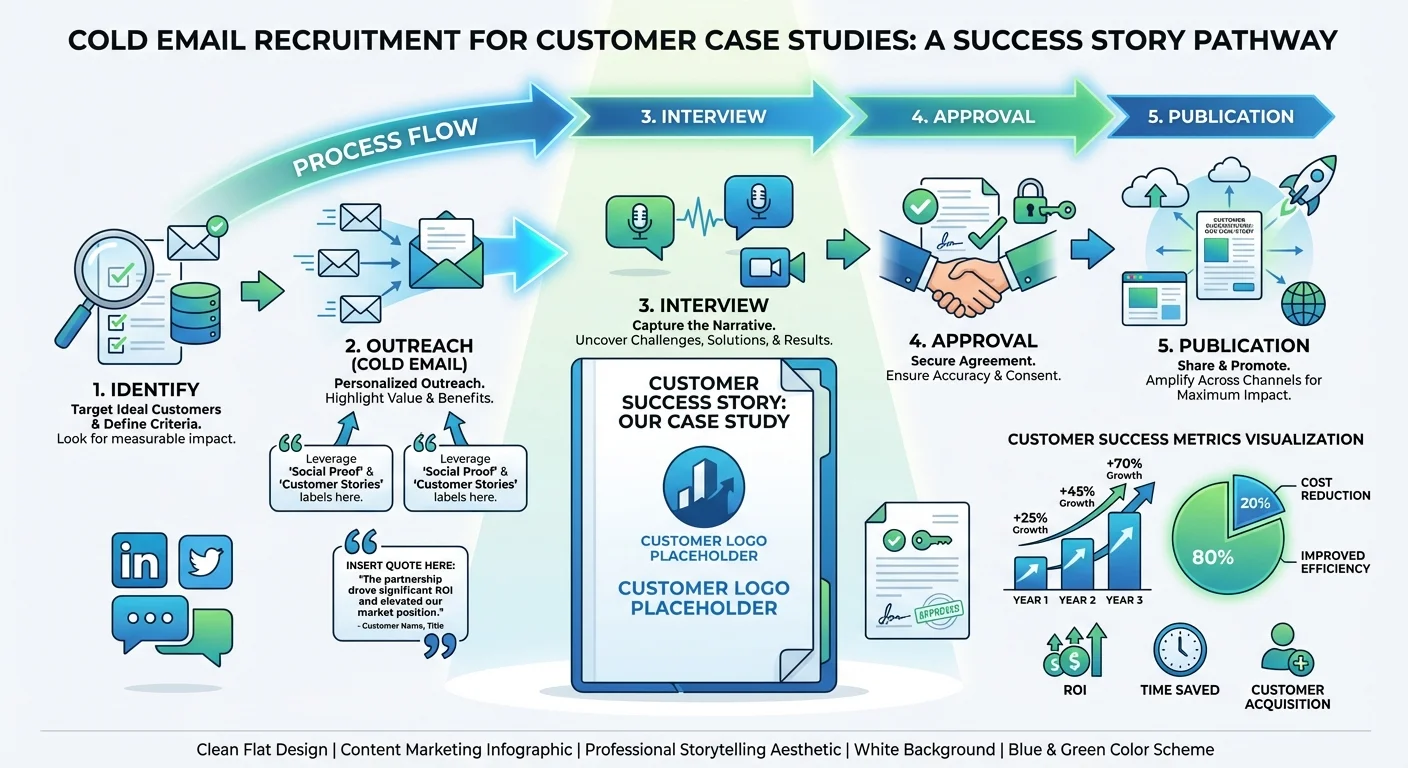
Cold email enables systematic recruitment of case study participants by allowing you to proactively contact customers who meet specific criteria rather than relying on opportunistic conversations. It provides comprehensive coverage across your customer base, precise targeting by industry or results achieved, and creates a scalable pipeline of participants. The approach works best when you identify customers with measurable results, representative profiles matching your target market, and willingness to discuss their outcomes publicly.
Key takeaways
- One SaaS company secured eight case study participants within two months using a structured cold email outreach program.
- Cold email allows you to target case study candidates based on specific criteria like company size, industry, use case, and measurable results rather than waiting for random opportunities.
- Ideal case study participants must be representative of your target market, have quantifiable outcomes to share, and be comfortable with public attribution.
- Customer success records, NPS data, product analytics, renewal data, and community engagement patterns reveal which customers are experiencing strong outcomes worth documenting.
- Systematic cold email outreach creates a consistent pipeline of case study participants rather than depending on which customers your team happens to interact with.
Reviewed and updated September 15, 2026
Cold Email for Case Study Participation: Complete Strategy Guide
Case studies rank among the most persuasive content assets in B2B marketing. They provide concrete evidence that your product delivers results, featuring real customers who faced real challenges and achieved measurable outcomes. However, creating compelling case studies requires customer participation, and securing that participation remains one of the most challenging aspects of content marketing. Cold email offers a systematic approach to recruiting case study participants, even from customers who might otherwise remain silent about their success.
A SaaS company had dozens of successful customers but zero published case studies. Their sales team frequently heard prospects ask for proof that the product worked for companies similar to theirs. After implementing a structured outreach program, the company secured eight case study participants within two months. Those case studies became their most-shared content assets and contributed directly to closing enterprise deals.
Why Cold Email Works for Case Study Recruitment
Traditional case study recruitment relies heavily on customer success teams identifying willing participants through relationship-based conversations. This approach has significant limitations. CS teams juggle many priorities and may not systematically identify ideal candidates. Relationship dynamics can make direct requests uncomfortable. Customers who would willingly participate never get asked because nobody thought to approach them.
Cold email complements relationship-based approaches by enabling systematic outreach to customers who meet specific criteria for case study value. You can reach customers across your entire base simultaneously, target specific industries or use cases, and create a pipeline of potential participants rather than hoping the right customer happens to mention their success.
The Strategic Advantage of Systematic Outreach
Cold email for case study recruitment offers several distinct benefits:
Comprehensive coverage: Rather than depending on which customers your team happens to interact with, you can proactively contact everyone who might be a valuable case study subject.
Targeting precision: You control exactly which customers receive case study invitations based on company size, industry, use case, results achieved, or other criteria that define your ideal case study.
Consistent messaging: Every potential participant receives a clear, compelling invitation that articulates the value of participation and addresses common concerns.
Scalable pipeline: Building a case study library requires multiple participants over time. Systematic outreach creates an ongoing pipeline rather than sporadic, opportunistic recruitment.
Data-driven optimization: Tracking outreach results reveals which customer segments respond most positively, which messaging resonates, and how to improve future recruitment efforts.
Finding Ideal Case Study Participants
The value of a case study depends entirely on selecting participants whose stories will resonate with your target prospects. Random customer selection produces weak content. Strategic targeting produces case studies that directly address prospect concerns and demonstrate relevant outcomes.
- Yes: Representative of target market: does this customer match the profile of prospects you want to attract?
- Yes: Measurable results achieved: can they quantify the outcomes they experienced?
- Yes: Articulate about their experience: can they explain their challenges, selection process and results clearly?
- Yes: Willing to be public: are they comfortable with their name, company and results appearing in marketing materials?
- Yes: Interesting story elements: unusual challenges, unexpected benefits, or significant transformation.
- Yes: Logo value: does featuring this customer's brand enhance your credibility?
Defining Your Ideal Case Study Profile
Before initiating outreach, establish clear criteria for ideal case study participants:
Representative of target market: Does this customer match the profile of prospects you want to attract? Case studies featuring customers similar to your target audience carry more persuasive weight.
Measurable results achieved: Can this customer quantify the outcomes they experienced? Specific metrics create more compelling case studies than vague satisfaction statements.
Articulate about their experience: Can this customer explain their challenges, solution selection process, and results clearly? Some excellent customers struggle to articulate their journey.
Willing to be public: Is this customer comfortable with their name, company, and results appearing in marketing materials? Some customers cannot participate due to internal policies or competitive concerns.
Interesting story elements: Does this customer's journey include compelling elements like unusual challenges, unexpected benefits, or significant transformation?
Logo value: Does featuring this customer's brand enhance your credibility? Recognized company names increase case study persuasive power.
Where to Find Case Study Candidates
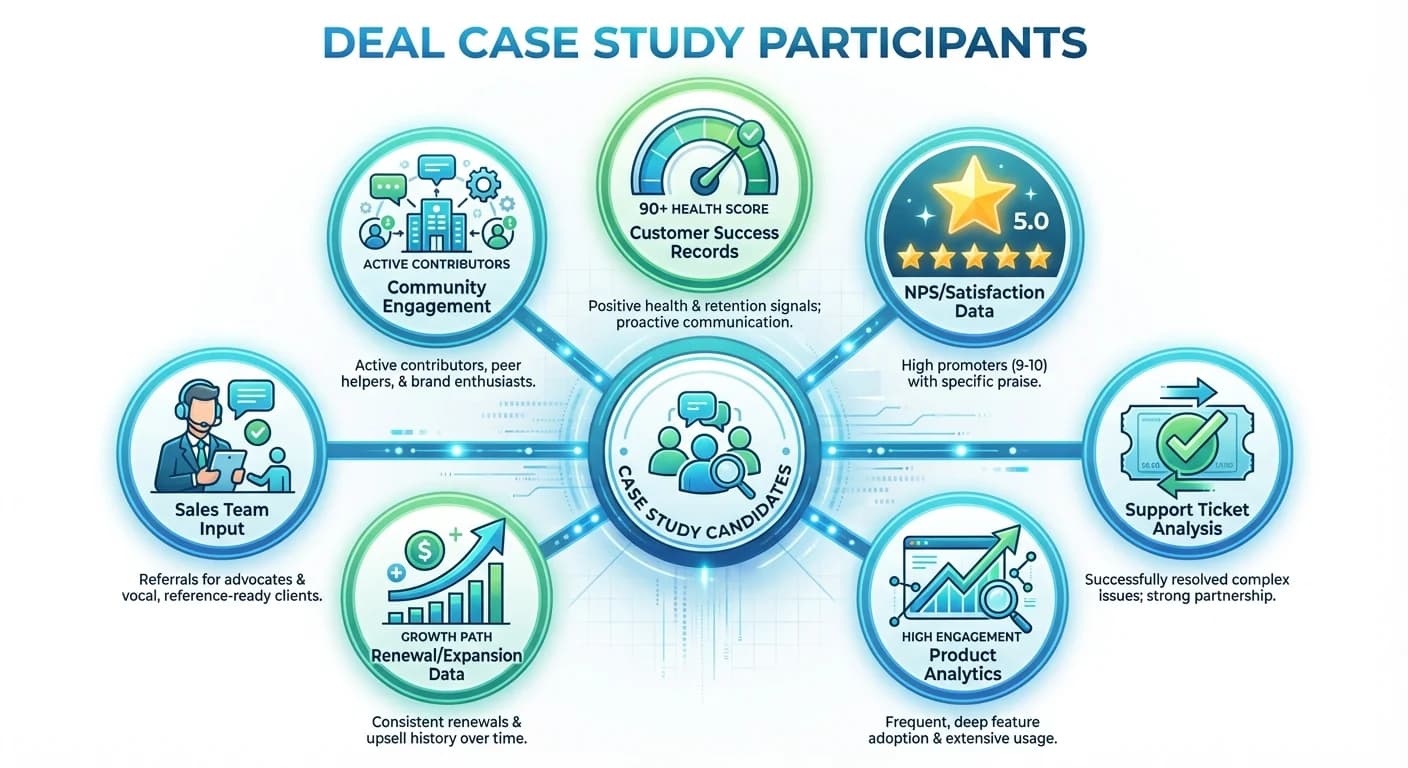
Identify case study candidates by examining your customer base through multiple lenses:
Customer success records: Review health scores, product usage data, and support interactions to identify customers experiencing strong outcomes.
NPS and satisfaction data: Customers who provide high satisfaction scores have already indicated positive sentiment and may welcome the opportunity to share their story.
Support ticket analysis: Customers who overcame significant challenges with your product have compelling narrative arcs.
Product analytics: Usage patterns, feature adoption rates, and engagement metrics reveal which customers derive the most value from your product.
Renewal and expansion data: Customers who renew, upgrade, or expand usage demonstrate commitment that suggests positive outcomes.
Sales team input: Account executives often know which customers are experiencing strong results and might be receptive to participation.
Community engagement: Customers who participate in user communities, leave reviews, or share feedback have already demonstrated willingness to discuss their experience.
Building Your Case Study Prospect List
Compile comprehensive information for each potential participant:
- Company name and contact person
- Industry, company size, and relevant firmographics
- Products or features they use
- Length of time as customer
- Known results or outcomes achieved
- Relationship history and key contacts
- Potential story angles
- Likely objections to participation
Prioritize your list by case study value and estimated willingness to participate. Begin outreach with prospects most likely to say yes, building momentum before approaching more challenging candidates.
What to Offer Case Study Participants
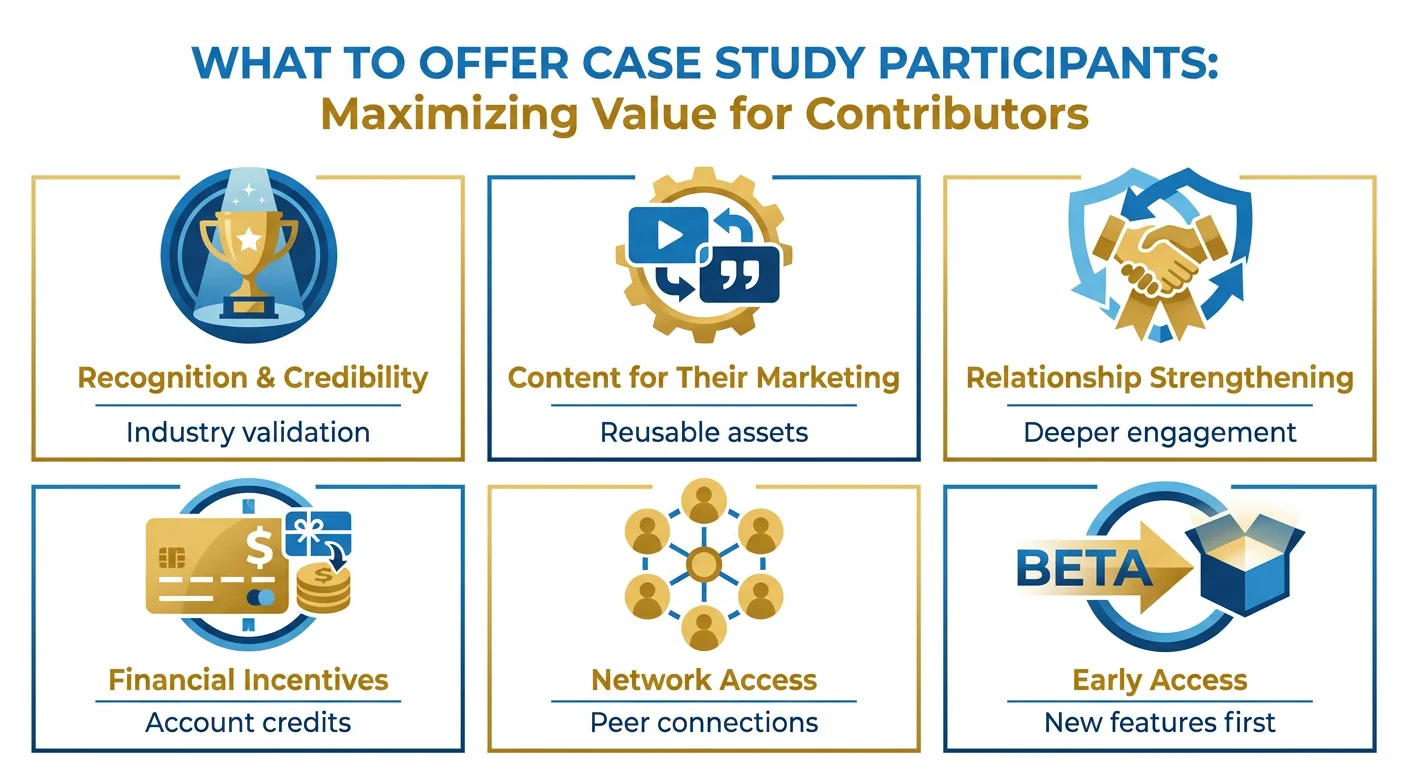
Case study participation requires significant investment from customers. They must allocate time, navigate internal approval processes, share potentially sensitive information, and accept the spotlight on their organization. Your offer must provide sufficient value to justify this investment.
Incentive Categories That Work
Different customers respond to different value propositions:
Recognition and credibility: Being featured as an industry example validates the customer's professional decisions and positions them as innovators. This appeals particularly to marketing leaders, executives seeking visibility, and organizations building thought leadership.
Content for their own marketing: Case study assets become content the participant can use. Offer to provide video clips, quote graphics, and written summaries they can share.
Relationship strengthening: Case study participation often leads to deeper engagement with your product team, priority support, and input on product direction.
Financial incentives: Account credits, extended contracts, or gift cards provide tangible value. However, financial incentives can sometimes reduce authenticity perception, so use them strategically.
Network access: Connecting case study participants with each other creates peer learning opportunities and exclusive community membership.
Co-marketing opportunities: Joint webinars, conference presentations, or content collaboration extend the value of participation beyond the case study itself.
Early access: Providing case study participants with early access to new features rewards their contribution and deepens engagement.
Structuring Your Case Study Offer
Your outreach should clearly communicate:
- What participation involves (interview, review, approval steps)
- Time commitment required at each stage
- How the case study will be used and distributed
- What control they have over content and approval
- Specific benefits they receive for participating
- Timeline for the process
- Who will be involved from your team
Specificity builds trust. Vague invitations trigger concerns about unknown commitments.
What Works: Case Study Recruitment Email Best Practices
Effective case study recruitment emails balance recognition of the customer's success with clear articulation of what participation entails. Your message should make customers feel valued while addressing practical concerns about time and approval.
Subject Line Principles
Your subject line must cut through inbox noise while avoiding spam triggers:
- Reference their specific success or results if known
- Mention case study opportunity explicitly
- Create curiosity about the recognition offered
- Keep it conversational and avoid marketing jargon
Examples that perform well:
- "Your results would make a great story"
- "Case study opportunity: [Company Name]"
- "Sharing your [product] success story?"
- "Quick question about your [product] results"
Email Body Structure
Structure your case study recruitment emails with these elements:
Recognition opening: Begin by acknowledging their success with your product. Reference specific results, milestones, or achievements when possible.
Clear purpose statement: Explain that you are interested in featuring their story as a case study. Be direct about what you are asking.
Value proposition: Articulate what they gain from participating. Recognition, content, relationship benefits, or other incentives.
Process overview: Briefly describe what participation involves so they can assess feasibility.
Objection preemption: Address common concerns like time commitment, approval requirements, and content control.
Easy response path: Make responding simple. A brief reply indicating interest is easier than committing fully.
- Step 1Recognition opening
Acknowledge their success with your product. Reference specific results, milestones or achievements when possible.
- Step 2Clear purpose statement
Explain that you are interested in featuring their story as a case study. Be direct about what you are asking.
- Step 3Value proposition
Articulate what they gain: recognition, content, relationship benefits or other incentives.
- Step 4Process overview
Briefly describe what participation involves so they can assess feasibility.
- Step 5Objection preemption
Address common concerns like time commitment, approval requirements and content control.
- Step 6Easy response path
A brief reply indicating interest is easier than committing fully.
Tone and Voice Guidelines
Case study recruitment emails succeed when they feel like genuine appreciation combined with a reasonable request:
- Express authentic gratitude for their business
- Acknowledge that you are asking for something valuable
- Demonstrate understanding of their time constraints
- Be specific about what makes their story compelling
- Offer flexibility in how participation can work
- Maintain warmth while being professional
Case Study Recruitment Email Templates
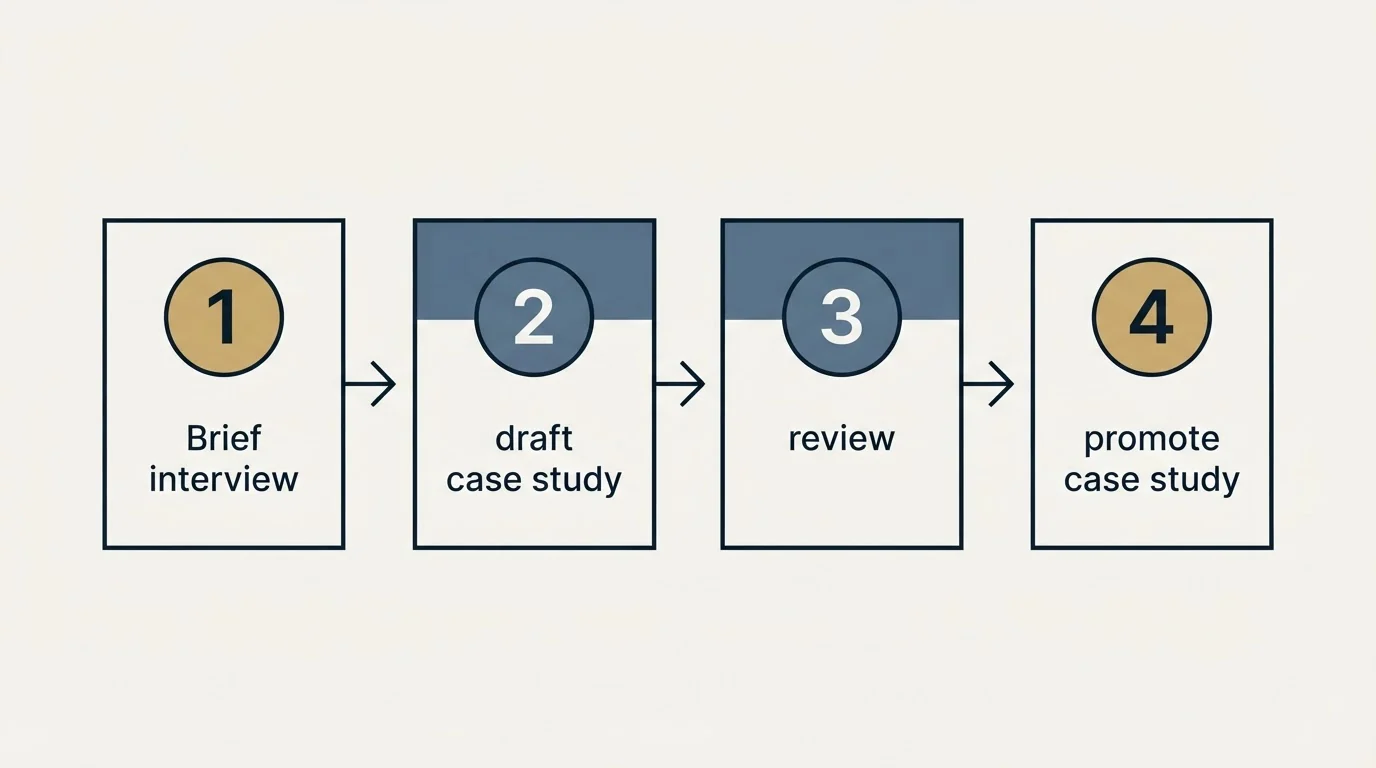
The following templates demonstrate effective approaches for recruiting case study participants. Customize these frameworks with specific details about your customers and case study program.
Template 1: The Results-Recognition Approach
Subject: Your [specific result] would make a great story
Body:
Hi [First Name],
I noticed that [Company Name] has achieved [specific result or milestone] with [Product Name] since you started using it [timeframe] ago. Results like yours stand out, and I wanted to reach out personally.
We are building case studies featuring customers who have experienced meaningful outcomes, and your success with [specific achievement] represents exactly the kind of story that would resonate with other [industry/role] professionals.
Being featured would involve:
- A 30-45 minute interview about your experience
- Review and approval of all content before publication
- Your final say on what we include
In return, you would receive:
- Professional video and written content featuring your company
- Assets you can use in your own marketing
- Promotion across our channels (reaching [audience size])
- [Additional incentive if applicable]
Would you be interested in exploring this further? Happy to answer any questions or discuss what would work best for your team.
Best, [Your Name] [Title]
Template 2: The Appreciation-First Approach
Subject: Thank you (and a quick question)
Body:
Hi [First Name],
I wanted to start by saying thank you. [Company Name] has been a customer for [timeframe], and the team here genuinely appreciates your business.
I am reaching out because our marketing team is developing case studies featuring customers with stories worth sharing. Based on what I know about your experience with [Product Name], particularly [specific detail], I think yours might be one of them.
Would you be open to a quick conversation about potentially being featured? The process is designed to be as easy as possible:
- One interview (30-45 min) scheduled at your convenience
- We write everything based on your input
- You review and approve before anything is published
- You control what information is included
No commitment required for an initial conversation. I can answer any questions and we can decide together if it makes sense.
Interested?
[Your Name]
Template 3: The Industry-Specific Approach
Subject: [Industry] case study opportunity
Body:
Hi [First Name],
We are building case studies specifically for the [industry] sector, and [Company Name] keeps coming up as an example of what successful [product] implementation looks like.
Prospects in [industry] frequently ask for evidence that our product works in their specific context. A case study featuring your experience would directly address that need while positioning [Company Name] as an industry innovator.
Here is what participation involves:
Your commitment:
- 30-45 minute interview (video or phone)
- Review of draft content for accuracy
- Final approval before publication
What you receive:
- Professional case study assets featuring your brand
- Distribution across our marketing channels
- [Specific additional benefits]
- Direct input on how your story is told
The entire process typically takes 3-4 weeks from interview to publication, with minimal time required from you beyond the initial conversation.
Would this be worth exploring? I am happy to share examples of case studies we have done with other [industry] companies.
[Your Name]
Template 4: The Executive Appeal
Subject: Featuring [Company Name] as an industry leader
Body:
Hi [First Name],
I wanted to reach out directly about an opportunity to feature [Company Name] in a case study highlighting [industry/function] innovation.
Your team's implementation of [Product Name] has produced results that stand out in our customer base. [Specific result or achievement] demonstrates the kind of forward-thinking approach that other [industry] leaders are trying to emulate.
Being featured positions [Company Name] as an innovator and provides:
- Professional video and written content showcasing your success
- Visibility across our marketing channels (reaching [audience description])
- A compelling success story for your own stakeholder communication
- Co-promotion opportunities with our brand
We have designed the process to be executive-friendly:
- A single 30-minute interview at your convenience
- Our team handles all production
- Your final approval on everything published
Would you be interested in learning more? I can share examples and discuss how we can make participation valuable for [Company Name].
Best regards, [Your Name] [Title]
Template 5: The Warm Handoff Approach
Subject: Following up on [CSM/Account Manager]'s conversation
Body:
Hi [First Name],
[CSM Name] mentioned that you have seen strong results with [Product Name], particularly around [specific outcome]. They suggested I reach out about a case study opportunity.
We are looking to feature customers whose experiences demonstrate what success with [Product Name] looks like in practice. Based on what [CSM Name] shared, [Company Name] would be an excellent example.
The case study process is straightforward:
- Brief interview (30-45 min) discussing your experience
- We draft the case study based on your input
- You review and approve everything before publication
- We promote the case study across our channels
Participants receive professional content assets, promotion to our audience of [description], and [additional benefits].
[CSM Name] is happy to be involved throughout the process if that helps. Would you be open to discussing this further?
[Your Name] Marketing Team
Handling Common Objections
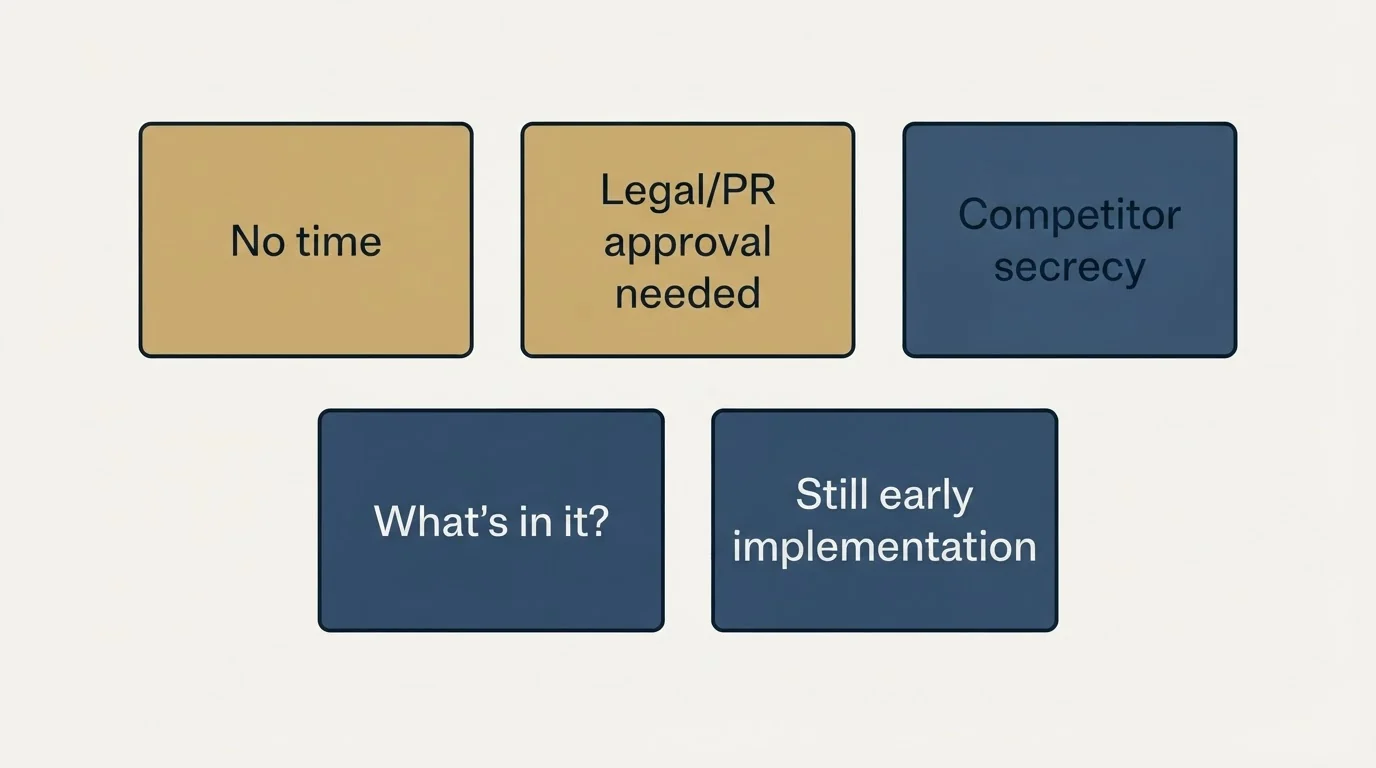
Case study recruitment faces predictable objections. Preparing responses to these concerns improves conversion rates.
"We do not have time"
Response: Acknowledge the concern and emphasize minimal time commitment. Offer flexible scheduling, phone interviews instead of video, or asynchronous options where they review and approve written questions.
"We need legal/PR approval"
Response: Provide materials that support their internal approval process. Offer to speak with relevant stakeholders, share sample case studies, and provide detailed information about content control and approval rights.
"We do not want competitors to know what we are doing"
Response: Discuss options for anonymization, metric generalization, or focusing on outcomes without revealing specific tactics. Some customers will participate with reduced detail levels.
"What is in it for us?"
Response: Clearly articulate specific benefits. Recognition, content assets, promotion, relationship deepening, or tangible incentives. Match benefits to what matters to this particular customer.
"We are still early in our implementation"
Response: Propose a timeline for future follow-up when their story will be more developed. Mark them as a future candidate and maintain the relationship.
Your Case Study Recruitment Checklist
Before launching your case study recruitment campaign, confirm completion of these steps:
Strategy Preparation
- Defined ideal case study participant criteria
- Identified specific customer segments to target
- Established case study benefits and incentives
- Created process documentation for participants
Prospect Research
- Built prioritized list of potential participants
- Gathered relevant details for each prospect (results, contacts, history)
- Coordinated with CS/Sales on relationship context
- Identified backup candidates for each target segment
Outreach Preparation
- Written customized email templates for different segments
- Prepared objection responses
- Created internal tracking system
Process Readiness
- Documented interview process and questions
- Established review and approval workflow
- Prepared participant agreements if needed
- Confirmed production and publication timeline
Build Your Case Study Pipeline
Recruiting case study participants through cold email transforms an opportunistic process into a systematic pipeline. The strategies, templates, and frameworks in this guide provide everything needed to build a library of compelling case studies that demonstrate your product's value.
Each successful case study becomes a persuasive asset that supports sales conversations, marketing campaigns, and prospect confidence. The investment in recruitment pays dividends across your entire go-to-market effort.
Ready to build your case study library? Our team specializes in outreach campaigns that secure customer participation. Get your free case study recruitment campaign and start turning customer success into powerful marketing assets.
Related Reading
Frequently asked questions.
Frequently asked questions- Why is cold email better than asking customer success teams to find case study participants?
- Cold email enables comprehensive, systematic outreach to all customers meeting specific criteria rather than relying on which customers CS teams happen to interact with. Customer success teams juggle multiple priorities and may not systematically identify ideal candidates, and relationship dynamics can make direct requests uncomfortable. Cold email creates consistent messaging, scalable pipelines, and allows precise targeting by industry, results, or use case.
- What makes someone a good case study participant?
- Ideal case study participants are representative of your target market, have achieved measurable results they can quantify, can articulate their experience clearly, and are comfortable being publicly identified. They should have interesting story elements like unusual challenges or significant transformation, and ideally represent recognized brands that enhance your credibility. The customer must also be willing to have their name, company, and results appear in marketing materials.
- Where do I find customers to invite for case studies?
- Look at customer success records showing high health scores and strong product usage, NPS data indicating high satisfaction, support tickets revealing customers who overcame significant challenges, product analytics showing deep feature adoption, and renewal or expansion data demonstrating commitment. Sales teams often know which customers are experiencing strong results, and customers who participate in user communities or leave reviews have already shown willingness to discuss their experience.
- How many case study participants can I recruit with cold email?
- Results vary based on your approach and customer base, but systematic outreach produces measurable pipelines. One example company secured eight case study participants within two months after implementing a structured cold email program. The key advantage is creating an ongoing pipeline of potential participants rather than sporadic, opportunistic recruitment that depends on chance interactions.
About the author.

Ben Carden is CRO at RevenueFlow, which builds and operates outbound revenue engines for B2B companies. Previously at Gartner Enterprise. Studied at London School of Economics.
Ben Carden · CRO
Connect on LinkedIn →Explore more.
Ready to scale your outreach?
We build GTM engines that book real meetings. See the receipts.
Related articles.
Cold Email for Partnerships: Building Relationships
Learn how to use cold email to build strategic partnerships, from identifying the right partners to crafting compelling outreach that gets responses from business development leaders.
Cold Email for Testimonials: Complete Strategy Guide
Learn how to use cold email to collect powerful customer testimonials that boost credibility and conversions. Includes proven templates, timing strategies, and response optimization techniques.
Cold Email for Interview Requests: Complete Strategy Guide
Learn how to use cold email to secure interviews with industry experts, thought leaders, and key stakeholders. Includes proven templates, timing strategies, and follow-up frameworks.
Cold Email for Influencer Outreach: Partner with Creators
Learn how to use cold email to build authentic influencer partnerships that drive real results for your brand, with proven templates and strategies.
Cold Email for Product Feedback: Complete Strategy Guide
Learn how to use cold email to gather valuable product feedback from users and prospects. Includes proven templates, feedback frameworks, and response optimization techniques.
Cold Email for PR: How to Pitch Journalists and Get Coverage
Learn how to craft cold emails that get journalists to open, read, and respond to your pitches. Includes real templates, timing strategies, and a complete PR outreach checklist.