Cold Email for Co-Marketing: Complete Strategy Guide
Learn how to use cold email to initiate co-marketing partnerships that expand your audience reach, share costs, and create valuable content collaborations.

Cold email for co-marketing works by directly reaching marketing decision-makers with specific collaboration proposals, allowing you to target companies with complementary audiences and non-competing products. Successful outreach identifies partners with comparable audience size and brand alignment, then proposes concrete initiatives like webinars, content collaboration, or research reports. The approach builds a proactive partnership pipeline rather than waiting for organic opportunities, enabling you to gauge interest quickly before investing planning time.
Key takeaways
- Good co-marketing partners have audience overlap without competition, meaning they serve similar target customers but offer non-competing products that complement rather than conflict.
- Cold email reaches marketing directors, content managers, and partnership leads directly, bypassing the limitations of waiting for partnership opportunities to emerge organically.
- Co-marketing partnerships include nine primary types: content collaboration, webinar partnerships, research reports, newsletter swaps, social media collaboration, podcast partnerships, event collaboration, bundle promotions, and referral arrangements.
- Effective partner qualification requires evaluating audience relevance, content quality, brand reputation, marketing activity level, and partnership track record before initiating outreach.
- Proactive outreach through cold email allows you to propose specific co-marketing concepts and quickly assess partner interest before investing significant time in detailed campaign planning.
Reviewed and updated September 15, 2026
Cold Email for Co-Marketing: Complete Strategy Guide
Co-marketing partnerships multiply marketing reach without proportionally increasing marketing budgets. When HubSpot partners with LinkedIn on research reports, both companies access each other's audiences. When Mailchimp collaborates with Shopify on educational content, each brand benefits from the other's credibility and distribution. These partnerships often begin with a cold email proposing collaboration.
Cold email provides direct access to marketing leaders, content managers, and partnership professionals who can evaluate and execute co-marketing initiatives. Rather than waiting for partnership opportunities to emerge organically, proactive outreach connects you with companies whose audiences and content could complement your own.
Why Cold Email Works for Co-Marketing
Co-marketing requires mutual interest and strategic alignment between marketing teams. Cold email initiates these conversations efficiently and at scale.
Access to marketing decision makers. Co-marketing decisions involve marketing directors, content managers, and partnership leads. Cold email reaches these professionals directly.
Targeted partner selection. You can target companies with specific audience characteristics, content types, or brand positioning that align with your marketing objectives.
Proactive partnership building. Waiting for partners to find you limits opportunities. Proactive outreach builds a pipeline of co-marketing relationships.
Speed and efficiency. Cold email allows you to propose specific co-marketing concepts and quickly gauge interest before investing significant time in planning.
Understanding Co-Marketing Opportunities
Co-marketing takes many forms depending on objectives, resources, and partner capabilities. Understanding options helps you propose appropriate collaborations.
Types of Co-Marketing Partnerships
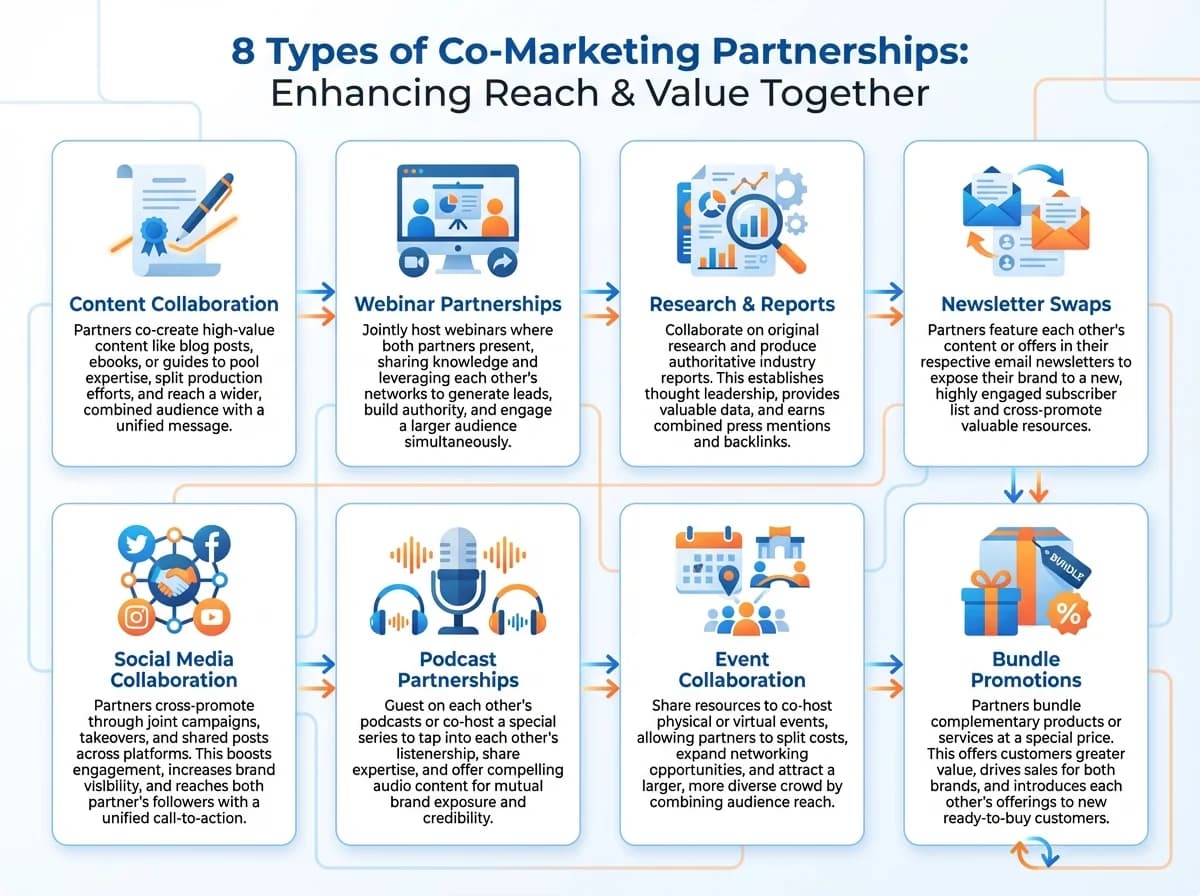
Content collaboration. Joint creation of blog posts, ebooks, whitepapers, or guides that both parties promote to their audiences.
Webinar partnerships. Co-hosted educational sessions where both companies present and promote to combined audiences.
Research and reports. Joint research studies or industry reports that establish both brands as thought leaders.
Newsletter swaps. Cross-promotion in email newsletters, where each partner features the other to their subscriber base.
Social media collaboration. Joint campaigns, cross-posting, or collaborative content for social platforms.
Podcast partnerships. Guest appearances, co-hosted episodes, or sponsored segments on partner podcasts.
Event collaboration. Joint conferences, meetups, or workshops where both brands participate and promote.
Bundle promotions. Combined offers where products from both companies are packaged together at special pricing.
Referral arrangements. Formal referral programs where partners recommend each other to their audiences.
What Makes Good Co-Marketing Partners
Audience overlap without competition. Ideal partners serve similar audiences with non-competing offerings. Your products should complement rather than compete.
Comparable audience quality. Partners should bring similar audience size or engagement levels. Significant imbalances create one-sided value exchange.
Brand alignment. Partner brands should share values and quality standards. Association with misaligned brands can damage perception.
Content capability. Partners should have capacity to contribute meaningfully to content creation and promotion.
Marketing maturity. Partners should have established marketing programs with consistent publishing, audience engagement, and promotional capacity.
Identifying Co-Marketing Partners
Strategic partner selection maximizes co-marketing value. The right partners bring complementary audiences without competitive conflict.
Qualification Criteria
Audience relevance. Does their audience match your target customer profile? Irrelevant audiences provide little value regardless of size.
Audience size and engagement. What's their reach across relevant channels? Quality often matters more than raw numbers.
Content quality. Is their content professional, valuable, and consistent? Content quality reflects on both partners.
Brand reputation. Are they respected in the market? Association affects perception both ways.
Marketing activity level. Are they actively publishing, promoting, and engaging? Dormant marketing programs make poor partners.
Partnership track record. Have they done successful co-marketing before? Experience suggests operational capability.
Finding Potential Partners
Adjacent product research. Identify companies whose products complement yours in customer workflows.
Content consumption analysis. Note which publications, blogs, and content sources your audience already consumes.
Conference exhibitors. Companies exhibiting at industry events often seek co-marketing opportunities.
Podcast guests. People appearing on industry podcasts have content to share and audience-building interest.
Newsletter research. Subscribe to industry newsletters and note which companies have strong content programs.
Social media analysis. Identify companies with engaged followings in your target space.
LinkedIn research. Search for titles like "Content Marketing Manager," "Head of Marketing," "Partnerships Manager," or "Director of Demand Generation."
Crafting Co-Marketing Outreach Emails
Co-marketing emails should propose specific, actionable collaboration concepts rather than vague partnership interest.
Email Structure Best Practices
Lead with mutual benefit. Frame the opportunity in terms of what both parties gain from collaboration.
Propose specific concepts. Vague "we should do something together" emails don't advance conversations. Propose concrete ideas.
Show you know their content. Reference their specific content, demonstrating you've done research and have genuine familiarity with their work.
Quantify your value. Share audience metrics, engagement rates, or reach data that demonstrate what you bring to the partnership.
Make response easy. Propose clear next steps that require minimal commitment to explore further.
Co-Marketing Outreach Email Templates
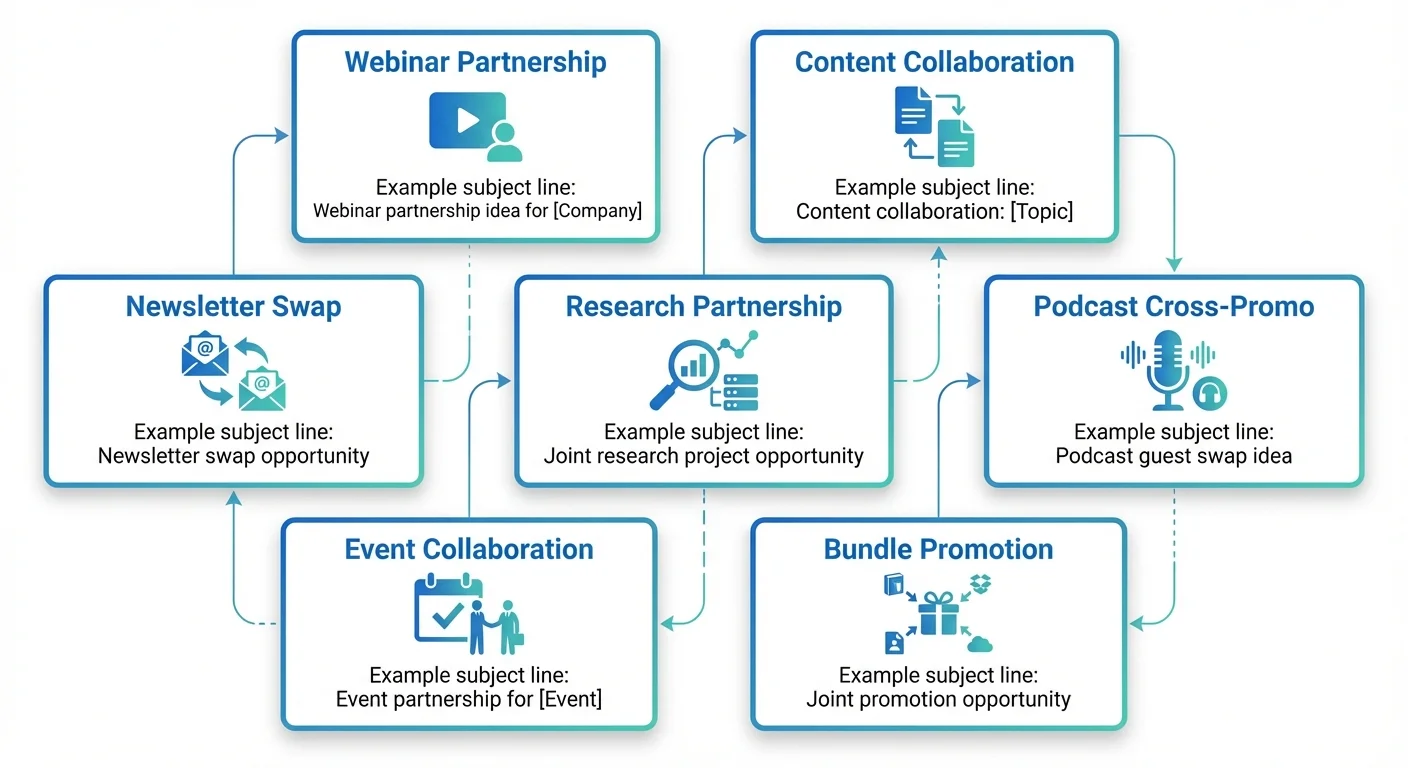
Template 1: Webinar Partnership Proposal
Subject: Webinar partnership idea for [Their Company]
Hi [Name],
I've been following [Their Company]'s content on [topic area], and I see a strong opportunity for a joint webinar that could benefit both our audiences.
I'm thinking: "[Proposed Webinar Title]" covering [specific topics].
Here's why this could work well:
- [Your Company] reaches [your audience description] through [your channels and metrics]
- [Their Company] serves [their audience description]
- Combined, we could deliver [specific value] to a larger audience than either could reach alone
The topic fits because [reason it aligns with both brands].
Would you be interested in exploring this? I'm happy to discuss format, promotion, and logistics.
[Your name]
Template 2: Content Collaboration Proposal
Subject: Content collaboration: [Proposed Topic]
Hi [Name],
I came across your [specific content piece] on [topic] and thought it was excellent. Your perspective on [specific point] particularly resonated.
I'd like to propose a content collaboration. [Your Company] is developing a [guide/ebook/report] on [topic], and I think including [Their Company]'s expertise would make it more valuable for readers.
The concept: [Brief description of content piece]
What we'd ask from [Their Company]:
- [Specific contribution, like expert quotes, data, or section authorship]
- Promotion to your audience upon publication
What [Their Company] gains:
- Co-branding on a substantial content asset
- Exposure to our audience of [size and description]
- [Additional benefit]
Would this be of interest? I'm happy to share more details about the project.
[Your name]
Template 3: Newsletter Swap Proposal
Subject: Newsletter swap opportunity
Hi [Name],
I subscribe to [Their Newsletter] and consistently find value in your coverage of [topic area]. Your recent piece on [specific edition] was particularly good.
I manage [Your Newsletter], which reaches [subscriber count] [audience description]. I'd like to propose a newsletter swap:
- We feature [Their Company] in an upcoming edition with a dedicated spotlight
- You feature [Your Company] in a future edition
Both audiences seem interested in [overlapping interest], so the cross-promotion should feel natural and valuable to readers.
Would this work for [Their Newsletter]?
[Your name]
Template 4: Research Partnership Proposal
Subject: Joint research project opportunity
Hi [Name],
I'm exploring a research initiative on [topic], and I think [Their Company] would be an ideal partner.
The concept: A comprehensive study on [specific research question] featuring survey data from [number] [target respondents].
Why partner:
- Combined audience reach for survey distribution
- Shared credibility in reporting findings
- Joint promotion generating coverage for both brands
What we'd create:
- Research report with both companies' branding
- Blog posts and social content from findings
- Potential webinar presenting results
[Your Company] would handle [your contribution], and we'd ask [Their Company] to contribute [their contribution].
Is research partnership something [Their Company] is interested in exploring?
[Your name]
Template 5: Podcast Cross-Promotion Proposal
Subject: Podcast guest swap idea
Hi [Name],
I've been listening to [Their Podcast] and appreciate your coverage of [topic area]. Your episode with [guest] on [subject] was particularly insightful.
I host [Your Podcast], which covers [topic area] for [audience description]. We have [listener metrics or notable guests].
I'd like to propose a guest swap:
- I appear on [Their Podcast] to discuss [topic you'd cover]
- You appear on [Your Podcast] to discuss [topic they'd cover]
Both appearances would expose us to each other's audiences while providing valuable content for listeners.
Would this be of interest?
[Your name]
Template 6: Event Collaboration Proposal
Subject: Event partnership for [Event Name/Concept]
Hi [Name],
I'm planning [event type] focused on [topic], and I believe [Their Company] would be an excellent co-host.
Event concept: [Brief description including format, audience, and timing]
Why co-host:
- Combined promotional reach ensures strong attendance
- Shared costs make a higher-quality event feasible
- Both brands benefit from association with valuable content
Proposed structure:
- [Your Company] handles [your contribution]
- [Their Company] handles [their contribution]
- Promotion and branding shared equally
Is event partnership something [Their Company] is exploring?
[Your name]
Template 7: Bundle Promotion Proposal
Subject: Joint promotion opportunity
Hi [Name],
I noticed [Their Product] and [Your Product] often serve the same customers for different needs. I'd like to propose a joint promotion.
Concept: We create a bundled offer featuring both products at [discount structure], promoted to both audiences.
This works because:
- Our customers frequently also need [their product type]
- Your customers likely need [your product type]
- Neither of us loses because we're not competitive
We could promote through:
- Email campaigns to both lists
- Social media announcements
- Dedicated landing page with shared branding
Would you be interested in exploring a joint promotion?
[Your name]
Where we differ from standard practice
Much of the advice on this page reflects how outbound is commonly run. We run it differently, and since this page sits on our site it is worth saying where the difference is and what it costs us.
- A sequence of messages to each prospect over several weeks
- Later messages often land in the same email thread
- Every contact is reached more than once, so a distracted reader gets another chance
- The later messages go only to people who did not answer the first
- Reputation cost accrues on the sending domain across everything else it sends
- One message, then that campaign is finished for that contact
- No thread replies and no bumps
- A non-responding audience becomes a new campaign with a genuinely different premise, not a reminder
- More of the work moves into targeting and into the one message
- We reach each contact less often, and that is the cost we accept
The reasoning is mechanical rather than moral. A follow-up arrives underneath a message the recipient has already seen and chosen not to answer, so it is delivered to the population most likely to mark it as spam, and the reputation cost of that lands on the sending domain across every campaign running on it. We set that cost against the replies a sequence recovers and decided the trade was not worth it. The full argument, with the numbers from our own campaigns, is in why we stopped using follow-ups.
Follow-Up Strategies
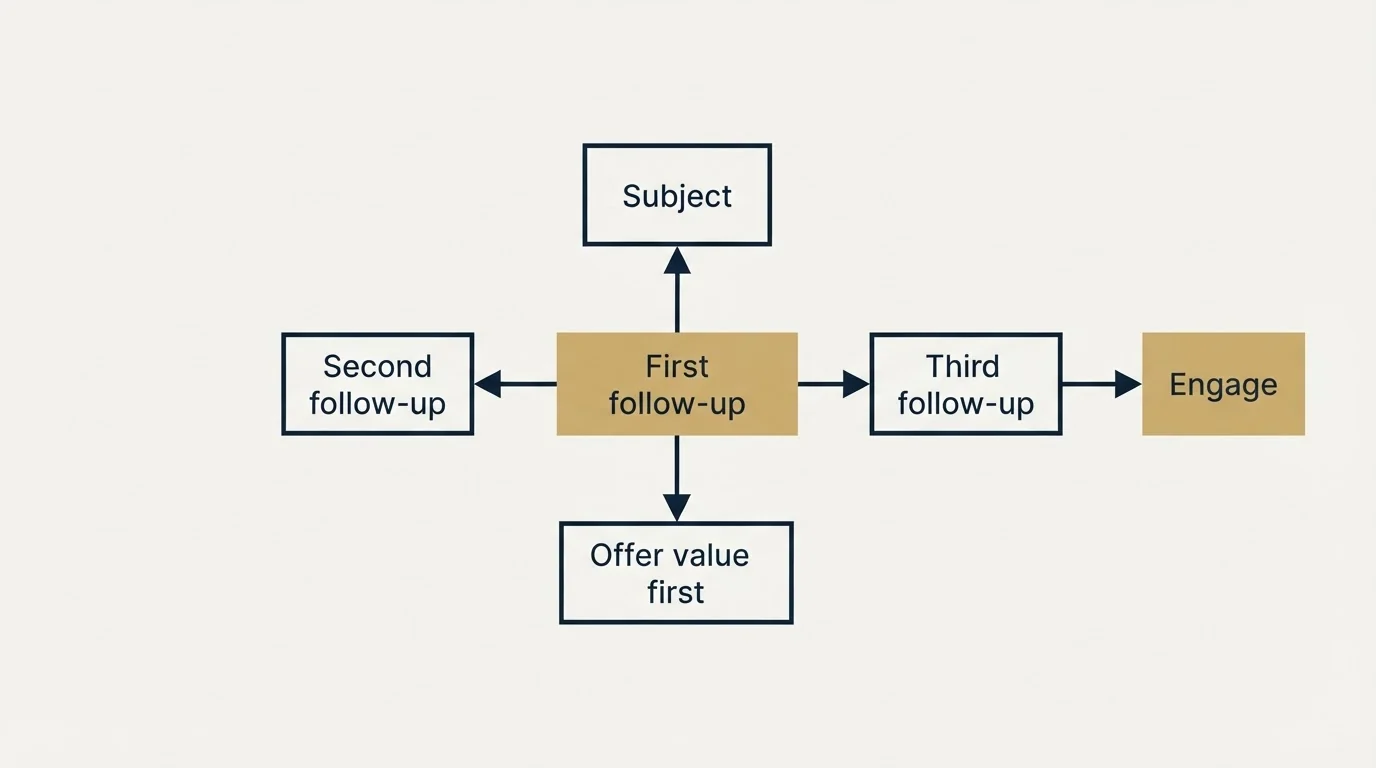
Marketing professionals receive substantial inbound volume. Thoughtful follow-up increases response rates without being intrusive.
Follow-Up Sequence
First follow-up (4-5 days after initial email):
Subject: Re: Webinar partnership idea
Hi [Name],
Wanted to follow up on my co-marketing proposal. I know your inbox is busy, but I think there's genuine potential here.
Quick summary: [One-sentence description of opportunity]
Worth a brief conversation to explore?
[Your name]
Second follow-up (5-6 days after first follow-up):
Subject: Following up
Hi [Name],
I'll keep this brief. If the [specific co-marketing concept] doesn't fit [Their Company]'s current priorities, I completely understand.
If timing is the issue, let me know when might work better. Or if there's another type of collaboration that would be more interesting, I'm open to ideas.
[Your name]
Third follow-up (2-3 weeks after second follow-up):
Subject: One more try
Hi [Name],
Last follow-up on this. If co-marketing partnerships aren't something [Their Company] is pursuing right now, no problem at all.
If circumstances change, feel free to reach out. I remain interested in exploring ways to collaborate.
[Your name]
Providing Value Between Outreach
Engage with their content. Share their posts, leave thoughtful comments, or reference their content in your own.
Offer value first. If you can provide something useful (an introduction, feedback, promotion) without expecting return, do so.
Share relevant opportunities. If you encounter opportunities that might benefit them (speaking slots, press inquiries, etc.), share them.
Planning and Executing Co-Marketing Campaigns
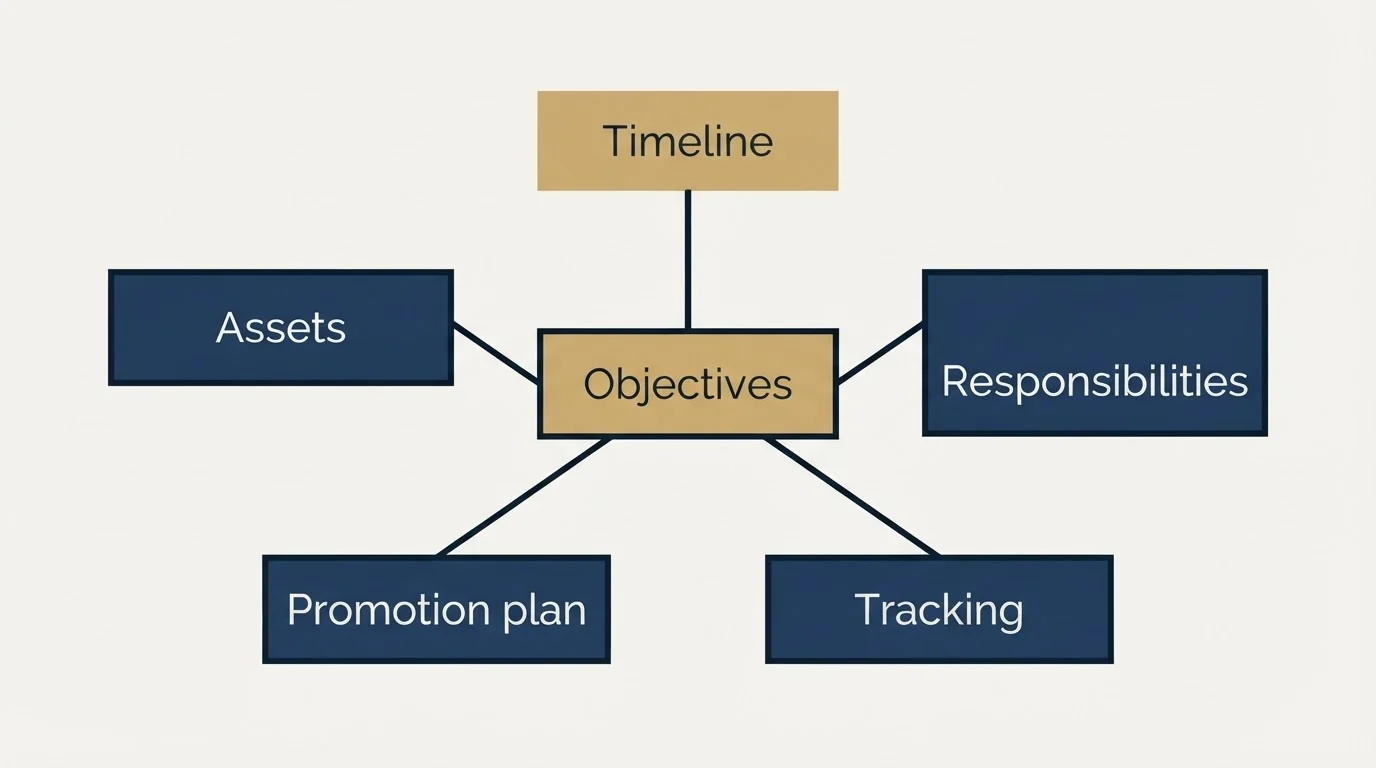
Once partners agree to collaborate, successful execution requires clear planning and coordination.
Campaign Planning Elements
Objectives. What does each party want to achieve? Lead generation, brand awareness, audience growth?
Timeline. What's the schedule for content creation, review, and launch?
Responsibilities. Who does what? Clarify content creation, design, promotion, and technical tasks.
Assets. What brand assets, images, templates, or resources will be shared?
Promotion plan. How will each party promote? Which channels, how many times, what messaging?
Tracking. How will results be measured? What metrics matter?
Communication. How will partners coordinate during execution? Who are the key contacts?
Execution Best Practices
Document everything. Create a shared document or project plan with all details, deadlines, and responsibilities.
Schedule check-ins. Regular sync calls ensure coordination and address issues early.
Build in review time. Both parties should have time to review and approve content before launch.
Coordinate promotion timing. Synchronize promotional activities for maximum impact.
Prepare response plans. Know who handles questions or issues that arise during campaigns.
Post-Campaign Activities
Share results. Provide partners with performance data after campaigns conclude.
Debrief on learnings. Discuss what worked, what didn't, and how future collaborations could improve.
Express appreciation. Thank partners for their contribution and collaboration.
Explore future opportunities. Successful partnerships often lead to ongoing collaboration.
Measuring Co-Marketing Success
Track metrics that indicate whether co-marketing efforts are delivering value.
Campaign Metrics
Reach. How many people were exposed to co-marketing content?
Engagement. What were engagement rates (clicks, shares, comments)?
Lead generation. How many leads did each partner generate?
Conversion. Did leads convert to customers or other desired actions?
Traffic. How much website traffic did campaigns drive for each partner?
Partnership Metrics
Partner satisfaction. Were both parties satisfied with the collaboration?
Efficiency. How much effort did the partnership require relative to results?
Relationship development. Did the partnership strengthen the relationship for future collaboration?
Program Metrics
Partnership pipeline. How many potential co-marketing partners are in various stages?
Execution rate. What percentage of proposed partnerships actually execute?
ROI. What's the return on investment across the co-marketing program?
Common Co-Marketing Mistakes
Avoid these errors that undermine co-marketing effectiveness.
Partner Selection Errors
Audience mismatch. Partnering with companies whose audiences don't match your targets wastes effort.
Quality mismatch. Partners with significantly lower quality standards reflect poorly on your brand.
Effort imbalance. Partners who don't contribute proportionally create frustration and poor results.
Planning Errors
Vague objectives. Partnerships without clear goals produce unmeasurable results.
Unclear responsibilities. Ambiguity about who does what leads to gaps and duplicated effort.
Insufficient lead time. Rushed campaigns produce lower quality and less coordinated promotion.
Execution Errors
Promotion gaps. Partners who fail to promote as agreed undermine campaign reach.
Quality compromises. Rushing to meet deadlines at the expense of quality damages both brands.
Poor communication. Lack of coordination during execution creates confusion and mistakes.
Relationship Errors
One-sided focus. Partnerships that primarily benefit one party don't sustain.
Lack of appreciation. Failing to acknowledge partner contributions damages relationships.
No follow-through. Not sharing results or debriefing after campaigns misses improvement opportunities.
Co-Marketing Outreach Checklist
Use this checklist to ensure your co-marketing outreach succeeds.
Before Starting:
- Co-marketing objectives defined
- Target partner profile established
- Specific campaign concepts developed
- Your audience metrics and value proposition prepared
Partner Identification:
- Target partner list built
- Marketing contacts identified
- Research completed on each target
- Prioritization applied
Outreach:
- Personalized emails drafted
- Supporting materials ready
- Response handling process established
Execution Preparation:
- Campaign planning template ready
- Asset and resource requirements defined
- Tracking and measurement approach established
Building Your Co-Marketing Program
Co-marketing partnerships extend your reach, share your costs, and create valuable content you couldn't develop alone. The most successful programs develop systematic approaches to identifying, pursuing, and managing partnerships.
Cold email provides direct access to the marketing professionals who can evaluate and execute co-marketing initiatives. By proposing specific, mutually beneficial concepts, you can open conversations that lead to valuable collaborations.
Start by defining what co-marketing objectives you want to achieve. Identify companies with complementary audiences and content programs. Research specific organizations and the people who manage their marketing partnerships. Craft outreach that proposes concrete collaboration concepts. Follow up persistently while building genuine relationships. Plan and execute campaigns carefully. Measure results and continuously improve.
Ready to expand your marketing reach through partnerships? Our team specializes in outreach campaigns that initiate valuable co-marketing relationships. Request your free custom campaign and let us help you connect with co-marketing partners.
Related Reading
Frequently asked questions.
Frequently asked questions- Why does cold email work for finding co-marketing partners?
- Cold email provides direct access to marketing directors, content managers, and partnership professionals who make co-marketing decisions. It allows you to proactively target companies with specific audience characteristics and brand positioning that align with your objectives, rather than waiting for partnerships to develop organically. This approach enables you to propose specific collaboration concepts and gauge interest quickly before investing significant planning time, building a pipeline of potential partnerships at scale.
- What makes a good co-marketing partner?
- Good co-marketing partners have audience overlap without direct competition, meaning they serve similar customers but offer complementary rather than competing products. They should bring comparable audience size or engagement levels to avoid one-sided value exchange. Additional qualifications include brand alignment with shared values, content capability to contribute meaningfully, marketing maturity with consistent publishing programs, and ideally a track record of successful partnerships that demonstrates operational capability.
- What types of co-marketing partnerships can I propose through cold email?
- You can propose nine primary co-marketing types: content collaboration on blog posts or ebooks, co-hosted webinars, joint research reports, newsletter swaps with cross-promotion, social media campaigns, podcast guest appearances, event collaboration on conferences or meetups, bundle promotions packaging both products, and formal referral arrangements. The appropriate type depends on your objectives, resources, and partner capabilities. Proposing specific, actionable concepts rather than vague partnership interest increases response rates.
- How do I find potential co-marketing partners to contact?
- Identify partners through adjacent product research to find complementary offerings, content consumption analysis to see what your audience reads, conference exhibitor lists, podcast guest rosters, industry newsletters with strong content programs, and social media accounts with engaged followings. Use LinkedIn to search for relevant titles like Content Marketing Manager or Director of Demand Generation. Focus on companies with established marketing programs, consistent publishing activity, and audiences that match your target customer profile.
- What should I include in a co-marketing cold email?
- Co-marketing outreach emails should propose specific, actionable collaboration concepts rather than vague partnership interest. While the article truncates before providing complete templates, the guidance emphasizes proposing concrete initiatives that demonstrate you've researched the partner and identified mutual value. The email structure should make it easy for marketing decision-makers to quickly evaluate the opportunity and respond, focusing on specific co-marketing types like webinars, content collaboration, or research reports that align with both parties' capabilities.
About the author.

Ben Carden is CRO at RevenueFlow, which builds and operates outbound revenue engines for B2B companies. Previously at Gartner Enterprise. Studied at London School of Economics.
Ben Carden · CRO
Connect on LinkedIn →Explore more.
Ready to scale your outreach?
We build GTM engines that book real meetings. See the receipts.
Related articles.
Cold Email for Affiliate Recruitment: Strategy Guide
Master cold email outreach to recruit high-performing affiliates who can drive significant revenue for your business with proven templates and strategies.
Cold Email for Reseller Partnerships: Strategy Guide
Learn how to use cold email to recruit resellers and channel partners who can expand your market reach and drive revenue through their existing customer relationships.