Cold Email for Customer Feedback: Complete Strategy Guide
Learn how to use cold email to gather actionable customer feedback, improve product development, and strengthen relationships through systematic outreach.

Cold email outperforms traditional feedback channels by proactively reaching targeted customer segments with conversational depth. It accesses churned customers who ignore surveys, enables follow-up questions that reveal reasoning behind feedback, and strengthens relationships by demonstrating you value customer opinions. Target power users for product insights, recent cancellations for churn analysis, and at-risk accounts to prevent departure.
Key takeaways
- In-app surveys typically achieve single-digit response rates, making cold email a more effective channel for systematic feedback collection.
- Churned customers rarely complete surveys but often respond to personal emails asking what went wrong.
- Cold email enables targeted outreach to specific customer segments based on usage patterns, plan type, tenure, or industry for more relevant insights.
- Four primary feedback types include product feedback (features and usability), experience feedback (onboarding and support), strategic feedback (value perception and competitive positioning), and churn feedback (departure reasons and recovery potential).
- Power users who extensively use the product provide the most valuable feedback due to their deep understanding and real-world experience.
Reviewed and updated September 15, 2026
Cold Email for Customer Feedback: Complete Strategy Guide
Customer feedback shapes products, influences roadmaps, and determines whether companies build features that matter or waste resources on capabilities nobody wants. Yet most companies struggle to gather feedback systematically. In-app surveys have single-digit response rates. Support tickets capture problems but miss opportunities. Customer success calls happen too infrequently to catch emerging issues.
Cold email provides a direct channel to customers for gathering feedback at scale. Whether reaching out to existing customers who have gone quiet, churned accounts you want to learn from, or power users whose insights could transform your product, email outreach generates the conversations that reveal what customers actually think.
Why Cold Email Works for Customer Feedback
Traditional feedback channels have significant limitations that cold email addresses.
Proactive rather than reactive. In-app surveys and support tickets only capture feedback from customers motivated enough to share on their own. Cold email reaches customers who have feedback but haven't prioritized sharing it.
Targeted precision. You can target specific customer segments for feedback based on usage patterns, plan type, tenure, industry, or any other characteristic. This targeted approach produces more relevant insights than broad feedback requests.
Conversational depth. Unlike multiple-choice surveys, email exchanges allow follow-up questions that explore the reasoning behind feedback. Understanding why customers feel certain ways matters more than knowing what they feel.
Relationship building. Reaching out to ask for feedback demonstrates that you value customer opinions. This strengthens relationships even when the feedback itself is critical.
Churned customer access. Customers who cancelled or didn't renew rarely complete surveys, but many will respond to a personal email asking what went wrong.
Types of Customer Feedback to Gather
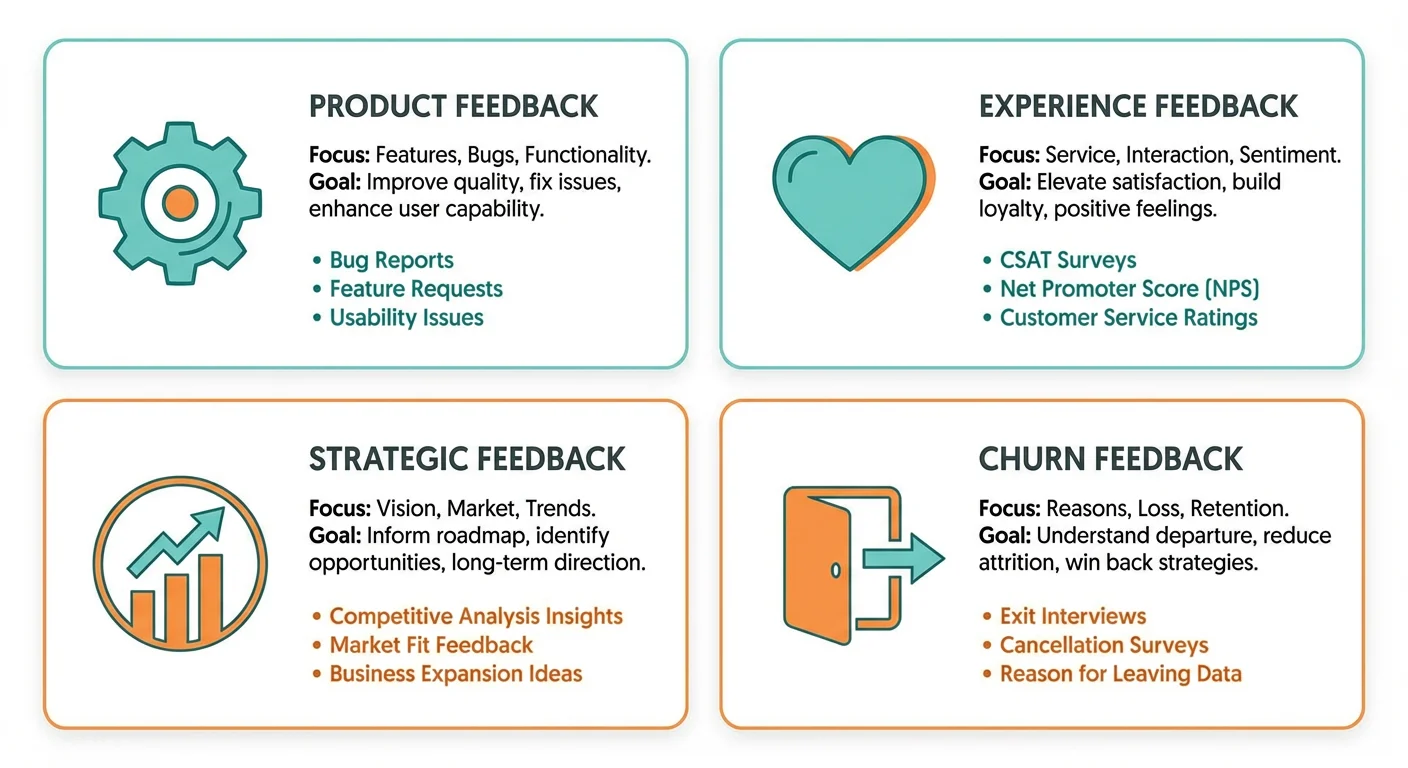
Different feedback types require different outreach approaches and target different customer segments.
Product Feedback
Understanding how customers use your product and what they wish it did differently.
Feature requests and prioritization. What capabilities do customers want? How would they rank potential features?
Usability issues. Where do customers struggle? What's confusing or frustrating?
Performance concerns. Is the product fast enough, reliable enough, comprehensive enough?
Integration needs. What other tools do customers use? Where do workflow gaps exist?
Experience Feedback
Evaluating the overall customer experience beyond product functionality.
Onboarding effectiveness. Did customers successfully adopt the product? Where did they get stuck?
Support quality. Are support interactions helpful? What could improve?
Documentation adequacy. Can customers find answers to their questions?
Communication preferences. How do customers want to hear from you?
Strategic Feedback
Gathering insights that inform broader business decisions.
Value perception. Do customers feel they're getting value for what they pay?
Competitive positioning. How do customers view you versus alternatives?
Renewal likelihood. What would influence a customer's decision to continue or expand?
Referral potential. Would customers recommend you? What would increase their likelihood to refer?
Churn Feedback
Learning from customers who left to prevent future churn.
Departure reasons. What drove the decision to cancel?
Missing features. Were there capabilities that would have changed their decision?
Competitive factors. Did they switch to an alternative? Why?
Recovery potential. Under what circumstances might they return?
Identifying Feedback Outreach Targets
Strategic targeting produces higher response rates and more actionable feedback.
Active Customer Segments
Power users. Customers who use your product extensively understand it deeply and have well-formed opinions. Their feedback reflects real-world experience.
Recent onboarding completers. Customers who just finished onboarding have fresh perspectives on the new user experience before familiarity sets in.
Long-tenure customers. Customers who have used your product for years understand its evolution and can comment on long-term trends.
Expansion candidates. Customers whose usage suggests they might benefit from additional features provide valuable input on what would justify increased investment.
At-risk accounts. Customers showing declining usage or engagement can explain what's causing them to drift away before they actually leave.
Churned Customer Segments
Recent cancellations. Customers who cancelled within the last 30-60 days have fresh memories of their decision-making process.
Post-trial non-converts. Prospects who completed trials but didn't convert can explain what prevented them from becoming customers.
Downgrade cases. Customers who reduced their plan level experienced some shift worth understanding.
Competitive losses. Prospects or customers who explicitly chose a competitor offer valuable competitive intelligence.
Prospect Segments
Evaluation completers. Prospects who evaluated your product but didn't purchase can explain their decision criteria.
Engaged non-buyers. Leads who showed significant interest but never converted may have valuable perspectives on your positioning.
Crafting Customer Feedback Emails
Effective feedback emails make responding easy while communicating genuine interest in customer opinions.
Feedback Email Templates
Template 1: General Product Feedback Request
Subject: How's [Product Name] working for you?
Hi [Name],
I wanted to check in personally to see how things are going with [Product Name]. You've been using it for [timeframe] now, and your perspective would be valuable.
A few quick questions I'm curious about:
- What's working well for you?
- What's been frustrating or confusing?
- Is there anything you wish [Product Name] did that it doesn't?
No need to write an essay. Even a sentence or two would help us understand how to serve you better.
[Your name] [Title], [Company]
Template 2: Feature Prioritization Request
Subject: Quick input on [Product Name] roadmap
Hi [Name],
We're planning our product roadmap for the next quarter, and I'd love your input on what we should prioritize.
Based on customer feedback, we're considering:
- [Potential feature 1]
- [Potential feature 2]
- [Potential feature 3]
If you had to pick one that would make the biggest difference for your team, which would it be? And is there something not on this list that should be?
Your input directly influences what we build next.
[Your name]
Template 3: Post-Onboarding Feedback
Subject: How was getting started with [Product Name]?
Hi [Name],
You completed setup with [Product Name] about a week ago. I wanted to check in while the experience is still fresh.
A few questions:
- Was anything confusing during setup?
- Did you get stuck anywhere?
- Is there something you expected to be able to do that you haven't figured out?
We're constantly trying to make onboarding smoother, and feedback from customers who just went through it helps most.
[Your name]
P.S. If there's anything you're still trying to figure out, I'm happy to help directly.
Template 4: At-Risk Account Check-In
Subject: Noticed your [Product Name] usage dropped
Hi [Name],
I noticed your team's [Product Name] usage has declined over the past few weeks. I wanted to reach out personally to understand what's happening.
Is there something about [Product Name] that's not working for you? Did something change on your end that affected how you use it?
I'd rather hear directly from you than guess. If there's something we can fix or improve, I want to know about it.
Would you have 10 minutes for a quick call? Or feel free to share your thoughts in a reply.
[Your name]
Template 5: Churned Customer Feedback
Subject: We miss you (and want to learn from this)
Hi [Name],
I noticed you cancelled your [Product Name] account last month. I'm reaching out to understand what drove that decision.
We try to learn from every customer who leaves. If you have a moment, I'd appreciate hearing:
- What prompted the decision to cancel?
- Was there something specific we could have done differently?
- Would anything bring you back in the future?
Your candid feedback helps us improve for other customers facing similar situations. No pitch, I promise.
[Your name]
Template 6: NPS Follow-Up
Subject: Following up on your feedback
Hi [Name],
Thank you for completing our recent survey. You gave us a [score], and I'd love to understand more about what drove that rating.
Specifically:
- What would have made your score higher?
- Is there a specific experience or issue that influenced your rating?
Your answers help us understand the "why" behind the numbers, which matters more than the numbers themselves.
[Your name]
Template 7: Competitive Intelligence Request
Subject: Quick question about your evaluation process
Hi [Name],
I understand you've been evaluating solutions in [category] and considered [Product Name] alongside some alternatives. I'd value your perspective on how we compared.
Not looking to change your decision, just trying to understand:
- What criteria mattered most in your evaluation?
- How did [Product Name] compare on those criteria?
- What influenced your final choice?
Your honest feedback helps us understand where we need to improve.
[Your name]
Where we differ from standard practice
Much of the advice on this page reflects how outbound is commonly run. We run it differently, and since this page sits on our site it is worth saying where the difference is and what it costs us.
- A sequence of messages to each prospect over several weeks
- Later messages often land in the same email thread
- Every contact is reached more than once, so a distracted reader gets another chance
- The later messages go only to people who did not answer the first
- Reputation cost accrues on the sending domain across everything else it sends
- One message, then that campaign is finished for that contact
- No thread replies and no bumps
- A non-responding audience becomes a new campaign with a genuinely different premise, not a reminder
- More of the work moves into targeting and into the one message
- We reach each contact less often, and that is the cost we accept
The reasoning is mechanical rather than moral. A follow-up arrives underneath a message the recipient has already seen and chosen not to answer, so it is delivered to the population most likely to mark it as spam, and the reputation cost of that lands on the sending domain across every campaign running on it. We set that cost against the replies a sequence recovers and decided the trade was not worth it. The full argument, with the numbers from our own campaigns, is in why we stopped using follow-ups.
Re-Approach Strategies
Initial feedback requests often get lost in busy inboxes. A second request, sent later as its own email, recovers responses without pestering anyone.
The Second Request
The rule described above applies here too: one message per campaign, then that campaign is finished for that customer. Somebody who did not answer a feedback request is not reminded underneath it. They get a fresh email weeks later, with its own subject line and its own question, which earns a fresh open rather than reopening a note they already skipped.
Second request (three to four weeks after the first):
Subject: One question about [Product Name]
Hi [Name],
One question, and a single sentence is a complete answer: what is the biggest thing you would change about [Product Name]?
Your answer genuinely helps us prioritize what to work on next.
[Your name]
Third request (the following quarter, with a new reason to write):
Subject: [Recent change] in [Product Name]
Hi [Name],
We shipped [recent change] since I last wrote. If your team has touched it, I would value 30 seconds of reaction, good or bad.
If timing isn't right for feedback, no worries at all. Just wanted to make sure you knew your input was welcome.
[Your name]
Alternative Approaches
If a second request doesn't generate responses, try alternative channels.
Phone calls. A brief phone call often succeeds where email fails, especially for important accounts.
LinkedIn messages. Some professionals respond more readily on LinkedIn than email.
In-app messages. For active users, in-app prompts can catch them at a relevant moment.
Video messages. Tools like Loom allow sending personalized video requests that stand out from text emails.
Converting Feedback into Conversations
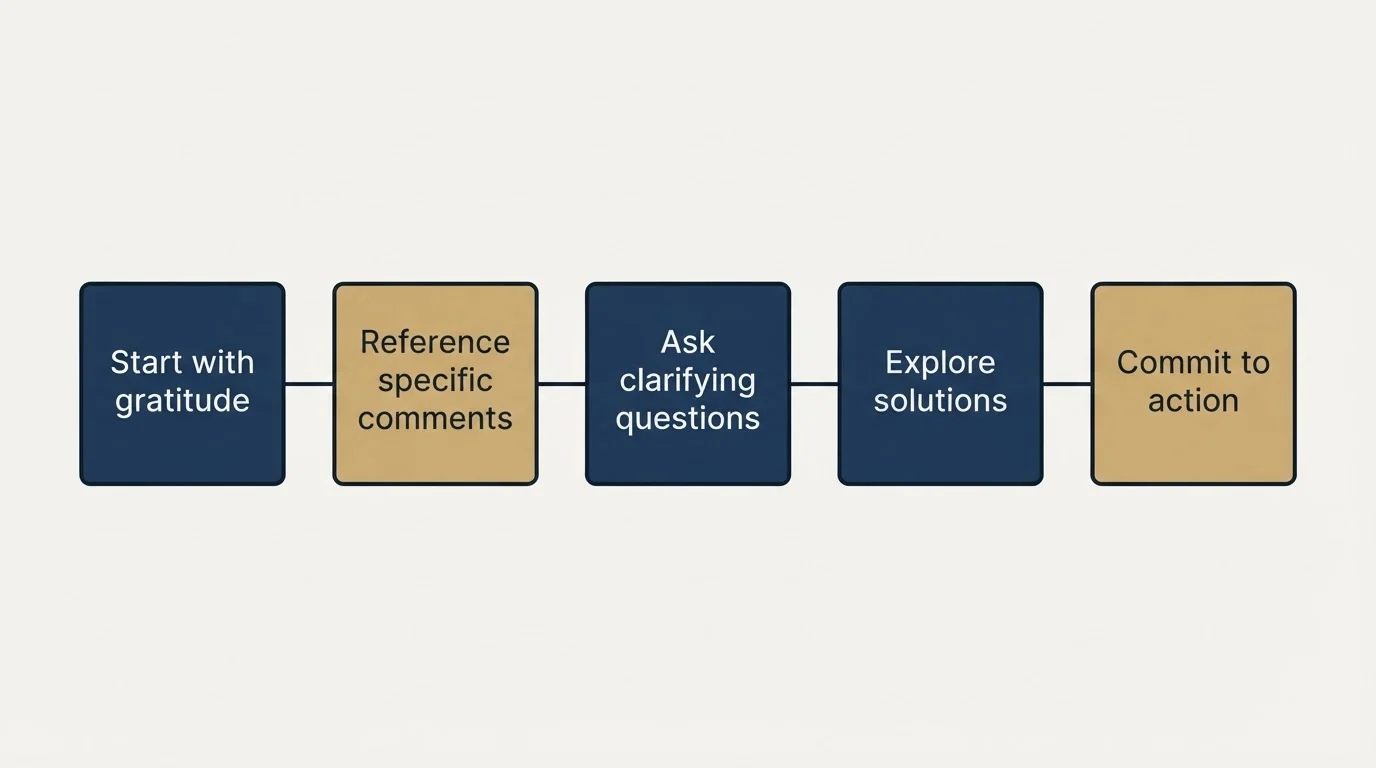
Written feedback provides a starting point, but conversations reveal deeper insights. Use initial responses as springboards for more substantive exchanges.
Scheduling Follow-Up Calls
Subject: Thanks for your feedback (quick call?)
Hi [Name],
Thank you for sharing your thoughts on [specific topic they mentioned]. Your point about [specific detail] really resonated.
I'd love to dig deeper on a few things you mentioned. Would you have 15 minutes for a quick call this week? I have specific questions about [topic] that would help us prioritize improvements.
[Scheduling link or time options]
[Your name]
Conducting Feedback Calls
Start with gratitude. Acknowledge their feedback and the time they're investing.
Reference their specific comments. Show you read and valued their written feedback.
Ask clarifying questions. Probe for the reasoning and context behind their comments.
Explore solutions. Ask what ideal solutions would look like from their perspective.
Commit to action. Tell them what you'll do with their feedback and when they might see results.
Processing and Acting on Feedback
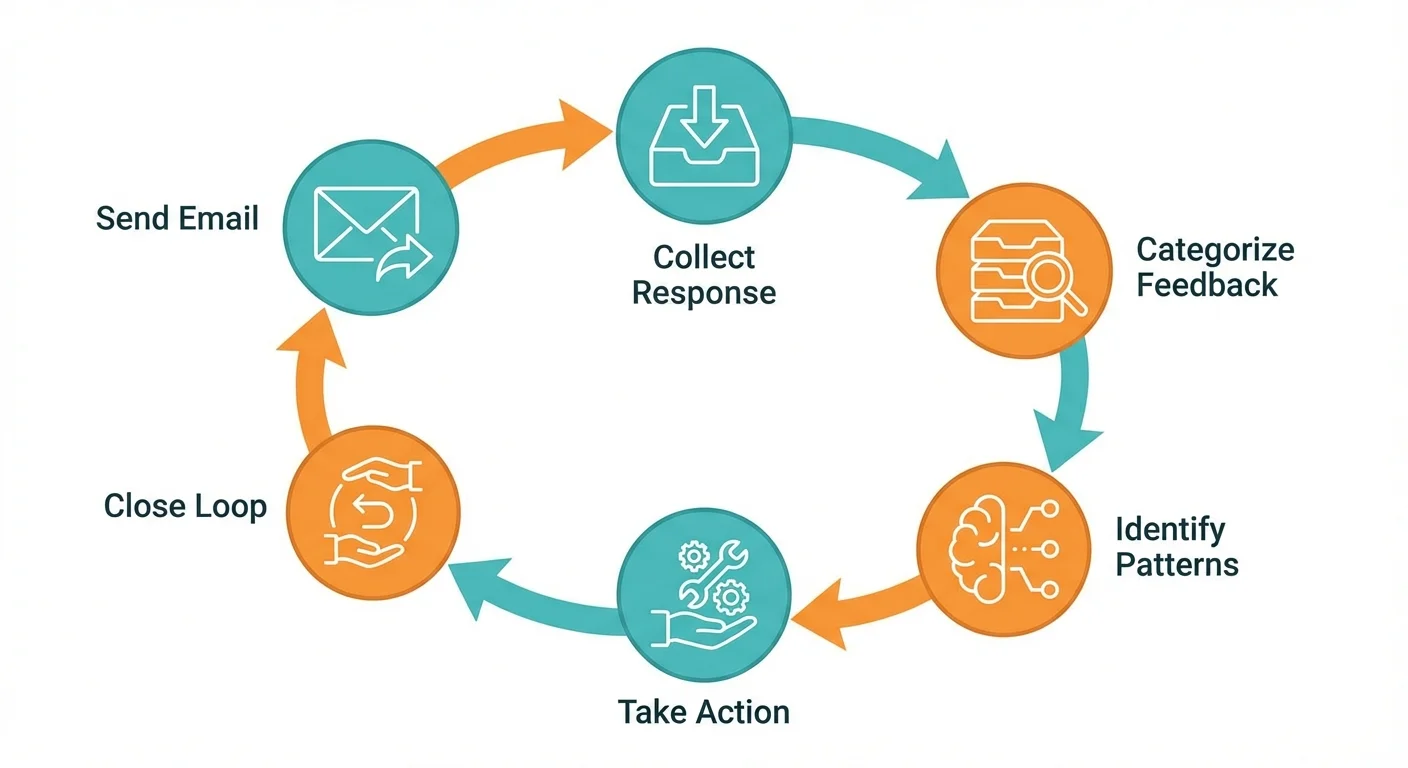
Gathering feedback without acting on it wastes everyone's time and damages trust. Systematic processing ensures feedback drives improvement.
Categorizing Feedback
Create a system for organizing feedback that makes patterns visible:
By type: Bug reports, feature requests, usability issues, praise, complaints By segment: Enterprise vs. SMB, industry, plan level, tenure By severity: Critical issues, significant opportunities, nice-to-haves By theme: Onboarding, core functionality, integrations, support, pricing
Identifying Patterns
Individual feedback items matter less than patterns across multiple customers:
Frequency. How many customers mention this issue? Consistency. Do different segments say the same thing? Intensity. How strongly do customers feel about this? Correlation. Does this feedback correlate with churn, expansion, or NPS?
Prioritizing Actions
Not all feedback warrants immediate action. Evaluate feedback against:
Customer impact. How many customers would benefit from addressing this? Business impact. Does this affect retention, expansion, or acquisition? Effort required. What resources would addressing this require? Strategic alignment. Does this fit your product direction?
Closing the Loop
Customers who share feedback want to know it mattered. Close the loop when you act on their input.
Immediate acknowledgment. Thank customers for feedback when they share it.
Progress updates. When you begin working on something a customer requested, let them know.
Completion announcements. When you ship improvements based on feedback, notify the customers who influenced the decision.
Public recognition. With permission, acknowledge customers who helped shape improvements in release notes or communications.
Measuring Feedback Program Effectiveness
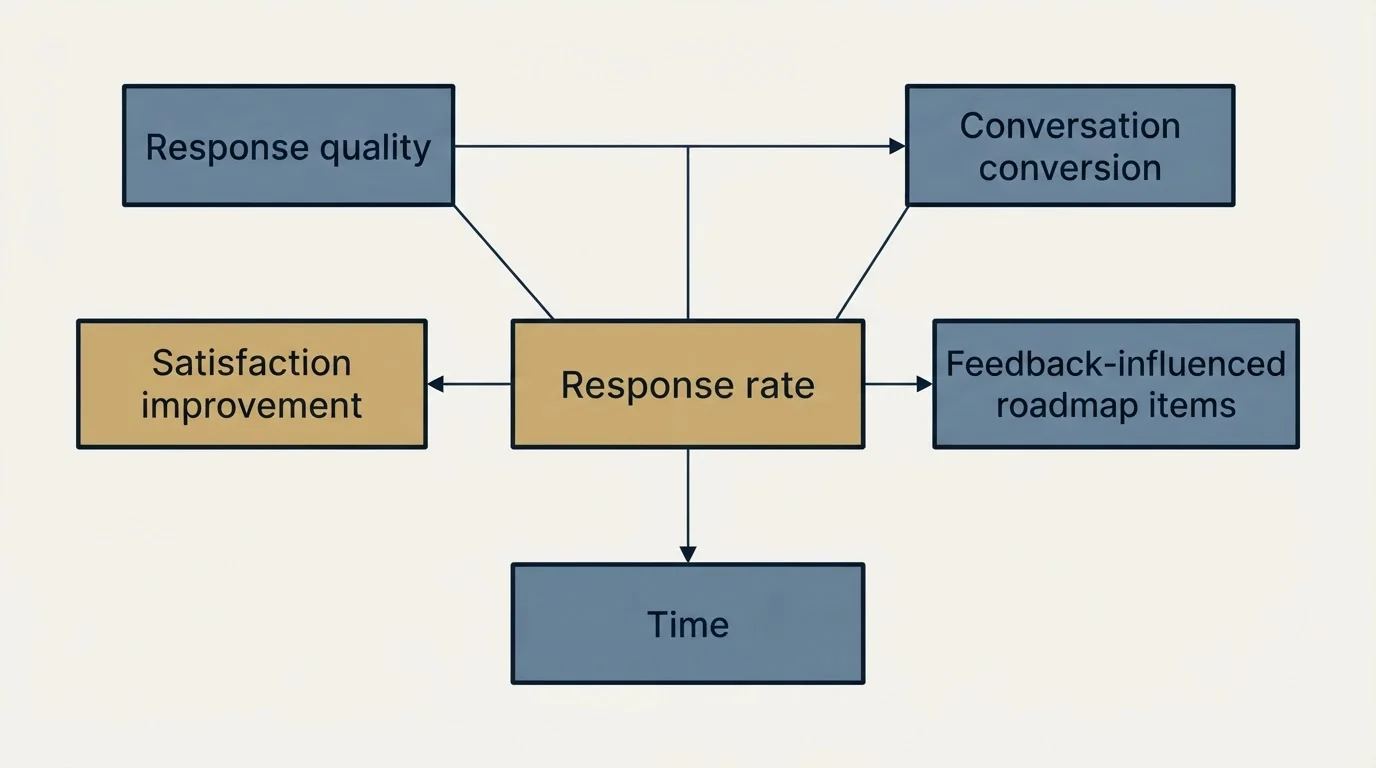
Track metrics that indicate whether your feedback program is working.
Response Metrics
Response rate by segment. What percentage of each customer segment responds to feedback requests?
Response quality. Are responses substantive enough to generate insights?
Conversation conversion. What percentage of initial responses convert to calls or deeper exchanges?
Impact Metrics
Feedback-influenced roadmap items. What percentage of roadmap items trace to customer feedback?
Time to action. How long does it take from feedback to shipped improvement?
Satisfaction improvement. Do NPS or satisfaction scores improve as you act on feedback?
Relationship Metrics
Engagement changes. Do customers who participate in feedback show different engagement patterns?
Retention correlation. Do customers who provide feedback churn at different rates?
Expansion correlation. Are feedback participants more likely to expand their accounts?
Common Feedback Email Mistakes
Avoid these errors that undermine feedback collection efforts.
Asking Too Many Questions
Long surveys disguised as emails overwhelm recipients. Stick to 2-3 focused questions in initial outreach. Save comprehensive feedback for conversations.
Being Defensive
When customers share criticism, resist the urge to explain or justify. Thank them for honest feedback and commit to considering it. Defensiveness discourages future feedback.
Failing to Follow Up
Customers who take time to share feedback feel ignored when they never hear back. Acknowledge every substantive response, even if you can't act on their specific suggestion.
Generic Outreach
"How's everything going?" requests generate vague responses. Specific questions about specific aspects of the experience produce actionable feedback.
Ignoring Patterns
Acting on individual feedback items while ignoring consistent patterns misallocates resources. Look for themes before prioritizing action.
Over-Promising Changes
Committing to make changes based on feedback when you can't or won't damages trust. Be honest about what feedback will and won't influence.
Feedback Email Checklist
Use this checklist to ensure your feedback outreach succeeds.
Before Starting:
- Feedback objectives clearly defined
- Target customer segments identified
- Feedback processing system established
- Response handling workflow ready
Email Content:
- Personalized subject line
- Clear, specific questions (2-3 maximum)
- Genuine tone without corporate speak
- Easy response options (reply to email is fine)
Re-Approach Plan:
- Timing set for a later request with a new question
- Alternative outreach channels identified
- Call scheduling process ready
- Acknowledgment templates prepared
Action Planning:
- Categorization system established
- Pattern identification process defined
- Prioritization framework ready
- Loop-closing communications planned
Building a Feedback Culture
Systematic feedback collection through cold email represents one component of a broader feedback culture. The most customer-centric companies gather feedback continuously through multiple channels, process it systematically, and visibly act on what they learn.
Start with targeted campaigns focused on specific feedback objectives. Build systems for processing and prioritizing what you gather. Close loops to show customers their input matters. Over time, you'll develop a feedback engine that continuously improves your product and strengthens customer relationships.
Ready to gather customer feedback that drives improvement? Our team specializes in outreach campaigns that generate meaningful customer responses. Request your free custom campaign and let us help you understand what your customers really think.
Related Reading
Frequently asked questions.
Frequently asked questions- Why is cold email better than surveys for gathering customer feedback?
- Cold email works proactively rather than reactively, reaching customers who have feedback but haven't prioritized sharing it. Unlike multiple-choice surveys, email exchanges allow follow-up questions that explore the reasoning behind feedback. Cold email also enables targeted precision, letting you reach specific customer segments based on usage patterns or other characteristics, producing more relevant insights than broad feedback requests.
- Which customer segments should I target for feedback outreach?
- Target power users for deep product insights, recent onboarding completers for fresh new-user perspectives, and at-risk accounts showing declining usage to prevent churn. For understanding why customers leave, reach out to recent cancellations within 30-60 days, post-trial non-converts, and competitive losses. Long-tenure customers provide valuable input on product evolution and long-term trends.
- What types of customer feedback can I gather through cold email?
- Four primary feedback types include product feedback covering feature requests, usability issues, and integration needs; experience feedback evaluating onboarding effectiveness, support quality, and documentation adequacy; strategic feedback on value perception, competitive positioning, and renewal likelihood; and churn feedback exploring departure reasons, missing features, and recovery potential.
- How does cold email help with churned customers?
- Churned customers rarely complete surveys, but many will respond to a personal email asking what went wrong. Cold email provides direct access to customers who cancelled or didn't renew, enabling you to understand their decision-making process, identify missing features that might have changed their decision, gather competitive intelligence, and assess recovery potential under different circumstances.
About the author.

Ben Carden is CRO at RevenueFlow, which builds and operates outbound revenue engines for B2B companies. Previously at Gartner Enterprise. Studied at London School of Economics.
Ben Carden · CRO
Connect on LinkedIn →Explore more.
Ready to scale your outreach?
We build GTM engines that book real meetings. See the receipts.
Related articles.
Cold Email for Affiliate Recruitment: Strategy Guide
Master cold email outreach to recruit high-performing affiliates who can drive significant revenue for your business with proven templates and strategies.
Cold Email for Reseller Partnerships: Strategy Guide
Learn how to use cold email to recruit resellers and channel partners who can expand your market reach and drive revenue through their existing customer relationships.