Cold Email for Data Analytics: The Complete Guide
Master cold email outreach for the data analytics industry. Learn how to reach decision-makers at data platform companies, BI tool vendors, and enterprises building their data infrastructure.
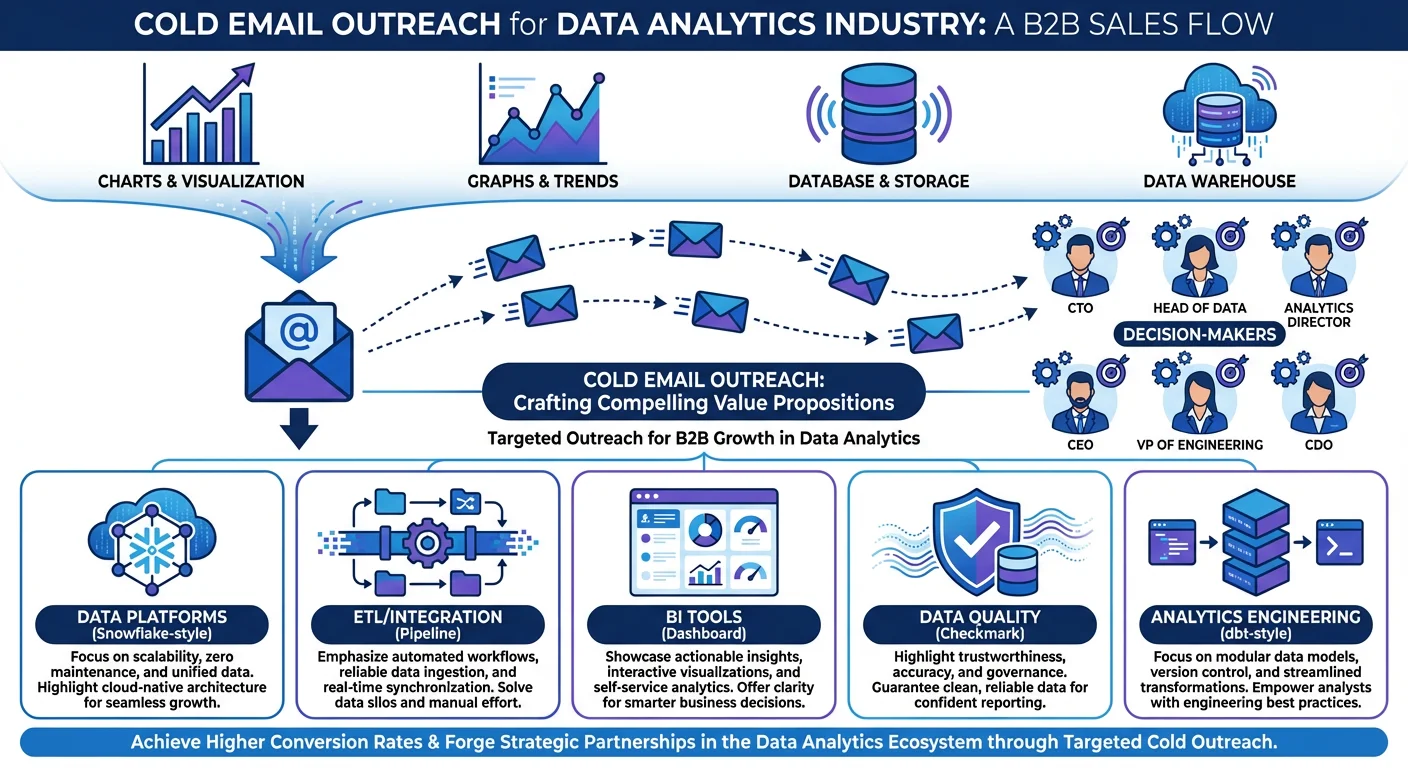
Cold email for data analytics requires targeting multiple decision-makers (from CDOs focused on strategy to data engineers managing infrastructure) with messaging that addresses their specific technical challenges. Success depends on using accurate modern data stack terminology, referencing specific tools like dbt or Snowflake, and timing outreach around budget cycles, tool evaluations, or data team growth. The data analytics buyer landscape spans five distinct segments: data platform providers, ETL/ELT vendors, BI tool companies, data quality solutions, and analytics engineering platforms.
Key takeaways
- The data analytics market divides into five distinct segments: data platform providers, ETL/ELT tools, business intelligence platforms, data quality solutions, and analytics engineering tools, each with different buying behaviors.
- Purchasing decisions involve multiple stakeholders including Chief Data Officers focused on strategy, Heads of Data Engineering concerned with infrastructure reliability, Analytics Engineering Managers handling transformation workflows, BI Managers prioritizing governance, and Data Analysts needing data access.
- Effective outreach requires using accurate modern data stack terminology, referencing specific tools and metrics, acknowledging data complexity, and demonstrating knowledge of the tool ecosystem.
- Optimal timing aligns with budget cycles, tool evaluation periods, data team growth, conference schedules, and the launch of new data initiatives.
- Common mistakes include generic messaging that ignores the modern data stack, overlooking data governance requirements, neglecting tool integration needs, focusing only on technical users, and understating implementation complexity.
Reviewed and updated August 28, 2026
Cold Email for Data Analytics: The Complete Guide
Data analytics has become essential to business operations across every industry. Organizations are building modern data stacks, implementing business intelligence solutions, and transforming raw data into actionable insights. The explosion of data volume and the democratization of analytics tools have created unprecedented demand for data infrastructure and expertise.
This growth creates substantial opportunities for vendors serving the data analytics ecosystem. Whether you offer data warehousing, ETL/ELT tools, visualization platforms, or consulting services, cold email can help you reach decision-makers who are actively building their data capabilities.
Choosing the right segment-specific approach comes down to matching technical language and timing to the niche, which outreach strategies for blockchain vendors covers for DeFi, exchanges, and enterprise chains.
However, the data analytics market presents unique challenges. Buyers range from highly technical data engineers to business analysts focused on insights. The modern data stack has fragmented into many specialized tools, and buyers must navigate complex architectural decisions. Breaking through requires targeted strategies that address specific data challenges.
Since buyer personas and technical fluency shift so much by vertical, teams selling into mobile-first companies may find the mobile app outreach strategies useful for platform-specific messaging.
This guide covers everything you need to know about cold emailing data analytics companies effectively.
Understanding the Data Analytics Market
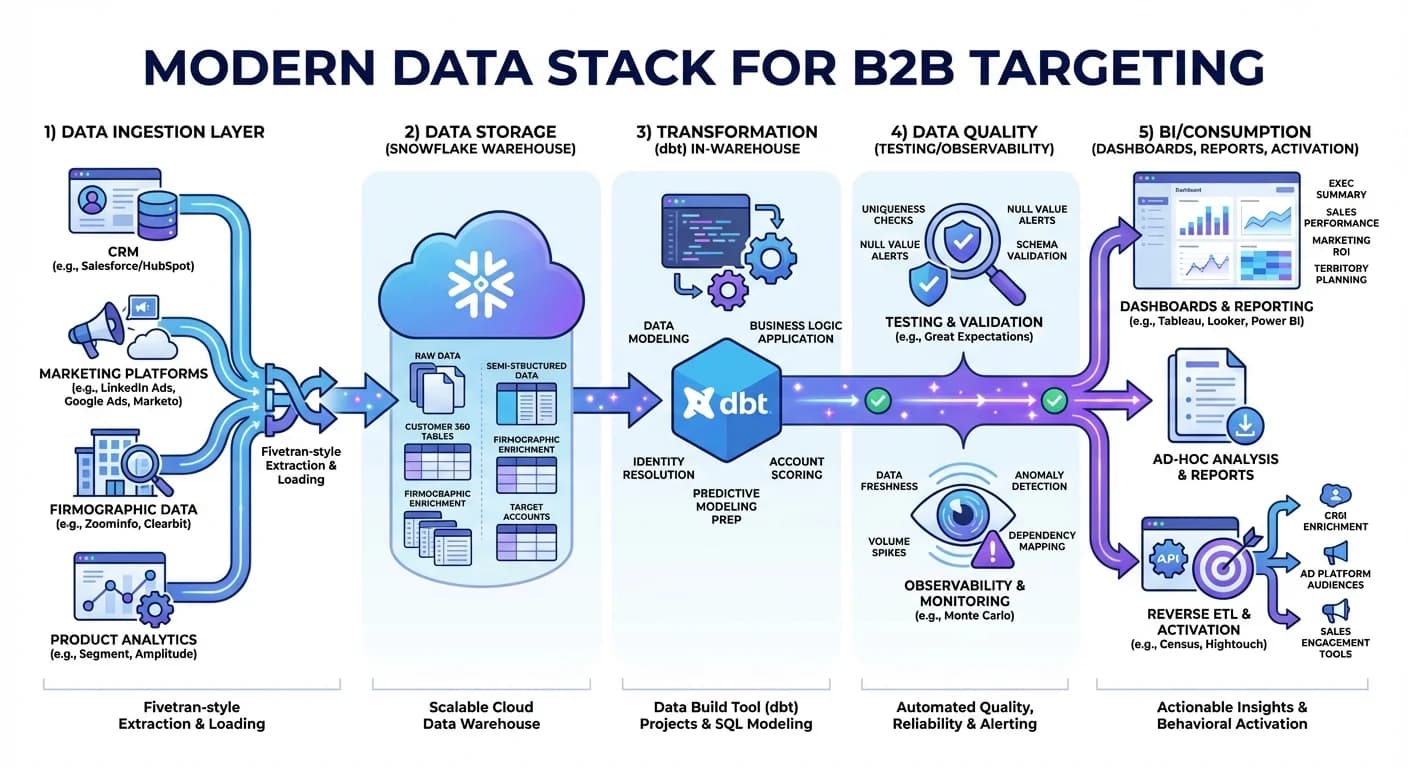
The data analytics industry encompasses distinct segments with different needs and buying behaviors.
Data Platform Providers
Platform providers build the infrastructure for data storage, processing, and analytics. They include cloud data warehouses, data lakes, and unified analytics platforms.
These organizations focus on performance, scalability, and ecosystem integration. They evaluate partners and tools based on how they enhance their platform value.
ETL/ELT and Data Integration
Data integration providers move and transform data between systems. They include traditional ETL tools, modern ELT platforms, and reverse ETL solutions.
These organizations prioritize connector coverage, transformation capabilities, and operational reliability. They serve data engineering teams building data pipelines.
Business Intelligence and Visualization
BI providers enable data exploration and visualization. They include enterprise BI platforms, self-service analytics tools, and embedded analytics solutions.
These organizations focus on user experience, governance capabilities, and enterprise features. They serve both technical and business users.
Data Quality and Observability
Data quality and observability providers help organizations trust and monitor their data. They include data quality platforms, data catalogs, and pipeline monitoring tools.
These organizations focus on data reliability, automated testing, and operational visibility. They serve data teams focused on data trust.
Analytics Engineering and Transformation
Analytics engineering tools support data transformation and modeling. They include transformation frameworks, metrics layers, and semantic modeling platforms.
These organizations focus on developer experience, collaboration features, and workflow integration. They serve analytics engineers and data teams.
Key Decision Makers in Data Analytics
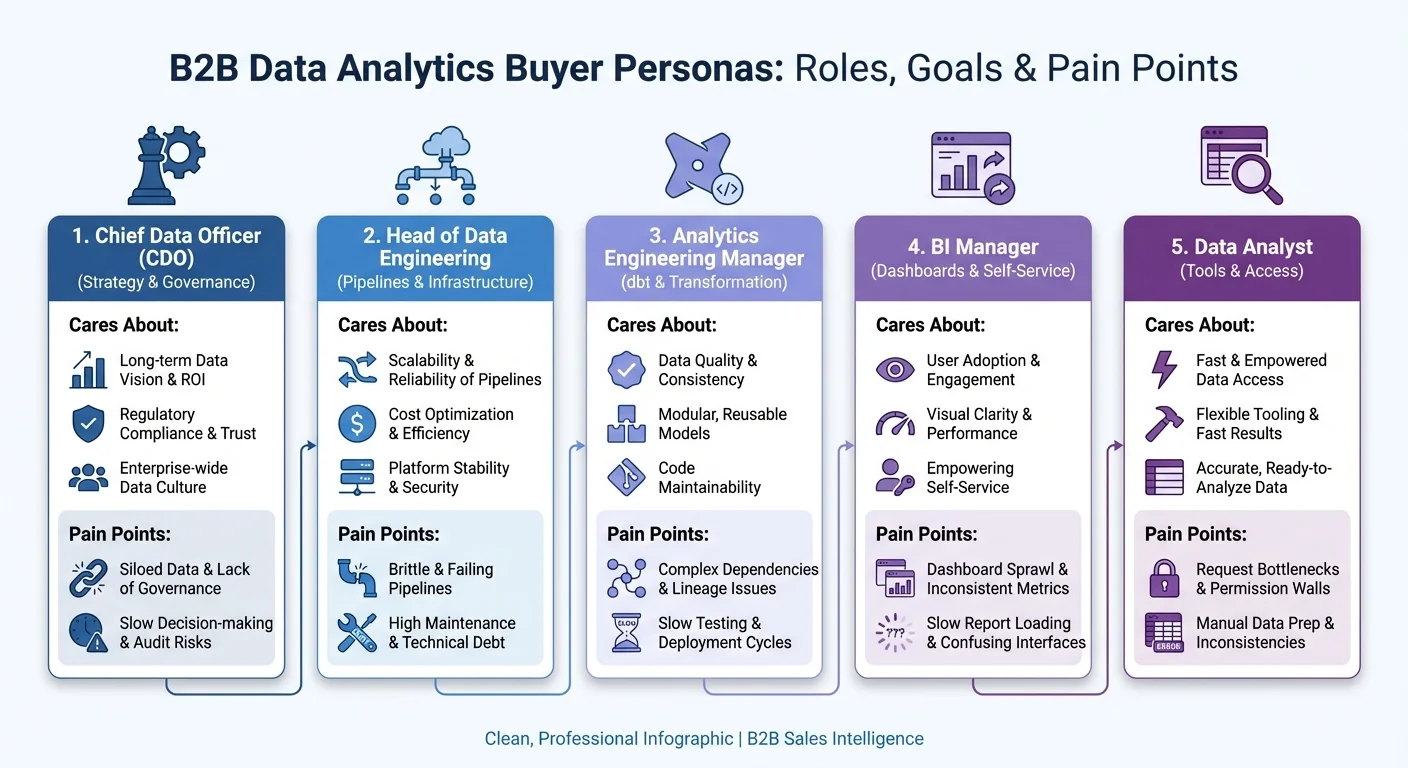
Data analytics purchasing decisions involve multiple stakeholders with different priorities.
Chief Data Officer (CDO) or VP of Data
What they care about: Data strategy, organizational data capabilities, governance, and business impact of data initiatives.
Pain points: Data silos, governance complexity, demonstrating data ROI, and organizational alignment.
Trigger events: Strategic planning cycles, organizational restructuring, and data-driven initiatives.
Email angle: Focus on strategic outcomes and organizational data capabilities. Connect technical solutions to business objectives.
Head of Data Engineering or Director of Data Platform
What they care about: Infrastructure reliability, pipeline performance, data quality, team productivity, and technology selection.
Pain points: Pipeline failures, data freshness issues, infrastructure costs, technical debt, and tool sprawl.
Trigger events: Infrastructure incidents, scaling challenges, team growth, and technology evaluations.
Email angle: Address infrastructure and engineering challenges. Quantify improvements to reliability, performance, or team productivity.
Analytics Engineering Manager
What they care about: Transformation workflows, modeling best practices, collaboration, and business stakeholder relationships.
Pain points: Transformation complexity, documentation challenges, stakeholder alignment, and workflow friction.
Trigger events: Analytics modernization, dbt adoption, metrics standardization, and team scaling.
Email angle: Focus on analytics engineering workflow improvements. Emphasize collaboration and modeling capabilities.
Director of Business Intelligence or BI Manager
What they care about: Report quality, self-service capabilities, governance, user adoption, and business stakeholder satisfaction.
Pain points: Report backlog, data trust issues, governance complexity, and adoption challenges.
Trigger events: BI platform evaluations, self-service initiatives, and governance requirements.
Email angle: Address BI workflow and governance challenges. Emphasize self-service capabilities and business impact.
Data Analyst or Analytics Lead
What they care about: Data access, analysis tools, insight quality, and stakeholder communication.
Pain points: Data access delays, tool limitations, context gaps, and report development time.
Trigger events: New analysis requirements, tool evaluations, and workflow pain points.
Email angle: Lead with analyst productivity and insight quality. Offer resources like documentation and trials.
CTO or VP of Engineering
What they care about: Technical architecture, system reliability, engineering velocity, and technology strategy.
Pain points: Data infrastructure complexity, integration challenges, and technology evaluation.
Trigger events: Architecture reviews, strategic planning, and technology refresh cycles.
Email angle: Focus on engineering and architectural considerations. Emphasize system reliability and integration capabilities.
Technical Considerations in Data Analytics
Data analytics buyers are technically sophisticated. Your outreach must demonstrate genuine understanding of data challenges.
The Modern Data Stack
Understanding modern data architecture helps you position your solution appropriately.
Data ingestion: Extracting data from source systems and loading into analytical environments.
Data storage: Cloud data warehouses (Snowflake, BigQuery, Redshift) and data lakes for storing analytical data.
Data transformation: SQL-based transformation tools and frameworks for modeling data.
Data quality: Testing, monitoring, and observability for data pipelines.
Data consumption: BI tools, dashboards, and applications that surface insights.
Reference relevant stack components when reaching out to accounts with specific architectural contexts.
Data Warehousing and Storage
Data storage decisions drive many purchasing choices.
Cloud data warehouses: Snowflake, BigQuery, Redshift, and Databricks offer different capabilities and pricing models.
Data lakes: Object storage combined with query engines for flexible, cost-effective storage.
Data lakehouses: Architectures combining warehouse and lake capabilities.
Understanding your prospect's storage strategy helps you position your solution appropriately.
Data Integration Patterns
Data integration approaches have evolved significantly.
ETL (Extract, Transform, Load): Traditional pattern with transformation before loading.
ELT (Extract, Load, Transform): Modern pattern leveraging warehouse compute for transformation.
Reverse ETL: Syncing warehouse data back to operational systems.
Change data capture (CDC): Real-time data replication from source systems.
Reference relevant integration patterns when reaching out to data engineering teams.
Data Governance and Quality
Governance considerations increasingly influence purchasing decisions.
Data quality: Accuracy, completeness, consistency, and timeliness of data.
Data lineage: Understanding data origins and transformations.
Access control: Managing who can access which data.
Compliance: Meeting regulatory requirements for data handling.
Governance capabilities are particularly important for enterprise deployments.
Industry Applications of Data Analytics
Different industries apply data analytics for different use cases. Tailoring your messaging to specific applications improves response rates.
Financial Services Analytics
Applications include risk analytics, customer analytics, fraud detection, and regulatory reporting.
Key concerns center on data security, regulatory compliance, and real-time capabilities.
Messaging angle:
"Financial services teams building analytics infrastructure need [specific capability] to meet regulatory requirements. We help organizations achieve [specific outcome] while maintaining compliance."
Healthcare Analytics
Applications include clinical analytics, operational efficiency, population health, and revenue cycle analytics.
Key concerns include HIPAA compliance, data integration from disparate systems, and clinical validation.
Messaging angle:
"Healthcare organizations building analytics capabilities need [specific capability] to integrate data across clinical systems. We help healthcare teams achieve [specific outcome] while maintaining HIPAA compliance."
Retail and E-commerce Analytics
Applications include customer analytics, inventory optimization, pricing analytics, and marketing attribution.
Key concerns center on customer data integration, real-time analytics, and actionable insights.
Messaging angle:
"Retail analytics teams need [specific capability] to unify customer data across channels. We help e-commerce organizations achieve [specific outcome] while improving marketing effectiveness."
SaaS and Product Analytics
Applications include product usage analytics, customer health, feature adoption, and retention analysis.
Key concerns include event data collection, user journey analysis, and self-service capabilities.
Messaging angle:
"SaaS companies building product analytics need [specific capability] to understand user behavior at scale. We help product teams achieve [specific outcome] while maintaining data freshness."
Marketing Analytics
Applications include attribution modeling, campaign analytics, customer segmentation, and marketing mix optimization.
Key concerns center on multi-touch attribution, data integration from marketing platforms, and privacy compliance.
Messaging angle:
"Marketing analytics teams need [specific capability] to measure campaign effectiveness across channels. We help marketing organizations achieve [specific outcome] while handling attribution complexity."
Building Credibility in Data Analytics Outreach
Data analytics professionals evaluate vendors carefully. Building credibility requires demonstrating genuine data understanding.
Use Accurate Terminology
Data analytics has specific terminology. Using terms correctly signals expertise.
Correct usage examples:
- "Data modeling" and "dimensional modeling" rather than vague "data organization"
- "DAG" (directed acyclic graph) for pipeline dependencies
- "dbt" for transformation frameworks
- "Medallion architecture" for data lake patterns
- Specific tool names (Snowflake, Fivetran, dbt) rather than generic descriptions
Incorrect terminology immediately signals unfamiliarity with the field.
Reference Specific Metrics
Data analytics professionals measure success with specific metrics. Reference relevant metrics in your outreach.
Data quality metrics: Freshness, completeness, accuracy, consistency.
Pipeline metrics: Run success rate, execution time, data latency.
Business metrics: Time to insight, self-service adoption, report usage.
Cost metrics: Compute costs, storage costs, query costs.
Including specific metrics demonstrates understanding of how data teams measure success.
Acknowledge Data Complexity
Data environments involve significant complexity. Acknowledging nuances builds credibility.
Example:
"Enterprise data environments typically involve hundreds of data sources with complex dependencies. Our platform handles incremental synchronization and schema evolution without manual intervention."
This demonstrates understanding that real-world data environments are complex.
Demonstrate Tool Ecosystem Knowledge
The modern data stack involves many interconnected tools. Show understanding of the ecosystem.
Example:
"Native integration with Snowflake, BigQuery, and Redshift. Works alongside your existing dbt models and orchestrators like Airflow or Dagster."
Ecosystem awareness builds credibility with data teams using modern approaches.
Timing Your Outreach
Several factors affect timing in the data analytics industry.
Budget and Planning Cycles
Enterprise data initiatives typically follow annual budget cycles. Reaching decision-makers during planning periods (Q3-Q4) positions you for consideration in upcoming budgets.
Data platform investments often align with broader digital transformation or data strategy initiatives.
Tool Evaluation Cycles
Data teams regularly evaluate new tools as the ecosystem evolves. Organizations approaching contract renewals or experiencing pain with current tools are more receptive.
Data Team Growth
Hiring activity often signals investment in data capabilities. Companies adding data engineers, analytics engineers, or BI developers are likely investing in infrastructure.
Conference and Event Timing
Major data events create natural conversation opportunities.
Relevant events:
- Snowflake Summit
- dbt Coalesce
- Data Council
- Industry-specific data events
Reaching out before or after events with relevant context improves engagement.
Data Initiative Timing
Organizations launching data initiatives (data mesh, self-service analytics, data governance) have concentrated purchasing activity. Identifying accounts in active initiatives creates timely outreach opportunities.
Email Templates for Data Analytics
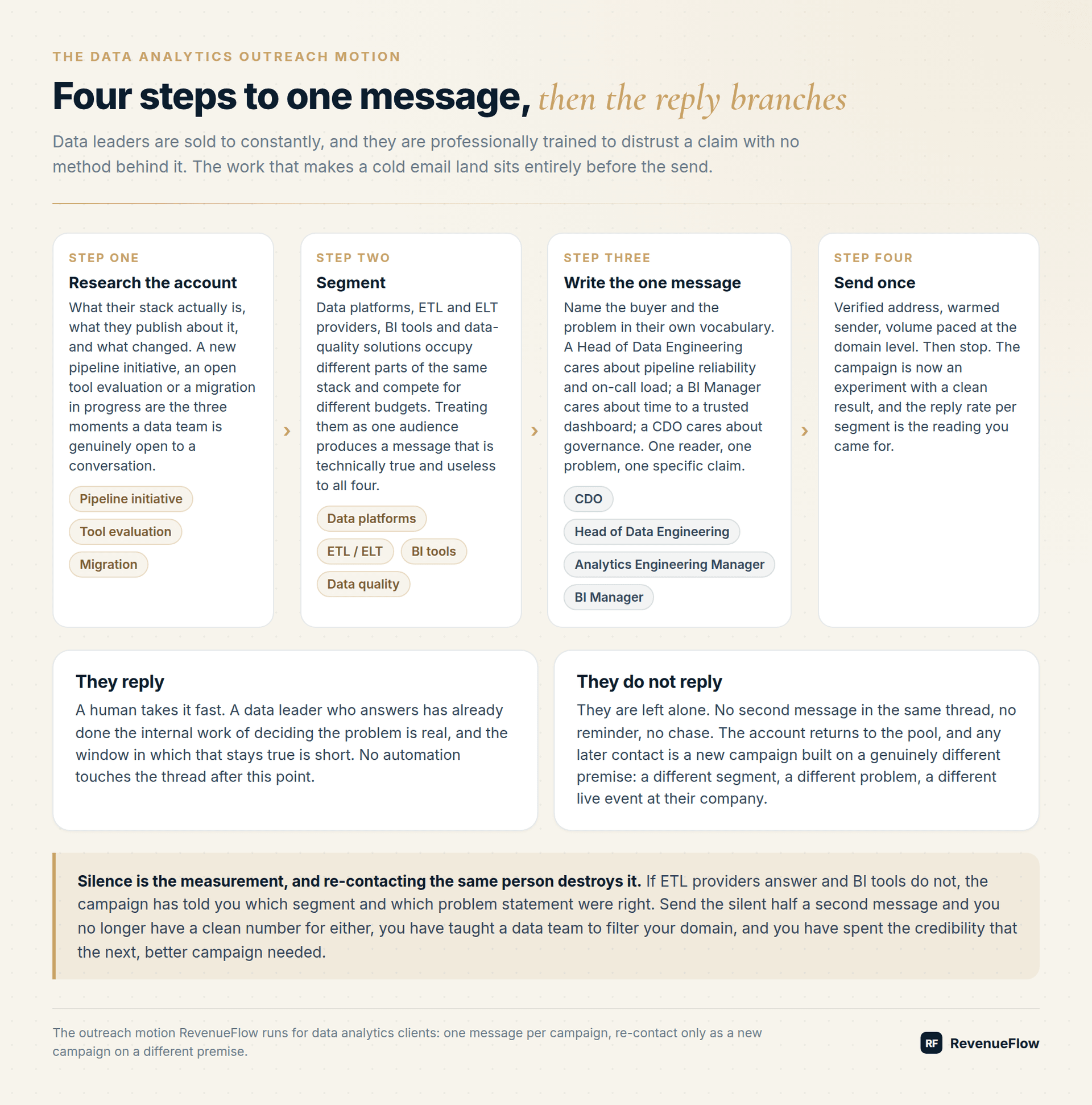
Here are templates adapted for different data analytics scenarios.
Template 1: Data Engineering Outreach
Subject: Data pipeline reliability at [Company]
Body:
[First Name],
Quick question: how is [Company] currently handling [specific challenge, e.g., pipeline monitoring, data quality testing, schema change management]?
We work with data engineering teams to improve [specific metric, e.g., pipeline reliability, data freshness, time spent on maintenance].
Data teams using our platform typically see [specific outcome, e.g., 80% reduction in pipeline incidents, 3x faster issue detection].
Worth a brief conversation to see if this applies to your data infrastructure?
[Your name]
Template 2: Analytics Engineering Outreach
Subject: Analytics workflow at [Company]
Body:
[First Name],
Analytics engineering teams typically spend significant time on [specific challenge, e.g., model documentation, testing coverage, metric definitions].
We help analytics engineers [specific capability] while maintaining dbt workflow integration.
Currently supporting [X] teams running [scale indicator, e.g., thousands of dbt models].
Happy to provide documentation and a trial environment before any call.
[Your name]
Template 3: BI and Self-Service Outreach
Subject: Self-service analytics at [Company]
Body:
[First Name],
Noticed [Company] is [expanding analytics capabilities / growing data team] based on [specific observation].
Organizations scaling self-service analytics typically face challenges with [specific challenge, e.g., data governance, semantic layer consistency, business user adoption].
We help BI teams address this with [specific capability]. Currently deployed at [X] organizations in [relevant industry].
Would it be useful to share how similar teams have approached this?
[Your name]
Template 4: Data Quality Outreach
Subject: Data quality at [Company]
Body:
[First Name],
Data teams often discover quality issues only when business users report problems. By then, trust is already damaged.
We help data teams implement automated data quality monitoring across their warehouse environment.
Organizations using our platform typically catch [percentage] of data issues before they impact dashboards.
Is data quality monitoring a priority for your team?
[Your name]
Template 5: Data Platform Modernization Outreach
Subject: Data platform at [Company]
Body:
[First Name],
Organizations modernizing their data platform typically face challenges with [specific challenge, e.g., legacy system migration, real-time capabilities, cost optimization].
We help teams [specific capability] while maintaining business continuity.
Currently supporting [X] organizations through their data platform modernization.
Worth exploring if data platform evolution is on your roadmap?
[Your name]
Common Mistakes to Avoid
Mistake 1: Generic Data Messaging
Data analytics encompasses diverse technologies and use cases. Generic messaging fails to resonate.
Weak:
"Our solution helps with data analytics."
Strong:
"Our platform monitors dbt model execution and alerts on freshness SLA violations across your Snowflake warehouse."
Specificity about tools, architectures, and use cases demonstrates expertise.
Mistake 2: Ignoring the Modern Data Stack
The data landscape has evolved significantly. Messaging focused on legacy approaches misses modern data teams.
Reference modern tools, approaches, and architectural patterns relevant to your target accounts.
Mistake 3: Overlooking Data Governance
Governance requirements increasingly influence purchasing decisions. Ignoring governance limits enterprise relevance.
Address data quality, lineage, access control, and compliance capabilities when relevant.
Mistake 4: Neglecting Tool Integration
Data teams use many interconnected tools. Solutions that require replacing existing tools face adoption barriers.
Weak:
"Replace your existing data tools with our comprehensive platform."
Strong:
"Works alongside your existing dbt models, Snowflake warehouse, and orchestrator. No workflow changes required."
Emphasize integration with existing tools rather than replacement.
Mistake 5: Focusing Only on Technical Users
Data initiatives involve both technical and business stakeholders. Purely technical messaging misses broader organizational context.
Connect technical capabilities to business outcomes that matter to non-technical stakeholders.
Mistake 6: Understating Implementation Complexity
Enterprise data environments are complex. Overpromising simplicity damages credibility.
Be realistic about implementation timelines and requirements.
Building a Data Analytics Cold Email Program
List Building
Quality targeting matters in the specialized data analytics market.
Focus on:
- Organizations with visible data investments (job postings, blog posts, conference activity)
- Companies in target industries building data capabilities
- Decision-makers at appropriate levels for your solution
- Accounts with observable growth signals or challenges
Segmentation Approaches
Effective segmentation improves response rates.
By data stack component:
- Data warehousing and storage
- Data integration and pipelines
- Transformation and modeling
- BI and visualization
- Data quality and observability
By organization type:
- Data platform providers
- Enterprise data teams
- Agencies and consultancies
By data maturity:
- Early data infrastructure
- Modern data stack adopters
- Advanced data organizations
By industry:
- Financial services
- Healthcare
- Retail and e-commerce
- SaaS and technology
Where we differ from standard practice
Much of the advice on this page reflects how outbound is commonly run. We run it differently, and since this page sits on our site it is worth saying where the difference is and what it costs us.
- A sequence of messages to each prospect over several weeks
- Later messages often land in the same email thread
- Every contact is reached more than once, so a distracted reader gets another chance
- The later messages go only to people who did not answer the first
- Reputation cost accrues on the sending domain across everything else it sends
- One message, then that campaign is finished for that contact
- No thread replies and no bumps
- A non-responding audience becomes a new campaign with a genuinely different premise, not a reminder
- More of the work moves into targeting and into the one message
- We reach each contact less often, and that is the cost we accept
The reasoning is mechanical rather than moral. A follow-up arrives underneath a message the recipient has already seen and chosen not to answer, so it is delivered to the population most likely to mark it as spam, and the reputation cost of that lands on the sending domain across every campaign running on it. We set that cost against the replies a sequence recovers and decided the trade was not worth it. The full argument, with the numbers from our own campaigns, is in why we stopped using follow-ups.
Follow-Up Strategy
Data professionals are busy managing complex environments. Most programmes plan four to six touches spaced five to seven business days apart. We send one message per campaign and put that effort into targeting and into the first message instead.
Where that effort goes:
- Share relevant technical content or best practices
- Reference industry developments or tool announcements
- Provide useful information about their specific challenges
- Keep the message concise and focused
When a non-responding list is worth another approach, it becomes a new campaign with its own premise rather than a second message under the first.
Measurement and Optimization
Track metrics to improve your program over time.
Key metrics:
- Open rates by segment and data role
- Reply rates by organization type and maturity level
- Meeting conversion rates
- Pipeline progression from cold outreach
- Deal size and close rates by source
Use data to refine targeting, messaging, and timing continuously.
Building Long-Term Relationships in Data Analytics
The data analytics industry values technical contribution and community involvement.
Contribute Technical Content
Publishing useful technical content, tutorials, or benchmarks builds credibility. Share content that helps data teams solve real problems.
Engage with Data Communities
Data communities are active on forums, Slack groups, and social media. Participating thoughtfully builds visibility and credibility.
Contribute to Open Source
Many data tools and frameworks are open source. Contributing to relevant projects builds visibility and credibility.
Participate in Data Events
Data conferences and meetups create networking opportunities. Building relationships at events makes subsequent outreach more effective.
Share Industry Research
Publishing research on data trends, benchmarks, or best practices positions you as a thought leader in the space.
Summary
Cold emailing the data analytics industry requires genuine understanding of data technology, architecture, and current challenges.
Success depends on:
- Understanding the market including data platforms, integration tools, BI providers, and data quality solutions
- Targeting the right decision-makers with role-appropriate messaging
- Demonstrating technical credibility through modern data stack knowledge and relevant metrics
- Tailoring to industry applications with use-case-specific messaging
- Timing outreach around budget cycles, events, and data initiatives
- Avoiding common mistakes like generic messaging and ignoring tool integration
- Building for the long term through community engagement and technical contribution
The data analytics market continues to grow as organizations invest in data infrastructure and capabilities. Vendors who demonstrate genuine expertise and provide real value will succeed in reaching decision-makers at data organizations.
Related Reading
- Cold Email for UI/UX: The Complete Guide
- Cold Email for SaaS Companies: The Complete Guide to B2B Outreach
If you would rather have this run for you, RevenueFlow books qualified meetings on a pay-per-meeting basis and publishes client results.
Frequently asked questions.
Frequently asked questions- Who are the key decision-makers for data analytics purchases?
- Data analytics purchases involve multiple stakeholders with different priorities. Chief Data Officers focus on strategy and governance, Heads of Data Engineering prioritize infrastructure reliability and team productivity, Analytics Engineering Managers care about transformation workflows and collaboration, BI Managers emphasize self-service capabilities and governance, and Data Analysts need efficient data access and analysis tools. Effective outreach requires tailoring messaging to each role's specific pain points and trigger events.
- What are the main segments in the data analytics industry?
- The data analytics industry encompasses five distinct segments. Data platform providers build infrastructure for storage and processing, ETL/ELT vendors handle data integration and transformation, business intelligence companies enable visualization and exploration, data quality providers ensure trust and monitoring, and analytics engineering tools support transformation and modeling. Each segment has different needs, with platform providers focused on ecosystem integration, BI vendors prioritizing user experience, and data quality solutions emphasizing reliability.
- When is the best time to send cold emails to data analytics companies?
- Optimal timing for data analytics outreach aligns with several key cycles. Budget and planning cycles drive purchasing decisions, tool evaluation periods indicate active buying intent, and data team growth signals infrastructure expansion needs. Conference and event timing creates engagement opportunities when prospects are researching solutions. Data initiative timing, such as analytics modernization or dbt adoption, represents trigger events when organizations actively seek new tools and partners.
- What mistakes should I avoid when cold emailing data analytics companies?
- The most critical mistakes include using generic data messaging instead of segment-specific language, ignoring modern data stack terminology and tools, overlooking data governance requirements that are essential to buyers, neglecting tool integration needs in a fragmented ecosystem, focusing only on technical users while missing business stakeholders, and understating implementation complexity. Success requires accurate technical terminology, acknowledgment of data challenges, and messaging tailored to specific roles and segments.
About the author.

Fernando Cao is CEO at RevenueFlow, which builds and operates outbound revenue engines for B2B companies. Previously at Accenture Strategy. Studied at University of Bath.
Fernando Cao · CEO
Connect on LinkedIn →Explore more.
Ready to scale your outreach?
We build GTM engines that book real meetings. See the receipts.
Related articles.
Cold Email for Maintenance Services: The Complete Guide
A comprehensive guide to cold email outreach for commercial maintenance companies, covering how to reach facility managers, property managers, and operations directors with messaging that wins preventive maintenance and repair contracts.
Cold Email for Staffing Agencies: The Complete Guide
A comprehensive guide to cold email outreach for staffing and temp agencies, covering how to reach HR directors, hiring managers, and operations leaders with messaging that wins temporary staffing, contract placement, and direct hire business.
Cold Email for Telecom: Reaching Carriers and MSPs
Telecom companies face rapid technology changes and competitive pressures. Here's how to approach cold email outreach to carriers, MSPs, and UCaaS providers.
Cold Email for Electronics Companies: The Complete Guide
A comprehensive guide to cold email outreach for electronics manufacturers, component suppliers, and EMS providers, covering buyer personas, OEM relationships, contract manufacturing, and proven strategies for reaching engineers, procurement managers, and supply chain leaders.
Cold Email for Security Services: The Complete Guide
A comprehensive guide to cold email outreach for security service providers, covering how to reach facility managers, corporate security directors, and property managers with messaging that builds trust and wins contracts.
Cold Email for Cloud Services: The Complete Guide
Learn how to effectively reach decision-makers at cloud service providers and enterprises adopting cloud infrastructure. This guide covers targeting strategies, technical credibility, and email templates for the cloud services industry.