Cold Email for Environmental Services: The Complete Guide
A comprehensive guide to cold email outreach for environmental services companies, covering consulting, remediation, compliance, and sustainability services with strategies for reaching environmental managers and corporate sustainability executives.
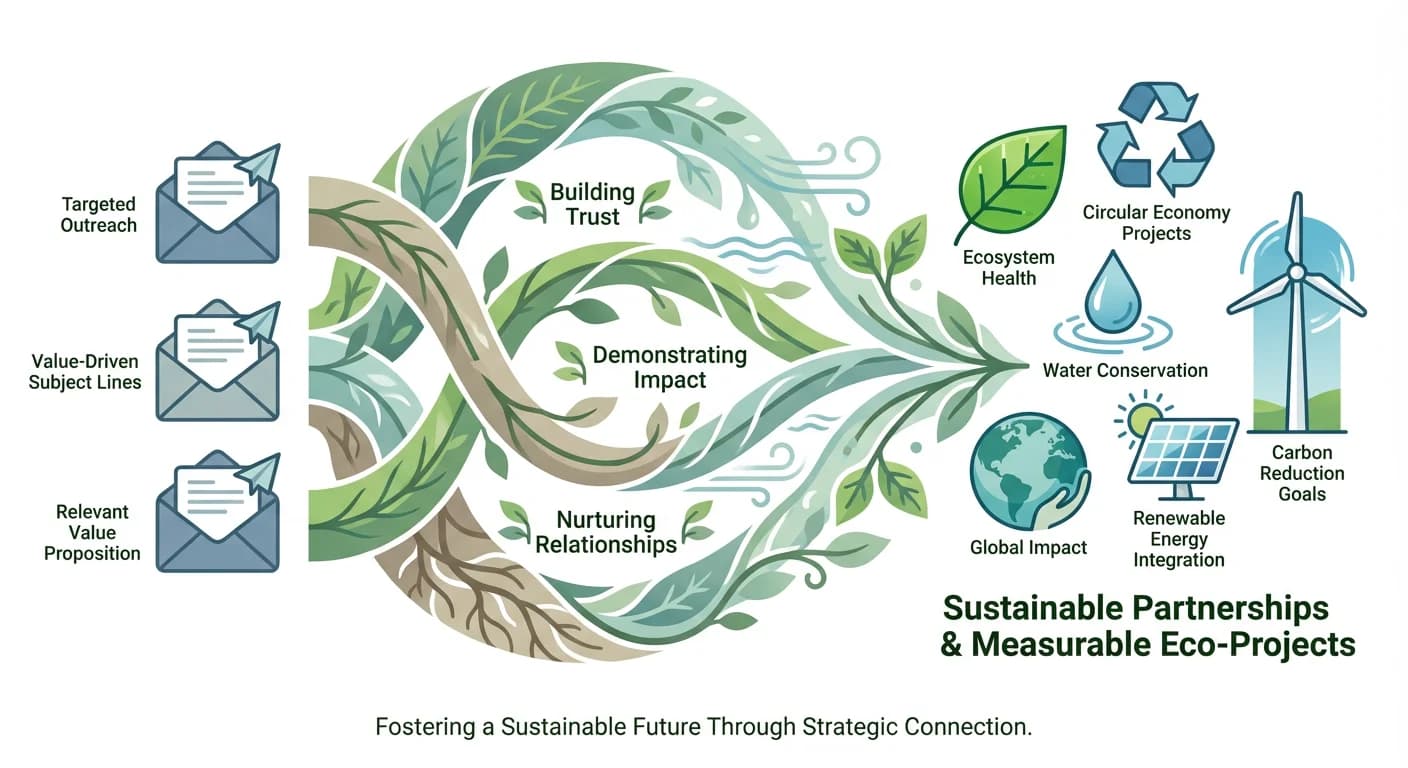
Cold email works effectively for environmental services because regulatory deadlines create urgent needs, corporate ESG commitments expand demand beyond traditional compliance, and decision-makers like EHS directors and sustainability officers are identifiable through professional networks. The key is targeting specific roles with technically credible messaging that demonstrates regulatory expertise and aligns outreach with compliance cycles and reporting deadlines when environmental challenges become pressing business priorities.
Key takeaways
- Environmental services buyers include four distinct personas: EHS directors who manage compliance, sustainability officers who lead ESG strategy, facility managers who handle operations, and real estate professionals who need due diligence for transactions.
- Regulatory drivers and compliance deadlines create specific timeframes when organizations must urgently engage environmental service providers, making timing crucial for outreach effectiveness.
- Corporate ESG reporting requirements have expanded the environmental services market beyond traditional compliance work, creating opportunities with organizations new to sustainability programs.
- Five primary challenges affect environmental services cold email: technical complexity, trust and liability concerns, distinguishing emergency from planned work, budget constraints, and established consultant relationships.
- Decision-making authority varies by role, with EHS directors controlling compliance contracts, sustainability officers influencing organization-wide procurement, and facility managers authorized for routine services only.
Reviewed and updated September 15, 2026
Cold Email for Environmental Services: The Complete Guide
The environmental services industry has experienced substantial growth as regulatory requirements expand, corporate sustainability commitments increase, and organizations recognize the business value of environmental performance. From remediation contractors to sustainability consultants, environmental service providers operate in a market where expertise, regulatory knowledge, and track record determine success.
Cold email has proven effective for environmental services business development. While the industry maintains strong networks through professional associations and regulatory relationships, proactive outreach allows firms to reach decision-makers facing environmental challenges who may not be actively seeking solutions through traditional channels.
This guide provides a comprehensive framework for implementing cold email campaigns that generate qualified opportunities for environmental services companies.
Why Cold Email Works for Environmental Services
The environmental services industry's characteristics create favorable conditions for well-executed cold email outreach.
Regulatory drivers create urgency. Environmental compliance deadlines, permit requirements, and enforcement actions create specific timeframes when organizations must engage environmental service providers. Cold email reaches decision-makers when regulatory pressures make solutions urgent.
Corporate sustainability commitments expand the market. ESG (Environmental, Social, Governance) reporting requirements and voluntary sustainability commitments have created demand for environmental services beyond traditional compliance work. Many organizations are new to this market and actively seeking guidance.
Decision-makers are identifiable. Environmental managers, EHS directors, sustainability officers, and facility managers maintain professional profiles and contact information accessible through industry directories and professional networks.
Problems are specific and often urgent. Environmental contamination, permit violations, climate reporting requirements, and sustainability targets create defined needs that match specific service capabilities. Cold email allows precise targeting.
Traditional marketing reaches limited audiences. Environmental services marketing through trade publications and conferences reaches engaged professionals but misses decision-makers who face environmental challenges without actively seeking solutions.
Understanding Environmental Services Buyers
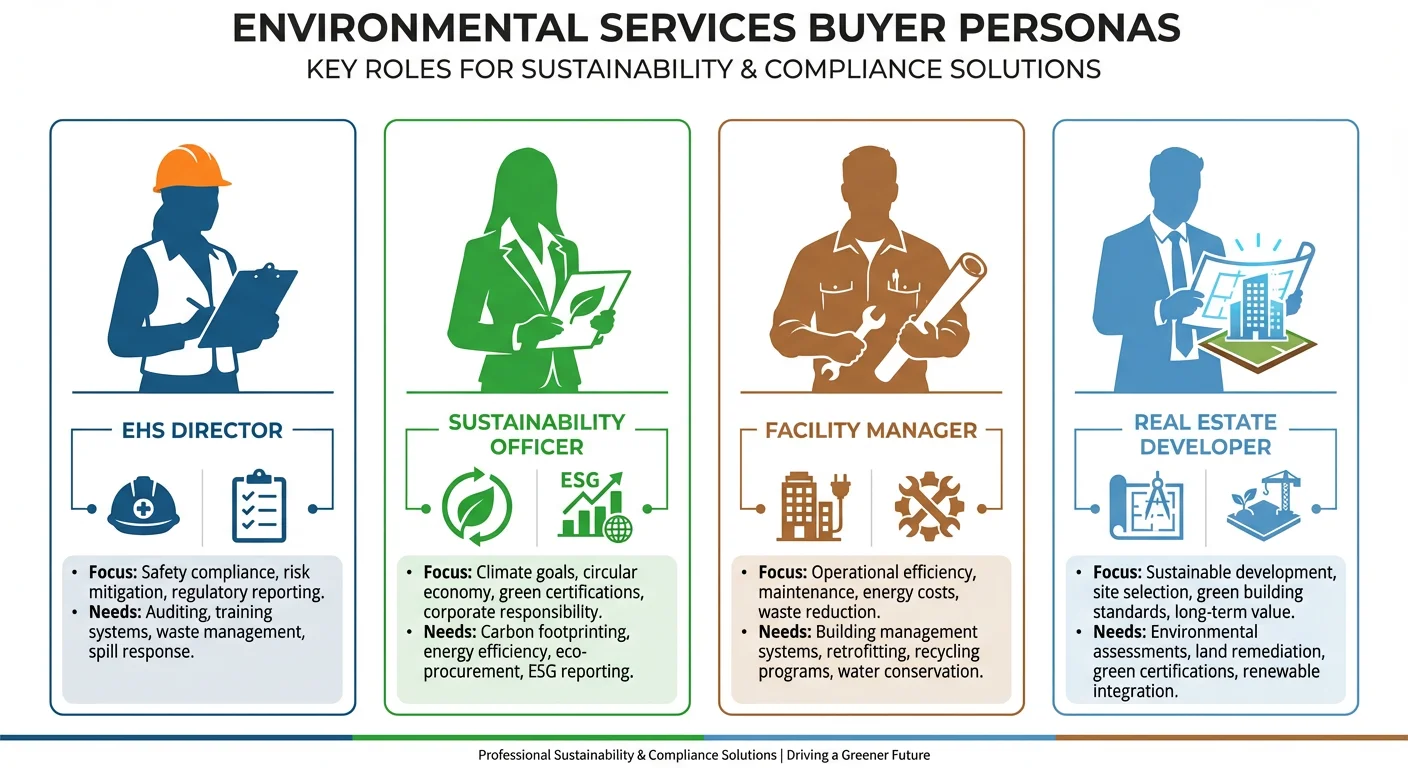
Effective cold email requires understanding the distinct roles, priorities, and decision-making patterns of environmental services buyers.
Environmental Health and Safety (EHS) Directors
EHS directors manage environmental compliance, health and safety programs, and regulatory relationships. They balance compliance requirements with operational efficiency and cost management.
What they value: Regulatory expertise, compliance track record, responsiveness to urgent needs, cost-effective solutions, and ability to navigate complex permitting processes.
Communication preferences: EHS directors appreciate communications that demonstrate regulatory knowledge and acknowledge the complexity of compliance management.
Decision-making patterns: EHS directors often have authority over compliance-related service contracts. Major remediation projects or capital investments typically require coordination with finance and executive leadership.
Sustainability Officers and ESG Leaders
Sustainability officers lead corporate environmental programs, ESG reporting, and climate strategy. They translate environmental commitments into operational initiatives and measurable outcomes.
What they value: Strategic thinking, measurement and reporting capabilities, industry benchmarking, stakeholder communication support, and alignment with recognized frameworks (GRI, SASB, TCFD, CDP).
Communication preferences: Sustainability leaders respond to communications that connect environmental services to business value and stakeholder expectations.
Decision-making patterns: Sustainability officers influence environmental services procurement across the organization and often lead vendor selection for sustainability-focused initiatives.
Facility Managers and Operations Leaders
Facility managers oversee site operations including environmental management responsibilities. They manage day-to-day environmental compliance while balancing operational priorities.
What they value: Practical solutions, responsive service, clear communication, and vendors who understand operational constraints.
Communication preferences: Facility managers appreciate straightforward communications that respect their time and offer specific solutions to identified problems.
Decision-making patterns: Facility managers have authority over routine environmental services (waste management, sampling, inspections) while larger projects require higher-level approval.
Real Estate and Development Professionals
Real estate developers, investors, and transaction professionals engage environmental services for due diligence, site assessment, and regulatory compliance related to property transactions and development.
What they value: Transaction timeline awareness, clear risk communication, defensible assessments, and responsive turnaround on deliverables.
Communication preferences: Real estate professionals appreciate communications that acknowledge transaction dynamics and demonstrate relevant experience.
Decision-making patterns: Environmental due diligence decisions often involve legal counsel, lenders, and investment committees, though initial vendor selection may rest with transaction leads.
Environmental Services Challenges in Cold Email Outreach
Cold email for environmental services faces unique obstacles that require thoughtful strategies.
Challenge 1: Technical Complexity and Regulatory Specificity
Environmental services require deep technical knowledge and understanding of complex regulatory frameworks that vary by jurisdiction, industry, and contaminant type.
Strategic response: Demonstrate technical credibility through specific expertise references rather than broad capability claims. Acknowledge regulatory complexity and jurisdictional variations.
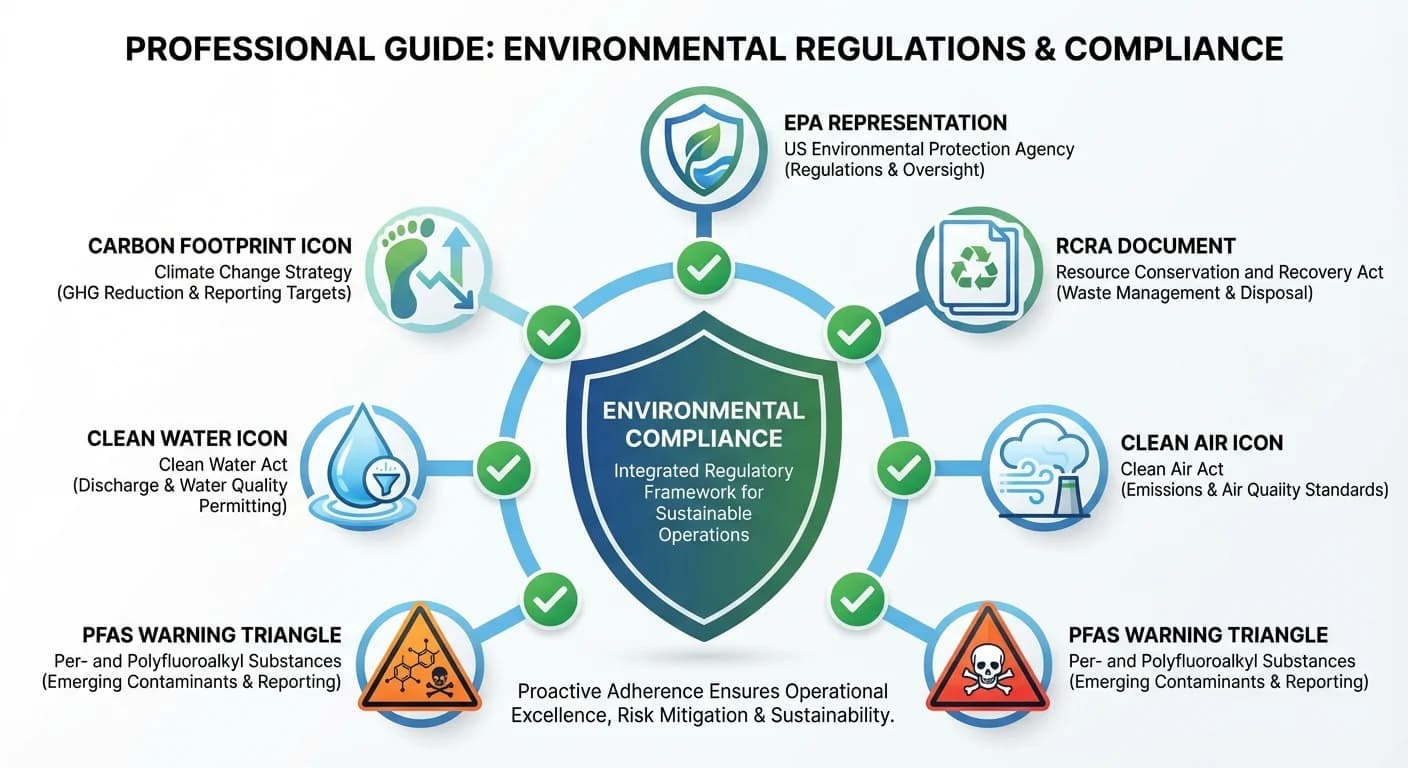
Practical application: Reference specific regulations (RCRA, CERCLA, Clean Air Act, Clean Water Act), state programs, or industry-specific requirements. Include professional credentials (PE, PG, CHMM) that establish technical qualification.
Challenge 2: Trust and Liability Considerations
Environmental services often involve significant liability exposure. Clients need confidence that service providers will deliver defensible work that protects them from regulatory penalties and third-party claims.
What drives trust: Professional certifications, insurance coverage, track record with similar projects, and references from similar clients.
Strategic response: Address liability concerns directly by highlighting credentials, insurance, and track record. Reference specific project types and client categories.
Practical application: Include professional licenses, insurance coverage, and relevant certifications in communications. Offer references or case studies that demonstrate successful outcomes.
Challenge 3: Emergency Response vs. Planned Work
Environmental services range from planned compliance programs to emergency response situations. Different buying scenarios require different outreach approaches.
Strategic response: Develop separate messaging for compliance/planning services and emergency response capabilities. Build awareness before emergencies occur while also being available when urgent needs arise.
Practical application: For planned work, focus on strategic value and cost management. For emergency services, emphasize response time, availability, and experience with similar incidents.
Challenge 4: Budget Constraints and Cost Sensitivity
Environmental work is often viewed as a cost center rather than a value driver. Budget constraints can delay needed work and create pressure on pricing.
Strategic response: Address cost concerns by emphasizing value, risk reduction, and potential cost of non-compliance. Where possible, quantify the business case for environmental investment.
Practical application: Include messaging about regulatory penalty avoidance, transaction facilitation, and operational efficiency improvement. Offer tiered service options where appropriate.
Challenge 5: Established Consultant Relationships
Many organizations maintain long-standing relationships with environmental consultants who have accumulated site history and institutional knowledge.
Strategic response: Position as a complement or specialized resource rather than complete replacement. Emphasize specific capabilities or capacity that existing relationships may not provide.
Practical application: Focus on specific capability gaps (specialized expertise, geographic coverage, surge capacity) that create opportunities for new consultant relationships.
Cold Email Best Practices for Environmental Services
Effective environmental services cold emails combine technical expertise with proven outreach principles.
Subject Lines That Get Opened
Environmental professionals receive numerous emails daily. Subject lines must immediately establish relevance and expertise.
Effective approaches:
- Reference specific regulatory requirements: "PFAS assessment capabilities for manufacturing facilities"
- Mention compliance deadlines: "2027 EPA reporting requirements for Scope 3 emissions"
- Highlight specialized expertise: "Vapor intrusion assessment for commercial transactions"
- Address industry-specific challenges: "Environmental due diligence for industrial acquisitions"
Approaches to avoid:
- Generic capability claims: "Comprehensive environmental solutions"
- Fear-based messaging: "Avoid regulatory penalties"
- Vague value propositions: "Environmental partnership opportunity"
- Questions that feel manipulative: "Are you prepared for the next inspection?"
Email Copy Structure
Environmental services cold emails should establish technical credibility, communicate specific capabilities, and provide clear engagement paths.
Opening statement: Reference a specific regulatory requirement, industry challenge, or environmental issue that establishes relevance to the recipient.
Credibility establishment: Within the first few sentences, establish why your company deserves attention. Include specific certifications, relevant project experience, and technical credentials.
Capability summary: Clearly state what you offer and why it matters to the recipient's environmental management responsibilities. Focus on outcomes (compliance assurance, risk reduction, transaction facilitation) rather than service descriptions.
Call to action: Request a specific, appropriate next step. For environmental services, this might be a capabilities overview, site discussion, or regulatory consultation.
Signature: Include professional licenses, certifications, and relevant credentials in your signature block.
Timing Considerations
Environmental services cold email timing should align with regulatory cycles, transaction patterns, and organizational planning.
Optimal timing:
- Before regulatory reporting deadlines
- During budget planning cycles
- When new regulations are announced
- Following industry incidents that raise awareness
- During active M&A cycles (for due diligence services)
Timing to avoid:
- Immediately following a recipient's environmental incident (appears opportunistic)
- During active enforcement actions without invitation
- During major site disruptions or operational crises
Sample Cold Emails for Environmental Services

The following examples demonstrate effective cold email approaches for different environmental services scenarios.
Example 1: Environmental Consulting Firm to EHS Director
Subject: PFAS assessment and remediation for manufacturing facilities
Body:
PFAS contamination has become a significant concern for manufacturing facilities, with evolving regulations creating compliance requirements and potential liability exposure.
[Your Company] provides PFAS site assessment, remediation design, and regulatory support for manufacturing clients. Our team includes professionals with direct experience navigating [state] PFAS regulations and working with [regulatory agency] on similar sites.
We recently completed PFAS characterization and remediation planning for [number] manufacturing facilities in [region], helping clients understand their exposure and develop cost-effective management strategies.
Would a brief discussion about PFAS regulatory requirements and assessment approaches be valuable for your facilities?
Best regards, [Name] [Credentials: PE, PG, CHMM, etc.] [Title] [Company]
Example 2: Sustainability Consultant to Chief Sustainability Officer
Subject: Scope 3 emissions measurement for [industry] companies
Body:
Many sustainability leaders I work with face challenges measuring Scope 3 emissions with the rigor that investors and rating agencies increasingly expect. Supply chain complexity and data availability create practical obstacles to accurate reporting.
[Your Company] specializes in Scope 3 emissions quantification for [industry] companies. We help clients develop measurement methodologies aligned with GHG Protocol standards and create supplier engagement programs that improve data quality over time.
Our approach has helped clients including [industry type] companies achieve CDP A-list recognition and satisfy institutional investor ESG requirements.
Would a conversation about Scope 3 measurement challenges and approaches be useful?
Best regards, [Name] [Title] [Company] [Relevant Certifications]
Example 3: Remediation Contractor to Real Estate Developer
Subject: Environmental due diligence for industrial property acquisitions
Body:
Industrial property transactions require environmental assessment that balances transaction timeline requirements with thorough risk evaluation. Incomplete due diligence can create post-acquisition liability exposure while excessive investigation delays closings.
[Your Company] provides Phase I and Phase II environmental site assessments tailored to transaction requirements. We specialize in industrial properties with recognized environmental concerns (former manufacturing, petroleum sites, dry cleaners) where targeted investigation efficiently characterizes risk.
Our average turnaround for Phase I assessments is [X] business days, and we have completed over [number] transaction-related assessments in [region].
Would it be helpful to discuss your current or upcoming transaction due diligence needs?
Best regards, [Name] [Credentials] [Title] [Company] [Insurance/Certification Information]
Example 4: Environmental Compliance Services to Facility Manager
Subject: Air permit compliance support for [facility type] operations
Body:
Managing air permit compliance requires ongoing attention to emission limits, monitoring requirements, and reporting deadlines. Many facilities struggle to maintain compliance programs while managing day-to-day operational priorities.
[Your Company] provides ongoing air compliance support including emission calculations, permit modification support, and regulatory reporting. We currently support [number] facilities with similar operations in [region].
Our approach combines regular compliance monitoring with responsive support when operational changes require permit evaluation.
Would a conversation about your facility's air compliance challenges be useful?
Best regards, [Name] [Title] [Company] [Relevant Certifications]
Building Your Environmental Services Cold Email Program
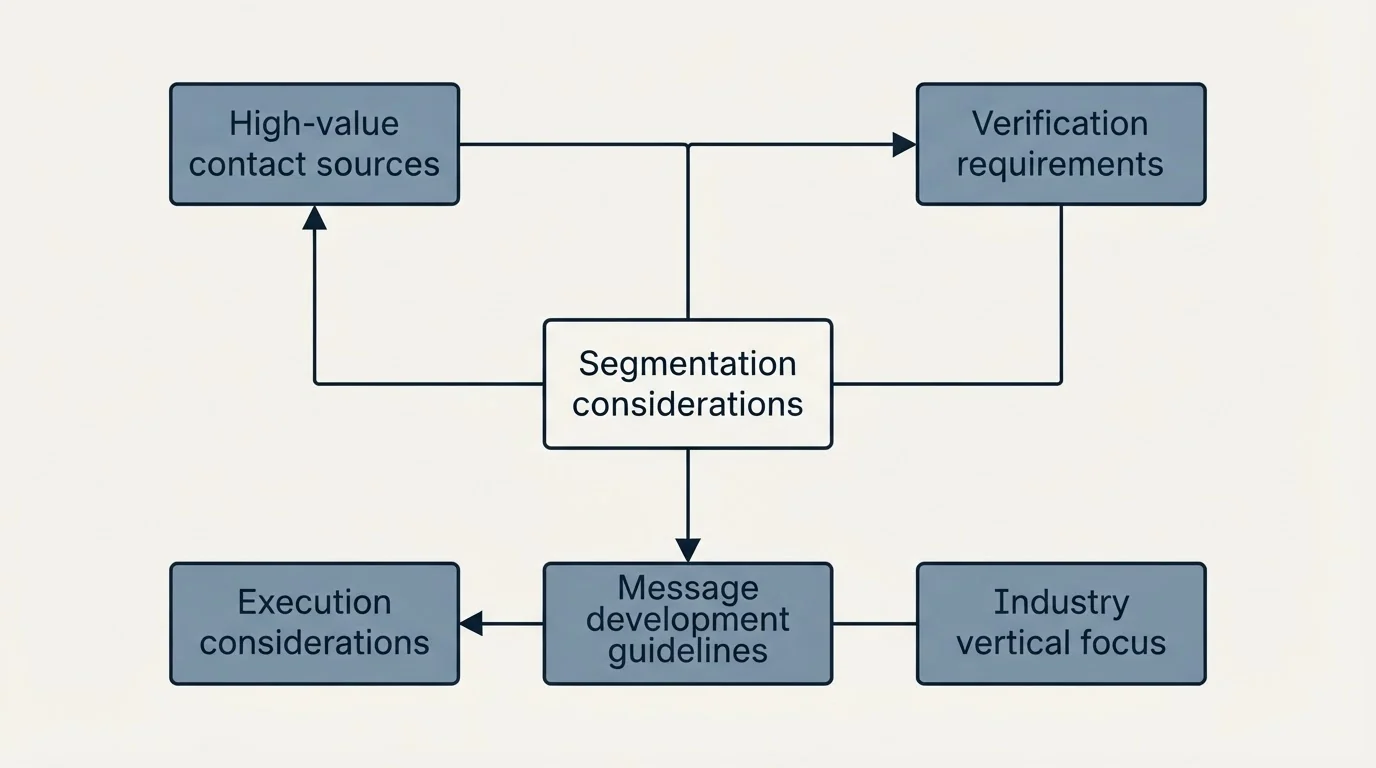
Implementing an effective environmental services cold email program requires systematic approach to targeting, messaging, and execution.
- Step 1Define Your Target Market
Clearly identify which client types and service areas represent your best opportunities based on expertise, geographic coverage, and market positioning.
- Step 2Build Targeted Contact Lists
Environmental services contacts can be identified through multiple sources, including company websites, LinkedIn, industry directories, and professional association memberships.
- Step 3Develop Technically Credible Messaging
Create email sequences that demonstrate genuine expertise and offer specific value to recipients.
- Step 4Execute with Regulatory Cycles in Mind
Time campaign execution to align with regulatory deadlines, reporting cycles, and industry patterns.
Step 1: Define Your Target Market
Clearly identify which client types and service areas represent your best opportunities based on expertise, geographic coverage, and market positioning.
Segmentation considerations:
- Industry vertical focus
- Service type specialization
- Geographic coverage
- Regulatory jurisdiction expertise
- Project size and complexity range
- Client organization type (industrial, real estate, municipal, etc.)
Step 2: Build Targeted Contact Lists
Environmental services contacts can be identified through multiple sources, including company websites, LinkedIn, industry directories, and professional association memberships.
High-value contact sources:
- Industry association member directories (NAEM, A&WMA, etc.)
- Conference attendee lists
- LinkedIn professional searches
- State regulatory permit databases (public records)
- Real estate transaction announcements
Verification requirements:
- Confirm current employment and role
- Validate email addresses before sending
- Verify relevance to your service offerings
Step 3: Develop Technically Credible Messaging
Create email sequences that demonstrate genuine expertise and offer specific value to recipients.
Message development guidelines:
- Reference specific regulations, contaminants, or industry challenges
- Include professional credentials and certifications
- Quantify capabilities with relevant metrics
- Offer educational value alongside service promotion
Step 4: Execute with Regulatory Cycles in Mind
Time campaign execution to align with regulatory deadlines, reporting cycles, and industry patterns.
Execution considerations:
- Monitor regulatory announcements and deadline changes
- Track industry M&A activity for due diligence opportunities
- Align with budget and planning cycles
- Coordinate with industry event schedules
Environmental Services Cold Email Checklist
Before launching environmental services cold email campaigns, verify the following:
Technical credibility:
- Professional credentials accurately stated
- Regulatory references current and accurate
- Service capabilities honestly represented
- Geographic and jurisdictional limitations acknowledged
Targeting accuracy:
- Decision-maker roles confirmed
- Industry and facility type appropriate
- Email addresses validated
- Geographic targeting appropriate
Message quality:
- Subject line specific to environmental challenges
- Opening establishes regulatory or technical relevance
- Credentials prominently featured
- Call to action appropriate and non-aggressive
- Professional tone maintained throughout
Compliance considerations:
- No misrepresentation of capabilities
- Insurance and licensing requirements met
- Professional conduct standards followed
- CAN-SPAM requirements satisfied
Technical setup:
- Email authentication configured
- Reply handling process established
- Follow-up sequences prepared
- CRM tracking functional
Getting Started with Environmental Services Cold Email
The environmental services industry offers significant opportunities for firms that can demonstrate relevant expertise and reach decision-makers at the right time. Cold email provides direct access to environmental managers and sustainability leaders who may not be actively seeking solutions but face challenges your services can address.
Success requires technical credibility established through credentials and track record, understanding of regulatory drivers that create client needs, and patience to build relationships that may take months to convert into engagements.
RevenueFlow specializes in cold email campaigns for environmental services companies. Our team understands the technical requirements, regulatory dynamics, and relationship-building approaches that drive success in environmental services business development.
Get your free cold email campaign and start reaching environmental services decision-makers →
Related Reading
Frequently asked questions.
Frequently asked questions- Why does cold email work for environmental services companies?
- Cold email works for environmental services because regulatory compliance deadlines create urgent needs that require immediate solutions. Corporate sustainability commitments through ESG reporting have expanded demand beyond traditional compliance, bringing new buyers into the market. Decision-makers like EHS directors and sustainability officers maintain accessible professional profiles, and their specific environmental challenges match particular service capabilities, allowing precise targeting that traditional marketing channels miss.
- Who are the main decision-makers for environmental services?
- The four primary buyer personas are EHS directors who manage compliance and regulatory relationships, sustainability officers who lead corporate ESG programs and climate strategy, facility managers who oversee site-level environmental operations, and real estate professionals who require environmental due diligence for property transactions. Each role has different priorities, communication preferences, and decision-making authority, with EHS directors typically controlling compliance contracts while facility managers handle only routine services.
- What challenges do environmental services companies face with cold email?
- Environmental services companies face five main cold email challenges: technical complexity requiring regulatory-specific messaging, trust and liability considerations that make buyers cautious about new vendors, difficulty distinguishing between emergency response and planned work opportunities, budget constraints that make cost a primary concern, and established consultant relationships that create switching barriers. Overcoming these requires demonstrating technical credibility, regulatory expertise, and understanding of compliance cycles.
- What do EHS directors value when selecting environmental service providers?
- EHS directors prioritize regulatory expertise, proven compliance track records, responsiveness to urgent needs, cost-effective solutions, and ability to navigate complex permitting processes. They balance compliance requirements with operational efficiency and appreciate communications that demonstrate regulatory knowledge while acknowledging compliance management complexity. They typically have authority over compliance-related service contracts but need coordination with finance and executives for major remediation projects.
About the author.

Fernando Cao is CEO at RevenueFlow, which builds and operates outbound revenue engines for B2B companies. Previously at Accenture Strategy. Studied at University of Bath.
Fernando Cao · CEO
Connect on LinkedIn →Explore more.
Ready to scale your outreach?
We build GTM engines that book real meetings. See the receipts.
Related articles.
Cold Email for Maintenance Services: The Complete Guide
A comprehensive guide to cold email outreach for commercial maintenance companies, covering how to reach facility managers, property managers, and operations directors with messaging that wins preventive maintenance and repair contracts.
Cold Email for Staffing Agencies: The Complete Guide
A comprehensive guide to cold email outreach for staffing and temp agencies, covering how to reach HR directors, hiring managers, and operations leaders with messaging that wins temporary staffing, contract placement, and direct hire business.
Cold Email for Telecom: Reaching Carriers and MSPs
Telecom companies face rapid technology changes and competitive pressures. Here's how to approach cold email outreach to carriers, MSPs, and UCaaS providers.
Cold Email for Electronics Companies: The Complete Guide
A comprehensive guide to cold email outreach for electronics manufacturers, component suppliers, and EMS providers, covering buyer personas, OEM relationships, contract manufacturing, and proven strategies for reaching engineers, procurement managers, and supply chain leaders.
Cold Email for Security Services: The Complete Guide
A comprehensive guide to cold email outreach for security service providers, covering how to reach facility managers, corporate security directors, and property managers with messaging that builds trust and wins contracts.
Cold Email for Cloud Services: The Complete Guide
Learn how to effectively reach decision-makers at cloud service providers and enterprises adopting cloud infrastructure. This guide covers targeting strategies, technical credibility, and email templates for the cloud services industry.