Cold Email for Fashion and Apparel: The Complete Guide
Learn how to craft cold emails that get responses from fashion buyers, merchandisers, and brand managers. Includes templates, timing strategies, and compliance considerations for the apparel industry.
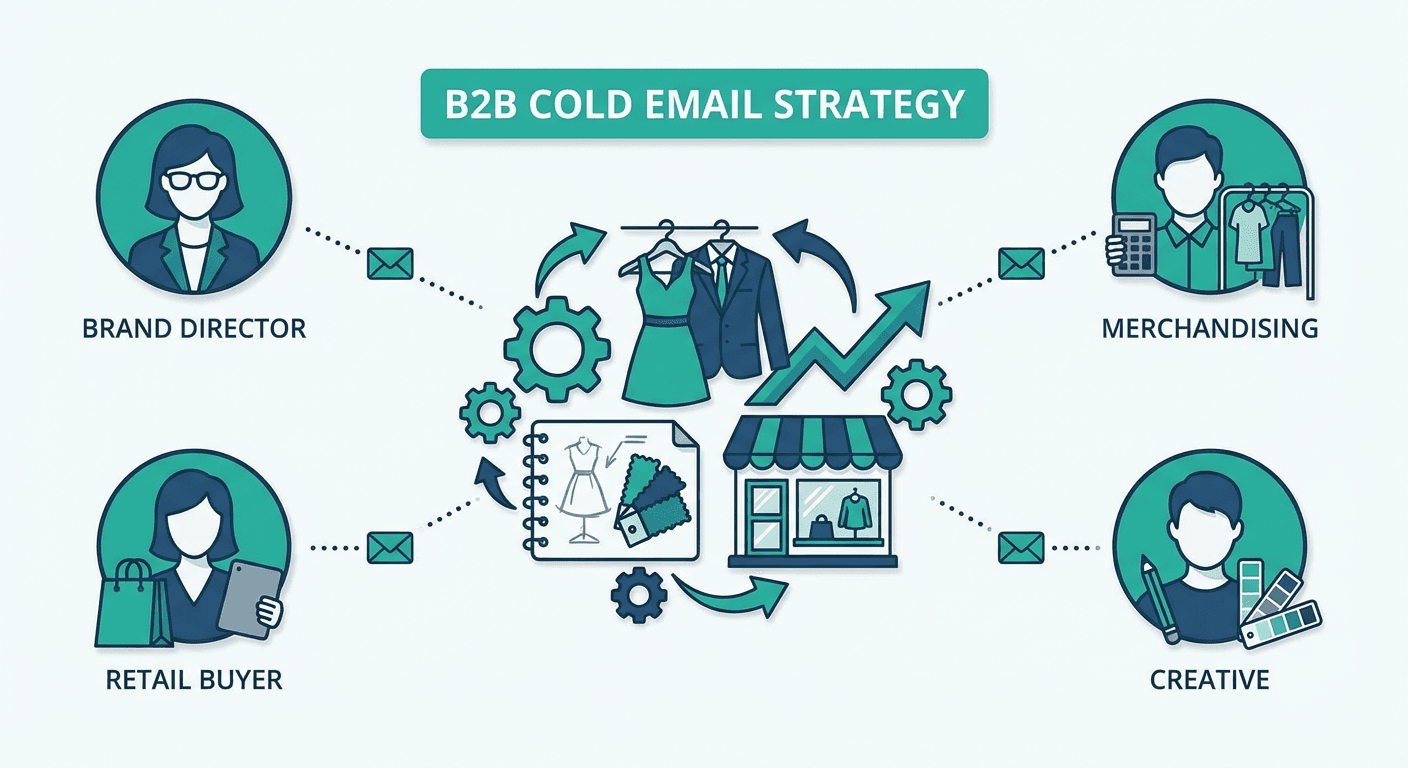
Cold email succeeds in fashion because buyers must continuously refresh inventory, with retailers replacing 40-60% of their assortment annually according to McKinsey. Decision-makers have direct purchasing authority without committee approval, and visual products allow immediate aesthetic assessment. Time outreach 4-6 months before delivery for spring/summer collections (contact August-October) and fall/winter collections (contact February-April), since fashion operates on fixed seasonal calendars where missing buying windows means waiting months for the next cycle.
Key takeaways
- A sustainable denim brand secured 11 buyer meetings and a $28,000 initial wholesale account from 47 cold emails sent to boutique buyers.
- The global apparel market reached $1.7 trillion in 2023, with retailers typically refreshing 40-60% of their product assortment each year.
- Fashion retail typically operates on 2.2-2.5x wholesale markup margins, a key consideration buyers evaluate when assessing new brands.
- Spring/summer collections require buyer outreach in August-October for January-March delivery, while fall/winter collections need February-April contact for July-September delivery.
- Fashion buyers have direct purchasing authority without extensive committee reviews, creating shorter paths from initial contact to purchase orders compared to other B2B industries.
Reviewed and updated August 28, 2026
Cold Email for Fashion and Apparel: The Complete Guide
A small sustainable denim brand in Los Angeles sent 47 cold emails to boutique buyers across the Southwest. Within three weeks, they had secured meetings with 11 stores and landed their first wholesale account worth $28,000 in initial orders. The fashion industry runs on relationships, and cold email is one of the most effective ways to start building them.
The global apparel market reached $1.7 trillion in 2023, according to Statista. Behind every retail shelf and online storefront sits a buyer who needs to discover new brands, fill inventory gaps, and stay ahead of trends. These professionals receive hundreds of pitches, but the right cold email can cut through the noise and open doors that would otherwise remain closed.
This guide covers everything you need to know about cold email outreach in the fashion and apparel industry, from understanding who you're emailing to crafting messages that generate responses.
Why Cold Email Works for Fashion and Apparel
The fashion industry presents unique opportunities for cold email outreach that don't exist in many other B2B contexts.
Discovery Is Built Into the Business Model
Fashion buyers and merchandisers are actively looking for new products. Unlike industries where decision-makers resist change, apparel professionals must constantly refresh their offerings. Seasonal collections, trend cycles, and consumer demand for novelty mean that buyers need a steady pipeline of new brands and products.
According to McKinsey's State of Fashion report, retailers typically refresh 40-60% of their assortment each year. This creates natural openings for outreach that would feel intrusive in more static industries.
Visual Products Create Immediate Interest
Fashion is inherently visual. A well-crafted email that includes compelling imagery or a lookbook link can capture attention in seconds. Buyers can quickly assess whether a brand's aesthetic fits their store's positioning without lengthy explanations or demos.
Relationship-Driven Industry
The apparel industry operates on relationships more than most B2B sectors. Buyers develop ongoing partnerships with brands they trust. A single successful cold email can lead to years of repeat orders, seasonal collaborations, and referrals to other retailers.
Clear Decision-Making Authority
In fashion retail, the path from initial contact to purchase order is often shorter than in other industries. Buyers and merchandisers typically have the authority to make purchasing decisions without extensive committee reviews or procurement processes. This makes cold email particularly effective because you're often reaching the actual decision-maker.
The Fashion Buyer: Who You're Really Emailing
Understanding the specific roles and priorities of fashion industry professionals is essential for effective outreach. Each role has different concerns, timelines, and decision-making criteria.
Retail Buyers
Retail buyers are responsible for selecting and purchasing products to sell in stores or online. They work with budgets, manage vendor relationships, and make decisions based on projected sell-through rates.
What They Care About:
- Margin potential (typical retail markup in fashion is 2.2-2.5x wholesale)
- Brand story and positioning that fits their customer base
- Minimum order quantities (MOQs) and reorder flexibility
- Delivery reliability and lead times
- Exclusivity options in their market
Where They Work:
- Department stores (Nordstrom, Macy's, Bloomingdale's)
- Specialty retailers (Anthropologie, Free People, Urban Outfitters)
- Independent boutiques
- Online retailers (Revolve, ASOS, Shopbop)
Merchandisers
Merchandisers focus on product planning, assortment strategy, and inventory optimization. They work closely with buyers but often have a more analytical focus on sell-through rates, inventory turns, and category performance.
What They Care About:
- Data on similar product performance
- Category trends and growth potential
- Inventory risk and return policies
- Seasonal timing and delivery windows
Brand Managers (for Brand-to-Brand Outreach)
When approaching larger brands for collaborations, licensing, or wholesale partnerships, you may be reaching out to brand managers who oversee brand positioning and partnership opportunities.
What They Care About:
- Brand alignment and values fit
- Market positioning and target demographic overlap
- Collaboration terms and creative control
- Marketing support and co-branding opportunities
E-commerce Buyers and Marketplace Category Managers
Online retailers and marketplaces have dedicated buyers who evaluate brands for their platforms. These roles often have more data-driven decision-making processes.
What They Care About:
- Product photography and content readiness
- Fulfillment capabilities and shipping performance
- Digital marketing capabilities
- Customer review potential and brand reputation
Fashion-Specific Challenges in Cold Email Outreach

The apparel industry presents distinct challenges that require specialized approaches to cold email.
- Yes: Fashion operates on fixed seasonal calendars that dictate when buyers review new brands.
- Yes: Fashion is a visual industry, but email has limitations.
- Yes: An email about a trend that peaked last season signals that you're out of touch with the market.
- Yes: Buyers now receive hundreds of pitches for every available slot on their shelves or websites.
- Yes: Many brands struggle with the gap between MOQs that make manufacturing efficient and order sizes that retailers are willing to commit to with new vendors.
Challenge 1: Seasonality and Buying Cycles
Fashion operates on fixed seasonal calendars that dictate when buyers review new brands. Missing these windows means waiting months for another opportunity.
Typical Buying Calendar:
- Spring/Summer collections: Buyers review in August-October (for delivery January-March)
- Fall/Winter collections: Buyers review in February-April (for delivery July-September)
- Resort/Holiday: Varies by retailer, typically reviewed 4-6 months before delivery
How to Address It: Time your outreach 4-6 months before delivery dates. Reference the specific season you're pitching for in your subject line and opening. If you're reaching out outside buying windows, acknowledge this and position your email as an introduction for the next cycle.
Challenge 2: Visual Communication Constraints
Fashion is a visual industry, but email has limitations. Large image files can trigger spam filters, and many corporate email systems block images by default.
How to Address It: Keep initial emails text-focused with a single, optimized image or a link to your lookbook. Ensure your website and digital materials are polished before reaching out. Consider using a brief video link (under 60 seconds) showing your collection.
Challenge 3: Trend Timing and Relevance
Fashion moves quickly. An email about a trend that peaked last season signals that you're out of touch with the market.
How to Address It: Reference current or emerging trends in your outreach. Cite specific runway shows, trade publications, or market data that support the timing of your pitch. Demonstrate that you understand where the market is heading.
Challenge 4: Oversaturation of the Market
The barriers to starting a fashion brand have dropped significantly. Buyers now receive hundreds of pitches for every available slot on their shelves or websites.
How to Address It: Differentiation is critical. Lead with what makes your brand genuinely different, whether that's manufacturing process, materials, price point, or target customer. Avoid generic claims like "high quality" or "unique designs" that every brand makes.
Challenge 5: Minimum Order Requirements and Cash Flow
Many brands struggle with the gap between MOQs that make manufacturing efficient and order sizes that retailers are willing to commit to with new vendors.
How to Address It: Be transparent about MOQs early in the conversation. Consider offering reduced minimums for first orders or test programs. If your MOQs are competitive, highlight this as a selling point.
What Works: Fashion Cold Email Best Practices
Effective fashion cold emails combine industry-specific knowledge with proven outreach principles.
Subject Lines That Get Opened
Fashion buyers scan subject lines quickly. The best subject lines are specific, relevant to current timing, and hint at a clear value proposition.
Effective Subject Line Formats:
- Season + Category + Differentiation: "SS26 Sustainable Denim for [Store Name]"
- Trend Reference + Brand: "Quiet Luxury Knitwear for Your Contemporary Floor"
- Specific Problem + Solution: "Filling the $100-150 Dress Gap at [Store Name]"
- Referral or Connection: "Sarah Chen Suggested I Reach Out About Outerwear"
- Results-Focused: "Accessories Line Averaging 3.2x Inventory Turn at Specialty Retail"
Subject Lines to Avoid:
- Generic pitches: "New Brand for Your Store"
- All caps or excessive punctuation: "AMAZING NEW COLLECTION!!!"
- Misleading claims: "RE: Our Meeting" (when there was no meeting)
- Overly long: Keep subject lines under 50 characters
Email Copy That Converts
Fashion cold emails should be concise, visual where possible, and immediately relevant to the buyer's needs.
Opening Lines:
Skip the pleasantries and get to the point. Buyers have limited time and appreciate directness.
Strong openings:
- "I noticed [Store Name] has been expanding your sustainable brands section. We manufacture certified organic cotton basics in Portugal with MOQs starting at 12 units per style."
- "Your contemporary sportswear assortment caught my attention. We're launching a technical athleisure line that fills the gap between premium activewear and everyday casual."
Weak openings:
- "I hope this email finds you well!"
- "My name is [Name] and I'm the founder of [Brand]."
- "I'm reaching out because I think you'd love our brand."
Body Structure:
- Hook (1-2 sentences): Why you're reaching out and why now
- Credibility (2-3 sentences): Brief brand background, relevant proof points
- Value Proposition (2-3 sentences): What you offer and why it matters for their specific situation
- Call to Action (1 sentence): Specific, easy next step
Proof Points That Matter:
- Current retail partners (especially recognizable names)
- Press coverage and editorial placements
- Sell-through rates from existing accounts
- Production capabilities and certifications
- Awards or industry recognition
Call to Action Options:
- Link to digital lookbook or line sheet
- Invitation to schedule a 15-minute call
- Offer to send samples
- Reference to upcoming market or trade show
Timing Your Outreach
Beyond seasonal calendars, timing within the week and month affects response rates.
Best Days: Tuesday, Wednesday, and Thursday typically see higher response rates. Monday emails compete with weekend backlog, and Friday emails may be deprioritized.
Best Times: Mid-morning (9-11 AM) and early afternoon (1-3 PM) in the recipient's time zone tend to perform well.
Follow-Up Cadence: Plan for 3-4 touchpoints over 2-3 weeks. Space follow-ups 4-5 business days apart. Each follow-up should add new information or value rather than simply asking "Did you get my last email?"
Compliance Considerations for Fashion Brands

Fashion and apparel businesses must navigate specific regulatory requirements that can affect email content and claims.
Sustainability and Environmental Claims
The FTC has increased scrutiny of environmental marketing claims in the fashion industry. The Green Guides provide direction on acceptable claims.
Key Requirements:
- Claims must be specific and substantiated ("Made with 50% recycled polyester" rather than "eco-friendly")
- Certifications must be current and verifiable (GOTS, OEKO-TEX, Fair Trade)
- "Sustainable" without qualification is considered too vague
- Country of origin for "sustainable" materials should be disclosed when possible
What This Means for Cold Email:
If you're leading with sustainability as a differentiator, ensure your claims are specific and backed by documentation you can provide. Avoid vague terms like "green," "natural," or "eco-friendly" without qualification.
Textile Labeling Requirements
While not directly applicable to email content, awareness of labeling requirements demonstrates professionalism when discussing product details.
The Textile Fiber Products Identification Act requires disclosure of:
- Fiber content by percentage
- Country of origin for manufacturing
- Manufacturer or brand identification
Made in USA Claims
If you're claiming domestic manufacturing, the FTC requires that "all or virtually all" of the product be made in the United States. "Assembled in USA" or "Designed in USA" have different requirements.
Import/Export Compliance
For brands manufacturing overseas, familiarity with customs requirements and tariff classifications can be relevant when discussing pricing and delivery timelines with buyers.
Real Fashion Cold Email Examples
These examples demonstrate effective approaches for different scenarios in fashion outreach.
Example 1: Independent Brand to Boutique Buyer
Subject: SS26 Sustainable Swim for Pacific Northwest Boutiques
Body:
Hi [First Name],
I've followed [Boutique Name]'s evolution from your original Ballard location to the three stores you now operate. Your focus on sustainable fashion brands that don't sacrifice style makes you an ideal partner for what we're building.
[Brand Name] manufactures swimwear from regenerated ocean plastic in our Bali facility. We launched in 2023 and now ship to 45 specialty retailers across North America, including Marine Layer and Reformation. Our average sell-through rate in independent boutiques is 72% within season.
For SS26, we're introducing 12 new silhouettes with wholesale prices from $38-62 (MSRP $95-155). MOQs are 6 units per style/color, and we offer net-60 terms for established accounts.
I've attached our digital lookbook. Would you have 15 minutes next week for a call? I'm also happy to send samples if you'd prefer to see the product first.
Best, [Name] [Title] [Brand Name] [Phone] | [Website]
Why This Works:
- Shows research on the specific boutique
- Leads with relevant differentiation (sustainable materials)
- Provides specific proof points (number of retailers, sell-through rate)
- Clear pricing and terms information
- Multiple response options (call or samples)
Example 2: Emerging Designer to Department Store Buyer
Subject: CFDA Nominee, Contemporary Knitwear, Fall 2026
Body:
Hi [First Name],
Contemporary knitwear at the $200-400 price point has seen 18% growth at specialty retail over the past two seasons, according to EDITED data. [Brand Name] is positioned to help [Department Store] capture this momentum.
We were nominated for the 2025 CFDA Emerging Designer Award and have been featured in Vogue, WWD, and Elle. Current wholesale partners include Bergdorf Goodman and Kirna Zabete. Our Fall 2026 collection focuses on transitional layering pieces in sustainable merino and cashmere blends.
Key details:
- Wholesale: $85-195 (MSRP $200-450)
- MOQ: 3 units per style/size
- Made in Italy with GOTS-certified yarns
- 30-day reorder turnaround on core styles
I'll be at Coterie February 23-25 (Booth 4412) and would welcome the opportunity to meet. Alternatively, I can send our line sheet and schedule a virtual showroom appointment.
Best, [Name] [Title] [Brand Name]
Why This Works:
- Opens with market data relevant to the buyer's category
- Establishes credibility through awards and press
- Lists current accounts at similar tier
- Provides specific product and pricing details
- References upcoming trade show for in-person meeting option
Example 3: Follow-Up Email After No Response
Subject: Re: SS26 Sustainable Swim for Pacific Northwest Boutiques
Body:
Hi [First Name],
Following up on my email from last week about [Brand Name] swimwear for [Boutique Name].
Quick update: We just confirmed our second season with Anthropologie, and ELLE named us in their "10 Sustainable Swim Brands to Watch" feature (link below).
I know you're likely deep in Fall buying, so I wanted to offer two easy next steps:
- I can overnight a sample pack (3 styles) at no cost
- Our Spring digital lookbook is now live with 360-degree product views
Either way, I'd love to connect when timing is right for your swim planning.
Best, [Name]
Why This Works:
- Adds new information (Anthropologie confirmation, press feature)
- Acknowledges the buyer's current priorities
- Offers low-commitment next steps
- Keeps the door open without being pushy
Your Fashion Cold Email Checklist
Use this checklist before sending any cold email to fashion buyers:
Research and Targeting
- Verified the contact is the correct buyer for your category
- Researched the retailer's current brand mix and positioning
- Confirmed you're reaching out during an appropriate buying window
- Checked for any mutual connections or referral opportunities
Email Content
- Subject line is under 50 characters and season-specific
- Opening line references something specific about the retailer
- Included 2-3 relevant proof points (accounts, press, data)
- Wholesale pricing and MOQs are clearly stated
- Any sustainability claims are specific and substantiated
- Call to action is clear and offers a low-commitment option
- Email is under 200 words
- Checked for typos and correct spelling of names
Visual Assets
- Lookbook or line sheet link is working
- Website is professional and up to date
- If including an image, file is optimized (under 100KB)
- All digital assets reflect current season's collection
Technical Setup
- Sending from a professional domain email
- Email signature includes phone and website
- SPF, DKIM, and DMARC records are configured
- Tested email on mobile devices
Follow-Up Plan
- Calendar reminders set for 3-4 follow-ups
- Each follow-up has new information to add
- Trade show or market week dates noted for potential meetings
Building Long-Term Relationships
Cold email is the beginning of a relationship, not the end goal. After you've made initial contact:
Track Everything: Use a CRM or spreadsheet to record outreach dates, responses, buyer preferences, and buying cycle timing. This information becomes valuable for future seasons.
Add Value Between Pitches: Share relevant industry news, congratulate them on store milestones, or send samples of new products without a hard pitch. These touchpoints maintain the relationship.
Respect Their Time: Buyers remember brands that are professional and easy to work with. Quick responses, accurate line sheets, and reliable delivery build trust that leads to expanded orders.
Ask for Feedback: If a buyer passes on your line, politely ask why. This feedback can inform product development and future outreach strategy.
Getting Started with Fashion Cold Email
Cold email outreach in fashion requires industry knowledge, precise timing, and compelling messaging. The brands that succeed are those that combine strong products with strategic, personalized outreach that respects buyers' time and demonstrates clear value.
The framework outlined in this guide works for independent designers pitching boutiques, established brands expanding into new retail channels, and everyone in between. The key is consistency, professionalism, and a genuine understanding of what buyers need.
Ready to launch your fashion cold email campaign? Book a free consultation to discuss how RevenueFlow can help you reach the right buyers with messaging that converts.
Related Reading
Frequently asked questions.
Frequently asked questions- Why does cold email work better for fashion brands than other industries?
- Fashion buyers actively seek new products because they must constantly refresh their offerings. Retailers typically replace 40-60% of their assortment each year according to McKinsey. Unlike industries where decision-makers resist change, apparel professionals need a steady pipeline of new brands to meet seasonal demands and consumer expectations for novelty. Additionally, buyers usually have direct purchasing authority without committee approval, creating faster decision paths.
- When should I send cold emails to fashion buyers?
- Time your outreach 4-6 months before delivery dates. For spring/summer collections, contact buyers in August-October for January-March delivery. For fall/winter collections, reach out in February-April for July-September delivery. Fashion operates on fixed seasonal calendars, so missing these buying windows means waiting months for the next opportunity to pitch your products.
- Who should I target when cold emailing in the fashion industry?
- Target retail buyers who make purchasing decisions for stores and online retailers, merchandisers who focus on assortment strategy and inventory optimization, brand managers for collaboration opportunities, or e-commerce category managers for marketplace placement. Retail buyers care about margin potential (typical fashion markup is 2.2-2.5x wholesale), brand positioning, minimum order quantities, and delivery reliability. Each role has different priorities but buyers typically have the most direct purchasing authority.
- What margins do fashion buyers expect from wholesale brands?
- Fashion retail typically operates on a 2.2-2.5x wholesale markup. Buyers evaluate brands based on margin potential as a primary factor, alongside brand story, minimum order quantities, delivery reliability, and exclusivity options in their market. Your pricing must allow retailers to achieve these margins while remaining competitive with their target customer base.
- How many cold emails does it take to land a wholesale account in fashion?
- Results vary, but one sustainable denim brand sent 47 cold emails to boutique buyers and secured meetings with 11 stores, landing their first wholesale account worth $28,000 in initial orders within three weeks. Success depends on timing your outreach to buying cycles, targeting the right decision-makers, and demonstrating clear brand fit with the retailer's customer base.
About the author.

Fernando Cao is CEO at RevenueFlow, which builds and operates outbound revenue engines for B2B companies. Previously at Accenture Strategy. Studied at University of Bath.
Fernando Cao · CEO
Connect on LinkedIn →Explore more.
Ready to scale your outreach?
We build GTM engines that book real meetings. See the receipts.
Related articles.
Cold Email for Architecture Firms: 2026 Strategy Guide
Architecture firms buy on project phases rather than fiscal quarters. How to build a list, time the spec window, and write cold emails principals answer.
Cold Email for Trucking and Fleet Companies: 2026 Guide
How to reach carriers, fleet operators, and safety buyers with cold email: FMCSA-driven list building, trigger timing, four templates, and compliance.
Cold Email for Cannabis Companies: 2026 Strategy Guide
The April 2026 rescheduling order split cannabis buyers into two tax realities. Here is how to segment, list-build, and write cold email for each.
Cold Email for Private Equity Firms: 2026 Strategy Guide
How to run cold email into private equity: mapping fund-level and portfolio-level buyers, list sources, four templates, and PE-specific deliverability rules.
Cold Email for Wealth Management Firms: 2026 Strategy Guide
RIAs are 16,500+ mostly small firms with public Form ADV data, small buying committees, and a compliance gate. How to run cold email into wealth management.
Cold Email for Interior Design Firms: 2026 Strategy Guide
Commercial interior designers specify products they never buy. Here is how to build cold email that wins the specification, plus four templates.