Cold Email for Focus Groups: Complete Strategy Guide
Learn how to use cold email to recruit qualified participants for focus groups. Includes proven templates, screening strategies, and group composition frameworks.

Cold email enables targeted recruitment of specific professionals for focus groups by reaching individuals who match exact criteria (senior executives, specialized practitioners, or industry-specific profiles) that traditional panels and ads cannot effectively access. Direct outreach fills groups 40-60% faster than passive methods while providing precise control over participant composition, which determines discussion quality and research outcomes.
Key takeaways
- A market research firm filled two complete CFO focus groups in ten days through cold email after traditional recruiting panels produced zero qualified respondents in three weeks.
- Standard focus groups require 6-10 participants, with over-recruitment of 10-20% to account for no-shows that can undermine session quality.
- Homogeneous groups with similar backgrounds encourage deeper sharing on specific experiences, while heterogeneous groups generate diverse perspectives on broader topics.
- Focus group sessions typically require 90 minutes to 2 hours of participant time, plus travel for in-person sessions, necessitating compensation that reflects this commitment.
- Power imbalances between participants at different seniority levels can inhibit open discussion, often requiring separation by organizational role or status.
Reviewed and updated September 15, 2026
Cold Email for Focus Groups: Complete Strategy Guide
Focus groups provide qualitative insights that surveys and analytics cannot capture. Watching real people discuss their experiences, challenge each other's perspectives, and react to concepts reveals nuances that inform product development, marketing strategy, and business decisions. However, the quality of focus group insights depends entirely on recruiting the right participants. Cold email provides a targeted method for assembling groups of qualified individuals who would never respond to traditional recruitment channels.
A market research firm needed to assemble a focus group of CFOs from mid-market manufacturing companies to discuss financial software adoption. Traditional recruiting panels produced zero qualified respondents after three weeks of effort. Through targeted cold email outreach to specific finance leaders at matching companies, they filled two complete focus groups within ten days. The resulting insights directly shaped their client's product positioning and sales approach.
Why Cold Email Works for Focus Group Recruitment
Traditional focus group recruitment relies on research panels, classified ads, and social media recruiting. These methods work for general consumer research but fail when you need specific professional profiles, senior decision-makers, or specialized practitioners. Cold email solves these limitations by enabling direct outreach to individuals who match your exact participant criteria.
The Strategic Advantage of Direct Recruitment
Cold email for focus group recruitment offers several distinct benefits:
Profile precision: You can identify and contact individuals who match specific professional, demographic, or behavioral criteria rather than hoping qualified people respond to generic recruitment.
Senior access: Executives and senior professionals rarely respond to panel recruiters or classified ads. Personalized email outreach reaches decision-makers directly.
Industry targeting: You can recruit from specific industries, company types, or market segments that traditional recruiting channels cannot effectively reach.
Speed of assembly: Direct outreach to qualified prospects fills focus groups faster than waiting for passive recruitment responses.
Group composition control: You determine exactly who participates, enabling deliberate group dynamics rather than accepting whoever shows up.
Designing Focus Group Recruitment Strategy
Effective focus group recruitment starts with clear research design. Understanding what insights you need determines who you recruit and how you compose groups.
Defining Your Participant Criteria
Before initiating recruitment, establish detailed criteria for focus group participants:
Primary qualifications: What characteristics must every participant have? These non-negotiable criteria define who can participate.
Diversity requirements: What variation do you need within each group? Different perspectives, experience levels, or contexts enrich discussion.
Group composition goals: How should participants relate to each other? Similar backgrounds encourage comfort and depth, while diverse backgrounds generate varied perspectives.
Exclusion criteria: What characteristics disqualify potential participants? Competitor employees, recent focus group participants, or other factors may require exclusion.
Practical requirements: What scheduling, location, or technology constraints affect eligibility?
Group Composition Principles
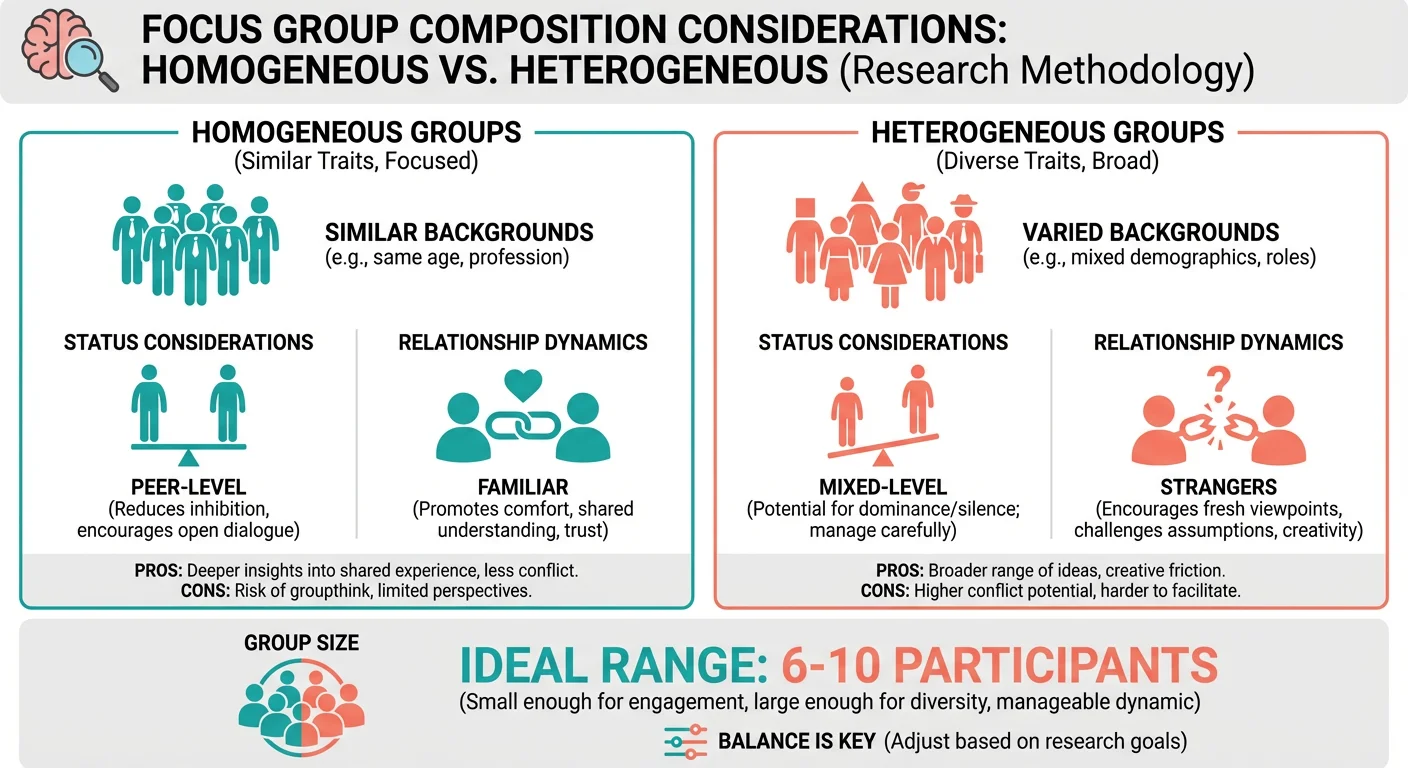
Focus group composition significantly affects discussion quality:
Homogeneous groups: Participants with similar backgrounds, roles, or experiences create comfortable environments where people share freely. Useful when exploring specific experiences in depth.
Heterogeneous groups: Participants with different backgrounds bring varied perspectives that spark richer discussion and surface diverse viewpoints. Useful when exploring broad topics or testing reactions across segments.
Status considerations: Power imbalances affect participation. Mixing executives with individual contributors may inhibit open discussion. Consider separating by seniority level.
Relationship considerations: Participants who know each other may have pre-existing dynamics that affect discussion. Sometimes familiarity helps; sometimes it hinders.
Group Size Planning
Standard focus groups include 6-10 participants. Consider these factors:
Larger groups (8-10): Generate more diverse perspectives but give each participant less speaking time. Better for broad exploration.
Smaller groups (6-8): Allow deeper individual contribution and more comfortable discussion. Better for sensitive topics or detailed exploration.
Over-recruitment: Always recruit 10-20% more participants than needed to account for no-shows. Focus groups suffer significantly when attendance falls below minimum thresholds.
What to Offer Focus Group Participants
Focus group participation requires significant time commitment, often 90 minutes to 2 hours, plus travel time for in-person sessions. Your offer must provide sufficient value to attract qualified participants, especially professionals whose time commands premium rates.
Compensation Frameworks
Appropriate compensation varies by participant profile:
General consumers: Standard compensation rates Professionals: Higher rates reflecting their time value Senior executives: Premium rates or alternative value propositions Hard-to-reach specialists: Premium rates reflecting recruitment difficulty
Compensation can take multiple forms:
Cash or check: Direct payment remains the most universal incentive. Provide payment immediately after session completion.
Gift cards: Flexible and easy to distribute. Consider prepaid Visa cards for maximum flexibility.
Product incentives: Free products, service credits, or early access may appeal to participants interested in your category.
Charitable donations: Some participants (especially senior executives) prefer donations to charity on their behalf.
Networking value: For professional focus groups, connecting participants with each other creates additional value.
Additional Value Propositions
Beyond compensation, other factors motivate participation:
Influence opportunity: Participants may value the chance to shape products or services they use.
Professional development: Learning from other participants and research findings provides career value.
Convenience: Easy location, flexible scheduling, and efficient sessions respect participants' time.
Research findings: Sharing aggregate results gives participants insight they would not otherwise have.
Food and hospitality: For in-person sessions, quality refreshments and comfortable environments enhance experience.
Structuring Your Focus Group Offer
Your outreach should clearly communicate:
- What the focus group will discuss (general topic)
- How long participation requires (including any travel)
- When and where the session occurs
- What compensation participants receive
- How many people will participate
- Who is conducting the research
- How their contributions will be used
Clarity about expectations attracts committed participants and reduces no-shows.
What Works: Focus Group Recruitment Email Best Practices
Effective focus group recruitment emails establish legitimacy, explain the opportunity clearly, and make expressing interest easy. The best recruitment messages feel like professional invitations rather than mass solicitations.
Subject Line Principles
Your subject line determines whether qualified prospects open your email:
- Reference their professional context or expertise
- Mention paid research opportunity
- Avoid spam-trigger language while maintaining clarity
- Keep it concise and professional
Examples that perform well:
- "Paid focus group for [role/industry] professionals"
- "Research opportunity: [topic area]"
- "[Organization] seeking [role type] perspectives"
- "Invitation: Paid discussion on [topic]"
Email Body Structure
Structure your focus group recruitment emails with these elements:
Credibility establishment: Open with context about who is conducting the research. Legitimacy is essential for recruitment success.
Topic introduction: Explain what the focus group will discuss without revealing so much detail that you bias participants.
Why them specifically: Articulate why you are contacting this particular person. Reference their professional context or qualifications.
Logistics clarity: Provide date, time, location (or virtual platform), and duration. Specificity helps recipients assess feasibility.
Compensation: Clearly state what participants receive for their time.
Group context: Mention that others like them will participate. Social proof and peer context increase comfort.
Privacy assurance: Address confidentiality and how their input will be used.
Easy response path: Make expressing interest simple. Detailed screening can happen after initial interest is established.
Tone and Voice Guidelines
Focus group recruitment emails succeed when they feel professional yet inviting:
- Write clearly and directly
- Establish legitimacy through organizational context
- Express genuine interest in their perspective
- Be specific about logistics and compensation
- Sound like an invitation from a real person
Focus Group Recruitment Email Templates
The following templates demonstrate effective approaches for recruiting focus group participants. Customize these frameworks with specific details about your research and target participants.
Template 1: The Professional Focus Group Request
Subject: Paid focus group for [role/industry] professionals
Body:
Hi [First Name],
I am [Your Name] from [Organization/Research Firm]. We are conducting focus group research on [general topic] and seeking [role type] professionals to participate.
Based on your background as [their role] at [Company], you would be an ideal participant. We are looking for people with experience in [relevant area] to share their perspectives.
Focus Group Details:
- Topic: [General description, not overly specific]
- Date: [Date] at [Time]
- Duration: Approximately [length, typically 90-120 minutes]
- Location: [Address or "Virtual via Zoom"]
- Group size: [Number] participants
- Compensation: [Amount] for your time
The discussion will be moderated by a professional researcher and will explore [general themes]. Your individual responses will be kept confidential.
Would you be interested in participating? If so, please reply with your availability and I will send additional details.
Best regards, [Your Name] [Title, Organization] [Contact information]
Template 2: The Executive Focus Group Request
Subject: Executive discussion opportunity: [Topic]
Body:
Hi [First Name],
I am reaching out on behalf of [Organization] regarding a paid focus group study for [senior role type] professionals.
We are assembling a small group of [role type] to discuss [topic area]. Given your position as [their title] at [Company], your perspective would be valuable for this research.
Session details:
- Format: [In-person/virtual] moderated discussion
- Participants: [Number] [role type] from [industry/company type]
- Duration: [Length]
- Date options: [Date 1] or [Date 2]
- Compensation: [Amount or "honorarium commensurate with your time"]
The discussion will focus on [general topic area]. All participants are peers at similar organizational levels, and the conversation is confidential.
As an additional benefit, participants receive a summary of key themes from the research following the study.
Is this something you would consider? I am happy to share more details or schedule a brief call to discuss.
[Your Name] [Organization]
Template 3: The Consumer Focus Group Request
Subject: Paid focus group opportunity in [City]
Body:
Hi [First Name],
We are conducting paid focus group research and think you might be a great fit based on [how you identified them or their relevant characteristic].
The opportunity:
- Topic: Discussion about [general topic area]
- When: [Date] from [Time] to [Time]
- Where: [Location with address or neighborhood]
- Compensation: [Amount] cash at the end of the session
- Food/drinks provided
The focus group will include [number] participants discussing [topic]. A professional moderator guides the conversation, and we are interested in your honest opinions and experiences.
Who we are looking for:
- [Criterion 1]
- [Criterion 2]
- [Criterion 3]
If this sounds like you, reply to this email or click here to answer a few quick screening questions: [Screener link]
Spots fill quickly, so please respond soon if interested.
Thanks, [Your Name] [Organization]
Template 4: The B2B Focus Group Request
Subject: Research discussion: [Industry/Function] perspectives needed
Body:
Hi [First Name],
[Organization] is conducting focus group research with [role type] professionals to understand [general research topic]. We are seeking participants from [industry/company type] organizations.
Your experience as [their role] at [Company] aligns well with what we are looking for. The research will inform [general purpose without revealing client if applicable].
Participation involves:
- A [length] moderated group discussion
- [Number] other [role type] professionals participating
- [Date options or scheduling flexibility]
- [In-person at location or virtual via platform]
Compensation: [Amount] for your time, payable immediately after the session.
The discussion is confidential. We are interested in honest perspectives about [topic area], including challenges and frustrations.
Would you be available to participate? Reply with your interest and I will follow up with screening questions and scheduling details.
[Your Name] [Title] [Organization]
Template 5: The Virtual Focus Group Request
Subject: Online focus group: [Amount] for [length]
Body:
Hi [First Name],
We are recruiting participants for a paid online focus group and thought you might be interested based on [relevant characteristic].
Details:
- Topic: [General topic description]
- Format: Video discussion via [Platform - Zoom, etc.]
- Duration: [Length] (typically 90 minutes)
- Compensation: [Amount] e-gift card sent within 24 hours of completion
- Scheduling: [Date/time options]
The focus group brings together [number] people to discuss [topic]. A moderator guides the conversation, and you participate from wherever you have stable internet access.
Requirements:
- Computer or tablet with webcam and microphone
- Stable internet connection
- Quiet, private space for the duration
- [Any other screening criteria]
Interested? Reply to this email or complete this brief screener: [Link]
Thanks, [Your Name]
Screening and Qualification Process

Cold email recruitment generates interest, but screening ensures only qualified participants join your focus groups. Establish a thorough screening process that verifies eligibility without creating excessive burden.
Screening Methods
Email screening questions: Include 2-3 critical qualification questions in your initial outreach or immediate follow-up.
Online screener surveys: Direct interested respondents to a brief survey collecting qualification data. Keep it under 5 minutes to maintain completion rates.
Screening calls: Brief phone conversations verify qualifications and assess how participants will contribute to group discussion.
Profile verification: Review LinkedIn profiles or other sources to verify self-reported professional credentials.
Assessing Group Fit
Beyond basic qualification, evaluate how each participant will contribute to group dynamics:
Articulation ability: Can they express their thoughts clearly? Focus groups need participants who can verbalize experiences.
Discussion willingness: Are they comfortable sharing in group settings? Some qualified individuals are too reserved for focus group participation.
Scheduling commitment: Can they firmly commit to the scheduled time? No-shows disrupt group dynamics significantly.
Perspective uniqueness: Does this person add something different from other confirmed participants?
Over-Recruitment Strategy
Always recruit more participants than you need:
- For groups of 6-8, confirm 8-10 participants
- For groups of 8-10, confirm 10-12 participants
- Send reminders 48 hours, 24 hours, and 2 hours before sessions
- Have backup participants on standby if possible for critical research
Managing the Recruitment Timeline
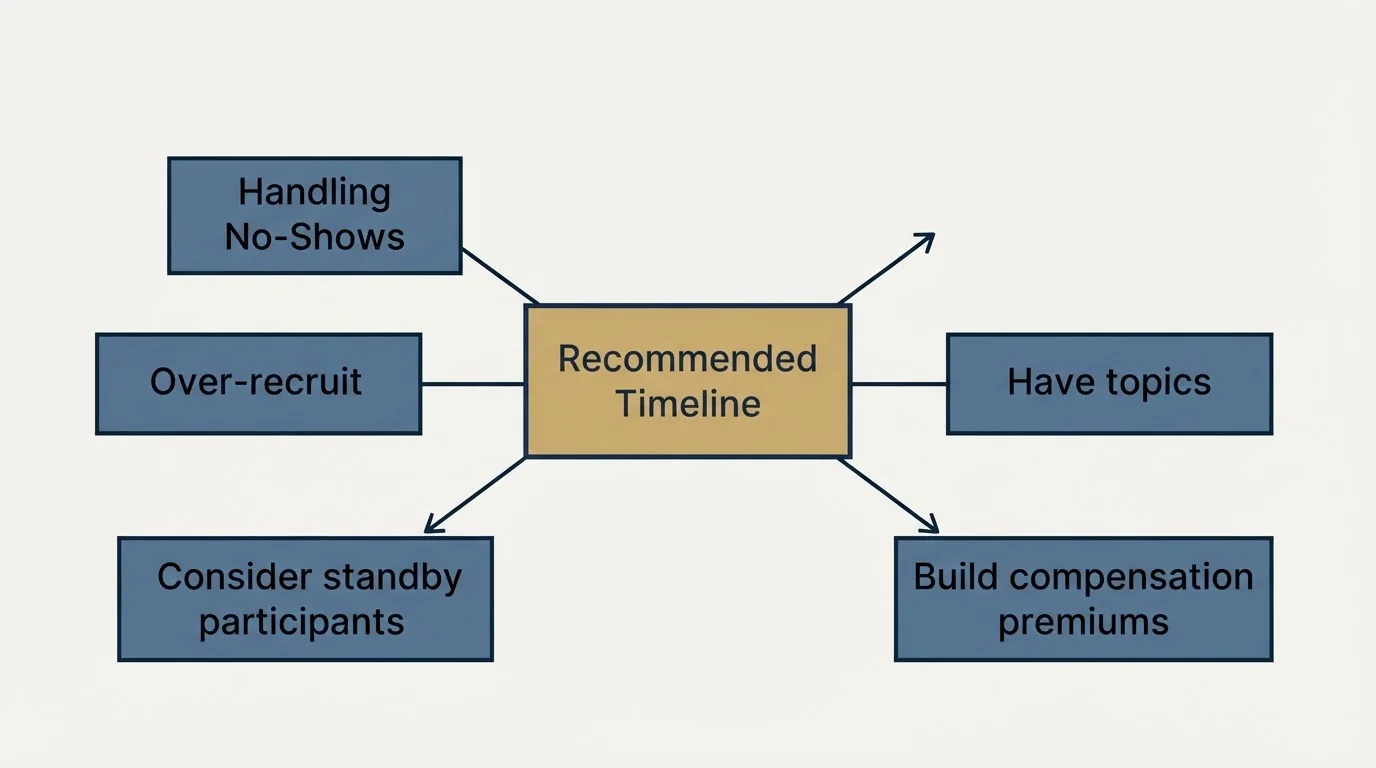
Focus group recruitment requires coordinated timing. Plan your timeline to ensure groups fill without last-minute pressure.
Recommended Timeline
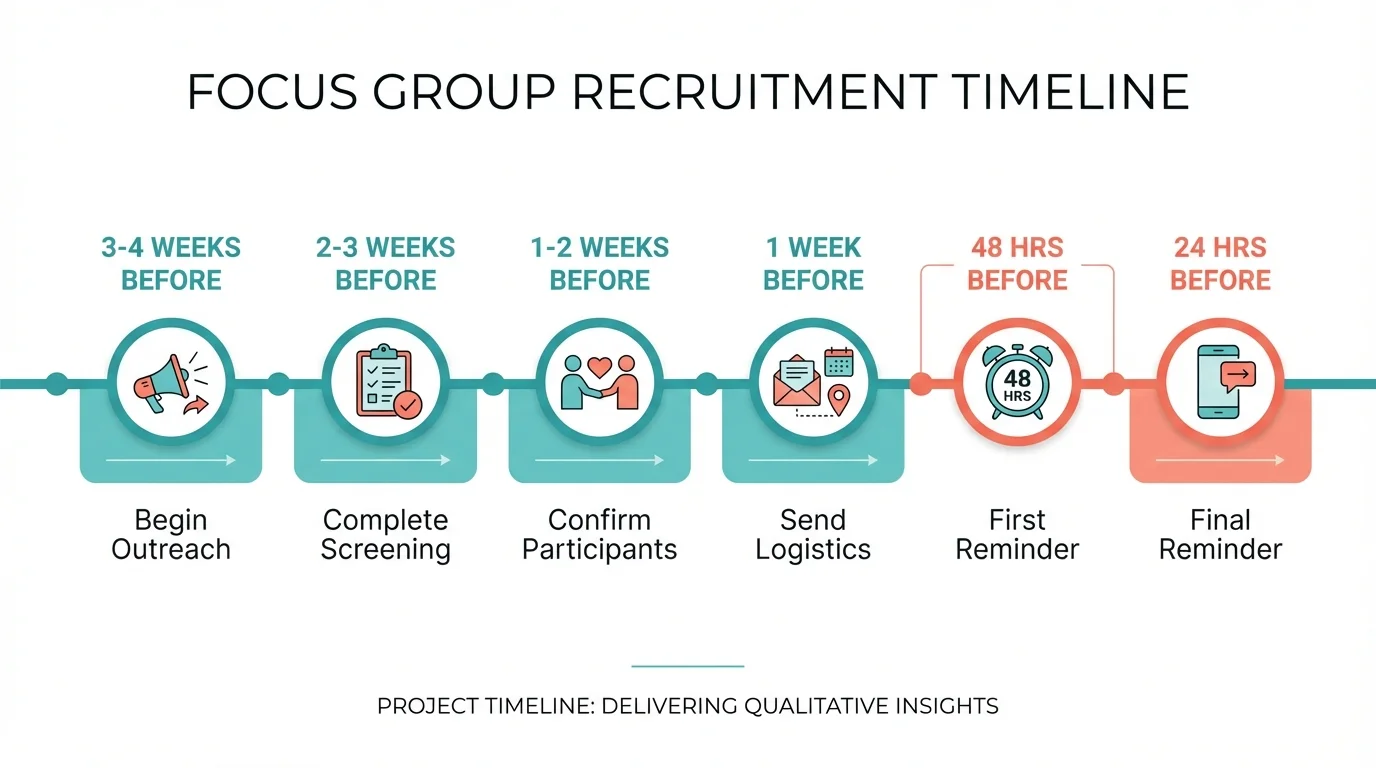
3-4 weeks before session: Begin outreach to target participants 2-3 weeks before: Complete initial recruitment, begin screening 1-2 weeks before: Confirm participants, begin back-fill recruitment if needed 1 week before: Send detailed logistics and calendar invitations 48 hours before: Send reminder with all details 24 hours before: Final reminder 2 hours before: Last reminder for virtual sessions
Handling No-Shows
Despite best efforts, some participants will not show up. Plan contingencies:
- Over-recruit from the start
- Have topics or formats that work with smaller groups as backup
- Consider standby participants who can join with short notice
- Build compensation premiums for reliable attendance if chronic no-shows become an issue
Common Mistakes to Avoid
Focus group recruitment fails for predictable reasons. Avoiding these errors improves both recruitment success and research quality.
- No: Insufficient Lead Time
- No: Inadequate Compensation
- No: Vague Topic Description
- No: Excessive Screening Burden
- No: Poor Logistics Communication
- No: Homogeneous Recruitment Channels
- No: Last-Minute Scheduling
Insufficient Lead Time
Starting recruitment too close to session dates creates pressure that compromises participant quality. Allow adequate time for outreach, screening, and back-fill.
Inadequate Compensation
Undercompensating reduces response rates and increases no-shows. Research competitive rates for your participant type and geography.
Vague Topic Description
Overly vague descriptions fail to generate interest. Participants want to know what they will discuss, even if you cannot reveal every detail.
Excessive Screening Burden
Lengthy screeners reduce completion rates. Screen for essential criteria first, then gather additional information from qualified participants.
Poor Logistics Communication
Confusion about location, parking, virtual platform access, or timing increases no-shows. Over-communicate logistics clearly and repeatedly.
Homogeneous Recruitment Channels
Recruiting only from one source creates sample bias. Diversify outreach across different channels and contacts.
Last-Minute Scheduling
Asking busy professionals to commit with short notice reduces participation. Provide adequate lead time for calendar planning.
Your Focus Group Recruitment Checklist
Before launching your recruitment campaign, confirm completion of these steps:
Research Design
- Defined research objectives and discussion guide
- Established participant qualification criteria
- Determined group size and composition requirements
- Set session date, time, and location/platform
Recruitment Preparation
- Built target list matching qualification criteria
- Written customized recruitment emails
- Created screening survey or questions
- Established appropriate compensation
Logistics Preparation
- Confirmed venue booking or virtual platform setup
- Arranged moderator and any observers
- Prepared recording equipment and consent forms
- Organized compensation distribution
- Created participant communication templates (confirmation, reminders)
Contingency Planning
- Over-recruited by appropriate margin
- Identified backup recruitment channels if needed
- Prepared for smaller-than-planned group scenario
- Established no-show follow-up process
Build Your Focus Group Participant Pipeline
Recruiting focus group participants through cold email enables research that traditional recruitment methods cannot support. The ability to target specific professional profiles, reach senior decision-makers, and control group composition transforms what questions you can answer through qualitative research.
The strategies, templates, and frameworks in this guide provide everything needed to assemble qualified focus groups that generate actionable insights.
Ready to recruit participants for your next focus group? Our team specializes in outreach campaigns that fill focus groups with qualified participants. Get your free focus group recruitment campaign and start assembling the groups that drive better research outcomes.
Related Reading
Frequently asked questions.
Frequently asked questions- Why does cold email work better than traditional methods for recruiting focus group participants?
- Cold email provides direct access to professionals who match exact criteria and would never respond to panels or classified ads. Traditional recruitment methods fail when targeting senior executives, specialized practitioners, or specific industries. Cold email delivers profile precision, reaches decision-makers directly, and fills groups faster than passive recruitment while giving complete control over group composition.
- How many people should I recruit for a focus group?
- Standard focus groups include 6-10 participants. Larger groups of 8-10 generate more diverse perspectives but reduce individual speaking time, making them better for broad exploration. Smaller groups of 6-8 allow deeper contribution and work better for sensitive or detailed topics. Always over-recruit by 10-20% to account for no-shows, as attendance below minimum thresholds significantly undermines session quality.
- Should focus group participants have similar or different backgrounds?
- It depends on your research goals. Homogeneous groups with similar backgrounds, roles, or experiences create comfortable environments where participants share freely, making them ideal for exploring specific experiences in depth. Heterogeneous groups with different backgrounds bring varied perspectives that spark richer discussion, making them useful for broad topics or testing reactions across segments. Status differences like mixing executives with individual contributors can inhibit open discussion.
- How long does it take to recruit focus group participants through cold email?
- Direct cold email outreach fills focus groups significantly faster than traditional methods. One market research firm filled two complete CFO focus groups in ten days through targeted cold email after traditional recruiting panels produced zero qualified respondents in three weeks. The speed advantage comes from directly contacting individuals who match exact criteria rather than waiting for passive responses to generic recruitment.
About the author.

Ben Carden is CRO at RevenueFlow, which builds and operates outbound revenue engines for B2B companies. Previously at Gartner Enterprise. Studied at London School of Economics.
Ben Carden · CRO
Connect on LinkedIn →Explore more.
Ready to scale your outreach?
We build GTM engines that book real meetings. See the receipts.
Related articles.
Cold Email for User Research: Complete Strategy Guide
Learn how to use cold email to recruit participants for user research studies. Includes proven templates, screening strategies, and incentive frameworks that attract qualified participants.
Cold Email for Influencer Outreach: Partner with Creators
Learn how to use cold email to build authentic influencer partnerships that drive real results for your brand, with proven templates and strategies.
Cold Email for Product Feedback: Complete Strategy Guide
Learn how to use cold email to gather valuable product feedback from users and prospects. Includes proven templates, feedback frameworks, and response optimization techniques.
Cold Email for PR: How to Pitch Journalists and Get Coverage
Learn how to craft cold emails that get journalists to open, read, and respond to your pitches. Includes real templates, timing strategies, and a complete PR outreach checklist.
Cold Email for Reviews: Complete Strategy Guide
Learn how to use cold email to generate authentic product reviews on G2, Capterra, and other platforms. Includes proven templates, compliance guidelines, and review generation frameworks.
Cold Email for Link Building: How to Get Quality Backlinks
Learn how to use cold email outreach to build high-quality backlinks that improve your SEO rankings, with proven templates and strategies that get responses.