Cold Email for Government: Procurement and RFPs
Government contracts require specific compliance and procurement processes. Here's how to approach cold email outreach to federal, state, and local agencies.
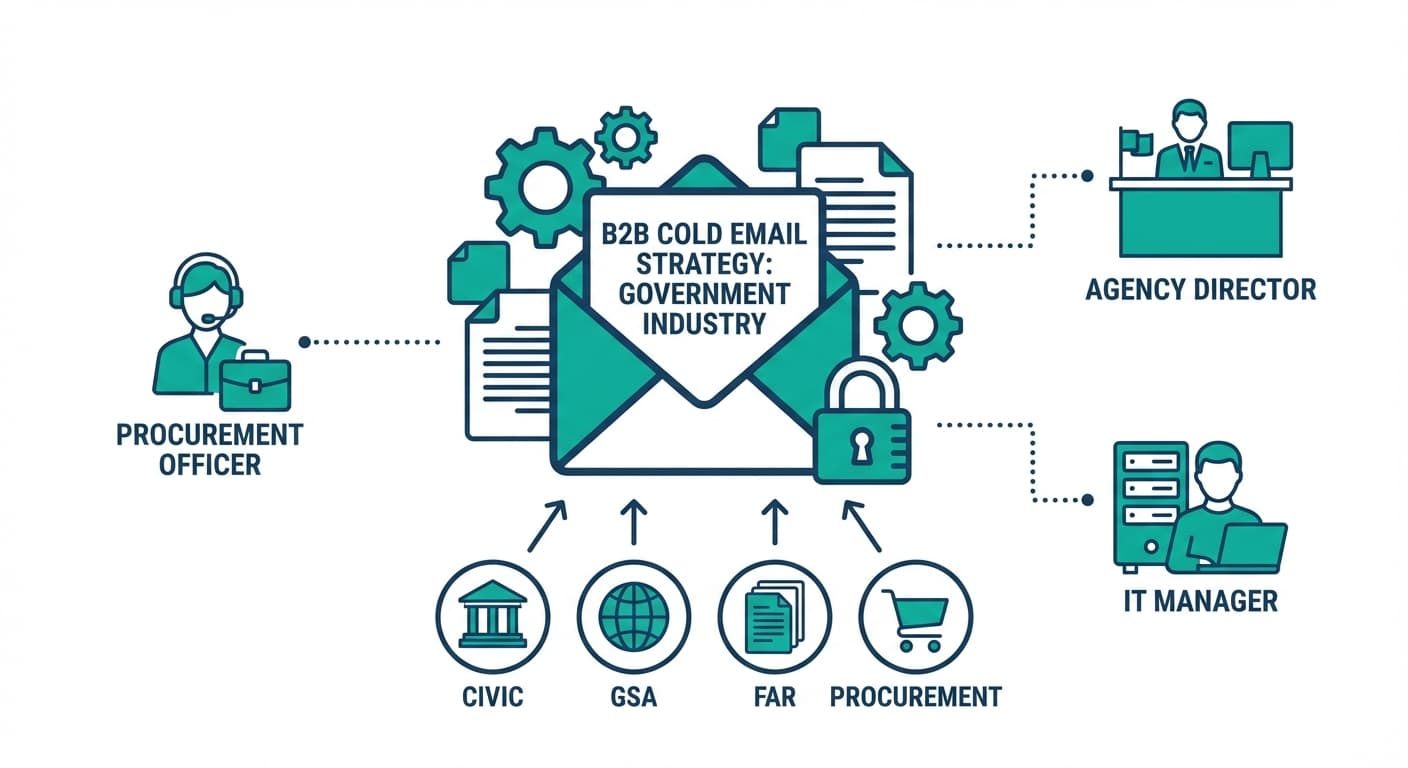
Cold email in government sales builds relationships and positions vendors for future RFP opportunities rather than closing direct deals. Government agencies operate under strict procurement regulations like the Federal Acquisition Regulation, requiring formal solicitation processes for significant purchases. Effective outreach focuses on program managers, contracting officers, and technical evaluators to establish awareness, gather market intelligence, and shape requirements before RFPs are written, while strictly adhering to procurement integrity rules and anti-lobbying restrictions.
Key takeaways
- Federal, state, and local governments collectively spend trillions of dollars annually on products and services, representing one of the largest B2B markets.
- Government agencies follow the Federal Acquisition Regulation (FAR) at the federal level, which governs procurement from small purchases to multi-billion dollar contracts.
- Set-aside programs at federal and state levels reserve certain contracts specifically for small businesses, veteran-owned, women-owned, minority-owned, and HUBZone businesses.
- The RFP process for government contracts can take months from initial posting to contract award, requiring detailed proposals evaluated against stated criteria.
- Cold email cannot close government deals directly or replace the formal proposal process, as procurement regulations prevent buyers from issuing purchase orders based on outreach alone.
Reviewed and updated September 15, 2026
Cold Email for Government: Navigating Public Sector Procurement and RFPs
Selling to government agencies represents one of the largest and most stable B2B markets in existence. Federal, state, and local governments collectively spend trillions of dollars annually on products and services. Yet many businesses avoid government sales entirely because the procurement process seems impenetrable.
Cold email can be an effective tool for government sales, but it requires a fundamentally different approach than commercial B2B outreach. You are not selling to a decision-maker who can sign a contract on a whim. You are building relationships with stakeholders who operate within strict procurement frameworks, budget cycles, and regulatory requirements.
This guide covers how to approach cold email outreach to government agencies at all levels, from local municipalities to federal departments.
Understanding Government Procurement
Before crafting a single email, you need to understand how government purchasing works. The rules and processes vary significantly by level of government and contract size, but certain principles apply broadly.
The Procurement Framework
Government agencies cannot simply buy from vendors they like. They operate under procurement regulations designed to ensure fair competition, prevent corruption, and protect taxpayer dollars. These regulations dictate how contracts are awarded, who can compete, and what documentation is required.
At the federal level, agencies follow the Federal Acquisition Regulation (FAR), which governs everything from small purchases to multi-billion dollar contracts. State and local governments have their own procurement codes, though many mirror federal requirements.
The RFP Process
For significant purchases, government agencies typically issue Requests for Proposals (RFPs), Requests for Quotes (RFQs), or Invitations for Bid (IFBs). These formal solicitations outline exactly what the agency needs, evaluation criteria, and submission requirements.
The RFP process can take months from initial posting to contract award. Vendors submit detailed proposals, agencies evaluate submissions against stated criteria, and awards go to the vendor offering the best value (or lowest price, depending on the solicitation type).
Set-Aside Programs
Federal and many state governments have programs that set aside certain contracts for specific business categories: small businesses, veteran-owned businesses, women-owned businesses, minority-owned businesses, and businesses in economically disadvantaged areas (HUBZone).
If your company qualifies for set-aside programs, this becomes a significant competitive advantage. Many government buyers actively seek out qualified small and disadvantaged businesses to meet their contracting goals.
Contract Vehicles
Large government agencies often establish contract vehicles: pre-negotiated agreements that allow agencies to purchase without going through the full RFP process each time. GSA Schedule contracts, Government-Wide Acquisition Contracts (GWACs), and Blanket Purchase Agreements (BPAs) streamline procurement for both agencies and vendors.
Getting on a contract vehicle requires significant upfront investment but can dramatically increase your access to government buyers. Many agencies prefer purchasing through existing vehicles because it reduces their administrative burden.
The Role of Cold Email in Government Sales
Given the formal procurement process, you might wonder where cold email fits in. The answer is relationship building, market development, and positioning for future opportunities.
What Cold Email Can Accomplish
Cold email in government sales serves different purposes than commercial outreach:
Building awareness. Government buyers need to know you exist before they can include you in competitive processes. Cold email introduces your capabilities to program managers, contracting officers, and technical evaluators.
Market research. Conversations with government stakeholders help you understand their priorities, pain points, and upcoming requirements. This intelligence informs your capture strategy for future opportunities.
Positioning for RFPs. The best time to influence an RFP is before it is written. If you can help an agency understand their requirements and potential solutions, you shape the competitive landscape in your favor.
Teaming opportunities. Prime contractors often seek subcontractors with specialized capabilities. Cold email can connect you with potential teaming partners for large contract pursuits.
What Cold Email Cannot Do
Cold email will not close government deals directly. You cannot email a government buyer and expect them to issue a purchase order. The procurement process exists for good reasons, and attempting to circumvent it is both ineffective and potentially illegal.
Cold email also cannot replace the formal proposal process. No matter how strong your relationship, you still need to submit a compliant, competitive proposal in response to official solicitations.
Finding the Right Contacts
Government organizations are large and complex. Identifying the right people to contact requires understanding how agencies are structured and who influences procurement decisions.
Program Managers
Program managers oversee the mission activities that your products or services would support. They understand operational needs, define requirements, and evaluate whether solutions meet their objectives. Program managers often have significant influence over procurement decisions even if they do not control contracting authority.
When reaching out to program managers:
- Focus on mission outcomes and operational improvements
- Demonstrate understanding of their specific program challenges
- Reference relevant experience with similar programs or agencies
- Offer to share insights or best practices from related work
Contracting Officers
Contracting officers have the legal authority to bind the government to contracts. They manage the procurement process, evaluate proposals, and make award decisions. Building relationships with contracting officers helps you understand upcoming opportunities and procurement timelines.
When reaching out to contracting officers:
- Respect their role as neutral evaluators
- Ask about upcoming solicitations and procurement schedules
- Inquire about small business goals and set-aside opportunities
- Request information about contract vehicles they use
Technical Evaluators
Technical evaluators assess vendor proposals against stated requirements. They are often subject matter experts who understand the technical details of what the agency needs. Their evaluations significantly influence award decisions.
When reaching out to technical evaluators:
- Lead with technical capabilities and expertise
- Offer demonstrations or technical briefings
- Share relevant case studies and performance data
- Focus on how your solution addresses their technical requirements
Small Business Liaisons
Federal agencies and many large prime contractors have small business liaison officers responsible for helping small businesses compete for contracts. These individuals can provide valuable guidance on set-aside opportunities, teaming arrangements, and agency-specific procurement processes.
When reaching out to small business liaisons:
- Highlight your small business certifications
- Ask about upcoming small business opportunities
- Request introductions to program managers or primes
- Inquire about small business events or matchmaking sessions
Compliance Considerations
Cold email to government contacts requires additional care around compliance. You are communicating with public servants who operate under strict ethics rules, and your approach should reflect awareness of these constraints.
Procurement Integrity
The Procurement Integrity Act restricts communication between vendors and government personnel during active procurements. Once a solicitation is issued, certain types of communication become prohibited. Violating these rules can result in disqualification, contract termination, or criminal penalties.
Best practices for procurement integrity:
- Ask contracting officers about blackout periods before reaching out
- Avoid discussing specific solicitations during restricted periods
- Document all communications with government personnel
- When in doubt, route questions through the official contracting officer
Anti-Lobbying Restrictions
Federal appropriations rules restrict the use of government funds for lobbying activities. This means you should not ask government contacts to advocate for funding or policy changes that would benefit your company.
Your outreach should focus on informing government personnel about your capabilities and understanding their requirements, not on influencing budget allocations or policy decisions.
Gift and Ethics Rules
Government employees face strict limits on accepting gifts, meals, and entertainment from contractors. What seems like normal business development in commercial sales may create ethics violations for government contacts.
Safe approaches include:
- Meetings at government facilities during business hours
- Modest refreshments at company-sponsored events open to multiple vendors
- Educational materials and product literature
- Demonstrations of your products or services
Avoid offering:
- Meals, entertainment, or hospitality
- Conference sponsorships that benefit specific individuals
- Gifts of any value to government personnel
- Travel or lodging expenses
Structuring Your Government Outreach
Cold email to government contacts should reflect your understanding of their operating environment. The tone, content, and call to action differ from commercial outreach in important ways.
The Capability Brief Approach
Government buyers often need to evaluate vendors before adding them to competitive processes. A capability brief introduces your company and relevant experience in a format familiar to government readers.
Structure:
- Company overview: Brief description of your company, size, and certifications
- Relevant experience: Past performance on similar government contracts
- Capabilities: Specific products or services relevant to their mission
- Value proposition: How you help agencies achieve their objectives
- Request: Ask for a capability briefing or introduction to relevant stakeholders
The Market Research Approach
Government buyers conduct market research before issuing solicitations. Positioning yourself as a resource during this phase can influence requirements and give you early insight into opportunities.
Structure:
- Timely hook: Reference their mission area or a known initiative
- Market knowledge: Share insight about industry trends or solutions
- Your perspective: Offer a point of view on addressing their challenges
- Low-pressure ask: Offer to participate in market research or provide information
The Teaming Approach
Many government contracts are too large or complex for a single vendor. Prime contractors actively seek subcontractors with specialized capabilities. Cold email can initiate teaming discussions for upcoming opportunities.
Structure:
- Specific opportunity: Reference a known contract or recompete
- Complementary capabilities: Explain what you bring to a potential team
- Relevant experience: Highlight past performance on similar work
- Teaming request: Propose a conversation about potential collaboration
Example Emails for Government Outreach
Example 1: Program Manager Introduction
Subject: Supporting [Agency]'s [Program Name] objectives
Good morning [First Name],
I lead [Your Company], a [certification if applicable] firm specializing in [your specialty area]. We have supported similar programs at [relevant agencies] and understand the challenges of [specific operational area].
We are currently tracking opportunities to support [Agency]'s mission in [specific area]. Based on our experience with [relevant past performance], we believe we can help [specific outcome].
I would welcome the opportunity to provide a capability briefing to you and your team. We are available to meet at [Agency location] or virtually at your convenience.
Would 15-20 minutes next week work for an initial conversation?
Respectfully, [Your name] [Title] [Company] [Relevant certifications: SDVOSB, 8(a), HUBZone, etc.]
Example 2: Contracting Officer Inquiry
Subject: Upcoming opportunities in [contract area]
Good morning [First Name],
I am reaching out to introduce [Your Company] and learn about upcoming procurement opportunities in [specific area].
We are a [certification] firm with past performance supporting [relevant agencies] on [type of work]. Our capabilities include [brief capability list].
I am interested in understanding:
- Upcoming solicitations in [your capability area]
- Contract vehicles preferred by [Agency]
- Small business opportunities and set-aside goals
If your schedule permits, I would appreciate a brief conversation to learn about procurement timelines and how we might support [Agency]'s mission.
Thank you for your time.
Respectfully, [Your name] [Title] [Company]
Example 3: Teaming Partner Outreach
Subject: Teaming for [Contract Name] recompete
Good morning [First Name],
The [Contract Name] contract at [Agency] is scheduled for recompete in [timeframe]. I am reaching out to explore potential teaming arrangements.
[Your Company] specializes in [specific capability] and has supported [relevant agencies] on similar requirements. We are seeking a prime contractor with [Agency] relationships and [complementary capabilities].
Our relevant qualifications include:
- [Specific certification or clearance]
- Past performance on [similar contract]
- Technical capabilities in [specific area]
Would you be open to a conversation about teaming opportunities for this pursuit?
Respectfully, [Your name] [Title] [Company]
Example 4: Small Business Liaison Request
Subject: Small business opportunities at [Agency]
Good morning [First Name],
I am the [title] of [Your Company], a [certifications] firm seeking to expand our work with [Agency].
We specialize in [capability area] and have past performance with [relevant agencies or primes]. We are interested in learning about:
- Upcoming small business set-aside opportunities
- Prime contractors seeking subcontractors in our capability area
- Industry days or matchmaking events
If you have a few minutes, I would appreciate any guidance on positioning for opportunities at [Agency].
Thank you for your service in supporting small businesses.
Respectfully, [Your name] [Title] [Company] [Certifications]
Timing Considerations
Government operates on predictable cycles that affect when outreach is most effective. Understanding these cycles helps you reach contacts at the right time.
The Federal Fiscal Year
The federal government operates on an October 1 to September 30 fiscal year. Budget availability, procurement timelines, and contracting activity all follow this cycle.
Key timing considerations:
- October-December: New fiscal year begins, agencies assess requirements
- January-March: Contracts from prior year funding finalize, new requirements develop
- April-June: Agencies release solicitations for current year execution
- July-September: Year-end spending surge as agencies obligate remaining funds
Budget Uncertainty
Government funding often faces uncertainty from continuing resolutions, budget disputes, and changing political priorities. During periods of budget uncertainty, contracting activity may slow as agencies wait for clarity on available funds.
Monitor budget developments and adjust your outreach timing accordingly. Periods immediately after budget resolution often see increased contracting activity as agencies catch up on delayed procurements.
Recompete Timelines
Existing contracts eventually expire and must be recompeted. These recompetes are often more predictable than new requirements because the scope and timing are known in advance.
Start your outreach 18-24 months before a contract's expected end date. This gives you time to build relationships, conduct market research, and position for the recompete.
Election Cycles
Political transitions affect government priorities and personnel. New administrations often bring new policy directions, budget priorities, and agency leadership. Senior career officials may be more receptive to outreach after transition periods stabilize.
Where we differ from standard practice
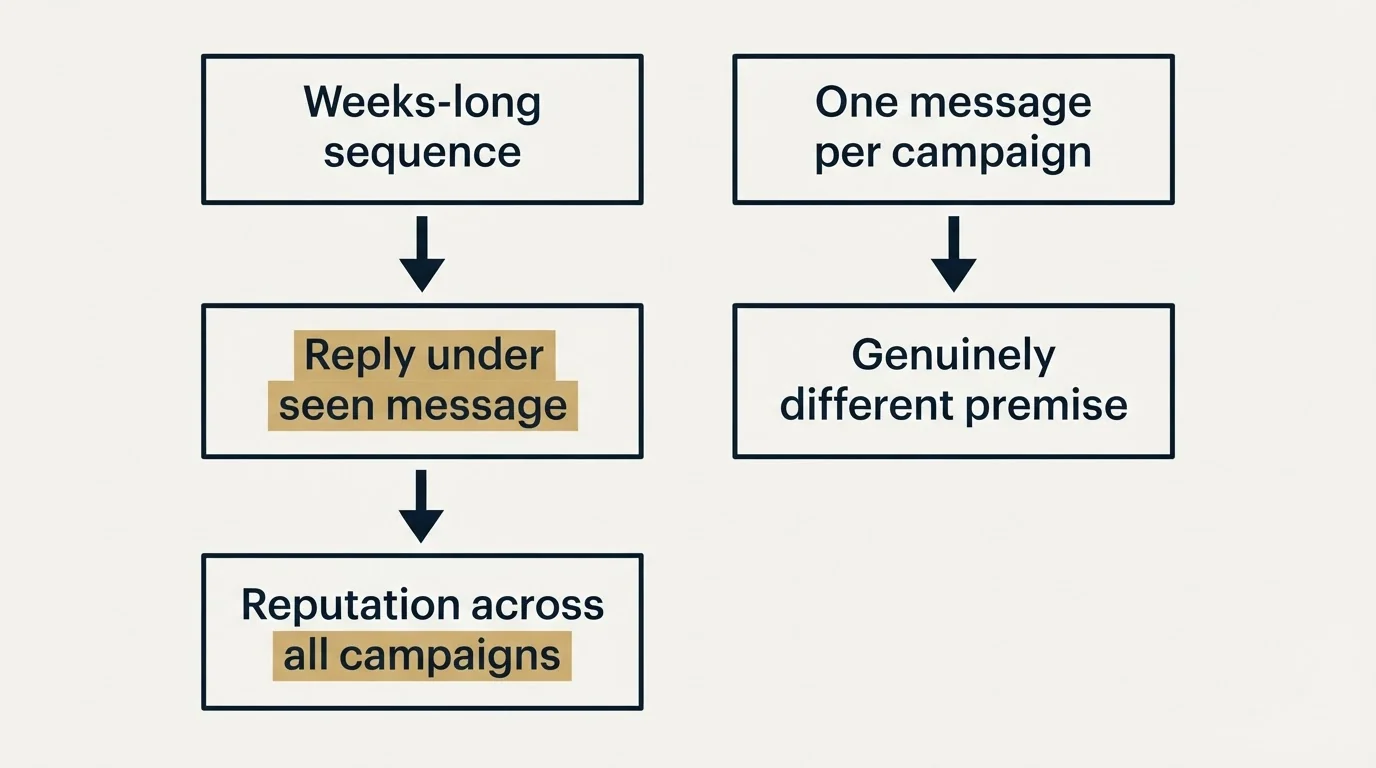
Much of the advice on this page reflects how outbound is commonly run. We run it differently, and since this page sits on our site it is worth saying where the difference is and what it costs us.
- A sequence of messages to each prospect over several weeks
- Later messages often land in the same email thread
- Every contact is reached more than once, so a distracted reader gets another chance
- The later messages go only to people who did not answer the first
- Reputation cost accrues on the sending domain across everything else it sends
- One message, then that campaign is finished for that contact
- No thread replies and no bumps
- A non-responding audience becomes a new campaign with a genuinely different premise, not a reminder
- More of the work moves into targeting and into the one message
- We reach each contact less often, and that is the cost we accept
The reasoning is mechanical rather than moral. A follow-up arrives underneath a message the recipient has already seen and chosen not to answer, so it is delivered to the population most likely to mark it as spam, and the reputation cost of that lands on the sending domain across every campaign running on it. We set that cost against the replies a sequence recovers and decided the trade was not worth it. The full argument, with the numbers from our own campaigns, is in why we stopped using follow-ups.
Follow-Up Strategy

Government personnel are busy and may not respond to initial outreach. Effective follow-up is essential, but it must respect government norms and communication preferences.
Appropriate Follow-Up Cadence
Government outreach typically requires patience. A reasonable follow-up sequence might include:
- Initial email
- Follow-up after 7-10 business days
- Second follow-up after another 2 weeks
- Final follow-up after 3-4 weeks
Space your follow-ups further apart than you might in commercial sales. Government personnel often have limited flexibility to respond quickly, and excessive follow-up can damage your reputation.
Adding Value in Follow-Ups
Each follow-up should add value, not simply repeat your request. Consider:
- Sharing relevant industry news or analysis
- Referencing new contract awards or past performance
- Noting upcoming conferences or events where you might connect
- Providing updates on your capabilities or certifications
Knowing When to Pause
If you receive no response after 4-5 outreach attempts, pause for several months before trying again. Government personnel rotate positions regularly, and a new person in the role may be more receptive.
Building Long-Term Government Relationships
Cold email is the beginning of a relationship-building process that may take years to produce significant contracts. Success in government sales requires sustained commitment and strategic patience.
Industry Events and Conferences
Government agencies host industry days, small business conferences, and technical symposiums. These events provide opportunities to meet contacts in person and learn about upcoming requirements.
Follow up cold emails with invitations to connect at relevant events. In-person meetings often accelerate relationship development.
Capability Briefings
Offer to provide formal capability briefings to government stakeholders. These presentations allow you to demonstrate your expertise and understand agency needs in depth.
Structure capability briefings around agency missions and challenges, not product features. Government buyers want to understand how you solve their problems, not hear a sales pitch.
Past Performance Development
Government evaluators heavily weight past performance in their assessments. Every contract you perform is an opportunity to build the track record that supports future wins.
Seek feedback from government customers, document your successes, and reference this performance in future outreach and proposals.
Patience and Persistence
Government sales cycles are long. A contract you win today may have roots in relationships you built years ago. Maintain consistent outreach even when immediate opportunities are not apparent.
The vendors who succeed in government sales are those who commit to the market long-term and build genuine relationships with government stakeholders over time.
Common Mistakes to Avoid
Government outreach has unique pitfalls that can damage your reputation or disqualify you from opportunities. Avoid these common errors.
Ignoring Procurement Rules
Attempting to sell directly or circumvent formal procurement processes signals that you do not understand how government works. This undermines your credibility with experienced government buyers.
Overly Aggressive Follow-Up
Government personnel operate in hierarchical organizations with limited flexibility. Aggressive sales tactics that work in commercial settings come across as unprofessional in government contexts.
Promising What You Cannot Deliver
Government contracts include strict performance requirements and oversight. Overstating capabilities in your outreach will catch up with you during proposal evaluation or contract performance.
Neglecting Certifications and Registrations
Many government opportunities require specific certifications, registrations, or clearances. Ensure your administrative requirements are in order before conducting outreach.
Key registrations include:
- SAM.gov registration (required for federal contracts)
- DUNS number (now UEI)
- Relevant small business certifications
- State and local vendor registrations
- Security clearances if applicable
Treating All Government Buyers the Same
Federal, state, and local governments have different procurement rules, priorities, and cultures. Research the specific agency and level of government before reaching out.
Measuring Government Outreach Success
Government sales metrics differ from commercial B2B benchmarks. Adjust your expectations and tracking accordingly.
Realistic Response Expectations
Government personnel receive substantial vendor outreach and may not respond to every email. Response rates of 5-15% are reasonable for well-targeted government outreach.
Relationship Metrics
Track relationship development, not just immediate responses:
- Meetings scheduled with program managers or contracting officers
- Capability briefings delivered
- Inclusion in industry days or market research
- Teaming partnerships established
- Contract vehicles and registrations completed
Pipeline Development
Government opportunities have long lead times. Track your pipeline by expected solicitation date and award date, recognizing that timelines often shift.
Win Rate by Contract Type
Analyze your win rates by contract type, size, and agency. This helps you focus outreach on opportunities where you have the strongest competitive position.
Final Thoughts
Cold email to government agencies requires understanding the unique environment in which public sector buyers operate. You are not selling to individuals who can make independent purchasing decisions. You are building relationships within complex organizations governed by regulations designed to ensure fair competition and protect public resources.
The vendors who succeed in government sales approach the market with patience, professionalism, and genuine commitment to supporting agency missions. They understand that cold email is one element of a longer relationship-building process that includes formal proposals, capability demonstrations, and performance on existing contracts.
Start with thorough research on the agencies and programs you want to support. Ensure your registrations and certifications are in order. Craft outreach that demonstrates your understanding of government processes and your commitment to playing by the rules.
The government market rewards vendors who invest in relationships over the long term. Your cold email today may lead to a contract award years from now. That timeline requires patience, but the scale and stability of government spending make the investment worthwhile.
Related Reading
- Cold Email for Retail: The Complete Guide to B2B Outreach
- Cold Email for Fintech Companies: Navigating Compliance and Building Trust
If you would rather have this run for you, RevenueFlow books qualified meetings on a pay-per-meeting basis and publishes client results.
This guide provides general information about government procurement and outreach strategies. Procurement rules vary by agency and jurisdiction. Consult with legal and compliance professionals before engaging in government sales activities.
Frequently asked questions.
Frequently asked questions- Can cold email close deals with government agencies?
- No, cold email cannot close government deals directly. Government buyers must follow strict procurement regulations that prevent them from issuing purchase orders based on outreach alone. Cold email builds awareness, gathers market intelligence, and positions vendors for future RFP opportunities, but you still must submit compliant, competitive proposals through formal solicitation processes to win contracts.
- Who should I contact when cold emailing government agencies?
- Target program managers who oversee mission activities and define requirements, contracting officers who manage procurement processes, technical evaluators who assess solution capabilities, and small business liaisons who help qualified vendors navigate opportunities. Program managers often have significant influence over procurement decisions even without contracting authority, making them valuable relationship-building targets for understanding agency priorities and upcoming requirements.
- What procurement rules do I need to follow when emailing government buyers?
- You must follow procurement integrity rules that prevent sharing non-public information, anti-lobbying restrictions that limit communications during certain procurement phases, and gift and ethics rules. Government agencies operate under the Federal Acquisition Regulation at the federal level or equivalent state and local procurement codes designed to ensure fair competition and prevent corruption. Violating these rules can disqualify your company from opportunities and create legal liability.
- What are government set-aside programs and how do they help vendors?
- Set-aside programs reserve certain government contracts specifically for small businesses, veteran-owned businesses, women-owned businesses, minority-owned businesses, and businesses in economically disadvantaged areas called HUBZone. These programs provide significant competitive advantages because many government buyers actively seek qualified small and disadvantaged businesses to meet their contracting goals. Qualifying for set-aside programs increases access to opportunities with reduced competition.
About the author.

Fernando Cao is CEO at RevenueFlow, which builds and operates outbound revenue engines for B2B companies. Previously at Accenture Strategy. Studied at University of Bath.
Fernando Cao · CEO
Connect on LinkedIn →Explore more.
Ready to scale your outreach?
We build GTM engines that book real meetings. See the receipts.
Related articles.
Cold Email for Telecom: Reaching Carriers and MSPs
Telecom companies face rapid technology changes and competitive pressures. Here's how to approach cold email outreach to carriers, MSPs, and UCaaS providers.
Cold Email for Architecture Firms: 2026 Strategy Guide
Architecture firms buy on project phases rather than fiscal quarters. How to build a list, time the spec window, and write cold emails principals answer.
Cold Email for Trucking and Fleet Companies: 2026 Guide
How to reach carriers, fleet operators, and safety buyers with cold email: FMCSA-driven list building, trigger timing, four templates, and compliance.
Cold Email for Cannabis Companies: 2026 Strategy Guide
The April 2026 rescheduling order split cannabis buyers into two tax realities. Here is how to segment, list-build, and write cold email for each.
Cold Email for Private Equity Firms: 2026 Strategy Guide
How to run cold email into private equity: mapping fund-level and portfolio-level buyers, list sources, four templates, and PE-specific deliverability rules.
Cold Email for Wealth Management Firms: 2026 Strategy Guide
RIAs are 16,500+ mostly small firms with public Form ADV data, small buying committees, and a compliance gate. How to run cold email into wealth management.