Cold Email for Investment and Asset Management: A Guide
A comprehensive guide to cold email outreach for investment and asset management firms, covering compliance requirements, buyer personas, and proven strategies for reaching portfolio managers, CIOs, and family offices.
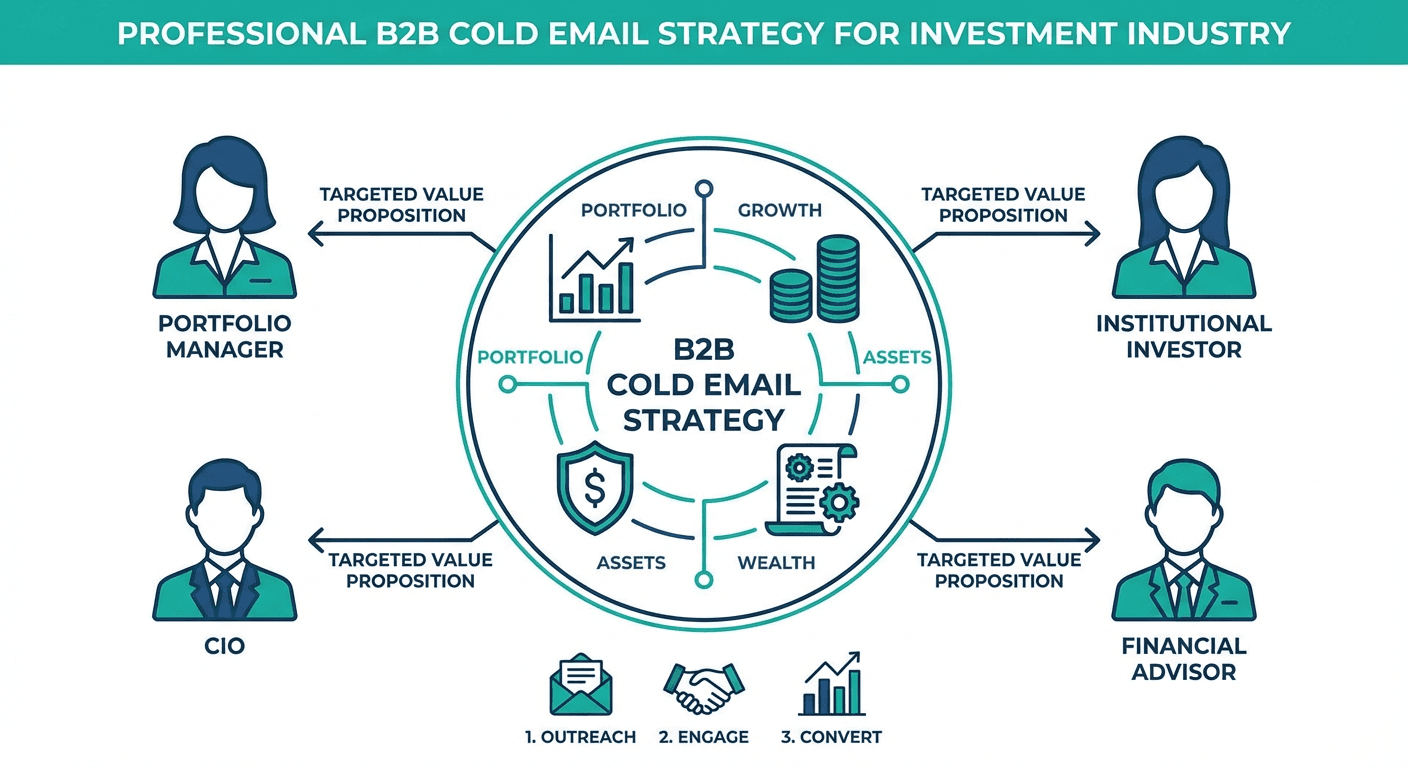
Cold email works effectively for investment and asset management firms because these professionals live in their inboxes, with 73% preferring email when evaluating vendors. Decision-making authority is concentrated in small teams, and firms can approve purchases quickly when they see clear ROI. Success requires targeting specific personas (portfolio managers seeking competitive edge, CIOs evaluating firm-wide impact, or family office principals focused on wealth preservation) with concise messages that demonstrate immediate value while navigating SEC and FINRA compliance requirements.
Key takeaways
- Portfolio managers at hedge funds receive over 200 emails daily, making brevity and immediate value articulation critical for cold outreach success.
- 73% of financial services professionals prefer email as their communication channel when evaluating new vendors.
- Decision-making authority in asset management firms is concentrated, with CIOs or small investment committees able to approve purchases without complex approval chains.
- Investment firms can approve new expenditures quickly when they see clear ROI, unlike corporations with rigid annual budget cycles.
- Portfolio managers evaluate vendors based on whether products provide an information advantage or quantifiable impact on returns.
Reviewed and updated September 1, 2026
Cold Email for Investment and Asset Management: The Complete Guide
A portfolio manager at a $2 billion hedge fund receives 200+ emails daily from vendors, consultants, and service providers. Most get deleted within seconds. Yet the ones that survive the initial scan often lead to six and seven-figure engagements. The difference between deletion and a discovery call comes down to understanding how investment professionals think, what they care about, and how to communicate value in a highly regulated environment.
The investment and asset management industry presents unique opportunities for cold email outreach. These firms manage trillions in assets, operate with lean teams, and constantly seek competitive advantages in data, technology, and operational efficiency. When approached correctly, cold email becomes a direct channel to decision-makers who control substantial budgets and make purchasing decisions quickly.
This guide covers everything you need to know about cold email for investment and asset management firms, from understanding your buyer personas to navigating compliance requirements and crafting messages that get responses.
Why Cold Email Works for Investment and Asset Management
The investment industry might seem like an unlikely fit for cold outreach. These professionals are notoriously busy, skeptical of sales pitches, and operate in a world of warm introductions and trusted relationships. Yet cold email consistently outperforms other channels for reaching this audience, and the reasons are structural.
Investment professionals live in their inboxes. Unlike executives in other industries who might spend their days in meetings or on the floor, portfolio managers, analysts, and CIOs spend significant time reading and responding to emails. Market updates, research reports, trade confirmations, and investor communications all flow through email. This creates a natural environment where a well-crafted cold email can blend into the workflow rather than feeling like an interruption.
Decision-making authority is concentrated. At most asset management firms, the CIO or a small investment committee makes purchasing decisions for data platforms, research tools, and operational systems. This concentrated authority means you're targeting a small number of individuals who can say "yes" without navigating complex approval chains.
The industry values efficiency over formality. While investment professionals appreciate relationship-building, they also respect direct communication that gets to the point. A concise email that clearly articulates value proposition often receives a warmer reception than lengthy sales materials or formal RFP processes.
Budget cycles favor opportunistic buying. Unlike corporations with rigid annual budget cycles, many investment firms can approve new expenditures quickly when they see clear ROI. If your product or service can demonstrate immediate value, the path from cold email to signed contract can be remarkably short.
According to industry research, email remains the preferred communication channel for 73% of financial services professionals when evaluating new vendors. The key is understanding who you're emailing and what motivates them.
The Investment Buyer: Who You're Really Emailing

Success in cold email starts with understanding your audience at a granular level. The investment industry contains distinct buyer personas, each with different priorities, pain points, and communication preferences.
Portfolio Managers
Portfolio managers are the revenue generators at investment firms. They make investment decisions, manage risk, and are ultimately responsible for fund performance. Their time is extraordinarily valuable, and they guard it fiercely.
What they care about: Alpha generation, risk management, information edge, and anything that helps them make better investment decisions faster. They're also concerned with operational efficiency, as time spent on non-investment activities is time not spent generating returns.
How they evaluate vendors: Portfolio managers think in terms of edge. Does this product give me an information advantage? Does it help me identify opportunities or risks before my competitors? Can I quantify the impact on my returns?
Communication preferences: Brevity is essential. Portfolio managers scan emails in seconds and make snap judgments about relevance. Data and specificity matter more than relationship-building language. If you can't articulate your value proposition in two sentences, you've already lost them.
Chief Investment Officers (CIOs)
CIOs oversee the entire investment operation, from strategy and asset allocation to team management and vendor relationships. They balance big-picture thinking with operational concerns.
What they care about: Firm-wide performance, risk management at the portfolio level, team productivity, and competitive positioning. CIOs also think about scalability, wondering whether a tool or service will work as the firm grows.
How they evaluate vendors: CIOs consider both immediate impact and long-term strategic value. They want to understand how your offering fits into their existing technology stack and investment process. Integration complexity and implementation timelines matter significantly.
Communication preferences: CIOs appreciate emails that demonstrate understanding of their firm's strategy and positioning. Generic pitches get ignored, but messages that reference their investment approach or recent portfolio moves show you've done your homework.
Family Office Principals
Family offices manage wealth for high-net-worth families and often operate with small, versatile teams. Principals may handle investment decisions, operations, and vendor relationships simultaneously.
What they care about: Wealth preservation, tax efficiency, multi-generational planning, and privacy. Family offices often have longer investment horizons than institutional managers and prioritize different metrics.
How they evaluate vendors: Trust and discretion are paramount. Family offices prefer working with vendors who understand their unique needs and can provide white-glove service. They're often willing to pay premium prices for superior relationships and responsiveness.
Communication preferences: Family office principals value personalization highly. Emails that reference their family's philanthropic interests, industry background, or specific investment preferences resonate more strongly than generic institutional messaging.
Operations and Technology Leaders
COOs, CTOs, and Heads of Operations manage the infrastructure that supports investment activities. They're responsible for trade execution, reporting, compliance, and technology systems.
What they care about: Reliability, efficiency, cost reduction, and regulatory compliance. Operations leaders are often evaluated on uptime, error rates, and the smooth functioning of daily activities.
How they evaluate vendors: Operations leaders want proof of reliability and support quality. Case studies, uptime statistics, and references from similar firms carry significant weight. They're also concerned about implementation complexity and the burden on their already-stretched teams.
Communication preferences: Technical specificity is appreciated. Operations leaders want to understand how your product works, not just what it does. Emails that address integration, data formats, and support models stand out.
Investment-Specific Challenges (And How to Overcome Them)
Cold email in the investment industry faces unique obstacles. Understanding these challenges helps you craft strategies that work within the industry's constraints.
Challenge 1: Extreme Time Scarcity
Investment professionals, particularly those involved in trading and portfolio management, operate under intense time pressure. They're processing market information, making decisions, and managing risk throughout the trading day.
Solution: Time your outreach strategically. Early morning (6:00-7:30 AM) reaches professionals before the market opens. Late afternoon (4:30-6:00 PM EST) catches them after market close. Avoid the trading day entirely (9:30 AM - 4:00 PM EST) when attention is focused on markets.
Keep emails extremely concise. Your entire message should be readable in 15 seconds or less. Front-load the most important information, as many readers won't make it past the first two sentences.
- 6:00-7:30 AMBefore the open
Early morning reaches professionals before the market opens.
- 9:30 AM to 4:00 PM ESTThe trading day
Avoid entirely. Attention is on markets, decisions and risk throughout the session.
- 4:30-6:00 PM ESTAfter the close
Late afternoon catches them after market close.
Challenge 2: Skepticism and Information Overload
Investment professionals are trained to be skeptical. They evaluate claims critically and are accustomed to filtering out noise. They've also seen countless vendors promise revolutionary products that underdeliver.
Solution: Lead with specifics rather than superlatives. Instead of claiming to be "the best" or "most advanced," cite concrete metrics, name recognizable clients (with permission), or reference specific use cases. Quantify your value proposition whenever possible.
Avoid marketing language and buzzwords. Investment professionals have finely tuned BS detectors, and phrases like "cutting-edge," "game-changing," or "disruptive" trigger automatic skepticism. Plain language that describes what you do and why it matters performs better.
Challenge 3: Regulatory and Compliance Concerns
The investment industry operates under extensive regulatory oversight. Any vendor relationship raises questions about data security, regulatory compliance, and operational risk.
Solution: Address compliance proactively in your outreach. Mention relevant certifications (SOC 2, ISO 27001), regulatory experience, and your track record with similar firms. If your product touches sensitive data or regulated activities, briefly explain your compliance framework.
Be prepared to discuss these topics in depth during follow-up conversations. Having compliance documentation readily available accelerates the sales process with investment firms.
Challenge 4: Preference for Warm Introductions
The investment industry runs on relationships. Many professionals prefer to work with vendors introduced by trusted colleagues rather than cold outreach.
Solution: Use cold email to create warm introductions. Rather than asking for a meeting directly, consider asking if you can send materials for their review or requesting an introduction to the appropriate person at their firm. These lower-friction asks can open doors that direct meeting requests cannot.
Leverage any existing connections aggressively. If you've worked with portfolio companies, industry peers, or former colleagues, mention these relationships early in your outreach.
Challenge 5: Long Evaluation Cycles for Certain Products
While investment firms can move quickly on some purchases, products that touch core systems (OMS, PMS, risk systems) often require extensive evaluation, legal review, and implementation planning.
Solution: Set appropriate expectations in your outreach. If you're selling enterprise software, frame your ask around starting the evaluation process rather than making an immediate decision. Acknowledge the complexity of their decision and position yourself as a resource throughout the process.
For products with shorter evaluation cycles, emphasize speed to value and implementation simplicity.
What Works: Investment Cold Email Best Practices

Effective cold email for investment professionals combines industry-specific knowledge with proven email optimization techniques.
Subject Lines That Get Opened
Subject lines for investment audiences should be short, specific, and relevant to their daily concerns. Avoid anything that looks like marketing or mass email.
Effective patterns include:
- Specificity: "Question about [Firm Name]'s fixed income data" performs better than "Data solutions for asset managers"
- Peer references: "How [Recognizable Firm] handles ESG data" leverages social proof
- Timeliness: "[Topic from recent news] implications" shows you're paying attention to their world
- Brevity: Subject lines under 6 words consistently outperform longer alternatives
Examples that work:
- "Quick question about alternatives data"
- "Used by Point72 and Citadel"
- "Your fixed income workflow"
- "Re: data vendor evaluation"
Avoid:
- ALL CAPS or excessive punctuation
- Vague subjects like "Introduction" or "Partnership opportunity"
- Marketing language like "Exclusive offer" or "Limited time"
- Misleading subjects that don't reflect email content
Email Copy That Gets Responses
Investment professionals respond to emails that demonstrate understanding of their world and respect for their time.
Opening lines matter enormously. Your first sentence determines whether they continue reading. Start with something relevant to their specific situation, whether that's a recent portfolio move, a market event affecting their strategy, or a challenge common to firms like theirs.
Value proposition must be crystal clear. By the end of your second sentence, the reader should understand what you offer and why it matters to them. Investment professionals don't have patience for emails that make them work to understand the point.
Social proof carries weight. If you work with recognizable firms, mention them (with permission). Investment professionals pay attention to what their peers are doing, and a reference to a respected firm can significantly increase response rates.
Call to action should be simple and low-friction. Asking for a 15-minute call is easier than asking for an hour-long demo. Offering to send additional information is easier than asking for a meeting. Start with smaller asks and escalate based on interest.
Keep emails short. Ideal length for investment audiences is 50-100 words. Anything longer significantly reduces response rates. If you can't convey your message in that length, you haven't refined your value proposition enough.
- Step 1Opening line
Your first sentence determines whether they continue reading. Start with something relevant to their specific situation, such as a recent portfolio move or a market event affecting their strategy.
- Step 2Value proposition
By the end of your second sentence, the reader should understand what you offer and why it matters to them.
- Step 3Social proof
If you work with recognizable firms, mention them with permission. Investment professionals pay attention to what their peers are doing.
- Step 4Call to action
Keep it simple and low-friction. Asking for a 15-minute call is easier than asking for an hour-long demo.
Compliance Considerations
Cold email to investment professionals operates in a regulated environment. Understanding the rules helps you stay compliant while maintaining effective outreach.
SEC Regulations
The Securities and Exchange Commission regulates advertising and communications by investment advisers. While cold email to solicit new business relationships (not investment recommendations) generally falls outside the strictest advertising rules, certain principles apply.
Communications should be truthful and not misleading. Performance claims must be substantiated and presented fairly. Any testimonials or endorsements must comply with the SEC's Marketing Rule (Rule 206(4)-1 for registered investment advisers).
If your product or service is targeted specifically at RIAs, be aware that references to their regulatory status should be accurate and current.
FINRA Rules
For broker-dealers and their associated persons, FINRA Rule 2210 governs communications with the public. This includes requirements for fair and balanced presentation of information, appropriate basis for claims, and supervisory review of communications.
If you're selling to FINRA-regulated firms, your outreach should avoid any appearance of promising specific investment results or making exaggerated claims about product benefits.
General Best Practices for Compliance
Document your outreach. Keep records of what you send, to whom, and when. This documentation protects you if questions arise.
Honor opt-outs immediately. CAN-SPAM requirements apply, and the investment industry has heightened sensitivity to respecting communication preferences.
Avoid references to specific securities. Unless your product is a research platform where such references are appropriate, avoid mentioning specific investment opportunities or recommendations.
Be accurate about your own regulatory status. If you're registered, unregistered, or exempt from registration, represent your status accurately.
When in doubt, consult counsel. The intersection of cold outreach and securities regulation can be complex. Legal advice specific to your situation is always worthwhile.
- Communications should be truthful and not misleading
- Performance claims must be substantiated and presented fairly
- Testimonials or endorsements must comply with the SEC's Marketing Rule (Rule 206(4)-1 for registered investment advisers)
- References to a firm's regulatory status should be accurate and current
- FINRA Rule 2210 governs communications with the public
- Fair and balanced presentation of information
- An appropriate basis for claims
- Supervisory review of communications
- Avoid any appearance of promising specific investment results
- Document what you send, to whom, and when
- Honor opt-outs immediately; CAN-SPAM requirements apply
- Avoid references to specific securities unless your product is a research platform where they are appropriate
- Be accurate about your own regulatory status
- When in doubt, consult counsel
Real Investment Cold Email Examples

These examples demonstrate the principles discussed above in action. Adapt them to your specific offering and target audience.
Example 1: Data Platform to Hedge Fund Portfolio Manager
Subject: Alternative data question
Body:
Hi [First Name],
Noticed [Fund Name] has been building positions in consumer discretionary. Our satellite imagery data covers 47 major retail parking lots in real-time, and several multi-manager platforms use it for consumer spending signals.
Happy to send sample data for [specific retailer in their portfolio] if useful for your process.
Best, [Your Name]
Why it works: The email is under 50 words, demonstrates knowledge of their portfolio, offers specific and relevant value, and makes a low-friction ask (sending data rather than requesting a meeting).
Example 2: Operations Software to Family Office COO
Subject: [Family Office Name] operations
Body:
Hi [First Name],
[Family Office Name] has grown substantially over the past few years. Congrats on the expansion.
We help family offices with $500M+ in assets consolidate reporting across managers. Currently working with 12 family offices including [Recognizable Name if permitted].
Would a brief overview of our platform be helpful as you evaluate operations solutions?
Best, [Your Name]
Why it works: Opens with a compliment based on research, establishes relevance through size threshold, uses social proof, and offers a low-commitment next step.
Example 3: Research Platform to Asset Manager CIO
Subject: ESG integration question
Body:
Hi [First Name],
Reading through [Firm Name]'s latest sustainability report, noticed you're expanding ESG integration across strategies.
We provide ESG data on 15,000+ securities with quantitative scores that integrate directly into Bloomberg PORT. Two of your competitors switched to our data last quarter, citing better coverage of emerging markets.
Worth a 15-minute call to explore fit?
Best, [Your Name]
Why it works: Shows knowledge of their publicly stated priorities, provides specific product details, uses competitive pressure appropriately, and asks for a short meeting rather than an extended presentation.
Your Investment Cold Email Checklist
Use this checklist before sending each campaign to ensure you're following best practices for investment and asset management outreach.
Targeting and Research
- Verified recipient's current role and firm
- Confirmed firm's investment strategy and focus areas
- Identified recent news, portfolio changes, or initiatives to reference
- Segmented list by buyer persona (PM, CIO, Operations, Family Office)
Subject Line
- Under 6 words
- Specific to recipient or their firm
- No marketing language or superlatives
- Tested multiple variations
Email Body
- Under 100 words total
- Value proposition clear within first two sentences
- Relevant social proof included (if available)
- Low-friction call to action
- No jargon or buzzwords
Timing
- Scheduled for early morning (6-7:30 AM) or after market close (4:30-6 PM EST)
- Avoided major market events, earnings seasons, or quarter-end periods
Compliance
- All claims are accurate and substantiated
- No misleading statements about products or performance
- Opt-out mechanism included
- Documentation of outreach maintained
Technical
- Sending domain properly warmed
- SPF, DKIM, and DMARC configured
- Email renders correctly on mobile
- Links are accurate and trackable
Getting Started with Investment Cold Email

Cold email to investment and asset management professionals works when you combine deep industry understanding with disciplined execution. The buyers in this industry are sophisticated, time-constrained, and skeptical of marketing claims. Success comes from respecting their constraints, demonstrating genuine value, and communicating with precision.
The strategies in this guide provide a foundation, but effective cold email is ultimately about testing, learning, and refining your approach based on what resonates with your specific audience.
If you'd like help implementing a cold email program for investment and asset management prospects, we can assist. Our team has experience reaching portfolio managers, CIOs, and family offices across the investment landscape.
Get your free investment cold email campaign and let our team handle targeting, copywriting, and campaign management. We focus on generating qualified conversations with investment professionals who match your ideal client profile.
Related Reading
Frequently asked questions.
Frequently asked questions- Why does cold email work for reaching investment professionals?
- Investment professionals spend significant time in their inboxes reading market updates, research reports, and trade confirmations, creating a natural environment for well-crafted cold emails. Unlike other industries, decision-making authority is concentrated in small teams who can approve purchases quickly. The industry also values efficiency over formality, making direct email communication more effective than lengthy sales processes or formal RFPs.
- What do portfolio managers care about when evaluating cold emails?
- Portfolio managers focus on alpha generation and competitive edge. They evaluate whether a product gives them an information advantage, helps identify opportunities before competitors, or improves operational efficiency. They think in terms of quantifiable impact on returns and scan emails in seconds, requiring value propositions stated in two sentences or less. Time spent on non-investment activities is time not generating returns, so brevity is essential.
- How do Chief Investment Officers differ from portfolio managers as email targets?
- CIOs oversee entire investment operations and balance big-picture strategy with operational concerns. They evaluate both immediate impact and long-term strategic value, considering how offerings fit into existing technology stacks and whether solutions will scale as the firm grows. CIOs appreciate emails demonstrating understanding of their firm's specific investment approach and positioning, while generic pitches get ignored.
- What compliance requirements apply to cold emailing investment firms?
- Investment-focused cold emails must navigate SEC regulations and FINRA rules governing financial services communications. While specific regulatory requirements vary by product type and sender, general best practices include avoiding prohibited claims, maintaining compliance review processes, and understanding disclosure requirements. The regulatory environment requires careful attention to messaging that doesn't run afoul of financial services marketing restrictions.
About the author.

Fernando Cao is CEO at RevenueFlow, which builds and operates outbound revenue engines for B2B companies. Previously at Accenture Strategy. Studied at University of Bath.
Fernando Cao · CEO
Connect on LinkedIn →Explore more.
Ready to scale your outreach?
We build GTM engines that book real meetings. See the receipts.
Related articles.
Cold Email for Architecture Firms: 2026 Strategy Guide
Architecture firms buy on project phases rather than fiscal quarters. How to build a list, time the spec window, and write cold emails principals answer.
Cold Email for Trucking and Fleet Companies: 2026 Guide
How to reach carriers, fleet operators, and safety buyers with cold email: FMCSA-driven list building, trigger timing, four templates, and compliance.
Cold Email for Cannabis Companies: 2026 Strategy Guide
The April 2026 rescheduling order split cannabis buyers into two tax realities. Here is how to segment, list-build, and write cold email for each.
Cold Email for Private Equity Firms: 2026 Strategy Guide
How to run cold email into private equity: mapping fund-level and portfolio-level buyers, list sources, four templates, and PE-specific deliverability rules.
Cold Email for Wealth Management Firms: 2026 Strategy Guide
RIAs are 16,500+ mostly small firms with public Form ADV data, small buying committees, and a compliance gate. How to run cold email into wealth management.
Cold Email for Interior Design Firms: 2026 Strategy Guide
Commercial interior designers specify products they never buy. Here is how to build cold email that wins the specification, plus four templates.