Cold Email for Joint Ventures: Complete Strategy Guide
Master cold email outreach to initiate joint venture partnerships that combine resources, capabilities, and market access for mutual growth.
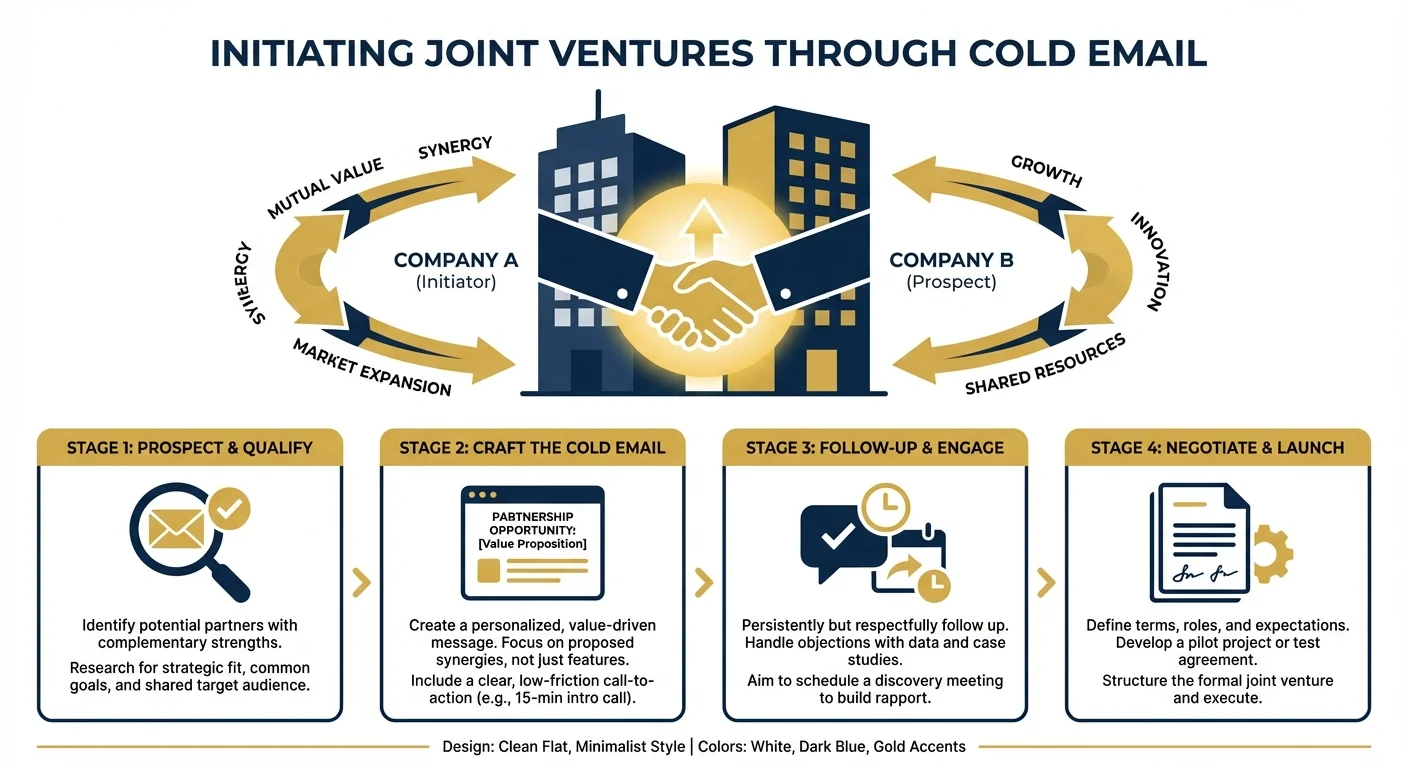
Cold email enables systematic outreach to senior executives who can authorize joint ventures, providing direct access to strategic decision-makers while allowing you to control how opportunities are framed. Successful JV outreach requires identifying partners with complementary capabilities and strategic alignment, then crafting proposals that demonstrate mutual value. Joint ventures take forms including equity JVs (new legal entities), contractual JVs (agreement-based), project-based JVs (temporary), and strategic alliances, each serving objectives like market entry, capability acquisition, or risk sharing.
Key takeaways
- Cold email provides direct access to strategic decision makers who can commit organizational resources to joint ventures, bypassing reliance on conference encounters or mutual connections.
- Joint ventures take five primary forms: equity joint ventures with new legal entities, contractual joint ventures through agreements, project-based temporary partnerships, consortium arrangements for large initiatives, and strategic alliances with less integration.
- Strategic complementarity is the first qualification criterion for JV partners: successful ventures require partners who contribute genuinely different but synergistic capabilities.
- Companies form joint ventures for seven strategic objectives: market entry, capability acquisition, risk sharing, scale achievement, regulatory compliance, innovation acceleration, and market defense.
- Controlling the initial framing of a joint venture opportunity through proactive outreach allows you to position the partnership in terms that resonate with each specific potential partner.
Reviewed and updated October 1, 2026
Cold Email for Joint Ventures: Complete Strategy Guide
Joint ventures create new business opportunities by combining the capabilities of two or more companies. When Sony and Ericsson formed Sony Ericsson, they combined Sony's consumer electronics expertise with Ericsson's telecommunications technology. When Starbucks partnered with PepsiCo to create bottled Frappuccinos, both companies accessed markets they couldn't reach alone. These transformative partnerships often begin with someone reaching out to propose a collaboration.
Cold email provides a direct path to the executives who can evaluate and pursue joint venture opportunities. Unlike waiting for chance encounters at conferences or relying on mutual connections, proactive outreach allows you to systematically approach potential JV partners with tailored proposals.
Why Cold Email Works for Joint Ventures
Joint ventures represent significant strategic commitments. Initiating these conversations requires reaching senior decision makers who can evaluate partnership potential.
Access to strategic decision makers. JV discussions require access to executives who can commit organizational resources. Cold email reaches these individuals directly when structured appropriately.
Controlled framing. When you initiate contact, you control how the opportunity is initially framed. This allows you to position the JV in terms that resonate with each potential partner.
Market exploration. Cold outreach reveals which potential partners are receptive to joint ventures. Responses provide intelligence about strategic priorities and partnership appetite.
First mover advantage. Approaching potential JV partners proactively establishes relationships before competitors pursue the same opportunities.
Understanding Joint Venture Structures
Joint ventures take various forms depending on objectives, resources, and risk tolerance. Understanding options helps you propose appropriate structures.
Types of Joint Ventures
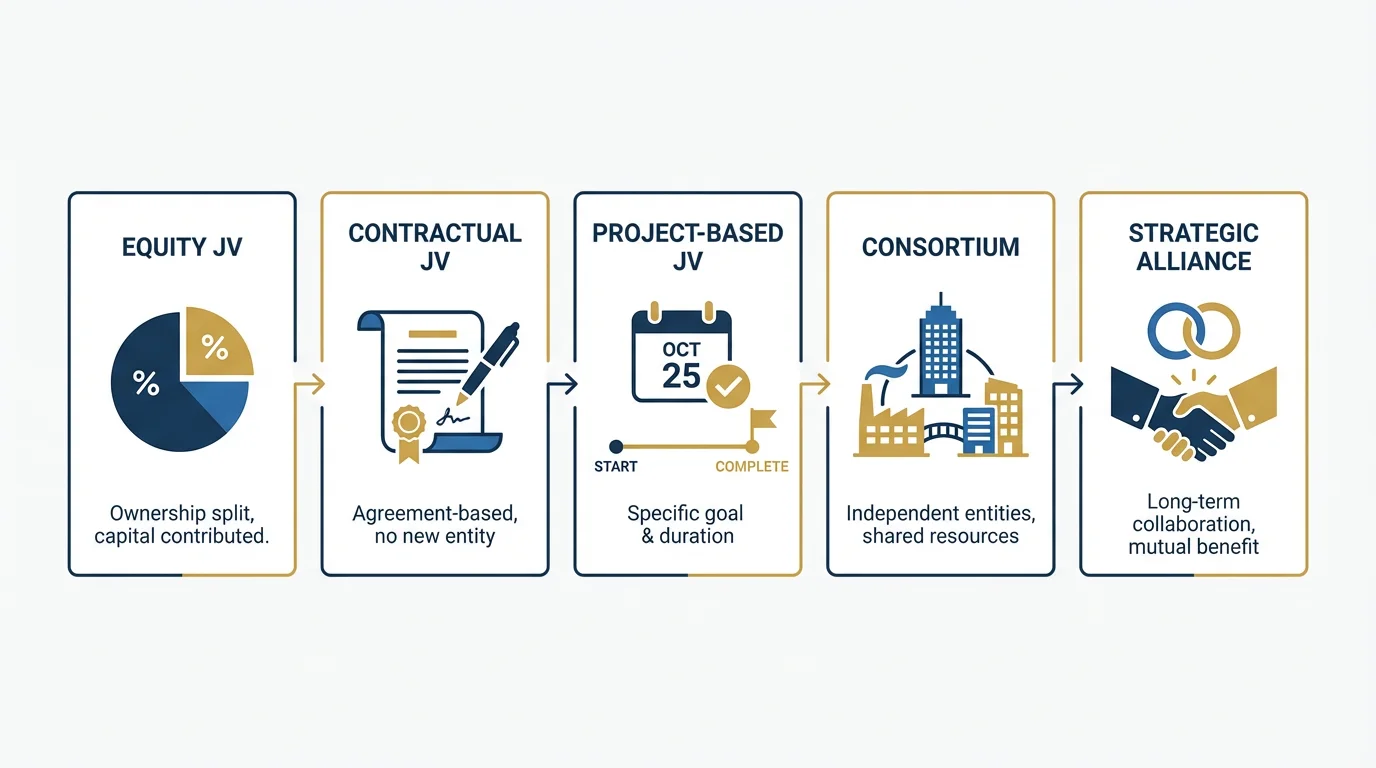
Equity joint ventures. Partners contribute capital to form a new legal entity. Each party holds equity shares proportional to their contribution. The JV operates as an independent business.
Contractual joint ventures. Partners collaborate through contractual agreements without forming a separate entity. Each party contributes defined resources and receives defined returns.
Project-based joint ventures. Temporary partnerships formed for specific projects, products, or initiatives. The JV dissolves upon project completion.
Consortium arrangements. Multiple parties collaborate on large-scale initiatives, often in industries like construction, defense, or research.
Strategic alliances. Looser collaborations that share some characteristics with JVs but involve less integration or resource commitment.
Joint Venture Objectives
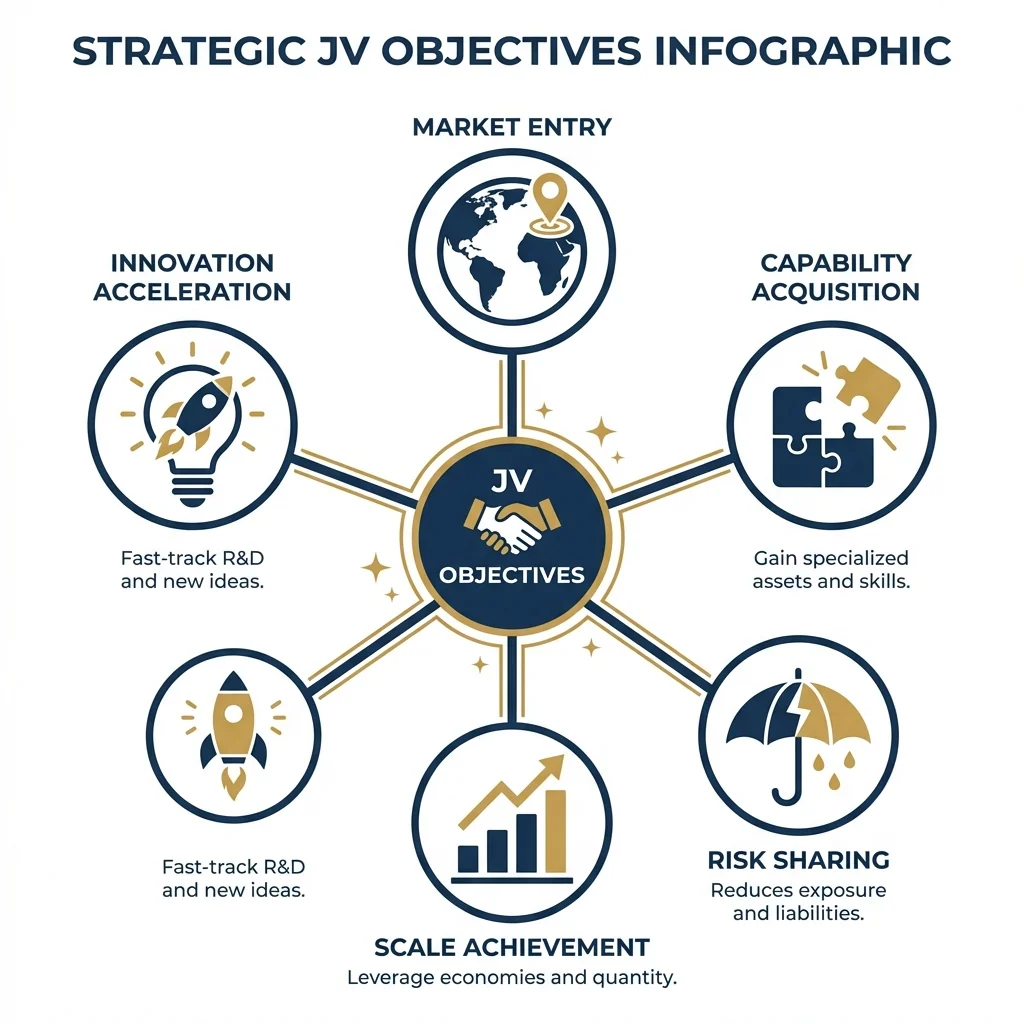
Companies form joint ventures for various strategic reasons:
Market entry. Accessing new geographic markets through partners with local presence, relationships, and expertise.
Capability acquisition. Gaining access to technology, skills, or resources that would take years to develop internally.
Risk sharing. Distributing the costs and risks of large projects or uncertain initiatives across multiple parties.
Scale achievement. Combining resources to achieve scale necessary for competition or market viability.
Regulatory compliance. Meeting local ownership requirements or regulatory conditions through partnership.
Innovation acceleration. Combining complementary R&D capabilities to develop new products or technologies faster.
Market defense. Strengthening competitive position through strategic partnerships that expand offerings or market reach.
Identifying Joint Venture Partners
Strategic partner selection determines JV success. The right partners bring complementary capabilities without excessive conflict potential.
Qualification Criteria
Strategic complementarity. Do their capabilities genuinely complement yours? JVs work when partners contribute different but synergistic elements.
Cultural compatibility. Are organizational cultures compatible enough for close collaboration? Significant cultural mismatches create operational friction.
Strategic alignment. Do their strategic priorities align with JV objectives? Misaligned priorities lead to partner conflict.
Resource capacity. Do they have resources to commit to the JV? Underfunded JVs fail to achieve objectives.
Reputation and reliability. Are they known as reliable partners? Due diligence on partnership track record matters.
Executive sponsorship potential. Is there likely executive sponsorship for a JV? Partnerships without senior champions struggle.
Finding Potential Partners
Strategic gap analysis. Identify what capabilities or market access you need but lack. Search for companies that possess those elements.
Competitor analysis. Review competitors' partnerships to identify potential partners you might also benefit from.
Industry mapping. Map your industry ecosystem to identify companies at different positions in the value chain.
Geographic research. For market entry JVs, research companies with strong presence in target geographies.
Technology scouting. For technology JVs, identify companies with relevant R&D capabilities or intellectual property.
Conference networks. Industry events bring together companies that might make good JV partners.
LinkedIn research. Search for executives responsible for corporate development, strategic partnerships, or business development.
Crafting Joint Venture Outreach Emails
JV outreach requires demonstrating strategic vision while being concrete enough to warrant serious consideration.
Email Structure Best Practices
Lead with strategic insight. Demonstrate you understand their strategic context and have identified a genuine opportunity.
Be specific about the opportunity. Vague partnership proposals get ignored. Describe the specific JV concept you envision.
Explain mutual benefit. Clearly articulate what each party brings and gains. One-sided proposals don't resonate.
Acknowledge complexity. JVs are complex undertakings. Show you understand this while proposing manageable next steps.
Request appropriate engagement. JV discussions require senior attention. Request an exploratory conversation rather than commitment.
Joint Venture Outreach Email Templates
Template 1: Market Entry JV Proposal
Subject: Joint venture opportunity in [Target Market]
Hi [Name],
I'm reaching out with a joint venture concept that could benefit both [Their Company] and [Your Company] in [Target Market].
[Your Company] has developed [your capability or offering], which has [performance or traction in existing markets]. We're looking to expand into [Target Market], where [Their Company] has established presence and relationships.
I envision a partnership where:
- We contribute: [Your contribution, like technology, products, or expertise]
- You contribute: [Their contribution, like market access, relationships, or local operations]
- Together we: [Joint objective]
The [Target Market] opportunity is significant. [Brief market data or rationale]. Neither of us could address it as effectively alone.
Would you be open to an exploratory conversation about whether this makes strategic sense for [Their Company]?
[Your name] [Title], [Your Company]
Template 2: Technology/Product JV Proposal
Subject: Product development partnership opportunity
Hi [Name],
I've been following [Their Company]'s work in [their technology or product area], and I believe there's an opportunity for a joint venture that could benefit both organizations.
[Your Company] has developed [your technology or capability]. [Their Company] has strength in [their complementary capability]. Combining these could create [specific product or offering] that neither could develop as effectively independently.
The market opportunity is substantial:
- [Market size or growth data]
- [Customer demand indicators]
- [Competitive landscape observation]
A joint venture could structure this as [brief structural concept, like shared development with revenue split].
I'd welcome the opportunity to explore whether this aligns with [Their Company]'s strategic priorities. Would you have time for a preliminary discussion?
[Your name]
Template 3: Geographic Expansion JV Proposal
Subject: Partnership for [Your Country/Region] expansion?
Hi [Name],
I manage strategic partnerships at [Your Company], and I wanted to explore a potential joint venture with [Their Company] for [geographic market] expansion.
[Your Company] has built [your product or capability] that's proven successful in [your current markets]. [Their Company]'s established presence in [their markets] suggests complementary geographic coverage.
A JV structure could allow us to:
- Bring [your product] to [their markets] leveraging your distribution and relationships
- Expand [their offering] to [your markets] through our established channels
- Share market development costs and risks
I believe there's strategic merit worth exploring. Would you be open to a preliminary conversation?
[Your name]
Template 4: Industry Consortium Proposal
Subject: Industry consortium opportunity
Hi [Name],
I'm exploring interest in forming an industry consortium to address [industry challenge or opportunity], and [Their Company] is one of the organizations I believe should be at the table.
The challenge: [Brief description of industry challenge]
The opportunity: [What a consortium could accomplish that individual companies cannot]
I envision a consortium of [number] leading companies collaborating to [specific objective]. Participants would contribute [contribution type] and benefit from [benefit type].
Companies I'm approaching include [other targets if appropriate to share]. [Their Company]'s strength in [relevant area] would be valuable to the consortium.
Would you be interested in an exploratory conversation about participation?
[Your name]
Template 5: Capability Combination JV Proposal
Subject: Strategic partnership concept
Hi [Name],
I've been thinking about [industry trend or market shift], and I believe there's an opportunity for a joint venture between [Your Company] and [Their Company] to capitalize on it.
The opportunity: [Brief description of market opportunity]
[Your Company] brings: [Your relevant capabilities] [Their Company] brings: [Their complementary capabilities] Together: [What the combination could achieve]
A JV could structure this as [brief structural concept]. The scale of investment and risk involved makes partnership more attractive than going alone.
I'd value your perspective on whether this opportunity aligns with [Their Company]'s priorities. Would you have 30 minutes for an exploratory conversation?
[Your name]
Template 6: Research and Development JV Proposal
Subject: R&D partnership opportunity
Hi [Name],
I manage corporate development at [Your Company], and I wanted to explore a potential R&D joint venture with [Their Company].
Both our organizations are investing in [technology or research area]. I believe combining efforts could accelerate development while sharing costs and risks.
Specifically, I envision:
- Pooling R&D resources for [specific objective]
- Sharing resulting intellectual property under [general framework]
- Bringing combined capabilities to market faster than either could alone
The competitive landscape is moving quickly in this space. A partnership could establish both companies as leaders rather than racing separately toward similar goals.
Would you be open to discussing whether this makes strategic sense?
[Your name]
Where we differ from standard practice
Much of the advice on this page reflects how outbound is commonly run. We run it differently, and since this page sits on our site it is worth saying where the difference is and what it costs us.
- A sequence of messages to each prospect over several weeks
- Later messages often land in the same email thread
- Every contact is reached more than once, so a distracted reader gets another chance
- The later messages go only to people who did not answer the first
- Reputation cost accrues on the sending domain across everything else it sends
- One message, then that campaign is finished for that contact
- No thread replies and no bumps
- More of the work moves into targeting and into the one message
- We reach each contact less often, and that is the cost we accept
The reasoning is mechanical rather than moral. A follow-up arrives underneath a message the recipient has already seen and chosen not to answer, so it is delivered to the population most likely to mark it as spam, and the reputation cost of that lands on the sending domain across every campaign running on it. We set that cost against the replies a sequence recovers and decided the trade was not worth it. The full argument, with the numbers from our own campaigns, is in why we stopped using follow-ups.
Follow-Up Strategies
Joint venture discussions involve senior executives with demanding schedules. Persistent, professional follow-up maintains presence without being aggressive.
Follow-Up Sequence
First follow-up (7-10 days after initial email):
Subject: Re: Joint venture opportunity in [Target Market]
Hi [Name],
I wanted to follow up on my note about a potential joint venture between [Your Company] and [Their Company].
I realize JV discussions are significant undertakings, and I'm not expecting immediate commitment. I'd simply welcome an exploratory conversation to determine whether there's strategic merit worth pursuing.
Would you have 30 minutes in the coming weeks?
[Your name]
Second follow-up (10-14 days after first follow-up):
Subject: Following up
Hi [Name],
I'll keep this brief. The joint venture concept I outlined [brief one-line summary] still seems strategically compelling, but I understand you have many priorities.
If now isn't the right time, would you prefer I follow up in a few months? Or if someone else on your team handles partnership evaluation, I'd appreciate a point in the right direction.
[Your name]
Third follow-up (4-6 weeks after second follow-up):
Subject: Circling back on partnership opportunity
Hi [Name],
I wanted to circle back on the joint venture concept I shared [timeframe] ago. Since then, [relevant development in your business, their business, or the market].
Does this change the strategic calculus for [Their Company]? I remain interested in exploring whether partnership makes sense.
[Your name]
Providing Value Between Outreach
Share relevant analysis. Send industry analysis, market research, or strategic observations relevant to the JV opportunity.
Reference their developments. Acknowledge their strategic moves or announcements that relate to the partnership concept.
Offer perspective. Share your perspective on industry developments that affect both organizations.
Evaluating and Structuring Joint Ventures
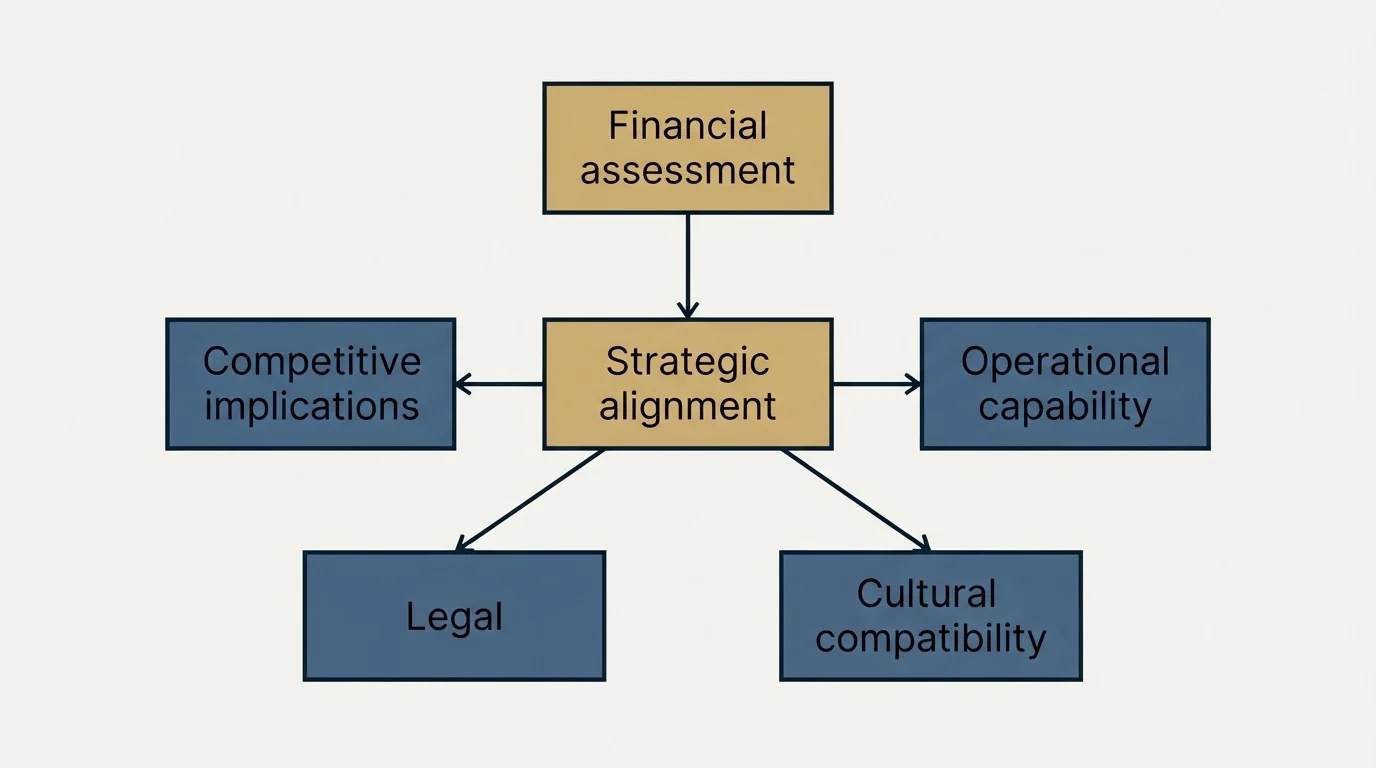
Once conversations begin, thorough evaluation and careful structuring determine JV success.
Due Diligence Considerations
Strategic alignment. Verify that strategic priorities genuinely align and that both parties are committed to JV objectives.
Financial assessment. Evaluate partner financial strength, contribution capacity, and value expectations.
Operational capability. Assess whether partners can actually deliver what they promise to contribute.
Cultural compatibility. Understand organizational cultures and identify potential friction points.
Legal and regulatory. Review any legal or regulatory constraints on partnership or JV formation.
Competitive implications. Consider how the JV affects competitive relationships and whether conflicts exist.
Key Structural Elements
Governance. How will the JV be governed? Who has decision authority over what?
Contributions. What does each party contribute? How are contributions valued?
Economics. How are revenues, costs, and profits shared? What's the equity split?
Operations. Who operates the JV? How are day-to-day decisions made?
IP ownership. Who owns intellectual property created by the JV?
Exit provisions. How can partners exit? What happens to JV assets upon dissolution?
Dispute resolution. How are disagreements resolved?
Term and renewal. How long does the JV last? What triggers renewal or termination?
Managing Joint Venture Relationships
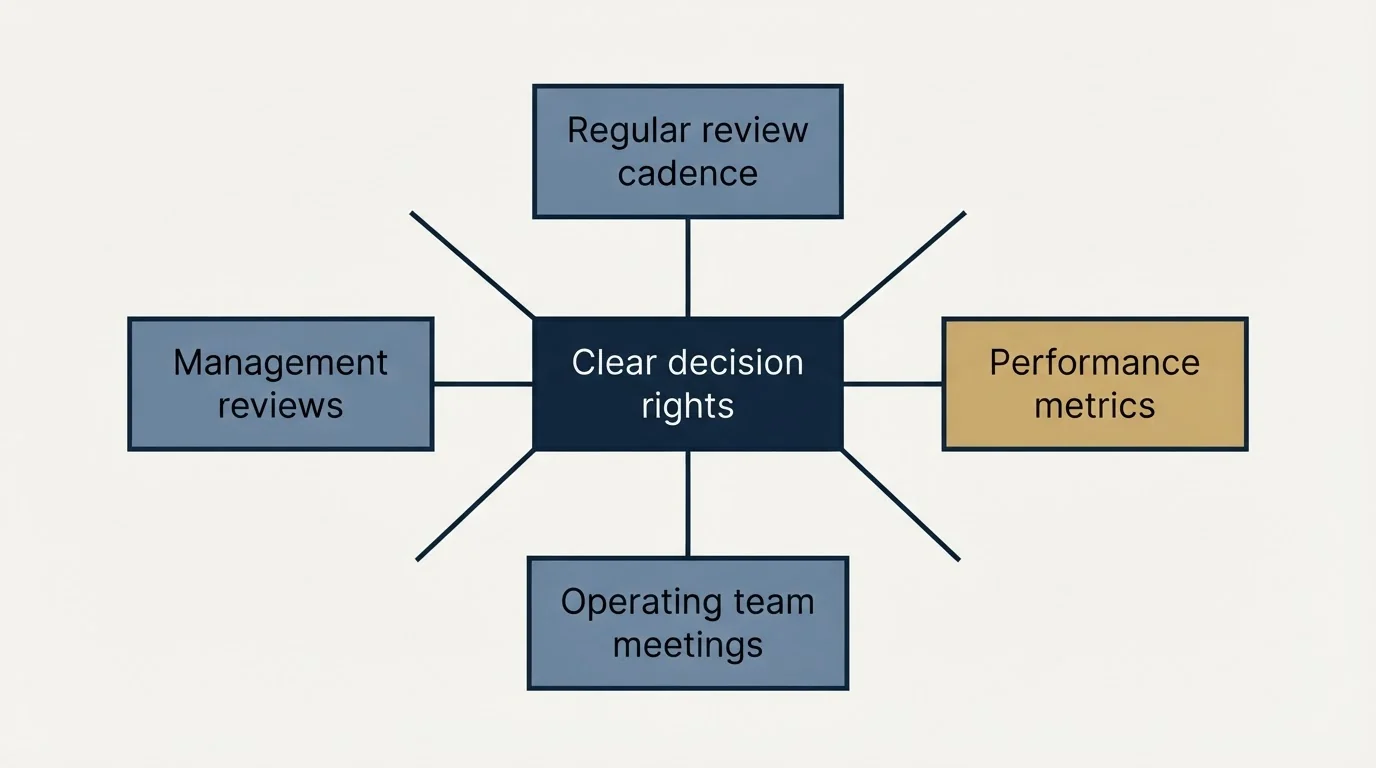
JV success requires ongoing relationship management beyond the initial agreement.
Governance Best Practices
Clear decision rights. Establish who decides what at outset. Ambiguity creates conflict.
Regular review cadence. Schedule periodic reviews to assess performance and address issues.
Escalation procedures. Define how disputes escalate and who resolves them.
Performance metrics. Agree on KPIs that measure JV success objectively.
Communication Rhythms
Operating team meetings. Regular meetings among teams doing day-to-day JV work.
Management reviews. Monthly or quarterly reviews with partner management.
Executive oversight. Periodic executive engagement to maintain strategic alignment.
Issue escalation. Clear channels for raising concerns that need partner attention.
Common JV Challenges
Strategic drift. Partner priorities change over time, potentially misaligning with JV objectives. Regular strategic discussions help.
Contribution disputes. Disagreements about whether partners are fulfilling their commitments. Clear metrics and regular review help.
Cultural friction. Operational differences between partner organizations. Proactive culture integration efforts help.
Control conflicts. Disputes about decision authority. Clear governance structures help.
Exit complexity. Disagreement about whether or when to dissolve the JV. Clear exit provisions help.
Measuring Joint Venture Success
Track metrics that indicate whether your JV development efforts are working.
Outreach Metrics
Response rate. What percentage of potential partners respond to outreach? Meeting conversion. What percentage of responses lead to substantive strategic discussions? Evaluation advancement. How many discussions progress to formal evaluation or due diligence? Formation rate. What percentage of evaluations result in formed JVs?
JV Performance Metrics
Strategic objective achievement. Is the JV achieving its stated objectives? Financial performance. Is the JV meeting financial targets? Operational metrics. Are operational KPIs being met? Partner satisfaction. Are both partners satisfied with the relationship?
Portfolio Metrics
JV success rate. What percentage of formed JVs achieve their objectives? Time to value. How long before JVs generate meaningful results? Return on investment. What's the ROI across your JV portfolio?
Common Joint Venture Mistakes
Avoid these errors that undermine JV success.
Partner Selection Errors
Capability mismatch. Partnering with organizations that don't actually have the capabilities you need.
Cultural incompatibility. Ignoring cultural differences that create ongoing operational friction.
Strategic misalignment. Partnering with organizations whose strategic priorities don't align with JV objectives.
Structural Errors
Governance gaps. Inadequate governance structures that allow disputes to fester.
Contribution ambiguity. Vague definitions of what each party contributes, leading to disagreements.
Exit complexity. Insufficient attention to exit provisions, creating problems when circumstances change.
Management Errors
Insufficient attention. Treating the JV as "set and forget" rather than actively managing the partnership.
Poor communication. Allowing communication to lapse, creating information gaps and trust erosion.
Delayed conflict resolution. Allowing disputes to escalate rather than addressing them promptly.
Joint Venture Outreach Checklist
Use this checklist to ensure your JV outreach succeeds.
Before Starting:
- JV strategic rationale defined
- Target partner profile established
- Initial JV structure concept developed
- Internal alignment on JV pursuit
Partner Identification:
- Target partner list built
- Decision makers identified
- Research completed on each target
- Prioritization applied
Outreach:
- Personalized emails drafted
- Supporting materials ready
- Response handling process established
Evaluation Preparation:
- Due diligence framework ready
- Legal counsel engaged
- Evaluation criteria defined
- Internal approval process clear
Building Joint Venture Capabilities
Joint ventures create opportunities that neither party could pursue independently. The companies that succeed with JVs develop systematic approaches to identifying, pursuing, and managing partnerships.
Cold email provides direct access to the executives who can evaluate and pursue JV opportunities. By demonstrating strategic insight and proposing specific partnership concepts, you can open conversations that lead to transformative collaborations.
Start by clearly defining what strategic objectives JVs could help you achieve. Identify companies with complementary capabilities. Research specific organizations and the executives who handle strategic partnerships. Craft outreach that presents compelling JV concepts. Follow up persistently while providing value. Conduct thorough evaluation and structure partnerships carefully. Manage relationships actively to ensure JV success.
Ready to explore joint venture opportunities? Our team specializes in outreach campaigns that initiate strategic partnership conversations. Request your free custom campaign and let us help you connect with potential JV partners.
Related Reading
Frequently asked questions.
Frequently asked questions- Why should I use cold email instead of warm introductions for joint venture partnerships?
- Cold email allows you to systematically approach potential JV partners with tailored proposals rather than waiting for chance conference encounters or mutual connections. You gain first-mover advantage by establishing relationships before competitors pursue the same opportunities, control how the opportunity is initially framed, and can explore the market to identify which potential partners are receptive. JV discussions require reaching executives who can commit organizational resources, and cold email provides direct access to these strategic decision-makers when structured appropriately.
- What types of joint venture structures can I propose through cold email outreach?
- You can propose five main JV structures depending on objectives and risk tolerance. Equity joint ventures involve partners contributing capital to form a new legal entity with proportional equity shares. Contractual joint ventures use agreements without forming separate entities. Project-based joint ventures create temporary partnerships for specific initiatives that dissolve upon completion. Consortium arrangements involve multiple parties collaborating on large-scale initiatives. Strategic alliances offer looser collaborations with less integration or resource commitment than traditional JVs.
- How do I identify the right companies to target for joint venture cold emails?
- Start with strategic gap analysis to identify capabilities or market access you need but lack, then search for companies possessing those elements. Review competitors' partnerships to find potential partners who might benefit you. Map your industry ecosystem to identify companies at different value chain positions. For market entry JVs, research companies with strong presence in target geographies. For technology partnerships, identify companies with relevant R&D capabilities or intellectual property. Strategic complementarity (partners contributing different but synergistic elements) is the essential qualification criterion.
- What makes a company a qualified joint venture partner?
- Qualified JV partners must demonstrate strategic complementarity by bringing capabilities that genuinely complement yours rather than duplicate them. Cultural compatibility matters because significant mismatches create operational friction during close collaboration. They need strategic alignment with JV objectives and sufficient resource capacity to commit to the partnership. Evaluate their reputation and reliability through due diligence on partnership track record. Finally, assess executive sponsorship potential, as partnerships without senior champions typically struggle to succeed.
- What strategic objectives do joint ventures typically serve?
- Companies form joint ventures for seven primary strategic reasons. Market entry JVs access new geographic markets through partners with local presence and expertise. Capability acquisition gains access to technology or skills that would take years to develop internally. Risk sharing distributes costs and risks of large or uncertain initiatives. Scale achievement combines resources to reach competitive viability. Regulatory compliance meets local ownership requirements. Innovation acceleration combines complementary R&D capabilities to develop products faster. Market defense strengthens competitive position through strategic partnerships that expand offerings or reach.
About the author.

Ben Carden is CRO at RevenueFlow, which builds and operates outbound revenue engines for B2B companies. Previously at Gartner Enterprise. Studied at London School of Economics.
Ben Carden · CRO
Connect on LinkedIn →Explore more.
Ready to scale your outreach?
We build GTM engines that book real meetings. See the receipts.
Related articles.
Cold Email for Affiliate Recruitment: Strategy Guide
Master cold email outreach to recruit high-performing affiliates who can drive significant revenue for your business with proven templates and strategies.
Cold Email for Reseller Partnerships: Strategy Guide
Learn how to use cold email to recruit resellers and channel partners who can expand your market reach and drive revenue through their existing customer relationships.