Cold Email for Legal Services: Law Firms and Legal Tech
Law firms and legal tech companies face unique cold email challenges. Here's how to approach professional services outreach while maintaining ethical standards.
Legal cold email requires strict adherence to professional conduct rules and understanding of buyer sophistication. Law firms can email corporate counsel and other attorneys but not individual consumers. Legal tech companies face fewer restrictions. Success depends on demonstrating verifiable claims, understanding long sales cycles, leveraging legal operations contacts, and building referral relationships. Lawyers value proof over promises and relationships over transactions.
Key takeaways
- The ABA Model Rule 7.3 generally prohibits law firms from cold emailing individual consumers for client solicitation, but permits B2B outreach to corporate counsel who are considered sophisticated users of legal services.
- Legal operations professionals are more receptive to cold outreach than attorneys and serve as the best entry point for legal technology vendors.
- Am Law 100 and global law firms have sophisticated procurement processes with long evaluation cycles that typically require partner-level relationships or peer firm references to break in.
- All claims in legal cold email must be verifiable under Rule 7.1, which prohibits false or misleading communications and restricts superlatives like 'best' or 'leading' unless substantiated.
- Law firm purchasing authority varies dramatically by size: solo practitioners decide immediately, mid-size firms involve 2-5 stakeholders, and large firms require committee review and partner buy-in.
Reviewed and updated September 1, 2026
Cold Email for Legal Services: Business Development for Law Firms and Legal Tech
The legal industry presents a distinctive set of challenges for cold email outreach. Whether you are a law firm seeking new clients or a legal tech company selling to attorneys, you need to understand the professional culture, ethical constraints, and decision-making patterns that define this market.
Lawyers are trained to be skeptical. They read contracts for a living and spot questionable claims immediately. They operate under strict professional responsibility rules that govern advertising and solicitation. And they value relationships, referrals, and reputation above almost everything else.
This guide covers how to approach cold email for legal services effectively, whether you are doing business development for a law firm, selling legal technology, or marketing services to in-house counsel.
Understanding the Legal Market
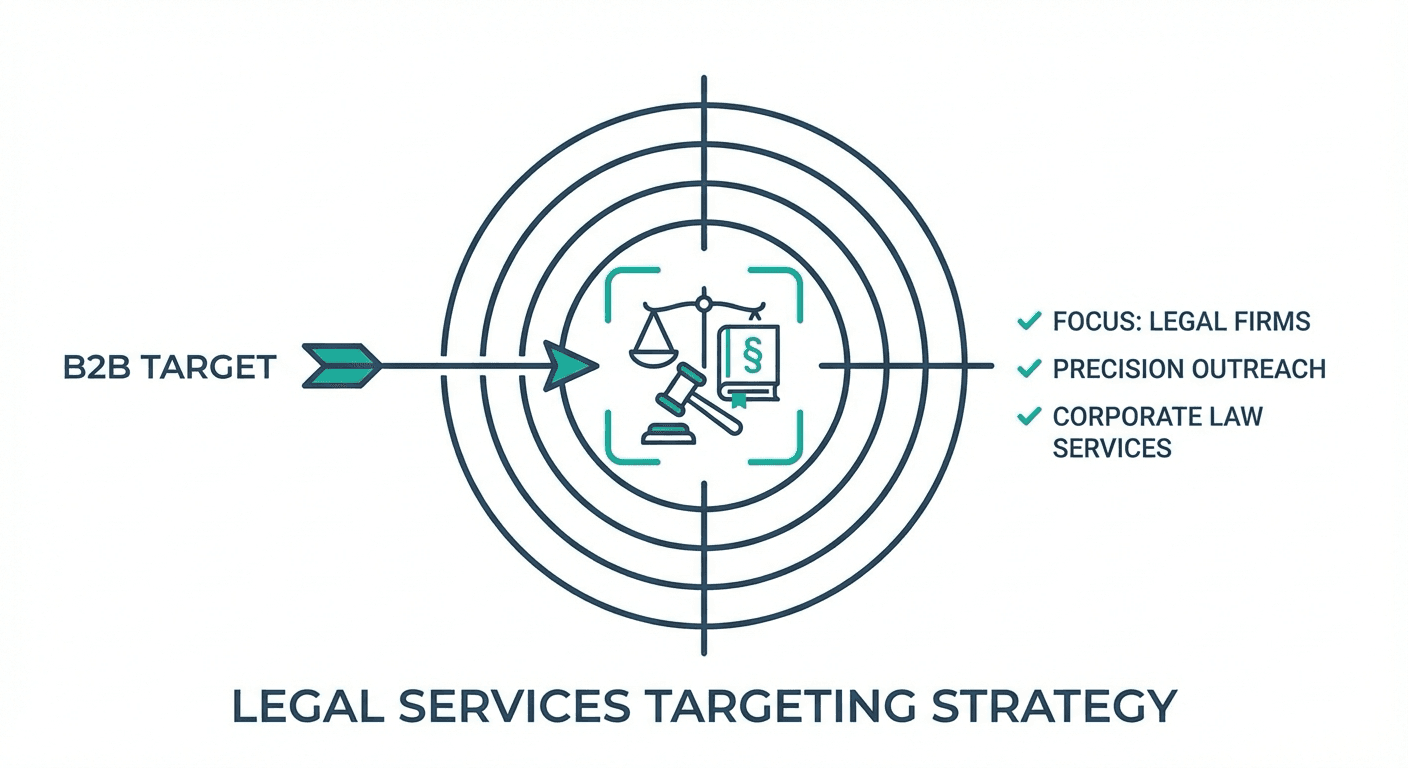
The legal industry spans a wide range of organizations with very different needs and buying behaviors.
Law Firms
Law firms range from solo practitioners to global enterprises with thousands of attorneys. The size and structure of a firm dramatically affects how they respond to cold outreach.
Solo and Small Firms (1-10 attorneys): Decision-making is fast but budgets are limited. The managing partner or sole proprietor makes purchasing decisions directly. They are often overwhelmed with administrative work and receptive to solutions that save time.
Mid-Size Firms (11-100 attorneys): Typically have some administrative structure, possibly a COO, CFO, or Director of Operations. Practice group leaders have influence over technology and service decisions within their groups. Decision-making involves more stakeholders but remains relatively efficient.
Large Law Firms (100+ attorneys): Have dedicated administrative leadership, procurement processes, and IT departments. Purchasing decisions can involve extensive committee review. Partner buy-in is essential for firm-wide initiatives.
Am Law 100 and Global Firms: The largest firms have sophisticated procurement, vendor management, and long evaluation cycles. Breaking in typically requires relationships at the partner level or a compelling reference from a peer firm.
Corporate Legal Departments
In-house legal teams at corporations represent a distinct market segment with different priorities than law firms.
General Counsel and Chief Legal Officers: Focused on risk management, cost control, and strategic legal positioning. They make decisions about outside counsel selection, legal technology investments, and departmental operations.
Associate General Counsel and Deputy GCs: Often manage specific practice areas (employment, IP, contracts, litigation) and have significant influence over vendors in their domain.
Legal Operations: A growing function focused on efficiency, technology, project management, and vendor management. Legal ops professionals are often more receptive to cold outreach than attorneys.
Legal Tech Buyers
Understanding who buys legal technology varies by the type of solution:
- Practice management software: Managing partners, administrators, office managers
- Document automation: Practice group leaders, knowledge management, IT
- E-discovery and litigation support: Litigation partners, legal ops, IT
- Contract management: In-house legal teams, legal ops, procurement
- Research tools: Librarians, associates, knowledge management
- Billing and accounting: CFOs, finance directors, accounting staff
Ethical Considerations for Law Firm Outreach
Law firms operate under professional responsibility rules that govern attorney advertising and solicitation. While these rules vary by jurisdiction, understanding the general framework is essential.
Model Rules of Professional Conduct
The American Bar Association's Model Rules provide the foundation for attorney advertising regulations across most US jurisdictions.
Rule 7.1 (Communications Concerning a Lawyer's Services): Prohibits false or misleading communications. This means any claims in your outreach must be verifiable. Avoid superlatives like "best" or "leading" unless they can be substantiated.
Rule 7.2 (Communications Concerning a Lawyer's Services: Specific Rules): Governs advertising and allows lawyers to advertise through various media, subject to certain restrictions.
Rule 7.3 (Solicitation of Clients): This is the most relevant rule for cold outreach. It generally prohibits real-time solicitation of prospective clients when a significant motive is pecuniary gain, unless the target is a lawyer, has a family or prior professional relationship, or is a sophisticated user of legal services (like corporate counsel).
What This Means for Law Firm Cold Email
If you are a law firm reaching out to individual consumers who might need legal services, cold email is generally prohibited or heavily restricted. Ambulance chasing, in any form, creates ethical problems.
However, several types of cold outreach are generally permissible:
B2B outreach to corporate counsel: General counsel and in-house legal teams are considered sophisticated users of legal services. Law firms can reach out to offer their services.
Referral network building: Reaching out to other lawyers for potential referral relationships is acceptable.
RFP responses and existing relationships: Responding to requests for proposals or reaching out to former clients is permitted.
Marketing legal technology: Selling technology or services to law firms is commercial activity, not attorney solicitation.
Important: This guide provides general information, not legal advice. Always consult your state bar's specific rules and, if necessary, an ethics attorney before launching cold email campaigns.
For Legal Tech Companies
Legal tech vendors face fewer regulatory constraints since they are selling products and services, not practicing law. However, understanding attorney ethics helps you:
Unlike legal outreach's ethical constraints, technical buyers present a different challenge entirely, as explored in this guide to reaching developers and engineering leaders.
- Frame your outreach appropriately
- Avoid triggering concerns about unauthorized practice of law
- Build credibility by demonstrating industry knowledge
- Position your solution in a way that helps lawyers meet their ethical obligations
Building Credibility with Legal Professionals
Lawyers are professional skeptics. They evaluate evidence for a living and apply that same critical lens to vendor claims.
Proof Points That Resonate
Peer Firm References: Nothing builds credibility faster than knowing that respected firms already use your service. If you work with notable law firms, reference them (with permission).
Bar Association Involvement: Involvement with state or specialty bar associations signals legitimate industry participation.
Legal Industry Experience: If your team includes former attorneys, legal administrators, or others with legal industry background, highlight this.
Published Content: Articles in legal publications, presentations at legal conferences, or contributions to bar association resources establish thought leadership.
Security and Confidentiality: Attorney-client privilege and client confidentiality are paramount. Any solution touching client data must demonstrate robust security practices.
Credibility Killers
Overpromising Results: Lawyers know that outcomes cannot be guaranteed. Promises of specific case results or ROI figures without substantiation undermine trust.
Misusing Legal Terminology: Using legal terms incorrectly signals that you do not understand the industry. If you reference case law, statutes, or legal concepts, get them right.
Aggressive Sales Tactics: High-pressure tactics are particularly ineffective with attorneys trained to negotiate and resist pressure.
Ignoring Confidentiality: Any suggestion that your solution might compromise client confidentiality is disqualifying.
Targeting General Counsel and In-House Teams
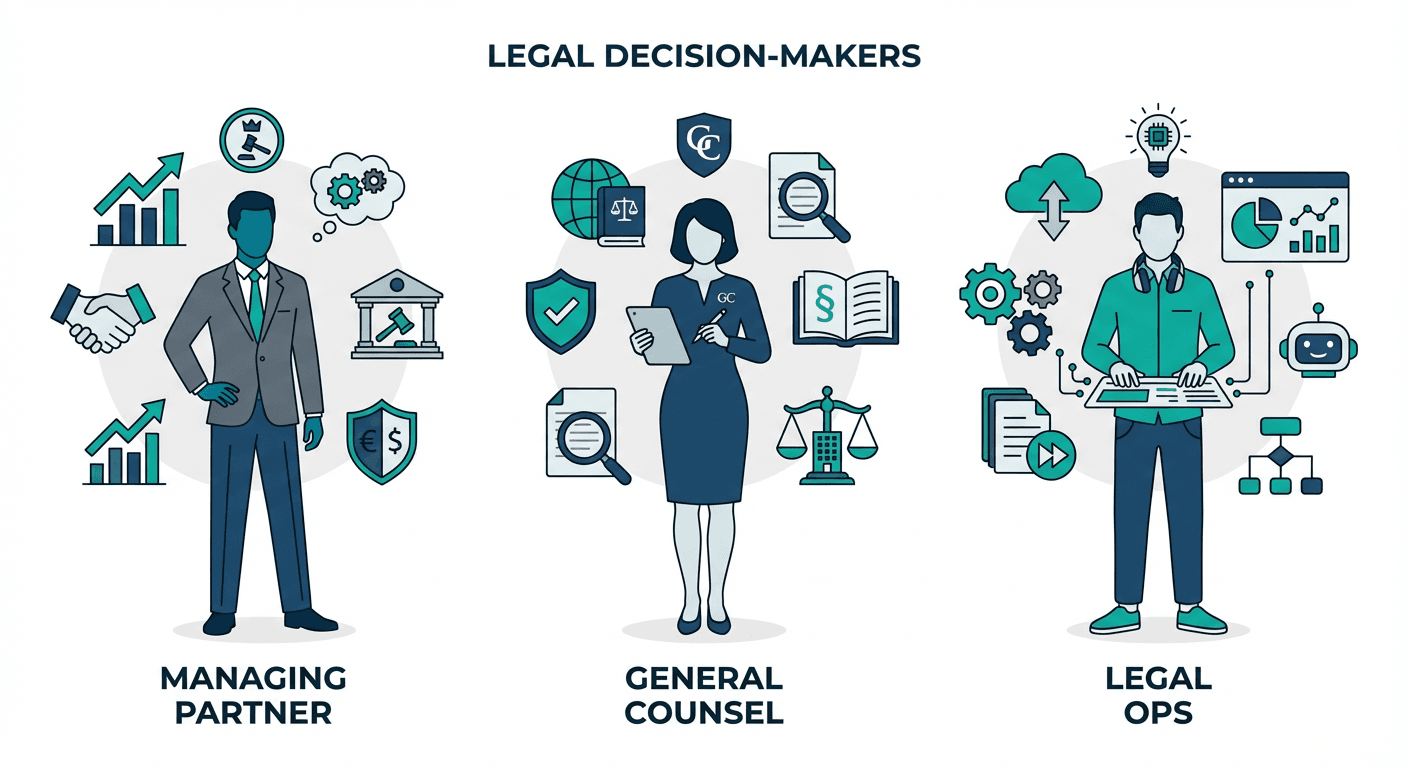
Corporate legal departments are often more receptive to cold outreach than law firms. They face constant pressure to do more with less and are actively seeking efficiency solutions.
Understanding GC Priorities
General counsel juggle multiple responsibilities:
- Managing outside counsel relationships and spend
- Overseeing legal risk across the organization
- Supporting business objectives while managing legal exposure
- Controlling legal department costs
- Implementing technology to improve efficiency
- Managing the legal team and professional development
Your outreach should connect to one or more of these priorities.
Legal Operations: Your Best Entry Point
Legal operations professionals are often more open to vendor conversations than attorneys. They are specifically tasked with finding efficiency improvements and managing technology implementations.
What Legal Ops Cares About:
- Process optimization
- Technology evaluation and implementation
- Vendor management and outside counsel cost control
- Data analytics and reporting
- Project management
- Budget management
How to Find Them:
- Look for titles like "Director of Legal Operations," "Legal Operations Manager," or "Legal Project Manager"
- Check for CLOC (Corporate Legal Operations Consortium) membership or conference attendance
- Search LinkedIn for legal ops professionals at target companies
Outside Counsel Guidelines
Many corporate legal departments publish outside counsel guidelines that specify their requirements for law firms. These documents reveal:
- What matters to them (billing practices, diversity, staffing)
- Pain points they are trying to address
- Evaluation criteria they use
Reference familiarity with common outside counsel requirements in your outreach to demonstrate industry understanding.
Professional Tone Requirements
Legal professionals expect a certain level of formality and precision in business communications.
Language and Style
Formal but Not Stiff: Use professional language while remaining approachable. Avoid both overly casual language and unnecessarily pompous prose.
Precision Matters: Lawyers notice imprecise language. If you make a claim, be specific. Vague statements suggest sloppy thinking.
Avoid Hyperbole: Claims like "revolutionary" or "game-changing" trigger skepticism. Let results speak rather than adjectives.
Proper Grammar and Spelling: Errors in written communication suggest carelessness, which is particularly problematic when selling to professionals who produce written documents for a living.
Subject Lines for Legal Audiences
Subject lines should be professional and specific. Avoid anything that could be perceived as spam or clickbait.
Effective Approaches:
- Reference a specific challenge: "Contract review bottleneck"
- Name a relevant connection: "Following up from ACC meeting"
- Reference a trigger event: "[Company] acquisition, legal integration"
- Be direct about purpose: "Legal tech demo request"
Avoid:
- All caps or excessive punctuation
- Urgency that seems manufactured
- Personal injury attorney-style messaging
- Anything resembling spam
Appropriate CTAs
Calls to action should be low-commitment and professional.
Effective:
- "Would a 15-minute call to discuss be useful?"
- "Happy to share a brief demo if relevant."
- "Worth a conversation to see if there is fit?"
Less Effective:
- "Book a meeting now!" (too aggressive)
- "Can I pick your brain?" (too casual)
- "Let me know your availability for the next two weeks." (too presumptuous)
Trigger Events for Legal Outreach
Timing matters enormously in legal sales. Certain events create natural openings for outreach.
For Law Firm Business Development
Litigation Filings: When companies face significant litigation, they often seek outside counsel. Monitor court filings, SEC disclosures, and news coverage.
Regulatory Actions: Investigations, consent decrees, and regulatory enforcement create immediate need for specialized counsel.
Corporate Transactions: Mergers, acquisitions, IPOs, and major financings require legal support. Deal announcements signal active legal needs.
Executive Changes: New GCs often review outside counsel relationships. A new general counsel at a target company is a strong trigger.
Geographic Expansion: Companies entering new markets or jurisdictions may need local counsel.
For Legal Tech Sales
Firm Growth or Merger: Growing firms often outgrow existing systems. Mergers create integration challenges.
Practice Management Changes: New practice groups, office openings, or restructuring can trigger technology evaluations.
Regulatory Changes: New regulations (like privacy laws) often require technology solutions.
Competitive Pressure: Firms competing for sophisticated clients may need to demonstrate technological capabilities.
Budget Cycles: Many firms finalize budgets in Q4. Legal operations teams at corporations also follow corporate budget cycles.
For In-House Legal Outreach
Litigation Events: Companies facing significant litigation may need legal technology for e-discovery, document review, or matter management.
Company Growth: Rapid growth often overwhelms legal departments, creating need for efficiency solutions.
Cost Pressure: Earnings calls mentioning legal costs or efficiency initiatives signal openness to cost-reduction solutions.
Leadership Changes: New GCs and legal ops leaders often evaluate existing vendors and systems.
Example Cold Emails
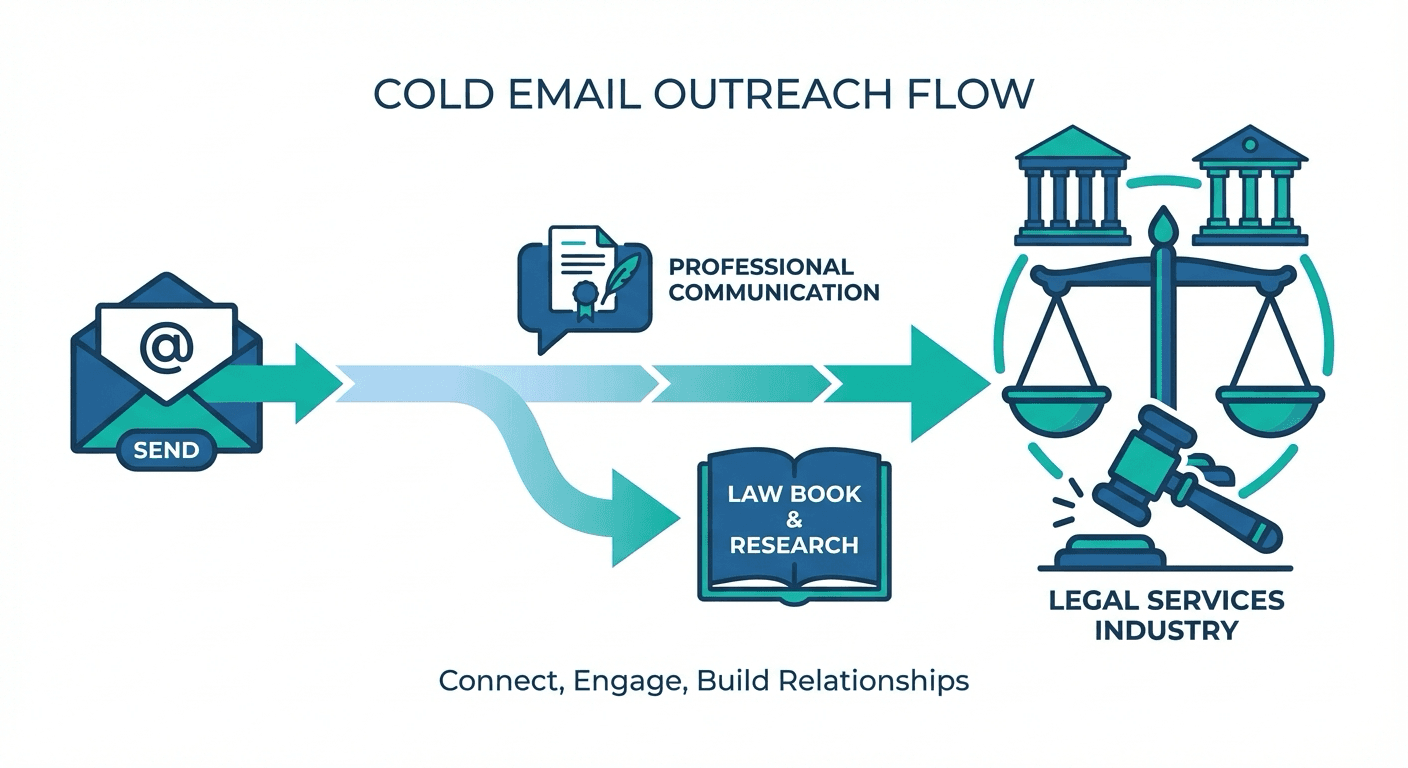
Here are examples tailored for different legal industry scenarios.
Example 1: Legal Tech to Law Firm Managing Partner
Subject: Practice management at mid-size firms
Hi [First Name],
Mid-size litigation firms like [Firm Name] often outgrow basic practice management tools as they scale. The gap between spreadsheets and enterprise systems creates operational friction.
We work with firms in the 15-50 attorney range to bridge this gap. [Reference Firm], a similar litigation practice, reduced matter onboarding time by 40% after implementation.
If you are experiencing any friction with current systems, I would welcome a conversation about what we have seen work at similar firms.
Worth a 15-minute call?
Best, [Your name]
Example 2: Law Firm BD to Corporate General Counsel
Subject: [Company] expansion, legal considerations
Hi [First Name],
Congratulations on [Company]'s recent expansion into [new market/region]. Cross-border operations typically create complexity around [relevant legal issue: employment law, regulatory compliance, IP protection].
At [Firm Name], we have supported several [industry] companies through similar expansion, including work with [reference client if possible]. We focus specifically on [practice area] for mid-market companies.
Would it be useful to have a brief conversation about what we typically see in these transitions?
Best, [Your name]
Example 3: Legal Tech to Director of Legal Operations
Subject: Contract lifecycle management for [Company]
Hi [First Name],
Legal ops teams at [industry] companies often manage thousands of contracts with limited visibility into obligations, renewals, and risk.
Our CLM platform is deployed at [X] companies in [industry], including [reference clients]. Average implementation time is [X weeks], with teams typically seeing ROI within [timeframe].
We are SOC 2 certified with enterprise security standards that meet legal confidentiality requirements.
If contract management is a priority for [Company], I would be happy to share a brief demo.
Worth 15 minutes this week?
Best, [Your name]
Example 4: Law Firm BD to In-House Employment Counsel
Subject: [State] employment law changes
Hi [First Name],
[State] recently passed [specific legislation] affecting [specific area]. Companies with [specific characteristic: employees in state, headquarters in state, etc.] will need to update policies by [deadline].
We advise [industry] companies on [state] employment compliance. Our team has worked with [X] companies on similar transitions, including [reference client if possible].
If you are working through these changes, I would welcome a conversation about what we are seeing in the market.
Best, [Your name]
Example 5: Legal Tech to Am Law 100 IT Director
Subject: Document management at large firms
Hi [First Name],
Large litigation practices generate vast document volumes across matters. Traditional DMS solutions often struggle with the scale and search requirements of modern discovery.
We work with [X] Am Law 100 firms on document management infrastructure. Our platform integrates with [relevant systems] and handles [specific capability].
Security is central to our architecture: SOC 2 Type II certified, with options for on-premise deployment if required.
If you are evaluating document management solutions, I would be happy to share our approach and reference contacts at peer firms.
Worth a conversation?
Best, [Your name]
Building a Legal Industry Cold Email Program
Success in the legal market requires systematic approach combined with patience.
List Building for Legal
For Law Firms:
- Legal directories (Martindale-Hubbell, Chambers, Legal 500)
- State bar directories
- Practice area associations
- Conference attendee lists
- Am Law rankings for firm prioritization
For In-House Counsel:
- Association of Corporate Counsel (ACC) membership
- LinkedIn Sales Navigator searches
- Corporate websites (many list legal leadership)
- SEC filings (often name general counsel)
- Legal news coverage
For Legal Operations:
- CLOC membership and conference attendees
- LinkedIn searches for legal operations titles
- Legal technology conference attendees
- Legal ops networking groups
Segmentation Strategies
Segment your lists by:
- Firm type: Plaintiff vs. defense, practice area, size
- Industry: Corporate counsel by industry vertical
- Role: Partner vs. administrator vs. legal ops
- Technology maturity: Early adopters vs. traditional firms
- Geographic focus: Regional vs. national vs. international
Where we differ from standard practice
Much of the advice on this page reflects how outbound is commonly run. We run it differently, and since this page sits on our site it is worth saying where the difference is and what it costs us.
- A sequence of messages to each prospect over several weeks
- Later messages often land in the same email thread
- Every contact is reached more than once, so a distracted reader gets another chance
- The later messages go only to people who did not answer the first
- Reputation cost accrues on the sending domain across everything else it sends
- One message, then that campaign is finished for that contact
- No thread replies and no bumps
- A non-responding audience becomes a new campaign with a genuinely different premise, not a reminder
- More of the work moves into targeting and into the one message
- We reach each contact less often, and that is the cost we accept
The reasoning is mechanical rather than moral. A follow-up arrives underneath a message the recipient has already seen and chosen not to answer, so it is delivered to the population most likely to mark it as spam, and the reputation cost of that lands on the sending domain across every campaign running on it. We set that cost against the replies a sequence recovers and decided the trade was not worth it. The full argument, with the numbers from our own campaigns, is in why we stopped using follow-ups.
Follow-Up Cadence
Legal professionals are busy and often slow to respond. Plan for:
- Initial email
- Follow-up 5-7 business days later
- Second follow-up 7-10 business days later
- Final follow-up 14 days later
Each follow-up should add value, not simply repeat your ask. Reference industry news, share relevant content, or offer a specific resource.
Measuring Results
Track metrics specific to your legal sales cycle:
- Open rates by segment: Compare partners vs. administrators vs. legal ops
- Reply rates by firm type: Compare Am Law 100 vs. mid-size vs. small firms
- Meeting conversion: How many replies become conversations
- Sales cycle length: Legal sales often take 6-12 months
- Common objections: Track and address patterns
Common Mistakes in Legal Cold Email
Failing to Understand the Market
Generic "business growth" messaging falls flat with legal audiences. Show that you understand law firm economics, billable hour pressures, client development challenges, and the specific pain points of legal practice.
Ignoring Confidentiality Concerns
Any solution that touches client information must address confidentiality. Lawyers have ethical obligations around client data that they take extremely seriously.
Overselling Technology
Many lawyers remain skeptical of technology promises. Focus on specific, provable benefits rather than transformational claims.
Sending the Same Message to Different Roles
Partners, administrators, and legal ops professionals have different priorities. A message that resonates with a firm administrator may not work for a practice group leader.
Underestimating the Sales Cycle
Legal industry sales often take longer than other B2B markets. Law firms are conservative, and corporate legal departments have procurement processes. Plan for relationship building over quarters, not weeks.
Missing the Relationship Element
The legal industry remains relationship-driven. Cold email is the start of a relationship, not a transactional sale. Treat each contact as a potential long-term relationship.
The Referral Reality
Referrals remain the primary source of new business for law firms and a significant factor in legal tech purchasing. Cold email works best when integrated with a broader relationship strategy.
Building Referral Networks
Use cold email to:
- Connect with potential referral sources (lawyers in complementary practice areas)
- Introduce yourself to key influencers (consultants, accountants, HR professionals)
- Start relationships that may lead to referrals over time
Asking for Introductions
Once you have established a relationship (even through cold email), asking for introductions can accelerate your business development:
"If you know colleagues facing similar challenges, I would appreciate any introductions you feel comfortable making."
Maintaining Relationships
Cold email that generates a conversation but no immediate sale still has value. Build systems to maintain these relationships:
- Quarterly check-ins with valuable content
- Invitations to relevant events
- Sharing industry news or insights
- Congratulations on professional achievements
Final Thoughts
Cold email for legal services requires understanding the unique characteristics of the legal market. Lawyers value precision, professionalism, and demonstrated expertise. They are skeptical of claims and responsive to peer references.
Success in this market comes from:
- Understanding the specific needs and constraints of your target segment
- Maintaining professional tone and precise language
- Demonstrating relevant expertise and credibility
- Respecting ethical boundaries and confidentiality requirements
- Building relationships over time, not seeking immediate transactions
- Integrating cold outreach with broader relationship development
The legal industry rewards patience and persistence. A contact who does not respond today may become a client or referral source years later. Approach legal cold email as the beginning of professional relationships, and the results will follow.
Related Reading
- Cold Email for Training and Development Companies: The Complete Guide
- Cold Email for Consulting Firms: Building a Pipeline Through Strategic Outreach
If you would rather have this run for you, RevenueFlow books qualified meetings on a pay-per-meeting basis and publishes client results.
This guide provides general information about cold email for legal services. It does not constitute legal advice. For questions about attorney advertising rules or ethical compliance, consult your state bar association or an ethics attorney.
Frequently asked questions.
Frequently asked questions- Can law firms use cold email to get new clients?
- Law firms can cold email corporate counsel and other attorneys, but generally cannot email individual consumers seeking legal services. ABA Model Rule 7.3 prohibits real-time solicitation of prospective clients when pecuniary gain is a motive, unless the target is a lawyer, has a prior relationship, or is a sophisticated user of legal services like corporate counsel. State bar rules vary, so firms must consult their jurisdiction's specific regulations before launching campaigns.
- Who should legal tech companies target with cold email?
- Legal tech buyers vary by product type. Practice management software targets managing partners and administrators. Document automation reaches practice group leaders and knowledge management. E-discovery targets litigation partners and legal operations. Contract management is purchased by in-house legal teams and legal ops. Legal operations professionals are the most receptive entry point because they focus on efficiency and technology, unlike attorneys who prioritize relationships and referrals.
- What ethical rules govern cold email for law firms?
- Law firms must follow ABA Model Rules of Professional Conduct, specifically Rule 7.1 prohibiting false or misleading communications, Rule 7.2 governing advertising, and Rule 7.3 restricting solicitation. Rule 7.3 is most relevant for cold outreach. All claims must be verifiable, superlatives require substantiation, and B2B outreach to corporate counsel is generally permissible while consumer solicitation is restricted. Rules vary by state, so firms should consult their state bar.
- How long does the sales cycle take for legal services?
- Legal sales cycles are significantly longer than typical B2B software sales. Solo and small firms make fast decisions but mid-size firms involve more stakeholders. Large law firms require extensive committee review and partner buy-in. Am Law 100 and global firms have sophisticated procurement with long evaluation cycles. The relationship-driven nature of legal services means trust-building extends timelines beyond initial outreach, making referrals and warm introductions more effective than cold approaches.
About the author.

Fernando Cao is CEO at RevenueFlow, which builds and operates outbound revenue engines for B2B companies. Previously at Accenture Strategy. Studied at University of Bath.
Fernando Cao · CEO
Connect on LinkedIn →Explore more.
Ready to scale your outreach?
We build GTM engines that book real meetings. See the receipts.
Related articles.
Cold Email for Telecom: Reaching Carriers and MSPs
Telecom companies face rapid technology changes and competitive pressures. Here's how to approach cold email outreach to carriers, MSPs, and UCaaS providers.
Cold Email for Architecture Firms: 2026 Strategy Guide
Architecture firms buy on project phases rather than fiscal quarters. How to build a list, time the spec window, and write cold emails principals answer.
Cold Email for Trucking and Fleet Companies: 2026 Guide
How to reach carriers, fleet operators, and safety buyers with cold email: FMCSA-driven list building, trigger timing, four templates, and compliance.
Cold Email for Cannabis Companies: 2026 Strategy Guide
The April 2026 rescheduling order split cannabis buyers into two tax realities. Here is how to segment, list-build, and write cold email for each.
Cold Email for Private Equity Firms: 2026 Strategy Guide
How to run cold email into private equity: mapping fund-level and portfolio-level buyers, list sources, four templates, and PE-specific deliverability rules.
Cold Email for Wealth Management Firms: 2026 Strategy Guide
RIAs are 16,500+ mostly small firms with public Form ADV data, small buying committees, and a compliance gate. How to run cold email into wealth management.