Cold Email for Manufacturing: Reaching Plant Managers
Manufacturing companies have long procurement cycles and multiple stakeholders. Here's how to approach cold email outreach to plant managers, procurement, and operations leaders.
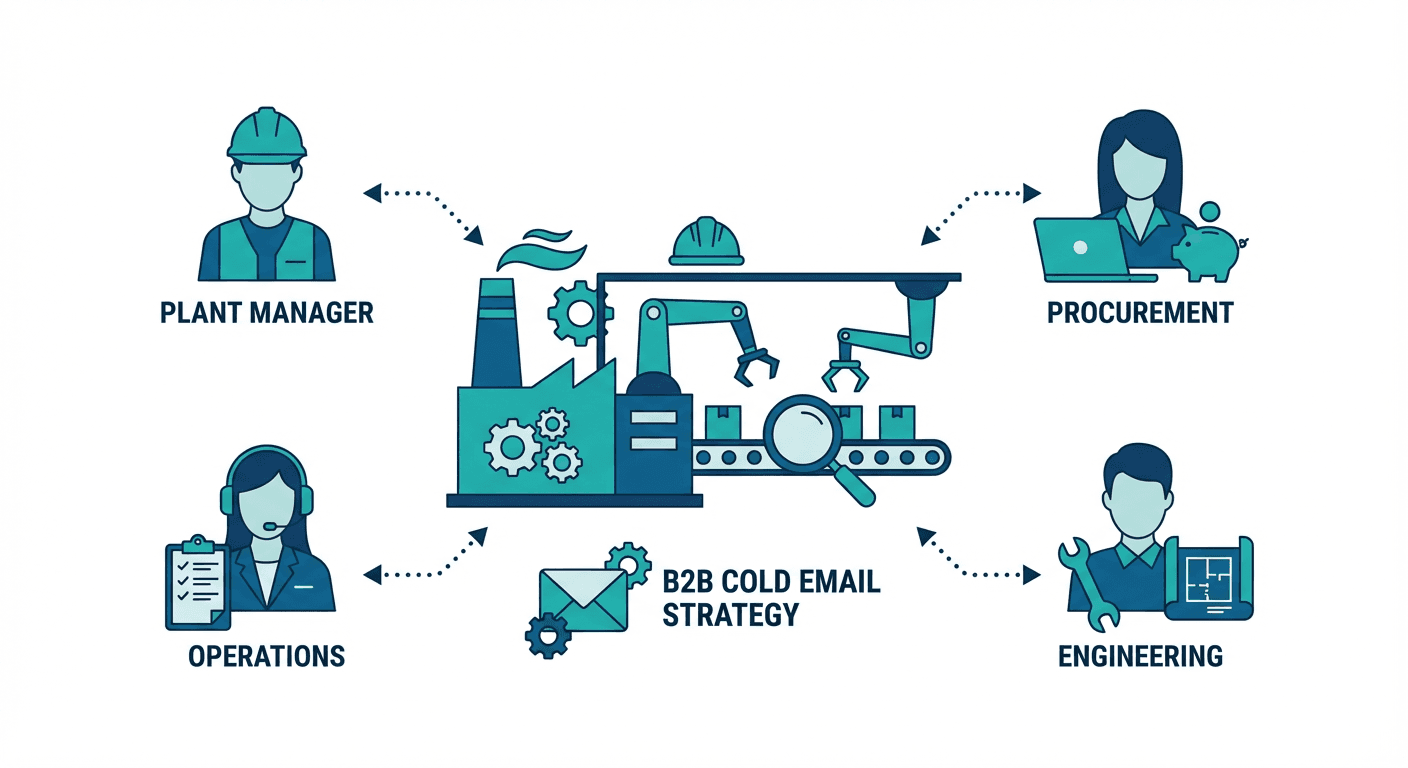
Manufacturing cold email requires technical credibility, quantifiable ROI evidence, and patience for 6-18 month procurement cycles involving 5-12 stakeholders. Target specific roles (plant managers, procurement directors, engineers) with tailored messages emphasizing operational outcomes, proven case studies from similar facilities, and risk mitigation. Multi-threading across stakeholders significantly improves success rates. Manufacturing buyers prioritize reliability over innovation, making testimonials and technical specifications essential components of outreach.
Key takeaways
- Manufacturing purchases typically involve 5 to 12 decision makers and influencers, including plant managers, procurement, engineers, maintenance teams, and finance leaders.
- Procurement cycles in manufacturing range from 6 to 18 months from initial contact to signed contract, with capital equipment purchases often extending longer.
- Capital equipment sales cycles last 12 to 24+ months and require higher-level decision makers, while MRO supplies have shorter cycles but face higher price competition.
- Manufacturing downtime costs can reach tens of thousands of dollars per hour, making buyers highly risk-averse and focused on proven solutions.
- Multi-threading (reaching multiple stakeholders at the same organization) significantly improves success rates in manufacturing cold email campaigns.
Reviewed and updated September 1, 2026
Cold Email for Manufacturing: Reaching Plant Managers and Industrial Buyers
Manufacturing is a sector built on precision, reliability, and long-term relationships. Whether you sell capital equipment, industrial components, maintenance services, or software solutions for the factory floor, reaching manufacturing decision makers through cold email requires a distinct approach. Plant managers, procurement directors, and operations leaders receive countless pitches, and they have learned to filter ruthlessly.
The manufacturing industry operates on thin margins, extended procurement cycles, and complex stakeholder hierarchies. A cold email strategy that works for SaaS startups or marketing agencies will fall flat in this environment. Manufacturing buyers need to see technical credibility, quantifiable ROI, and evidence that you understand their operational realities.
This guide covers the principles, targeting strategies, and specific tactics that make cold email effective for reaching manufacturing companies.
Understanding the Manufacturing Buying Environment
Before writing a single email, you need to understand how manufacturing companies make purchasing decisions. The dynamics differ significantly from other B2B sectors.
Extended Procurement Cycles
Manufacturing purchases often take 6 to 18 months from initial contact to signed contract. Capital equipment purchases can extend even longer. This timeline reflects multiple factors: budget approval processes, technical evaluations, vendor qualification requirements, and implementation planning.
Cold email in manufacturing is rarely about closing quick deals. Your goal is to start conversations that eventually lead to opportunities. Patience and consistent follow-up are essential.
Multiple Stakeholder Involvement
A single manufacturing purchase typically involves 5 to 12 decision makers and influencers. These may include:
- Plant managers who own operational outcomes
- Procurement professionals who manage vendor relationships
- Engineers who evaluate technical specifications
- Maintenance teams who will service the equipment
- Finance leaders who approve capital expenditures
- Safety and compliance officers who assess risk
- Corporate leadership for significant purchases
Your email outreach strategy must account for this complexity. Multi-threading (reaching multiple stakeholders at the same organization) significantly improves your odds of success.
Risk Aversion and Proven Solutions
Manufacturing companies are inherently conservative when adopting new solutions. Downtime costs can reach tens of thousands of dollars per hour. A failed component can halt an entire production line. Safety incidents carry enormous liability.
This risk aversion means manufacturing buyers prioritize proven solutions over innovative ones. They want case studies from similar operations, references they can call, and evidence that your solution has performed reliably in comparable environments.
Capital Equipment vs. Supplies and Services
The nature of what you sell dramatically affects your outreach approach:
Capital Equipment (machines, production lines, automation systems)
- Longer sales cycles (12-24+ months)
- Higher-level decision makers involved
- Significant technical evaluation required
- Focus on total cost of ownership and long-term ROI
MRO Supplies and Components (maintenance items, replacement parts, consumables)
- Shorter cycles but high competition
- Procurement-driven purchasing
- Price sensitivity is higher
- Focus on reliability, availability, and total procurement cost
Services (maintenance, consulting, training, implementation)
- Medium cycle lengths
- Operations and maintenance stakeholders involved
- Focus on expertise, responsiveness, and track record
- Existing relationships heavily influence decisions
Industrial Software (MES, ERP, maintenance management, quality systems)
- Significant IT involvement alongside operations
- Implementation complexity is a major concern
- Integration with existing systems is critical
- Focus on ease of adoption and support capabilities
Key Decision Makers and How to Reach Them
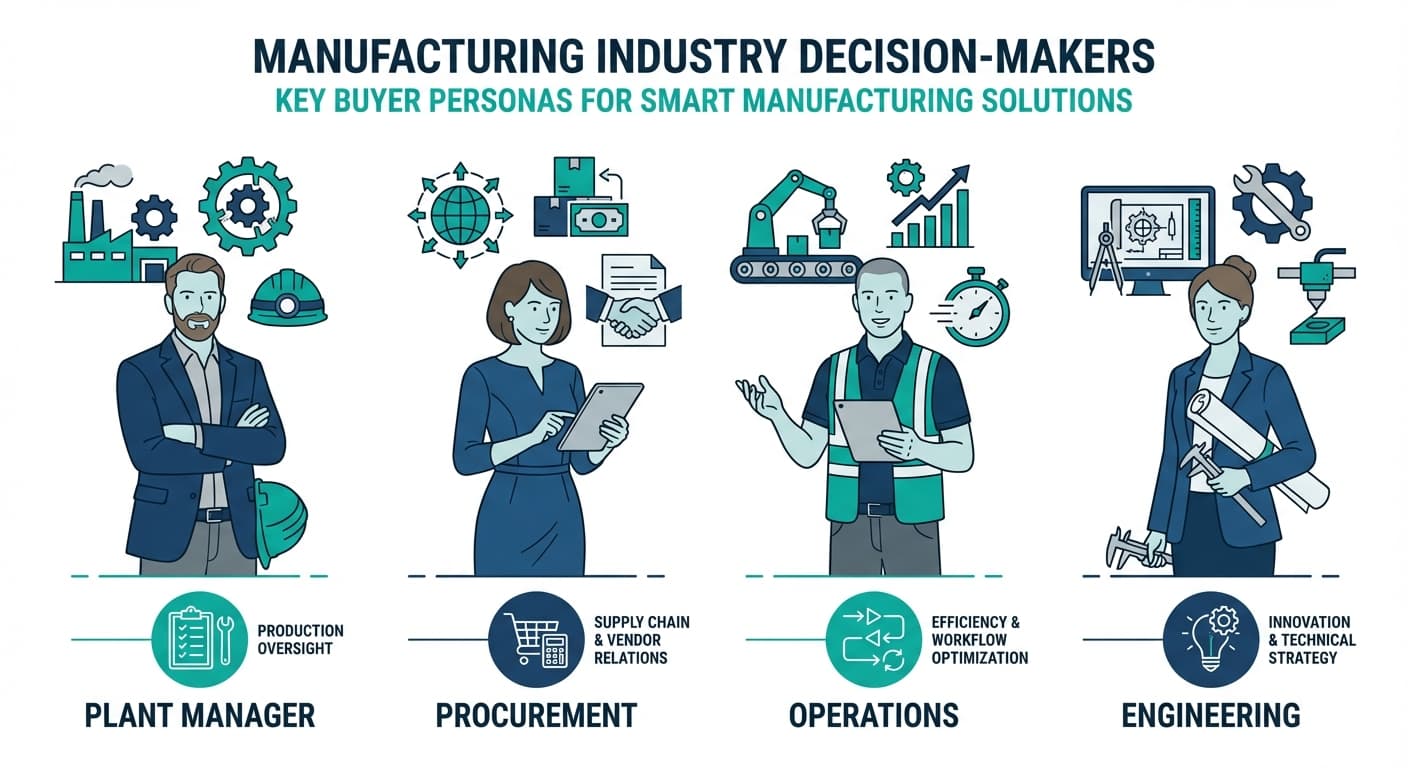
Different roles within manufacturing organizations have different priorities, pain points, and communication preferences. Tailoring your outreach to each stakeholder type improves response rates significantly.
Plant Managers and General Managers
Plant managers are accountable for everything that happens within their facility: production output, quality, safety, cost control, and workforce management. They are generalists by necessity, juggling dozens of competing priorities.
What they care about:
- Production efficiency and throughput
- Reducing unplanned downtime
- Meeting quality standards and customer requirements
- Controlling costs within tight budgets
- Safety performance and compliance
- Workforce productivity and retention
How to reach them:
- Lead with operational outcomes, not product features
- Reference specific metrics: OEE, yield rates, downtime percentage
- Demonstrate understanding of their industry and operational challenges
- Keep emails concise (they are extremely time-constrained)
- Suggest brief calls during non-peak hours (early morning or late afternoon)
VP of Operations and COO
Operations executives oversee multiple facilities or the entire manufacturing operation. They think at a higher strategic level than individual plant managers.
What they care about:
- Standardizing best practices across facilities
- Capacity planning and capital allocation
- Supply chain resilience and optimization
- Continuous improvement and operational excellence programs
- Meeting corporate financial targets
How to reach them:
- Focus on enterprise-wide impact and scalability
- Reference experience with multi-site implementations
- Discuss strategic outcomes: competitive positioning, market responsiveness
- Provide data and benchmarks from comparable organizations
- Offer executive briefings rather than product demonstrations
Procurement and Strategic Sourcing
Procurement professionals manage vendor relationships, negotiate contracts, and ensure the organization gets value from its purchases. They are gatekeepers who can accelerate or block opportunities.
What they care about:
- Total cost of ownership (not just purchase price)
- Vendor reliability and service levels
- Contract terms and risk allocation
- Consolidating vendor relationships
- Qualifying new suppliers to approved vendor lists
How to reach them:
- Lead with value proposition and TCO analysis
- Reference your track record with similar accounts
- Be prepared to discuss your qualification process
- Offer case studies with documented cost savings
- Demonstrate financial stability and supply capability
Engineering and Technical Staff
Engineers evaluate technical specifications, assess compatibility with existing systems, and often have significant influence over purchasing decisions.
What they care about:
- Technical specifications and performance data
- Integration with existing equipment and systems
- Reliability data and failure rates
- Service and support capabilities
- Technical documentation quality
How to reach them:
- Include specific technical details in your outreach
- Offer technical resources: spec sheets, white papers, application guides
- Reference relevant standards and certifications
- Propose technical discussions or demonstrations
- Speak their language (avoid marketing hyperbole)
Maintenance and Reliability Teams
Maintenance professionals keep equipment running and minimize downtime. They often influence equipment purchases because they will be responsible for servicing it.
What they care about:
- Equipment reliability and maintainability
- Availability of spare parts
- Training and technical support
- Predictive maintenance capabilities
- Mean time between failures (MTBF)
How to reach them:
- Focus on reliability and serviceability
- Reference maintenance-friendly design features
- Discuss parts availability and lead times
- Offer training and support programs
- Share reliability data from installed base
Crafting Manufacturing-Specific Cold Emails
Effective cold emails for manufacturing audiences share common characteristics: technical credibility, quantifiable benefits, and respect for the recipient's time and expertise.
The Technical Credibility Approach
Manufacturing professionals respect expertise. Emails that demonstrate genuine understanding of their technical environment earn attention.
Structure:
- Technical hook: Reference a specific technical challenge relevant to their operation
- Your understanding: Show you know why this challenge matters
- Solution hint: Briefly reference how your solution addresses it
- Credibility marker: Mention relevant experience or certifications
- Low-friction ask: Propose a brief technical conversation
The ROI-Focused Approach
Manufacturing companies make decisions based on numbers. Emails that lead with quantifiable outcomes resonate.
Structure:
- Metric hook: Reference a specific operational metric
- Benchmark data: Share what similar operations have achieved
- Relevance: Connect this to their likely situation
- Proof point: Reference a specific customer result
- Next step: Offer to discuss applicability to their operation
The Trigger Event Approach
Certain events create opportunities in manufacturing: new facility announcements, expansion projects, executive changes, quality issues, or recalls. Timing your outreach to these triggers improves response rates.
Structure:
- Event reference: Acknowledge the specific trigger event
- Challenge framing: Connect the event to likely challenges
- Relevant experience: Reference similar situations you have addressed
- Value proposition: Briefly state how you can help
- Conversation offer: Propose a brief discussion
Example Emails for Manufacturing
Example 1: Capital Equipment to Plant Manager
Subject: Reducing changeover time at [Company]
Hi [First Name],
I noticed [Company]'s expansion into [new product line/market]. Changeover efficiency often becomes a constraint when product mix increases. Many plant managers find their overall equipment effectiveness drops as they add SKUs, even when individual run rates remain stable.
We specialize in quick-changeover solutions for [industry type] manufacturing. Our clients typically reduce changeover time by 40-60%, which translates directly to increased capacity without additional capital investment.
Would a 15-minute call be useful to discuss how other [industry] manufacturers have addressed similar challenges? I can share some specific before/after data from comparable operations.
Best, [Your name]
Example 2: MRO Supplies to Procurement Director
Subject: Reducing unplanned spare parts costs
Hi [First Name],
Procurement teams in [industry] manufacturing often struggle with the trade-off between inventory carrying costs and the risk of production delays from parts shortages. The data from our customers shows that unplanned spare parts purchases cost 30-40% more than planned procurement due to expediting fees and premium pricing.
We work with [industry] manufacturers to optimize MRO procurement. Our approach combines predictive parts forecasting with strategic stocking programs that reduce both inventory investment and stockout risk.
Would it be valuable to see how [similar company] reduced their annual MRO spend by 18% while improving parts availability? I can send a brief case study or schedule a quick call to discuss relevance to your operation.
Best, [Your name]
Example 3: Industrial Software to VP Operations
Subject: OEE visibility across [Company]'s facilities
Hi [First Name],
Operations leaders overseeing multiple facilities often lack real-time visibility into equipment performance. Monthly reports surface problems weeks after they occur. Without consistent OEE data across sites, identifying and replicating best practices becomes difficult.
We provide real-time production monitoring that gives operations executives a single dashboard view across all facilities. Our customers typically see 8-15% OEE improvement within the first year, driven primarily by faster identification and resolution of performance issues.
I would welcome a conversation about how [Company] currently tracks cross-facility performance and whether our approach might be relevant. Would a brief call next week work?
Best, [Your name]
Example 4: Maintenance Services to Reliability Manager
Subject: Preventing unplanned downtime on [equipment type]
Hi [First Name],
[Equipment type] failures often provide warning signs weeks before catastrophic failure, but detecting those signals requires specialized monitoring and analysis capabilities that most maintenance teams lack in-house.
We provide predictive maintenance services specifically for [equipment type] in [industry] applications. Our condition monitoring approach has helped customers reduce unplanned downtime by 60-70% while extending equipment life.
If reliability improvement is a priority for your team, I would be glad to share how we have helped similar operations. A 15-minute call could help determine whether our approach fits your situation.
Best, [Your name]
Example 5: Engineering Services to Technical Director
Subject: [Specific technical challenge] at [Company]
Hi [First Name],
I noticed [Company]'s [recent project/announcement/expansion]. Projects like this often surface [specific technical challenge] that can delay timelines and increase costs if not addressed early in the engineering phase.
Our engineering team specializes in [specific technical area] for [industry] manufacturers. We have completed [X] projects involving similar technical requirements, including [reference project if public].
Would it be useful to discuss the technical approach for your project? I can share relevant experience and potentially provide input that helps avoid common pitfalls.
Best, [Your name]
Multi-Threading Your Manufacturing Outreach
Given the number of stakeholders involved in manufacturing purchases, reaching only one person significantly limits your success. Multi-threading (simultaneous outreach to multiple contacts at the same organization) increases your odds of finding an active opportunity and building internal consensus.
Building Your Contact Map
Before launching outreach, identify the key roles involved in your typical purchase decision:
- Economic buyer: Who approves the budget?
- Technical evaluator: Who assesses technical fit?
- User champion: Who will use or manage your solution daily?
- Procurement gatekeeper: Who manages the vendor process?
- Executive sponsor: Who provides strategic support?
Sequencing Your Outreach
There are two schools of thought on sequencing:
Top-down approach: Start with senior executives to establish strategic interest, then work down to technical evaluators. This approach works well for significant capital purchases where executive sponsorship is essential.
Bottom-up approach: Start with technical users and engineers to build grassroots support, then elevate to decision makers. This approach works well for solutions where user adoption drives success.
Simultaneous approach: Reach all stakeholders at roughly the same time with role-appropriate messaging. This approach accelerates the process but requires careful coordination to avoid appearing disorganized.
Role-Specific Messaging
Each stakeholder should receive messaging tailored to their priorities:
- Plant Manager: Operational outcomes, productivity, cost control
- Procurement: Total cost, vendor qualification, contract terms
- Engineering: Technical specifications, integration, standards compliance
- Maintenance: Reliability, serviceability, support availability
- Finance: ROI analysis, capital efficiency, payback period
Addressing Manufacturing-Specific Objections
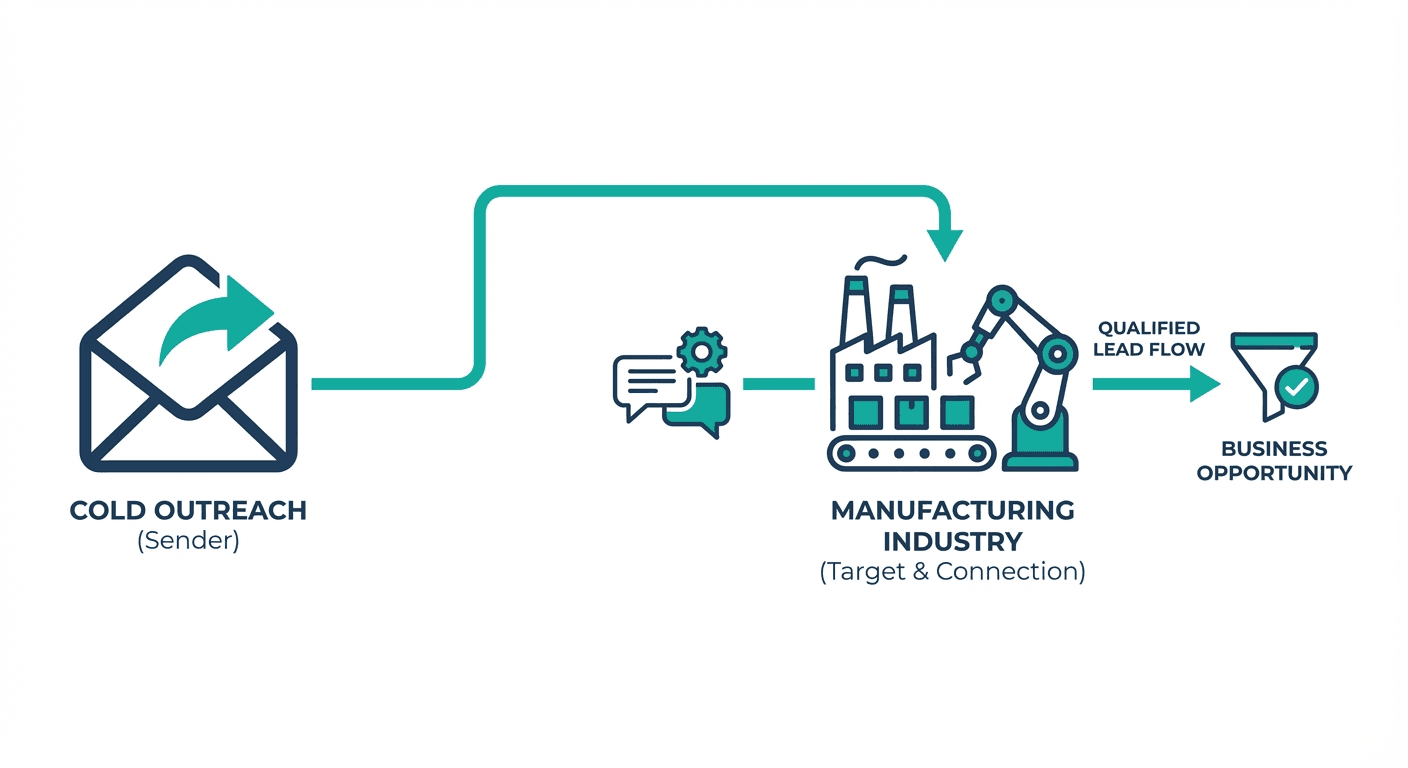
Manufacturing prospects raise predictable objections. Preparing responses in advance allows you to address concerns without losing momentum.
"We have existing supplier relationships"
Manufacturing companies value long-term vendor relationships. Displacing an incumbent requires demonstrating significant incremental value.
Response approach:
- Acknowledge the value of existing relationships
- Position yourself as a complement or alternative for specific needs
- Offer to start with a small scope to demonstrate value
- Provide evidence of successful transitions from competitor solutions
"We need to see it work in our environment"
Manufacturing buyers want proof that solutions work in conditions similar to their own. Generic case studies are often insufficient.
Response approach:
- Offer reference calls with customers in similar industries
- Propose pilot programs or proof-of-concept projects
- Share technical data from comparable installations
- Offer facility visits to see installations in operation
"The timing is not right"
Budget cycles, production schedules, and competing priorities often delay manufacturing purchases.
Response approach:
- Ask about their timeline and planning cycles
- Offer to provide information for future budget planning
- Request permission to follow up at an appropriate time
- Provide value in the interim (technical resources, benchmark data)
"Your price is too high"
Manufacturing companies are cost-conscious, but they also understand total cost of ownership.
Response approach:
- Shift the conversation from price to total value
- Provide ROI analysis and payback calculations
- Reference the cost of inaction (downtime, inefficiency)
- Offer flexible terms or phased implementation options
"We tried something similar before"
Past negative experiences with similar solutions create skepticism that must be addressed directly.
Response approach:
- Acknowledge their experience and ask what went wrong
- Explain how your solution or approach differs
- Offer references from customers who successfully switched
- Propose low-risk evaluation options
Where we differ from standard practice
Much of the advice on this page reflects how outbound is commonly run. We run it differently, and since this page sits on our site it is worth saying where the difference is and what it costs us.
- A sequence of messages to each prospect over several weeks
- Later messages often land in the same email thread
- Every contact is reached more than once, so a distracted reader gets another chance
- The later messages go only to people who did not answer the first
- Reputation cost accrues on the sending domain across everything else it sends
- One message, then that campaign is finished for that contact
- No thread replies and no bumps
- A non-responding audience becomes a new campaign with a genuinely different premise, not a reminder
- More of the work moves into targeting and into the one message
- We reach each contact less often, and that is the cost we accept
The reasoning is mechanical rather than moral. A follow-up arrives underneath a message the recipient has already seen and chosen not to answer, so it is delivered to the population most likely to mark it as spam, and the reputation cost of that lands on the sending domain across every campaign running on it. We set that cost against the replies a sequence recovers and decided the trade was not worth it. The full argument, with the numbers from our own campaigns, is in why we stopped using follow-ups.
Follow-Up Strategies for Long Sales Cycles
Manufacturing sales cycles require sustained follow-up over months or years. Your follow-up approach must add value without becoming annoying.
Value-Adding Follow-Ups
Each follow-up should provide something useful, not just repeat your ask:
- Share relevant industry news or regulatory updates
- Provide benchmark data or research findings
- Offer invitations to webinars or industry events
- Send case studies from similar operations
- Reference news about their company or competitors
Timing Your Follow-Ups
Manufacturing professionals are busy. Timing your outreach appropriately shows respect for their schedules:
- Avoid month-end and quarter-end (production crunch times)
- Early morning (before production meetings) often works well
- Avoid Mondays (catching up from weekend) and Fridays (wrapping up)
- Plant shutdown periods may offer better availability
- Trade show follow-up should happen within 48 hours
Maintaining Long-Term Engagement
For opportunities that are not ready now, maintain engagement without overwhelming:
- Monthly or quarterly touchpoints for warm prospects
- Add them to relevant company newsletters (with permission)
- Connect on LinkedIn and engage with their content
- Set reminders for key dates (budget cycles, project timelines)
- Track trigger events that might accelerate their timing
Metrics That Matter in Manufacturing Outreach
Tracking the right metrics helps you optimize your approach over time.
Email Performance Metrics
- Open rates: Aim for 35-50% for well-targeted manufacturing lists
- Reply rates: 5-10% is strong for cold outreach to manufacturing executives
- Positive reply rates: Track genuine interest versus automated responses
- Meeting booking rate: Percentage of positive replies that become calls
Pipeline Metrics
- Opportunities created: Number of qualified opportunities from outreach
- Average deal size: Compare outreach-generated deals to other sources
- Sales cycle length: Track how long outreach opportunities take to close
- Win rate: Compare close rates for outreach opportunities versus inbound
Engagement Patterns
- Best-performing subject lines: Track which approaches get opened
- Role response rates: Which stakeholder types respond most often
- Industry variations: Some manufacturing segments respond better than others
- Timing patterns: Days and times that generate the most engagement
Integrating Cold Email with Other Channels
Cold email works best as part of a broader engagement strategy. Manufacturing buyers conduct extensive research before making decisions.
Trade Shows and Industry Events
Manufacturing trade shows remain important venues for relationship building. Coordinate your email outreach with show schedules:
- Pre-show outreach to schedule meetings
- Post-show follow-up within 48 hours
- Reference show conversations in your messaging
- Use show content (presentations, demos) as follow-up material
LinkedIn Engagement
Many manufacturing professionals are active on LinkedIn. Coordinate your approach:
- Connect before or after email outreach
- Engage with their content before reaching out
- Share relevant industry content to build visibility
- Use LinkedIn for additional touchpoints in your sequence
Technical Content Marketing
Manufacturing buyers consume technical content during their research process:
- White papers on technical topics relevant to your solution
- Case studies with detailed operational data
- Webinars featuring customer presentations
- Technical blog posts addressing common challenges
Reference this content in your outreach and offer it as a value-add in follow-ups.
Phone Calls
Cold calling still works in manufacturing, particularly for reaching plant-floor decision makers who may not prioritize email:
- Use phone as a follow-up to email outreach
- Time calls for early morning or late afternoon
- Keep initial calls brief and focused on scheduling longer conversations
- Leave voicemails that reference your email outreach
Common Mistakes in Manufacturing Cold Email
Using Consumer Marketing Language
Manufacturing professionals respond to technical, straightforward communication. Marketing language filled with superlatives and vague promises signals that you do not understand their environment.
Avoid: "Revolutionary solution that will transform your operations" Instead: "15% average OEE improvement based on data from 40 installations in [industry]"
Ignoring Technical Requirements
Manufacturing buyers need technical details. Emails that focus entirely on business benefits without addressing technical fit miss the mark.
Include: Relevant specifications, standards compliance, integration capabilities, and performance data.
Underestimating Procurement Complexity
Many salespeople focus exclusively on technical or operational stakeholders and are surprised when procurement blocks the deal. Engage procurement early and understand their qualification requirements.
Failing to Provide Proof Points
Manufacturing buyers want evidence. Claims without supporting data are ignored.
Include: Specific customer results, installation counts, reliability data, and references from comparable operations.
Giving Up After Initial Non-Response
Manufacturing decision makers are extremely busy. Initial non-response often reflects competing priorities, not lack of interest. Consistent, value-adding follow-up over time yields results.
Final Thoughts
Cold email for manufacturing requires patience, technical credibility, and respect for the industry's operational realities. Manufacturing buyers are skeptical of vendors who do not understand their environment and dismissive of those who waste their time.
The companies that succeed with manufacturing outreach share common traits: they lead with value rather than pitches, they speak the language of operations and engineering, they provide quantifiable evidence for their claims, and they persist through long sales cycles.
Start with deep research into your target accounts. Understand their operations, challenges, and priorities before writing a single email. Build multi-threaded relationships across stakeholder groups. Provide value in every interaction, even when the timing is not right for an immediate opportunity.
Manufacturing relationships, once established, tend to be durable and valuable. The investment in thoughtful outreach pays dividends over years of repeat business and referrals. That long-term perspective should guide your approach from the first email forward.
Related Reading
- Cold Email for SaaS Companies: The Complete Guide to B2B Outreach
- Cold Email for Retail: The Complete Guide to B2B Outreach
If you would rather have this run for you, RevenueFlow books qualified meetings on a pay-per-meeting basis and publishes client results.
The examples and approaches in this guide represent general best practices for manufacturing outreach. Your specific approach should be tailored to your product category, target market segment, and company positioning.
Frequently asked questions.
Frequently asked questions- How long does a typical manufacturing sales cycle take?
- Manufacturing purchases typically take 6 to 18 months from initial contact to signed contract. Capital equipment purchases can extend even longer, often 12 to 24+ months, reflecting budget approval processes, technical evaluations, vendor qualification requirements, and implementation planning. Cold email in this sector focuses on starting conversations rather than closing quick deals, so judge a campaign on conversations opened over a year rather than on replies in the first month.
- Who should I target with cold emails in manufacturing companies?
- Manufacturing purchases involve 5 to 12 decision makers, so target multiple stakeholders including plant managers (who own operational outcomes), procurement professionals (who manage vendor relationships), engineers (who evaluate technical specifications), maintenance teams, finance leaders (for capital approvals), and operations executives. Multi-threading your outreach across these roles significantly improves success rates because each stakeholder has different priorities and influence in the purchasing process.
- What should I emphasize in cold emails to manufacturing buyers?
- Emphasize technical credibility, quantifiable ROI, and evidence you understand their operational realities. Manufacturing buyers need case studies from similar operations, references they can call, and proof your solution has performed reliably in comparable environments. Lead with operational outcomes rather than product features, reference specific metrics like OEE or downtime percentage, and demonstrate how your solution mitigates risk. Manufacturing companies are inherently conservative due to high downtime costs and prefer proven solutions over innovative ones.
- How is selling capital equipment different from MRO supplies in manufacturing?
- Capital equipment sales involve 12-24+ month cycles, higher-level decision makers, significant technical evaluation, and focus on total cost of ownership and long-term ROI. MRO supplies and components have shorter cycles but higher competition, are procurement-driven, face greater price sensitivity, and require focus on reliability, availability, and total procurement cost. The distinction affects your outreach approach, with capital equipment requiring more technical depth and senior-level engagement.
- Why are manufacturing buyers so risk-averse?
- Manufacturing companies operate on thin margins where downtime costs can reach tens of thousands of dollars per hour and a failed component can halt entire production lines. Safety incidents carry enormous liability, and operational failures directly impact profitability and customer commitments. This environment makes buyers prioritize proven solutions with documented track records over innovative but unproven options. They need evidence of reliability in similar operational environments before committing to new vendors or solutions.
About the author.

Fernando Cao is CEO at RevenueFlow, which builds and operates outbound revenue engines for B2B companies. Previously at Accenture Strategy. Studied at University of Bath.
Fernando Cao · CEO
Connect on LinkedIn →Explore more.
Ready to scale your outreach?
We build GTM engines that book real meetings. See the receipts.
Related articles.
Cold Email for Telecom: Reaching Carriers and MSPs
Telecom companies face rapid technology changes and competitive pressures. Here's how to approach cold email outreach to carriers, MSPs, and UCaaS providers.
Cold Email for Architecture Firms: 2026 Strategy Guide
Architecture firms buy on project phases rather than fiscal quarters. How to build a list, time the spec window, and write cold emails principals answer.
Cold Email for Trucking and Fleet Companies: 2026 Guide
How to reach carriers, fleet operators, and safety buyers with cold email: FMCSA-driven list building, trigger timing, four templates, and compliance.
Cold Email for Cannabis Companies: 2026 Strategy Guide
The April 2026 rescheduling order split cannabis buyers into two tax realities. Here is how to segment, list-build, and write cold email for each.
Cold Email for Private Equity Firms: 2026 Strategy Guide
How to run cold email into private equity: mapping fund-level and portfolio-level buyers, list sources, four templates, and PE-specific deliverability rules.
Cold Email for Wealth Management Firms: 2026 Strategy Guide
RIAs are 16,500+ mostly small firms with public Form ADV data, small buying committees, and a compliance gate. How to run cold email into wealth management.