Cold Email for Media Coverage: Complete Strategy Guide
Learn how to use cold email to secure media coverage and build relationships with journalists. Includes proven templates, pitch strategies, and best practices for earned media outreach.

Cold email secures media coverage by pitching story angles (not promotional messages) to journalists who cover your specific topic. Success requires researching journalists' beats, developing newsworthy angles tied to current trends or data, crafting personalized pitches under 150 words that lead with the story hook, and following up once after 3-5 days. Journalists receive 50-100+ daily pitches and prioritize stories serving their audience with timeliness, exclusivity, or original data over company announcements.
Key takeaways
- Beat journalists receive 50-100+ pitches daily, making personalization and story relevance critical to breaking through inbox clutter.
- Journalists prioritize stories over companies, requiring pitches to offer newsworthy angles like trend insights, original data, or expert commentary rather than promotional content.
- Story angles must be tailored by publication type, with trade publications needing technical details while consumer outlets require lifestyle impact and cultural relevance.
- Effective media pitches keep the initial email under 150 words, lead with the story hook in the first sentence, and avoid promotional language.
- Send one pitch per story. Journalists who do not respond are telling you the story is not for them, and chasing it costs the relationship you need for the next pitch.
Reviewed and updated September 15, 2026
Cold Email for Media Coverage: Complete Strategy Guide
Earned media coverage provides credibility that advertising cannot buy. When respected publications write about your company, product, or expertise, their audience receives an implicit endorsement from a trusted source. The challenge is that journalists are overwhelmed with pitches, and breaking through requires strategic, personalized outreach. Cold email provides a direct channel to journalists and editors when executed thoughtfully.
This guide covers everything you need to know about using cold email to secure media coverage, from developing story angles to building lasting journalist relationships.
The Value of Earned Media Coverage
Earned media delivers benefits that other marketing channels struggle to replicate.
Third-party credibility. When journalists choose to cover your story, they're vouching for its newsworthiness to their audience. This credibility transfers to your brand.
Search visibility. Coverage from high-authority publications generates valuable backlinks and improves your search presence.
Social proof. "As featured in [Publication]" signals legitimacy to potential customers, investors, and partners.
Audience reach. Publications have established audiences that take years and significant investment to build independently.
Content leverage. Media coverage creates assets you can repurpose across marketing channels.
Competitive differentiation. Coverage in respected publications distinguishes you from competitors who lack media presence.
Understanding How Journalists Work
Effective media outreach requires understanding journalist priorities, constraints, and incentives.
What Journalists Care About
Stories, not companies. Journalists write about interesting stories, not about companies. Your pitch must offer a story, not a promotional message.
Their audience. Every journalist writes for a specific audience. They care about content that serves that audience.
Timeliness. News has a shelf life. Stories connected to current events, trends, or timing receive priority.
Access and exclusivity. Journalists value unique access to information, sources, or perspectives their competitors lack.
Credibility and reliability. Journalists protect their reputation by working with sources who deliver accurate information on time.
Journalist Constraints
Overwhelming inboxes. The average beat journalist receives 50-100+ pitches daily. Most get deleted immediately.
Tight deadlines. Journalists work under constant deadline pressure. Anything that slows them down gets deprioritized.
Editorial standards. Journalists must justify story choices to editors. Weak pitches that require explanation don't survive this filter.
Beat boundaries. Most journalists have defined coverage areas. Pitches outside their beat waste their time.
What Gets Stories Killed
- Pitches that are obviously promotional
- Information that's already widely covered
- Stories without a clear news hook
- Sources who are difficult to reach or unresponsive
- Inaccurate or unverifiable claims
Developing Media-Worthy Story Angles
Before reaching out to journalists, develop compelling story angles that serve their needs.
Story Angle Types

Trend stories. Position your company, data, or perspective within broader industry or cultural trends.
Data and research. Original data, surveys, or analysis provide journalists with exclusive material for their stories.
Expert commentary. Offer executives as sources who can provide insight on industry developments or breaking news.
Human interest. Customer success stories, founder journeys, or employee experiences provide narrative hooks.
Contrarian perspectives. Thoughtful challenges to conventional wisdom attract journalist attention.
Breaking news. Significant company announcements (funding, products, leadership) warrant coverage when genuinely newsworthy.
Validating Your Story Angle
Before pitching, ask:
- Would this story interest a journalist who has never heard of my company?
- Is there a timely hook that makes this relevant now?
- What makes this angle different from similar stories already published?
- Can I support this story with data, examples, or credible sources?
- Who specifically would want to read this story?
Tailoring Angles to Publications
Different publications need different angles on the same underlying story:
- Trade publications: Technical details, industry impact, competitive analysis
- Business press: Market size, financial implications, executive strategy
- Consumer publications: User benefits, cultural relevance, lifestyle impact
- Local media: Community impact, local jobs, regional significance
Building Your Media Contact List
Strategic contact selection dramatically impacts outreach success.
Finding the Right Journalists
Byline research. Search for recent articles on topics related to your story. Note who wrote them and study their coverage patterns.
Publication coverage. Review target publications' content over the past 6-12 months to understand what they cover and who covers it.
Social media research. Journalists often share what they're working on and interested in via Twitter, LinkedIn, and other platforms.
Media databases. Tools like Cision, Muck Rack, and Meltwater provide journalist contact information and beat details.
HARO and similar services. Help A Reporter Out connects sources with journalists working on specific stories.
Evaluating Journalist Fit
Beat alignment. Does their regular coverage match your story topic?
Publication relevance. Does their publication reach your target audience?
Recent activity. Have they published recently? Inactive journalists may have moved on.
Coverage tone. Do they cover stories like yours favorably, critically, or neutrally?
Relationship potential. Could this be an ongoing relationship, or is it a one-time pitch?
Organizing Your Media List
Segment journalists by:
- Priority tier (based on publication reach and fit)
- Beat category (industry, function, topic)
- Relationship status (existing contact, past coverage, cold)
- Contact preferences (if known)
Personalizing Your Media Outreach
Generic pitches fail. Personalization separates serious outreach from spam.
Research Requirements
Before pitching any journalist:
- Read 5-10 of their recent articles
- Note recurring themes and interests
- Identify their perspective and voice
- Find specific articles to reference
- Check their social media for current interests
Personalization Elements
Reference specific work. Mention a recent article and connect it to your pitch.
Demonstrate relevance. Show you understand their beat and why your story fits.
Anticipate their needs. Provide what they'd need to pursue the story (data, sources, access).
Match their style. Adjust your pitch tone to match the publication's voice.
Personalization Mistakes
- Generic references ("I love your publication")
- Mentioning articles from years ago
- Misunderstanding their beat
- Over-personalizing to the point of awkwardness
- Pretending connection that doesn't exist
Crafting Effective Media Pitches
Your pitch email determines whether journalists engage or delete.
Subject Lines
Subject lines must immediately communicate newsworthiness:
- Lead with the story hook
- Be specific, not clever
- Keep it under 10 words
- Avoid spam triggers
Examples:
- "Story angle: [Specific trend] + data"
- "[Expert] available on [breaking topic]"
- "Exclusive: [Newsworthy development]"
- "[Specific angle] for your [beat] coverage"
Pitch Structure
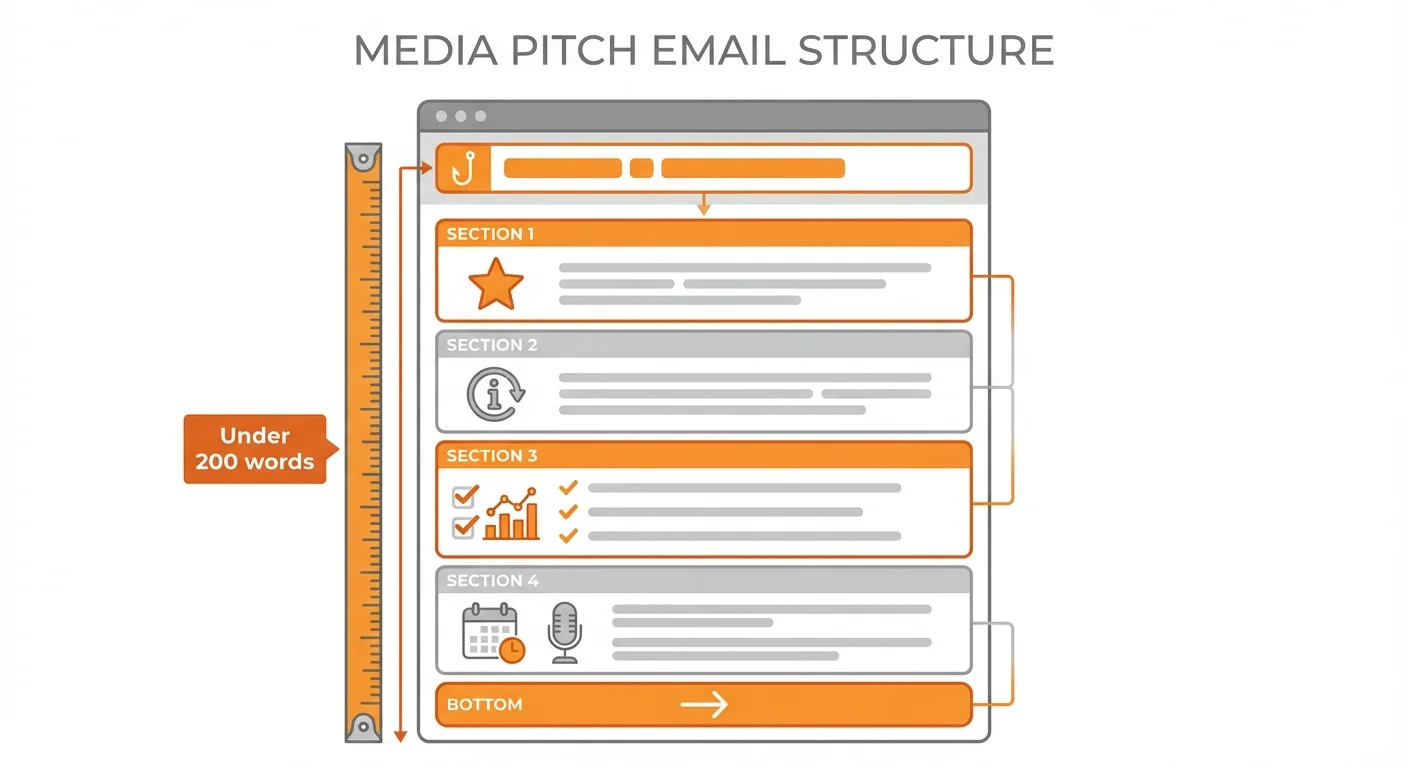
Subject line: Clear indication of the story opportunity
Opening (1-2 sentences): Lead with the story, not your company. Why should a journalist care right now?
Context (2-3 sentences): Background that makes the story meaningful. Why does this matter to their readers?
Proof points (2-3 sentences): Data, examples, or credentials that make the story credible and easy to pursue.
Access (1-2 sentences): What you're offering (interview availability, exclusive data, customer introductions).
Call to action (1 sentence): Clear next step.
Total length: 150-200 words maximum.
Tone Guidance
- Newsworthy, not promotional: Write like a journalist, not a marketer
- Confident without overselling: Let the story speak for itself
- Respectful of their expertise: Don't explain their beat to them
- Direct and efficient: Value their time by getting to the point
Media Coverage Pitch Templates
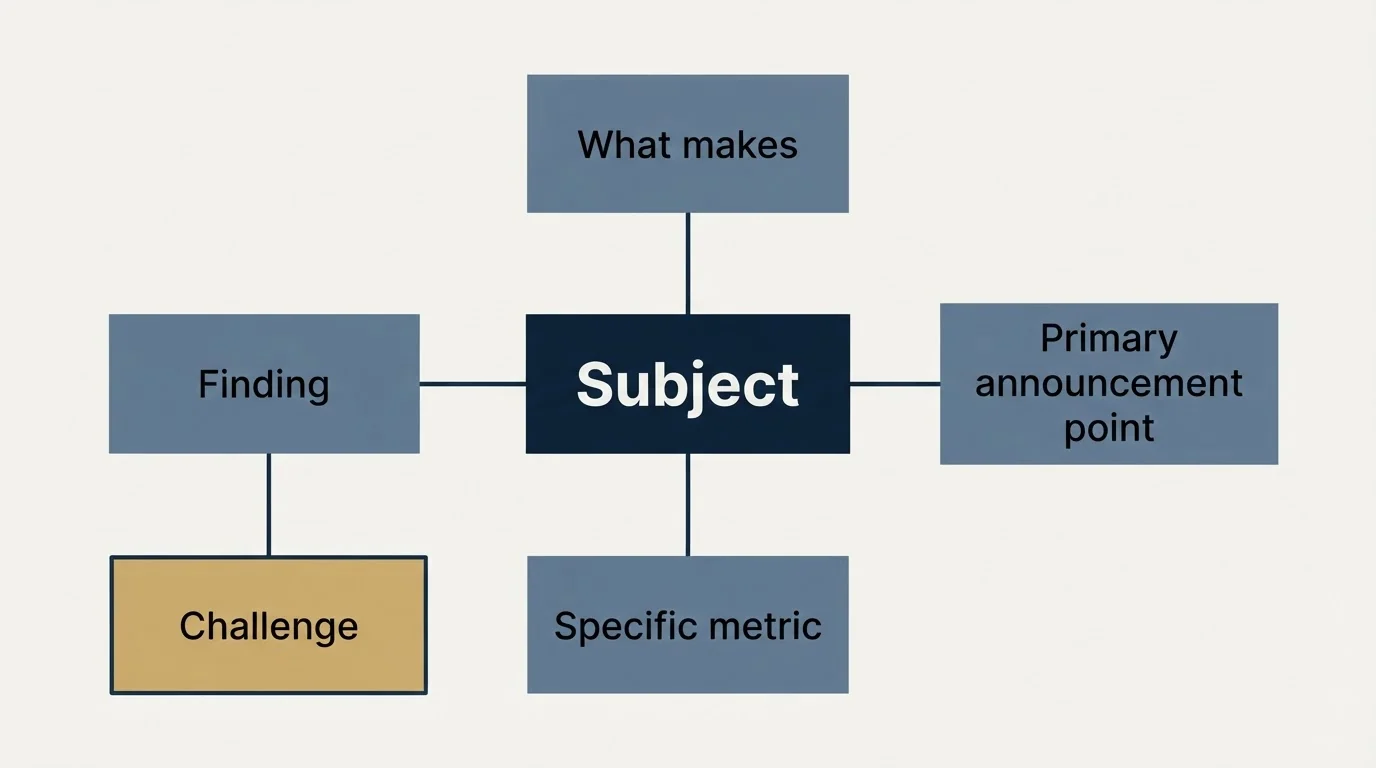
Template 1: Trend Story Pitch
Subject: Story angle: [Trend] + new data
Hi [Name],
Your recent coverage of [related topic] caught my attention, particularly your point about [specific insight]. I have some data that might interest you for a follow-up angle.
[Company] just completed [research/survey/analysis] on [topic], and the findings reveal [specific counterintuitive or surprising result]. This directly relates to [broader trend you've been covering].
Key data points:
- [Specific finding 1]
- [Specific finding 2]
- [Finding that challenges conventional thinking]
I can share the full data exclusively, and [Executive Name] is available to provide context on what this means for [industry/market].
Would this work for a story?
[Your Name] [Contact info]
Template 2: Expert Source Pitch
Subject: [Expert] available on [topic]
Hi [Name],
Given your coverage of [topic], I wanted to offer a source for your future stories in this area.
[Name], [Title] at [Company], has [specific relevant experience: built X, advised Y, been through Z]. They can speak to [specific topics they're qualified to address].
[Name] has been quoted in [notable publications] and provides [specific value: data-driven insights, practitioner perspective, contrarian viewpoint].
They're available for interviews on [topic]. Would this be helpful for any upcoming pieces?
[Your Name]
Template 3: Customer Story Pitch
Subject: Story idea: [Company/Person] + [result]
Hi [Name],
I have a story that aligns with your coverage of [topic]: [Customer Company/Person] [achieved specific result] by [method].
What makes this interesting for your readers:
- [Specific metric or outcome]
- [Challenge they overcame]
- [What makes their approach different]
[Customer contact] is willing to speak on the record about their experience. I can also provide before/after data and supporting context.
Is this the type of story you're interested in?
[Your Name]
Template 4: Contrarian Perspective Pitch
Subject: Different take on [widely discussed topic]
Hi [Name],
The recent conversation about [topic] has focused on [conventional perspective]. I wanted to offer a different viewpoint.
[Executive Name], [Title] at [Company], argues that [contrarian position] because [reasoning backed by evidence].
Their perspective comes from [relevant experience/data]. This challenges the narrative that [dominant assumption].
[Executive] is available to explain this viewpoint and debate the conventional wisdom. They can back it up with [specific evidence].
Would this perspective be worth exploring?
[Your Name]
Template 5: Breaking News Pitch
Subject: [Company] announcement: [Key news point]
Hi [Name],
[Company] is announcing [specific news] on [date]. Given your coverage of [related topic], I wanted to offer you early access.
The key news:
- [Primary announcement point]
- [Supporting detail that adds context]
- [Why this matters for the market/industry]
This is significant because [connection to broader trends or your past coverage].
[Executive Name] is available for an interview before the announcement. I can also share [supporting materials: data, visuals, customer reactions].
Would you like exclusive or early access?
[Your Name]
Where we differ from standard practice
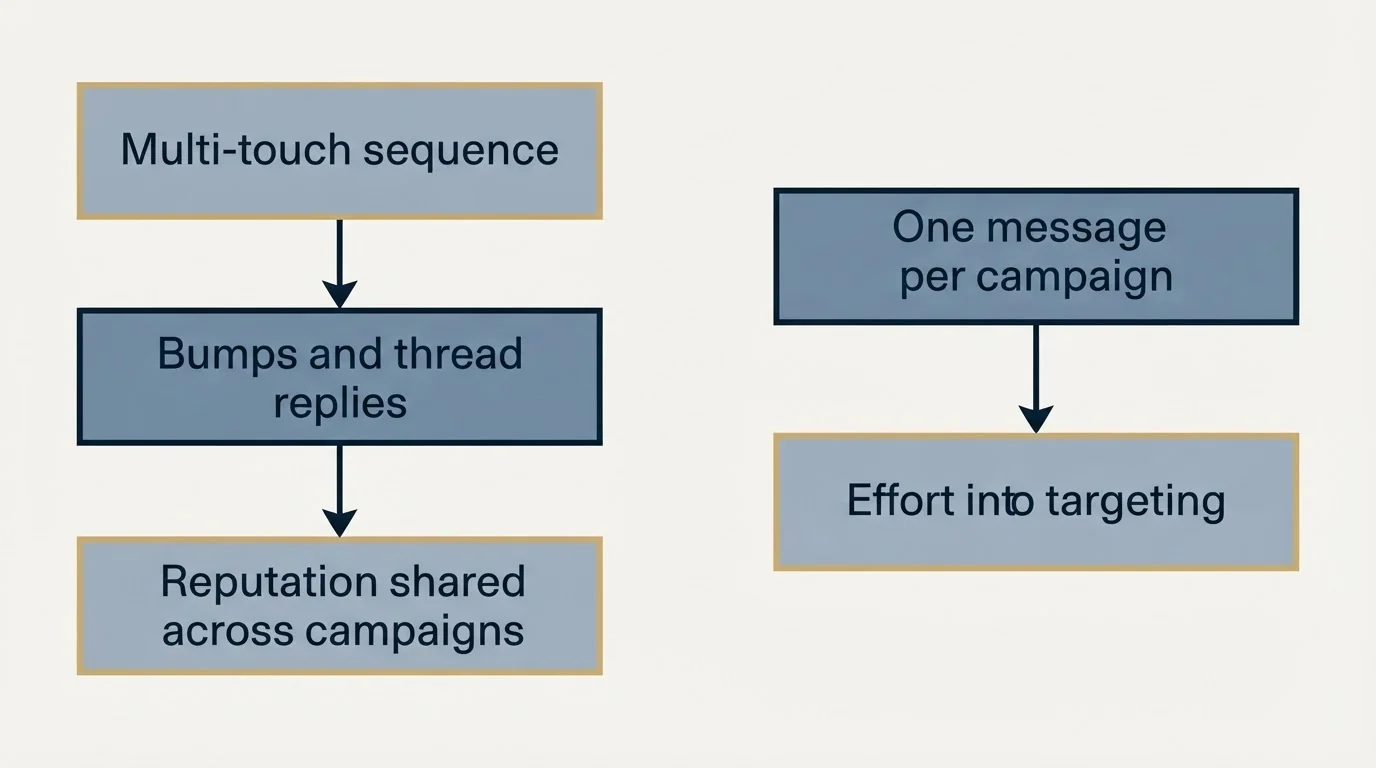
Much of the advice on this page reflects how outbound is commonly run. We run it differently, and since this page sits on our site it is worth saying where the difference is and what it costs us.
- A sequence of messages to each prospect over several weeks
- Later messages often land in the same email thread
- Every contact is reached more than once, so a distracted reader gets another chance
- The later messages go only to people who did not answer the first
- Reputation cost accrues on the sending domain across everything else it sends
- One message, then that campaign is finished for that contact
- No thread replies and no bumps
- A non-responding audience becomes a new campaign with a genuinely different premise, not a reminder
- More of the work moves into targeting and into the one message
- We reach each contact less often, and that is the cost we accept
The reasoning is mechanical rather than moral. A follow-up arrives underneath a message the recipient has already seen and chosen not to answer, so it is delivered to the population most likely to mark it as spam, and the reputation cost of that lands on the sending domain across every campaign running on it. We set that cost against the replies a sequence recovers and decided the trade was not worth it. The full argument, with the numbers from our own campaigns, is in why we stopped using follow-ups.
Follow-Up Strategy
Journalists are busy. Thoughtful follow-ups can make the difference between coverage and silence.
Follow-Up Timing
- Follow-up 1: 2-3 days after initial pitch
- Follow-up 2: 4-5 days after first follow-up
- Final follow-up: 7-10 days after second follow-up (only if story is still timely)
Follow-Up Approach
Keep follow-ups brief and add value:
Follow-up 1:
Hi [Name],
Following up on my pitch about [topic]. Since I sent it, [new development: additional data, relevant news, customer update].
Let me know if you have questions or would prefer a different angle.
[Your Name]
Follow-up 2:
Hi [Name],
One more note on [topic]. I saw your recent piece on [related article] and thought there might be a connection to the angle I pitched.
If this story isn't a fit right now, I'd appreciate any feedback on what types of stories you're looking for.
[Your Name]
When to Stop
- If they've declined (respect the no)
- If the story is no longer timely
- If you've followed up twice with no response
- If they're clearly dealing with breaking news
Building Long-Term Journalist Relationships
The most effective media outreach comes from established relationships built over time.
Between Pitches
Engage authentically. Share their articles, comment thoughtfully on their work, be genuinely interested in their coverage.
Be a resource. Offer to help with background information, connect them with sources, or provide context even when there's nothing in it for you.
Respect boundaries. Don't overwhelm them with constant communication. Be present but not pushy.
After Coverage
Thank them promptly. A brief, genuine thank you (not effusive flattery) is appropriate.
Share their work. Amplify coverage through your channels, which supports their metrics.
Provide follow-up. If the story develops, proactively update them.
Remember the relationship. When you have future stories, prioritize journalists who've covered you well.
Being a Good Source
Be responsive. Return calls and emails quickly, especially under deadline.
Be honest. Never mislead journalists. Credibility lost is nearly impossible to regain.
Be prepared. Have facts, data, and talking points ready.
Be quotable. Provide clear, concise quotes they can use directly.
Avoiding Common Media Outreach Mistakes
Pitching Without a Story
"Hey, I thought you might want to write about my company" is not a pitch. Journalists need story angles, not promotional requests.
Mass Blasting
Sending identical pitches to dozens of journalists signals spam. Each pitch should be tailored to the specific journalist and publication.
Following Up Too Aggressively
One or two follow-ups are professional. Daily emails after being ignored are harassment.
Overselling
Excessive superlatives and hype damage credibility. Let the story's merits speak.
Ignoring Beat Boundaries
Pitching irrelevant stories wastes journalist time and burns your reputation for future relevant pitches.
Being Difficult to Work With
Unresponsiveness, missed deadlines, or last-minute changes make journalists less likely to work with you again.
Your Media Outreach Checklist
Story Development
- Story angle is genuinely newsworthy
- Timing hook identified (why now?)
- Supporting evidence available (data, sources, examples)
- Story tailored to publication types
Contact Research
- Journalists identified by beat relevance
- Recent work reviewed (5-10 articles per journalist)
- Contact information verified
- Priority tiers established
Pitch Quality
- Subject line is specific and newsworthy
- Opening leads with story, not company
- Pitch is personalized to journalist's beat
- Proof points support the story
- Access/availability is clear
- Total length under 200 words
Process
- Response tracking system in place
- Relationship notes documented
- Coverage monitoring active
Earning Media Coverage Through Strategic Outreach
Cold email to journalists works when it offers genuine value: stories worth telling, sources worth quoting, and data worth sharing. The goal is not to convince journalists to cover you; it's to provide opportunities that serve their audience and make their job easier.
Build relationships over time, be consistently reliable, and prioritize long-term reputation over short-term wins. The journalists who trust you become invaluable assets for ongoing coverage.
If you're looking to scale your media outreach while maintaining the personalization that generates coverage, RevenueFlow can help. Our done-for-you cold email campaigns apply the research and personalization principles above to build your earned media presence systematically.
Get Your Free Campaign and see how targeted cold email can generate media coverage for your company.
Related Reading
Frequently asked questions.
Frequently asked questions- How do I get journalists to respond to my cold emails?
- Journalists respond when your pitch offers a genuine story their audience cares about, not a promotional message. Research their recent coverage to ensure your story matches their beat, craft a subject line under 50 characters that states the news hook, and keep your initial pitch under 150 words leading with why the story matters now. Personalize by referencing their recent work and demonstrating you understand their publication's focus. Include all necessary information upfront so they don't need to ask follow-up questions to evaluate your pitch.
- What story angles do journalists actually want to cover?
- Journalists prioritize stories with timeliness, exclusivity, or original insight that serves their specific audience. Strong angles include trend analysis positioning your data within broader industry movements, original research or surveys providing exclusive material, expert commentary on breaking news or developments, contrarian perspectives challenging conventional wisdom, and human interest narratives with emotional hooks. The angle must offer value to readers independent of your company's promotional interests and include a clear news hook explaining why coverage matters now rather than next month.
- What should I do if a journalist doesn't respond to my pitch?
- Move on. Journalists who don't respond typically aren't interested, and additional messages damage your reputation as a source, so send one pitch and leave it there. When you have a genuinely different story for that journalist, new data, a new angle, or a live news hook, pitch that on its own merits rather than reviving the old thread. A fresh reason to write is welcome; a chase on a story they already passed on is not.
- What's the biggest mistake people make when pitching journalists?
- The most common mistake is pitching promotional company announcements instead of actual stories. Journalists write for their audience, not as free advertising for your company. Pitches that focus on your product features, company milestones without broader relevance, or messaging that reads like a press release get deleted immediately. Another critical error is mass-blasting generic pitches without researching whether journalists cover your topic: pitching outside someone's beat wastes their time and marks you as someone who doesn't respect their work.
- How do I find the right journalists to pitch for media coverage?
- Start by searching for recent articles on topics related to your story and noting the journalists who wrote them. Review target publications' content from the past 6-12 months to understand coverage patterns and identify writers whose beat aligns with your angle. Check journalists' social media profiles where they often share interests and current projects. Media databases like Cision, Muck Rack, and Meltwater provide contact information and beat details. Prioritize journalists who have published recently on your topic, ensuring they're actively covering that beat and their publication reaches your target audience.
About the author.

Ben Carden is CRO at RevenueFlow, which builds and operates outbound revenue engines for B2B companies. Previously at Gartner Enterprise. Studied at London School of Economics.
Ben Carden · CRO
Connect on LinkedIn →Explore more.
Ready to scale your outreach?
We build GTM engines that book real meetings. See the receipts.
Related articles.
Cold Email for Awards Nominations: Complete Strategy Guide
Learn how to use cold email to secure industry awards and recognitions. Includes proven templates, submission strategies, and best practices for awards outreach that gets results.
Cold Email for PR: How to Pitch Journalists and Get Coverage
Learn how to craft cold emails that get journalists to open, read, and respond to your pitches. Includes real templates, timing strategies, and a complete PR outreach checklist.
Cold Email for Mentorship: Complete Strategy Guide
Learn how to use cold email to find and connect with mentors who can accelerate your career or business. Includes proven templates, personalization strategies, and best practices for building meaningful mentor relationships.
Cold Email for Conference Speaking: Complete Strategy Guide
Learn how to use cold email to secure speaking opportunities at industry conferences and events. Includes proven templates, pitch strategies, and best practices for speaker outreach.
Cold Email for Webinar Guest Recruitment: Strategy Guide
Learn how to use cold email to recruit expert guests for your webinars. Includes proven templates, personalization strategies, and best practices for building a roster of compelling webinar speakers.
Cold Email for Guest Blogging: Complete Strategy Guide
Learn how to use cold email to secure guest blogging opportunities on high-authority publications. Includes proven templates, pitch strategies, and best practices for building your content portfolio.