Cold Email for Testimonials: Complete Strategy Guide
Learn how to use cold email to collect powerful customer testimonials that boost credibility and conversions. Includes proven templates, timing strategies, and response optimization techniques.
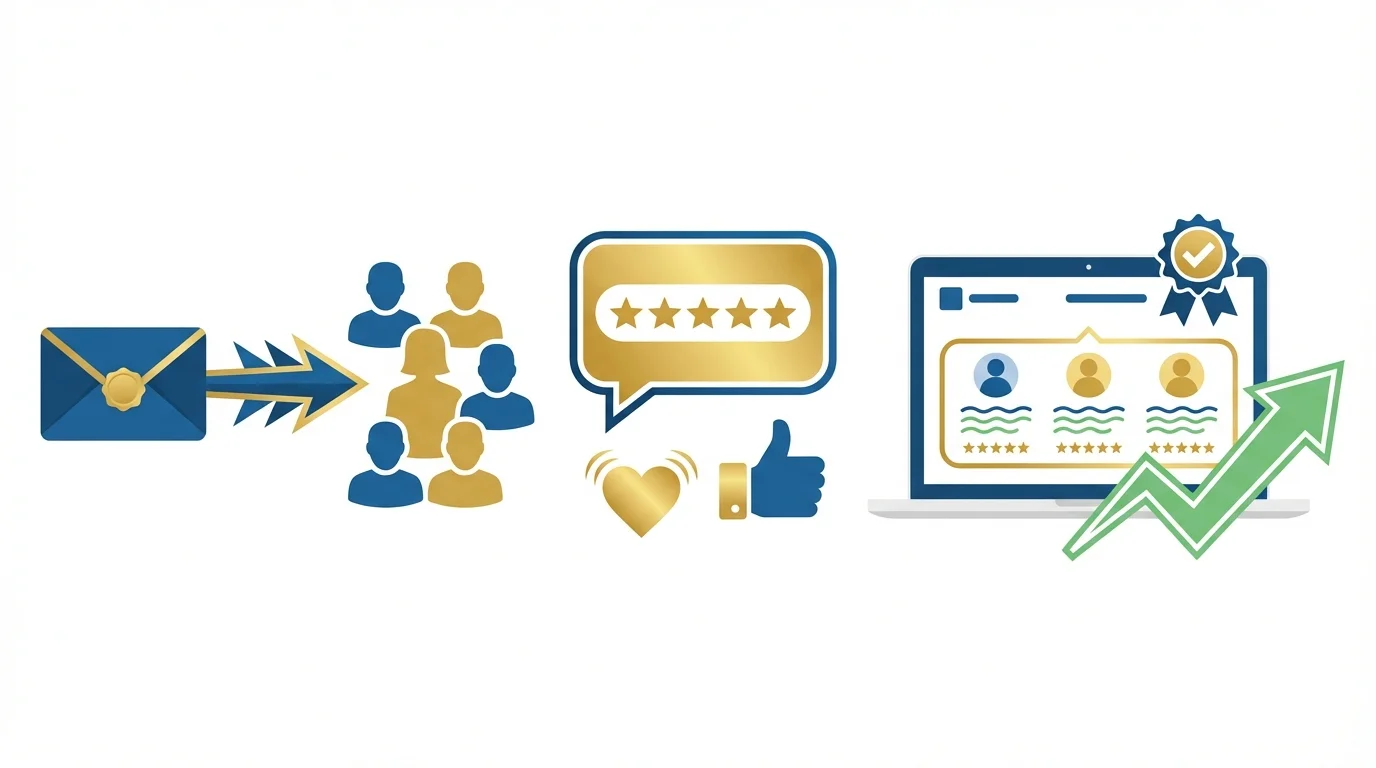
Cold email enables systematic testimonial collection by letting you proactively contact satisfied customers at optimal moments, rather than relying on sporadic requests. A B2B software company collected 47 new testimonials within six weeks using structured email outreach, improving conversion rates on pages featuring the fresh social proof. Success requires targeting customers who show satisfaction indicators, achieved specific results, and match your target prospect profiles.
Key takeaways
- A B2B software company gathered 47 new testimonials within six weeks through systematic email outreach and saw measurable conversion rate improvements on pages featuring the fresh testimonials.
- Cold email outreach allows targeting customers at high-sentiment moments like successful implementations, renewals, or positive support resolutions rather than waiting for random interactions.
- The most valuable testimonials come from customers whose profile matches your target prospects in industry, company size, use case, and buyer persona.
- Ideal testimonial candidates show satisfaction through multiple indicators including high NPS scores, support ticket resolutions, renewal behavior, and active product usage patterns.
- Strategic testimonial collection requires targeting specific customer segments to fill portfolio gaps across industries, use cases, and company sizes rather than accepting random feedback.
Reviewed and updated September 15, 2026
Cold Email for Testimonials: Complete Strategy Guide
Customer testimonials remain one of the most powerful forms of social proof in business. When prospects see real customers describing their positive experiences, skepticism diminishes and trust increases. Studies consistently show that testimonials on landing pages, sales materials, and websites significantly influence purchase decisions. Yet most companies struggle to systematically collect testimonials, relying instead on sporadic requests that yield inconsistent results. Cold email provides a structured approach to gathering testimonials at scale.
A B2B software company had thousands of satisfied customers but only three testimonials on their website. Those same testimonials had been displayed for two years. After implementing a systematic email outreach program to collect customer feedback, they gathered 47 new testimonials within six weeks. Conversion rates on pages featuring fresh, relevant testimonials improved measurably, and their sales team gained new proof points for every major industry vertical they served.
Why Cold Email Works for Testimonial Collection
Traditional testimonial collection depends on customer success teams remembering to ask happy customers at the right moment. This approach fails for several reasons. Timing is inconsistent. Some customers never interact with CS teams. The customers who would provide the best testimonials may not be the ones with the strongest team relationships. Cold email eliminates these dependencies by enabling systematic outreach to any customer who meets your criteria.
The Strategic Advantage of Proactive Outreach
Cold email for testimonial collection offers several distinct benefits:
Systematic coverage: Rather than depending on which customers happen to interact with your team, you can proactively contact everyone who might provide a valuable testimonial.
Timing optimization: You control when outreach happens, allowing you to target customers at moments when positive sentiment is highest (after successful implementations, renewals, or positive interactions).
Segmented targeting: You can target specific customer segments to fill gaps in your testimonial portfolio, ensuring coverage across industries, use cases, company sizes, and buyer personas.
Consistent quality: Thoughtfully crafted outreach guides customers toward providing testimonials that address specific points you want prospects to see.
Scalable process: Email-based collection can be repeated regularly, creating an ongoing stream of fresh testimonials rather than a one-time collection effort.
Identifying Ideal Testimonial Candidates
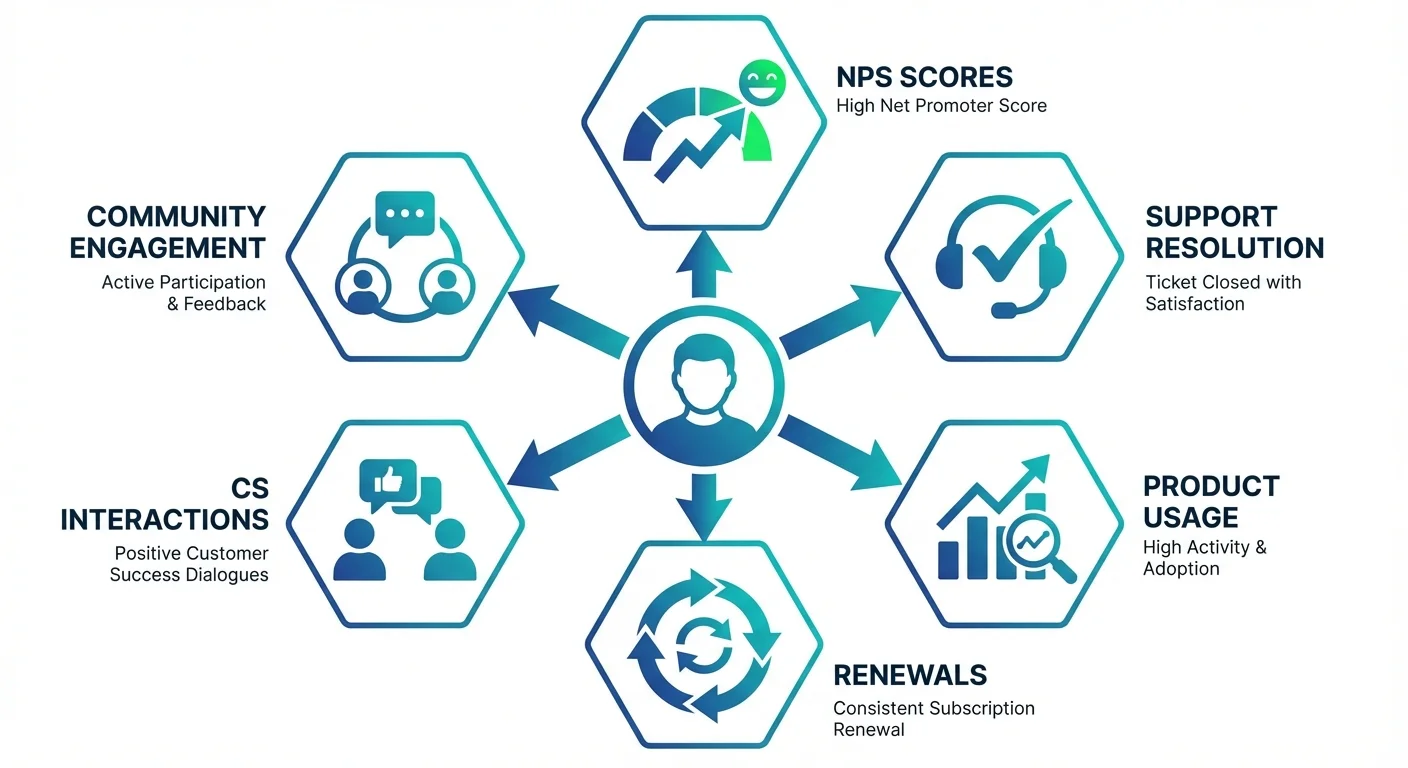
The most valuable testimonials come from customers whose experiences mirror those of your target prospects. Strategic selection ensures that collected testimonials directly support your sales and marketing objectives.
Defining Your Ideal Testimonial Provider
Before initiating outreach, establish clear criteria for ideal testimonial candidates:
Satisfaction indicators: Has this customer demonstrated positive sentiment through NPS scores, support interactions, renewal behavior, or expansion purchases?
Results achieved: Can this customer speak to specific outcomes or improvements experienced? Results-focused testimonials carry more persuasive weight than general praise.
Prospect relevance: Does this customer's profile (industry, size, use case, role) match prospects you want to influence? Testimonials resonate most strongly when prospects see themselves reflected.
Credibility factors: Does this customer's title, company, or background enhance testimonial credibility? Senior titles and recognized companies add persuasive power.
Communication ability: Can this customer articulate their experience clearly? Some satisfied customers struggle to express why they are happy.
Willingness signals: Has this customer previously indicated willingness to share feedback, participate in surveys, or engage publicly?
Where to Find Testimonial Candidates
Identify potential testimonial providers through multiple data sources:
NPS and satisfaction surveys: Customers who provide high scores have already indicated positive sentiment. High-score respondents are prime testimonial candidates.
Support ticket resolution: Customers whose issues were successfully resolved often express gratitude. Positive support experiences create testimonial opportunities.
Product usage analytics: High engagement, feature adoption, and regular usage correlate with satisfaction. Active users make credible testimonial sources.
Renewal and expansion data: Customers who renew or expand demonstrate commitment through behavior, suggesting positive experiences worth sharing.
Customer success interactions: CS teams identify customers experiencing success. Regular debriefs with CS surface testimonial opportunities.
Community engagement: Customers who participate in user communities, forums, or events have demonstrated willingness to engage publicly.
Referral behavior: Customers who refer others have already advocated for your product. Formalizing their praise into testimonials captures existing enthusiasm.
Building Your Testimonial Prospect List
Compile relevant information for each potential testimonial provider:
- Contact name, title, and company
- Email address and alternative contacts
- Customer tenure and products used
- Known results or outcomes achieved
- Recent interactions (positive indicators)
- Desired testimonial angle (what aspect of experience to highlight)
- Portfolio gap this testimonial would fill
Prioritize your list by strategic value and likelihood of response. Begin with customers showing strongest positive signals to build momentum.
What to Offer Testimonial Providers
Providing a testimonial requires time and willingness to be publicly associated with your brand. While many satisfied customers happily provide testimonials without incentives, thoughtful offers increase response rates and demonstrate appreciation.
Value Propositions That Work
Different customers respond to different motivations:
Recognition: Being featured on your website, in marketing materials, or in industry publications validates the customer's professional decisions.
Reciprocal promotion: Offering to promote their company alongside their testimonial creates mutual marketing value.
Account benefits: Credits, extended features, or priority support reward testimonial contribution without appearing to purchase endorsements.
Exclusive access: Early access to new features, beta programs, or roadmap previews provides tangible value that deepens engagement.
Simple appreciation: A genuine thank-you, handwritten note, or small gift acknowledges their contribution meaningfully.
Content partnership: Offering to collaborate on content (co-authored posts, joint webinars) extends the relationship beyond a single testimonial.
Structuring Your Testimonial Request
Your outreach should clearly communicate:
- What you are asking for (written testimonial, video, brief quote)
- How much time it requires
- How the testimonial will be used
- What control they have over content and placement
- Any benefits they receive for participating
- Whether they can review and approve before publication
Clarity reduces friction. Customers who understand exactly what they are agreeing to respond more readily.
What Works: Testimonial Collection Email Best Practices
Effective testimonial collection emails make providing feedback easy while guiding customers toward responses that serve your marketing objectives. The best requests feel like natural conversations rather than data extraction exercises.
Subject Line Principles
Your subject line should feel personal rather than promotional:
- Reference their experience or relationship
- Avoid words that trigger corporate-speak resistance
- Create curiosity without appearing demanding
- Keep it conversational
Examples that perform well:
- "Quick question about your experience"
- "Would you help us out?"
- "Your feedback would mean a lot"
- "A small favor?"
Email Body Structure
Structure your testimonial collection emails with these elements:
Appreciation opening: Begin by thanking them for being a customer. Genuine gratitude sets a positive tone.
Context for request: Explain why you are collecting testimonials. Transparency about purpose increases compliance.
Specific ask: Describe exactly what you need. A few sentences? Specific questions answered? Video recording?
Guidance on content: Provide prompts or questions that guide their response toward useful testimonial content.
Use explanation: Explain where and how the testimonial will appear.
Simplicity emphasis: Make clear how easy participation is. Reduce perceived effort.
Easy response path: Make providing the testimonial as simple as possible. Reply to the email, use a short form, or other low-friction options.
Guiding Testimonial Content
Open-ended requests often yield generic praise that lacks persuasive power. Guiding questions help customers provide specific, useful testimonials:
- What specific problem were you trying to solve?
- What results have you experienced?
- How does our product compare to alternatives you considered?
- What would you tell someone considering our product?
- What specific feature or aspect has been most valuable?
Including these prompts in your request dramatically improves testimonial quality.
Tone and Voice Guidelines
Testimonial collection emails succeed when they feel like genuine requests from real people:
- Write conversationally, as if asking a colleague for help
- Express authentic appreciation for their business
- Acknowledge that you are asking for something
- Keep the request simple and undemanding
- Offer flexibility in how they can respond
Testimonial Collection Email Templates
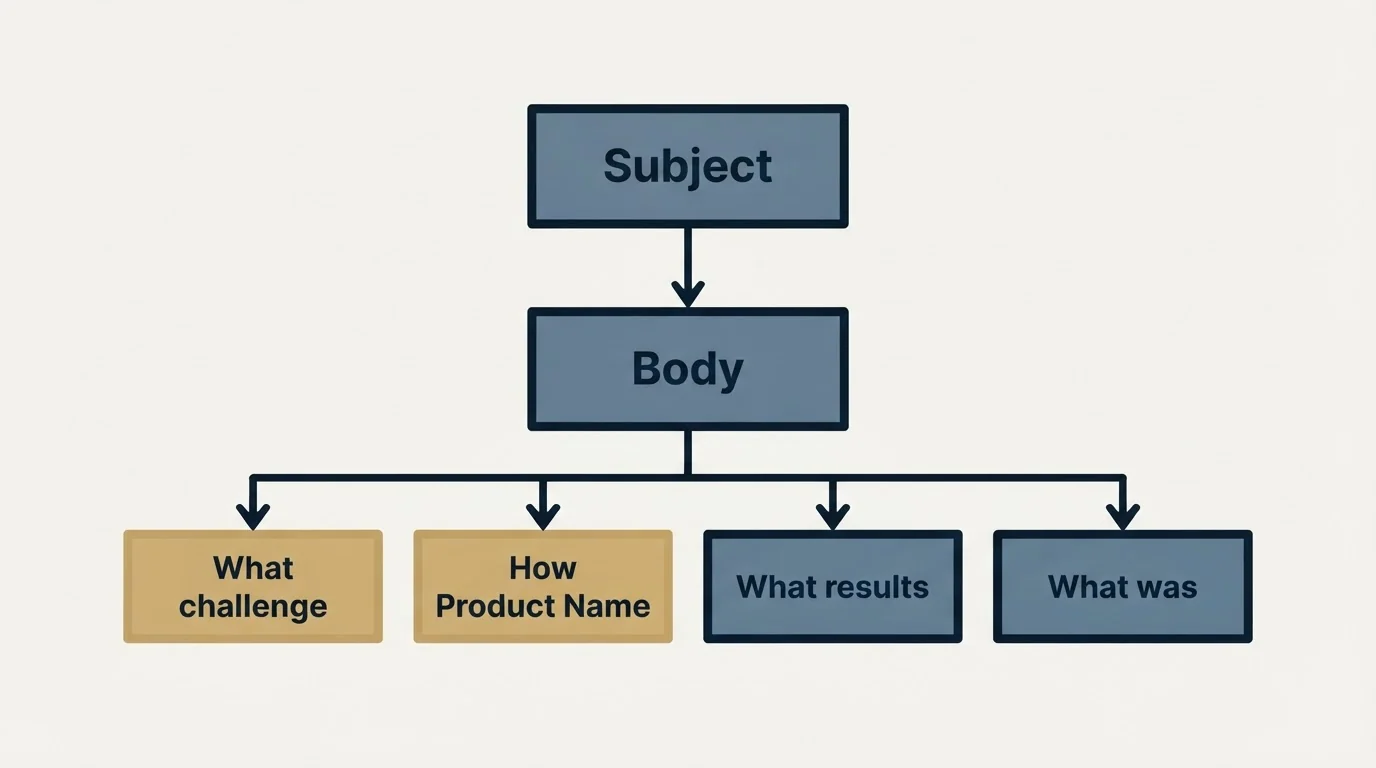
The following templates demonstrate effective approaches for collecting testimonials. Customize these frameworks with specific details about your customers and testimonial needs.
Template 1: The Simple Direct Request
Subject: Quick question about your experience
Body:
Hi [First Name],
I hope things are going well at [Company Name]. We genuinely appreciate having you as a customer.
I am reaching out because we are collecting testimonials from customers who have had positive experiences with [Product Name]. Based on what we know about your results, you came to mind immediately.
Would you be willing to share a brief testimonial about your experience? Just a few sentences describing:
- What challenge you were facing
- How [Product Name] helped
- What results you have seen
You can simply reply to this email with your thoughts, and I will handle everything from there. I will send you the final version for approval before we use it anywhere.
If you have questions or prefer a different format (video, phone call we record), just let me know.
Thank you for considering, [Your Name]
Template 2: The Results-Focused Request
Subject: Your [specific result] caught our attention
Body:
Hi [First Name],
I was reviewing customer data and noticed that [Company Name] has achieved [specific result or metric] since implementing [Product Name]. Results like that stand out, and I wanted to reach out personally.
Would you be willing to share your experience as a testimonial? Your perspective would help other [industry/role] professionals understand what kind of outcomes are possible.
A few questions that might help frame your response:
- What was the situation before you started using [Product Name]?
- What specific improvements have you experienced?
- What would you tell someone in a similar situation?
A paragraph or two is perfect. I can also jump on a quick call if you prefer to share verbally.
We would include your name, title, and company with the testimonial. Happy to send the final version for your approval before publishing.
Thanks for considering, [Your Name]
Template 3: The Segmented Collection Request
Subject: [Industry] perspective needed
Body:
Hi [First Name],
We are building testimonials specifically from customers in the [industry] space, and [Company Name] represents exactly the kind of success story that would resonate with similar organizations.
Would you share your experience with [Product Name]? Your perspective would help other [industry] professionals who are evaluating solutions for [relevant challenge].
Here are some prompts if helpful:
- What [industry-specific challenge] were you facing?
- How has [Product Name] addressed that challenge?
- What outcomes have you seen that other [industry] companies should know about?
Your testimonial would appear on our [industry] page and in materials we share with [industry] prospects. Full attribution with name, title, and company.
Simply reply with your thoughts, or let me know if you would prefer a brief phone call instead.
[Your Name]
Template 4: The Post-Success-Moment Request
Subject: Congratulations on [achievement]
Body:
Hi [First Name],
I heard about [specific recent achievement, milestone, or successful project]. Congratulations to you and the team at [Company Name].
I am reaching out because moments like this represent exactly the kind of outcomes we hope to help customers achieve. Would you be willing to share a brief testimonial about your experience with [Product Name]?
Your perspective on:
- The role [Product Name] played in this success
- What the journey looked like
- Advice for others pursuing similar goals
...would be incredibly valuable for other [industry/role] professionals evaluating their options.
Happy to work with whatever format is easiest for you. A few sentences via email reply works great, or I can set up a quick call.
Thanks, and congratulations again, [Your Name]
Template 5: The Reciprocal Value Request
Subject: Feature your company on our website?
Body:
Hi [First Name],
We are refreshing our customer testimonials section, and I would love to feature [Company Name] as one of our highlighted success stories.
Here is what that would include:
- Your testimonial about working with [Product Name]
- Your company logo featured on our homepage
- Link to [Company Name] website
- Promotion in our [newsletter/social channels] reaching [audience size]
In return, I am looking for a few sentences describing:
- What [Product Name] helps you accomplish
- Why you would recommend it to peers
- Any specific results worth mentioning
Would you be interested? I would send the final testimonial for your approval before publishing, and you can update or remove it anytime.
[Your Name]
Testimonial Format Options
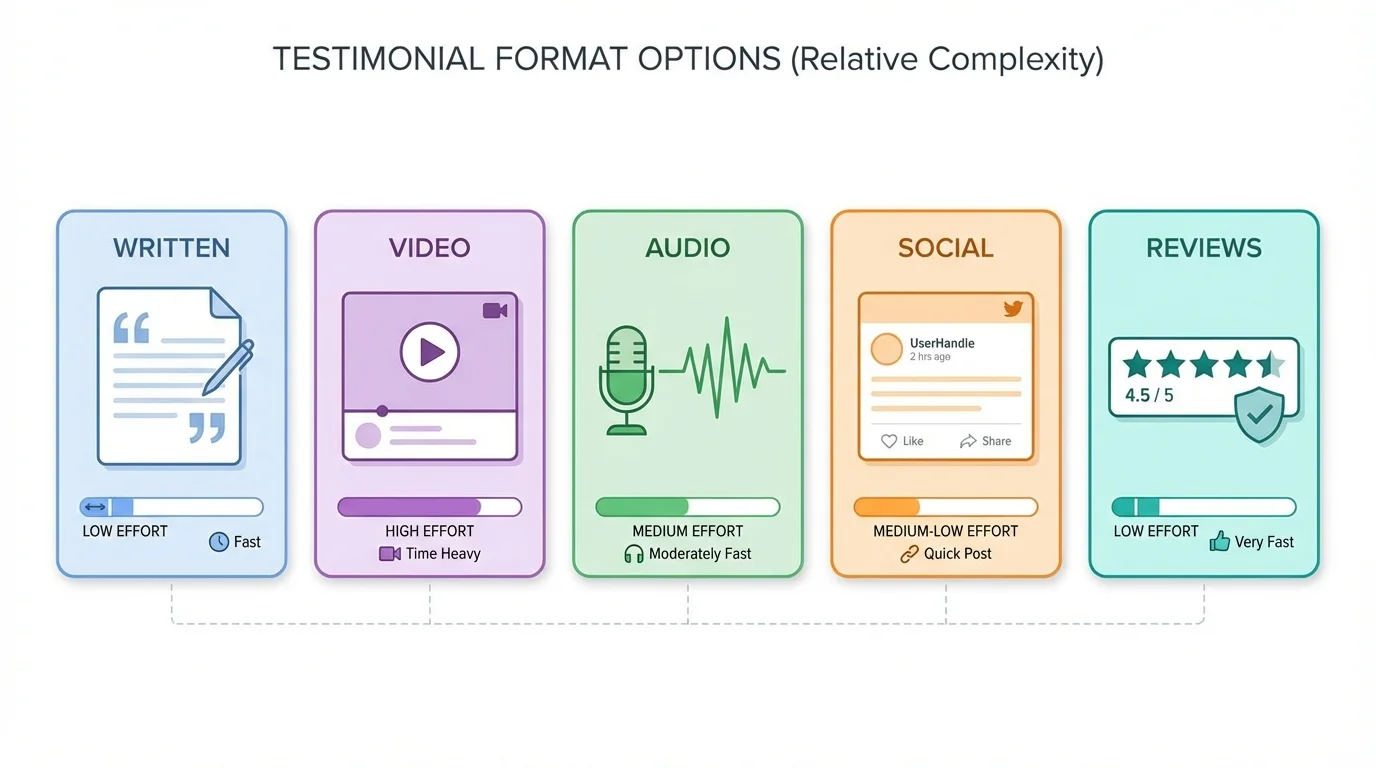
Different testimonial formats serve different purposes. Offer flexibility to increase response rates while guiding customers toward formats that serve your needs.
Written Testimonials
The most common format. Easy to collect via email reply, simple to edit for clarity, and versatile for use across marketing materials.
Best for: Website pages, email campaigns, sales collateral, social proof sections.
Video Testimonials
More persuasive than written testimonials but require more customer effort. Consider offering professional production support or accepting simple self-recorded videos.
Best for: Landing pages, sales presentations, social media, trade shows.
Audio Testimonials
Middle ground between written and video. Customers can record easily via phone, and audio adds personality without video production requirements.
Best for: Podcasts, radio ads, hold music, audio versions of written content.
Social Media Quotes
Brief testimonials formatted for social sharing. Can be excerpted from longer testimonials or collected specifically for social use.
Best for: Social media campaigns, paid social ads, community engagement.
Structured Reviews
Testimonials formatted as ratings and reviews. Useful for comparison sites, app stores, or review platforms.
Best for: Third-party review sites (G2, Capterra), app store listings, Google reviews.
Common Mistakes to Avoid
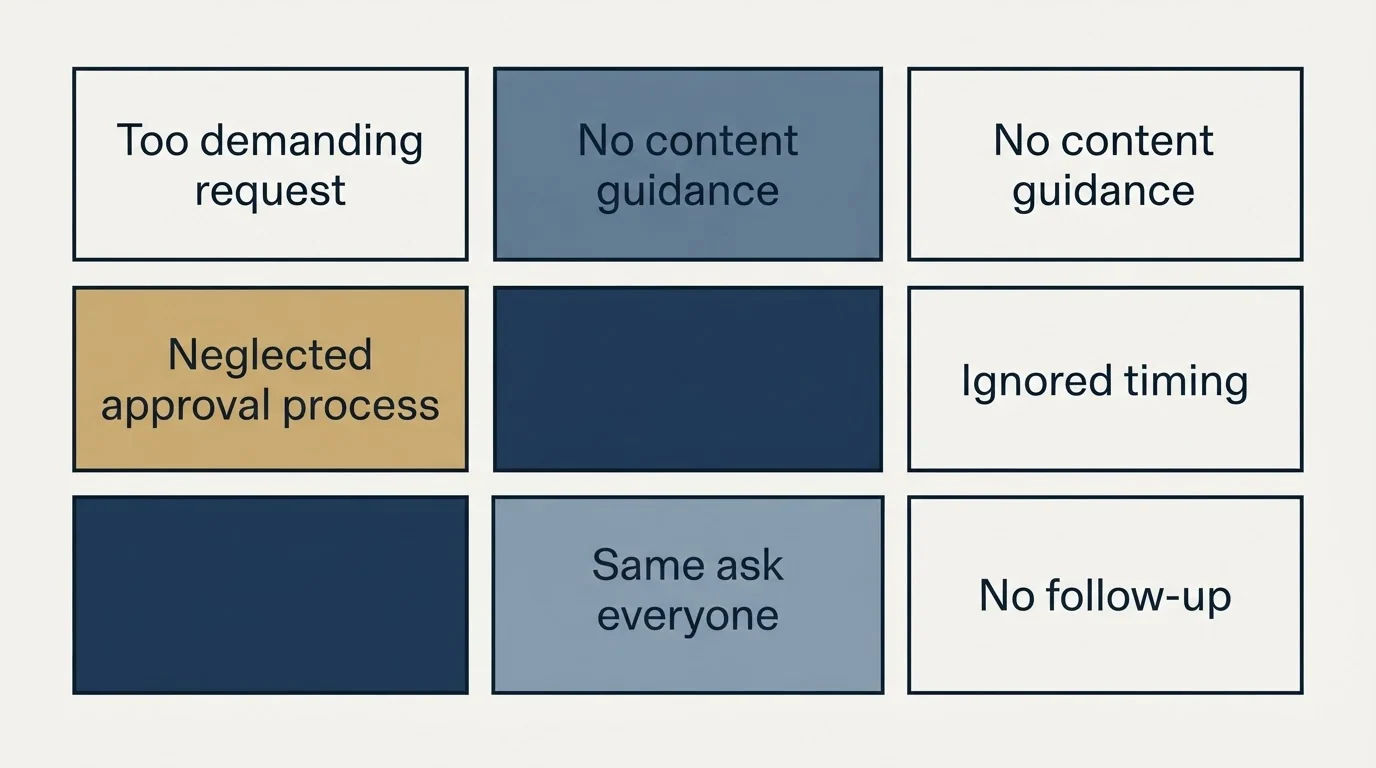
Testimonial collection campaigns fail for predictable reasons. Avoiding these errors improves response rates and testimonial quality.
Making the Request Too Demanding
Asking for lengthy testimonials, video recordings, or multi-step processes reduces response rates. Make initial requests simple. You can always request expanded versions later.
Failing to Guide Content
Open-ended requests yield generic responses. Provide questions or prompts that direct customers toward specific, useful testimonial content.
Neglecting Approval Process
Customers who feel they lost control over how their words are used become uncomfortable and may request removal. Always confirm approval before publishing.
Ignoring Timing
Requesting testimonials at random times yields random results. Time requests to follow positive experiences, successful implementations, or satisfaction indicators.
Using the Same Ask for Everyone
Different customers respond to different appeals. Segment your outreach and customize requests based on customer characteristics and testimonial needs.
Not Following Up
Many willing customers forget to respond or deprioritize the request. Follow-up emails significantly improve collection rates.
Hoarding Without Using
Collecting testimonials that never appear in marketing materials wastes customer goodwill. Use collected testimonials promptly and visibly.
Your Testimonial Collection Checklist
Before launching your testimonial collection campaign, confirm completion of these steps:
Strategy Preparation
- Defined ideal testimonial provider criteria
- Identified portfolio gaps to fill (industries, use cases, personas)
- Established collection format(s)
- Created approval workflow
Prospect Identification
- Built prioritized list of testimonial candidates
- Gathered satisfaction indicators for each candidate
- Identified personalization opportunities
- Coordinated with CS/Sales on relationship context
Outreach Preparation
- Written customized email templates
- Developed guiding questions for testimonial content
- Created response tracking system
Post-Collection Process
- Established editing and formatting standards
- Created approval request workflow
- Identified placement opportunities for collected testimonials
- Planned thank-you process for contributors
Build Your Testimonial Library
Collecting testimonials through cold email transforms sporadic gathering into systematic cultivation. The strategies, templates, and frameworks in this guide provide everything needed to build a comprehensive testimonial library that supports sales and marketing objectives.
Each testimonial collected becomes a reusable asset that influences prospects across multiple touchpoints. Regular collection ensures your testimonial portfolio stays fresh, relevant, and representative of your evolving customer base.
Ready to build your testimonial library? Our team specializes in outreach campaigns that generate customer participation. Get your free testimonial collection campaign and start turning customer satisfaction into persuasive social proof.
Related Reading
Frequently asked questions.
Frequently asked questions- Why is cold email better than waiting for customers to give testimonials naturally?
- Cold email provides systematic coverage and timing control that passive collection cannot match. Traditional approaches depend on customer success teams remembering to ask happy customers, which creates inconsistent timing and misses customers who don't interact with CS teams. Cold email lets you proactively contact any customer meeting your criteria at moments when positive sentiment is highest, like after successful implementations or renewals.
- Which customers should I contact for testimonials?
- Target customers who show satisfaction indicators like high NPS scores, successful support resolutions, renewal behavior, or high product engagement. The best testimonial providers also achieved specific measurable results, match your target prospect profile in industry and company size, hold credible titles, and can articulate their experience clearly. Look for customers who have demonstrated willingness to engage through community participation or referral behavior.
- How quickly can I collect testimonials using cold email outreach?
- One B2B software company gathered 47 new testimonials within six weeks using structured email outreach. The speed depends on your existing customer base, how well you target satisfied customers, and how effectively you guide their responses. Cold email enables scalable, repeatable processes that create ongoing streams of fresh testimonials rather than one-time collection efforts.
- What information do I need before sending testimonial requests?
- Compile contact details, customer tenure, products used, and known results achieved for each potential provider. Identify recent positive interactions, determine what specific aspect of their experience you want highlighted, and note which portfolio gap this testimonial would fill. Prioritize by strategic value and response likelihood. This preparation ensures requests are targeted and testimonials address specific points you want prospects to see.
About the author.

Ben Carden is CRO at RevenueFlow, which builds and operates outbound revenue engines for B2B companies. Previously at Gartner Enterprise. Studied at London School of Economics.
Ben Carden · CRO
Connect on LinkedIn →Explore more.
Ready to scale your outreach?
We build GTM engines that book real meetings. See the receipts.
Related articles.
Cold Email for Reviews: Complete Strategy Guide
Learn how to use cold email to generate authentic product reviews on G2, Capterra, and other platforms. Includes proven templates, compliance guidelines, and review generation frameworks.
Cold Email for Case Study Participation: Strategy Guide
Learn how to use cold email to recruit customers for case studies that demonstrate your product's value. Includes proven templates, incentive frameworks, and approval strategies.
Cold Email for Influencer Outreach: Partner with Creators
Learn how to use cold email to build authentic influencer partnerships that drive real results for your brand, with proven templates and strategies.
Cold Email for Product Feedback: Complete Strategy Guide
Learn how to use cold email to gather valuable product feedback from users and prospects. Includes proven templates, feedback frameworks, and response optimization techniques.
Cold Email for PR: How to Pitch Journalists and Get Coverage
Learn how to craft cold emails that get journalists to open, read, and respond to your pitches. Includes real templates, timing strategies, and a complete PR outreach checklist.
Cold Email for Link Building: How to Get Quality Backlinks
Learn how to use cold email outreach to build high-quality backlinks that improve your SEO rankings, with proven templates and strategies that get responses.