Cold Email for User Research: Complete Strategy Guide
Learn how to use cold email to recruit participants for user research studies. Includes proven templates, screening strategies, and incentive frameworks that attract qualified participants.
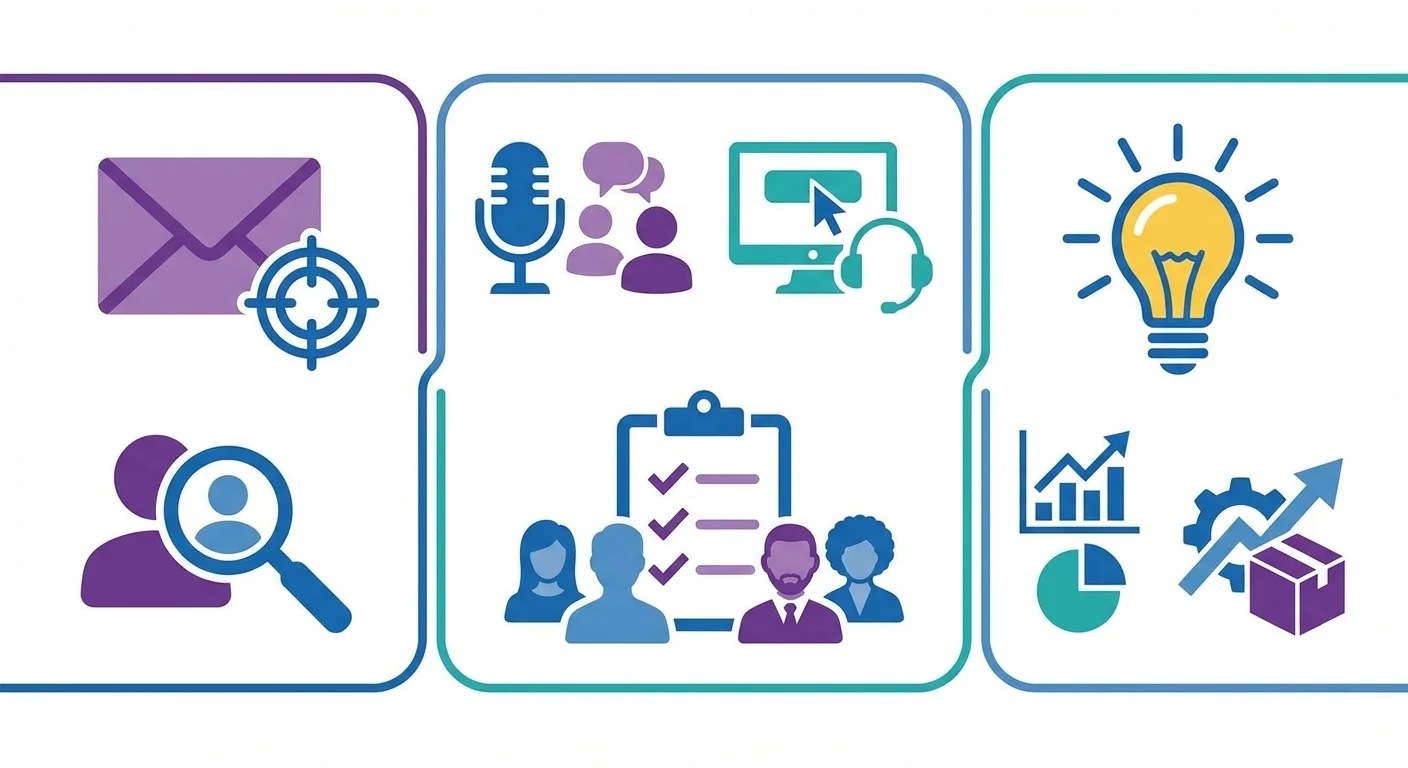
Cold email enables user research teams to recruit participants by targeting specific professional profiles directly rather than relying on panels or passive methods. The approach works by defining precise participant criteria, offering appropriate incentives, and using personalized outreach to reach specialized profiles like senior executives or domain experts who rarely appear in traditional recruiting channels. A product team recruited 15 Fortune 500 IT directors within two weeks using this method.
Key takeaways
- A product team recruited 15 qualified Fortune 500 IT directors within two weeks through targeted cold email, providing insights that shaped their product roadmap and positioning strategy.
- Cold email recruitment provides access to hard-to-reach profiles like senior executives and specialized practitioners who do not respond to recruiting panels.
- Effective user research recruitment requires defining primary criteria, secondary criteria, exclusion criteria, diversity requirements, and practical constraints before beginning outreach.
- Common participant profile types include current users, prospective users, expert practitioners, decision makers, and churned users, each serving different research objectives.
- Screening methods for verifying participant qualification include pre-screen questions, screening calls, surveys, and LinkedIn profile review.
Reviewed and updated September 15, 2026
Cold Email for User Research: Complete Strategy Guide
User research forms the foundation of product decisions, yet recruiting qualified participants remains one of the most challenging aspects of the process. The difference between valuable research and wasted effort often comes down to who you study. Cold email provides a direct, scalable method for recruiting specific types of participants who match your research criteria, enabling studies that would be impossible through passive recruitment channels.
A product team at an enterprise software company needed to understand how IT directors at Fortune 500 companies evaluated security tools. Posting recruiting ads yielded mostly individual contributors and small business owners. Traditional recruiting panels did not have the specific senior profiles required. Through targeted cold email outreach, they recruited 15 qualified IT directors within two weeks, gathering insights that fundamentally shaped their product roadmap and positioning strategy.
Why Cold Email Works for User Research Recruitment
Traditional research recruitment has significant limitations. Recruiting panels often lack specialized professional profiles. Social media recruiting attracts self-selected participants who may not represent your target users. Relying on existing customer networks limits perspective to people already familiar with your approach. Cold email solves these problems by enabling direct outreach to specific individuals who match your exact research criteria.
The Strategic Advantage of Targeted Recruitment
Cold email for user research recruitment offers several distinct benefits:
Precise targeting: You can identify and contact individuals who match specific professional, demographic, or behavioral criteria that define your ideal research participant.
Access to hard-to-reach profiles: Senior executives, specialized practitioners, and other high-value participants who never respond to panel recruiters can be reached through personalized direct outreach.
Control over composition: You determine the exact mix of participants rather than accepting whoever happens to respond to passive recruitment.
Speed: Direct outreach to qualified prospects accelerates recruitment timelines compared to waiting for panel responses or posting and hoping for relevant applicants.
Cost efficiency: Compared to specialized recruiting agencies or enterprise panels, cold email recruitment can reduce costs significantly while improving participant quality.
Designing Research-Driven Recruitment
Effective recruitment starts with clear research design. Vague research goals produce vague recruitment criteria, which yield participants who cannot provide the insights you need. Defining your research requirements precisely enables targeted outreach that attracts qualified participants.
Defining Your Ideal Participant Profile
Before initiating any outreach, establish detailed criteria for research participants:
Primary criteria: What characteristics absolutely must participants have? These are non-negotiable qualifications that define study inclusion.
Secondary criteria: What additional characteristics would add value to the research? These help prioritize among candidates who meet primary criteria.
Exclusion criteria: What characteristics disqualify potential participants? Past research participation, competitive employment, or other factors may exclude otherwise qualified individuals.
Diversity requirements: What variation do you need across your participant pool? Different company sizes, industries, experience levels, or perspectives may be required for valid research.
Practical constraints: What scheduling, technology, or location requirements affect eligibility? Remote participants require different setup than in-person studies.
Common Participant Profile Types
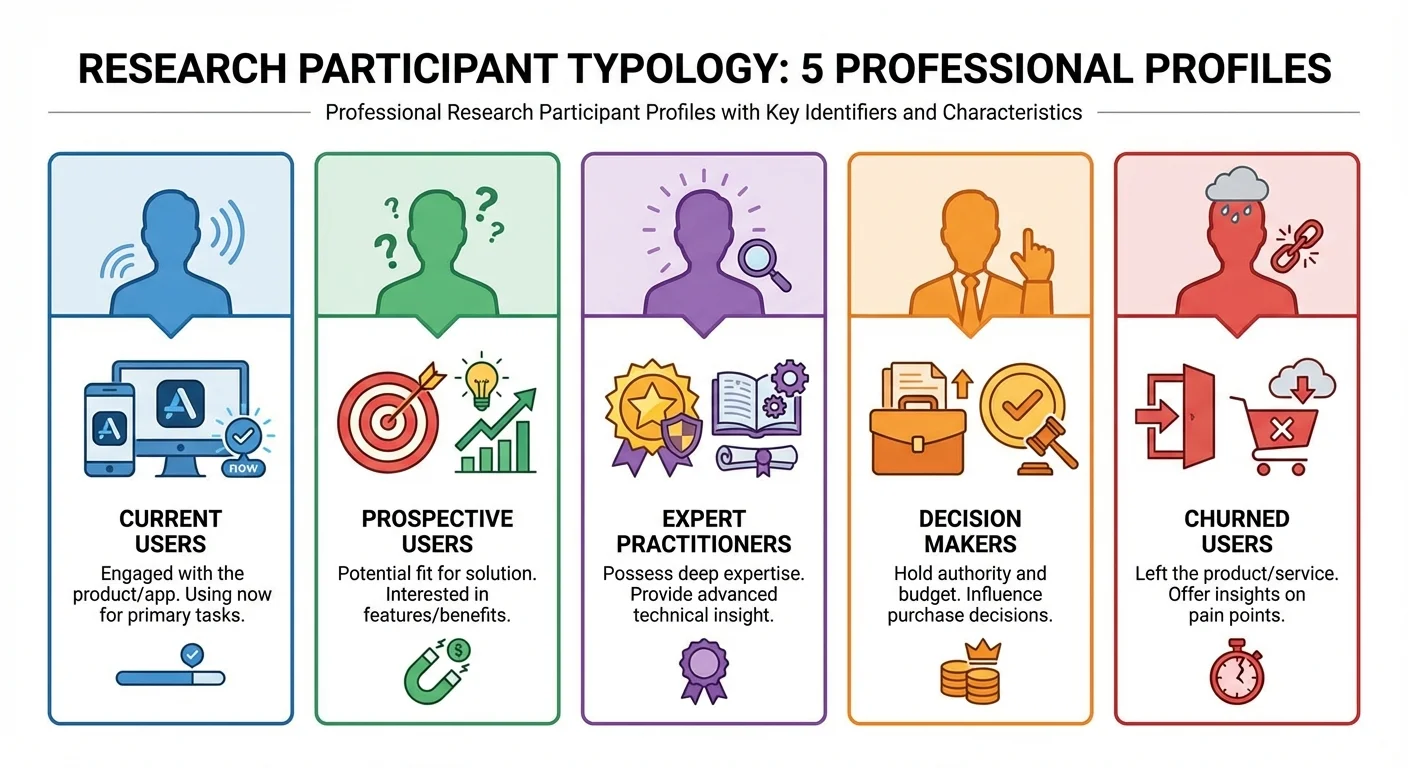
Different research questions require different participant profiles:
Current users: People who currently use your product, a competitor's product, or a related product category. They provide perspective on existing behaviors and pain points.
Prospective users: People who fit your target market but have not adopted any solution. They reveal unmet needs and adoption barriers.
Expert practitioners: People with deep expertise in a relevant domain who can provide specialized insight. They offer nuanced understanding of complex problems.
Decision makers: People who control purchasing decisions for relevant products. They reveal buying criteria and organizational dynamics.
Churned users: People who previously used a product and stopped. They illuminate abandonment reasons and unmet expectations.
Screening for Qualification
Cold email recruitment must include screening to verify participant qualification. Consider these screening approaches:
Pre-screen questions: Include qualification questions in your initial outreach or follow-up. Responses help filter before committing to scheduling.
Screening calls: Brief phone conversations verify qualifications and assess participant quality before formal research sessions.
Surveys: Short qualification surveys collect structured data that enables objective filtering.
LinkedIn profile review: Professional profiles provide verification data that supplements self-reported qualifications.
What to Offer Research Participants
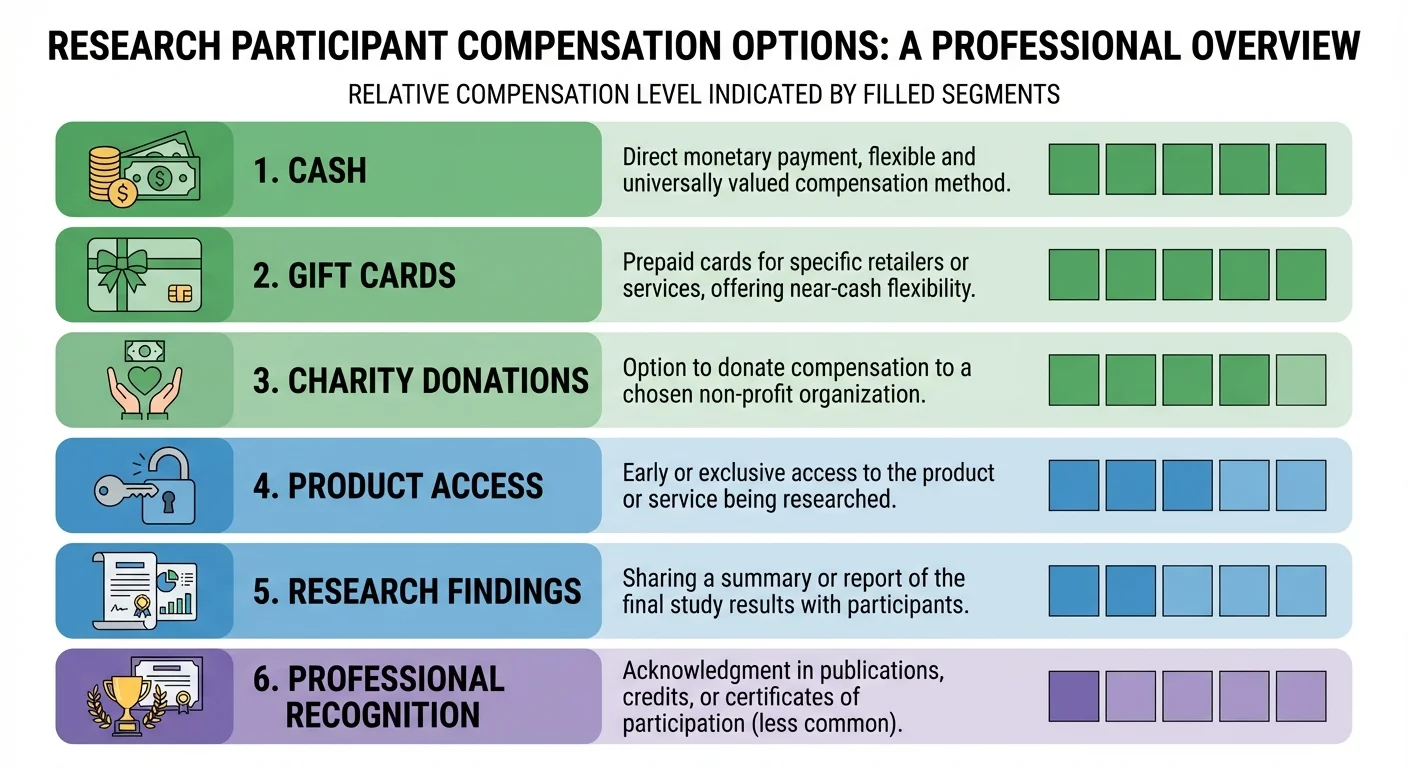
User research participation requires significant time investment and willingness to share candid feedback. Your offer must provide sufficient value to attract qualified participants, especially senior professionals whose time commands premium value.
Incentive Frameworks That Work
Different participant types respond to different value propositions:
Cash compensation: The most universal incentive. Rates vary by participant seniority, session length, and research complexity. Senior executives typically require higher rates than individual contributors.
Gift cards: Provide flexibility and appeal broadly. Amazon, Visa prepaid cards, or retailer-specific cards work for most participants.
Charitable donations: Some participants prefer donations to charity on their behalf, particularly those for whom direct compensation feels inappropriate.
Product access: Early access, extended trials, or premium features appeal to participants interested in your product category.
Research findings: Sharing aggregate insights or research reports provides value to participants interested in the topic.
Professional recognition: Acknowledgment in publications, advisory board membership, or professional networking opportunities appeal to participants seeking career benefits.
Setting Appropriate Compensation
Compensation should reflect participant time investment, expertise level, and recruitment difficulty:
- 30-minute sessions with general consumers: Lower compensation range
- 60-minute sessions with professionals: Moderate compensation range
- 90+ minute sessions with senior executives: Higher compensation range
- Diary studies or longitudinal participation: Premium compensation
Research industry benchmarks and adjust based on your specific participant profile and recruitment difficulty. Underpaying reduces response rates and participant quality. Overpaying may attract participants motivated primarily by compensation rather than genuine engagement.
Lower compensation range
Moderate compensation range
Higher compensation range
Structuring Your Research Offer
Your outreach should clearly communicate:
- What the research involves (methods, topics, activities)
- How long participation requires
- When sessions will occur (scheduling flexibility)
- How sessions will be conducted (format, technology)
- What compensation participants receive
- How their data will be used and protected
- Who is conducting the research
Clarity about expectations attracts participants who can genuinely commit and reduces no-shows and disqualifications.
What Works: User Research Recruitment Email Best Practices
Effective recruitment emails balance professional credibility with approachable tone. Your message must quickly establish legitimacy while making participation feel worthwhile and easy.
Subject Line Principles
Your subject line determines whether qualified prospects open your email:
- Reference their specific expertise or professional context
- Mention research participation opportunity
- Avoid spam-trigger words while maintaining clarity
- Keep it concise and professional
Examples that perform well:
- "Research study for [role/industry] professionals"
- "Your expertise in [area] for a research study"
- "Paid research opportunity: [topic]"
- "[Organization] research invitation"
Email Body Structure
Structure your recruitment emails with these essential elements:
Credibility establishment: Open with context about who you are and who is conducting the research. Legitimacy matters for recruitment success.
Research purpose: Explain what you are studying and why. Transparency about purpose increases participation willingness.
Why them specifically: Articulate why you are contacting this particular person. Reference their expertise, experience, or profile characteristics.
Participation details: Describe what participation involves, how long it takes, and when it would happen.
Compensation: Clearly state what participants receive for their time.
Privacy assurance: Address how their data will be protected and used.
Easy response path: Make expressing interest simple. A brief reply indicating interest is easier than completing lengthy forms upfront.
- Yes: Credibility establishment: who you are and who is conducting the research.
- Yes: Research purpose: what you are studying and why.
- Yes: Why them specifically: their expertise, experience or profile characteristics.
- Yes: Participation details: what it involves, how long it takes, when it would happen.
- Yes: Compensation: clearly state what participants receive for their time.
- Yes: Privacy assurance: how their data will be protected and used.
- Yes: Easy response path: a brief reply indicating interest, rather than a lengthy form upfront.
Tone and Voice Guidelines
User research recruitment emails succeed when they feel professional yet approachable:
- Write clearly and directly
- Avoid excessive academic or corporate jargon
- Express genuine interest in their perspective
- Respect their time by being concise
- Maintain appropriate formality for your participant type
- Sound like a real person, not automated outreach
User Research Recruitment Email Templates
The following templates demonstrate effective approaches for recruiting different types of research participants. Customize these frameworks with specific details about your research and target participants.
Template 1: The Professional Expertise Request
Subject: Research study for [role/industry] professionals
Body:
Hi [First Name],
I am [Your Name], a researcher at [Organization]. We are conducting a study on [topic/research question] and looking for [role/industry] professionals to participate.
Based on your experience as [their role] at [Company], your perspective would be particularly valuable for this research. We are specifically interested in understanding [specific aspect relevant to their expertise].
Study details:
- Format: [Interview/usability test/survey]
- Duration: [Time estimate]
- Scheduling: [Timeframe and flexibility]
- Location: [Remote/in-person details]
Compensation: [Amount/type] for your time
Your participation is completely voluntary, and all responses are kept confidential. We are seeking honest perspectives to inform [general purpose of research].
Would you be interested in participating? I am happy to answer any questions about the study.
Best regards, [Your Name] [Title, Organization] [Contact information]
Template 2: The Senior Leader Request
Subject: Research invitation: [Senior role] perspectives needed
Body:
Hi [First Name],
I am reaching out on behalf of [Organization] regarding a research study focused on how [senior role type] approach [topic/challenge].
Given your position as [their title] at [Company], your perspective would provide valuable insight. We are particularly interested in understanding [specific aspect relevant to their seniority level].
The study involves a [time estimate] [interview/discussion] at your convenience. We are offering [compensation] in recognition of your time, or a donation to the charity of your choice.
Key details:
- Confidential participation (your identity protected in any reports)
- Flexible scheduling including early morning and evening options
- [Remote/phone/video] format for your convenience
This research will inform [general purpose without revealing competitive details].
Is this something you would consider? I would be glad to share more details or schedule a brief call to discuss.
[Your Name] [Organization]
Template 3: The Current User Research Request
Subject: Share your experience with [product/category]
Body:
Hi [First Name],
I am [Your Name] from [Organization]. We are conducting research with people who use [product or product category] to understand how the experience could be improved.
Based on [how you identified them as a user], I am reaching out to see if you would be interested in participating in a [study type] about your experience.
What participation involves:
- [Brief description of activities]
- Time commitment: [Duration]
- Format: [Remote/in-person, technology used]
You would receive: [Compensation/incentive]
Your feedback would directly inform how we improve [product/experience]. We are looking for honest perspectives, including what does not work well.
Interested in participating? Reply with your availability, and I will send additional details.
Thanks, [Your Name]
Template 4: The Prospective User Request
Subject: Research opportunity: [Topic area]
Body:
Hi [First Name],
We are conducting research on how [target audience] approach [challenge/task/decision] and would value your perspective.
You came to our attention because [reason they match criteria: industry, role, company type, etc.]. We are looking to understand experiences and perspectives from people like you who [relevant characteristic].
Study overview:
- Topic: [General description of what you are exploring]
- Format: [Interview/survey/task-based study]
- Duration: [Time estimate]
- Compensation: [Amount/type]
The research is conducted by [Organization] and will inform [general purpose]. Your participation would be confidential, and you can withdraw at any time.
Would you be willing to participate? If timing is a concern, I can offer flexible scheduling options.
[Your Name] [Organization]
Template 5: The Expert Practitioner Request
Subject: Your expertise in [domain] for research study
Body:
Hi [First Name],
Your work in [specific area of their expertise] caught my attention, particularly [specific reference to their published work, presentations, or known expertise].
I am conducting research on [topic] and seeking perspectives from practitioners with deep expertise in [their domain]. Your experience with [specific relevant aspect] would provide valuable insight that most participants cannot offer.
Study details:
- Format: [Expert interview/method]
- Focus: [Specific topics you want to explore]
- Duration: [Time estimate]
- Compensation: [Amount appropriate for expert level]
The research will inform [purpose]. Given your expertise level, I am happy to share relevant findings from the study as additional value for your participation.
Would you be interested in a conversation about participating?
Best, [Your Name] [Credentials/Organization]
Screening and Qualification Process
Cold email recruitment generates interest from respondents, but not all interested parties will qualify for your research. Establish a screening process that efficiently identifies qualified participants.
Screening Methods
Email screening questions: Include 2-3 critical qualification questions in your initial outreach or immediate follow-up. Filter responses before investing in scheduling.
Online screener surveys: Direct interested respondents to a brief survey that collects qualification data. Tools like Typeform, Google Forms, or dedicated research platforms work well.
Screening calls: Brief 5-10 minute phone conversations verify qualifications and assess participant engagement. More time-intensive but higher quality filtering.
LinkedIn profile verification: Review professional profiles to verify self-reported credentials, experience levels, and company affiliations.
Managing Unqualified Respondents
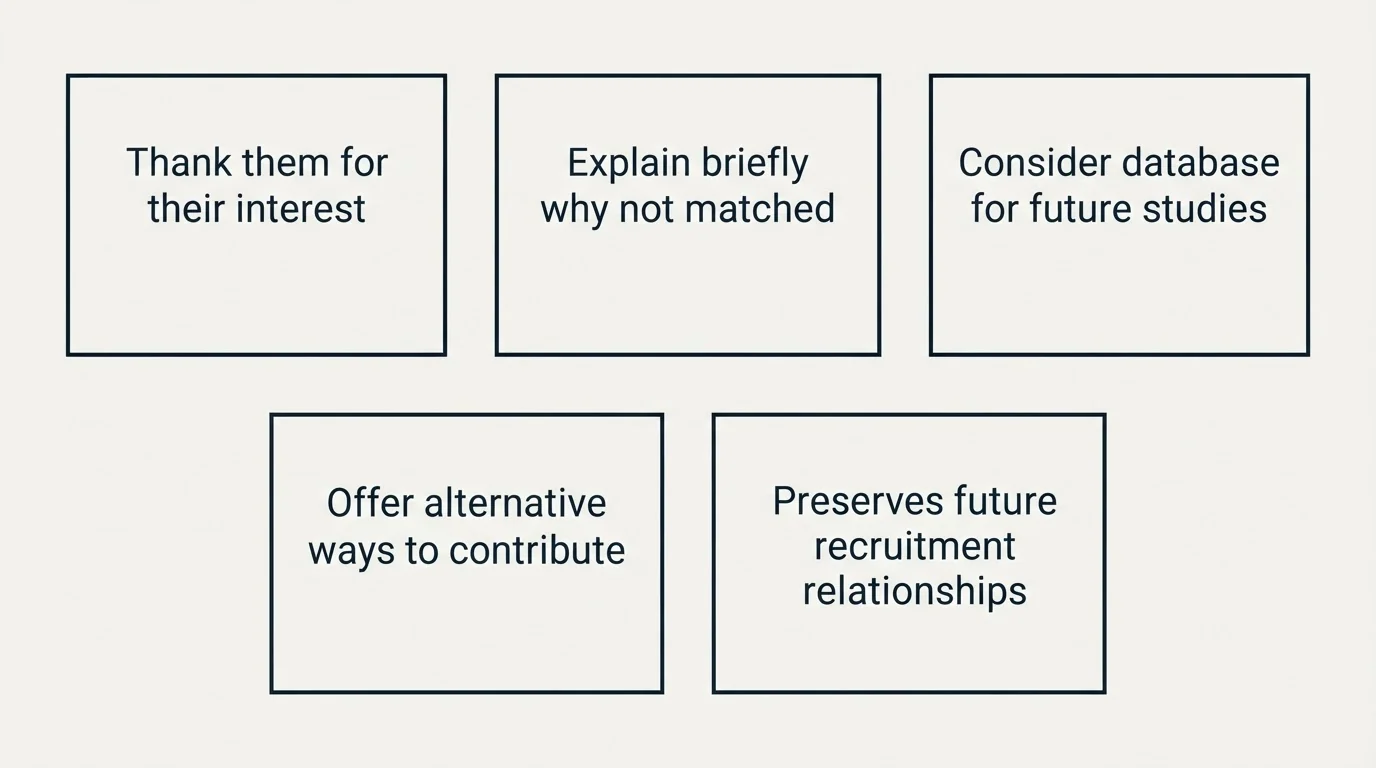
When respondents do not meet qualification criteria:
- Thank them for their interest
- Explain briefly why they do not match current study requirements
- Consider maintaining a database for future studies with different criteria
- Offer alternative ways to contribute if appropriate
Handling disqualification professionally preserves relationships for potential future recruitment.
Common Mistakes to Avoid
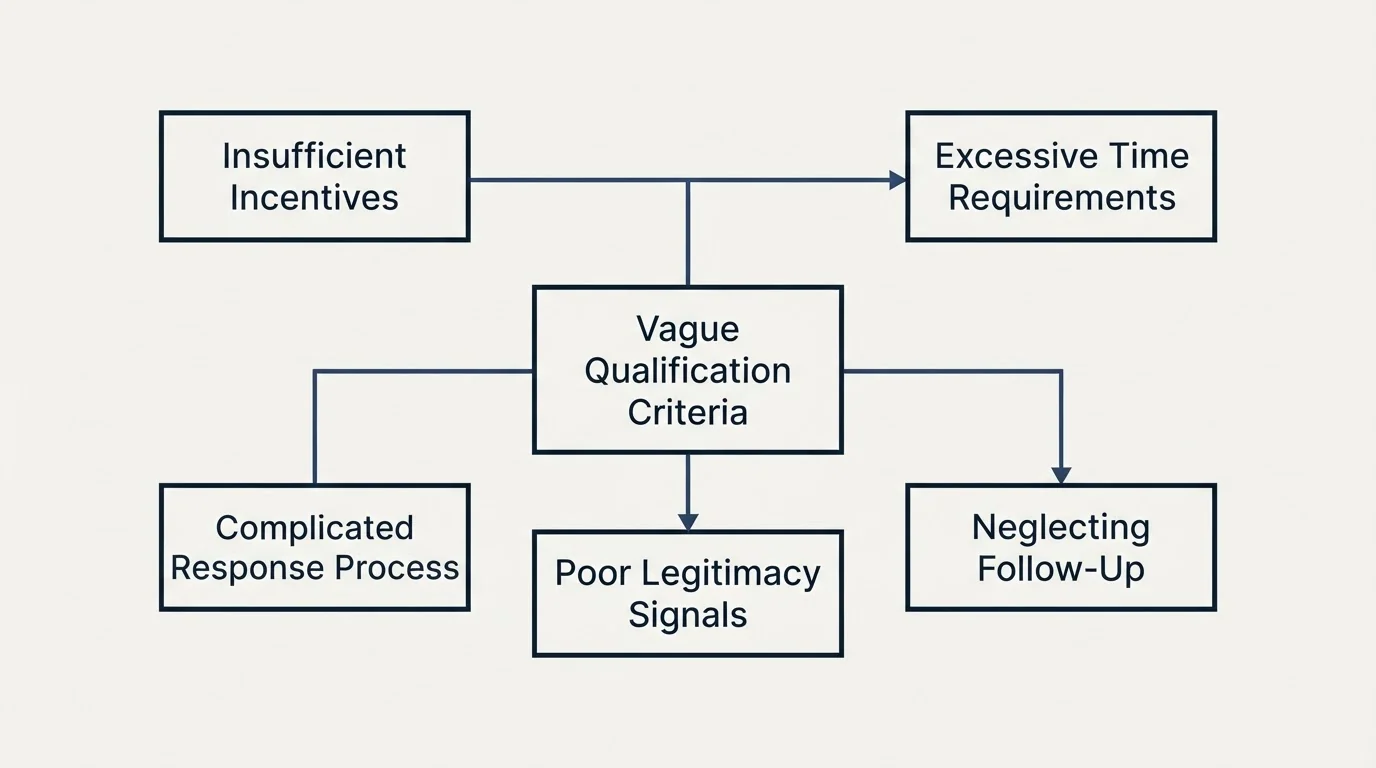
User research recruitment fails for predictable reasons. Avoiding these errors improves both response rates and participant quality.
Vague Qualification Criteria
Unclear criteria attract unqualified participants and create screening burden. Define precise requirements before initiating outreach.
Insufficient Incentives
Undercompensating reduces response rates and attracts participants motivated by any amount rather than genuine engagement. Research competitive rates for your participant type.
Excessive Time Requirements
Asking for more time than necessary reduces participation. Be precise about actual requirements and avoid padding estimates.
Poor Legitimacy Signals
Participants worry about scam outreach. Establish legitimacy through professional context, clear organizational affiliation, and transparent research purpose.
Complicated Response Process
If expressing interest requires multiple steps, forms, or decisions, response rates decrease. Make initial response simple and handle details after interest is established.
Neglecting Follow-Up
Many qualified participants intend to respond but deprioritize your email. Follow-up significantly improves recruitment success.
Mismatched Outreach and Requirements
Targeting people who cannot possibly qualify wastes effort and damages reputation. Verify that your outreach list matches your qualification criteria.
Your User Research Recruitment Checklist
Before launching your recruitment campaign, confirm completion of these steps:
Research Design
- Defined research objectives and methodology
- Established participant qualification criteria (primary, secondary, exclusion)
- Determined sample size and composition requirements
- Planned screening process
Prospect Identification
- Built target list matching qualification criteria
- Gathered contact information and personalization details
- Segmented list by participant type if needed
- Verified list quality and targeting accuracy
Outreach Preparation
- Written customized recruitment emails
- Established appropriate compensation
- Prepared screening questions or survey
- Created tracking system
Logistics Preparation
- Confirmed scheduling availability
- Prepared research session materials
- Set up recording/data collection systems
- Established participant consent process
- Arranged compensation distribution method
Build Your Research Participant Pipeline
Recruiting user research participants through cold email transforms research from opportunistic to strategic. The ability to recruit specific participant types enables research questions that would otherwise be unanswerable due to recruitment limitations.
The strategies, templates, and frameworks in this guide provide everything needed to recruit qualified participants who can provide the insights that drive product decisions.
Ready to recruit participants for your next research study? Our team specializes in outreach campaigns that connect you with hard-to-reach research subjects. Get your free research recruitment campaign and start building the participant pipeline that enables valuable research.
Related Reading
Frequently asked questions.
Frequently asked questions- Why is cold email better than recruiting panels for user research?
- Cold email allows you to target specific professional profiles that recruiting panels often lack, especially specialized or senior roles. Panels typically attract self-selected participants who may not represent your target users, while cold email gives you control over participant composition and access to high-value individuals like executives who never respond to panel recruiters. It also accelerates recruitment timelines and reduces costs compared to specialized agencies.
- What criteria should I define before recruiting user research participants?
- Define five categories of criteria: primary criteria that participants absolutely must have, secondary criteria that add value, exclusion criteria that disqualify candidates, diversity requirements for variation across your pool, and practical constraints like scheduling or technology needs. Clear criteria enable targeted outreach that attracts qualified participants and prevents wasted effort on people who cannot provide needed insights.
- How do I verify that cold email respondents actually qualify for my research study?
- Use screening methods including pre-screen questions in your initial outreach or in your reply to an interested participant, brief screening calls to verify qualifications before formal sessions, short qualification surveys that collect structured filtering data, and LinkedIn profile reviews that provide verification data supplementing self-reported qualifications. Screening prevents committing resources to unqualified participants.
- What types of participants should I recruit for different research questions?
- Choose from five common profile types based on research goals: current users for understanding existing behaviors and pain points, prospective users for revealing unmet needs and adoption barriers, expert practitioners for specialized domain insight, decision makers for buying criteria and organizational dynamics, or churned users for understanding abandonment reasons. Different research questions require different participant profiles.
About the author.

Ben Carden is CRO at RevenueFlow, which builds and operates outbound revenue engines for B2B companies. Previously at Gartner Enterprise. Studied at London School of Economics.
Ben Carden · CRO
Connect on LinkedIn →Explore more.
Ready to scale your outreach?
We build GTM engines that book real meetings. See the receipts.
Related articles.
Cold Email for Product Feedback: Complete Strategy Guide
Learn how to use cold email to gather valuable product feedback from users and prospects. Includes proven templates, feedback frameworks, and response optimization techniques.
Cold Email for Focus Groups: Complete Strategy Guide
Learn how to use cold email to recruit qualified participants for focus groups. Includes proven templates, screening strategies, and group composition frameworks.
Cold Email for Influencer Outreach: Partner with Creators
Learn how to use cold email to build authentic influencer partnerships that drive real results for your brand, with proven templates and strategies.
Cold Email for PR: How to Pitch Journalists and Get Coverage
Learn how to craft cold emails that get journalists to open, read, and respond to your pitches. Includes real templates, timing strategies, and a complete PR outreach checklist.
Cold Email for Reviews: Complete Strategy Guide
Learn how to use cold email to generate authentic product reviews on G2, Capterra, and other platforms. Includes proven templates, compliance guidelines, and review generation frameworks.
Cold Email for Link Building: How to Get Quality Backlinks
Learn how to use cold email outreach to build high-quality backlinks that improve your SEO rankings, with proven templates and strategies that get responses.