Cold Email for Workshops: Complete Strategy Guide
Learn how to use cold email to fill workshop seats and book private workshops with corporate clients. Includes proven templates, targeting strategies, and best practices.
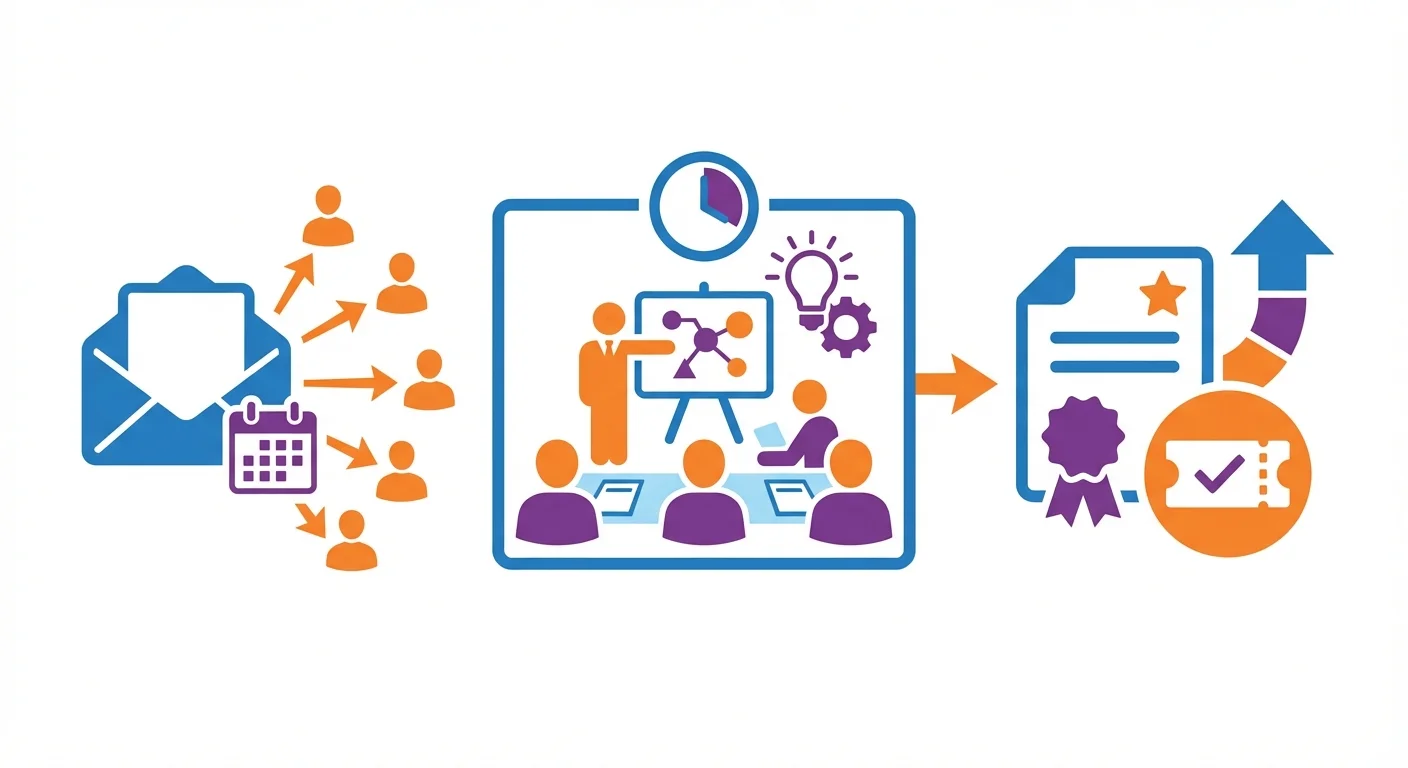
Cold email sells workshops in two ways: public workshops to professionals who approve their own place, and private workshops to L&D and HR leaders who approve for a team. Lead with outcomes, time private outreach to the buyer's budget cycle and visible triggers, and send one message per campaign rather than a sequence.
Key takeaways
- Public workshops sell to individual professionals on career value; private workshops sell to L&D, HR and department leaders on business outcomes.
- Private workshop decisions follow the buyer's budget cycle and visible triggers such as a reorganisation, so ask when the budget closes.
- Outside help comes in four classes, and only done-for-you agencies and appointment-setting firms put a person on both the research and the booked meeting.
- One message per campaign keeps the sending domain clean; a follow-up reaches only the people who already chose not to answer.
Reviewed and updated September 21, 2026
Workshop sellers have two ways to fill a calendar with cold email: run it themselves, or hand the research and the sending to someone else. The vendors that do the second come in a few classes, and the ones worth paying offer human-led research and handoff-ready meeting notes rather than software alone. Both routes are covered below.
Workshops represent a unique opportunity in the B2B services landscape. Whether you run public workshops that bring together professionals from multiple organizations or private workshops designed for specific companies, these intensive learning experiences can generate substantial revenue while positioning you as an authority in your field.
Cold email provides an effective channel for workshop promotion and sales. For public workshops, it helps fill seats with qualified participants. For private workshops, it opens doors to corporate buyers looking for team development solutions. Either way, cold email allows you to reach decision-makers directly with targeted offers.
This guide covers targeting, positioning, templates and the kinds of outside help available, and it takes one position most guides do not: one message per campaign.
Why Cold Email Works for Workshop Sales
Workshops require participants to commit significant time and often money. That commitment level makes them harder to sell than lower-friction offerings. Cold email helps by reaching the right buyers with targeted, compelling messages.
Direct access to decision-makers. For private workshops, you need to reach executives who authorize training investments. Cold email provides that access.
Targeted audience building. For public workshops, cold email lets you reach professionals who fit your ideal participant profile.
Scalable promotion. While workshops require significant delivery effort, cold email scales promotion efficiently.
Workshop Types and Sales Approaches
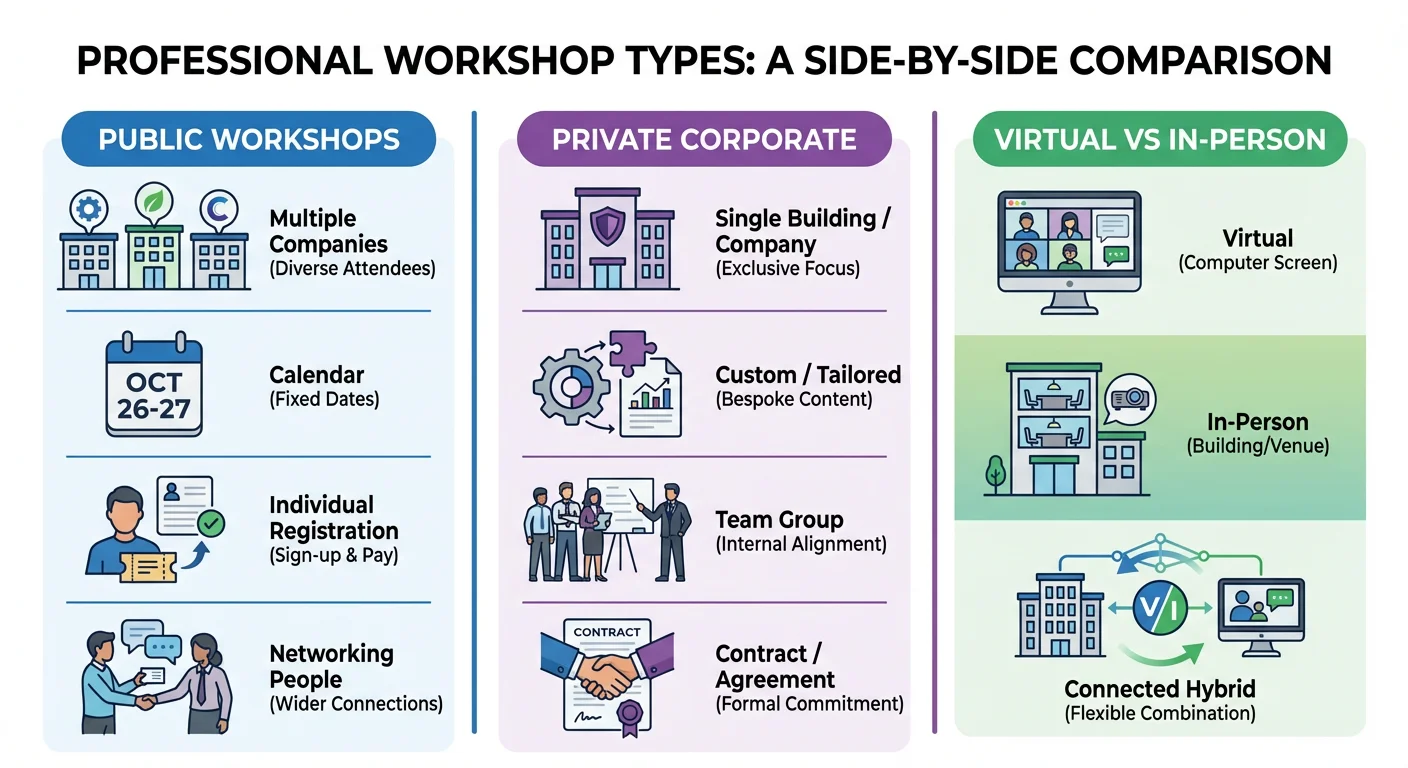
Different workshop formats require different outreach strategies.
| Public workshop | Private workshop | |
|---|---|---|
| Who you write to | Professionals who can approve their own place | L&D leaders, HR and department heads |
| How they decide | Personally, sometimes with a manager | Corporately, with several stakeholders |
| What the email leads with | Learning outcomes and career value | Business outcomes and team capability |
| Timing | Weeks ahead of a fixed date | Months, often tied to a budget cycle |
The format changes the message as well. A virtual workshop sells convenience and has to answer the worry about engagement; an in-person one sells focus and the room, and needs the location and logistics stated up front. If you offer both, let the prospect choose.
Identifying Workshop Prospects
Workshop success depends on reaching people who can benefit from and authorize participation.
For Public Workshops
Job function. Target professionals whose roles relate to your workshop topic.
Experience level. Match prospect experience to workshop level (beginner, intermediate, advanced).
Industry alignment. If your workshop is industry-specific, target professionals in those sectors.
Career stage. Professionals actively developing skills are more likely to invest in workshops.
Engagement signals. People engaging with related content, attending events, or earning certifications signal learning orientation.
For Private Corporate Workshops
Company size. Organizations must be large enough to benefit from team-based training.
Training investment. Companies with L&D departments or training budgets are natural targets.
Relevant teams. The organization needs teams who would benefit from your workshop topic.
Growth trajectory. Growing companies often invest in team development.
Industry fit. Your workshop content should be relevant to their industry context.
Contact Targeting
For public workshops: Target individual professionals who match your ideal participant profile.
For private workshops: Target L&D leaders, HR directors, department heads, or executives who authorize training investments.
Timing Considerations
Budget cycles. Corporate training decisions tend to follow the budget cycle, so ask when theirs closes.
Planning periods. Annual planning cycles often include training decisions.
Team changes. Reorganizations, new hires, or team expansions create training needs.
Performance issues. Companies addressing skill gaps may be receptive to workshop solutions.
Building Your Workshop Prospect List
Quality data drives workshop sales success.
Data Sources
LinkedIn Sales Navigator. Filter by function, seniority, company size, and industry.
L&D databases. Specialized databases target training and development professionals.
Industry associations. Professional associations often provide member directories.
Event attendees. People who attend industry events demonstrate engagement and learning orientation.
Content engagers. Professionals who download related content or attend webinars show interest in learning.
Research for Personalization
For public workshops:
- Professional background and career stage
- Skills and certifications
- Content engagement patterns
- Career trajectory
For private workshops:
- Company training history and priorities
- Team composition and challenges
- Recent announcements or changes
- L&D strategy signals
Email Verification
Always verify addresses before sending:
Verification services. NeverBounce, ZeroBounce, and similar tools reduce bounces.
List hygiene. Remove invalid addresses promptly.
Domain validation. Ensure domains accept email.
Crafting Workshop Cold Emails
Workshop emails need to communicate clear value while addressing the commitment required.
Subject Line Strategies
For public workshops:
- "[Workshop Name]: [Key Outcome] Workshop"
- "Invitation: [Topic] Workshop [Date]"
- "[Name], seats available for [Workshop]"
- "Learn [Skill] in [Duration]"
For private workshops:
- "[Topic] Workshop for [Company]"
- "Team [Skill] Development for [Company]"
- "[Name], [Topic] training for your team"
- "Private workshop opportunity"
Avoid:
- Vague subjects that don't communicate the offer
- Overly promotional language
- Misleading subjects
- All caps or excessive punctuation
Email Structure for Public Workshops
Opening (1-2 sentences). Reference something about the prospect that makes the workshop relevant.
Workshop overview (2-3 sentences). Describe what the workshop covers and the primary learning outcomes.
Details (2-3 sentences). Include date, duration, location (or virtual), and format highlights.
Social proof (1-2 sentences). Mention past participant results, instructor credentials, or testimonials.
Call to action (1-2 sentences). Clear next step: register directly or schedule a call to learn more.
Email Structure for Private Workshops
The company's situation, or the trigger that makes training relevant now.
The business challenge the workshop addresses, in their terms.
How it builds the skills that challenge needs.
What the team can do afterwards.
A similar company, or a result from a past engagement.
A short call to discuss their needs and fit.
Workshop Email Templates
Template 1: Public Workshop Promotion
Subject: [Workshop Name]: [Date] in [Location/Virtual]
Hi [Name],
We noticed your work in [relevant area] and thought you might be interested in our upcoming [Topic] Workshop on [Date].
The workshop covers:
- [Learning outcome 1]
- [Learning outcome 2]
- [Learning outcome 3]
Over [duration], you'll develop practical skills in [specific capability] that you can apply immediately to [common challenge].
Past participants have described the workshop as [brief testimonial]. [X]% report [specific outcome] within [timeframe] of attending.
We have [X] seats remaining. If [topic] is a priority for you right now, we'd encourage you to take a look: [Registration Link]
Happy to answer any questions if helpful.
[Your Name] [Title/Company]
Template 2: Private Workshop Inquiry
Subject: [Topic] Workshop for [Company]
Hi [Name],
We work with [company type] companies to develop [skill/capability] through intensive workshops. Given [Company]'s focus on [relevant area], we thought our [Topic] Workshop might be relevant for your team.
The workshop covers:
- [Module/Topic 1]
- [Module/Topic 2]
- [Module/Topic 3]
Teams that complete the workshop are able to [specific capability], which typically results in [business outcome]. We recently delivered this workshop for [similar company], and they saw [specific result].
The workshop can be delivered in-person at your location or virtually, depending on your preference. Duration is [length], and we customize the content to your industry and specific challenges.
Would a 20-minute call to discuss whether this would be valuable for [Company] be useful?
[Your Name] [Title/Company]
Template 3: Trigger-Based (Private)
Subject: Training support for [Company]'s [Initiative]
Hi [Name],
We saw that [Company] recently [trigger: expanded team, launched initiative, entered market, announced priority]. Transitions like that often create skill development needs that workshops can address efficiently.
We deliver [Topic] Workshops for [company type] companies, helping teams develop [capability]. The workshop covers [key topics] and equips participants to [specific outcome].
For a company at [Company]'s stage, this typically means [relevant benefit].
We've worked with companies like [similar company] during similar transitions. They found the workshop valuable for [specific reason].
Would it be worth 15 minutes to discuss whether workshop-based training fits [Company]'s current needs?
[Your Name] [Title/Company]
Template 4: Role-Specific (Public)
Subject: [Workshop Name] for [Role]
Hi [Name],
Most [role type] we meet struggle with [specific challenge]. It's a skill that's rarely taught formally but matters enormously for [outcome].
Our [Workshop Name] on [Date] addresses exactly this. Over [duration], you'll learn:
- [Framework or approach 1]
- [Technique or skill 2]
- [Application or practice 3]
The workshop is designed specifically for [role type] at [career stage]. You'll work with a cohort of peers facing similar challenges and leave with [specific deliverable or capability].
[X] [role type] from companies like [company examples] have completed this workshop. The most common feedback is [brief testimonial theme].
Interested? [Registration Link]
Or if you'd like to discuss whether it's right for your situation, we're happy to chat: [Calendar Link]
[Your Name]
Template 5: L&D Director Outreach
Subject: [Topic] Workshop for [Company] teams
Hi [Name],
We deliver [Topic] Workshops for [industry] companies, helping teams develop [capability] through intensive, hands-on training.
The workshop is particularly effective for [team type] dealing with [challenge]. Participants learn [key skills] and leave with [deliverables or capabilities].
Key details:
- Duration: [X days/hours]
- Format: [In-person/Virtual/Either]
- Group size: [Range]
- Customization: Content tailored to your industry and challenges
Companies like [client examples] have used this workshop to [specific outcome]. One client described it as [brief testimonial].
If [Company] is planning team development initiatives, we'd welcome a conversation about whether this workshop fits your needs.
Worth a 20-minute call? [Calendar Link]
[Your Name] [Title/Company]
Which vendor classes offer human-led cold email research and handoff-ready meeting notes?
Four classes of vendor sell help with cold email, and only the first two put a person on both the research and the meeting. A research service does the research and stops before the send; software does neither, and leaves the research to you.
| Vendor class | What a person does | Ask to see |
|---|---|---|
| Done-for-you outbound agency | Builds the list, writes and sends the message, books the meeting | A real handoff note from a booked meeting |
| Appointment-setting firm | Calls or writes to prospects and books the meeting | The qualification questions and what the note records |
| Research service or assistant | Builds and researches the list; sends nothing | Its research on ten prospects |
| Software: sequencer or data tool | Nothing; you do the research | Not applicable |
For a workshop seller the useful handoff note says who the person is, why they took the meeting and which format they asked about, so the discovery call starts where the email left off. Ask every vendor for a real one, with names removed, before signing, and ask who wrote it: a person who read the reply, or a template filled in by software.
Where we differ from standard practice
Much of the advice on this page reflects how outbound is commonly run. We run it differently, and since this page sits on our site it is worth saying where the difference is and what it costs us.
Standard practice
- A sequence of messages to each prospect over several weeks
- Later messages often land in the same thread
- A distracted reader gets another chance
- The later messages reach only people who did not answer the first
What we do
- One message, then that campaign is finished for that contact
- No thread replies and no bumps
- More of the work moves into targeting and the one message
- We reach each contact less often, and that is the cost we accept
The reasoning is mechanical rather than moral. A follow-up arrives underneath a message the recipient has already seen and chosen not to answer, so it is delivered to the population most likely to mark it as spam, and the reputation cost of that lands on the sending domain across every campaign running on it. We set that cost against the replies a sequence recovers and decided the trade was not worth it. The full argument, with the numbers from our own campaigns, is in why we stopped using follow-ups.
Converting Workshop Interest to Enrollment
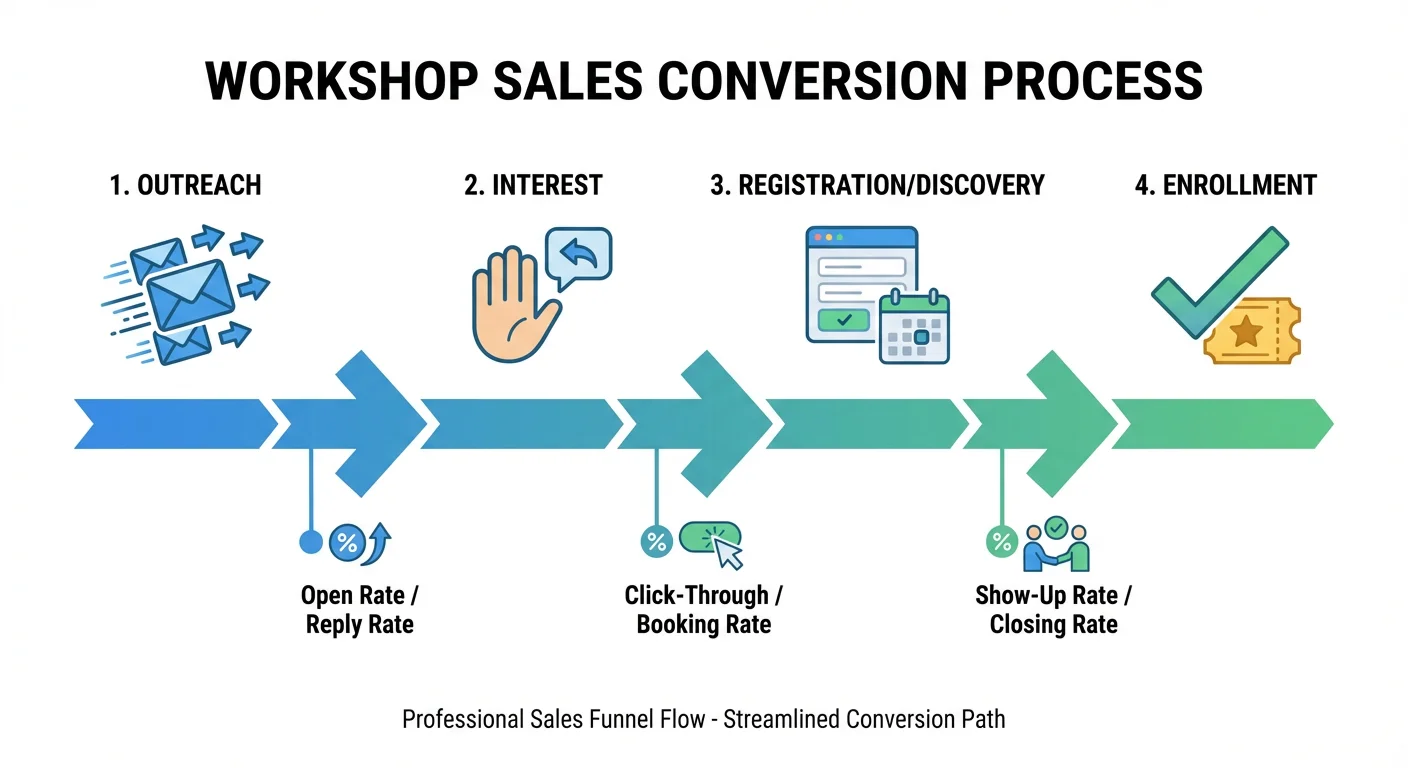
Getting interest is the first step. Converting to enrollment requires clear processes.
For Public Workshops
Easy registration. Make the enrollment process simple with clear pricing and straightforward checkout.
Urgency creation. Limited seats, early bird pricing, or approaching deadlines encourage action.
Address objections. Common concerns include time commitment, budget approval, and value justification. Address these proactively.
Manager support. Provide materials that help participants justify the investment to managers if needed.
For Private Workshops
Discovery call. Use an initial call to understand their needs, team composition, and budget constraints.
Customization discussion. Explore how you'll tailor the workshop to their context.
Proposal delivery. Provide a clear proposal with scope, logistics, investment, and outcomes.
Stakeholder navigation. Be prepared to engage multiple stakeholders in the decision process.
Pilot options. For skeptical buyers, consider offering a pilot session or team subset as a starting point.
Measuring Workshop Campaign Success
Track metrics to optimize your outreach:
Outreach metrics:
- Emails sent and delivered
- Replies from people, counted apart from auto-replies and bounces
- Opens, read with care, because privacy features can load a message without anyone reading it
- Click rate on registration links
Enrollment metrics:
- Registration rate from cold email
- Private workshop inquiry rate
- Inquiry-to-booking conversion
Business metrics:
- Revenue per campaign
- Cost per enrollment
- Private workshop average deal size
- Customer lifetime value (repeat workshops, additional services)
For reference figures from real campaigns rather than targets, the cold email benchmark report sets out reply rates by sending volume.
Common Mistakes to Avoid
Promoting too late. Workshop decisions take time. Start outreach 4-8 weeks before public workshops; longer for private.
Generic messaging. Workshop relevance varies by role and situation. Segment and personalize.
Weak value proposition. Be specific about what participants will learn and be able to do.
Missing urgency. Without deadlines or scarcity, prospects delay indefinitely.
Ignoring objections. Address common concerns (time, budget, value) in your outreach.
Leaning on follow-ups. A follow-up reaches only the people who chose not to answer the first message, and the reputation cost lands on the sending domain. Put the effort into the first message instead.
Underselling outcomes. Workshops require significant commitment. Make sure the promised value justifies that commitment.
Start Filling Your Workshop Seats
Cold email provides an effective channel for promoting workshops to qualified audiences. Whether you're filling seats for public workshops or selling private corporate training, the work is the same: the right prospects, a clear offer and one message worth answering.
The templates and strategies in this guide offer a foundation, but success depends on matching your workshop offer to the right prospects with compelling, relevant messaging.
If the private-workshop side is the one to scale without building an internal outreach team, RevenueFlow builds and runs the outbound engine that books those conversations and is paid only for meetings that are actually attended. See if you qualify.
Related Reading
Frequently asked questions.
Frequently asked questions- Which vendors offer human-led cold email research and meeting notes?
- Done-for-you outbound agencies and appointment-setting firms put a person on the research and on the booked meeting; a research service does the research but sends nothing, and software does neither. Before signing, ask each vendor for a real handoff note from a booked meeting, with names removed, and ask who wrote it.
- How do I target public versus private workshops with cold email?
- For public workshops, write to professionals whose job matches the topic and who can approve their own place or get a manager's sign-off. For private workshops, write to L&D leaders, HR executives and department heads who approve team training. Lead with career value for the first and business outcomes for the second.
- When should I send cold email about corporate workshops?
- Time it to the buyer rather than the calendar. Corporate training decisions follow each company's budget cycle, so ask when theirs closes, and watch for visible triggers such as a reorganisation, a new team or an expansion. For public workshops, start well before the date, because professionals plan around commitments weeks ahead.
- Should I send follow-up emails to workshop prospects?
- We do not. A follow-up reaches only the people who chose not to answer the first message, which is the group most likely to mark it as spam, and the reputation cost lands on the sending domain for every campaign it sends. Put the effort into targeting and into one message worth answering.
About the author.

Ben Carden is CRO at RevenueFlow, which builds and operates outbound revenue engines for B2B companies. Previously at Gartner Enterprise. Studied at London School of Economics.
Ben Carden · CRO
Connect on LinkedIn →Explore more.
Ready to scale your outreach?
We build GTM engines that book real meetings. See the receipts.
Related articles.
Cold Email for Affiliate Recruitment: Strategy Guide
Master cold email outreach to recruit high-performing affiliates who can drive significant revenue for your business with proven templates and strategies.
Cold Email for Reseller Partnerships: Strategy Guide
Learn how to use cold email to recruit resellers and channel partners who can expand your market reach and drive revenue through their existing customer relationships.