Cold Email Reply Rate Benchmarks: What's a Good Rate?
Industry data shows average cold email reply rates range from 1-5%, but top performers consistently achieve 8-15% through strategic optimization. Discover the benchmarks that matter for your campaigns.
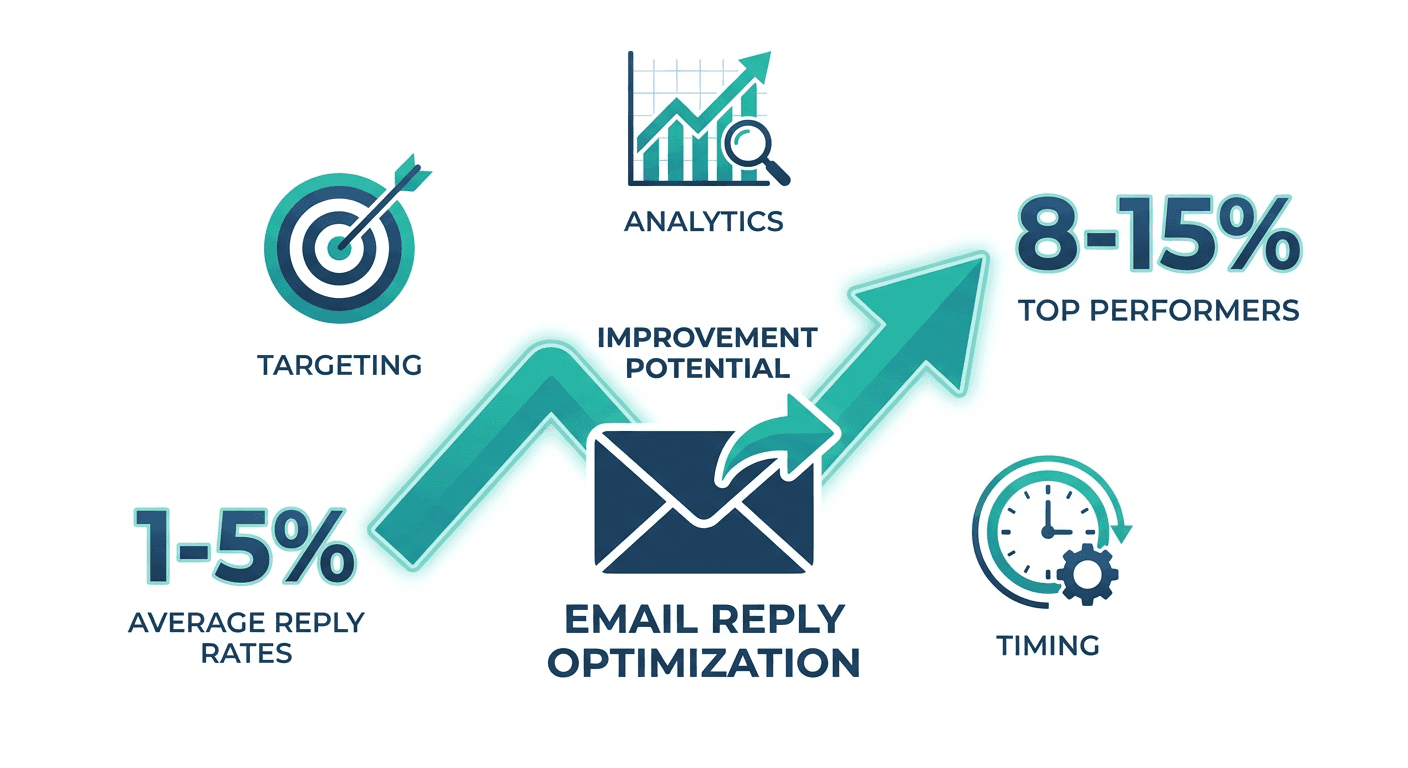
A good cold email reply rate for most B2B campaigns is 5% or higher, with industry averages ranging from 1-5%. Top performers consistently achieve 8-15% through strategic targeting and messaging optimization. Reply rates vary significantly by industry, company size, and email sequence position, with smaller companies (8-15%) and professional services sectors (5-10%) typically showing the highest engagement.
Key takeaways
- Industry data shows average cold email reply rates range from 1-5%, while top performers achieve 8-15% and exceptional campaigns reach above 15%.
- Smaller companies (1-10 employees) generate 8-15% reply rates compared to 1-4% for enterprise organizations with 1000+ employees.
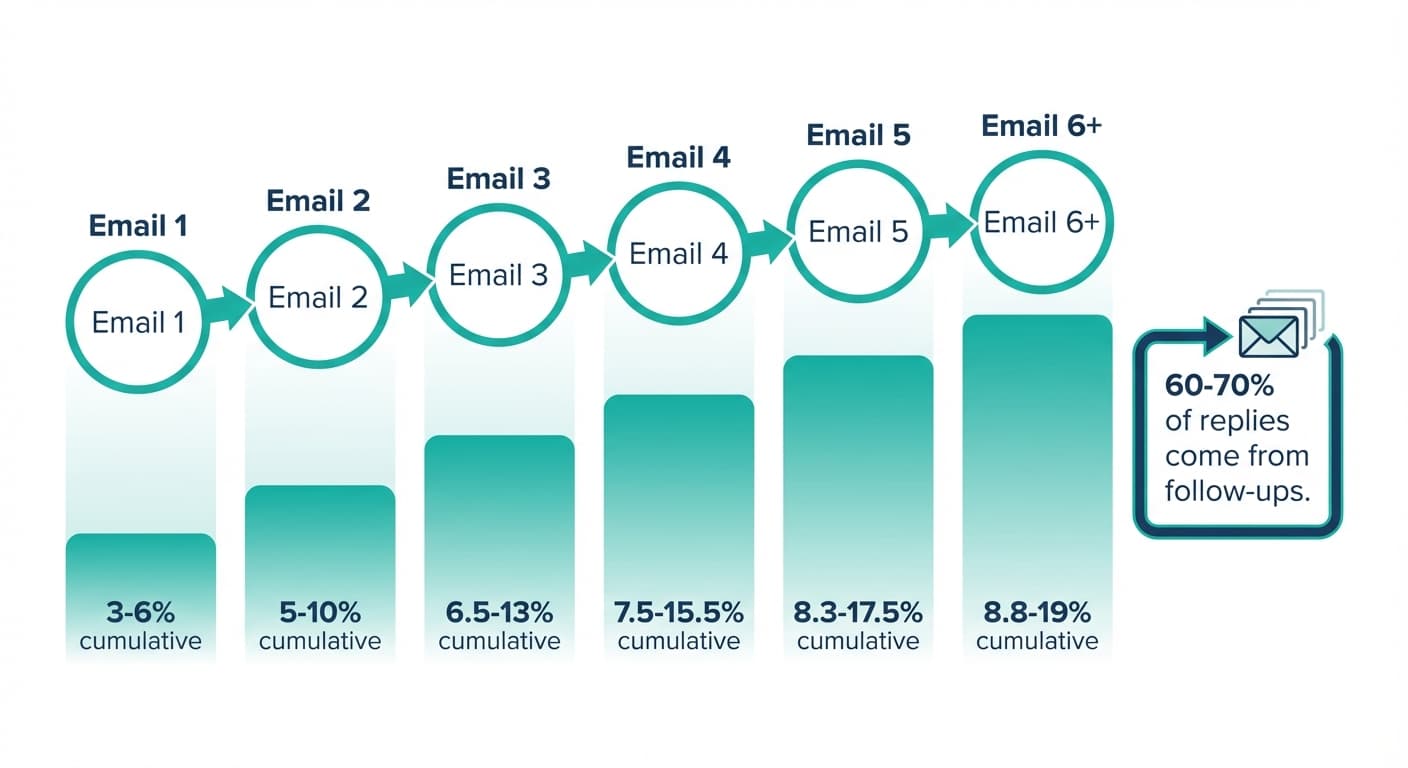
- 60-70% of total replies come from follow-up emails rather than the initial outreach message.
- Professional services industries see reply rates of 5-10%, significantly higher than technology sectors at 2-5%.
- The first email in a sequence typically generates 3-6% replies, with diminishing returns setting in around the fifth or sixth email.
Reviewed and updated September 15, 2026
Cold Email Reply Rate Benchmarks: What's a Good Response Rate?
The average cold email reply rate sits between 1% and 5%, according to industry estimates from leading sales engagement platforms. Yet top-performing sales teams consistently achieve reply rates of 8% to 15%, with some campaigns reaching 20% or higher. Understanding where your campaigns fall within these benchmarks is essential for optimizing your outreach strategy and setting realistic performance expectations.
About This Data
The benchmarks presented in this report are compiled from publicly available industry research, aggregated data from sales engagement platforms, and typical ranges observed across B2B cold email campaigns. These figures represent industry estimates and general ranges rather than definitive standards. Your actual results will vary based on your specific industry, target audience, offer quality, and execution.
We recommend using these benchmarks as directional guidance while establishing your own baseline metrics through consistent tracking and testing.
What Is a Good Reply Rate for Cold Email?
A "good" reply rate depends heavily on context, but here are the general benchmarks based on industry data:
| Performance Level | Reply Rate Range |
|---|---|
| Poor | Below 1% |
| Below Average | 1% - 2% |
| Average | 2% - 5% |
| Good | 5% - 8% |
| Excellent | 8% - 15% |
| Exceptional | 15%+ |
For most B2B cold email campaigns, achieving a 5% reply rate indicates solid performance. Campaigns consistently hitting 8% or above demonstrate strong targeting, messaging, and timing alignment.
Keep in mind that reply rate alone doesn't tell the full story. A 10% reply rate with mostly negative responses is less valuable than a 5% reply rate with highly engaged, qualified prospects.
Reply Rate Benchmarks by Industry
Different industries see dramatically different reply rates based on factors like buyer sophistication, inbox competition, and decision-making complexity.
Technology and SaaS
| Segment | Typical Reply Rate |
|---|---|
| Enterprise Software | 2% - 5% |
| SMB SaaS | 4% - 8% |
| Developer Tools | 3% - 6% |
| Cybersecurity | 2% - 4% |
| MarTech | 3% - 6% |
Technology buyers receive high volumes of sales outreach, making differentiation critical. Campaigns focusing on specific pain points rather than product features tend to outperform generic approaches.
Professional Services
| Segment | Typical Reply Rate |
|---|---|
| Consulting | 5% - 10% |
| Legal Services | 3% - 6% |
| Accounting/Finance | 4% - 8% |
| HR/Recruiting | 4% - 7% |
| Marketing Agencies | 5% - 9% |
Professional services typically see higher reply rates due to relationship-driven purchasing decisions. Prospects in these industries often value introductory conversations more than those in transactional sectors.
Manufacturing and Industrial
| Segment | Typical Reply Rate |
|---|---|
| Manufacturing | 3% - 7% |
| Construction | 4% - 8% |
| Industrial Equipment | 3% - 6% |
| Logistics/Supply Chain | 4% - 7% |
These industries tend to have longer sales cycles and more stakeholders involved in decisions. Reply rates may be lower, but engaged responses often indicate higher purchase intent.
Healthcare and Life Sciences
| Segment | Typical Reply Rate |
|---|---|
| Healthcare IT | 2% - 5% |
| Medical Devices | 3% - 6% |
| Pharmaceuticals | 2% - 4% |
| Healthcare Services | 4% - 7% |
Regulatory considerations and compliance requirements make healthcare buyers more cautious. Building trust through relevant case studies and compliance messaging improves response rates.
Financial Services
| Segment | Typical Reply Rate |
|---|---|
| Banking | 2% - 4% |
| Insurance | 3% - 6% |
| Investment Management | 2% - 5% |
| FinTech | 4% - 8% |
Traditional financial services organizations tend to have stricter email security and compliance requirements. FinTech companies, being more digitally native, typically show higher engagement with cold outreach.
Reply Rate Benchmarks by Company Size
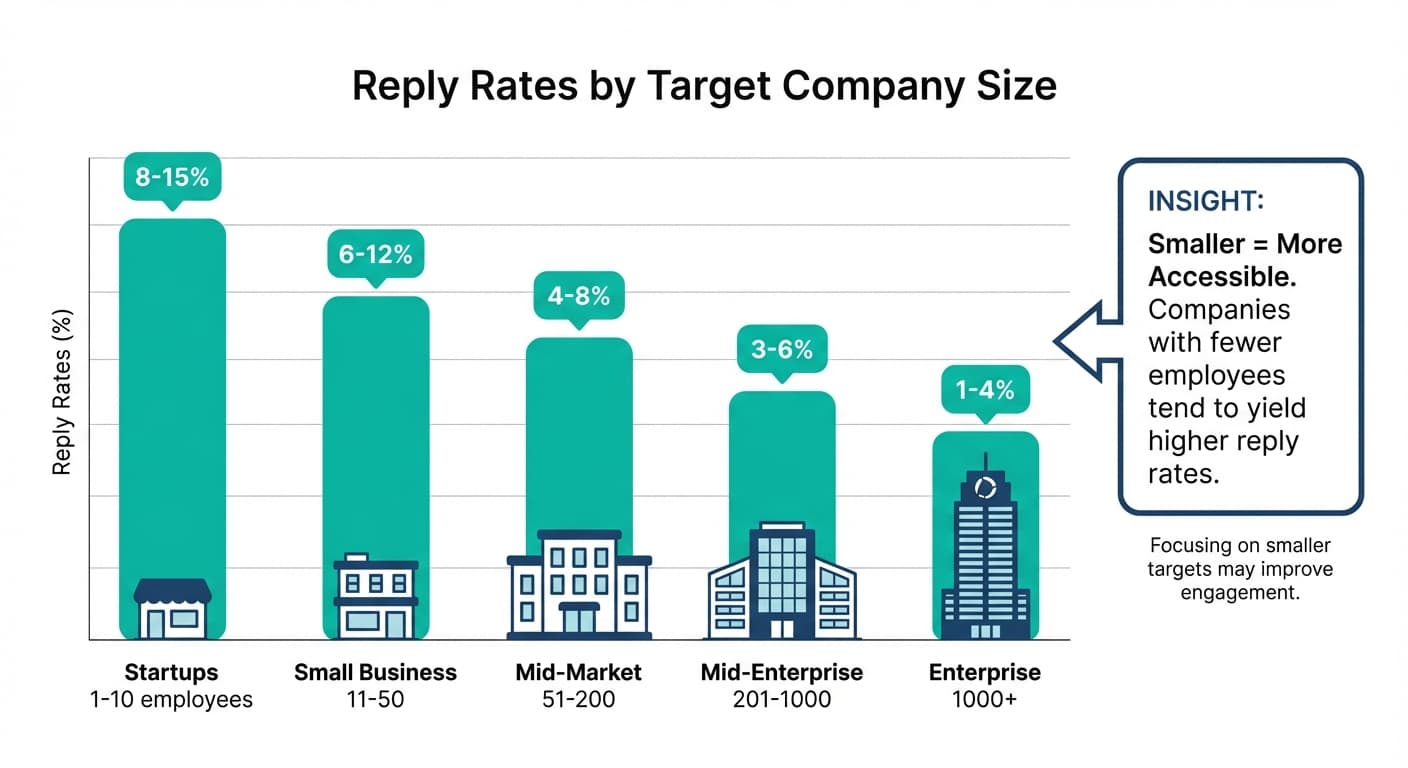
Target company size significantly impacts reply rates, with smaller companies generally showing higher engagement.
| Company Size | Typical Reply Rate | Notes |
|---|---|---|
| Startups (1-10 employees) | 8% - 15% | Decision-makers more accessible, fewer gatekeepers |
| Small Business (11-50) | 6% - 12% | Still relatively lean structures |
| Mid-Market (51-200) | 4% - 8% | More process, but still agile |
| Mid-Enterprise (201-1000) | 3% - 6% | Established procurement processes |
| Enterprise (1000+) | 1% - 4% | Multiple stakeholders, longer cycles |
Smaller companies offer faster access to decision-makers, while enterprise targets require more touches and multi-threaded approaches to generate responses.
Reply Rate Benchmarks by Email Sequence Position
Reply rates vary significantly based on where an email falls within a sequence. Understanding these patterns helps optimize your follow-up strategy.
| Email Position | Typical Reply Rate | Cumulative Response |
|---|---|---|
| Email 1 | 3% - 6% | 3% - 6% |
| Email 2 | 2% - 4% | 5% - 10% |
| Email 3 | 1.5% - 3% | 6.5% - 13% |
| Email 4 | 1% - 2.5% | 7.5% - 15.5% |
| Email 5 | 0.8% - 2% | 8.3% - 17.5% |
| Email 6+ | 0.5% - 1.5% | 8.8% - 19% |
Key observations from sequence data:
First emails generate the most replies because they represent the initial point of contact when curiosity is highest. However, relying solely on first emails leaves significant opportunity on the table.
Follow-ups are essential. Industry data suggests that 60% to 70% of total replies come from follow-up emails rather than initial outreach. Many prospects need multiple touches before engaging.
Diminishing returns set in around email 5 or 6. While additional touches still generate responses, the effort required increases substantially. Most high-performing sequences include 4 to 6 emails.
Timing between emails matters. Spacing of 3 to 5 business days between emails typically outperforms both shorter gaps (which feel aggressive) and longer gaps (which lose momentum).
Reply Rate Benchmarks by Subject Line Type
Subject lines play a crucial role in determining whether emails get opened and read. Different approaches yield different reply rates.
| Subject Line Type | Typical Reply Rate | Open Rate Impact |
|---|---|---|
| Personalized (name/company) | 5% - 10% | High |
| Question-based | 4% - 8% | Medium-High |
| Direct value proposition | 3% - 7% | Medium |
| Curiosity/intrigue | 3% - 6% | Medium-High |
| Re: or Fwd: (fake thread) | 2% - 4% | High opens, lower trust |
| Generic/template | 1% - 3% | Low |
Personalized subject lines consistently outperform generic alternatives. Including the prospect's name, company, or a specific reference creates immediate relevance.
Question-based subjects engage curiosity and imply a conversation rather than a pitch. Examples like "Quick question about [initiative]" tend to perform well.
Fake thread indicators (using "Re:" or "Fwd:" without prior correspondence) may boost open rates but often damage trust when prospects realize the deception. This approach typically hurts long-term reply rates and brand perception.
Reply Rate Benchmarks by Personalization Level
The degree of personalization in your emails correlates strongly with reply rates.
| Personalization Level | Description | Typical Reply Rate |
|---|---|---|
| None | Generic template, no customization | 0.5% - 2% |
| Basic | First name, company name | 2% - 4% |
| Moderate | Industry-specific pain points, role relevance | 4% - 7% |
| High | Company-specific research, recent news, mutual connections | 7% - 12% |
| Hyper-personalized | Custom insights, specific business observations | 10% - 20%+ |
The personalization investment trade-off: Hyper-personalized emails deliver the highest reply rates but require significant research time per prospect. The optimal approach balances personalization depth with volume goals.
For most B2B campaigns, moderate to high personalization (4% to 12% reply rates) offers the best return on time invested. Templates with strategic customization points allow scale without sacrificing relevance.
Positive vs. Negative Reply Rates
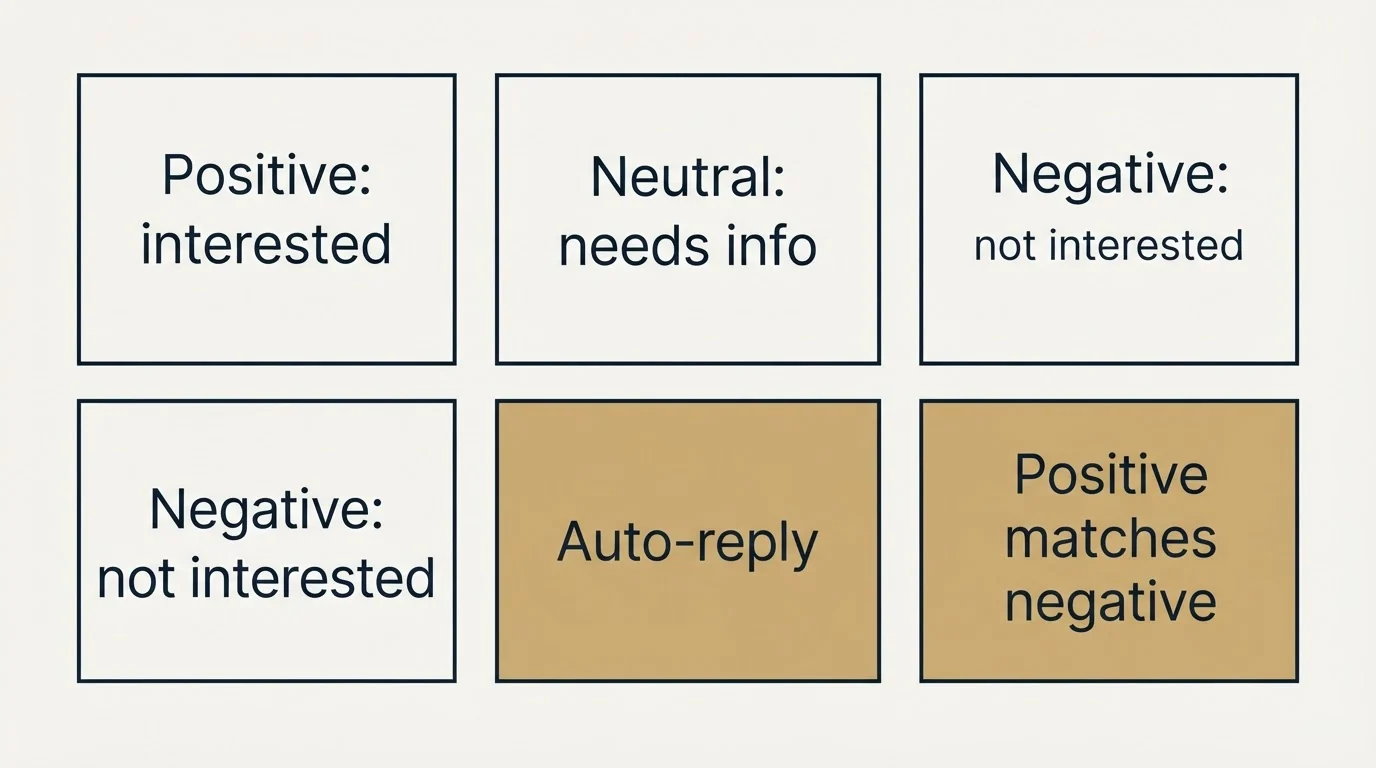
Raw reply rates don't distinguish between interested prospects and people asking to be removed from your list. Breaking down reply sentiment provides a more accurate picture of campaign performance.
Typical Reply Sentiment Distribution
| Reply Type | Percentage of Total Replies |
|---|---|
| Positive (interested) | 30% - 50% |
| Neutral (more info needed) | 20% - 30% |
| Negative (not interested, unsubscribe) | 25% - 40% |
| Out of office/auto-reply | 5% - 15% |
Adjusted Benchmarks by Sentiment
If your overall reply rate is 6%, your effective positive reply rate might look like this:
| Reply Type | Rate |
|---|---|
| Total Reply Rate | 6.0% |
| Positive Reply Rate | 2.1% - 3.0% |
| Neutral Reply Rate | 1.2% - 1.8% |
| Negative Reply Rate | 1.5% - 2.4% |
A healthy positive-to-negative ratio typically sees at least as many positive responses as negative ones. Campaigns with significantly more negative replies may indicate targeting or messaging issues.
Neutral replies represent opportunity. Prospects asking questions or requesting more information are often open to engagement. Quick, helpful responses to neutral replies frequently convert them to positive outcomes.
Factors That Impact Reply Rates
Multiple variables influence your reply rates beyond the benchmarks listed above.
List Quality and Targeting
Impact: Very High
The quality of your prospect list is often the single largest factor in reply rate performance. Emails sent to poorly targeted or outdated lists consistently underperform, regardless of messaging quality.
Key list quality factors:
- Email accuracy and deliverability
- ICP (Ideal Customer Profile) alignment
- Decision-maker vs. general contact targeting
- Data freshness and verification
Sending Infrastructure
Impact: High
Technical setup affects whether emails reach inboxes at all.
- Domain reputation and age
- Email authentication (SPF, DKIM, DMARC)
- Sending volume and warm-up status
- IP reputation
Timing and Day of Week
Impact: Medium
Industry data suggests optimal sending windows, though results vary by audience.
| Day | Relative Performance |
|---|---|
| Tuesday | Highest |
| Wednesday | High |
| Thursday | High |
| Monday | Medium |
| Friday | Medium-Low |
| Weekend | Low |
Morning sends (8 AM to 10 AM recipient time) generally outperform afternoon sends for B2B audiences.
Offer Strength
Impact: High
What you're asking prospects to do significantly affects response rates.
| CTA Type | Relative Reply Rate |
|---|---|
| Quick question/advice ask | Highest |
| 15-minute call | High |
| Demo/presentation | Medium |
| Proposal/quote | Medium-Low |
| Trial signup | Low |
Lower-commitment asks typically generate more replies but may require additional qualification.
Email Length
Impact: Medium
| Length | Word Count | Typical Performance |
|---|---|---|
| Very Short | Under 50 words | Good for follow-ups |
| Short | 50-100 words | Often optimal for initial emails |
| Medium | 100-150 words | Good with strong personalization |
| Long | 150+ words | Lower reply rates typically |
Shorter emails that respect the prospect's time while delivering clear value tend to outperform longer messages.
How to Calculate and Track Your Reply Rate
Basic Reply Rate Formula
Reply Rate = (Total Replies / Emails Delivered) x 100
Example: If you send 1,000 emails, 950 are delivered, and you receive 57 replies: Reply Rate = (57 / 950) x 100 = 6%
Metrics to Track
| Metric | Formula | Benchmark |
|---|---|---|
| Total Reply Rate | Replies / Delivered | 2% - 5% average |
| Positive Reply Rate | Positive Replies / Delivered | 1% - 3% average |
| Reply-to-Meeting Rate | Meetings / Total Replies | 20% - 40% |
| Sequence Reply Rate | Replies / Prospects in Sequence | 8% - 15% cumulative |
Tracking Best Practices
- Track at the sequence level, not just individual email level, to understand cumulative performance
- Segment by campaign to identify which approaches work best for different audiences
- Monitor sentiment, not just volume, to understand true engagement quality
- Compare against your own baseline rather than only external benchmarks
- Track reply timing to understand when prospects are most responsive
Strategies to Improve Reply Rates
Targeting and List Quality
- Tighten your ICP definition. Narrower targeting typically improves reply rates more than broader reach.
- Verify email addresses before sending to reduce bounces and protect sender reputation.
- Research trigger events like funding rounds, new hires, or expansion announcements that indicate timing relevance.
- Multi-thread accounts by contacting multiple stakeholders rather than single points of contact.
Messaging Optimization
- Lead with relevance, not credentials. Open with why you're reaching out to them specifically.
- Focus on one clear value proposition rather than listing multiple benefits.
- Use social proof strategically. Mention relevant customers or results that resonate with your target audience.
- End with a specific, low-friction CTA. Make it easy to say yes.
Follow-Up Strategy
- Add new value with each touch. Avoid "just following up" messages that add nothing.
- Vary your approach across the sequence with different angles, formats, or proof points.
- Test breakup emails that create urgency while remaining professional.
- Respect unsubscribes immediately to protect your reputation and stay compliant.
Testing and Iteration
- A/B test one variable at a time to identify what drives improvement.
- Test subject lines first since they determine whether emails get opened at all.
- Run tests with statistical significance (typically 100+ sends per variant minimum).
- Document learnings and apply winning approaches to future campaigns.
Setting Realistic Expectations
The claim that cold email response rates collapsed after the pandemic is testable rather than atmospheric, and the way to test it is against a year on year reading of your own industry rather than against a remembered number from an earlier market.
Understanding benchmarks helps set appropriate goals, but several factors deserve consideration:
New campaigns typically underperform. Expect below-average results during the first few weeks as you optimize targeting, messaging, and sending patterns.
Seasonality affects reply rates. Holiday periods, fiscal year-ends, and summer months often see lower engagement in B2B outreach.
Benchmarks vary by data source. Different platforms report different averages based on their user bases. Your own historical data is the most relevant benchmark.
Quality matters more than quantity. A 3% reply rate with qualified, interested prospects generates more pipeline than a 10% reply rate with poor-fit responses.
Take Your Reply Rates to the Next Level
Understanding benchmarks is the first step. Consistently achieving above-average reply rates requires ongoing optimization across targeting, messaging, timing, and follow-up strategy.
If you're looking to improve your cold email performance without the trial-and-error of doing it yourself, our team specializes in building high-converting outreach campaigns for B2B companies.
Get a free campaign audit and see how your current performance compares to top-performing campaigns in your industry. We'll identify specific opportunities to improve your reply rates and generate more qualified conversations.
Related Reading
Frequently asked questions.
Frequently asked questions- What is a good reply rate for cold email?
- A good reply rate for B2B cold email campaigns is 5% or higher. Average performance ranges from 2-5%, while excellent campaigns achieve 8-15%. Anything below 1% is considered poor performance. However, reply rate quality matters more than quantity: a 5% reply rate with highly engaged prospects is more valuable than 10% with mostly negative responses.
- Do follow-up emails actually get replies?
- Yes, follow-up emails are essential and generate the majority of responses. Industry data shows 60-70% of total replies come from follow-up emails rather than initial outreach. The second email typically generates 2-4% replies, the third 1.5-3%, and subsequent emails continue adding responses. Most prospects need multiple touches before engaging, making follow-ups critical to campaign success.
- Does company size affect cold email reply rates?
- Company size dramatically impacts reply rates. Startups with 1-10 employees generate 8-15% reply rates due to accessible decision-makers and fewer gatekeepers. Small businesses (11-50 employees) see 6-12%, mid-market companies (51-200) achieve 4-8%, while enterprises with 1000+ employees typically get only 1-4% due to multiple stakeholders, established procurement processes, and longer decision cycles.
- Which industries have the highest cold email reply rates?
- Professional services industries show the highest reply rates, with consulting at 5-10%, marketing agencies at 5-9%, and accounting/finance at 4-8%. These relationship-driven sectors value introductory conversations more than transactional industries. In contrast, technology sectors like enterprise software (2-5%) and banking (2-4%) see lower rates due to high inbox competition and stricter security requirements.
About the author.

Hosun Chung is COO at RevenueFlow, which builds and operates outbound revenue engines for B2B companies. Previously at Gleacher Shacklock LLP. Studied at London School of Economics.
Hosun Chung · COO
Connect on LinkedIn →Explore more.
Ready to scale your outreach?
We build GTM engines that book real meetings. See the receipts.
Related articles.
SaaS Cold Email Benchmarks: Open, Reply, Conversion Data
Industry benchmark data for SaaS cold email campaigns, including open rates, reply rates, and conversion metrics segmented by company stage, target persona, and deal size.
Cold Email ROI Benchmarks: 2026 Performance Data
The 36x cold email ROI figure comes from email marketing surveys. What the published cold email data shows, and how to compute your own ROI.
B2B Cold Email Benchmarks 2026: The Complete Industry Report
The average B2B cold email reply rate is 3.43% on Instantly's data and 1.5% on Woodpecker's median. What each counts, and the levers that move your own rate.
Cold Email Spam Rate Benchmarks: 2026 Performance Data
Industry standards require keeping spam complaint rates below 0.1% to maintain sender reputation. Learn the benchmarks and strategies to protect your cold email deliverability.
Cold Email Follow-Up Benchmarks: 2026 Performance Data
The follow-up benchmarks kept intact and read against their own definitions, plus why RevenueFlow sends one message per campaign instead.
Cold Email Bounce Rate Benchmarks: 2026 Performance Data
A 3.04% platform bounce rate held 1.27% true hard bounces, 2.38% with blocks included, and 12.6% delay notices. What low bounce email data is made of.