50 Cold Email Subject Lines That Get Opens
Your subject line determines whether your email gets opened or ignored. Here are 50 proven subject line formulas for cold outreach.
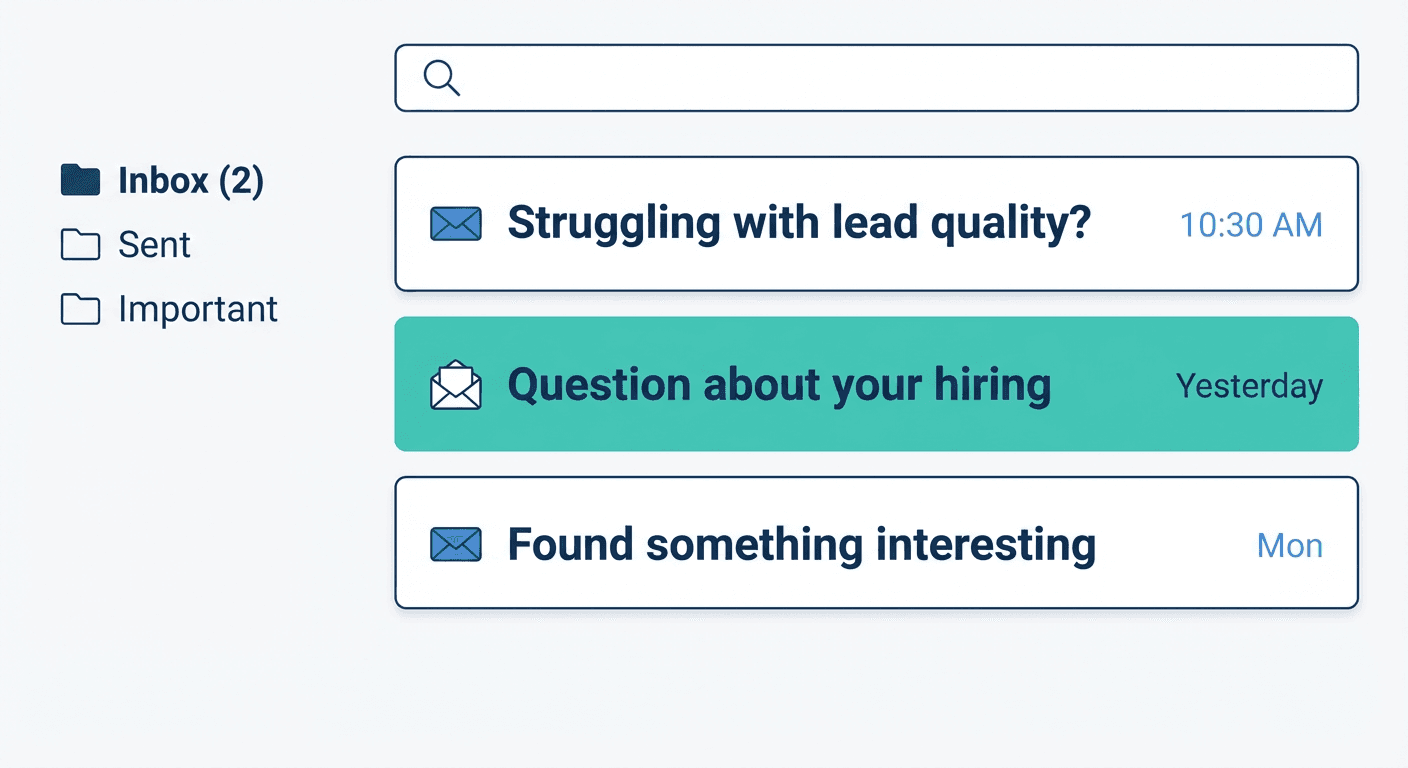
Effective cold email subject lines fall into nine categories: question-based (challenges, outcomes, processes), personalized (company name, news, connections), curiosity-driven (incomplete thoughts, numbers), direct (meeting requests, introductions), problem-focused (pain points, bottlenecks), benefit-focused (results, time savers), referral-based (mutual connections, similar companies), trigger event-based (funding, hires), and re-approach lines for a later campaign. Best practices include keeping subject lines under 40 characters, avoiding spam triggers, being specific, matching the email body, and testing systematically across different audiences.
Key takeaways
- Subject lines should be 40 characters or fewer to avoid truncation on mobile devices.
- The nine subject line categories are question-based, personalized, curiosity-driven, direct, problem-focused, benefit-focused, referral-based, trigger event-based, and re-approach.
- Spam trigger words like 'free,' 'guarantee,' and 'limited time' should be avoided in B2B cold outreach.
- Subject lines must match the email body content to maintain trust and prevent unsubscribes.
- Different industries and roles respond to different subject line approaches, requiring systematic testing and tracking.
Reviewed and updated August 29, 2026
50 Cold Email Subject Lines That Get Opens
Your subject line is the gatekeeper to your cold email. It determines whether prospects open your message or scroll past it in their inbox.
A compelling subject line earns you the chance to make your pitch. A weak one means your carefully crafted email never gets read at all. This guide provides 50 proven subject line formulas organized by category, along with guidance on when to use each type.
Why Subject Lines Matter
Think about your own inbox. You probably receive dozens of emails daily, and you make split-second decisions about which ones deserve your attention. Your prospects are no different.
The subject line is your first impression. It signals whether the email inside is worth reading or whether it belongs in the trash. Even with a well-researched, personalized email body, a generic or spammy subject line will prevent your message from being opened.
The good news: subject line optimization is a learnable skill. By understanding what makes prospects click, you can improve your open rates and get more of your emails read.
Subject Line Best Practices
Before diving into the templates, here are principles that apply across all categories.
Keep It Short
Most email clients truncate subject lines on mobile devices. Aim for 40 characters or fewer to ensure your full subject line displays across all devices. Even on desktop, shorter subject lines feel less intimidating and easier to process.
Avoid Spam Triggers
Certain words and patterns trigger spam filters or make recipients suspicious. Avoid all caps, excessive punctuation (especially exclamation marks), and words like "free," "guarantee," "limited time," and "act now." These tactics might work for some B2C marketing, but they damage credibility in B2B cold outreach.
Be Specific
Vague subject lines get ignored. "Quick question" tells the recipient nothing about what you want. "Question about your hiring process" gives them context and a reason to open.
Match the Email Body
Your subject line is a promise. The email body should deliver on that promise. If your subject line mentions a specific topic, your email should address it immediately. Bait-and-switch subject lines might get opens initially, but they destroy trust and lead to unsubscribes.
Test and Iterate
Different industries, roles, and individuals respond to different approaches. What works for reaching CTOs might not work for reaching marketing managers. Track your open rates by subject line and continuously refine your approach based on data.
Category 1: Question-Based Subject Lines
Questions create an open loop in the reader's mind. They naturally invite engagement because the brain wants to answer them or discover the answer inside the email.
Template 1: The Challenge Question
Subject: Struggling with [specific challenge]?
Example: Struggling with lead quality?
When to use: When you have strong reason to believe the prospect faces a specific challenge your solution addresses.
Template 2: The Outcome Question
Subject: Want to [desired outcome]?
Example: Want to cut your sales cycle in half?
When to use: When you can connect your solution to a specific outcome the prospect likely cares about.
Template 3: The Process Question
Subject: How are you handling [process]?
Example: How are you handling Q2 hiring?
When to use: When your solution improves a specific business process the prospect manages.
Template 4: The Priority Question
Subject: Is [topic] a priority right now?
Example: Is customer retention a priority right now?
When to use: When you want to gauge timing and relevance before making a pitch.
Template 5: The Comparison Question
Subject: [Your company] vs your current approach?
Example: RevenueFlow vs your current outbound?
When to use: When the prospect likely has an existing solution and you offer a competitive alternative.
Template 6: The Permission Question
Subject: Mind if I share something?
Example: Mind if I share something?
When to use: When you have something valuable to share (case study, insight, resource) and want to lead with curiosity.
Category 2: Personalized Subject Lines
Personalization shows the recipient that your email was written specifically for them, not mass-blasted to thousands of contacts. These subject lines require research but generate strong engagement.
Template 7: Company Name Reference
Subject: [Company name] + [Your company/topic]
Example: Acme Corp + outbound pipeline
When to use: Simple but effective for showing you know who you're emailing.
Template 8: Recent News Reference
Subject: Congrats on [recent news/achievement]
Example: Congrats on the Series B
When to use: When the company has had recent news (funding, product launch, expansion, award) that you can reference.
Template 9: Mutual Connection Reference
Subject: [Name] suggested I reach out
Example: Sarah Chen suggested I reach out
When to use: When you have a genuine mutual connection who can vouch for you.
Template 10: Content Reference
Subject: Your [article/post/podcast] on [topic]
Example: Your LinkedIn post on hiring
When to use: When you've consumed their content and can reference something specific they said.
Template 11: Role-Specific Reference
Subject: For [Company name]'s new [role/title]
Example: For Acme's new VP of Sales
When to use: When the prospect recently started a new role and is likely evaluating tools and processes.
Template 12: Location Reference
Subject: Fellow [city/region] company
Example: Fellow Boston startup
When to use: When geographic proximity creates natural affinity, especially for local services or networking.
Category 3: Curiosity-Driven Subject Lines
These subject lines create intrigue without revealing everything. They work because the human brain wants closure and will open the email to satisfy curiosity.
Template 13: The Incomplete Thought
Subject: About your [topic]...
Example: About your sales team...
When to use: When you have a specific observation or insight to share about an aspect of their business.
Template 14: The Unexpected Angle
Subject: [Counter-intuitive statement]
Example: Why more leads might hurt you
When to use: When you can offer a fresh perspective that challenges conventional thinking.
Template 15: The Number Tease
Subject: [Number] ways to [outcome]
Example: 3 ways to shorten your sales cycle
When to use: When you can deliver on the promise with specific, actionable content.
Template 16: The Discovery
Subject: Found something interesting about [company/topic]
Example: Found something interesting about your pricing page
When to use: When you've done research and genuinely discovered something worth sharing.
Template 17: The Idea Seed
Subject: Idea for [specific area]
Example: Idea for your outbound strategy
When to use: When you have a genuine suggestion that could help them.
Template 18: The Observation
Subject: Noticed something about [company/topic]
Example: Noticed something about your job postings
When to use: When you've observed something in your research that signals a need or opportunity.
Category 4: Direct Subject Lines
Sometimes the best approach is straightforward. Direct subject lines work well for prospects who value efficiency and clarity over cleverness.
Template 19: The Straight Pitch
Subject: [Your offering] for [Company]
Example: Cold email campaigns for Acme Corp
When to use: When the prospect's need is obvious and you want to get straight to the point.
Template 20: The Meeting Request
Subject: 15 minutes this week?
Example: 15 minutes this week?
When to use: When you have an established connection or warm introduction and want to move directly to scheduling.
Template 21: The Quick Question
Subject: Quick question about [specific topic]
Example: Quick question about your lead gen
When to use: When you have a genuine question (not a disguised pitch) that leads into your value proposition.
Template 22: The Introduction
Subject: Introduction from [Your name/company]
Example: Introduction from RevenueFlow
When to use: When you want to formally introduce yourself and your company without gimmicks.
Template 23: The Resource Share
Subject: [Resource type] for [their goal]
Example: Case study for improving response rates
When to use: When you're leading with value by sharing something useful before asking for anything.
Template 24: The Partnership Angle
Subject: Partnership idea
Example: Partnership idea
When to use: When you're approaching prospects as potential partners, not just customers.
Category 5: Problem-Focused Subject Lines
These subject lines address pain points directly. They work because they resonate with challenges the prospect is actively experiencing or thinking about.
Template 25: The Pain Point
Subject: [Common pain point] getting worse?
Example: Lead quality getting worse?
When to use: When you can address a well-known industry challenge.
Template 26: The Time Drain
Subject: Tired of [frustrating task]?
Example: Tired of chasing unqualified leads?
When to use: When your solution eliminates a tedious or frustrating part of their job.
Template 27: The Broken Process
Subject: Your [process] might be broken
Example: Your follow-up process might be broken
When to use: When you can identify a specific process that often underperforms and offer to fix it.
Template 28: The Common Mistake
Subject: The [topic] mistake most [role] make
Example: The outbound mistake most sales leaders make
When to use: When you can offer insight into a common error and position yourself as the solution.
Template 29: The Symptom
Subject: Why [symptom] keeps happening
Example: Why your demos keep ghosting you
When to use: When you can diagnose a symptom they're experiencing and explain the underlying cause.
Template 30: The Bottleneck
Subject: Is [process] your bottleneck?
Example: Is prospecting your bottleneck?
When to use: When you can help remove a constraint that's limiting their growth.
Category 6: Benefit-Focused Subject Lines
These subject lines lead with outcomes and results. They appeal to prospects who are goal-oriented and want to know what's in it for them.
Template 31: The Result
Subject: [Specific result] for [Company/role]
Example: More qualified meetings for your sales team
When to use: When you can credibly promise a specific outcome.
Template 32: The Improvement
Subject: Improve your [metric/process]
Example: Improve your email response rates
When to use: When you can help optimize something they're already measuring.
Template 33: The Transformation
Subject: From [current state] to [desired state]
Example: From cold leads to warm conversations
When to use: When your solution enables a meaningful shift in how they operate.
Template 34: The Time Saver
Subject: Save [X hours] on [task]
Example: Save 10 hours weekly on prospecting
When to use: When you can quantify time savings your solution provides.
Template 35: The Growth Enabler
Subject: Help [Company] grow faster
Example: Help Acme Corp grow faster
When to use: When your solution directly contributes to revenue or growth.
Template 36: The Simplifier
Subject: [Task] made simple
Example: B2B outreach made simple
When to use: When your solution simplifies something complex or time-consuming.
Category 7: Referral and Social Proof Subject Lines
These subject lines leverage credibility from connections, similar companies, or existing customers.
Template 37: The Mutual Connection
Subject: [Name] said we should talk
Example: John Smith said we should talk
When to use: When you have a genuine referral from someone the prospect knows and respects.
Template 38: The Similar Company
Subject: How [Similar Company] solved [problem]
Example: How TechStart solved their pipeline problem
When to use: When you've helped a company similar to theirs and can share relevant insights.
Template 39: The Industry Peer
Subject: What [Peer Company] is doing for [outcome]
Example: What other SaaS companies are doing for lead gen
When to use: When you can reference industry trends or competitor approaches.
Template 40: The Investor/Advisor Connection
Subject: [Investor/Advisor name] mentioned [Company]
Example: Your Series A lead mentioned Acme
When to use: When you have a connection through their investors, advisors, or board members.
Template 41: The Shared Experience
Subject: Fellow [group/community/alumni] member
Example: Fellow YC founder
When to use: When you share membership in a group they identify with.
Template 42: The Customer Reference
Subject: [Customer name] suggested I reach out
Example: Your customer Mark suggested I reach out
When to use: When one of their customers or partners has referred you.
Category 8: Trigger Event Subject Lines
These subject lines reference something that just happened, making the email timely and relevant.
Template 43: The Funding Announcement
Subject: Congrats on the [round] raise
Example: Congrats on the $5M seed raise
When to use: When the company recently announced funding and is likely ramping up.
Template 44: The New Hire
Subject: Saw you're hiring [role]
Example: Saw you're hiring SDRs
When to use: When job postings signal growth or specific needs your solution addresses.
Template 45: The Product Launch
Subject: Congrats on launching [product/feature]
Example: Congrats on launching the new API
When to use: When a recent launch creates an opening for your solution.
Template 46: The Leadership Change
Subject: Welcome to [Company]
Example: Welcome to Acme Corp
When to use: When the prospect recently joined the company and is evaluating vendors.
Template 47: The Expansion
Subject: Thoughts on your [market/region] expansion
Example: Thoughts on your European expansion
When to use: When the company is expanding into new markets where you can help.
Template 48: The Industry News
Subject: [Industry event] and your [area]
Example: New regulations and your compliance process
When to use: When industry news creates urgency around your solution area.
Category 9: Re-Approach Subject Lines
These subject lines are for a later campaign to people who did not answer an earlier one. We run one message per campaign and never write a second time into a message somebody has already passed over, so a re-approach is a new email weeks later carrying its own subject line and its own premise. A second note under an ignored one reads as pressure, and it is delivered to exactly the readers most likely to report it, so the reputation cost is charged to the sending domain across every other campaign it carries. A new subject line earns a fresh open. The full argument, with the numbers from our own campaigns, is in why we stopped using follow-ups.
Template 49: The One Number
Subject: One [metric] number for [Company]
Example: One pipeline number for Acme
When to use: In a later campaign, when you have a single figure that is worth reading on its own and can lead with it rather than with a reminder.
Template 50: The Routing Ask
Subject: [Topic] at [Company]: 1, 2 or 3?
Example: Outbound at Acme: 1, 2 or 3?
When to use: A later campaign that offers numbered answers, so replying costs one keystroke and even a "not for us" comes back as usable data.
How to Choose the Right Subject Line
With 50 options, how do you decide which subject line to use? Consider these factors:
Know Your Audience
Different industries and roles respond to different approaches. Technical buyers often prefer direct, specific subject lines. Executive buyers may respond better to outcome-focused or curiosity-driven approaches. Sales professionals appreciate clever subject lines because they understand the craft.
Match the Relationship Level
Cold outreach to someone who's never heard of you requires a different approach than following up with someone you met at a conference. Use personalized and referral-based subject lines when you have any connection to leverage.
Consider the Timing
Trigger event subject lines work best when the event is recent (within a few weeks). Question-based and problem-focused subject lines work well when you know the prospect is actively dealing with the issue you address.
Align with Your Email Body
Your subject line sets expectations. Make sure your email delivers on whatever your subject line promises. A curiosity-driven subject line should lead to something genuinely interesting. A benefit-focused subject line should quickly explain how you deliver that benefit.
Test Systematically
Send different subject lines to similar prospect segments and track open rates. Over time, you'll develop intuition for what works in your specific market.
Common Subject Line Mistakes to Avoid
Being Too Clever
Puns and wordplay can work, but they can also fall flat or confuse recipients. When in doubt, prioritize clarity over cleverness.
Making False Promises
Subject lines like "Re:" or "Following up on our call" when there was no previous conversation damage trust immediately. Your prospects will remember the deception.
Being Too Long
Mobile email clients show roughly 30-40 characters. Front-load the important words so your message gets across even when truncated.
Using All Caps or Excessive Punctuation
THIS FEELS LIKE SHOUTING!!! It triggers spam filters and makes you look unprofessional.
Being Generic
"Touching base" and "Checking in" tell the recipient nothing. Every subject line should give them a reason to open.
Testing Your Subject Lines
Before sending any cold email campaign, test your subject lines with this checklist:
-
Is it under 40 characters? If not, can you shorten it without losing meaning?
-
Does it promise something the email delivers? Read your email body and confirm alignment.
-
Would you open this email? Put yourself in the prospect's position honestly.
-
Does it avoid spam triggers? Check for suspicious words and punctuation.
-
Is it specific to this prospect or segment? Generic subject lines get generic results.
-
Does it create a reason to open now? Urgency or curiosity helps, but only if genuine.
Putting It All Together
Subject lines are the first step in cold email success. But they work best as part of a complete outreach strategy that includes:
- Targeted prospect lists
- Personalized email body copy
- A fresh single-message campaign for anyone who didn't reply
- Proper email deliverability setup
- Continuous testing and optimization
A great subject line gets your email opened. The email body determines whether that open converts to a meeting, and the next campaign has to earn its own open with a new subject line.
Related Reading
- 8 Sales Pitch Email Templates That Convert
- 10 Referral Request Email Templates for B2B Sales
- 10 Thank You Email Templates for Business and Sales
Get Help With Your Cold Email Subject Lines
Writing effective subject lines is one piece of building a cold email system that generates consistent pipeline. If you're looking to improve your entire outbound approach, we can help.
Schedule a free strategy call to discuss:
- Your current subject line performance and testing approach
- How to structure emails that convert opens to replies
- Building campaigns that generate qualified meetings
- Complete done-for-you cold email campaigns
Schedule your free strategy call here.
We'll review your current approach and provide specific recommendations for improving your open rates and overall campaign performance.
Frequently asked questions.
Frequently asked questions- How long should a cold email subject line be?
- Cold email subject lines should be 40 characters or fewer. This length ensures the full subject line displays on mobile devices, where most email clients truncate longer text. Even on desktop, shorter subject lines feel less intimidating and are easier to process quickly, which matters when prospects are making split-second decisions about which emails to open.
- What words should I avoid in cold email subject lines?
- Avoid spam trigger words and patterns including 'free,' 'guarantee,' 'limited time,' and 'act now.' Also avoid all caps, excessive punctuation (especially multiple exclamation marks), and vague phrases. While these tactics may work in some B2C marketing contexts, they damage credibility in B2B cold outreach by triggering spam filters and making recipients suspicious of your intentions.
- Should I personalize my cold email subject lines?
- Yes, personalized subject lines generate strong engagement because they show the recipient your email was written specifically for them, not mass-blasted. Effective personalization includes referencing the company name, recent news, mutual connections, their content, their role, or location. While personalization requires research, it significantly improves open rates by demonstrating relevance and genuine interest.
- What happens if my subject line doesn't match my email content?
- Mismatched subject lines destroy trust and lead to unsubscribes. Your subject line is a promise that the email body must deliver on. If your subject line mentions a specific topic, your email should address it immediately. Bait-and-switch tactics might generate initial opens, but they damage your credibility and prevent long-term success with cold outreach.
- How do I know which subject line type will work for my audience?
- Different industries, roles, and individuals respond to different subject line approaches. What works for CTOs may not work for marketing managers. The only way to know is to track open rates by subject line type and continuously refine your approach based on data. Test systematically, compare performance across categories, and adapt your strategy to what resonates with your specific target audience.
- What is a good email subject line for networking?
- Something specific enough to be recognisable and short enough to survive a phone preview. Name the shared context in the subject itself: the event you both attended, the mutual contact, the post that prompted the message. Curiosity gaps work less well here than in sales outreach, because a networking approach carries no offer to justify the click.
About the author.

Ben Carden is CRO at RevenueFlow, which builds and operates outbound revenue engines for B2B companies. Previously at Gartner Enterprise. Studied at London School of Economics.
Ben Carden · CRO
Connect on LinkedIn →Explore more.
Ready to scale your outreach?
We build GTM engines that book real meetings. See the receipts.
Related articles.
10 B2B Cold Email Templates for One-Message Sends
Ten B2B cold email templates written for a single send, with the four slot structure underneath them and the test that separates a good example from a bad one.
Cold Email Templates for Customer Success Managers
Eleven cold email templates for customer success managers, covering champion change, expansion, renewal rescue, and win-back, with subject lines and timing.
14 Renewal Email Templates That Retain Customers
Master subscription and contract renewals with 14 proven email templates. Reduce churn, lock in renewals early, and maintain customer relationships.
13 Case Study Request Email Templates That Get Results
Get proven email templates for requesting case studies, video testimonials, and written reviews from your happiest customers. Includes templates for every stage from initial ask to final approval.
Email Subject Line Capitalization: What the Guides Say
What the style authorities actually rule on subject line case, what the published tests measured, and the default for a one to one sales email.
Follow-Up Call Scripts: Nine Calls Into a Live Conversation
Nine follow-up call scripts, each tied to the event that earns the call, from a demo to a renewal, plus the four moves they share and how each call should end.