10 Re-engagement Email Templates for Lost Deals
Not every deal closes on the first attempt. Here are templates for re-engaging lost opportunities, stalled conversations, and contacts whose situation has changed.
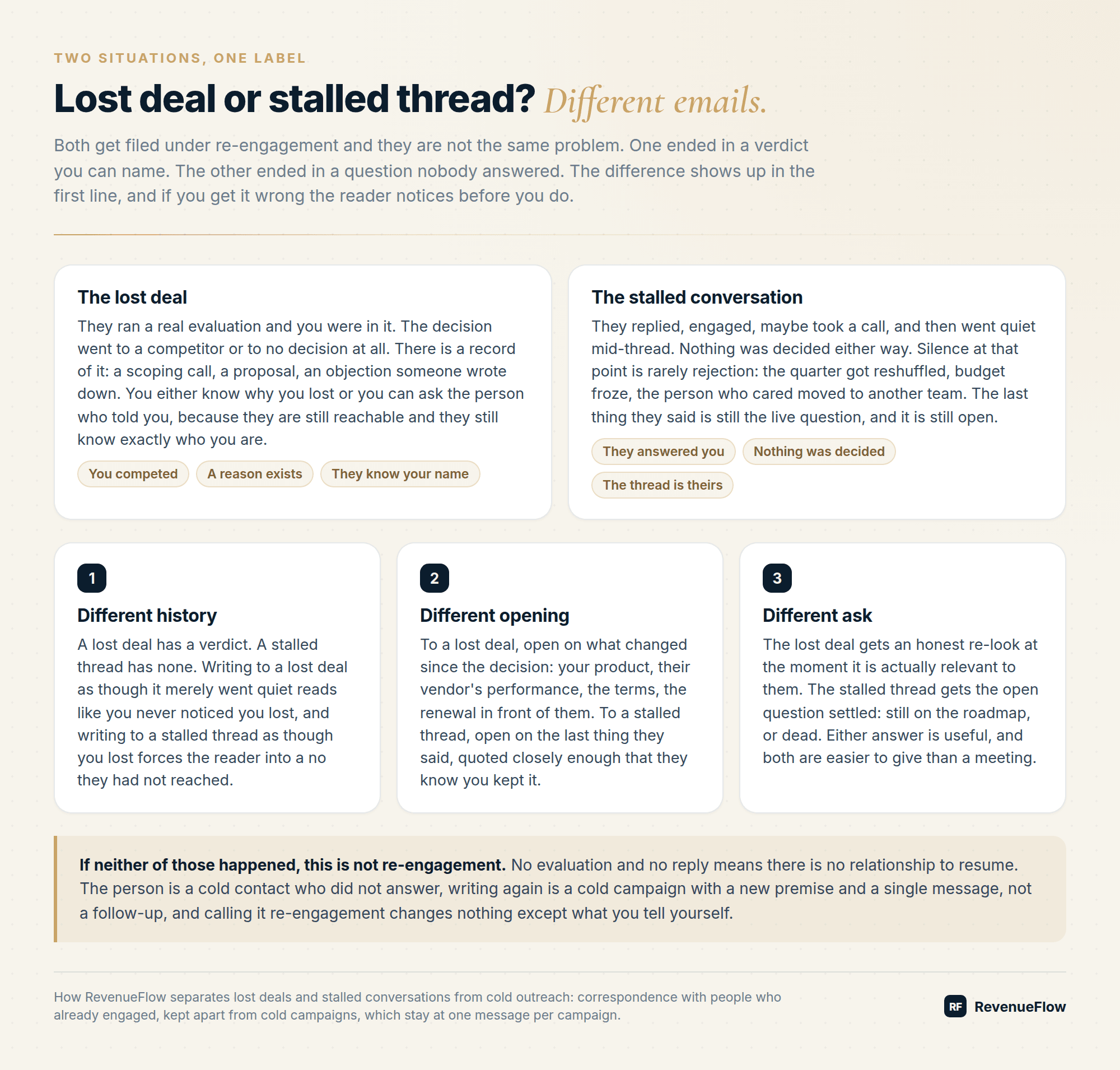
Re-engagement emails go to people you already have a relationship with: a lost deal, a prospect who went quiet mid-conversation, or a contact whose situation has changed. Timing varies by scenario: wait 2-4 months for lost deals, 2-3 weeks for mid-conversation drop-offs, and write immediately on a trigger event. Successful templates reference the previous relationship, provide an easy out, ask questions rather than pitch, and acknowledge changed circumstances without pressure.
Key takeaways
- Wait 2-4 months before re-engaging a lost deal and 2-3 weeks for a prospect who went silent mid-conversation; a trigger event overrides both.
- Re-engaged prospects are more efficient to convert than cold contacts because they already know your company and value proposition.
- Trigger-based re-engagement emails should be sent immediately when observing relevant company news or role changes while the event is fresh.
- The guide provides 10 templates covering five categories: lost deals, cold lead revival, went-silent prospects, timing-based outreach, and trigger event approaches.
- Effective re-engagement emails reference the previous relationship, provide an easy out, and acknowledge that circumstances likely changed rather than re-pitching the entire value proposition.
Reviewed and updated September 15, 2026
10 Re-engagement Email Templates for Lost Deals and Stalled Conversations
Every sales pipeline has them: prospects who seemed interested but disappeared, deals that looked promising but fell through, and leads that went cold without explanation. These contacts represent significant untapped potential because you've already invested time in building awareness and initial interest.
Re-engagement emails give you a second chance at these opportunities. When done well, they can revive conversations that seemed dead and convert prospects who simply weren't ready the first time around.
This guide provides 10 re-engagement email templates covering different scenarios: lost deals, cold leads, prospects who went silent, timing-based outreach, and trigger event approaches. Each template includes context for when to use it and customization guidance.
Why Re-engagement Campaigns Matter
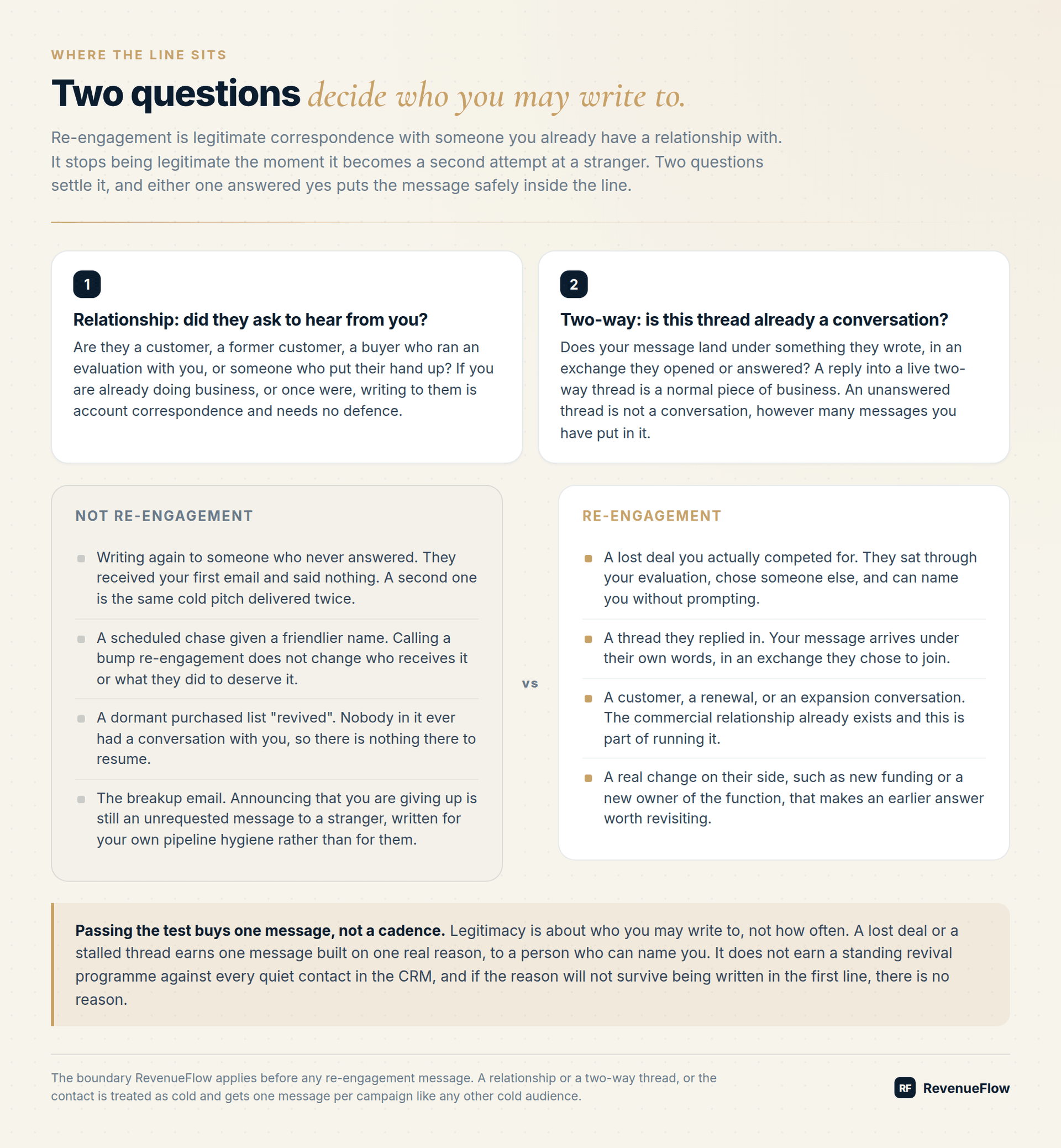
The prospects in your database who didn't convert represent valuable assets. They already know your company. They've seen your value proposition. In many cases, they were genuinely interested but the timing, budget, or priorities didn't align.
Re-engaging these contacts is more efficient than starting from scratch with completely cold outreach. The familiarity you've built creates a foundation that pure cold email lacks. When circumstances change on their end, being the company that reached back out at the right moment can make all the difference.
Re-engagement works because situations change. Budgets get approved. Priorities shift. The person who blocked the deal leaves. New pain points emerge. The company grows into your solution's sweet spot. All of these create windows of opportunity that a well-timed re-engagement email can capture.
When to Send Re-engagement Emails
Teams who want to warm a cold list before inviting them to something usually mean a sequence of soft touches, and the position above applies unchanged: re-verify the addresses, then run one message on one premise rather than a warm-up series that arrives underneath itself.
The timing of re-engagement depends on the situation:
Lost deals: Wait 2-4 months after the deal closed lost. This gives enough time for circumstances to change without the conversation feeling stale.
Cold leads that went dark: Wait 4-8 weeks after your breakup email or last outreach attempt. Reaching out sooner can feel pushy. Waiting longer risks them forgetting you entirely.
Prospects who went silent mid-conversation: These deserve faster follow-up. Wait 2-3 weeks to see if they're simply busy, then send a re-engagement message.
Trigger-based re-engagement: Send immediately when you observe a relevant trigger event. Speed matters here because the event is fresh.
Timing-based re-engagement: Align with their likely planning or budget cycles. Q4 for companies planning next year's initiatives. Month-end for companies with monthly budget reviews.
Template Categories
This guide covers:
- Lost deal follow-up (no hard feelings approach)
- Lost deal follow-up (new development angle)
- Cold lead revival (simple check-in)
- Cold lead revival (value-based approach)
- Went silent mid-conversation (direct approach)
- Went silent mid-conversation (alternative offer)
- Timing-based re-engagement (new quarter/year)
- Timing-based re-engagement (budget cycle)
- Trigger event re-engagement (company news)
- Trigger event re-engagement (role change)
Where we differ from standard practice
Much of the advice on this page reflects how outbound is commonly run. We run it differently, and since this page sits on our site it is worth saying where the difference is and what it costs us.
- A sequence of messages to each prospect over several weeks
- Later messages often land in the same email thread
- Every contact is reached more than once, so a distracted reader gets another chance
- The later messages go only to people who did not answer the first
- Reputation cost accrues on the sending domain across everything else it sends
- One message, then that campaign is finished for that contact
- No thread replies and no bumps
- A non-responding audience becomes a new campaign with a genuinely different premise, not a reminder
- More of the work moves into targeting and into the one message
- We reach each contact less often, and that is the cost we accept
The reasoning is mechanical rather than moral. A follow-up arrives underneath a message the recipient has already seen and chosen not to answer, so it is delivered to the population most likely to mark it as spam, and the reputation cost of that lands on the sending domain across every campaign running on it. We set that cost against the replies a sequence recovers and decided the trade was not worth it. The full argument, with the numbers from our own campaigns, is in why we stopped using follow-ups.
Template 1: Lost Deal Follow-Up (No Hard Feelings)
When to use: When a deal closed lost 2-4 months ago and you want to check if anything has changed. This works well when the original loss was due to timing, budget, or competing priorities rather than product fit.
Subject: Checking in from [Your Company]
Email:
Hi [Name],
It's been a few months since we last spoke about [specific solution or project]. At the time, [brief reference to why the deal didn't happen, such as timing wasn't right or other priorities took precedence].
Wanted to reach out and see how things are going at [Company]. Has anything changed on your end regarding [challenge or goal you were addressing]?
No pressure at all. If circumstances are different now and it makes sense to reconnect, I'd be happy to chat. If not, I completely understand.
Either way, hope things are going well.
Best, [Your name]
Customization tips:
- Reference the specific reason the deal didn't happen to show you remember the conversation
- Keep the tone light and pressure-free
- Don't rehash your entire value proposition in this email
- Acknowledge their situation has likely evolved
Template 2: Lost Deal Follow-Up (New Development Angle)
When to use: When your company has made improvements, launched new features, or achieved results that address the specific objection or gap that caused the original deal to fall through.
Subject: Quick update since we last talked
Email:
Hi [Name],
When we spoke back in [month], you mentioned that [specific concern, objection, or gap that contributed to the deal not moving forward].
Since then, we've [describe the new development: launched a feature, changed pricing structure, improved a process, achieved a relevant result with a similar company].
Given that was a key consideration in your original evaluation, I wanted to let you know in case it changes the equation for [Company].
Would it be worth a brief call to discuss what's new and see if it addresses your concerns?
Best, [Your name]
Customization tips:
- Be specific about both the original concern and what has changed
- Only use this template when you have a genuine new development to share
- Connect the dots clearly between their concern and your update
- Keep the new development explanation brief
Template 3: Cold Lead Revival (Simple Check-In)
When to use: When a lead went cold 2-3 months ago without clear explanation and you want to gently restart the conversation. This low-pressure approach works well when you're unsure why they went dark.
Subject: Still on your radar?
Email:
Hi [Name],
I reached out a while back about [brief reference to original topic]. You've probably been busy with a hundred other things since then.
Wanted to briefly check in and see if [solving specific challenge or achieving specific outcome] is still something [Company] is thinking about.
If timing is better now, I'd be happy to reconnect. If priorities have shifted elsewhere, no worries at all.
What does your situation look like these days?
Best, [Your name]
Customization tips:
- Keep it short and conversational
- Reference the original topic but don't repeat your entire pitch
- Ask an open-ended question to understand their current situation
- No pressure, no guilt about the silence
Template 4: Cold Lead Revival (Value-Based Approach)
When to use: When you want to provide new value as part of re-engaging a cold lead. This works well when you have relevant content, insights, or results to share that might reignite interest.
Subject: Thought of you when I saw this
Email:
Hi [Name],
We connected a few months ago about [topic]. I came across [relevant content, data, case study, or industry insight] and thought it might be useful for you.
[One to two sentence summary of what makes this valuable for their specific situation or industry]
Here's the link: [URL]
I'd be curious to hear your thoughts. Also happy to catch up on what's happening at [Company] if you have a few minutes.
Best, [Your name]
Customization tips:
- The resource should be genuinely valuable, not just a disguised sales pitch
- Explain briefly why you thought of them specifically
- Use this as a conversation starter, not a full sales push
- Choose content that relates to their original interest or challenge
Template 5: Went Silent Mid-Conversation (Direct Approach)
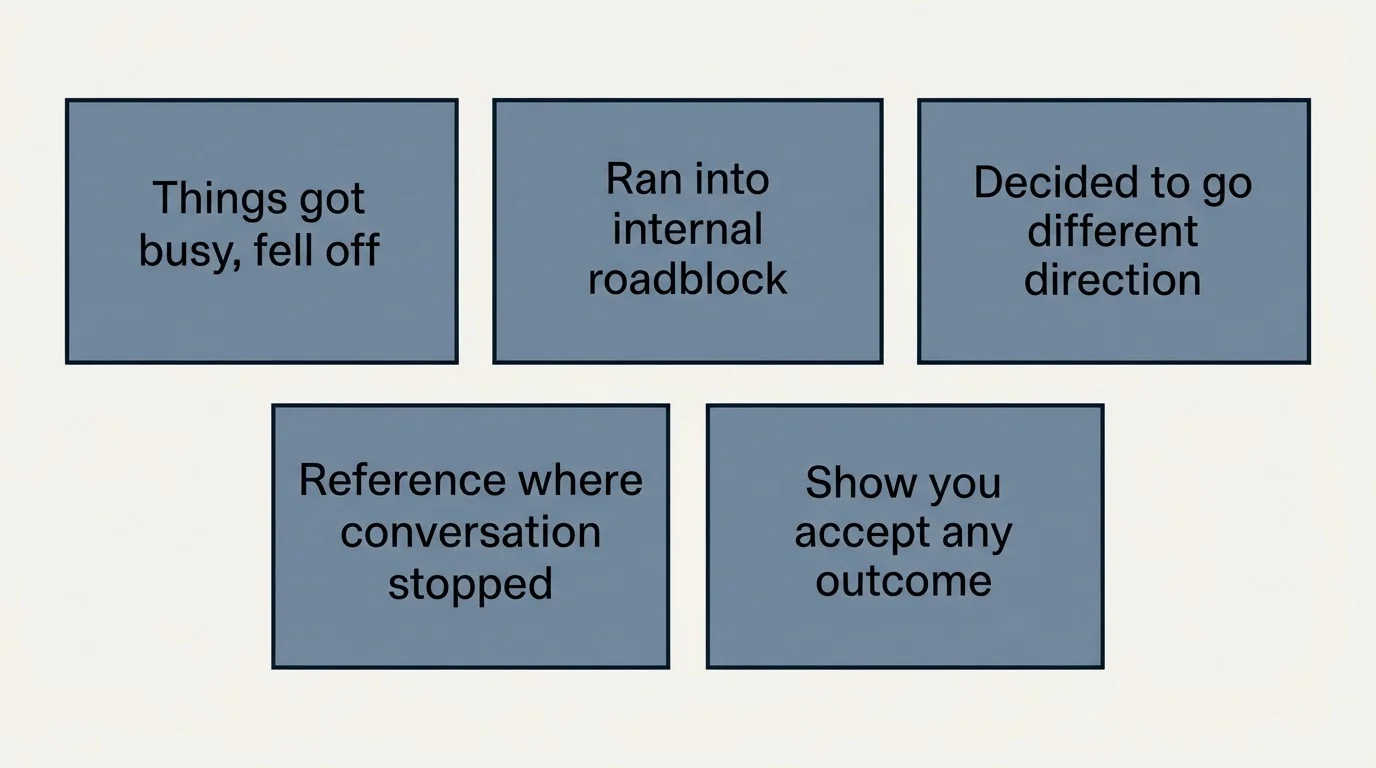
When to use: When a prospect was actively engaged in conversation but suddenly stopped responding. This might have been after a demo, proposal, or detailed discussion. The direct approach works when you've invested significant time in the relationship.
Subject: Did something come up?
Email:
Hi [Name],
We were in the middle of discussing [specific topic or next step] and then I lost touch with you. I wanted to check in and see if something came up on your end.
A few possibilities:
- Things got busy and this fell off your plate
- You ran into an internal roadblock or concern
- You've decided to go a different direction
Any of those accurate? I'd genuinely like to know where things stand so I can either help move things forward or respect your decision to pause.
What's happening on your end?
Best, [Your name]
Customization tips:
- Reference the specific point where conversation stopped
- The numbered options make it easy to respond with a quick answer
- Show that you're okay with any outcome
- This approach works best when there was genuine engagement before the silence
Template 6: Went Silent Mid-Conversation (Alternative Offer)

When to use: When you suspect the prospect went silent because the original proposal or approach didn't quite fit. Offering an alternative can restart the conversation.
Subject: Different approach?
Email:
Hi [Name],
I've been thinking about our conversation regarding [specific solution or project] and wanted to suggest something.
If the original approach we discussed didn't feel like the right fit, I'd be open to exploring alternatives. For example:
- [Alternative approach 1: smaller scope, different pricing structure, phased implementation]
- [Alternative approach 2: different solution emphasis or use case]
Sometimes the first approach isn't the right one, and there's a path forward that works better for your situation.
Would either of these be worth discussing? Or is there something else that would make more sense?
Best, [Your name]
Customization tips:
- Offer genuinely different alternatives, not just minor variations
- Be willing to adapt based on what might have caused the stall
- This works well when you suspect fit or budget concerns
- Keep alternatives brief and focused on their likely pain points
Template 7: Timing-Based Re-engagement (New Quarter/Year)
When to use: At the start of a new quarter or fiscal year when companies are reviewing priorities, allocating budgets, and planning initiatives. This is particularly effective for prospects who declined due to timing.
Subject: [Q1/New year] priorities at [Company]?
Email:
Hi [Name],
With [Q1 / the new year / the new fiscal year] underway, I wanted to reach out and see what [Company] is focused on.
When we last spoke, [reference the original challenge or goal you discussed] wasn't the top priority. Curious if that's changed as you're looking at the year ahead.
If [solving that challenge or achieving that goal] has moved up the list, I'd be happy to reconnect and explore how we might help. If not, I understand and can check back in later.
What does your Q1 roadmap look like?
Best, [Your name]
Customization tips:
- Align timing with their likely planning cycles
- Reference the specific topic from your previous conversation
- Ask about their broader priorities, not just your solution
- This works well for enterprise sales where budget cycles matter
Template 8: Timing-Based Re-engagement (Budget Cycle)
When to use: When you know or suspect their budget cycle is about to reset. Common scenarios include annual budget approvals, departmental planning periods, or end-of-quarter spending deadlines.
Subject: Budget planning for [relevant initiative]
Email:
Hi [Name],
I know many teams are in budget planning mode right now for [next quarter/next year]. Wanted to see if [challenge you solve or outcome you deliver] has made it onto the priority list for [Company].
When we last connected, you mentioned [reference to their specific situation or interest]. If you're building a case for [relevant initiative or investment], I'd be happy to provide any information that might help with the planning process.
Is this something that's on the table for the upcoming budget cycle?
Best, [Your name]
Customization tips:
- Be genuinely helpful with budget justification materials if needed
- Reference their specific situation from previous conversations
- Timing is crucial with this template so research their likely budget cycle
- Position yourself as a resource during their planning process
Template 9: Trigger Event Re-engagement (Company News)
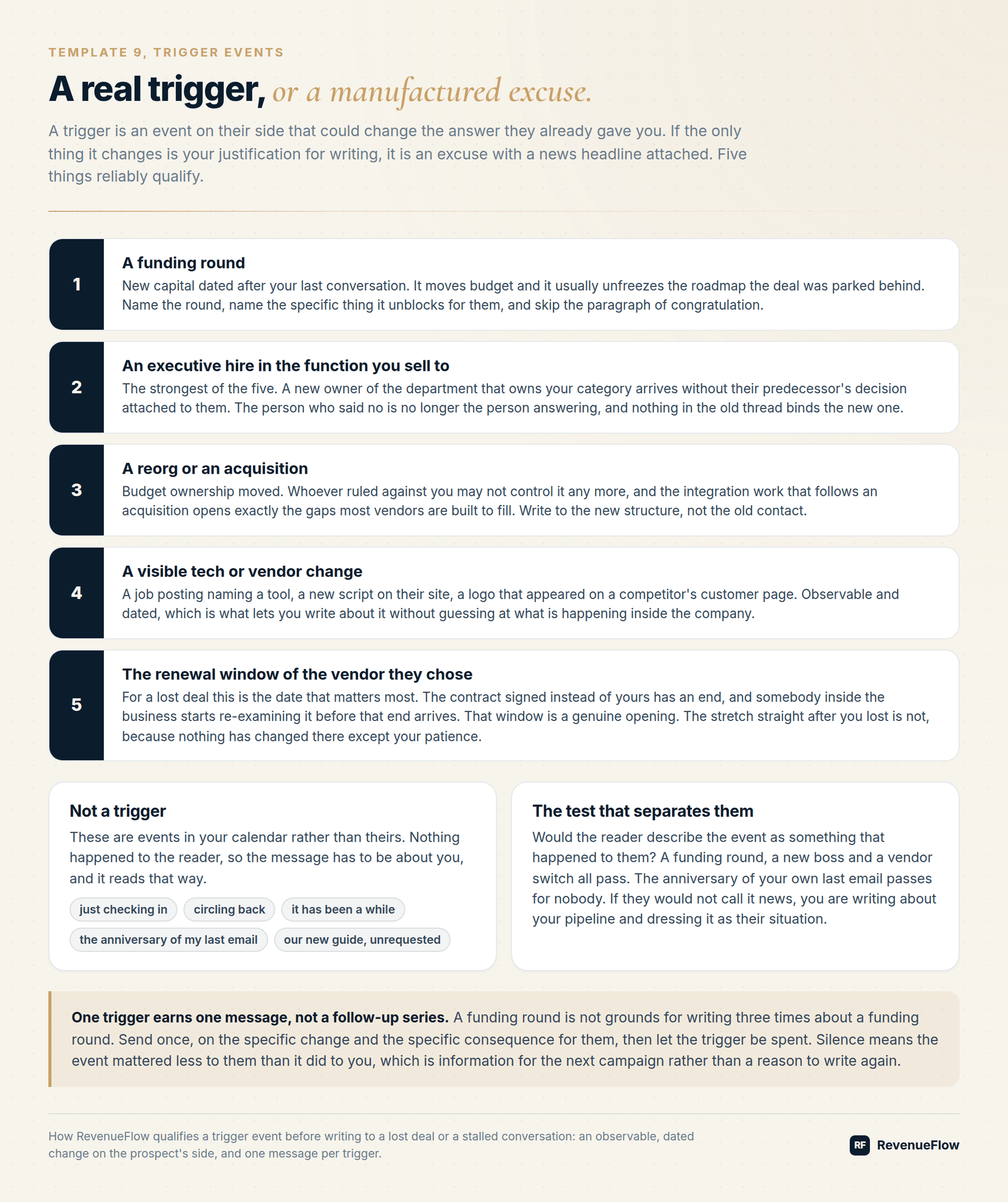
When to use: When you see relevant company news such as funding announcements, acquisitions, product launches, expansion announcements, or leadership changes. These events often signal new priorities and budgets.
Subject: Congrats on [the news]
Email:
Hi [Name],
I saw the news about [specific event: the funding round, the acquisition, the expansion into new market, the product launch]. Congratulations to you and the team.
Events like this often shift priorities and create new challenges. When we last spoke, you were focused on [reference original topic]. Curious if [the news event] changes anything on that front.
I'd imagine [brief hypothesis about how the event might relate to your solution, like rapid growth often surfaces needs around X or expansions typically require Y].
If it would be helpful to reconnect and discuss how we could support what's ahead, I'm happy to make time.
Best, [Your name]
Customization tips:
- Lead with genuine congratulations, not just a sales angle
- Connect the event to their previous challenge or interest
- Don't assume you know their new priorities, ask questions
- Speed matters with trigger events so send within days of the news
Template 10: Trigger Event Re-engagement (Role Change)
When to use: When your contact has moved to a new role or company. This creates an opportunity to re-engage because they may have new priorities, new budgets, or influence in a different organization.
Subject: Congrats on the new role
Email:
Hi [Name],
I noticed you've moved to [new company or new role]. Congratulations on the transition.
We connected back when you were at [old company] about [brief reference to original topic]. Given your new position at [new company], I'm curious if [the challenge or goal you address] is something you're thinking about in this role.
If you're settling in and this isn't on your radar yet, completely understand. But if it's relevant to what you're building at [new company], I'd be happy to reconnect.
How's the new role going?
Best, [Your name]
Customization tips:
- Lead with genuine interest in their career move
- Reference your previous relationship but don't assume it carries over automatically
- Recognize they may be in a settling-in period
- This can also work for introducing yourself to their replacement at the old company
Best Practices for Re-engagement Emails
Reference the Relationship
Always acknowledge your previous interaction. Remind them who you are and what you discussed. Cold re-engagement emails that ignore the history feel impersonal and waste the connection you've already built.
That said, keep the reference brief. You're not rehashing the entire sales conversation. A single sentence that jogs their memory is enough.
Provide an Easy Out
Re-engagement emails should feel low-pressure. Make it clear that you're genuinely okay if they're not interested or if timing still isn't right. Prospects are more likely to respond honestly when they don't feel cornered.
Phrases like "If priorities have shifted, no worries" or "If this isn't relevant anymore, I understand" give them permission to say no, which paradoxically makes them more likely to engage.
Ask Questions, Don't Pitch
Your re-engagement email isn't the place to restart your full sales pitch. Instead, ask questions to understand their current situation. Has anything changed? What are they focused on now? Is this topic still relevant?
The goal of the re-engagement email is to restart the conversation, not close the deal. Get them talking, then you can assess next steps.
Use Fresh Subject Lines
Don't reply to old email threads. Start fresh with a new subject line. Old threads can get lost or feel stale. A new subject line signals a new conversation and increases open rates.
Choose subject lines that create curiosity or reference their situation rather than announcing you're following up.
Respect Their Time
Keep re-engagement emails concise. You're asking for attention from someone who stopped responding. Lengthy emails feel demanding and are less likely to get read.
Aim for emails that can be read and responded to in under a minute.
Track and Iterate
Different re-engagement approaches work for different situations. Track which templates get responses and which don't. Note patterns based on the original reason for lost engagement.
Over time, you'll develop intuition for which template fits which scenario. Your data will guide better decisions about timing, messaging, and approach.
Building a Re-engagement System
Individual re-engagement emails are useful. A systematic approach to re-engagement is more valuable.
Consider building re-engagement into your regular workflow:
Monthly lost deal review: Each month, review deals that closed lost 2-3 months prior. Identify any that are worth re-engaging and send appropriate templates.
Quarterly cold lead audit: Each quarter, review leads that went cold. Segment them by original interest level and reason for going dark. Send targeted re-engagement based on segment.
Trigger event monitoring: Set up alerts for key accounts and contacts. When you see relevant news, send a timely re-engagement email.
Calendar-based outreach: Align re-engagement with predictable timing events like budget cycles, fiscal year starts, and planning seasons.
The goal is making re-engagement a consistent practice rather than an occasional afterthought.
Related Reading
Getting Help With Your Re-engagement Strategy
Re-engagement is one component of a comprehensive outreach system. Your initial sequences, follow-up cadences, breakup emails, and re-engagement campaigns all work together to maximize conversion over time.
If you're looking to build or improve your outreach system, we can help.
Schedule a free strategy call to discuss:
- Your current pipeline of lost deals and cold leads
- How to structure re-engagement campaigns for different prospect segments
- Timing and triggers that make sense for your market
- Building an outreach system that maximizes the value of every lead
Schedule your free strategy call here.
We'll review your current situation and provide specific recommendations for re-engaging your pipeline.
Frequently asked questions.
Frequently asked questions- How long should I wait before sending a re-engagement email to a lost deal?
- Wait 2-4 months after a deal closes lost before sending a re-engagement email. This timeframe gives enough time for circumstances to change on the prospect's end (such as budget approval, priority shifts, or personnel changes) without the conversation feeling stale or outdated. Reaching out too soon can feel pushy, while waiting too long risks them forgetting your previous interactions entirely.
- Why are re-engagement emails more effective than cold outreach?
- Re-engagement emails are more efficient than starting from scratch because the prospect already knows your company and has seen your value proposition. You've already invested time building initial awareness and interest. The familiarity creates a foundation that pure cold email lacks. When circumstances change (budgets get approved, priorities shift, pain points emerge, or the person blocking the deal leaves), being the company that reaches back out at the right moment can convert prospects who simply weren't ready the first time.
- What should I include in a re-engagement email to a prospect who went silent?
- Reference the previous relationship specifically, provide an easy out so they don't feel pressured, and ask questions rather than pitching again. Keep the tone light and acknowledge their situation has likely evolved. For prospects who went silent mid-conversation, wait 2-3 weeks to see if they're simply busy, then send a direct, low-pressure message. Avoid rehashing your entire value proposition and respect their time by keeping the email brief and focused on whether circumstances have changed.
- When should I use trigger events for re-engagement emails?
- Send trigger-based re-engagement emails immediately when you observe a relevant event like company news, funding announcements, or role changes. Speed matters because the event is fresh and creates a natural conversation opener. The guide includes specific templates for company news triggers and role change triggers. This approach works because it connects your outreach to a real change in their situation rather than arbitrary timing, making the contact feel timely and relevant rather than random.
About the author.

Ben Carden is CRO at RevenueFlow, which builds and operates outbound revenue engines for B2B companies. Previously at Gartner Enterprise. Studied at London School of Economics.
Ben Carden · CRO
Connect on LinkedIn →Explore more.
Ready to scale your outreach?
We build GTM engines that book real meetings. See the receipts.
Related articles.
10 B2B Cold Email Templates for One-Message Sends
Ten B2B cold email templates written for a single send, with the four slot structure underneath them and the test that separates a good example from a bad one.
Cold Email Templates for Customer Success Managers
Eleven cold email templates for customer success managers, covering champion change, expansion, renewal rescue, and win-back, with subject lines and timing.
14 Renewal Email Templates That Retain Customers
Master subscription and contract renewals with 14 proven email templates. Reduce churn, lock in renewals early, and maintain customer relationships.
13 Case Study Request Email Templates That Get Results
Get proven email templates for requesting case studies, video testimonials, and written reviews from your happiest customers. Includes templates for every stage from initial ask to final approval.
Email Subject Line Capitalization: What the Guides Say
What the style authorities actually rule on subject line case, what the published tests measured, and the default for a one to one sales email.
Follow-Up Call Scripts: Nine Calls Into a Live Conversation
Nine follow-up call scripts, each tied to the event that earns the call, from a demo to a renewal, plus the four moves they share and how each call should end.