SaaS Cold Email Benchmarks: Open, Reply, Conversion Data
Industry benchmark data for SaaS cold email campaigns, including open rates, reply rates, and conversion metrics segmented by company stage, target persona, and deal size.
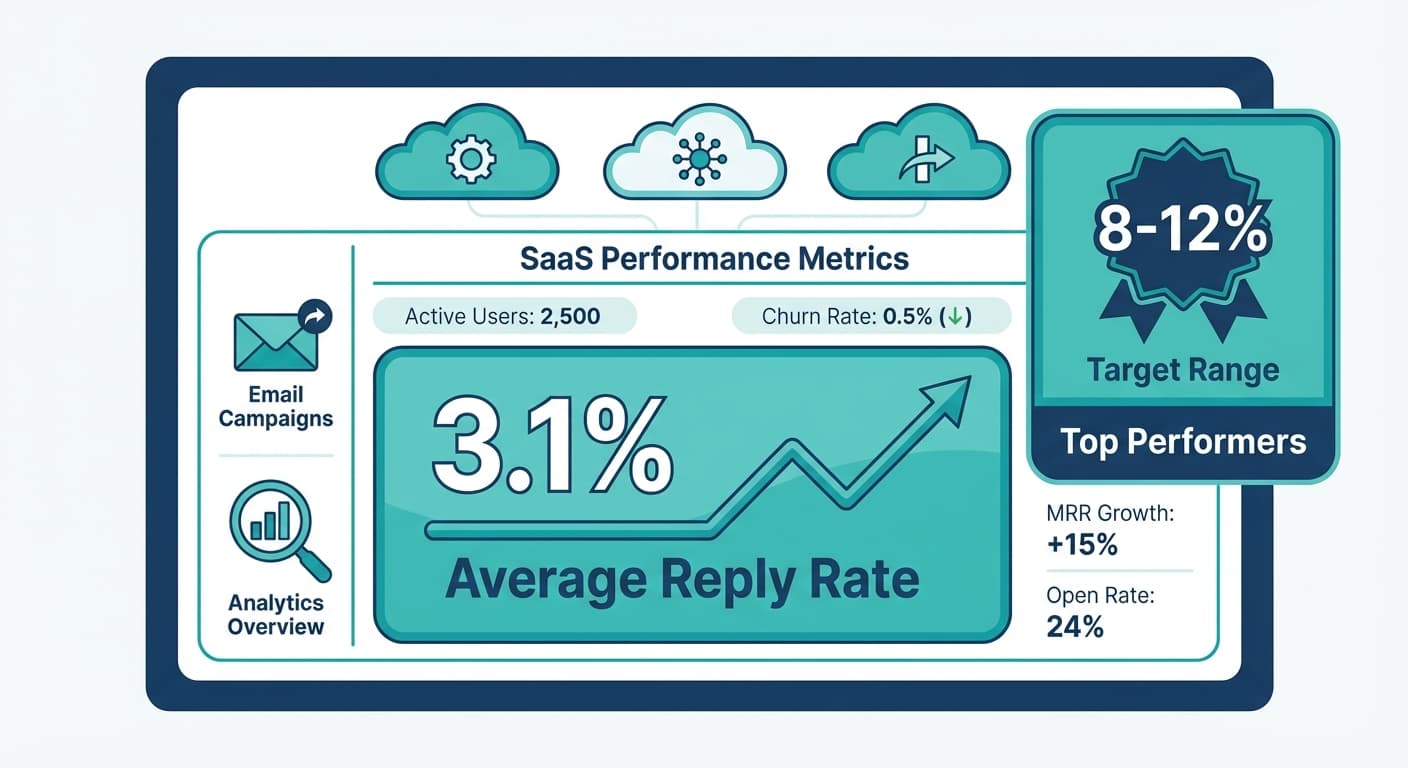
The average SaaS cold email campaign achieves a 2-4% reply rate, with top performers hitting 7%+. Open rates typically range from 35-45%, positive reply rates from 1-2%, and meeting booking rates from 0.5-1.5%. Performance varies significantly by company stage, target persona, and deal size: seed-stage companies often see 5-10% reply rates while enterprise campaigns average 1.5-3.5%.
Key takeaways
- Top-performing SaaS cold email campaigns consistently achieve 8-12% reply rates, compared to the industry average of 3.1%.
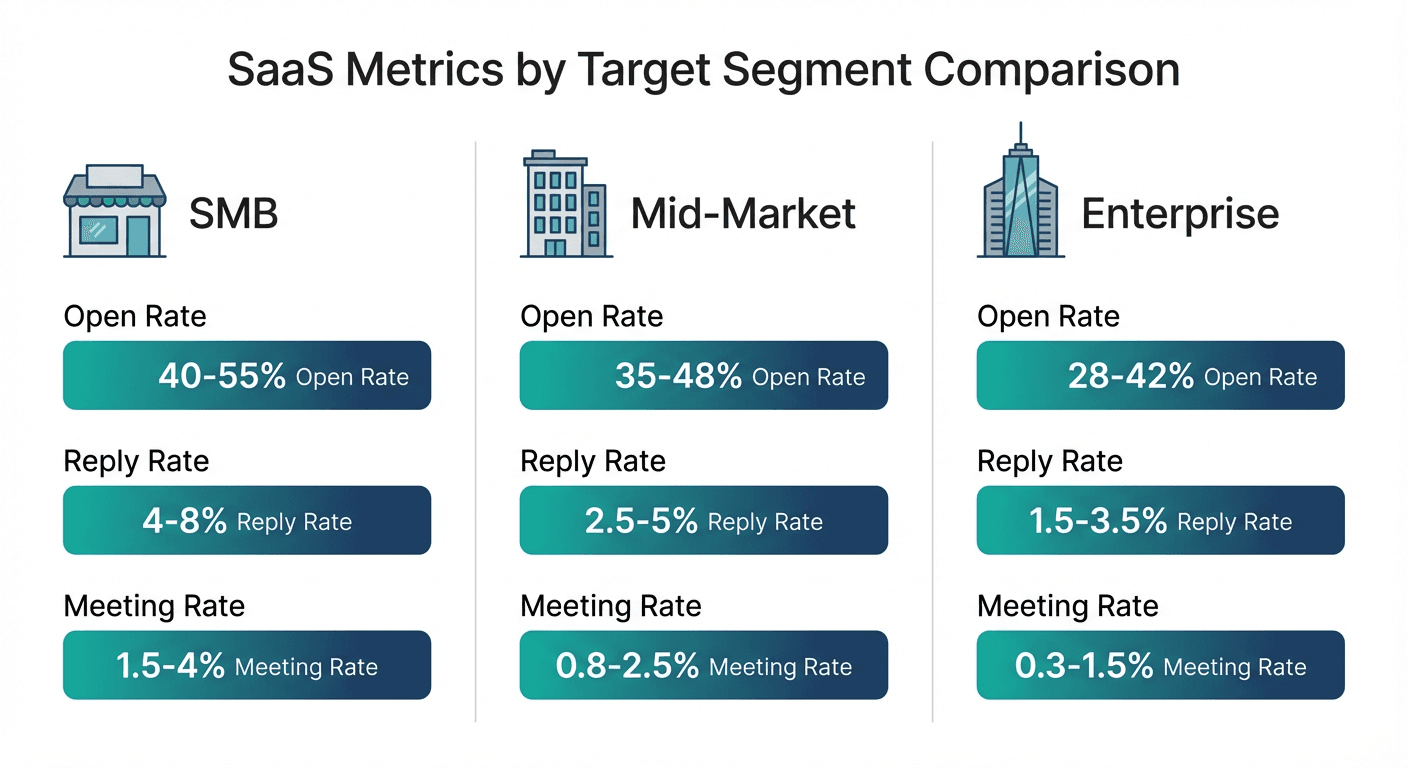
- SMB targets show significantly higher engagement than enterprise, with reply rates of 4-8% versus 1.5-3.5% for enterprise contacts.
- Seed-stage companies typically achieve 5-10% reply rates due to highly targeted, founder-led outreach with strong personalization.
- Meeting booking rates range from 0.5-1.5% industry-wide, with SMB targets converting at 1.5-4% and enterprise at 0.3-1.5%.
- Well-targeted campaigns see 40-60% of total replies as positive, while poorly targeted campaigns drop to 20-30% positive responses.
Reviewed and updated September 15, 2026
The average SaaS cold email campaign achieves a 3.1% reply rate, but top performers consistently hit 8-12%. Understanding where your campaigns fall within industry benchmarks is the first step toward meaningful improvement.
This comprehensive benchmark report compiles data from industry sources, published studies, and typical performance ranges observed across SaaS companies of various stages and sizes. While individual results vary significantly based on factors like list quality, messaging, and targeting, these benchmarks provide a useful framework for evaluating your own cold email performance.
Methodology Note
The benchmarks presented in this report represent industry estimates and typical ranges rather than data from a single controlled study. These figures are compiled from publicly available research, industry reports, and commonly cited performance standards in the B2B SaaS space. Your actual results will depend on numerous factors including your specific market, product, messaging quality, and list accuracy.
Use these benchmarks as directional guidance rather than absolute targets. The goal is to understand where you stand relative to typical industry performance and identify areas for improvement.
Key SaaS Cold Email Metrics Overview
Before diving into segment-specific data, here are the primary metrics every SaaS company should track in their cold email campaigns.
Open Rates
Open rates measure the percentage of recipients who open your email. While open rates have become less reliable due to privacy features like Apple Mail Privacy Protection, they still provide useful directional data.
Industry-Wide SaaS Benchmarks:
- Below average: Under 35%
- Average: 35-45%
- Good: 45-55%
- Excellent: 55%+
By Target Segment:
| Segment | Typical Open Rate Range |
|---|---|
| SMB (1-50 employees) | 40-55% |
| Mid-Market (51-500 employees) | 35-48% |
| Enterprise (500+ employees) | 28-42% |
SMB contacts typically show higher open rates due to less sophisticated email filtering and fewer gatekeepers. Enterprise contacts often have stricter spam filters and receive higher email volumes, resulting in lower open rates.
Reply Rates
Reply rates are the most meaningful metric for cold email campaigns since they indicate actual engagement. This includes both positive and negative responses.
Industry-Wide SaaS Benchmarks:
- Below average: Under 2%
- Average: 2-4%
- Good: 4-7%
- Excellent: 7%+
By Target Segment:
| Segment | Typical Reply Rate Range |
|---|---|
| SMB | 4-8% |
| Mid-Market | 2.5-5% |
| Enterprise | 1.5-3.5% |
The significant variation between segments reflects differences in buyer behavior, decision-making complexity, and the competitive landscape for attention.
Positive Reply Rates
Positive reply rates measure responses that express genuine interest, request more information, or agree to a meeting. This is distinct from total replies, which include negative responses and opt-out requests.
Industry-Wide SaaS Benchmarks:
- Below average: Under 1%
- Average: 1-2%
- Good: 2-4%
- Excellent: 4%+
Typically, 40-60% of total replies are positive in well-targeted campaigns. Poorly targeted campaigns may see positive reply rates as low as 20-30% of total replies.
Meeting Booking Rates
Meeting booking rates measure the percentage of contacted prospects who schedule a discovery call or demo. This metric bridges outreach and pipeline generation.
Industry-Wide SaaS Benchmarks:
- Below average: Under 0.5%
- Average: 0.5-1.5%
- Good: 1.5-3%
- Excellent: 3%+
By Target Segment:
| Segment | Typical Meeting Rate Range |
|---|---|
| SMB | 1.5-4% |
| Mid-Market | 0.8-2.5% |
| Enterprise | 0.3-1.5% |
Conversion to Opportunity
This metric tracks prospects who become qualified opportunities in your pipeline after the initial meeting.
Industry-Wide SaaS Benchmarks:
- Below average: Under 15% of meetings
- Average: 15-30% of meetings
- Good: 30-45% of meetings
- Excellent: 45%+ of meetings
The meeting-to-opportunity conversion rate is heavily influenced by your qualification criteria and how well your cold email targeting aligns with your ideal customer profile.
SaaS Benchmarks by Company Stage
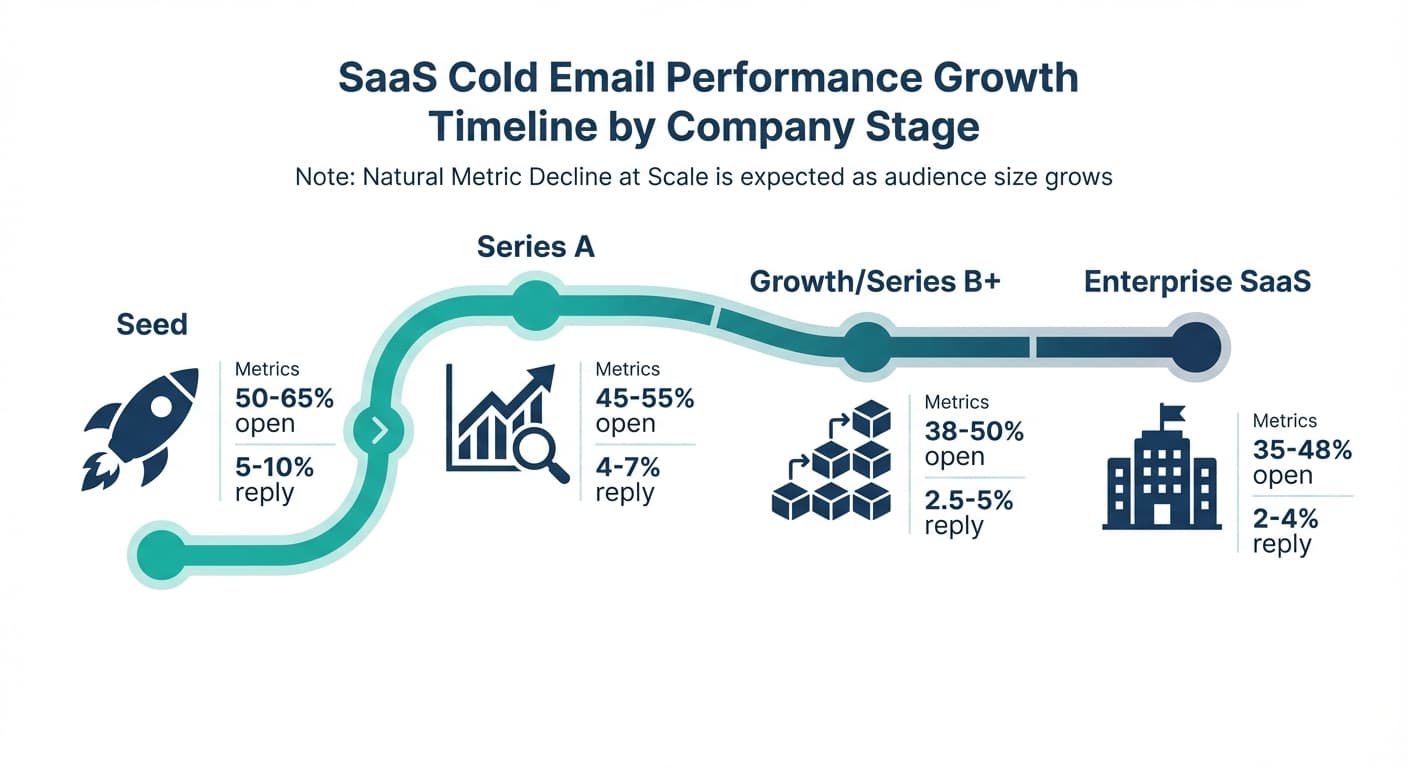
Cold email performance varies significantly based on your company's stage. Early-stage companies often see better metrics due to founder-led selling and highly targeted outreach, while growth-stage companies may experience declining rates as they scale.
Seed Stage Companies
Seed-stage SaaS companies typically run smaller, highly targeted campaigns with strong founder involvement.
Typical Performance Ranges:
- Open rates: 50-65%
- Reply rates: 5-10%
- Positive reply rates: 3-6%
- Meeting booking rates: 2-5%
Seed-stage companies benefit from the authenticity of founder outreach and highly personalized messaging. The smaller scale allows for more research per prospect and genuinely customized emails.
Series A Companies
Series A companies are beginning to systematize their outreach while maintaining reasonable personalization.
Typical Performance Ranges:
- Open rates: 45-55%
- Reply rates: 4-7%
- Positive reply rates: 2-4%
- Meeting booking rates: 1.5-3.5%
At this stage, companies typically transition from pure founder-led outreach to SDR teams, which can temporarily impact metrics as new reps ramp up.
Growth Stage (Series B+)
Growth-stage companies operate at higher volumes with more standardized processes.
Typical Performance Ranges:
- Open rates: 38-50%
- Reply rates: 2.5-5%
- Positive reply rates: 1.5-3%
- Meeting booking rates: 1-2.5%
The decline in metrics at scale is normal and expected. The key is maintaining efficiency while increasing volume. A 3% reply rate at 10,000 emails per month generates more pipeline than a 6% reply rate at 1,000 emails.
Enterprise SaaS Companies
Established enterprise SaaS companies often focus on account-based strategies with highly targeted outreach.
Typical Performance Ranges:
- Open rates: 35-48%
- Reply rates: 2-4%
- Positive reply rates: 1-2.5%
- Meeting booking rates: 0.8-2%
Enterprise companies often prioritize quality over quantity, accepting lower response rates in exchange for larger deal sizes and longer customer lifetimes.
Benchmarks by Target Persona
The role and function of your target buyer significantly impacts cold email performance.
Technical Buyers (Engineering, IT, DevOps)
Technical buyers are typically skeptical of sales outreach and respond best to value-driven, technical content.
Typical Performance Ranges:
- Open rates: 32-45%
- Reply rates: 1.5-4%
- Positive reply rates: 0.8-2%
- Meeting booking rates: 0.5-1.5%
Technical buyers require different messaging approaches. They respond better to specific technical problems, integration capabilities, and peer recommendations than to traditional sales language.
Business Buyers (Sales, Marketing, Operations)
Business buyers are generally more receptive to cold outreach, especially when the value proposition is clear.
Typical Performance Ranges:
- Open rates: 42-55%
- Reply rates: 3-7%
- Positive reply rates: 1.5-4%
- Meeting booking rates: 1.2-3%
Business buyers often have budget authority and are actively looking for solutions to hit their targets. They respond well to ROI-focused messaging and case studies.
Executive Buyers (C-Suite, VP+)
Executives receive high volumes of outreach but can move quickly when engaged.
Typical Performance Ranges:
- Open rates: 28-42%
- Reply rates: 1-3%
- Positive reply rates: 0.5-1.5%
- Meeting booking rates: 0.4-1.2%
While raw metrics are lower, executive engagement often leads to faster sales cycles and larger deals. Many successful campaigns use a multi-threaded approach, engaging both executives and their teams.
Department-Specific Variations
| Department | Open Rate Range | Reply Rate Range |
|---|---|---|
| Sales | 45-58% | 4-8% |
| Marketing | 42-55% | 3-6% |
| Customer Success | 40-52% | 3-5.5% |
| Finance | 38-48% | 2-4% |
| HR | 40-50% | 2.5-5% |
| IT/Engineering | 32-45% | 1.5-4% |
| Legal | 30-40% | 1-2.5% |
Benchmarks by Deal Size
Your average contract value (ACV) influences both your targeting strategy and expected benchmarks.
Low ACV ($1K-$10K annually)
Products with lower price points typically target higher volumes with more transactional messaging.
Typical Performance Ranges:
- Open rates: 42-55%
- Reply rates: 3.5-7%
- Meeting booking rates: 1.5-4%
- Sales cycle: 14-45 days
Low ACV products can afford lower conversion rates due to higher volumes and shorter sales cycles.
Mid ACV ($10K-$50K annually)
Mid-market products balance volume with personalization.
Typical Performance Ranges:
- Open rates: 40-52%
- Reply rates: 2.5-5%
- Meeting booking rates: 1-2.5%
- Sales cycle: 30-90 days
High ACV ($50K-$200K annually)
Higher-value products require more targeted, account-based approaches.
Typical Performance Ranges:
- Open rates: 38-48%
- Reply rates: 2-4%
- Meeting booking rates: 0.8-2%
- Sales cycle: 60-180 days
Enterprise ACV ($200K+ annually)
Enterprise deals justify significant investment in research and multi-threaded outreach.
Typical Performance Ranges:
- Open rates: 35-45%
- Reply rates: 1.5-3.5%
- Meeting booking rates: 0.5-1.5%
- Sales cycle: 120-365 days
Lower response rates are acceptable when individual deals represent substantial revenue. A single enterprise deal may justify months of targeted outreach.
What Top Performers Do Differently
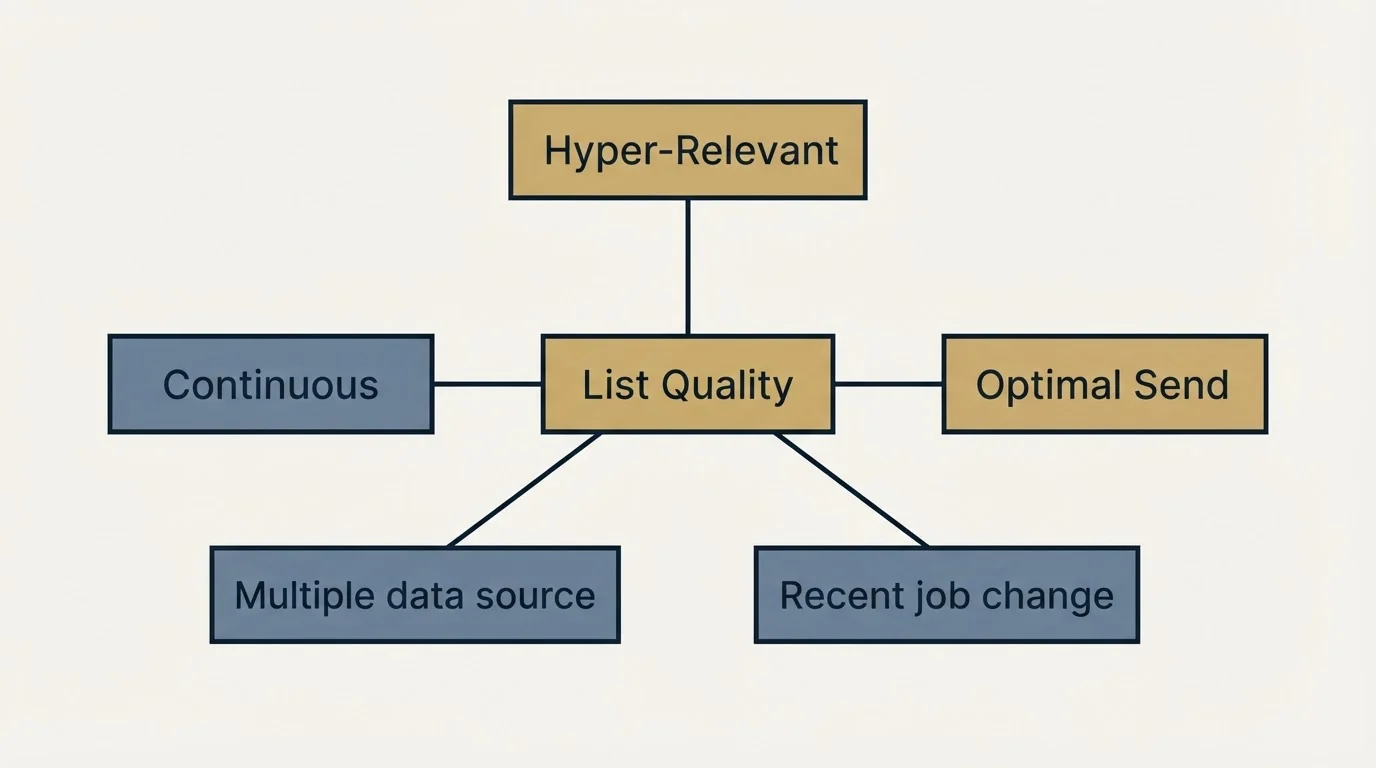
Companies achieving top-quartile cold email results (8%+ reply rates, 3%+ meeting rates) share several common characteristics.
List Quality Over Quantity
Top performers prioritize data accuracy and targeting precision. They typically spend 2-3x more time on list building and verification compared to average performers. Key practices include:
- Multiple data source validation
- Recent job change and funding triggers
- Technographic filtering for product fit
- Manual review of high-value accounts
Hyper-Relevant Messaging
Instead of generic value propositions, top performers reference specific, timely triggers that demonstrate genuine research. Common approaches include:
- Recent company news or announcements
- Specific technology stack references
- Industry-specific pain points
- Mutual connections or shared experiences
Optimal Send Timing and Sequencing
Top performers test and optimize their send schedules based on actual recipient behavior. General guidelines that high performers have validated:
- Tuesday through Thursday typically outperform Monday and Friday
- Morning sends (8-10 AM recipient time) often show higher open rates
Continuous Testing and Iteration
High-performing teams run systematic A/B tests on subject lines, opening lines, value propositions, and call-to-action language. They make data-driven decisions rather than relying on assumptions or best practices alone.
How to Measure Your Own Performance
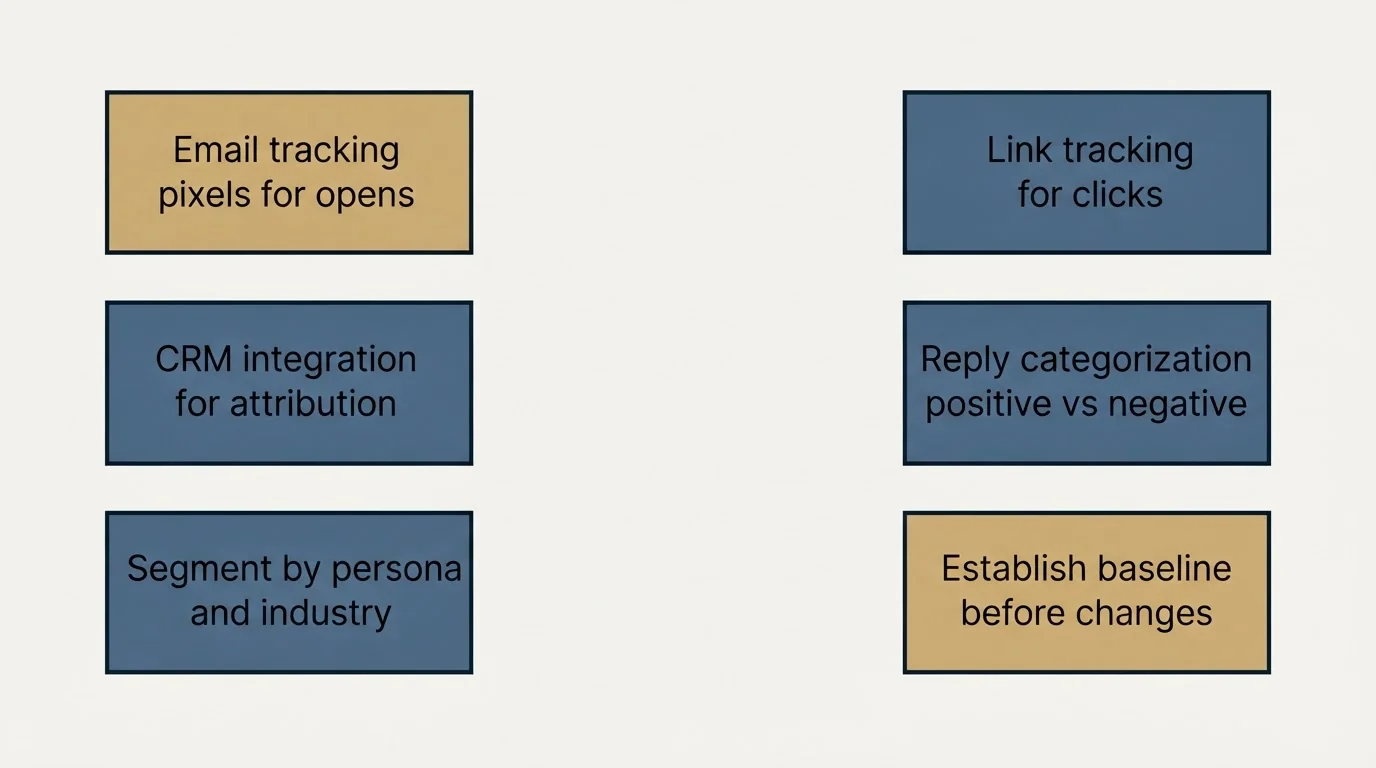
Accurate measurement requires proper infrastructure and consistent methodology.
Essential Tracking Setup
- Email tracking pixels for open rate measurement (accounting for privacy limitations)
- Link tracking for click-through measurement
- CRM integration for opportunity and revenue attribution
- Reply categorization to distinguish positive from negative responses
Calculating Your Metrics
Open Rate: (Unique opens / Emails delivered) x 100
Reply Rate: (Total replies / Emails delivered) x 100
Positive Reply Rate: (Positive replies / Emails delivered) x 100
Meeting Rate: (Meetings booked / Emails delivered) x 100
Opportunity Rate: (Qualified opportunities / Meetings held) x 100
Segmenting Your Data
To gain actionable insights, segment your performance data by:
- Target persona
- Company size
- Industry vertical
- Campaign type (cold vs warm, first touch vs follow-up)
- Time period
Establishing Your Baseline
Before implementing changes, establish a clear baseline with at least 1,000 emails sent over 30+ days. This provides statistically meaningful data for comparison.
Improving Your Metrics
If your metrics fall below industry benchmarks, focus on these high-impact areas.
For Below-Average Open Rates
Subject line optimization:
- Keep subject lines under 45 characters
- Use lowercase, conversational language
- Include personalization tokens (name, company)
- Test curiosity-driven vs. value-driven approaches
Sender reputation management:
- Warm up new domains gradually (50-100 emails daily to start)
- Monitor bounce rates (keep under 2%)
- Authenticate with SPF, DKIM, and DMARC
- Use dedicated sending domains
List quality improvements:
- Verify email addresses before sending
- Remove bounced addresses immediately
- Update contact data quarterly
For Below-Average Reply Rates
Messaging improvements:
- Lead with relevant pain points, not your product
- Keep initial emails under 125 words
- Include one clear, low-friction call to action
- Remove jargon and marketing language
Targeting refinements:
- Narrow your ICP definition
- Add technographic and firmographic filters
- Focus on companies showing buying signals (funding, hiring, technology changes)
Sequence optimization:
- Test shorter sequences with higher value per touch
- Vary your angle across sequence steps
- Include social proof and case studies in later touches
For Below-Average Meeting Rates
Qualification improvements:
- Respond to positive replies within 2 hours
- Offer specific meeting times rather than open-ended availability
- Include a brief agenda or value proposition for the meeting
- Remove friction from the scheduling process
Follow-up optimization:
- Send calendar invites immediately after confirmation
- Include reminder emails 24 hours before meetings
- Provide easy rescheduling options
Industry-Specific Considerations
Cold email benchmarks vary across SaaS verticals. While comprehensive vertical-specific data is limited, general patterns emerge:
Higher-performing verticals (typically 20-30% above average):
- Sales and revenue tools
- Marketing technology
- Customer success platforms
Average-performing verticals:
- HR and recruiting technology
- Finance and accounting software
- Operations and productivity tools
More challenging verticals (typically 20-30% below average):
- Security and compliance
- Infrastructure and DevOps
- Legal technology
These variations reflect buyer accessibility, competitive intensity, and typical purchasing processes within each vertical.
The Path to Top-Quartile Performance
Reaching top-quartile cold email performance requires systematic improvement across multiple dimensions. Based on industry patterns, companies that achieve 8%+ reply rates typically:
- Invest heavily in data quality with multi-source verification and regular list hygiene
- Personalize at scale using triggers and research rather than generic mail merge
- Test continuously with structured A/B experiments and rapid iteration
- Align closely with sales ensuring seamless handoff and feedback loops
- Focus on deliverability with proper authentication and sender reputation management
Where we differ from standard practice
Much of the advice on this page reflects how outbound is commonly run. We run it differently, and since this page sits on our site it is worth saying where the difference is and what it costs us.
- A sequence of messages to each prospect over several weeks
- Later messages often land in the same email thread
- Every contact is reached more than once, so a distracted reader gets another chance
- The later messages go only to people who did not answer the first
- Reputation cost accrues on the sending domain across everything else it sends
- One message, then that campaign is finished for that contact
- No thread replies and no bumps
- A non-responding audience becomes a new campaign with a genuinely different premise, not a reminder
- More of the work moves into targeting and into the one message
- We reach each contact less often, and that is the cost we accept
The reasoning is mechanical rather than moral. A follow-up arrives underneath a message the recipient has already seen and chosen not to answer, so it is delivered to the population most likely to mark it as spam, and the reputation cost of that lands on the sending domain across every campaign running on it. We set that cost against the replies a sequence recovers and decided the trade was not worth it. The full argument, with the numbers from our own campaigns, is in why we stopped using follow-ups.
Next Steps
Understanding benchmarks is valuable, but achieving them requires consistent execution. If your current cold email performance falls below these industry standards, consider whether your internal resources and processes can drive the systematic improvements needed.
Many SaaS companies find that partnering with specialized outreach teams accelerates their path to top-quartile performance. Our done-for-you cold email campaigns combine proven methodologies with continuous optimization to help SaaS companies achieve above-benchmark results.
Get your free campaign strategy to see how your metrics compare to industry benchmarks and identify specific opportunities for improvement.
Related Reading
Frequently asked questions.
Frequently asked questions- What is a good reply rate for SaaS cold emails?
- A good reply rate for SaaS cold emails is 4-7%, while excellent performance is 7% or higher. The industry average sits at 2-4%, with below-average campaigns generating under 2%. These rates vary by target segment: SMB campaigns typically achieve 4-8% while enterprise campaigns see 1.5-3.5%. Top performers consistently hit 8-12% by focusing on list quality, hyper-relevant messaging, and continuous testing.
- How do cold email metrics differ between SMB and enterprise targets?
- SMB targets show substantially higher engagement across all metrics. SMB open rates range from 40-55% versus 28-42% for enterprise, reply rates reach 4-8% versus 1.5-3.5%, and meeting booking rates hit 1.5-4% versus 0.3-1.5%. The difference reflects less sophisticated email filtering at SMBs, fewer gatekeepers, lower email volumes, and simpler decision-making processes compared to enterprise buyers.
- What percentage of cold email meetings should convert to opportunities?
- The industry average for meeting-to-opportunity conversion is 15-30%, with good performance at 30-45% and excellent performance above 45%. This metric is heavily influenced by qualification criteria and how well your cold email targeting aligns with your ideal customer profile. Below-average performance sits under 15%, suggesting either poor qualification during outreach or misalignment between your messaging and actual product fit.
- Why do seed-stage companies see better cold email performance?
- Seed-stage companies typically achieve 5-10% reply rates and 2-5% meeting booking rates, significantly outperforming later stages. This advantage comes from the authenticity of founder-led outreach, highly personalized messaging at smaller scale, and more research invested per prospect. The limited volume allows for genuinely customized emails rather than templated approaches, and founders often bring credibility and passion that resonates with early adopters.
About the author.

Hosun Chung is COO at RevenueFlow, which builds and operates outbound revenue engines for B2B companies. Previously at Gleacher Shacklock LLP. Studied at London School of Economics.
Hosun Chung · COO
Connect on LinkedIn →Explore more.
Ready to scale your outreach?
We build GTM engines that book real meetings. See the receipts.
Related articles.
Cold Email ROI Benchmarks: 2026 Performance Data
The 36x cold email ROI figure comes from email marketing surveys. What the published cold email data shows, and how to compute your own ROI.
B2B Cold Email Benchmarks 2026: The Complete Industry Report
The average B2B cold email reply rate is 3.43% on Instantly's data and 1.5% on Woodpecker's median. What each counts, and the levers that move your own rate.
Cold Email Spam Rate Benchmarks: 2026 Performance Data
Industry standards require keeping spam complaint rates below 0.1% to maintain sender reputation. Learn the benchmarks and strategies to protect your cold email deliverability.
Cold Email Follow-Up Benchmarks: 2026 Performance Data
The follow-up benchmarks kept intact and read against their own definitions, plus why RevenueFlow sends one message per campaign instead.
Cold Email Bounce Rate Benchmarks: 2026 Performance Data
A 3.04% platform bounce rate held 1.27% true hard bounces, 2.38% with blocks included, and 12.6% delay notices. What low bounce email data is made of.
Cold Email Subject Line Benchmarks: 2026 Performance Data
Industry data reveals that subject lines determine 35-50% of open rate variation. Discover the benchmarks for length, personalization, and format that drive the highest engagement.