The 3-Step Cold Email Strategy That Actually Gets Responses
Most cold emails fail because they ask for too much, too soon. Learn the proven 3-step approach that gets responses by focusing on benefits over features and building conversations before asking for meetings.
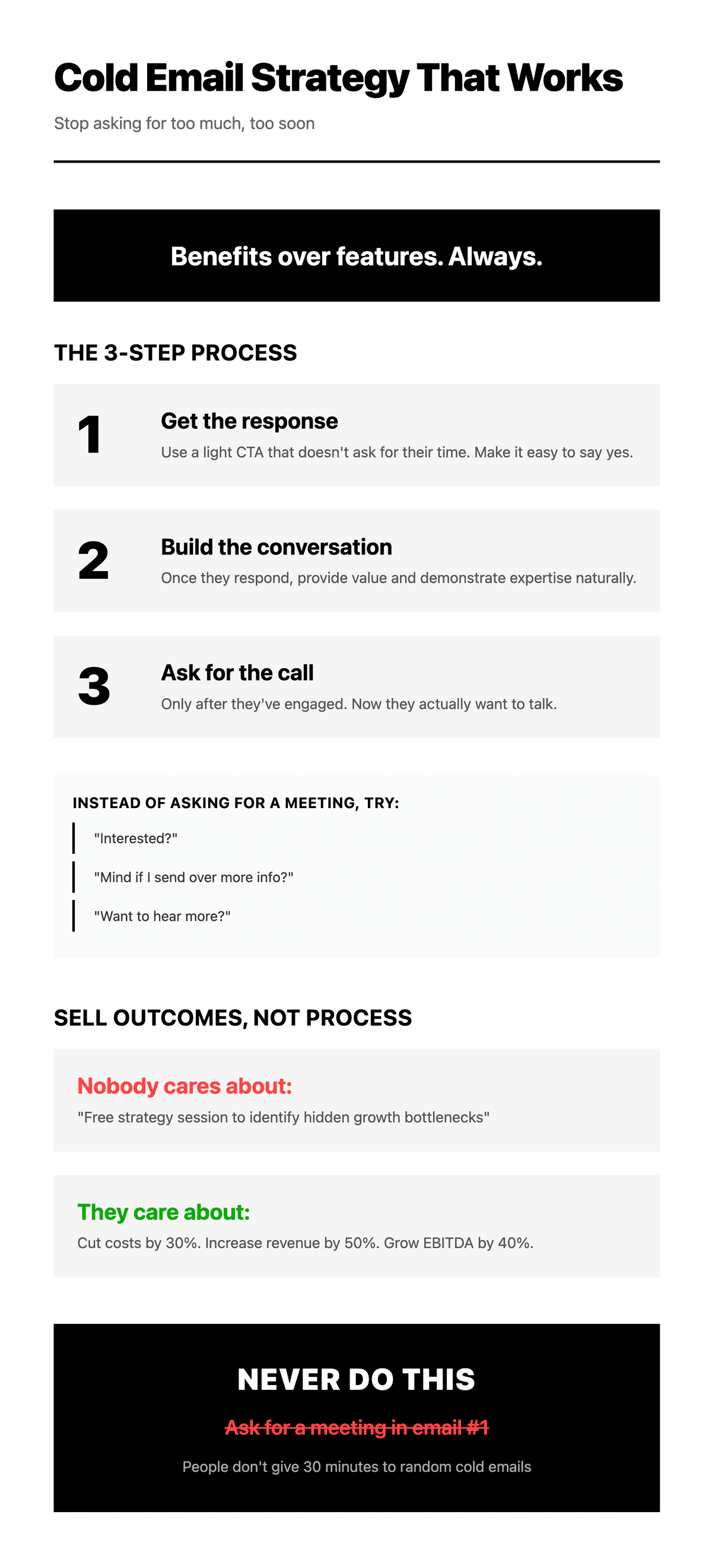
The 3-step cold email strategy prioritizes conversation over immediate meeting requests. Step one uses a low-commitment call-to-action like "Interested?" to start dialogue. Step two delivers promised value and demonstrates expertise through relevant insights. Step three asks for a meeting only after engagement is established. This works because it builds trust incrementally and respects that prospects won't commit time to strangers, resulting in dramatically higher conversion rates than traditional cold emails that request meetings immediately.
Key takeaways
- Cold emails should focus on specific outcomes like "Cut costs by 30%" rather than process-oriented features like "free strategy session" because prospects care about results, not activities.
- The first email's only goal is to get a response using low-pressure questions like "Interested?" or "Mind if I send over more info?" which require minimal commitment.
- The second email should deliver promised value and demonstrate industry expertise without pitching, building credibility before requesting any time commitment.
- Asking for a meeting only after two prior engagements produces remarkably higher conversion rates because prospects are pre-qualified and have already invested attention.
- Trust builds incrementally through small commitments before large ones, making it essential to avoid requesting 30-minute meetings from strangers who aren't actively buying.
Reviewed and updated August 28, 2026
The 3-Step Cold Email Strategy That Actually Gets Responses
Most cold emails fail because they ask for too much, too soon.
You've seen them. Maybe you've even sent them. Those perfectly crafted emails that mention your "free strategy session to identify hidden growth bottlenecks" or your "complimentary consultation to unlock revenue potential."
They sound professional. They feel valuable. And they get ignored.
Here's why: Time is the most valuable resource your prospects have. They're not going to give 30 minutes to someone who cold emailed them ten minutes ago, no matter how compelling your subject line was.
But there's a better way. A strategy that actually works because it respects how people make decisions and build trust. Let me show you.
- Step 1Get the Response
A light call-to-action that doesn't ask for time.
- Step 2Build the Conversation
Deliver on whatever you promised in the first one.
- Step 3Ask for the Call
Only after they've engaged, only after you've demonstrated value.
The Foundation: Benefits Over Features, Always
Before we dive into the three steps, you need to understand the most critical principle of effective cold outreach: Nobody cares about your process. They care about the outcome.
When you write "free strategy session to identify hidden growth bottlenecks," you're selling a feature. You're describing what you'll do. But your prospect doesn't care about the session itself. They care about what comes after.
Instead, lead with the actual outcome. What happens when those bottlenecks are identified and fixed? That's what matters.
Consider these transformations:
- "Free strategy session" becomes "Cut costs by 30%"
- "Revenue optimization consultation" becomes "Increase revenue by 50%"
- "Growth audit" becomes "Grow EBITDA by 40%"
The difference is dramatic. One describes an activity. The other describes a result. In a world where everyone is competing for attention, results win every time.
This changes how you think about your value proposition completely. Understanding your unique value proposition is the foundation of effective cold outreach, but knowing how to communicate it is what separates responses from silence.
Step 1: Get the Response
The first email in your cold outreach sequence has one job: Start the conversation.
That's it. Not book the meeting. Not explain your entire service offering. Not showcase your case studies.
Just get them to respond.
The best cold emails use a light call-to-action that doesn't ask for time. They make it incredibly easy to say yes to something small. Think of it as opening a door rather than asking someone to walk through it immediately.
Here's what this looks like in practice. Instead of "Can we schedule 30 minutes next Tuesday?", try one of these:
"Interested?"
"Mind if I send over more info?"
"Want to hear more?"
These feel conversational. They're low-pressure. Most importantly, they require minimal commitment. Someone can reply "Sure" in five seconds and continue with their day. You've now started a dialogue.
This approach works because it acknowledges a fundamental truth about human behavior: We say yes to small things before we say yes to big things. A reply to your email is a small commitment. A 30-minute meeting is a significant commitment. You can't skip steps.
Step 2: Build the Conversation
Once they respond, now you have permission to provide value and demonstrate expertise naturally.
This is where most people who do get a response blow it. They immediately pivot to "Great! What time works for you?" They treat the reply as a yes to a meeting when it was actually just a yes to continuing the conversation.
Your second email should deliver on whatever you promised in the first one. If you asked "Mind if I send over more info?", now you send that information. But here's the key: Make it valuable. Make it specific to them. Make it demonstrate that you understand their world.
This is where you can share a relevant case study, a specific insight about their industry, or a clear explanation of how the outcome you mentioned actually happens. You're not pitching. You're educating. You're showing expertise without explicitly claiming it.
The goal here is to build credibility and create genuine interest. When someone reads your second email and thinks "This person actually gets it," you've succeeded. When they think "This might be worth exploring further," you're ready for step three.
For companies looking to scale this approach while maintaining quality, scaling personalization becomes crucial. But the principles remain the same: Value first, relevance always, pitching never.
Step 3: Ask for the Call
Only after they've engaged, only after you've demonstrated value, only after they've shown genuine interest: now you ask for their time.
The difference in conversion rates at this stage is remarkable. When someone has already responded to your first email and engaged with your second one, they're pre-qualified. They've shown interest. They've invested attention. They actually want to talk.
Compare this to asking for a meeting in your first email. In that scenario, you're asking a stranger to commit time based on nothing but your claims. In this scenario, you're asking someone who's already engaged with you to take the next logical step in a conversation they've opted into.
"Based on what we've discussed, it sounds like this could be a good fit. Want to jump on a quick call to explore further?"
This isn't pushy. It's natural. It's the logical progression of a conversation that's been building value at each step.
Why This Works: The Psychology Behind the Strategy
This three-step approach succeeds because it aligns with how trust actually builds.
Think about your own behavior. When's the last time you committed to a meeting with someone you'd never interacted with before? Probably never, unless it was a warm introduction or you had a pressing need you were actively trying to solve.
Most prospects aren't in active buying mode when your email lands in their inbox. They might have the problem you solve, but they're not actively researching solutions at that exact moment. Your email is an interruption, not an answer to a question they're asking.
By breaking the process into three steps, you're gradually building a relationship. You're giving them multiple opportunities to assess whether you're credible, whether you understand their challenges, and whether it's worth their time to explore further.
Each step requires a small commitment that leads naturally to the next one. Reply with one word. Read an email with value. Schedule a conversation. The psychological barriers decrease with each step because they've already invested and seen returns on that investment.
Make It Specific: The Secret Ingredient
Throughout all three steps, one principle amplifies your results: Specificity beats generality.
Generic claims get ignored because they could apply to anyone. Specific outcomes get responses because they demonstrate understanding and create believability.
"We help companies grow" lands with a thud. "We've helped three financial services companies reduce customer acquisition costs by 35% in 90 days" demands attention.
The specificity doesn't just make your claims more credible. It also helps prospects self-select. When someone reads a specific outcome and thinks "That's exactly what I need," they're far more likely to respond than if they read a general claim and have to imagine how it might apply to them.
This applies to every element of your cold email strategy. Specific subject lines outperform vague ones. Specific value propositions outperform generic ones. Specific asks outperform open-ended ones.
The best cold emails don't feel like sales pitches because they're too specific to be generic marketing messages. They feel like the start of a conversation worth having because they demonstrate understanding of specific challenges and specific outcomes.
The Common Mistake: Selling the Process
Here's where most cold email strategies fail, even when they follow some version of a multi-step approach.
They sell the process instead of the outcome.
Your prospect doesn't want a strategy session. They want the results that might come from implementing what's discussed in that session. They don't want a demo. They want the efficiency gains that your software might provide. They don't want a consultation. They want the growth that might follow from taking your advice.
Every time you describe what you'll do, you're focusing on the wrong thing. Focus instead on what changes for them after you've done it.
This is particularly important in competitive markets where everyone is offering some version of the same thing. Understanding what makes great cold email copy comes down to this distinction: Features describe you. Benefits describe them.
When your entire cold email strategy is built on outcomes rather than activities, specificity rather than generality, and building conversations rather than pitching meetings, you stop sounding like everyone else. You start sounding like someone worth talking to.
Implementation: What to Do Today
If you're ready to implement this strategy, here's where to start.
First, audit your current cold emails. Count how many bullets points you have. Count how many times you mention what you do versus what changes for your prospect. Count how many ask for a meeting in the first email.
Then rebuild your sequence:
Email 1 should have one clear outcome-focused statement and one low-commitment question. That's it. No three-paragraph explanations of your service. No case study links. No company background. Just outcome and ask.
Email 2 should deliver value. Share something specific. Demonstrate expertise. Make them think "This person understands my world." Still no meeting request.
Email 3 is where you suggest a conversation, but only if they've engaged with email two. If they haven't, you keep providing value until they do.
Remember: You're not being patient. You're being strategic. Every email that focuses on building the relationship instead of closing the meeting is an investment in a higher-quality conversation when that meeting finally happens.
The Results Speak for Themselves
Companies that implement this three-step strategy consistently report dramatic improvements in response rates. More importantly, they report improvements in meeting quality and conversion rates from those meetings.
When someone takes a meeting with you after going through this process, they're more educated, more interested, and more qualified than someone who agreed to a meeting just to get you to stop emailing them.
That difference compounds. Better meetings lead to better close rates. Better close rates lead to better customer fit. Better customer fit leads to better retention. What started as a simple change in cold email strategy becomes a fundamental improvement in the quality of your entire pipeline.
Your Turn
Are you asking for too much in your first email?
Most companies are. They're trying to compress relationship-building into a single message. They're asking strangers for their most valuable resource, time, before earning the right to that ask.
The three-step strategy works because it respects how trust builds and how decisions are made. Get the response. Build the conversation. Ask for the call.
It's simple. It's effective. And it only works if you actually implement it.
Stop asking for meetings in your first email. Start building conversations instead. The meetings will follow, and they'll be better when they do.
If you would rather have this run for you, RevenueFlow books qualified meetings on a pay-per-meeting basis and publishes client results.
Related Reading
Frequently asked questions.
Frequently asked questions- Why do most cold emails that request a free consultation or strategy session get ignored?
- These emails ask for too much too soon by requesting 30 minutes from someone who received the email minutes ago. Time is prospects' most valuable resource, and they won't commit it to strangers regardless of how compelling the offer sounds. The email sells a feature (the session itself) rather than the actual outcome prospects care about, making it easy to ignore.
- What should the first cold email actually ask for instead of a meeting?
- The first email should use a light call-to-action that starts a conversation without requesting time, such as "Interested?", "Mind if I send over more info?", or "Want to hear more?" These conversational, low-pressure questions can be answered in five seconds and acknowledge that people say yes to small commitments before big ones. The goal is simply to get a response, not book a meeting.
- When should you actually ask for a meeting in a cold email sequence?
- Ask for a meeting only in the third email, after the prospect has responded to your first email and engaged with your second one. At this point they're pre-qualified, have shown genuine interest, and have invested attention in the conversation. The conversion rates are remarkably higher because you're asking someone who's already opted into a dialogue to take the next logical step, not asking a stranger to commit time based solely on claims.
- How should you phrase your value proposition in cold emails?
- Lead with specific outcomes rather than describing your process or features. Transform "free strategy session" into "Cut costs by 30%", "revenue optimization consultation" into "Increase revenue by 50%", and "growth audit" into "Grow EBITDA by 40%". Prospects don't care about the session or audit itself: they care about the tangible results that come after. In a world competing for attention, results win over activities every time.
About the author.

Ben Carden is CRO at RevenueFlow, which builds and operates outbound revenue engines for B2B companies. Previously at Gartner Enterprise. Studied at London School of Economics.
Ben Carden · CRO
Connect on LinkedIn →Explore more.
Ready to scale your outreach?
We build GTM engines that book real meetings. See the receipts.
Related articles.
Cold Email Frameworks: Which One Fits Your Offer
AIDA, PAS and Before-After-Bridge arrange the same four elements in different orders. What each one assumes about the reader, and what none of them fix.
QuickMail Pricing: Volume Bands, Not Seat Counts
QuickMail charges on monthly sends and stored contacts rather than seats. The three bands, the missing annual option, and the inbox billing its own pages disagree about.
GMass Mail Merge: Sending Inside Gmail, and What It Costs
GMass runs the merge inside Gmail, which removes every setup step and hands your sending ceiling and your reputation to Google in the same move.
The GMass Extension: What Sending From Your Mailbox Trades
GMass puts the sending layer inside Gmail, which removes the setup and concentrates the risk on your primary domain. When that trade is right, and when it is not.
Mailshake Review: Sends Are Unlimited, Mailboxes Are Not
Mailshake's $49 tier advertises unlimited sends and allows two email addresses. How mailboxes are really bought, and where two vendor pages state the limit differently.
CAN-SPAM Act Compliance for B2B Cold Email: The Rules
The CAN-SPAM Act makes no exception for business-to-business email. Here are the seven requirements, the opt-out clocks, and where liability lands when an agency sends.