Cold Email for Mining: The Complete Guide
A comprehensive guide to cold email outreach for mining industry suppliers and service providers, covering exploration, extraction, processing, and equipment sales with strategies for reaching mining executives and procurement teams.
Cold email works effectively in mining because decision-makers are concentrated among relatively few major producers, operational challenges create constant demand for solutions, projects follow predictable procurement cycles, and geographic remoteness makes direct communication valuable. The industry's technical complexity, long procurement cycles, and safety requirements demand targeted messaging that addresses specific operational challenges, demonstrates technical understanding, and respects the distinct priorities of general managers, procurement teams, technical leaders, and HSE managers.
Key takeaways
- The global mining industry is dominated by a small number of major producers alongside thousands of junior exploration companies, making targeted outreach efficient for reaching significant market share.
- Mining projects move through predictable phases including exploration, feasibility, development, construction, and operations, each with distinct procurement requirements.
- Four key decision-maker roles exist in mining: Mine General Managers who balance production and safety, Procurement Managers who manage supplier relationships, Technical and Engineering Leaders who evaluate equipment based on specifications, and HSE Managers who assess vendors on safety records and environmental compliance.
- Mining operations face constant pressure to improve productivity, reduce costs, ensure worker safety, and minimize environmental impact, creating ongoing demand for new solutions.
- Geographic remoteness of mining operations creates communication barriers that make email a cost-effective way to initiate relationships that would otherwise be prevented by distance.
Reviewed and updated September 15, 2026
Cold Email for Mining: The Complete Guide
The mining industry operates on a scale that few other sectors can match. Single projects involve billions of dollars in capital expenditure, span decades of operation, and require coordination among hundreds of suppliers and service providers. For companies serving the mining sector, the ability to reach decision-makers directly can determine whether you participate in major projects or remain invisible to the buyers who matter.
Cold email has proven remarkably effective in mining industry business development. Despite the industry's reputation for conservative purchasing practices and long-established supplier relationships, mining companies actively seek new vendors who can solve specific technical challenges, reduce operational costs, or improve safety outcomes.
This guide provides a comprehensive framework for implementing cold email campaigns that generate qualified opportunities within the mining industry.
Why Cold Email Works for Mining
The mining industry's unique characteristics create favorable conditions for cold email outreach.
Decision-makers are concentrated. The global mining industry is dominated by a relatively small number of major producers (Rio Tinto, BHP, Vale, Glencore, Anglo American, and others) along with thousands of junior exploration and development companies. This concentration means targeted outreach can efficiently reach significant market share.
Operational challenges drive vendor searches. Mining operations face constant pressure to improve productivity, reduce costs, ensure worker safety, and minimize environmental impact. These challenges create ongoing demand for new solutions and technologies.
Projects have defined procurement cycles. Major mining projects move through predictable phases (exploration, feasibility, development, construction, operations) with distinct procurement requirements at each stage. Cold email can reach buyers precisely when their needs emerge.
Trade publications and conferences have limitations. While industry events and publications remain important, they provide passive exposure rather than direct engagement. Cold email supplements these channels by initiating targeted conversations.
Geographic remoteness creates communication barriers. Many mining operations exist in remote locations where face-to-face business development is impractical. Email provides a cost-effective way to initiate relationships that geography would otherwise prevent.
Understanding Mining Industry Buyers

Effective cold email requires understanding the distinct roles, priorities, and decision-making patterns of mining industry buyers.
Mine General Managers and Site Leaders
General managers bear overall responsibility for mining operations, balancing production targets, cost control, safety performance, and environmental compliance. They evaluate vendors based on track record, reliability, and alignment with operational priorities.
What they value: Proven performance in similar operations, minimal implementation risk, strong safety records, and vendor responsiveness to operational issues.
Communication preferences: Site leaders prefer concise communications that respect their time constraints. They respond to emails that demonstrate understanding of operational realities and offer clear value propositions.
Decision-making patterns: General managers often delegate initial vendor evaluation to functional managers but remain involved in decisions affecting safety, major capital expenditure, or operational continuity.
Procurement and Supply Chain Managers
Procurement professionals in mining manage complex supplier relationships across multiple categories: equipment, consumables, services, and capital projects. They balance cost optimization with supply security and operational risk management.
What they value: Competitive pricing, supply reliability, quality consistency, favorable payment terms, and simplified supplier management.
Communication preferences: Procurement managers respond to emails that address specific category needs and demonstrate understanding of mining-specific procurement challenges.
Decision-making patterns: Procurement teams typically manage formal RFQ processes for significant purchases while maintaining authority over smaller discretionary purchases and approved vendor lists.
Technical and Engineering Leaders
Chief engineers, technical services managers, and specialized engineering roles evaluate equipment and services based on technical merit, operational fit, and alignment with mining plans.
What they value: Technical specifications, performance data, integration capabilities, maintenance requirements, and proven performance in similar applications.
Communication preferences: Technical buyers appreciate substantive content and specific data. They respond to emails that demonstrate genuine technical understanding rather than generic sales messaging.
Decision-making patterns: Engineering leaders provide technical approval for vendor selection and often drive requirements definition for major purchases.
Health, Safety, and Environment (HSE) Managers
HSE professionals evaluate vendors based on safety records, environmental compliance, and alignment with corporate sustainability commitments. Their approval is often required before new vendors can work on site.
What they value: Strong safety records, environmental certifications, compliance documentation, and demonstrated commitment to responsible mining practices.
Communication preferences: HSE managers respond to emails that acknowledge safety and environmental priorities as genuine concerns rather than checkbox requirements.
Decision-making patterns: HSE approval is typically required for contractors working on site and for products that affect worker safety or environmental performance.
Mining Industry Challenges in Cold Email Outreach
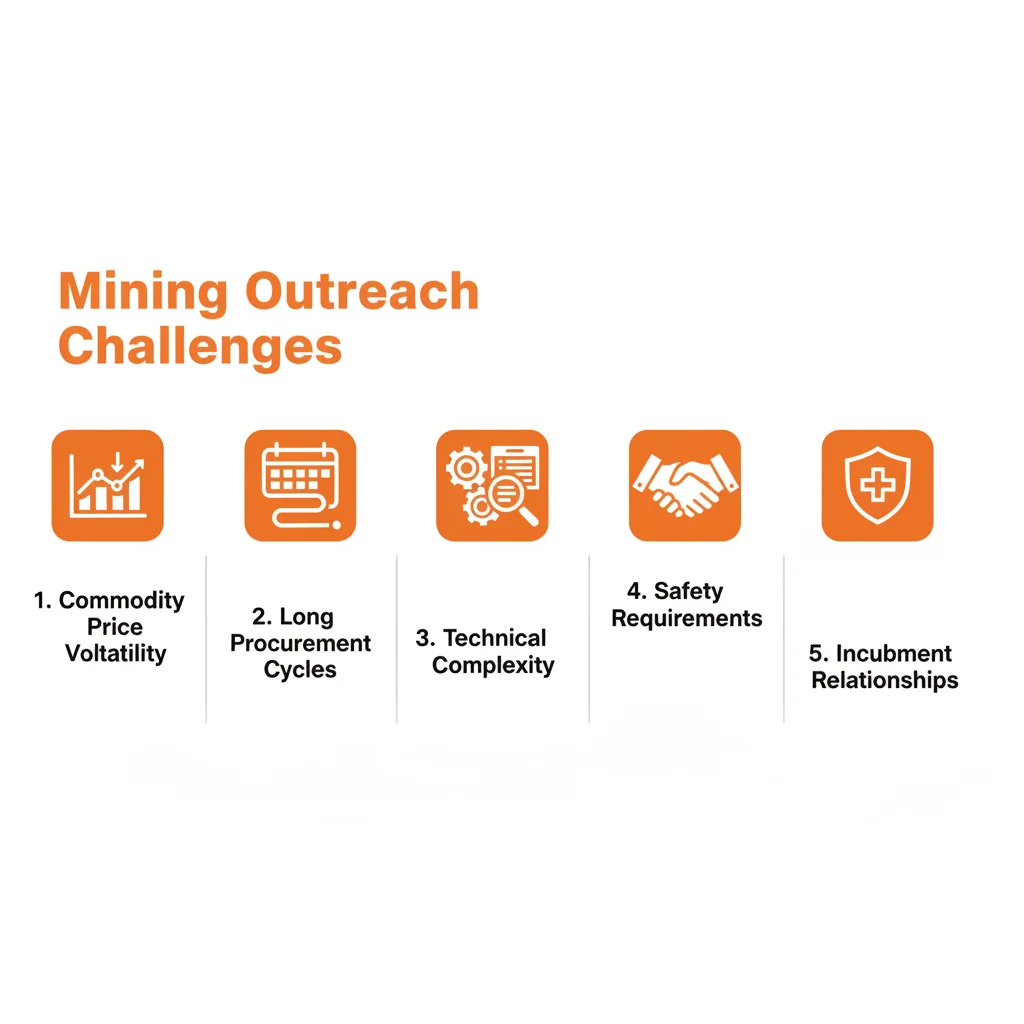
Cold email in mining faces unique obstacles that require strategic responses.
Challenge 1: Commodity Price Volatility
Mining investment fluctuates significantly with commodity prices. During downturns, procurement freezes and capital project delays can extend for years. During upturns, urgent needs create rapid procurement cycles.
Strategic response: Align outreach timing with commodity market conditions and individual company circumstances. Monitor production guidance, capital expenditure announcements, and project development news to identify companies with active procurement needs.
Practical application: Track commodity price trends and mining company announcements. Increase outreach intensity when conditions favor procurement activity. During downturns, focus on cost reduction and efficiency messaging rather than growth-oriented proposals.
- urgent needs create rapid procurement cycles
- Increase outreach intensity when conditions favor procurement activity
- procurement freezes and capital project delays can extend for years
- focus on cost reduction and efficiency messaging rather than growth-oriented proposals
Challenge 2: Long Procurement Cycles
Major equipment purchases and service contracts in mining often involve extended evaluation periods, formal tender processes, and multi-level approval requirements.
Strategic response: Design cold email campaigns for relationship building and vendor qualification rather than immediate sales. Early engagement positions your company for inclusion in future tender processes.
Practical application: Plan 12-24 month engagement sequences that build awareness and establish credibility. Focus initial outreach on earning opportunities to demonstrate capabilities rather than securing immediate orders.
Challenge 3: Technical Complexity and Specification Requirements
Mining equipment and services must meet demanding specifications for durability, performance in harsh environments, and integration with existing systems.
Strategic response: Demonstrate technical credibility through specific performance data, relevant certifications, and reference installations in comparable mining environments.
Practical application: Reference specific operating conditions you can support (temperature ranges, altitude, dust exposure, etc.) and certifications relevant to mining applications (MSHA, ISO standards, OEM approvals).
Challenge 4: Safety and Compliance Requirements
Mining operations maintain rigorous safety and environmental standards. Vendors must demonstrate alignment with these requirements to gain site access and procurement consideration.
Strategic response: Proactively address safety credentials in cold email communications. Highlight relevant certifications, safety records, and experience working within mining safety management systems.
Practical application: Include safety statistics (TRIFR, LTI rates) in your signature block. Reference relevant safety certifications and training programs. Acknowledge the priority of safety in your value proposition.
Challenge 5: Incumbent Vendor Relationships
Mining companies often maintain long-term relationships with established suppliers. These relationships represent significant switching barriers for new vendors.
Strategic response: Position as a complement or alternative source rather than a replacement for existing vendors. Emphasize specific capabilities or value propositions that differentiate from incumbents.
Practical application: Acknowledge that mining companies maintain valued supplier relationships. Focus messaging on specific gaps or opportunities that existing suppliers may not address effectively.
Cold Email Best Practices for Mining
Effective mining industry cold emails combine sector knowledge with proven outreach principles.
Subject Lines That Get Opened
Mining professionals receive fewer sales emails than their counterparts in technology or financial services, but they are equally protective of their time. Subject lines must quickly establish relevance.
Effective approaches:
- Reference specific operational challenges: "Reducing haul truck tire costs in open pit operations"
- Mention relevant commodities or mining methods: "Flotation circuit optimization for copper sulfide ores"
- Highlight safety or environmental benefits: "Dust suppression solution with 40% water reduction"
- Connect to known projects or expansions: "Equipment availability for [Region] greenfield developments"
Approaches to avoid:
- Generic capability claims: "Industry-leading mining solutions"
- Urgency tactics: "Limited time offer on mining equipment"
- Vague value propositions: "Partnership opportunity in mining"
- Questions that feel manipulative: "Are you satisfied with your current supplier?"
Email Copy Structure
Mining cold emails should follow clear structures that establish credibility, communicate specific value, and provide paths to continued engagement.
Opening statement: Reference a specific challenge, project, or shared connection that establishes relevance to the recipient's operation.
Credibility establishment: Within the first few sentences, establish why your company deserves attention. Include specific project experience, relevant certifications, or reference installations at comparable operations.
Value proposition: Clearly state what you offer and why it matters to mining operations. Focus on outcomes (productivity improvement, cost reduction, safety enhancement) rather than feature lists.
Call to action: Request a specific, appropriate next step. For mining, this often means a technical discussion, site visit opportunity, or capability presentation.
Signature: Include relevant certifications, safety credentials, and professional affiliations in your signature block.
Timing Considerations
Mining cold email timing should align with industry cycles and company-specific circumstances.
Optimal timing:
- Following production reports or earnings announcements that indicate investment capacity
- During annual budgeting cycles (typically Q4 for calendar-year companies)
- After project approvals or expansion announcements
- Following industry conferences where your company exhibited or presented
- When commodity prices support investment activity
Timing to avoid:
- During active production crises or safety incidents
- Immediately following major layoff announcements
- During known blackout periods around tender processes you wish to participate in
Sample Cold Emails for Mining
The following examples demonstrate effective cold email approaches for different mining industry scenarios.
Example 1: Equipment Supplier to Mine General Manager
Subject: Haul truck availability for [Mine Name] fleet expansion
Body:
I noticed [Company] announced plans to expand production at [Mine Name], which typically requires additional haulage capacity.
[Your Company] manufactures ultra-class haul trucks deployed at over 40 open pit operations worldwide, including [similar climate/commodity operations]. Our trucks deliver [specific efficiency metric] compared to industry averages, with maintenance intervals extended to [hours/km].
We currently have production slots available for delivery in [timeframe] that could align with your expansion timeline.
Would a conversation make sense to discuss your fleet requirements and how our equipment might support [Mine Name] expansion plans?
Best regards, [Name] [Title] [Company] ISO 9001 Certified | [Safety Certification]
Example 2: Service Provider to Procurement Manager
Subject: Contract mining services for [Region] operations
Body:
Many procurement managers I work with in [Region] mention challenges securing reliable contract mining services as project activity increases across the region.
[Your Company] provides contract mining services with a fleet of [equipment types] and a workforce of [number] experienced operators. We currently support [number] operations in [Region] and maintain capacity to take on additional work.
Our safety record includes [TRIFR/LTI statistics], and we hold [relevant certifications] for surface and underground operations.
I would welcome the opportunity to discuss how we might support [Company]'s mining operations. Would a brief call next week work to explore this?
Best regards, [Name] [Title] [Company] MSHA Certified | ISO 45001 Compliant
Example 3: Technology Provider to Technical Services Manager
Subject: Real-time ore grade analysis for [mining method] operations
Body:
Grade control remains one of the most significant value drivers in [commodity] mining, yet many operations still rely on delayed assay results that limit real-time decision making.
[Your Company] provides sensor-based ore sorting and grade analysis systems deployed at over 25 [commodity] operations globally. Our technology enables real-time grade determination with [accuracy metric] correlation to laboratory assays.
Typical deployments achieve [percentage] improvement in metal recovery and [percentage] reduction in processing of sub-economic material.
Would you be interested in a technical overview of how our systems might apply to [Company]'s operations?
Best regards, [Name] [Title] [Company]
Example 4: Environmental Services Provider to HSE Manager
Subject: Tailings management solutions for [Company] operations
Body:
Tailings management has become a board-level priority for mining companies following recent industry incidents. Many HSE leaders I work with seek additional assurance around tailings facility performance and monitoring.
[Your Company] provides tailings monitoring and management services, including [specific services]. We currently support tailings facilities at [number] operations across [regions], helping clients maintain compliance and demonstrate due diligence to stakeholders.
Our team includes [credentials of key personnel] with experience at operations similar to those in [Company]'s portfolio.
Would a conversation about tailings management practices be valuable? I am happy to share insights from our work with similar operations.
Best regards, [Name] [Title] [Company] [Relevant Certifications]
Building Your Mining Cold Email Program
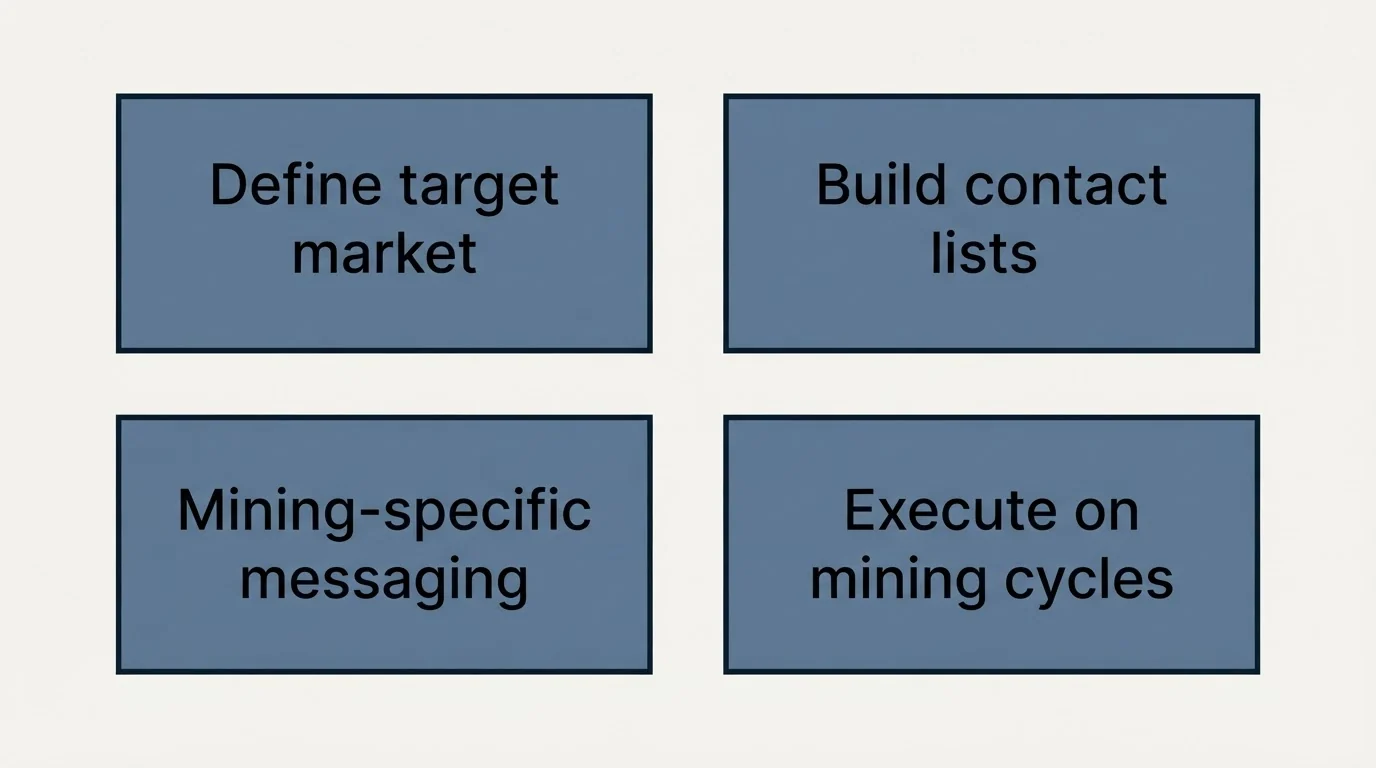
Implementing an effective mining cold email program requires systematic approach to targeting, messaging, and execution.
Step 1: Define Your Target Market
Clearly identify which mining companies represent your best opportunities based on commodity focus, geographic presence, production scale, and current investment activity.
Segmentation considerations:
- Commodity type (gold, copper, iron ore, coal, etc.)
- Mining method (open pit, underground, in-situ)
- Company size and ownership structure
- Geographic locations and operating regions
- Project phase (exploration, development, operations)
- Current investment and expansion activity
Step 2: Build Targeted Contact Lists
Mining industry contacts can be identified through multiple sources, including company websites, LinkedIn, industry directories, and conference attendee lists.
High-value contact sources:
- Mining company organizational announcements
- LinkedIn searches filtered by company and function
- Industry association member directories
- Conference speaker and attendee lists
- Trade publication editorial contacts
Verification requirements:
- Confirm current employment and role
- Validate email addresses before sending
- Verify relevance to your offering
Step 3: Develop Mining-Specific Messaging
Create email sequences that demonstrate genuine understanding of mining operations and offer specific value to recipients.
Message development guidelines:
- Reference specific commodities, mining methods, or operational challenges
- Include quantified performance claims supported by evidence
- Acknowledge safety and environmental priorities
- Offer technical resources as engagement mechanisms
Step 4: Execute with Mining Cycles in Mind
Time campaign execution to align with industry and company-specific cycles.
Execution considerations:
- Monitor commodity prices and industry news
- Track individual company announcements
- Align outreach with budgeting and planning cycles
- Coordinate with industry event schedules
Mining Cold Email Checklist
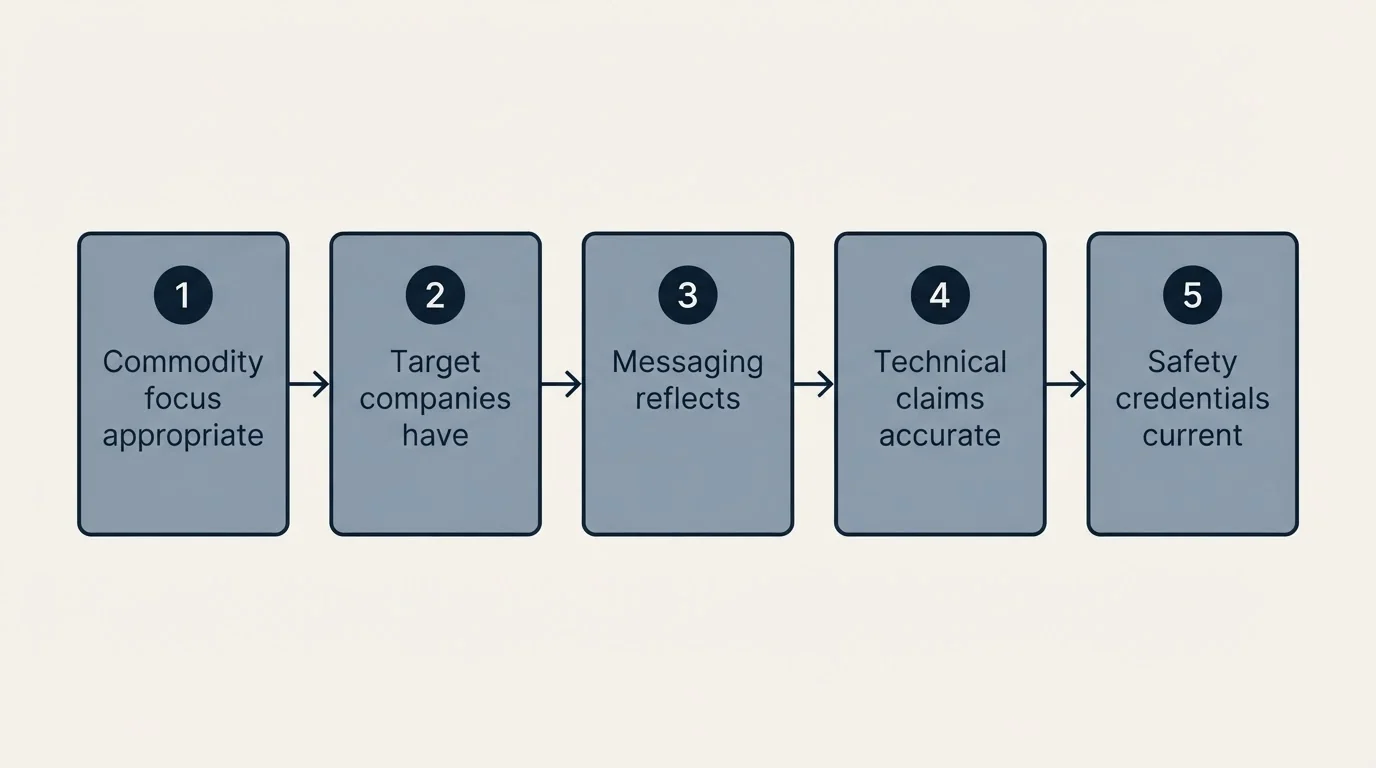
Before launching mining industry cold email campaigns, verify the following:
Industry alignment:
- Commodity focus appropriate for current market conditions
- Target companies have active procurement needs
- Messaging reflects understanding of mining operations
- Technical claims accurate and supportable
Compliance and credibility:
- Safety credentials current and highlighted
- Relevant certifications included
- Reference customers appropriate to mention
- Claims verified for accuracy
Targeting accuracy:
- Decision-maker titles confirmed
- Company fit verified
- Email addresses validated
- Geographic targeting appropriate
Message quality:
- Subject line specific to mining challenges
- Opening establishes operational relevance
- Value proposition quantified where possible
- Call to action appropriate for mining buying cycles
- Safety and environmental awareness demonstrated
Technical setup:
- Email authentication configured
- Reply handling process established
- Follow-up sequences prepared
- CRM tracking functional
Getting Started with Mining Cold Email
The mining industry offers significant opportunities for suppliers and service providers who understand how to navigate its unique characteristics. Cold email provides a direct channel to reach mining decision-makers who may be underserved by traditional marketing approaches.
Success requires patience to accommodate extended procurement cycles, technical credibility to earn consideration from engineering-driven buyers, and ongoing attention to industry conditions that affect procurement activity.
RevenueFlow specializes in cold email campaigns for mining industry suppliers and service providers. Our team understands the procurement dynamics, technical requirements, and relationship-building timelines that drive success in mining business development.
Get your free cold email campaign and start reaching mining industry decision-makers →
Related Reading
Frequently asked questions.
Frequently asked questions- Why does cold email work for mining companies?
- Cold email works in mining because the industry has concentrated decision-makers among major producers, ongoing operational challenges that drive vendor searches, and predictable procurement cycles tied to project phases. Geographic remoteness of many mining operations makes email practical where face-to-face contact isn't feasible. Mining companies actively seek vendors who can solve technical challenges, reduce costs, or improve safety outcomes, making direct outreach effective despite conservative purchasing practices.
- Who are the main decision-makers in mining procurement?
- Mining procurement involves four key decision-maker types: Mine General Managers who oversee operations and prioritize proven performance and safety; Procurement and Supply Chain Managers who balance cost optimization with supply reliability; Technical and Engineering Leaders who evaluate equipment based on specifications and performance data; and HSE Managers who assess vendors on safety records and environmental compliance. Each role has distinct priorities and communication preferences that effective cold email must address.
- What do procurement managers in mining care about most?
- Procurement managers in mining prioritize competitive pricing, supply reliability, quality consistency, favorable payment terms, and simplified supplier management. They manage complex supplier relationships across equipment, consumables, services, and capital projects while balancing cost optimization with supply security and operational risk. They typically oversee formal RFQ processes for significant purchases while maintaining authority over smaller discretionary purchases and approved vendor lists.
- How do technical leaders in mining evaluate vendors?
- Technical and engineering leaders in mining evaluate vendors based on technical specifications, performance data, integration capabilities, maintenance requirements, and proven performance in similar applications. They appreciate substantive content and specific data rather than generic sales messaging. These buyers provide technical approval for vendor selection and often drive requirements definition for major purchases, making their evaluation critical to vendor success.
About the author.

Fernando Cao is CEO at RevenueFlow, which builds and operates outbound revenue engines for B2B companies. Previously at Accenture Strategy. Studied at University of Bath.
Fernando Cao · CEO
Connect on LinkedIn →Explore more.
Ready to scale your outreach?
We build GTM engines that book real meetings. See the receipts.
Related articles.
Cold Email for Maintenance Services: The Complete Guide
A comprehensive guide to cold email outreach for commercial maintenance companies, covering how to reach facility managers, property managers, and operations directors with messaging that wins preventive maintenance and repair contracts.
Cold Email for Staffing Agencies: The Complete Guide
A comprehensive guide to cold email outreach for staffing and temp agencies, covering how to reach HR directors, hiring managers, and operations leaders with messaging that wins temporary staffing, contract placement, and direct hire business.
Cold Email for Telecom: Reaching Carriers and MSPs
Telecom companies face rapid technology changes and competitive pressures. Here's how to approach cold email outreach to carriers, MSPs, and UCaaS providers.
Cold Email for Electronics Companies: The Complete Guide
A comprehensive guide to cold email outreach for electronics manufacturers, component suppliers, and EMS providers, covering buyer personas, OEM relationships, contract manufacturing, and proven strategies for reaching engineers, procurement managers, and supply chain leaders.
Cold Email for Security Services: The Complete Guide
A comprehensive guide to cold email outreach for security service providers, covering how to reach facility managers, corporate security directors, and property managers with messaging that builds trust and wins contracts.
Cold Email for Cloud Services: The Complete Guide
Learn how to effectively reach decision-makers at cloud service providers and enterprises adopting cloud infrastructure. This guide covers targeting strategies, technical credibility, and email templates for the cloud services industry.