Cold Email for Partnerships: Building Relationships
Learn how to use cold email to build strategic partnerships, from identifying the right partners to crafting compelling outreach that gets responses from business development leaders.
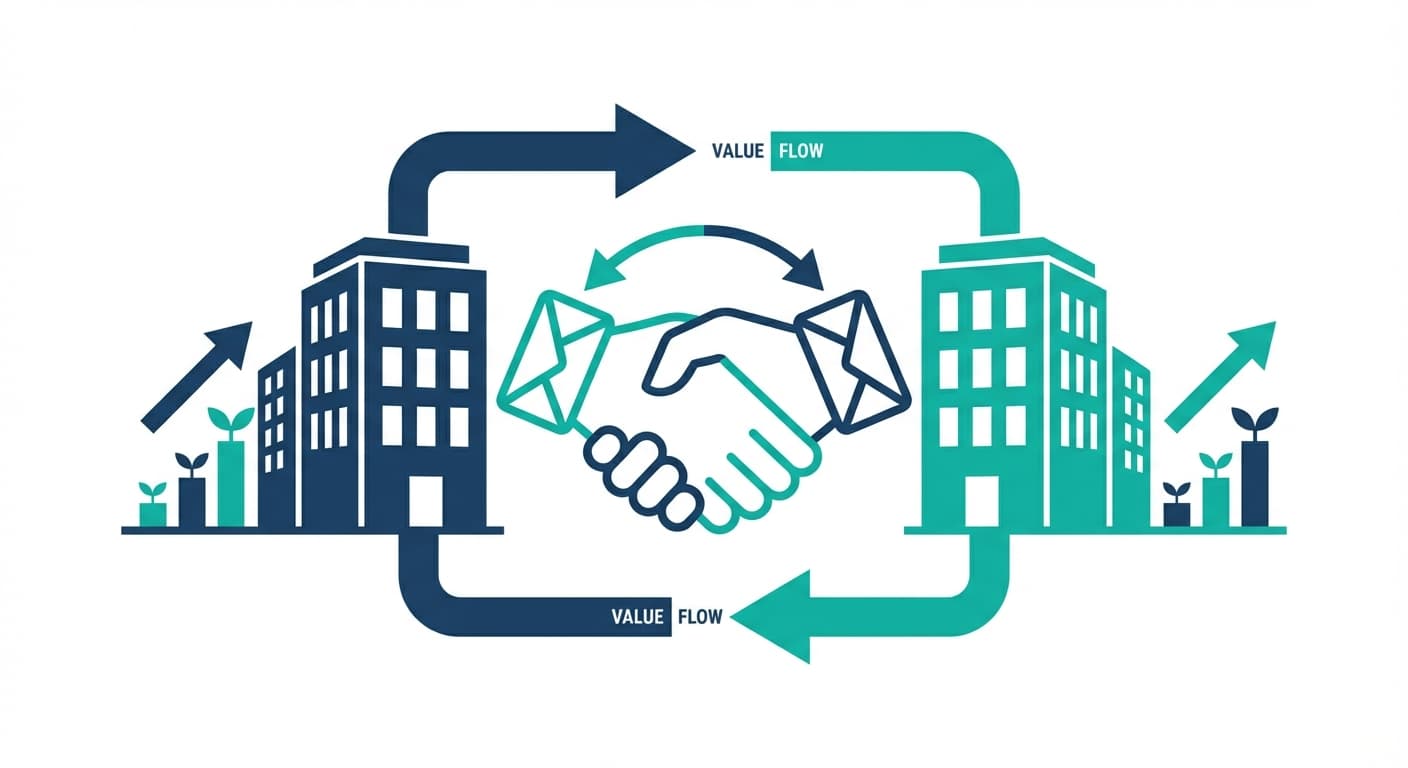
Cold email works effectively for partnership outreach because it proposes mutual value creation rather than requesting budget. Target titles like Director of Partnerships, VP of Business Development, or Head of Alliances depending on company size. Successful partnership emails lead with the partner's goals, quantify the opportunity with specific metrics, demonstrate strategic fit through research, and avoid sales language. The five main partnership types are integration, co-marketing, reseller/referral, strategic/go-to-market, and distribution partnerships.
Key takeaways
- Partnership decision-makers typically have more accessible inboxes than sales targets because they receive fewer relevant opportunities daily.
- At companies under 100 employees, founders or CEOs often handle partnership discussions directly and can move quickly on opportunities.
- At mid-market companies with 100-1000 employees, Directors or VPs of Business Development specifically own partnership evaluation and execution.
- Partnership emails trigger different mental processes than sales emails: recipients think about growth opportunities and strategic alignment rather than budget and procurement.
- The five main partnership categories are integration partnerships, co-marketing partnerships, reseller and referral partnerships, strategic or go-to-market partnerships, and distribution partnerships.
Reviewed and updated September 15, 2026
Cold Email for Partnerships: Building Strategic Business Relationships
A single strategic partnership can transform your business trajectory faster than months of traditional sales efforts. When Slack partnered with Salesforce for their initial CRM integration, it opened doors to thousands of enterprise accounts overnight. When Stripe integrated with Shopify, both companies expanded their reach exponentially. These partnerships started somewhere, and more often than you might expect, that somewhere was an outbound email.
Cold email remains one of the most effective channels for initiating partnership conversations. Unlike sales outreach where you're asking for budget, partnership emails propose mutual value creation. This fundamental difference changes everything about how recipients perceive and respond to your message.
A collaboration email is the same message under a different name, and everything below applies to writing one: name the partnership type, lead with what the other side gains, and ask for a single specific next step.
Why Cold Email Works for Partnerships
Partnership outreach through cold email succeeds for several key reasons that distinguish it from other outreach types.
Lower perceived risk than sales emails. When someone receives a sales email, they immediately think about budget, procurement processes, and whether they need what you're selling. Partnership emails trigger different mental processes. Recipients think about growth opportunities, competitive advantages, and strategic alignment. The conversation starts from a place of possibility rather than defense.
- they immediately think about budget, procurement processes, and whether they need what you're selling
- Recipients think about growth opportunities, competitive advantages, and strategic alignment
- The conversation starts from a place of possibility rather than defense
Decision makers are accessible. Business development and partnership leaders often have more accessible inboxes than sales targets. A VP of Sales at a Fortune 500 company might receive hundreds of pitches daily. The Director of Partnerships at that same company likely sees far fewer relevant opportunities in their inbox, making your well-crafted email more likely to stand out.
Mutual benefit changes the dynamic. Cold emails proposing genuine mutual value naturally receive warmer responses. You're not asking someone to spend money or change their workflow. You're offering to help them hit their partnership KPIs while achieving your own business objectives.
Partnerships compound over time. Unlike one-time sales transactions, partnerships create ongoing value. A single successful partnership email can lead to years of revenue, co-marketing opportunities, and expanded market reach. This ROI makes the effort of crafting excellent partnership outreach worthwhile.
Who to Target for Partnership Outreach
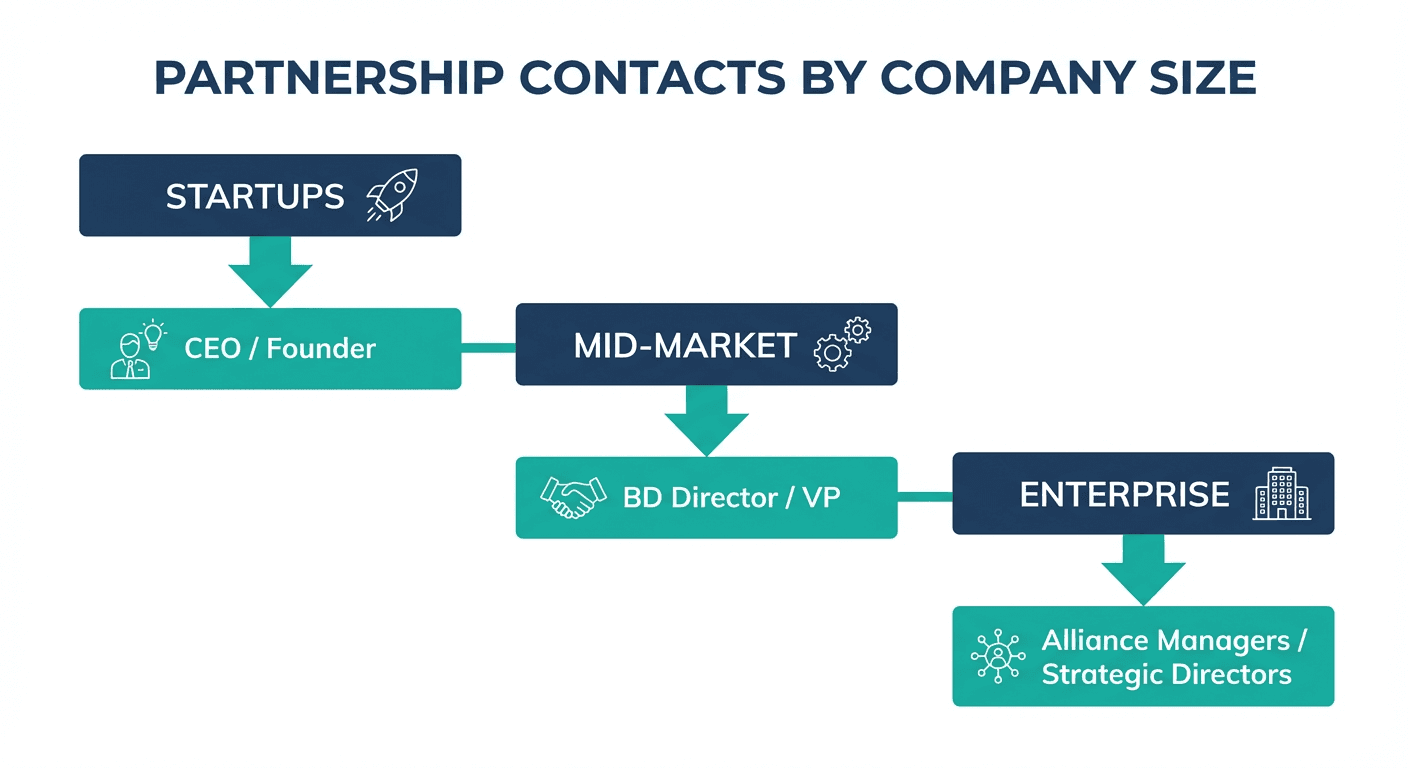
Identifying the right contact at potential partner organizations dramatically impacts your success rate. The ideal target varies based on company size and partnership type.
At Startups and Small Companies (Under 100 employees)
CEO or Founder: At early-stage companies, founders often handle partnership discussions personally. They have the authority to move quickly and the vision to see strategic alignment.
Head of Growth or Marketing: In growth-focused startups, marketing leaders frequently own partnership initiatives, especially for co-marketing and integration partnerships.
At Mid-Market Companies (100-1000 employees)
Director or VP of Business Development: These roles exist specifically to evaluate and execute partnership opportunities. They understand partnership economics and can champion deals internally.
Head of Partnerships or Alliances: Companies at this stage often have dedicated partnership roles. These individuals have KPIs tied to new partnership development.
Product Managers (for integration partnerships): When proposing technical integrations, product managers can assess feasibility and advocate for prioritization.
At Enterprise Organizations (1000+ employees)
Partnership or Alliance Managers: Large companies have entire teams dedicated to partnerships. Target the manager responsible for your category or region.
Senior Directors or VPs of Strategic Partnerships: For significant partnership proposals, reaching senior leadership ensures your opportunity gets appropriate attention.
Corporate Development (for larger strategic deals): When proposing partnerships with M&A potential or significant revenue implications, corporate development teams may be appropriate contacts.
Finding the Right Contacts
Use LinkedIn Sales Navigator to identify partnership-focused roles at target companies. Search for titles including "partnerships," "business development," "alliances," "strategic relationships," or "ecosystem." Review company announcements about recent partnerships to identify who led those initiatives. Check if the company has a partner program page listing a contact or application process.
Types of Partnerships to Pursue
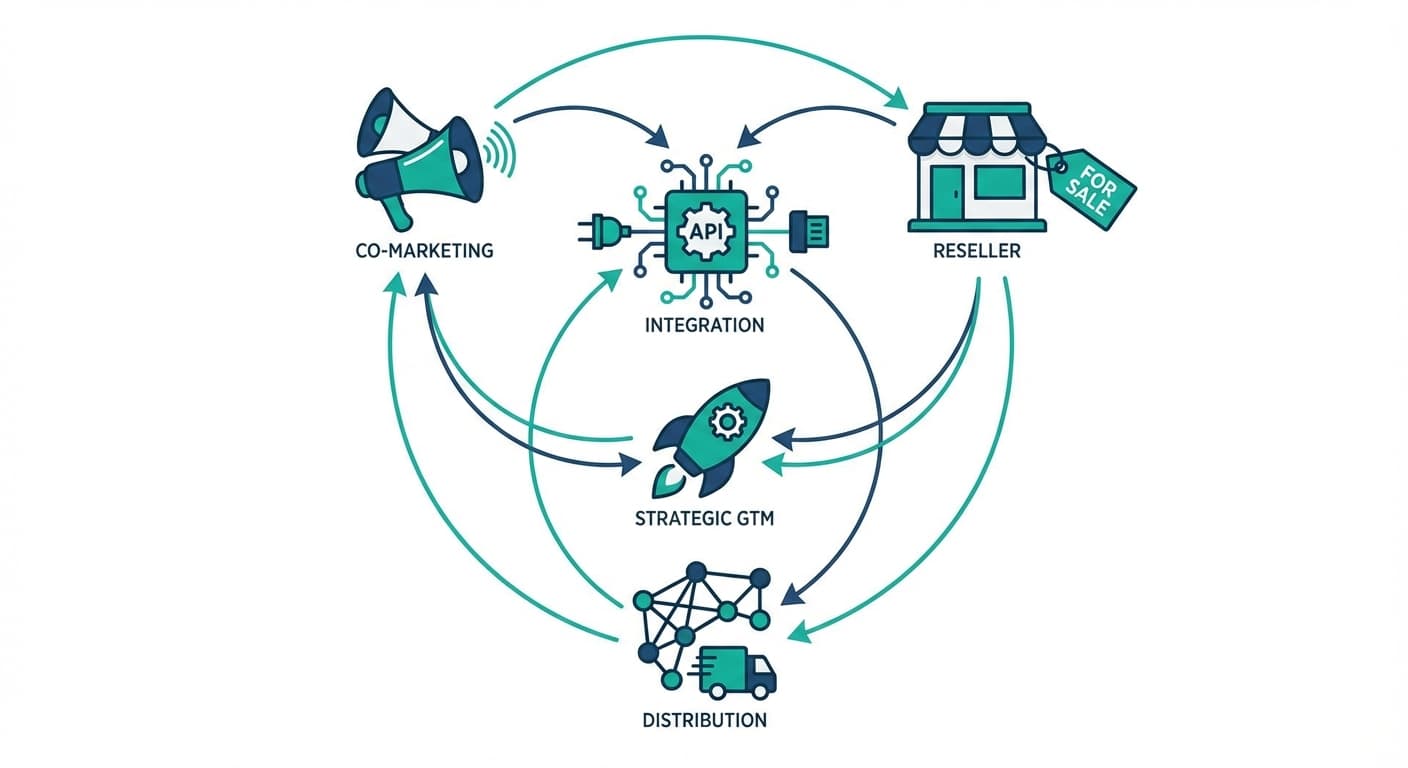
Different partnership types require distinct outreach approaches. Understanding the category helps you tailor your value proposition appropriately.
Integration Partnerships
Technical integrations connect your product with complementary tools your customers already use. These partnerships create product stickiness for both parties and expand functionality without development investment.
Best for: SaaS companies, API-based products, platforms with extensible architecture
Value proposition focus: Shared customer base, technical feasibility, customer demand signals
Co-Marketing Partnerships
Joint marketing initiatives allow partners to reach each other's audiences through webinars, content collaboration, email swaps, or joint campaigns.
Best for: Companies with similar target audiences but non-competing products
Value proposition focus: Audience overlap, content assets, marketing reach metrics
Reseller and Referral Partnerships
Channel partnerships where one company sells or refers the other's product, typically with revenue sharing arrangements.
Best for: Products that complement existing sales motions, tools with strong referral potential
Value proposition focus: Commission structure, sales enablement support, customer fit
Referral partners are the lightest version of this and the one most often written badly, because the proposal is small enough to feel like it needs no work. It does. The message has to name which of their clients you would be useful to, specifically enough that they can picture one, since a partner cannot refer into a description they have to translate first. It has to say what happens after the introduction, because the risk they are weighing is their own relationship rather than your product. And it has to state the commercial shape plainly rather than deferring it to a call, since a partner deciding whether to spend a relationship on you is making a commercial decision at exactly that moment.
Strategic or Go-to-Market Partnerships
Broader collaborations involving joint solutions, bundled offerings, or coordinated market approaches.
Best for: Companies pursuing enterprise markets, products with strong synergy potential
Value proposition focus: Market opportunity, competitive positioning, executive alignment
Distribution Partnerships
Arrangements where one company provides access to customers or channels the other lacks.
Best for: Companies entering new markets, products seeking rapid scale
Value proposition focus: Market access, customer reach, operational support
What Works: Partnership Email Best Practices
Effective partnership outreach differs from sales emails in important ways. These best practices will improve your response rates.
Lead with Their Goals
Research your target's partnership priorities before writing. Review their existing partnerships, press releases about strategic initiatives, and any partner program documentation. Reference specific goals or challenges they've publicly discussed.
Quantify the Opportunity
Partnership leaders think in terms of revenue potential, customer reach, and strategic value. Include relevant metrics like your customer base size, overlap potential, or market data that demonstrates opportunity scale.
Demonstrate Strategic Fit
Explain why your companies make sense as partners beyond generic synergy claims. Reference specific customer overlaps, complementary capabilities, or market positioning that creates natural alignment.
Make the Next Step Easy
Partnership discussions involve multiple stakeholders and extended timelines. Propose a simple first step like a 20-minute exploratory call rather than asking for commitment to a partnership.
Show You've Done Your Homework
Reference their existing partnerships, recent company news, or specific product capabilities. Generic outreach suggesting you haven't researched them signals low-quality partnership potential.
Keep Initial Emails Concise
Save detailed partnership proposals for follow-up conversations. Initial outreach should establish relevance and interest, not negotiate terms.
Real Partnership Cold Email Examples
These templates demonstrate effective partnership outreach across different scenarios. Customize them based on your specific situation and research.
Example 1: Integration Partnership Proposal
Subject: Integration opportunity: [Your Company] + [Their Company]
Hi [Name],
I lead partnerships at [Your Company], where we help [brief description of what you do] for [target customer type]. We currently serve [X customers/users] including [notable customer if relevant].
I've noticed significant overlap between our customer bases. [X number] of our customers also use [Their Product], and we regularly receive requests for a native integration.
An integration would allow our mutual customers to [specific benefit]. Based on our customer data, we estimate this could drive [specific metric] for both products.
Would you be open to a 20-minute call to explore whether an integration makes sense? I can share our technical documentation and customer research in advance.
Best, [Your name]
Example 2: Co-Marketing Partnership
Subject: Co-marketing idea for [Their Company]
Hi [Name],
I came across your recent [webinar/report/content piece] on [topic] and thought it was excellent. The insights about [specific point] particularly resonated with our audience.
I run marketing at [Your Company]. We help [target audience] with [your value proposition] and have built an engaged community of [X subscribers/followers/users].
I see a strong opportunity for co-marketing collaboration. Our audiences share similar challenges around [common challenge], and we could create valuable content together without competing for the same budget.
Some ideas: joint webinar on [topic], co-authored research report, or a content swap to our respective newsletters.
Would you be interested in exploring this? Happy to share audience demographics and past co-marketing results.
[Your name]
Example 3: Reseller Partnership Proposal
Subject: Channel partnership opportunity
Hi [Name],
Your team at [Their Company] has built an impressive client base in [industry/segment]. I've been following your growth and particularly noted [specific achievement or client win].
I lead channel partnerships at [Your Company]. Our [product/service] helps [target customers] achieve [outcome], and I believe it would complement your existing offerings well.
Several companies similar to yours have built meaningful revenue streams by reselling our solution. Partners typically see [X% margins] and benefit from [key support you provide].
The fit seems strong because your clients likely face [challenge your product solves], which you could now address without building the capability in-house.
Would you have 15 minutes to discuss whether a reseller arrangement makes sense for [Their Company]?
[Your name]
Example 4: Strategic Partnership Introduction
Subject: Strategic partnership exploration
Hi [Name],
Congratulations on [recent company news]. The expansion into [market/segment] represents an exciting opportunity.
I'm reaching out because I believe [Your Company] could accelerate that initiative. We've built [brief description of relevant capability] and currently work with [relevant customers] in exactly the space you're entering.
Rather than competing for the same customers, I see potential for a joint go-to-market approach. Combining your [their strength] with our [your strength] could create a compelling solution for [target customer type].
I'd welcome the chance to explore whether strategic alignment exists. Even if partnership isn't the right path, I'd enjoy exchanging market perspectives.
Would you have 20 minutes for an introductory conversation?
[Your name]
Common Mistakes to Avoid
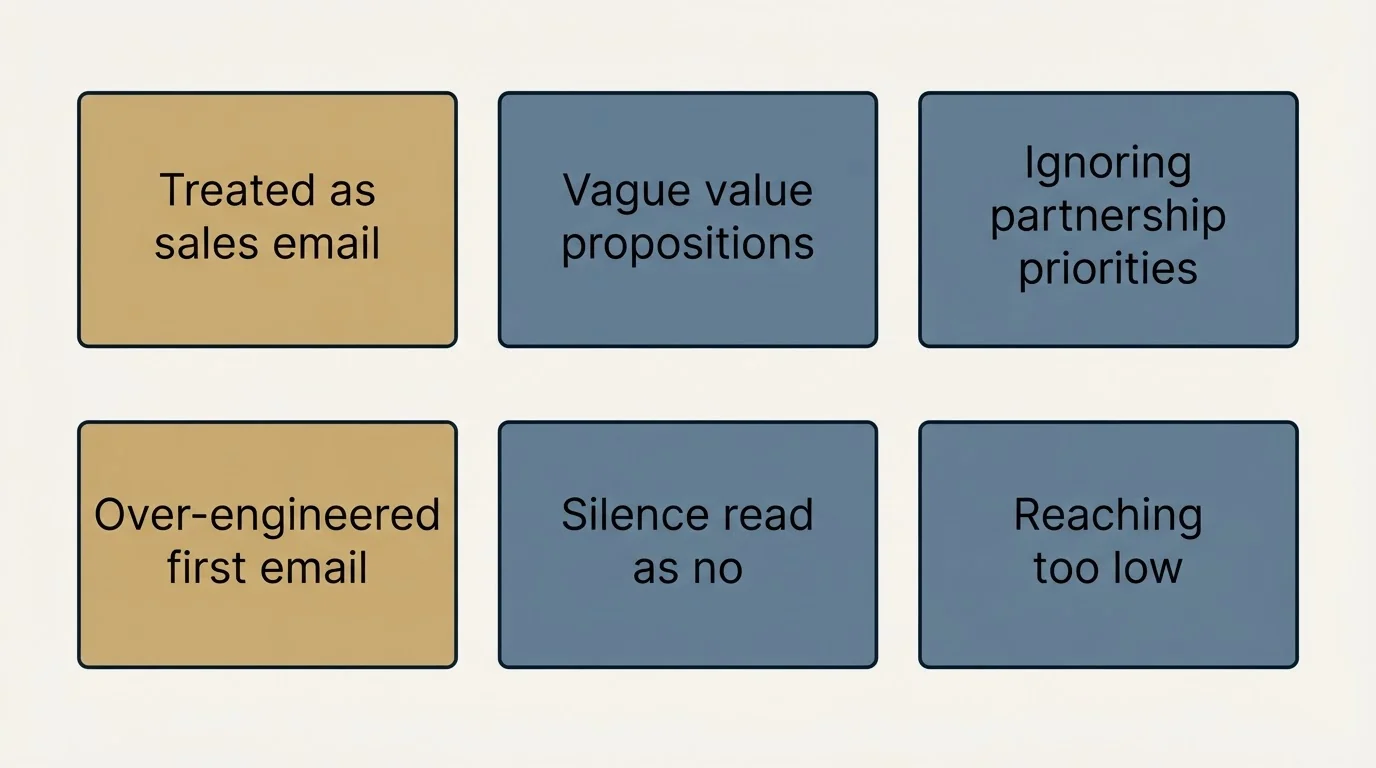
Partnership outreach fails for predictable reasons. Avoiding these mistakes will improve your results.
Treating It Like a Sales Email
Partnership emails that read like sales pitches immediately lose credibility. Phrases like "I'd love to show you a demo" or "we're offering a special rate" signal you're looking for a customer, not a partner. Focus on mutual value creation rather than selling.
Vague Value Propositions
Claims like "our companies have great synergy" or "we'd make excellent partners" without specifics waste recipient attention. Quantify opportunities, reference concrete overlap, and explain exactly how the partnership would work.
Ignoring Their Partnership Priorities
Every partnership team has specific goals and partnership types they're actively pursuing. Proposing a reseller arrangement to a team focused exclusively on technology integrations demonstrates poor research. Study their existing partnerships and partner program documentation.
Over-Engineering the First Email
Some partnership proposals arrive as multi-page documents with detailed term sheets. This overwhelms recipients and suggests inflexibility. Initial outreach should spark interest and secure a conversation, not negotiate the deal.
Reading One Silence As A No
Partnership leaders juggle numerous opportunities and priorities, so a first approach that lands in a busy month can fail on timing alone. Rather than adding touches to the same thread, plan to approach the same companies again later with a genuinely different proposal: a new integration, a new audience overlap, a new commercial shape.
Reaching Too Low in the Organization
Unlike sales where broad outreach sometimes works, partnership proposals require reaching someone with authority to evaluate and advance opportunities. Sending partnership emails to customer success associates or junior marketing coordinators wastes effort.
Proposing Partnerships That Don't Make Sense
Before reaching out, honestly assess whether a partnership creates value for both sides. Proposing partnerships to companies where the benefit flows one direction, or where no clear synergy exists, damages your reputation and wastes everyone's time.
Your Partnership Outreach Checklist
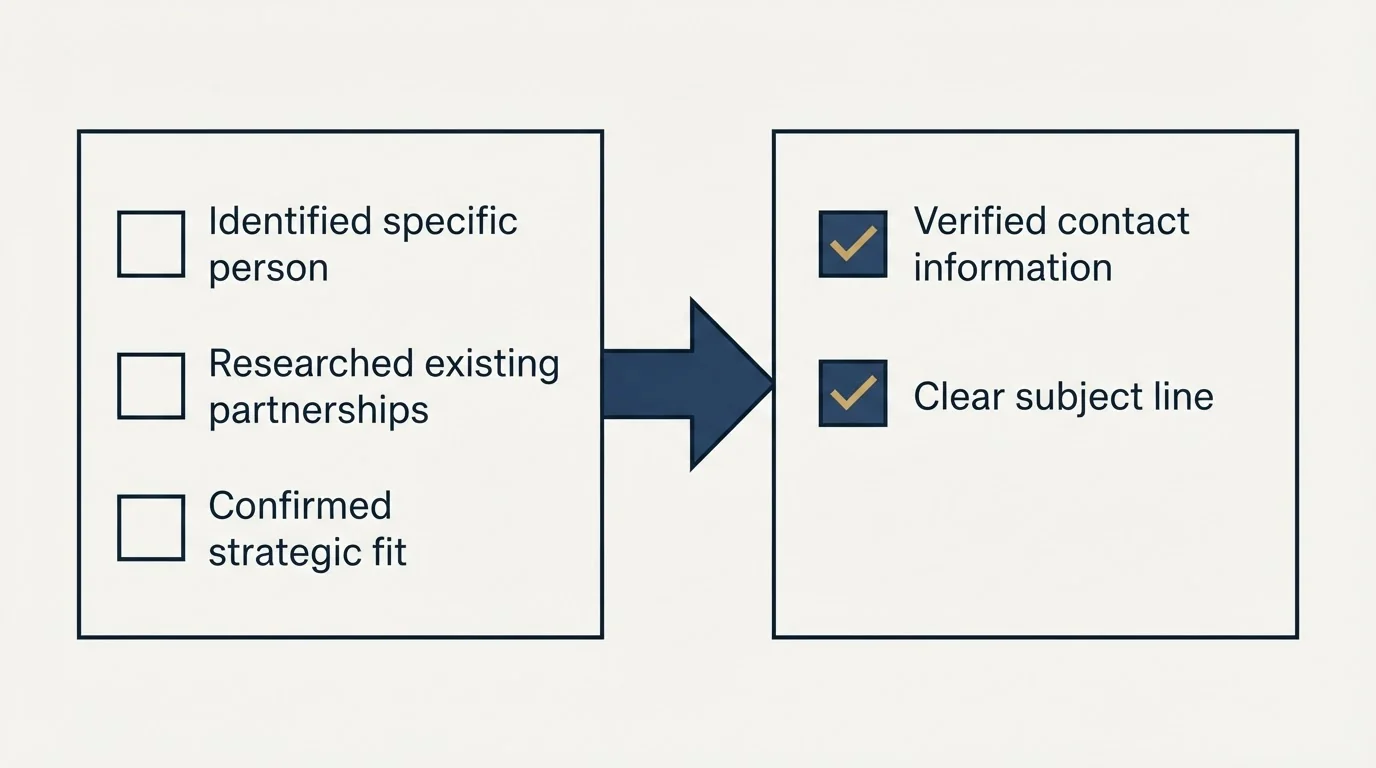
Use this checklist before sending partnership outreach to maximize your success rate.
Research and Targeting
- Identified specific person responsible for partnerships
- Researched their existing partnerships and partner program
- Confirmed strategic fit exists for both companies
- Verified contact information is current
Email Content
- Clear subject line indicating partnership intent
- Personalized opening showing research
- Specific value proposition with quantified opportunity
- Concrete next step (typically a brief call)
- Concise length (under 150 words for initial email)
Value Proposition
- Mutual benefit clearly explained
- Relevant metrics included (customer overlap, market size, etc.)
- Specific partnership type proposed
- Alignment with their stated priorities
Follow-Up Plan
- One message per campaign, with any later campaign built on a genuinely different proposal
- Later campaigns timed to a real change at the partner, not to a day count
- If partnerships sit with someone else, that person is approached in their own right rather than as a fallback for an unanswered email
Start Building Strategic Partnerships Today
Cold email remains one of the most effective ways to initiate partnership conversations that transform businesses. The combination of direct access to decision makers, low perceived risk, and mutual value propositions creates favorable conditions for meaningful responses.
Success requires treating partnership outreach differently than sales prospecting. Lead with research, quantify opportunities, propose specific collaboration models, and make it easy for busy partnership leaders to say yes to an initial conversation.
The partnerships you build through strategic outreach today become the competitive advantages that compound for years. A single integration partner can drive thousands of new users. A successful co-marketing relationship can expand your reach exponentially. A strong channel partnership can open entirely new markets.
Ready to launch partnership outreach that generates responses? Our team specializes in crafting cold email campaigns that open doors to strategic partnerships. Request your free custom campaign and let us help you build the partnerships that accelerate your growth.
Related Reading
Frequently asked questions.
Frequently asked questions- Why does cold email work better for partnerships than for sales?
- Cold email works better for partnerships because it proposes mutual value creation rather than asking for budget. This changes how recipients perceive the message: they think about growth opportunities and competitive advantages instead of defensively evaluating a purchase. Partnership decision-makers also typically have more accessible inboxes than sales targets since they receive fewer relevant opportunities, making well-crafted emails more likely to stand out.
- Who should I contact for partnership outreach at different company sizes?
- At startups under 100 employees, contact the CEO, Founder, or Head of Growth who often handle partnerships personally. At mid-market companies with 100-1000 employees, target Directors or VPs of Business Development or dedicated Heads of Partnerships. At enterprise organizations over 1000 employees, reach Partnership Managers responsible for your category, Senior Directors of Strategic Partnerships, or Corporate Development teams for significant deals. Use LinkedIn Sales Navigator to find roles with titles including 'partnerships,' 'business development,' or 'alliances.'
- What are the main types of partnerships I can pursue through cold email?
- The five main partnership types are integration partnerships (technical connections between complementary products), co-marketing partnerships (joint marketing initiatives to reach shared audiences), reseller and referral partnerships (channel arrangements with revenue sharing), strategic or go-to-market partnerships (broader business alignment), and distribution partnerships (accessing new markets or customer segments). Each type requires a distinct outreach approach tailored to the specific value proposition and partnership mechanics.
- What makes a partnership cold email successful?
- Successful partnership emails lead with the recipient's goals rather than your needs, quantify the opportunity with specific metrics about shared customers or market reach, and demonstrate strategic fit through research about their business. Keep initial emails concise, make the next step easy with a clear low-commitment ask, and avoid treating it like a sales email. Partnership emails should focus on mutual value creation and strategic alignment rather than features or pricing.
About the author.

Ben Carden is CRO at RevenueFlow, which builds and operates outbound revenue engines for B2B companies. Previously at Gartner Enterprise. Studied at London School of Economics.
Ben Carden · CRO
Connect on LinkedIn →Explore more.
Ready to scale your outreach?
We build GTM engines that book real meetings. See the receipts.
Related articles.
Cold Email for Influencer Outreach: Partner with Creators
Learn how to use cold email to build authentic influencer partnerships that drive real results for your brand, with proven templates and strategies.
Cold Email for Case Study Participation: Strategy Guide
Learn how to use cold email to recruit customers for case studies that demonstrate your product's value. Includes proven templates, incentive frameworks, and approval strategies.
Cold Email for Interview Requests: Complete Strategy Guide
Learn how to use cold email to secure interviews with industry experts, thought leaders, and key stakeholders. Includes proven templates and timing strategies.
Cold Email for Product Feedback: Complete Strategy Guide
Learn how to use cold email to gather valuable product feedback from users and prospects. Includes proven templates, feedback frameworks, and response optimization techniques.
Cold Email for PR: How to Pitch Journalists and Get Coverage
Learn how to craft cold emails that get journalists to open, read, and respond to your pitches. Includes real templates, timing strategies, and a complete PR outreach checklist.
Cold Email for Reviews: Complete Strategy Guide
Learn how to use cold email to generate authentic product reviews on G2, Capterra, and other platforms. Includes proven templates, compliance guidelines, and review generation frameworks.