Cold Email for Demo Requests: Complete Strategy Guide
Learn how to use cold email to book product demos with qualified prospects. Includes proven templates, targeting strategies, and best practices for demo conversion.
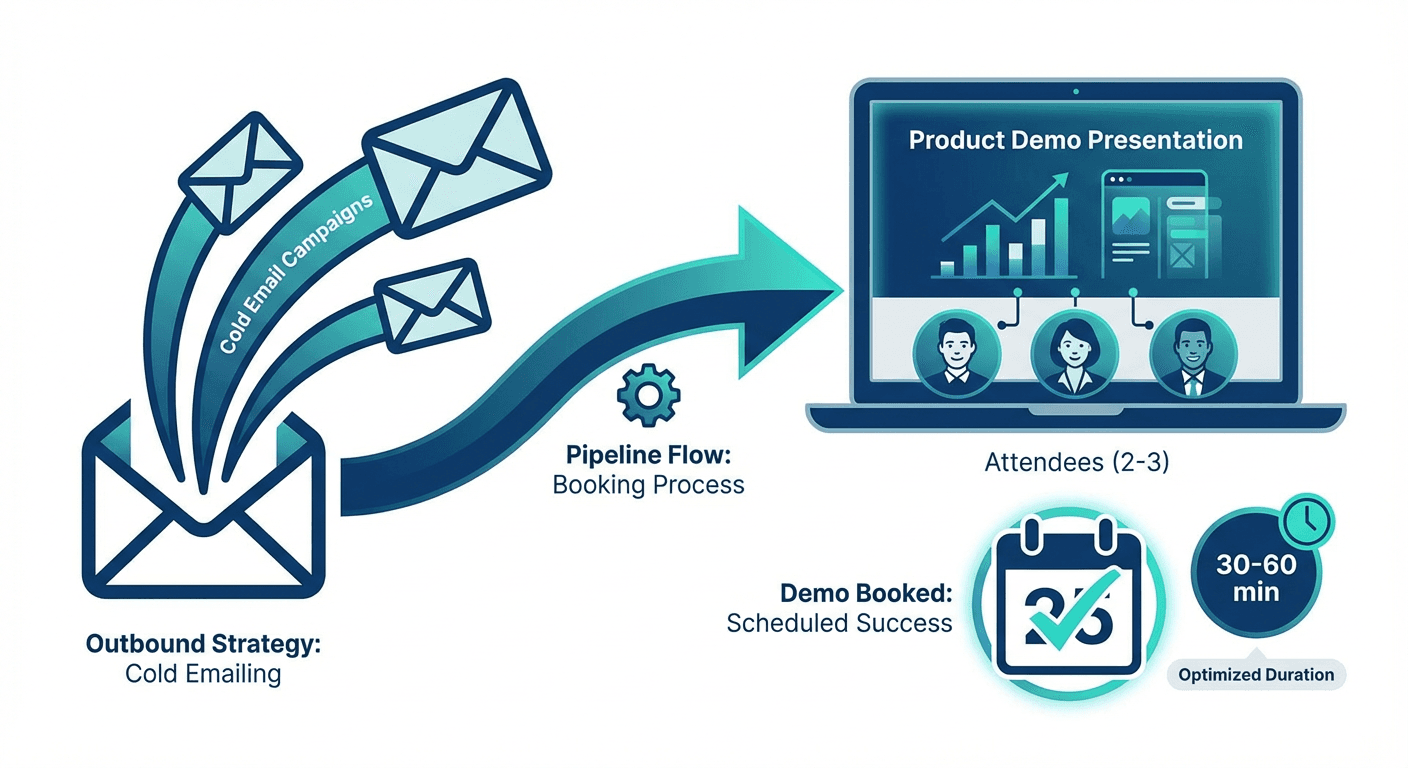
Cold email for demo requests works by proactively targeting qualified prospects at companies matching your ideal customer profile before they actively search for solutions. Focus on decision-makers with budget authority in companies of the right size and industry fit. Use personalized messaging that frames a specific problem, positions your solution's value, and offers a low-friction demo booking. Verify emails before sending, segment by vertical and company size, and time the send to a trigger event such as a funding round or a new executive hire.
Key takeaways
- Effective demo prospecting targets decision-makers with purchasing authority at companies matching specific size, industry, and technology stack criteria rather than broadly emailing anyone at a target account.
- Cold email allows proactive pipeline control by generating demos according to sales capacity targets instead of waiting for inbound requests, while reaching prospects before they enter competitive evaluation.
- Email verification through services like NeverBounce or ZeroBounce before sending is essential to reduce bounce rates and protect sender reputation.
- Segmentation by vertical, company size, use case, and persona enables personalized messaging that resonates more strongly than generic outreach.
- Trigger events such as funding rounds, executive hires, expansion announcements, and product launches often precede tool purchases and signal optimal outreach timing.
Reviewed and updated October 1, 2026
Cold Email for Demo Requests: Complete Strategy Guide
Product demonstrations remain one of the most effective steps in the B2B sales process. A well-executed demo allows prospects to see exactly how your solution addresses their specific challenges, ask questions, and envision implementation within their organization. The challenge is getting qualified prospects to commit 30 to 60 minutes of their time for a demo in the first place.
Cold email provides a direct path to booking demos with decision-makers at your target accounts. When done well, it generates a predictable pipeline of qualified demo requests that fuel your sales team with genuine opportunities.
This guide covers everything you need to know about using cold email to book product demos, from targeting and messaging to follow-up sequences and demo optimization.
Why Cold Email Works for Demo Generation
Inbound marketing attracts prospects who are already searching for solutions. Cold email allows you to reach companies that match your ideal customer profile before they start actively looking, positioning you ahead of competitors.
Proactive pipeline control. Instead of waiting for demo requests to arrive, cold email lets you generate demos according to your sales capacity and growth targets.
Account-based targeting. You choose exactly which companies to pursue, ensuring demos come from accounts with high potential value.
Decision-maker access. Cold email reaches the people who can evaluate and purchase your solution, not just anyone researching the market.
Competitive positioning. When you initiate the conversation, you set the frame for how prospects evaluate solutions rather than responding to their existing criteria.
Timing advantages. Reaching prospects before they're deep in competitive evaluation means you can shape their requirements and establish relationships early.
Defining Your Ideal Demo Prospect
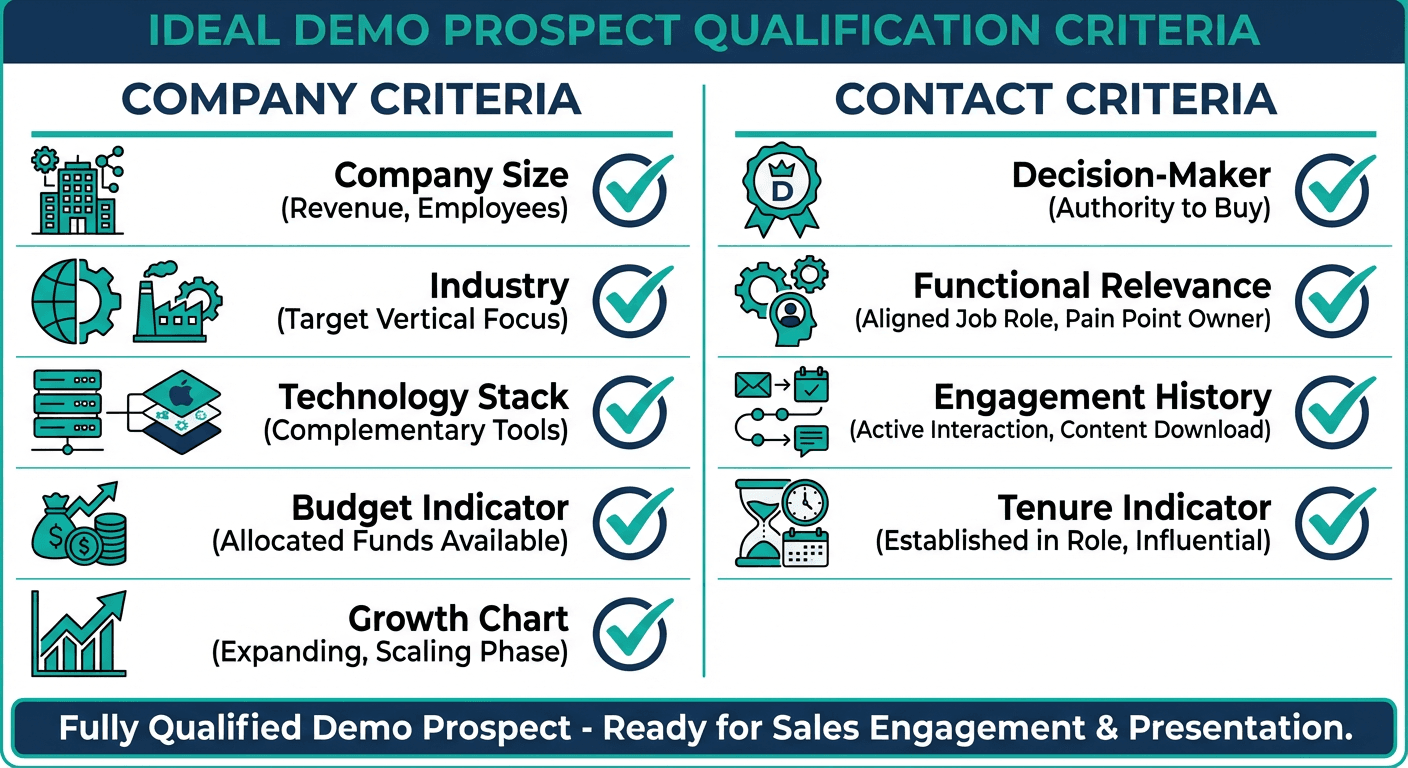
Demo time is valuable for both your team and prospects. Qualifying targets before outreach ensures you spend that time with companies likely to convert.
Company Qualification Criteria
Company size. Identify the size range where your product delivers the best fit. Too small may mean inadequate budgets or use cases. Too large may mean complex procurement processes your team cannot handle.
Industry alignment. Some industries have faster adoption cycles, clearer use cases, or existing customer references that make demos more productive.
Technology requirements. Companies with compatible technology stacks can see relevant demos that reflect their actual implementation experience.
Budget indicators. Funding stage, revenue estimates, or public financial information can signal budget availability for your solution.
Growth trajectory. Growing companies invest in tools that support scale. Stagnant companies may not prioritize new purchases.
Contact Qualification
Decision-making authority. Target contacts who can approve a purchase or significantly influence the decision. Demos for junior employees without authority rarely convert.
Functional relevance. The contact should be close to the problem your product solves. A marketing automation demo should reach marketing leaders, not random executives.
Engagement history. Contacts who have engaged with your content, visited your website, or attended industry events may be more receptive.
Tenure and stability. New hires often drive tool evaluation. Long-tenured employees may be more resistant to change.
Timing Indicators
Trigger events. Funding rounds, executive hires, expansion announcements, or product launches often precede tool purchases.
Seasonal patterns. Many industries have budget cycles that influence purchase timing.
Competitive signals. Companies whose competitors adopt new solutions may feel pressure to evaluate alternatives.
Building Your Demo Prospect List
High-quality data is essential for demo generation campaigns. Poor data wastes time and damages your sender reputation.
Data Sources
LinkedIn Sales Navigator. Filter by company characteristics, job titles, and engagement signals to build targeted lists.
Intent data platforms. Bombora, G2 Buyer Intent, and similar tools identify companies actively researching your category.
CRM enrichment. Tools like Clearbit, ZoomInfo, or Apollo can add contact information to accounts already in your CRM.
Website visitor identification. Platforms like Leadfeeder or Clearbit Reveal identify companies visiting your website, signaling interest.
Industry lists. Conference attendees, award winners, and directory listings often represent engaged, innovative companies.
Email Verification
Verify all email addresses before sending:
Verification services. NeverBounce, ZeroBounce, and Hunter provide validation to reduce bounces.
Domain checks. Ensure target domains have valid MX records and accept email.
Historical data. Remove contacts who previously bounced or unsubscribed.
Segmentation Strategy
Segment your list for personalized outreach:
By vertical. Industry-specific messaging and examples resonate more strongly.
By company size. Enterprise and SMB prospects have different concerns and evaluation processes.
By use case. If your product serves multiple use cases, segment by primary need for relevant demos.
By persona. Technical evaluators want different demo content than business decision-makers.
Crafting Demo Request Emails
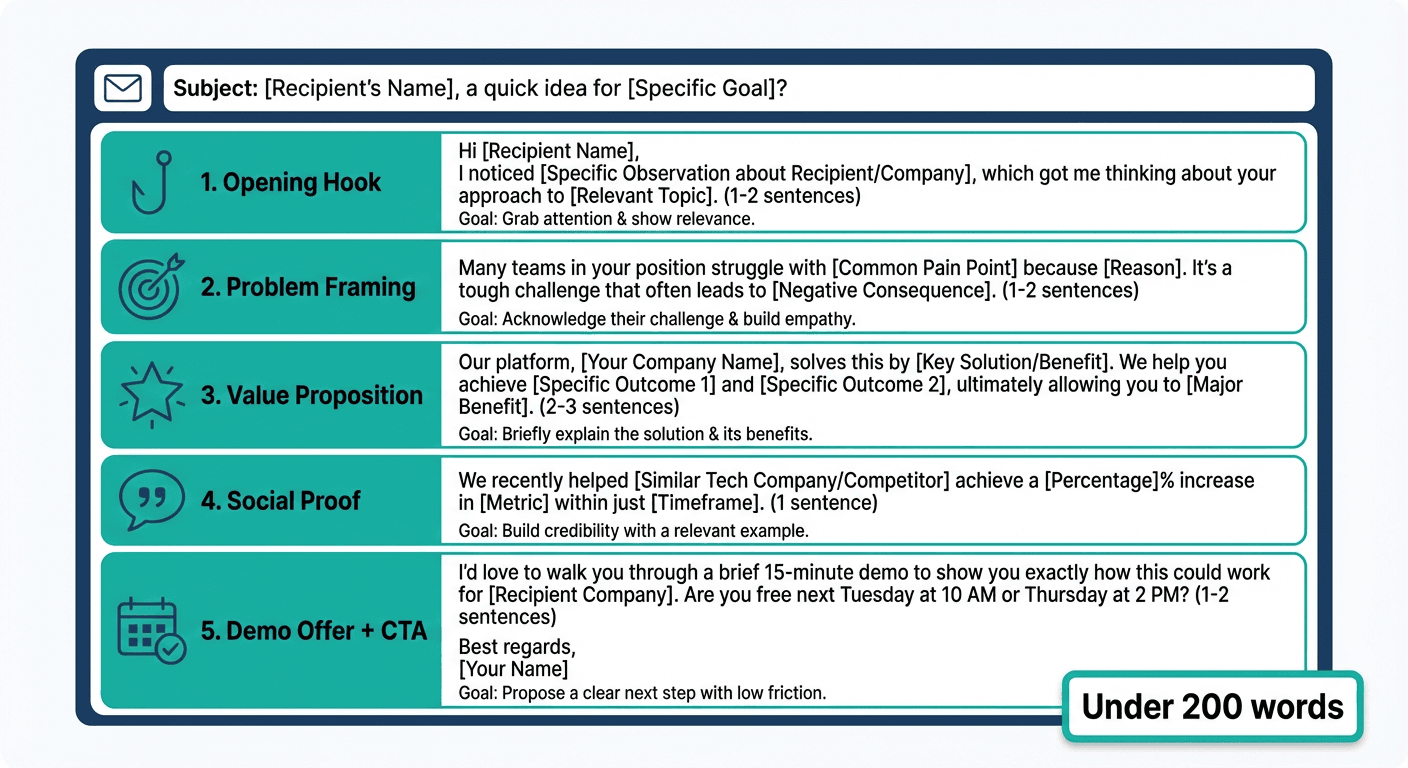
Your email needs to accomplish several objectives: establish relevance, communicate enough value to justify the time commitment, and make scheduling easy.
Subject Line Approaches
Subject lines should create interest without misleading:
Effective patterns:
- "[Company] + [Your Company] demo this week?"
- "15 minutes to show you [Specific Outcome]"
- "[Name], quick demo question"
- "How [Similar Company] solved [Problem]"
Avoid:
- Clickbait that doesn't reflect the email content
- All caps or excessive punctuation
- Generic "Touching base" or "Following up" without context
- Overly long subjects that get truncated
Email Structure
Opening hook (1-2 sentences). Reference something specific about the prospect or company that establishes why you're reaching out to them specifically.
Problem framing (1-2 sentences). Articulate the challenge your product addresses in terms relevant to their situation.
Value proposition (2-3 sentences). Explain what your product does and the primary outcome it delivers. Focus on results, not features.
Social proof (1 sentence). Name a relevant customer or cite a specific result that builds credibility.
Demo offer (1-2 sentences). Present the demo as a valuable use of time, not a sales pitch. Emphasize what they'll learn or see.
Call to action (1 sentence). Make scheduling easy with a specific time suggestion or calendar link.
Demo Positioning
Frame the demo as valuable education rather than a sales pitch:
Show, don't sell. Emphasize that the demo will show how to solve their problem, not convince them to buy.
Respect their time. Be specific about duration (15, 30, or 45 minutes) and stick to it.
No pressure. Acknowledge that the demo is for evaluation with no obligation.
Customization promise. Note that you'll tailor the demo to their specific use case or challenges.
Demo Request Email Templates
Template 1: Problem-Solution
Subject: [Company]'s [Challenge] in 20 minutes
Hi [Name],
I noticed [Company] has been [growth signal: expanding, hiring, launching]. In my experience, that often means [specific challenge] becomes a bigger priority.
[Product] helps [target persona] solve this by [mechanism]. Companies like [Customer] have achieved [specific result] after implementing our approach.
I'd love to show you exactly how this works in a 20-minute demo tailored to [Company]'s situation. No pitch, just a walkthrough of how we'd approach your use case.
Would [Day] at [Time] work for a quick call? Or feel free to grab time here: [Calendar Link]
Best, [Your Name]
Template 2: Competitive Differentiation
Subject: Different approach to [Problem] worth seeing
Hi [Name],
Most [product category] solutions approach [problem] by [common approach]. The challenge is [limitation of that approach].
We built [Product] with a different philosophy: [your differentiated approach]. The result is [specific outcome] without [common tradeoff].
[Customer example] switched from [competitor/old way] and saw [specific improvement].
I'd be happy to show you the difference in a brief demo. 20 minutes is usually enough to see whether our approach fits [Company]'s needs.
Interested? Here's my calendar: [Link]
[Your Name]
Template 3: Trigger Event
Subject: Congrats on [Trigger], [Name]
Hi [Name],
Congratulations on [Company]'s [trigger event: funding round, acquisition, product launch, expansion]. That's exciting news.
Rapid growth like that usually puts pressure on [relevant function]. [Product] helps companies at your stage [specific benefit] so they can [desired outcome] without [common growing pain].
We recently helped [similar company at similar stage] navigate this transition, and I'd love to share what worked for them.
Would a 25-minute demo be useful? I can show you how we'd approach [specific challenge] for [Company].
Let me know what works, or grab time here: [Link]
Best, [Your Name]
Template 4: Role-Specific
Subject: Demo for [Role]
Hi [Name],
I work with [Role title]s at [company type] companies, and [specific challenge] comes up in almost every conversation.
[Product] was built specifically to help [their role] with [primary use case]. Unlike tools designed for [other role], we focus on [differentiator].
I'd love to show you how [similar company]'s [same role] uses [Product] to [specific outcome]. It's a 20-minute demo focused entirely on your use case.
Worth a look? [Calendar Link]
[Your Name]
Template 5: Social Proof Heavy
Subject: How [Customer] achieved [Result]
Hi [Name],
[Customer], a [description similar to prospect's company], was struggling with [challenge]. They tried [common alternatives] but kept running into [limitation].
After implementing [Product], they [specific quantified result]. Their [role] called it "[brief quote if available]."
I think [Company] could see similar results based on [reason for fit].
Would you be open to a 20-minute demo to see how they did it and whether the same approach would work for you?
[Calendar Link]
[Your Name]
Where we differ from standard practice
Much of the advice on this page reflects how outbound is commonly run. We run it differently, and since this page sits on our site it is worth saying where the difference is and what it costs us.
- A sequence of messages to each prospect over several weeks
- Later messages often land in the same email thread
- Every contact is reached more than once, so a distracted reader gets another chance
- The later messages go only to people who did not answer the first
- Reputation cost accrues on the sending domain across everything else it sends
- One message, then that campaign is finished for that contact
- No thread replies and no bumps
- More of the work moves into targeting and into the one message
- We reach each contact less often, and that is the cost we accept
The reasoning is mechanical rather than moral. A follow-up arrives underneath a message the recipient has already seen and chosen not to answer, so it is delivered to the population most likely to mark it as spam, and the reputation cost of that lands on the sending domain across every campaign running on it. We set that cost against the replies a sequence recovers and decided the trade was not worth it. The full argument, with the numbers from our own campaigns, is in why we stopped using follow-ups.
Follow-Up Sequences for Demo Booking
Most demo bookings come from follow-up emails. Plan a multi-touch sequence that adds value with each message.
Sequence Structure
Email 1 (Day 0). Initial outreach with demo offer and value proposition.
Email 2 (Day 3-4). Add new value: case study, relevant insight, or different angle on the problem.
Email 3 (Day 7-8). Address common objections or share a specific feature relevant to their situation.
Email 4 (Day 12-14). Brief, friendly close that leaves the door open.
Follow-Up Templates
Follow-up 1 (Adding Value):
Hi [Name],
Following up on my note about a [Product] demo. I should have mentioned we just published a case study about [similar company] that might be relevant regardless of whether we connect.
Here's the link: [Case Study URL]
If you'd like to see how we'd apply the same approach to [Company], I'm happy to do a quick demo. Here's my calendar: [Link]
[Your Name]
Follow-up 2 (Different Angle):
Hi [Name],
One thing I didn't mention in my last email: [Product] integrates with [tool they likely use], which means you could [specific benefit of integration].
For [Company], that would look like [specific implementation scenario].
If you're curious, a 15-minute demo would be enough to see whether it fits. [Calendar Link]
[Your Name]
Follow-up 3 (Addressing Objections):
Hi [Name],
I know [Role]s are busy, and demos can feel like a time commitment.
To make it worthwhile, I'll customize the demo to [Company]'s specific situation and keep it to 20 minutes. If it's not relevant after the first few minutes, I'll cut it short.
Fair enough? [Calendar Link]
[Your Name]
Follow-up 4 (Graceful Close):
Hi [Name],
I've reached out a few times about a [Product] demo and don't want to be a pest.
If [challenge we solve] becomes a priority for [Company] down the road, I'd be happy to reconnect. Just reply to this email whenever timing is better.
Best of luck with [relevant initiative or challenge], [Your Name]
Optimizing Demo Conversion
Getting the demo booked is the first step. Converting demos to opportunities requires preparation and execution.
Pre-Demo Preparation
Research the company. Understand their business model, recent news, competitive landscape, and likely challenges.
Research the contact. Review their LinkedIn, published content, and any engagement history with your company.
Customize the demo. Prepare scenarios and examples relevant to their specific situation rather than generic presentations.
Set the agenda. Send a brief agenda before the demo so prospects know what to expect and can invite relevant colleagues.
During the Demo
Discovery first. Start with questions to understand their specific needs before showing the product.
Relevant scenarios. Show use cases that match their stated challenges, not every feature you have.
Engagement checks. Ask questions throughout to ensure relevance and keep attention.
Clear next steps. End with a specific proposed next action, whether that's a technical deep-dive, proposal, or decision timeline.
Post-Demo Follow-Up
Same-day recap. Send a brief email summarizing key points and confirming next steps.
Relevant resources. Share content that addresses questions raised during the demo.
Stakeholder expansion. Offer to present to additional stakeholders if mentioned during the call.
Timeline management. Follow up according to the agreed timeline with specific questions to keep momentum.
Measuring Demo Campaign Success
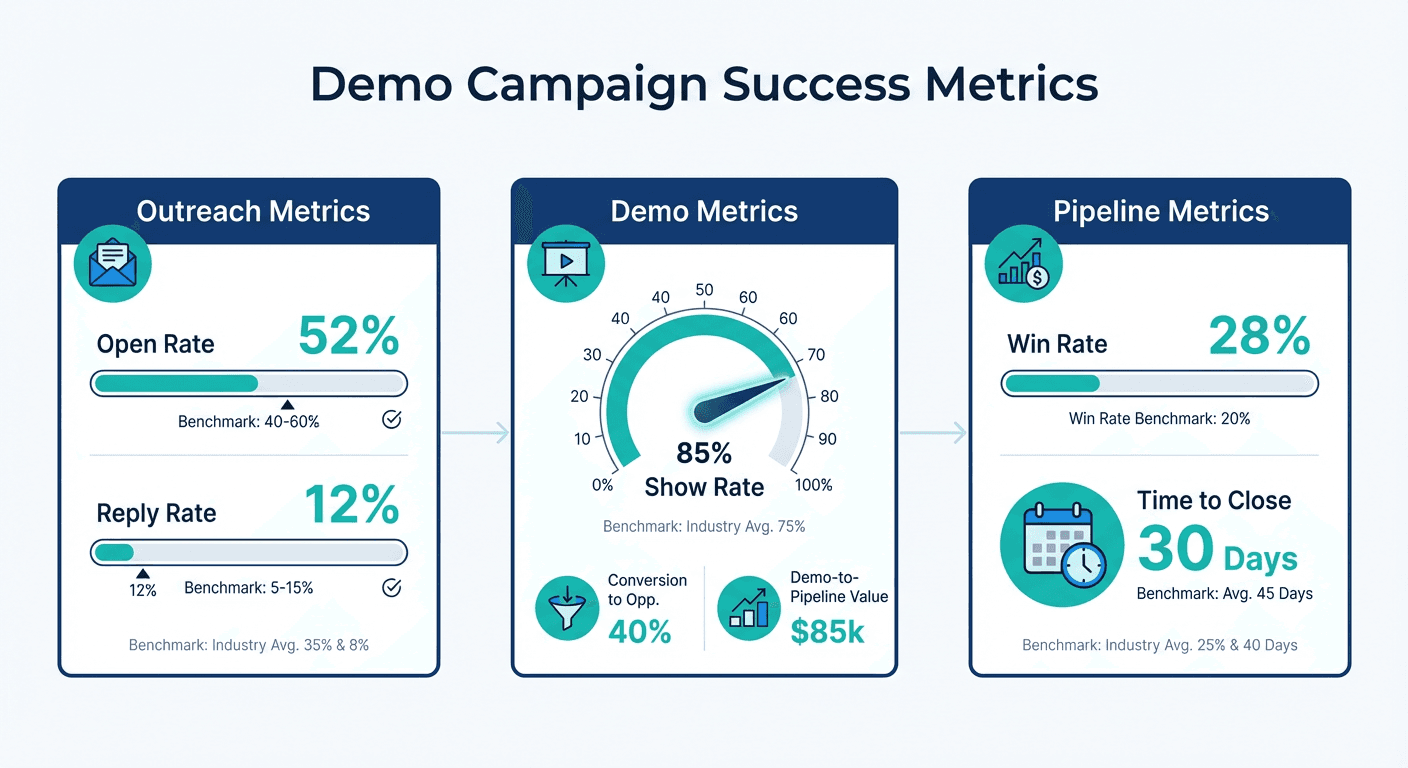
Track metrics at each stage of your funnel:
Outreach metrics:
- Emails sent and delivered
- Open rate (benchmark: 40-60%)
- Reply rate (benchmark: 5-15%)
- Demo booking rate from replies
Demo metrics:
- Demos scheduled vs. completed (show rate)
- Demo-to-opportunity conversion rate
- Average deal size from cold email demos
Pipeline metrics:
- Revenue from cold email-sourced demos
- Time from demo to close
- Win rate for cold email opportunities
Common Mistakes to Avoid
Targeting too broadly. Demos with unqualified prospects waste everyone's time. Invest in targeting.
Feature-focused messaging. Prospects don't care about features. They care about solving problems. Lead with outcomes.
Weak follow-up. Most responses come from follow-ups. Commit to the full sequence.
Generic demos. One-size-fits-all demos fail to connect. Customize based on research.
No show management. High no-show rates indicate poor qualification or scheduling. Send reminders and confirm attendance.
Weak call-to-action. Make booking easy with calendar links and specific time suggestions. Vague requests reduce conversions.
Overselling in the email. The goal is to book the demo, not to close the deal. Let the demo do the selling.
Start Booking More Demos
Cold email provides a reliable channel for generating product demos with qualified prospects at target accounts. When combined with solid demo execution and follow-up, it becomes a predictable engine for pipeline generation.
The templates and strategies in this guide offer a foundation, but consistent execution determines results. Target carefully, personalize thoughtfully, follow up persistently, and optimize continuously.
If you're looking to scale demo generation without building an internal SDR team, RevenueFlow can help. Our done-for-you cold email campaigns apply these principles to book qualified demos for B2B companies.
Get Your Free Campaign and start filling your demo calendar today.
Related Reading
Frequently asked questions.
Frequently asked questions- Why is cold email effective for booking product demos?
- Cold email enables proactive outreach to qualified prospects before they begin actively searching for solutions, giving you positioning advantage over competitors. It provides account-based targeting where you select high-value companies, direct access to decision-makers who can evaluate and purchase, and control over pipeline generation aligned with your sales capacity. By initiating the conversation, you shape how prospects evaluate solutions rather than responding to pre-existing criteria they've developed through competitor research.
- How do I identify qualified prospects for demo requests?
- Qualify prospects across three dimensions: company criteria including appropriate size range, industry alignment with your use cases, compatible technology stacks, and budget indicators; contact criteria focusing on decision-making authority and functional relevance to the problem you solve; and timing indicators like trigger events such as funding rounds or executive hires. Growing companies with decision-makers who have authority and direct connection to your product's use case convert at higher rates than broadly targeted contacts.
- What data sources work best for building demo prospect lists?
- LinkedIn Sales Navigator enables filtering by company characteristics and job titles for targeted list building. Intent data platforms like Bombora and G2 Buyer Intent identify companies actively researching your category. CRM enrichment tools including Clearbit, ZoomInfo, and Apollo add contact information to existing accounts. Website visitor identification platforms like Leadfeeder reveal companies already showing interest. Industry-specific sources such as conference attendee lists and award winners often represent engaged, innovative prospects.
- Should I segment my prospect list before sending demo request emails?
- Yes, segmentation by vertical, company size, use case, and persona enables personalized messaging that performs significantly better than generic outreach. Industry-specific messaging and examples resonate more strongly with prospects. Enterprise and SMB prospects have different concerns and evaluation processes requiring distinct approaches. If your product serves multiple use cases, segment by primary need to showcase relevant demo content. Technical evaluators want different information than business decision-makers during the demo booking conversation.
About the author.

Ben Carden is CRO at RevenueFlow, which builds and operates outbound revenue engines for B2B companies. Previously at Gartner Enterprise. Studied at London School of Economics.
Ben Carden · CRO
Connect on LinkedIn →Explore more.
Ready to scale your outreach?
We build GTM engines that book real meetings. See the receipts.
Related articles.
Cold Email for Affiliate Recruitment: Strategy Guide
Master cold email outreach to recruit high-performing affiliates who can drive significant revenue for your business with proven templates and strategies.
Cold Email for Reseller Partnerships: Strategy Guide
Learn how to use cold email to recruit resellers and channel partners who can expand your market reach and drive revenue through their existing customer relationships.