Cold Email for Free Trials: Complete Strategy Guide
Learn how to use cold email to drive free trial signups for your SaaS product. Includes proven templates, targeting strategies, and best practices for converting trials to paid customers.
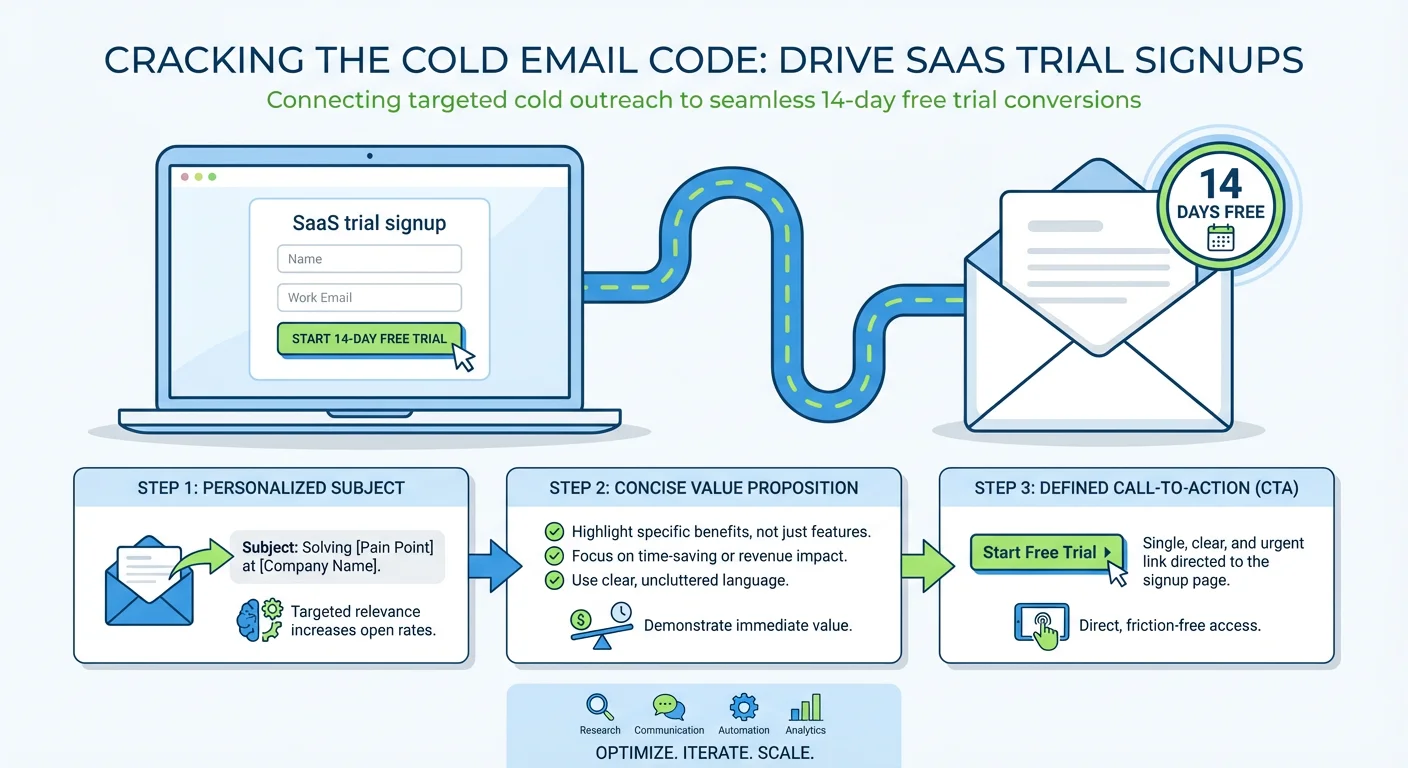
Cold email for free trials targets qualified prospects who match your ideal customer profile but haven't discovered your product organically. Effective campaigns identify companies by size, industry, tech stack, and growth signals; segment contacts by job function and authority level; and use problem-focused messaging with minimal friction. Verification tools and intent data improve list quality, while follow-up sequences during and after trials drive conversion to paid accounts.
Key takeaways
- Cold email allows you to proactively build pipeline and reach decision-makers at companies that match your ideal customer profile, rather than waiting for inbound trial signups.
- Targeting companies by complementary technology stack and growth indicators improves trial quality and conversion rates.
- Email verification tools like NeverBounce and ZeroBounce validate addresses before sending to reduce bounces and spam complaints.
- Segmenting prospect lists by company size, use case, competitor usage, and contact role enables personalized messaging that increases engagement.
- Timing signals such as recent hires, funding rounds, and competitive activity identify prospects with higher urgency and likelihood to start trials.
Reviewed and updated October 1, 2026
Cold Email for Free Trials: Complete Strategy Guide
Free trials remain one of the most effective conversion mechanisms for SaaS companies. They allow prospects to experience your product firsthand, reducing the risk of purchase decisions and building familiarity before the sales conversation. The challenge is getting qualified prospects to start a trial in the first place.
While many companies rely solely on inbound marketing to drive trial signups, cold email offers a powerful complement. It allows you to reach specific accounts that match your ideal customer profile, control your pipeline timing, and start conversations with decision-makers who might never find your website through organic search.
This guide covers everything you need to know about using cold email to drive free trial signups, from targeting and messaging to follow-up sequences and conversion optimization.
Why Cold Email Works for Free Trial Acquisition
Inbound marketing generates trials from companies actively searching for solutions. Cold email expands your reach to companies that have the problem you solve but haven't started looking for a solution yet, or who don't know your specific approach exists.
Proactive pipeline building. Rather than waiting for trials to arrive, cold email lets you fill your pipeline according to your capacity and growth goals.
Ideal customer targeting. You choose exactly which companies to reach, ensuring trials come from accounts that match your success criteria.
Decision-maker access. Cold email reaches the people who can actually use and champion your product, not just whoever fills out website forms.
Competitive situations. When prospects are evaluating alternatives, cold email ensures your solution gets consideration alongside competitors they're already aware of.
Relationship initiation. The best trial-to-paid conversions happen when there's human connection. Cold email starts that relationship before the trial even begins.
Defining Your Ideal Trial Prospect
Not all trial signups are equal. Some convert to paying customers quickly, others require extensive nurturing, and many never convert at all. Targeting the right prospects from the start improves trial quality and conversion rates.
Company Characteristics
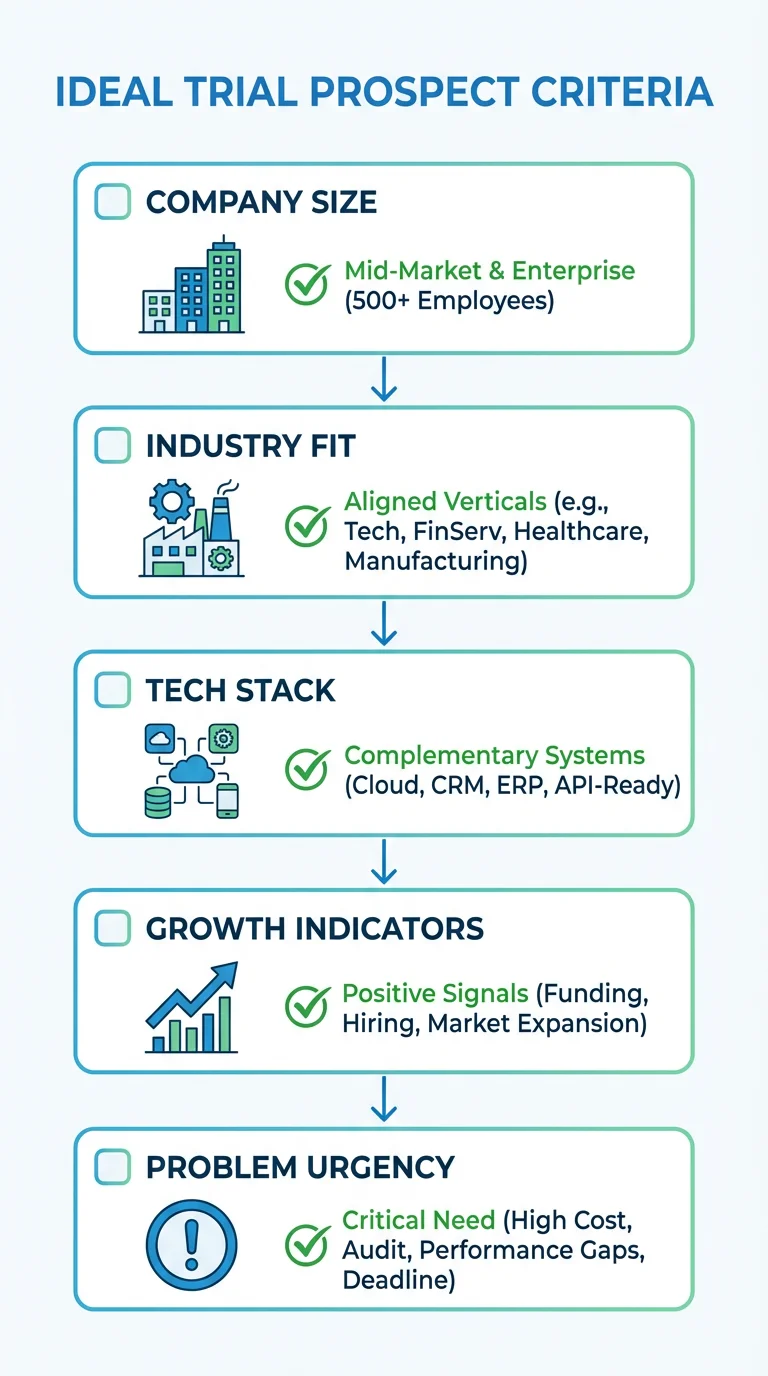
Size and stage. Identify the company sizes where your product delivers the most value. Very small companies may not need your full solution, while very large ones may require enterprise features you don't have.
Industry fit. Some industries adopt new tools quickly, while others have longer evaluation cycles. Prioritize industries where you have existing success.
Technology stack. Companies using complementary tools often integrate better and see value faster during trials.
Growth indicators. Growing companies invest in new solutions. Look for hiring activity, funding announcements, or expansion news.
Problem urgency. Companies actively experiencing the pain your product solves will engage more deeply with trials than those with theoretical interest.
Contact Characteristics
Job function. Target people who will actually use the product during the trial. They can evaluate fit and champion internally.
Authority level. Decision-makers can convert trials to paid accounts. Influencers can recommend, but may not be able to approve purchases.
Technical capability. If your product requires setup or integration, target contacts who can complete these steps or have resources to help.
Career incentives. People measured on metrics your product improves have personal motivation to explore solutions.
Timing Signals
Recent triggers. New hires, promotions, funding rounds, or product launches often prompt tool evaluation.
Competitive activity. Companies whose competitors adopt new solutions may feel pressure to keep pace.
Industry trends. Regulatory changes, market shifts, or technology developments create urgency around specific problems.
Building Your Trial Prospect List
Quality data determines cold email success. Poor data leads to bounces, spam complaints, and wasted effort.
Data Sources for SaaS Trials
LinkedIn Sales Navigator. Filter by company size, industry, technology usage, and job titles to build targeted lists.
G2 and Capterra. Identify companies reviewing competitor products who may be actively evaluating solutions.
Job boards. Companies hiring for roles related to your product domain often need tools to support new team members.
Technographic data. Tools like BuiltWith or Slintel reveal technology stacks, helping you target based on complementary tools or competitor usage.
Intent data. Platforms like Bombora or G2 Buyer Intent identify companies actively researching your product category.
Email Verification
Always verify email addresses before sending:
Verification tools. NeverBounce, ZeroBounce, and similar services validate addresses and flag high-risk contacts.
Domain validation. Check that target domains have valid MX records and accept email.
List hygiene. Remove role-based addresses (info@, sales@) that rarely convert and may trigger spam filters.
Segmentation for Personalization
Segment your list to enable targeted messaging:
By company size. Enterprise prospects have different needs and objections than SMB.
By use case. If your product serves multiple use cases, segment by primary need.
By competitor. Prospects using specific competitors may respond to targeted differentiation messages.
By role. Technical evaluators care about different things than business decision-makers.
Crafting Free Trial Cold Emails
Your email needs to accomplish several things: establish relevance, communicate value, reduce friction, and drive action.
Subject Line Strategies
Subject lines for trial outreach should create curiosity without being clickbait:
Effective approaches:
- "[Company], have you tried [Product Category]?"
- "[Specific benefit] for [Role]"
- "14-day test for [Problem]"
- "[Name], quick question about [Challenge]"
Avoid:
- "FREE" in all caps (spam trigger)
- Overly clever or vague subjects
- Misleading clickbait
- Excessive punctuation
Email Structure
Opening (1-2 sentences). Reference something specific about the prospect or their company to establish relevance and demonstrate research.
Problem statement (1-2 sentences). Articulate the challenge your product solves. This shows understanding and qualifies whether the prospect has the problem.
Solution introduction (2-3 sentences). Briefly explain what your product does and the primary benefit. Focus on outcomes, not features.
Trial offer (1-2 sentences). Present the free trial clearly: duration, what's included, and any limitations.
Social proof (1 sentence). Brief credibility builder: customer names, metrics, or relevant traction.
Call to action (1 sentence). Clear next step, either signing up directly or scheduling a brief call to learn more.
Reducing Trial Friction
Address common objections proactively:
Time concerns. Mention how quickly they can see value or complete initial setup.
Commitment fears. Emphasize no credit card required, no obligation, easy cancellation.
Integration worries. Note compatibility with tools they likely use.
Support availability. Mention help resources available during the trial.
Free Trial Email Templates
Template 1: Problem-Focused
Subject: [Company]'s approach to [Challenge]
Hi [Name],
I noticed [Company] is [growing rapidly / expanding into new markets / hiring in X area]. That usually means [specific challenge related to your product] becomes increasingly difficult to manage.
[Product] helps [target persona] solve this by [primary benefit]. Companies like [Customer 1] and [Customer 2] have reduced [relevant metric] by [X%] after implementing our solution.
We offer a 14-day free trial with full access to all features, no credit card required. Most users see value within the first few days.
Would you be interested in testing it out? You can start here: [Trial Link]
Or if you'd prefer a quick walkthrough first, I'm happy to show you the highlights in 15 minutes.
Best, [Your Name]
Template 2: Competitor-Aware
Subject: Alternative to [Competitor] worth testing
Hi [Name],
I saw that [Company] uses [Competitor] for [use case]. I wanted to share a different approach that some [Industry] companies have found more effective.
[Product] takes a [differentiated approach] to [problem], which means [specific benefit]. [Customer example] switched from [Competitor] and saw [specific result].
We're confident enough in the difference that we offer a free trial with no strings attached. You can run [Product] alongside [Competitor] and compare results directly.
If you're curious, here's the trial link: [Link]
Or if you have 15 minutes, I can show you the key differences that matter most for [their use case].
[Your Name]
Template 3: Trigger-Based
Subject: Congrats on [Trigger Event]
Hi [Name],
Congratulations on [Company]'s recent [funding round / acquisition / expansion / product launch]. That's exciting news.
With that kind of growth typically comes [specific challenge]. [Product] helps [target persona] handle [challenge] by [solution approach]. We've helped companies like [similar company] scale [relevant function] without [common pain point].
If [challenge] is on your radar, we have a 14-day free trial that lets you test our approach with no commitment. Setup takes about [time], and our team is available to help if you need anything.
Worth exploring? [Trial Link]
Best, [Your Name]
Template 4: Role-Specific
Subject: [Product Category] built for [Role]
Hi [Name],
Most [product category] tools are designed for [other role], which means [their role] ends up with workarounds and compromises.
We built [Product] specifically for [their role], with [key feature 1], [key feature 2], and [key feature 3] that make [specific task] significantly easier.
[X]% of our users are [their role], and the average user saves [time/metric] per week.
Our free trial gives you 14 days to test everything, no credit card required. If you're tired of tools that weren't built for how you work, it's worth 10 minutes to explore.
Start here: [Trial Link]
[Your Name]
Template 5: Value-First
Subject: [Specific metric improvement] for [Company]
Hi [Name],
What if [Company] could [specific outcome: reduce X by Y%, increase A by B%, save N hours per week]?
That's what [Product] delivers for companies like [similar company 1] and [similar company 2]. We help [target persona] achieve [outcome] by [mechanism].
The math is simple: the free trial costs you nothing but a few hours, and the potential upside is [relevant metric improvement].
If the numbers make sense, here's where to start: [Trial Link]
Happy to answer any questions or do a quick walkthrough if that's more helpful.
[Your Name]
Where we differ from standard practice
Much of the advice on this page reflects how outbound is commonly run. We run it differently, and since this page sits on our site it is worth saying where the difference is and what it costs us.
- A sequence of messages to each prospect over several weeks
- Later messages often land in the same email thread
- Every contact is reached more than once, so a distracted reader gets another chance
- The later messages go only to people who did not answer the first
- Reputation cost accrues on the sending domain across everything else it sends
- One message, then that campaign is finished for that contact
- No thread replies and no bumps
- More of the work moves into targeting and into the one message
- We reach each contact less often, and that is the cost we accept
The reasoning is mechanical rather than moral. A follow-up arrives underneath a message the recipient has already seen and chosen not to answer, so it is delivered to the population most likely to mark it as spam, and the reputation cost of that lands on the sending domain across every campaign running on it. We set that cost against the replies a sequence recovers and decided the trade was not worth it. The full argument, with the numbers from our own campaigns, is in why we stopped using follow-ups.
Follow-Up Sequences for Trial Signups
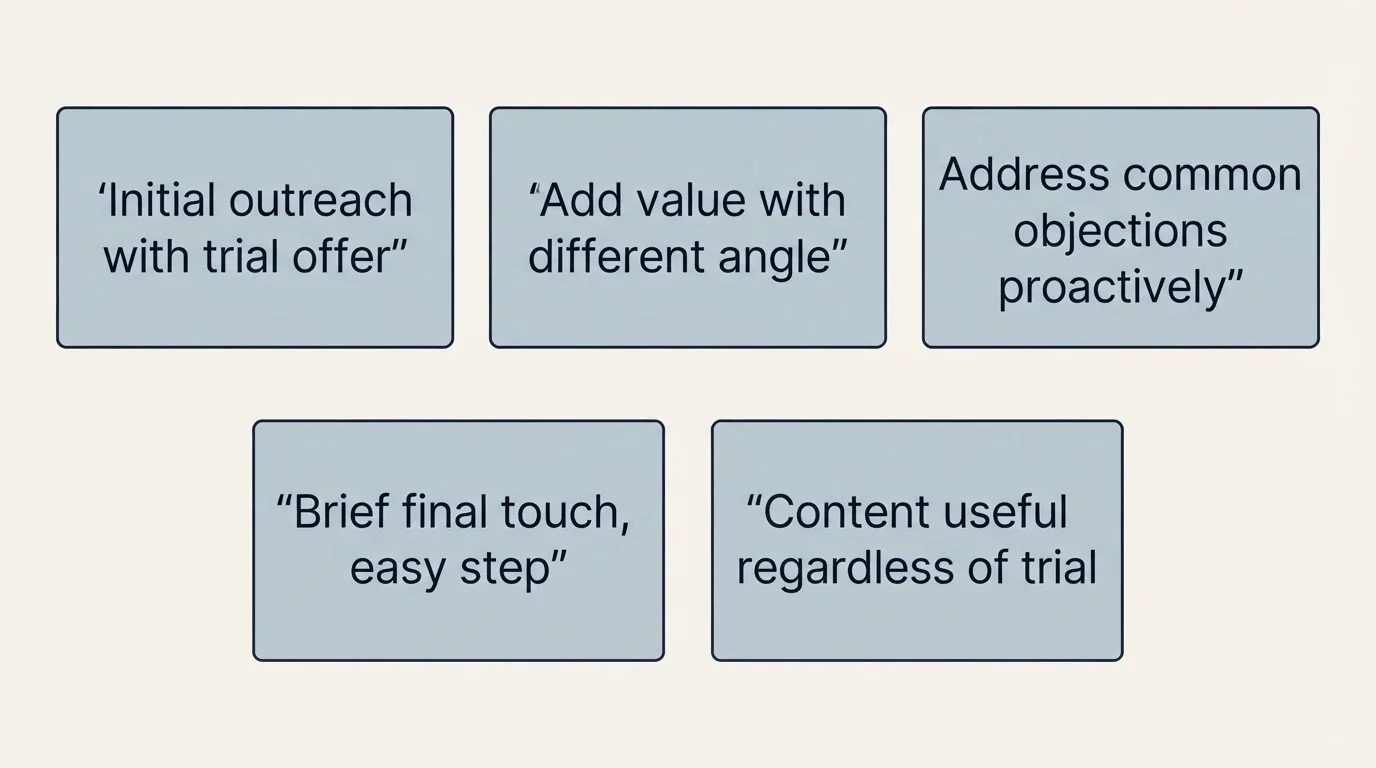
Most cold email responses come from follow-ups. Plan a sequence that adds value with each touchpoint.
Recommended Sequence
Email 1 (Day 0). Initial outreach with trial offer.
Email 2 (Day 3). Different angle or additional value (case study, specific feature highlight, relevant content).
Email 3 (Day 7). Address common objections or questions proactively.
Email 4 (Day 10). Brief final touch with easy next step.
Follow-Up Templates
Follow-up 1 (Adding Value):
Hi [Name],
Following up on my note about [Product]. I should have mentioned that we just published a guide on [relevant topic] that might be useful regardless of whether you try our product.
Here's the link: [Content Link]
If you do want to explore the trial, it's still available here: [Trial Link]
[Your Name]
Follow-up 2 (Addressing Objections):
Hi [Name],
Quick follow-up. The most common concern I hear about trying new [product category] tools is [objection: time, complexity, integration, etc.].
With [Product], [how you address that objection]. Our average user completes setup in [time], and we have [support resource] if you get stuck.
Still interested in testing it out? [Trial Link]
[Your Name]
Follow-up 3 (Final Touch):
Hi [Name],
I'll keep this short. I've reached out a few times about [Product]'s free trial and don't want to be a nuisance.
If [problem you solve] becomes a priority for [Company], the trial will be here: [Trial Link]
Feel free to reach out whenever timing is better.
[Your Name]
Optimizing Trial Conversion
Getting signups is only half the battle. Converting trials to paid customers requires thoughtful engagement.
During-Trial Communication
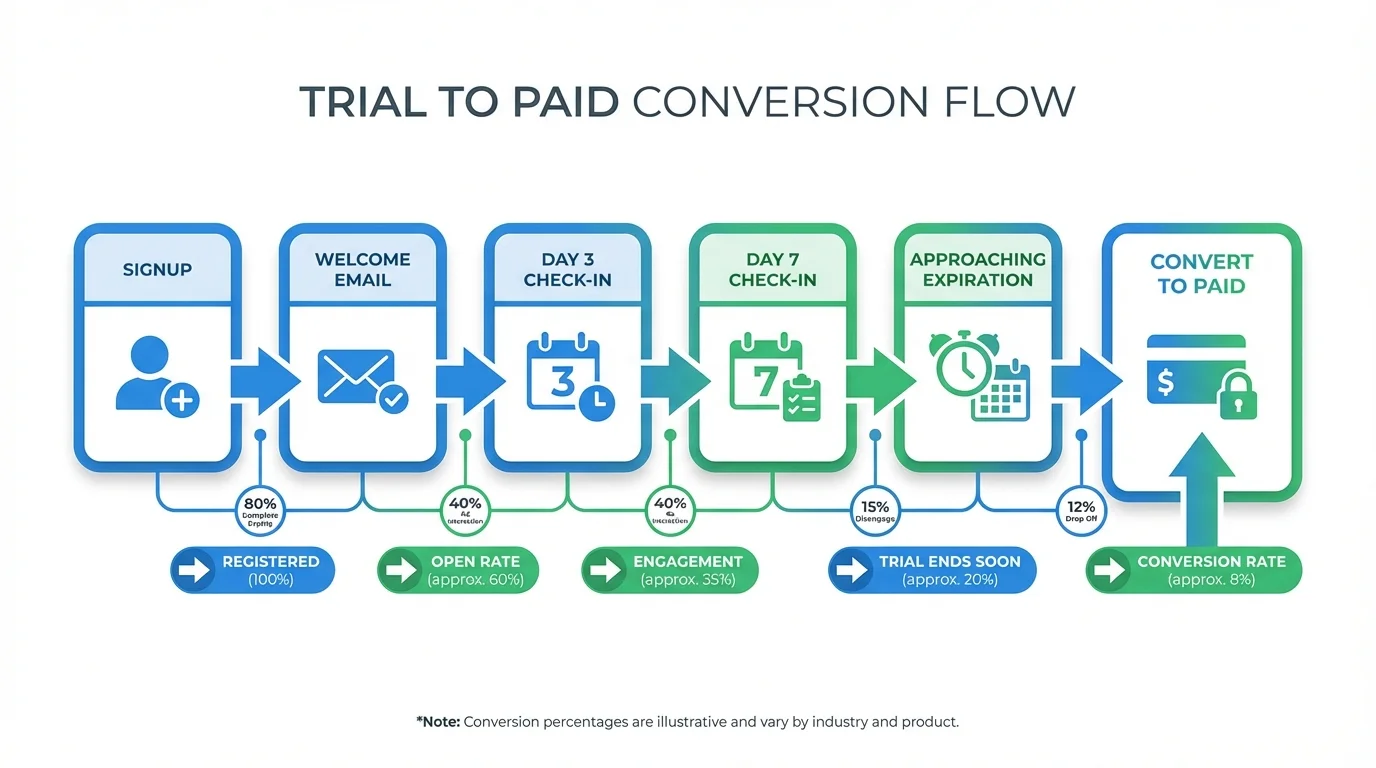
Welcome email. Immediately after signup, send a personal welcome with key resources and offer of help.
Check-in emails. At day 3 and day 7, check in with helpful tips and ask about progress.
Success milestones. Celebrate when users complete key actions that correlate with conversion.
Approaching expiration. Before the trial ends, reach out with conversion options and answer remaining questions.
Trial Success Metrics
Track indicators of healthy trials:
Activation rate. What percentage of signups complete key setup actions?
Feature usage. Are users engaging with core features that deliver value?
Login frequency. How often are trial users returning to the product?
Time to value. How quickly do users experience the primary benefit?
Conversion Tactics
Remove friction. Make upgrading as easy as possible with clear pricing and simple checkout.
Create urgency. Trial-only discounts or limited-time offers can accelerate decisions.
Offer help. Many trial users have questions that prevent conversion. Proactive support removes barriers.
Extend strategically. For promising prospects who need more time, trial extensions can be more valuable than losing the opportunity.
Measuring Campaign Success
Track metrics at each stage of the funnel:
Outreach metrics:
- Emails sent
- Delivery rate (target: 95%+)
- Open rate (target: 40-60%)
- Reply rate (target: 5-15%)
- Click rate on trial links
Trial metrics:
- Trial signups from cold email
- Trial activation rate
- Trial engagement metrics
- Trial-to-paid conversion rate
Business metrics:
- Customer acquisition cost from cold email
- Lifetime value of cold email-sourced customers
- Payback period on cold email investment
Common Mistakes to Avoid
Targeting too broadly. Unqualified trials waste your support resources and skew your conversion data. Target precisely.
Overselling in the email. The goal is a trial signup, not a sale. Keep emails concise and let the product demonstrate value.
Weak follow-up. Most responses come from follow-up emails. Plan and execute a complete sequence.
Ignoring trial experience. Getting signups without helping users succeed creates churn. Invest in trial support and engagement.
Not tracking source. Tag trial signups by source to measure cold email effectiveness and optimize accordingly.
One-size-fits-all messaging. Different segments have different needs. Customize your approach based on company size, industry, and role.
Start Driving Trial Signups
Cold email provides a powerful channel for driving free trial signups from precisely targeted accounts. When combined with strong trial onboarding and conversion processes, it can become a reliable engine for customer acquisition.
The templates and strategies in this guide provide a foundation, but execution determines results. Consistent outreach, thoughtful follow-up, and continuous optimization will maximize your trial volume and quality.
If you're looking to scale your trial acquisition without building an internal team, RevenueFlow can help. Our done-for-you cold email campaigns apply these principles to drive qualified trial signups for SaaS companies.
Get Your Free Campaign and start filling your trial pipeline today.
Related Reading
Frequently asked questions.
Frequently asked questions- Why should I use cold email for free trials instead of relying only on inbound marketing?
- Cold email expands your reach beyond companies actively searching for solutions to include those who have the problem you solve but haven't started looking yet. It allows proactive pipeline building according to your growth goals, gives you control over which accounts enter your funnel, and ensures decision-makers at ideal customer profile companies discover your product even if they never visit your website organically.
- What company characteristics should I target for SaaS free trial cold emails?
- Target companies by size and stage where your product delivers maximum value, industries with existing success and quick adoption cycles, complementary technology stacks that integrate well, growth indicators like hiring or funding, and evidence of problem urgency. Avoid companies too small to need your full solution or too large for your current feature set.
- How do I find qualified prospects for free trial cold email campaigns?
- Use LinkedIn Sales Navigator to filter by company and contact criteria, monitor G2 and Capterra for companies reviewing competitors, check job boards for relevant hiring activity, leverage technographic tools like BuiltWith to identify tech stacks, and access intent data platforms like Bombora to find companies actively researching your category. Always verify addresses with tools like NeverBounce before sending.
- What timing signals indicate a prospect is ready for a free trial?
- Look for recent triggers like new hires, promotions, funding rounds, or product launches that often prompt tool evaluation. Monitor competitive activity where companies feel pressure to keep pace with competitors adopting new solutions. Track industry trends such as regulatory changes or technology developments that create urgency around specific problems your product addresses.
About the author.

Ben Carden is CRO at RevenueFlow, which builds and operates outbound revenue engines for B2B companies. Previously at Gartner Enterprise. Studied at London School of Economics.
Ben Carden · CRO
Connect on LinkedIn →Explore more.
Ready to scale your outreach?
We build GTM engines that book real meetings. See the receipts.
Related articles.
Cold Email for Affiliate Recruitment: Strategy Guide
Master cold email outreach to recruit high-performing affiliates who can drive significant revenue for your business with proven templates and strategies.
Cold Email for Reseller Partnerships: Strategy Guide
Learn how to use cold email to recruit resellers and channel partners who can expand your market reach and drive revenue through their existing customer relationships.